Hello, Spirit of Cecilia music fans! In this post, Brad Birzer and Tad Wert discuss the recently released eponymously titled album by Lords of Atlantis.
Tad: Okay, Brad, you were the one who suggested we tackle this album, and I confess I was unfamiliar with it. When I first cranked it up, I thought it was a soundtrack to an Hawaii 5-O episode! It’s an interesting mix of surf music and prog, all instrumental. According to the House of Tabu website, it is a supergroup of sorts from the surf genre, bringing together guitarist Ivan Pongracic and drummer Dane Carter of The Madeira, guitarist Jeremy DeHart of The Manakooras and Aqualads, and bassist Jonpaul Balak of Surfer Joe and the Tikiyaki multiverse.
Tell me why you are so enthusiastic about these guys!
Brad: Dear Tad, I love doing these with you. Thank you, my friend. I’m sorry to be a bit late in responding. We started college classes on Wednesday, I had a wedding on Friday afternoon, and, my oldest son, Nathaniel, returned for a year in Jerusalem today. So, lots and lots of chaos in the Birzer household!
Tad, I will freely admit, I’m not in the least objective when it comes to the Lords of Atlantis. I’ve had the privilege of meeting (briefly) Dane Carter, the drummer, and he’s a great guy. But, my real bias is with Ivan Pongracic. He’s not only one of my favorite colleagues at Hillsdale (he teaches economics), but he’s also one of my closest friends. So, when I hear Ivan’s guitar’s beautiful Hawaii 5-0 style guitar, I think gentleman, friend, economist, friend, colleague, friend, fellow beer drinker, friend, and fellow cat lover!
I’m a huge fan of The Madeira (I even own a t-shirt!), and I’m an even bigger fan of Lords of Atlantis. Ivan has been shaped by The Shadows, by The Beatles, by Pink Floyd, etc. The guy is not only brilliant, he’s also the epitome of an artist when it comes to surf and prog. He reeks of integrity.
I told him recently that I have a hard time reviewing his music, only because it’s instrumental. When you and I review, I focus so heavily on lyrics, Tad. As Ivan told me (and I believe him), instrumental just means “imagist.” That is, each song is a color, each song is a chapter, and each song is a story. I love that.
Tad: Brad, that is fascinating, and it explains why you are an evangelist for the Lords. Now that I understand that context, let me say that the first time I listened to their album, it was the guitar work that most impressed me. I can definitely hear shades of David Gilmour, especially on the song, Seaglass. As a matter of fact, I think that is my favorite track of the album. It’s a beautiful song with a wonderful melody. Barbary Corsairs is another winner, reminiscent of early Merseybeat music. Atlas is a roaring rocker that I like a lot as well. Throughout the entire album, Pongracic is a master of the lean and economical guitar phrase (sorry, I couldn’t resist!).
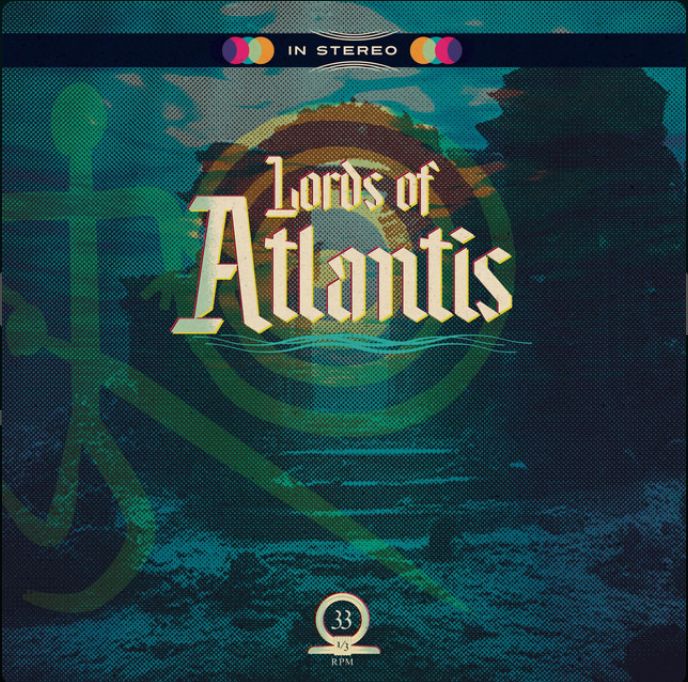
Also, let me mention how much I like the cover art. It has a fun retro feel to it, with its “In Stereo” flag at the top, and the 33 1/3 rpm at the bottom. Very cool!
Brad: Thanks, Tad, for indulging my passions and my friendships! I agree with you completely about the Lords of Atlantis and the David Gilmour feel. But, then, of course, there’s a HUGE Dick Dale feel and influence as well. So. . . Gilmour, Dale, Pongracic. Amazing trio! Two things I’d like to add to this conversation. First, like Pongracic himself, his guitar playing (and the playing of the entire band) is simply tasteful. Taste just exudes from this music.
Second, each song really is a kind of tone poem, awaiting our own visual interpretations. When, for example, I hear “Barbary Corsairs,” I can’t help but imagine the corsairs floating illegally and unlawfully through the Mediterranean, wreaking havoc upon the civilized world. Yet, again, there’s something so tasteful about the song, that I also can’t help but imagine Thomas Jefferson defending American sovereignty in the area and sending in the Marines to attack North African slave fortresses! Or, when I hear “Libertas!” I can’t help but imagine the American patriots defending common law and Natural Rights against the oppressions of King George. And again, when I hear “Chariots of the Gods,” I can’t help but imagine the various pantheons of the ancient world, all mixed and warring with one another. Zeus, Venus, Jupiter, Aphrodite! Which pantheon wins?
Tad: Brad, I agree that the music evokes wonderful visuals – “Eye of the Sahara” made me think of a camel caravan traveling across a dune in the desert.
Well, I think we can agree that this album is a real treat for fans of upbeat instrumental rock. They supply the tunes, the listener supplies the pictures!
THOMAS MUNRO Sr. circa 1939 with his beloved dog Fuzzie
I once asked my Highland grandfather if it bothered him that most of his grandchildren did not speak Gaelic or have any interest in Scottish Heritage. He said it would bother him if had no grandchildren at all. In a long journey, some things must be left behind.
In a long journey, one has to carry the essentials: The ability to communicate, the ability to adapt, the desire to work, the necessity to love and serve others. To enjoy things of beauty like nature, music, and sport. To dread God and obey his commandments.
THOMAS MUNRO SR with his beloved FUZZY picked up as a puppy in GALVESTON, TEXAS 1923. Inseparable for almost 20 years.
I asked him when I was a young boy how he celebrated Christmas as boy (he was boy apprentice at sea). He said he “cleaned up the drunken vomit of the gude for nocht (good for nothing) sailors.” When we watched westerns he would say of the bad guy with a black hat “Aye, he’s the BADJIN (Bad ane). Shane, now he is the GOODJIN “(good one). He would say AYE IT’S TIME FOR THE GUDE WARDS (good words/ prayers). When I was sad and disappointed he would say. Och man, it’s no the end of the WARLD!!! AYE!!! Dinna fash yersel!
(DON’T WORRY). This too shall pass.
And you know what they say: being born in a garage doesn’t make you a car. I wouldn’t mind visiting Scotland again (I haven’t been there since 2005 and have been lucky enough to have visited it a few times 1967-2000 as well) but I have no burning desire to return and no family and few friends to greet me.
Cianalas is the Highland word for it -that place you are connected to by heritage where joy and sadness mingle.
But it is quite true. You can’t go home again.
The greatest distance between two points is time. New York, Glasgow, Argyll, Inverness, Glenties, Ferindonald represent lost worlds to me. So is Seattle, Washington where we lived for seven years.
There is some warmth of memories in all of those places -places where my family lived for over one thousand years but I know them well enough to know they all belong to the past and are not likely to have any place in my future and the future of my children.
They are now part of Yesterday’s Seven Thousand Years.
We may sing of them and memory remembers the ghost of a tune and the ghost of a kiss and the Silent Ones.
But the Silent Ones greet forever as they greet no more.
Gars ye tae greet,aye. “But the broken heart it kens no second spring again thought the waeful heart cease not from its greeting.” (grieving; lamenting -that’s Scots dialect)
But then I am speaking only to myself.
“The world is hard and cruel. We are here none knows why, and we go none knows whither. We must be very humble. We must see the beauty of quietness. We must go through life so inconspicuously that Fate does not notice us. And let us seek the love of simple, ignorant people. Their ignorance is better than all our knowledge. Let us be silent, content in our little corner, meek and gentle like them. That is the wisdom of life.” (The Moon and Sixpence, W. Somerset Maugham)
It is sad when you know your mother’s email and phone number and you know no matter how long you wait there will never be a return message or call.
Phone numbers disconnected and ideas for conversations that would never take place. The past is a door that is irrevocably shut closed.
I used to call my mother long distance at least once a week and she would say “this is costing money” and I told her it was cheaper than a cocaine habit and in any case I know each day is a gift.
I told her I would call her now for a modest amount. The time is coming, I said to her, that no matter how much I would spend the door would be locked and the phone disconnected. She would be silent on the line for a moment. She understood.
Life and love are just a brief moment in time.
My mother used to say that. I half believed it.
Now I have learned it.
I thought winter would never come but winter came and the snow is general.
Love those about you and tell those dear ones in your life that you LOVE THEM often and NOW. And of course, NE OBLIVISCARIS do not forget. Remember them always.
A favorite music artist of ours is North Atlantic Oscillation. This Scottish duo have created an utterly unique and beautiful sound that manages to combine Beach Boys harmonies, Radiohead melodicism, and shoegazer walls of sound. They recently released their fifth album, United Wire, and it is a triumph. With songs varying from hushed, angelic voices to dissonant-yet-attractive noise, it is another reason why NAO are unparalleled in their ability to meld disparate musical elements into a stunning and immensely satisfying listening experience.
Once again, Brad Birzer and Tad Wert take some time to share thoughts on a much-loved group:
Tad: Okay, Brad, I have been smitten with North Atlantic Oscillation since their debut album, Grappling Hooks. As a matter of fact, it was my favorite album of 2010! And rather than succumbing to the dreaded “sophomore slump”, I thought their second album, Fog Electric, was even better. The Third Day maintained the high quality of their music. I should probably mention Sam Healy’s excellent solo 2013 record, Sand, which, for all intents and purposes, sounds like an NAO album to me.
They left KScope Music and released Grind Show in 2018, which was a bit of a disappointment. Their consistently excellent releases up to that point, and the tremendous growth they exhibited must have spoiled me! Grind Show, while good, didn’t blow me away like every other album of theirs. So it was with some trepidation that I bought United Wire. I needn’t have worried; this is a tremendous return to form, in my opinion. What are your thoughts on it?
Brad: Dear Tad (how’s that for a traditional introduction?), I love doing these with you, my friend. If anything, I worry that I’ll bug you too much about such dialogues! I could definitely do one or more a week over the next year.
That said, you bring out the best of me.
And, for all you readers out there, Tad may have formally introduced himself under the “Tad:” bit, but he actually wrote the intro (above) to this piece as well, and I can’t think of a better way of introducing the true beauty and excellence of NAO than what he typed: “utterly unique and beautiful sound that manages to combine Beach Boys harmonies, Radiohead melodicism, and shoegazer walls of sound.” In a million years, or armed with 1,000 monkeys and their typewriters, I could not have captured the band so perfectly.
I will also admit this as well, I love Sam Healy, and it’s incredibly hard for me to be objective about him. Granted, I don’t know him well personally, but he and I have corresponded a bit, and I think he’s just freaking brilliant.
And, generous. An example: I tried like mad to purchase a copy of the latest release, United Wire, through the internet, and the site continuously rejected my credit card (for those of you who don’t know me, I’ve been employed by the same place since 1999, and my wife also has an income–we’re not un-well off!) repeatedly. I mentioned this to Sam on Facebook, and a few weeks later, I found a copy of United Wire waiting for me in my Michigan mailbox. Gratis!
And, what happened? On the first play, I fell in love with the album. Several weeks later, it’s still in constant rotation, and I think the world of it. Whether it’s NAO or SAND, Healy knows music. He lives it, and he breathes it.
Tad, I must admit–we, for once, disagree on something–I really liked Grind Show. I didn’t think it was as good as the first three NAO albums, but I definitely liked it. For me, though, at least prior to United Wire, the true masterpiece, a PROG MUST OWN, was Fog Electric. To me, one can’t consider him or herself a fan of progressive rock at all without actually loving Fog Electric. Grappling Hooks was brilliant pop (in the Tears for Fears vein), but Fog Electric was pure prog.
When Fog Electric first came out, admittedly at first, I didn’t get it. Then, Kscope re-released it, and I was utterly blown away by it. I would consider it, for me, a top fifteen ever rock album. That is, going all the way back to Bill Haley and the Comets, NAO’s Fog Electric is one of the top fifteen albums of all time.
So, Tad, what do you think of NAO album no. five, United Wire?
Tad: Brad, I love United Wire. My credit card worked (ha!), and I bought the CD through MusicGlue, which also included a digital download. One of the options is a “merged” version, which has all of the tracks merged into one long one. I think that is the way NAO intended for the album to be listened to, and I really like it.
Matryoshka is my favorite track. It begins with a distorted and processed voice over a mechanized beat, and then it transforms into a beautiful piano-based coda that I wish would last forever. Then the distortion tries to take over again, but the piano wins in the end.
Brad: Tad, I’m not sure I have a favorite track. I love the whole damned (sorry for the expletive) thing!!!! I would agree with you that Sam intentionally made the bandcamp release (which I bought) one long track. The album really, really works. As in, really, really, works!
Tad: Oh, I agree. As I mentioned earlier, I think the way we’re supposed to listen to it is as one continuous suite of songs. Sam Healy is a musical genius when it comes to composing melodies and arranging instrumental accompaniment. At first listen, you think there is something wrong with the tape speed, then you realize it’s been deliberately slowed down and sped up. And it works! Drum and percussion bang out frenetic beats while angelic vocals float serenely above the chaos. Underpinning everything are electronic ambiences that sometimes come to the fore, but usually remain in the background. There are layers and layers of sound that keep the music endlessly fascinating.
Well, I think we’ve made clear our love for this band in general and this album in particular. You can purchase your own copy of it at MusicGlue or BandCamp.
The Pineapple Thief has just released a huge box set that reissues its first five albums along with two bonus albums. It’s entitled How Did We Find Our Way, and it includes remixed and remastered versions of Abducted At Birth, One Three Seven, Variations On A Dream/8 Days, 10 Stories Down/8 Days Later, and Little Man. There is also a Blu-ray disc that has 5.1 and Atmos mixes of seven albums. The discs come in a beautiful 64 page hardcover book with enlightening notes for every album from Bruce Soord, Jon Sykes, and Steve Kitch, as well as reminiscences of the band’s early years by French journalist Julien Monsenego.
Brad Birzer and Tad Wert are so excited about this release, they decided to do a joint dialogue/review:
Tad: Brad, it’s good to be doing another music review with you!
I already had all the albums in this set from the versions KScope Music released earlier. However, based on the fact that there are quite a few unreleased bonus tracks in this new set, as well as the surround sound mixes, I bit the bullet and bought it. I have to say, I do not have any regrets! The new mixes are fantastic – they really open up the soundstage and allow every instrument to be heard clearly. What led you to splurge on it?
Brad: Dear Tad, my friend, it is great to be doing these reviews with you again. Too much time has elapsed since our last such outing. I blame myself–the summer has been wonderfully crazy. Wonderful, but crazy! Anyway, very glad we’ve got the band–so to speak–back together.
I’ve been a huge fan of The Pineapple Thief and Bruce Soord ever since Tightly Wound came out in 2008. That was my introduction to Soord’s music. So, coming up on fifteen years now. That album, pop rather than prog, demonstrated to me the brilliance of Kscope. I thought (and still think) that Soord created a genius album, a pop masterpiece, with Tightly Wound. From there, I began to explore The Pineapple Thief’s music, going backwards in time. Much to my joy, I found that I loved everything the band had done up to that point, but I was especially taken with One Three Seven and What We Have Sown (not included in this package). Little Man, too, really grabbed me. You might remember that 3000 Days came out right after Tightly Wound. Though I’m not generally a “greatest hits” or compilation kind of guy, I loved 3000 Days, and it certainly introduced me to the best of Soord’s music.
As to How Did We Find Our Way. . . I actually own all the early The Pineapple Thief cds as well, but I was happy to spend the money on these remixed and remastered versions, and I especially wanted the blu-ray. So, I asked for the set for Father’s Day! What are dads for???
Let me also state, at this point in our dialogue, that I absolutely love Kscope’s packaging. When Porcupine Tree released their latest last year, I was sorely disappointed that they went with a company (Sony) other than Kscope. I bought the album, of course, and I loved it, but I was very disappointed with the packaging. Kscope, though, always does things with excellence, and I now have a very tidy collection of releases in this earbook (is this the right term) format from Gazpacho, The Pineapple Thief, and others.
Tad: Brad, it looks like our Pineapple Thief experience is remarkably similar. I too first heard them via KScope’s release of Tightly Wound, and I enjoyed it so much I sought out their earlier releases.
Okay, on to the current set: as I mentioned earlier, I think it’s worth buying just for the new mixes. In addition to them, though, we also get to hear all of these classic albums in 5.1 mixes, which is wonderful! I spent an entire afternoon reading and listening to them, and it was as if I was hearing them for the first time.
Also, there are quite a few very good bonus tracks that were not included on any of KScope’s reissues. One of my all-time favorite songs of Soord’s is Watch the World Turn Grey, which was included on the infamous 12 Stories Down – the album that Soord quickly pulled from the market because of mastering issues. It’s a beautiful little gem of a song that, for some reason, he never included in any reissue or compilation.
In the liner notes, Soord mentioned that, while going back and remixing his back catalog, he had neglected some songs that were actually quite good. Yes, Bruce! I’m glad we now have a complete set of early TPT tunes.
Speaking of the liner notes, I learned so much about the early history of The Pineapple Thief. I was really surprised to discover that the first three albums were basically solo albums recorded in his home. In the original albums’ credits, he made up names of musicians to make it look like The Pineapple Thief was a real group!
When Variations On A Dream was reissued by Kscope, I reviewed it on Amazon, and I wrote that Soord’s music would appeal to fans of minimalist composers like Steve Reich, Philip Glass, and Arvo Part. Sure enough, in his commentary here for that album, he says that seeing an ensemble performing some Reich compositions was an important formative experience for him.
Before this set, if I had to pick a favorite early Pineapple Thief album, I would go with Variations On A Dream. However, after my marathon listening session, I am now thinking Little Man is the best. It takes on real emotional heft for me, now that I know the context in which it was written and recorded. In his commentary, Soord explains it was put together in the aftermath of the tragic loss of his prematurely born son.
Are you able to pick a favorite, Brad?
Brad: Tad, thanks so much for your enthusiastic and very interesting response. Great that we came to the band at the same time. Obviously, the band’s switch to Kscope introduced them to an entirely new audience.
You ask what my favorite album is. I must admit, I’m not entirely sure. I’ve been listening to these albums for at least fifteen years, so they kind of have become just a part of my life, at least autobiographically speaking. Re-listening to them again, especially in this new package, I find that I’m still relatively neutral when it comes to ranking them. That is, they all seem rather extraordinary to them.
Of this new set, though, I can state unhesitatingly that my favorite music are/is the “leftover” albums–Eight Days and Eight Days Later. I love the idea that Soord spontaneously recorded each of these after finishing massive album projects. There’s something deeply special, original, and wholesome about music so created. It’s almost like giving rock a jazz-sheen.
Before we finish this review and dialogue, I also want to note that I’m a rather proud The Pineapple Thief fan. This set shows that Soord was inventive from the beginning and that he possessed, again from the beginning, an immense amount of integrity. It makes the more recent albums–I especially love Your Wilderness–shine even more. Truly, Soord has progressed, but really from excellence to excellence.
Tad: I agree that there is something very fresh and endearing about the Eight Days and Eight Days Later albums. In my aforementioned Amazon review from many years ago, I made the same point. Soord seems to work well under pressure, when he isn’t able to “fix” every little detail of the songs. I think that works to their benefit.
Brad, thanks again for resurrecting with me our dialogues on music. And thank you, Spirit of Cecilia followers for reading! We are already planning to discuss the recently released North Atlantic Oscillation album, United Wire, so stay tuned for that!
[originally published at The American Conservative–to honor my daughter’s eleventh birthday. This year, she would’ve been sixteen]
Had things worked or happened differently, I would be celebrating the eleventh birthday of my daughter, Cecilia Rose Birzer, today. I can visualize exactly what it might be like. A cake, eleven candles, hats, cheers, goofiness, photos, and, of course, ice cream. I imagine that she would love chocolate cake–maybe a brownie cake–and strawberry ice cream. Her many, many siblings cheer here, celebrating the innumerable smiles she has brought the family. As I see her at the table now, I see instantly that her deep blue eyes are mischievous to be sure, but hilarious and joyous as well. Her eyes are gateways to her soul, equally mischievous, hilarious, and joyous. She’s tall and thin, a Birzer. She also has an over abundance of dark brown curls, that match her darker skin just perfectly. She loves archery, and we just bought her first serious bow and arrow. No matter how wonderful the cake, the ice cream, and the company, she’s eager to shoot at a real target.
She’s at that perfect age, still a little girl with little girl wants and happinesses, but on the verge of discovering the larger mysteries of the teenage and adult world. She cares what her friends think of her, but not to the exclusion of what her family thinks of her. She loves to dance to the family’s favorite music, and she knows every Rush, Marillion, and Big Big Train lyric by heart. She’s just discovering the joys of Glass Hammer. As an eleven-year old, she loves princesses, too, and her favorite is Merida, especially given the Scot’s talents and hair and confidence. She has just read The Fellowship of the Ring, and she’s anguished over the fate of Boromir. Aragorn, though. There’s something about him that seems right to her.
If any of this is actually happening, it’s not happening here. At least not in this time and not on this earth. Here and now? Only in my dreams, my hopes, and my broken aspirations.
Eleven years ago today, my daughter, Cecilia Rose Birzer, strangled on her own umbilical cord. That which had nourished her for nine months killed her just two days past her due date.
On August 6, 2007, she came to term. Very early on August 8, my wife felt a terrible jolt in her belly and then nothing. Surely this, we hoped, was Cecilia telling us she was ready. We threw Dedra’s hospital bag into the car as we had done four times before, and we drove the 1.5 miles to the hospital. We knew something was wrong minutes after we checked in, though we weren’t sure what was happening. Nurses, doctors, and technicians were coming in and out of the room. The medical personnel were whispering, looking confused, and offering each other dark looks. Finally, after what seemed an hour or more, our beloved doctor told us that our child–a girl, it turned out–was dead and that my wife would have to deliver a dead child.
We had waited to know the sex of the baby, but we had picked out names for either possibility. We had chosen Cecilia Rose for a girl, naming her after my great aunt Cecelia as well as St. Cecilia, the patron saint of music, and Rose because of St. Rose of Lima being the preferred saint for the women in my family and because Sam Gamgee’s wife was named Rosie.
I had never met my Aunt Cecelia as she had died at age 21, way back in 1927. But, she had always been a presence in my family, the oldest sister of my maternal grandfather. She had contracted tetanus, and the entire town of Pfeifer, Kansas, had raised the $200 and sent someone to Kansas City to retrieve the medicine. The medicine returned safely to Pfeifer and was administered to my great aunt, but it was too late, and she died an hour or two later. Her grave rests rather beautifully, just to the west of Holy Cross Church in Pfeifer valley, and a ceramic picture of her sits on her tombstone. Her face as well as her story have intrigued me as far back as I can remember. Like my Cecilia Rose, she too had brown curly hair and, I suspect, blue eyes. She’s truly beautiful, and her death convinced her boyfriend to become a priest.
The day of Cecilia Rose’s death was nothing but an emotional roller coaster. A favorite priest, Father Brian Stanley, immediately drove to Hillsdale to be with us, and my closest friends in town spent the day, huddled around Dedra. We cried, we laughed, and we cried some more–every emotion was just at the surface. I’m more than certain the nurses thought we were insane. Who were these Catholics who could say a “Hail Mary” one moment, cry the next, and laugh uproariously a few minutes later? Of course, the nurses also saw just how incredibly tight and meaningful the Catholic community at Hillsdale is. And, not just the Catholics–one of the most faithful with us that day was a very tall Lutheran.
Late that night, Dedra revealed her true self. She is–spiritually and intellectually–the strongest person I know. She gave birth with the strength of a Norse goddess. Or maybe it was just the grace of Mary working through her. Whatever it was, she was brilliant. Any man who believes males superior to females has never seen a woman give birth. And, most certainly, has never seen his wife give birth to a dead child. Cecilia Rose was long gone by the time she emerged in the world, but we held her and held her and held her for as long as we could. With the birth of our other six children, I have seen in each of them that unique spark of grace, given to them alone. Cecilia Rose was a beautiful baby, but that spark, of course, was absent, having already departed to be with her Heavenly Father.
For a variety of reasons, we were not able to bury her until August 14. For those of you reading this who are Catholic, these dates are pretty important. August 8 is the Feast of St. Dominic, and August 14 is the Feast of St. Maximilian Kolbe.
Regardless, those days between August 8 and August 14 were wretched. We were in despair and depression. I have never been as angry and confused as I was during those days. Every hour seemed a week, and the week itself, seemed a year. I had nothing but love for my family, but I have never been that angry with God as I was then and, really, for the following year, and, frankly, for the next nine after that. We had Cecilia Rose buried in the 19th-century park-like cemetery directly across the street from our house. For the first three years after her death, I walked to her grave daily. Even to this day, I visit her grave at least once a week when in Hillsdale. In the first year after her death, I was on sabbatical, writing a biography of Charles Carroll of Carrollton. Every early afternoon, I would walk over to her grave, lay down across it, and listen to Marillion’s Afraid of Sunlight. Sometime in the hour or so visit, I would just raise my fist to the sky and scream at God. “You gave me one job, God, to be a father to this little girl, and you took it all away.” In my fury, I called Him the greatest murderer in history, a bastard, an abortionist, and other horrible things. I never doubted His existence, but I very much questioned His love for us.
Several things got me through that first year: most especially my wife and my children as well as my friends. There’s nothing like tragedy to reveal the true faces of those you know. Thank God, those I knew were as true in their honor and goodness as I had hoped they would be. A few others things helped me as well. I reread Tolkien, and I read, almost nonstop, Eliot’s collected poetry, but especially “The Hollow Men,” “Ash Wednesday,” and the “Four Quartets.” I also, as noted above, listened to Marillion. As strange as it might seem, my family, my friends, Tolkien, Eliot, and Marillion saved my life that year. I have no doubt about that. And, nothing gave me as much hope as Sam Gamgee in Mordor. “Sam saw a white star twinkle for a while. The beauty of it smote his heart, as he looked up out of the forsaken land, and hope returned to him that in the end the Shadow was only a small and passing thing: there was light and high beauty forever beyond its reach.” As unorthodox as this might be, we included Tolkien’s quote in the funeral Mass.
A year ago, my oldest daughter–the single nicest person I have ever met–and I were hiking in central Colorado. We were remembering Cecilia Rose and her death. Being both kind and wise, my daughter finally said to me, “You know, dad, it’s okay that you’ve been mad at God. But, don’t you think that 10 years is long enough?” For whatever reason–and for a million reasons–my daughter’s words hit me at a profound level, and I’m more at peace over the last year than I’ve been since Cecilia Rose died. I miss my little one like mad, and tears still spring almost immediately to my eyes when I think of her. I don’t think any parent will ever get over the loss of a child, and I don’t think we’re meant to. But, I do know this: my Cecilia Rose is safely with her Heavenly Father, and, her Heavenly Mother, and almost certainly celebrating her birthday in ways beyond our imagination and even our hope. I have no doubt that my maternal grandmother and grandfather look after her, and that maybe even Tolkien and Eliot look in on her from time to time. And, maybe even St. Cecilia herself has taught my Cecilia Rose all about the music of the spheres. Indeed, maybe she sees the White Star. Let me re-write that: I know that Cecilia Rose sees the White Star. She is the White Star.
Happy birthday, Cecilia Rose. Your daddy misses you like crazy, but he does everything he can to make sure that he makes it to Heaven–if for no other reason than to hug you and hug you and hug you.




 Spirit of Cecilia
You must be logged in to post a comment.