
By Richard K. Munro
TRUE FRIENDS NEVER PART ALL TOGETHER
We try to stay connected with friends. You hear an old friend with whom you have fallen out of close contact is seriously ill. You write to him and give him your phone numbers and email and tell him to call or write any time. You offer up a prayer for him and his family. But the rest is silence. Only God knows the reason.
Of course, it is sad to realize I cannot connect with some good friends except via prayer because they are dead.
No more contact is possible this side of paradise.
Classmates I knew in school are dead.
Some died in their 20’s, in their 30’s , in their 40’s some in their 50’s.
My next-door neighbor -a close acquaintance of 20 years but I considered him a friend. He was a really nice guy. He was only 62 younger than I. We are going to his funeral next week.
Three of my really close friends were killed in car accidents by drunk drivers. Two of them were killed within walking distance of my house. I don’t even like to drive that way anymore because that corner has bad associations.
Yes, who can know? Perhaps that person who doesn’t communicate is depressed or embarrassed or just doesn’t care. SCIRE NEFAS ..it is forbidden to know all. Not all can be known.
It is sad of course to be rejected by people but relationships are a two- way street.
Corresponding is difficult but picking up the phone is easy but it is also intimate. Some people don’t want to open up or give answers. So all you can do is be prepared to accept their phone call IF they call. I know someone I cannot call any longer because it is painful. The last four or five times I called that person just BANG hung up on me. So I will never call again. That was almost ten years ago.
All one can do is do the right and humane thing. Then offer up a prayer for our friend of yesteryear.
Many of the men I knew in school and in the Marines are gone -dead.
In 1976 a Sea Knight Helicopter crashed in Quantico and 23 Marines were killed. I didn’t see the crash but I saw the bird take off. The weather was turning bad so our Company Commander said -people grumbled- we would walk back to camp over 20 miles. We arrived when it was almost dark dirty and hungry. But that’s when we found out that one of the previous birds went down.
When on liberty on the USS Trenton there was a collusion and dozens of Marines were killed. I could have been on either one of those trips.
But when the door is closed, when the mail doesn’t arrive, when the phone doesn’t ring when the email box is empty all one can do is pray.
Some people are friends when it is convenient or useful or when they’re coworkers.
Some people are just ships passing in the night. Some signal and some go quietly by.
If one has a single true friend or a single loved one for any period of time one should be grateful. I think I have been luckier than most though less fortunate perhaps than many others.
But I am not jealous.
I am just grateful for the love and close relationships I have known.
And I am thankful for the great classics -the Bible, Shakespeare, Dante, Horace, Cervantes. In my retirement I have plenty of sun, plenty of quiet, baseball on the radio, plenty of music and plenty of books. I have enough money to be generous to our grandchildren -we are blessed to have them- and visit them from time to time. I don’t have the resources or the stamina to travel all over the world but I am very grateful that from 1961-2005 in particular I had the chance to visit many states and provinces and many countries in South America, the Caribbean ,and Western Europe. Next week I will have a chance to visit -again-Washington DC a city which I have visited dozens of times. I spent a year at the University of Virginia so I have seen most of the principal sights. But mostly I will enjoy seeing friends and remembering friends and loved ones. As Thomas Moore sang in the Meeting of the Waters.
Yet it was not that nature had shed o’er the scene
Her purest of crystal and brightest of green;
‘Twas not her soft magic of streamlet or hill,
Oh! no, — it was something more exquisite still.
‘Twas that friends, the beloved of my bosom, were near,
Who made every dear scene of enchantment more dear,
And who felt how the best charms of nature improve,
When we see them reflected from looks that we love.

Many years ago at the old 1407 Club Club in New York City (now long gone) my father and I met the tenor James McCracken. He had just released an album of Scottish and Irish songs -The Meeting of the Waters. He had finished his dinner and generously offered that we finish our coffee with him. My father, in particular, knew his work very well and had seen him perform at the Metropolitan Opera. But we talked about why he made his Scottish-Irish album and he said he had listened to McCormack, Frank Paterson and Kenneth McKellar his entire life and he loved the traditional and popular songs. He said it was important, he believed to cross over from classical to popular music. It was a nice moment. He loved being with genuine fans of his music We loved spending some time with him. From then on when I hear this song I remember my father and James McCracken. But also Thomas Moore and the sentiment of his poem.
My father had been a fine athlete in Scotland (winning a medal for best goalie in the city of Glasgow for his level youth team). But in America, he working at several jobs -almost full-time year-round – from his 12th birthday. So he had no time for sports. He turned ALL of his money to his mother and she would give him 25 cents for the subway and a Saturday movie
My father played on a legendary and ill-starred Football (soccer) team called the St. Anthony Ants of 1924-1925-1926-1927 when they were the champions every year or close to it.
The Ants first ground was a public park situated beyond the southern end of Hamilton Street (now Nethan Street) in Govan (South Glasgow.. It was a humble grass soccer field. It was unenclosed -cold and wet in the winter and had no pavilion, so the players had to change in the League of the Cross Hall in Hamilton Street.
Father Collins (parish priest of St. Anthony’s)and Bishop Donald Macintosh were both avid supporters of the team and helped the boys get shoes and equipment. Both men had studied at the Scots College (then at Valladolid, Spain and in Rome). Both were avid linguists and could speak Italian and Spanish as well as Gaelic, Scots and English. My father loved both men and they were friends of Uncle Johnny Dorian (his fourth-grade teacher and later headmaster of St. Anthony’s.). My father called him Uncle Johnny but he was really my grandmother’s sister’s son so my father’s cousin.
Father Collins married his parents, baptized my father on March 17, 1915, was at his first communion. Father Collins had a very strong influence on my father and his mother, brother and sister visited the Dorian household often and Father Collins and Bishop Macintosh were frequent visitors. My father, his family, and Johnny Dorian and his daughters and the Bishop would listen to recordings of Caruso and John McCormack, chiefly Italian opera but also English, Irish, and Scottish songs. Father Collins and Bishop Macintosh later became close friends with Father Sidney MacEwan, also of Govan and later a successful recording artist. When McCormack died MacEwan was by his side and sang to him the Highland song ISLAND MOON.
I believe my father’s love of languages and classical music, particularly opera began with those Sunday dinners in the 1920s. The legendary great years of the ill-starred ANTS:
Scottish Junior League Victory Cup Winners 1918/19, 1921/22
Glasgow Junior Cup Winners 1918/19, 1921/22,
Elder Cottage Hospital Charity Cup Winners 1923/24,
Scottish Junior Cup Runners-Up 1918/19, 1924/25
Why such a tragic team?
Because so many of their fathers had been killed in WWI and many of my father’s teammates were later killed themselves in WWII many at Dunkirk with the 51st Highland Division, North Africa, and Normandy.
Some died in Nazi slave labor camps. One of the few times I saw my father weep in public was when we went to the Scottish National War Memorial in Edinburgh in 1967. There was THOMAS CRAIG (Cameronians/Scottish Rifles) 4 Dec 1942 (North Africa) KILLED IN ACTION. His teammate and very best friend.
PATRICK QUIGLEY KILLED 10 October 1943 (HLI -Highland Light Infantry -his teammate and cousin)
Many of his Quigley kin had been killed in the Argylls or HLI in the First World War. There was also his “Uncle Johnny” (or American Johnny) Robertson his father’s best friend who had returned to Scotland in 1938 to retire. He was killed in the Glasgow Blitz -6 May 1941. I still have books that belonged to Robertson that he gave my father in 1938, Shaw, Kipling, and Burns. My father as he saw name upon name began to cry uncontrollably. I was frightened.
But I always remember the Scottish people there were very kind and sat with my father and talked to him and comforted him. My father said, “If I hadn’t come to America in 1927 my name would be in the books next to theirs. It was rifles against tanks and they didn’t have much chance. They were always in the front lines in the thick of the fight.” It left a strong impression on me and when we had teas and Empire biscuits afterward he spoke Johnny Robertson and his friends and kinsmen. Immigration had been good for my father but also had caused him personal suffering, pain ,and loneliness. My father always wanted to be an American but knew he was partially a permanent exile. In 1967 my father pointed out the Boer War memorial that that been bomb damaged on 6 May 1941 in Kelvin Grove Park. When I am Glasgow I always go back to visit that spot if only for a few moments. REMEMBRANCE.
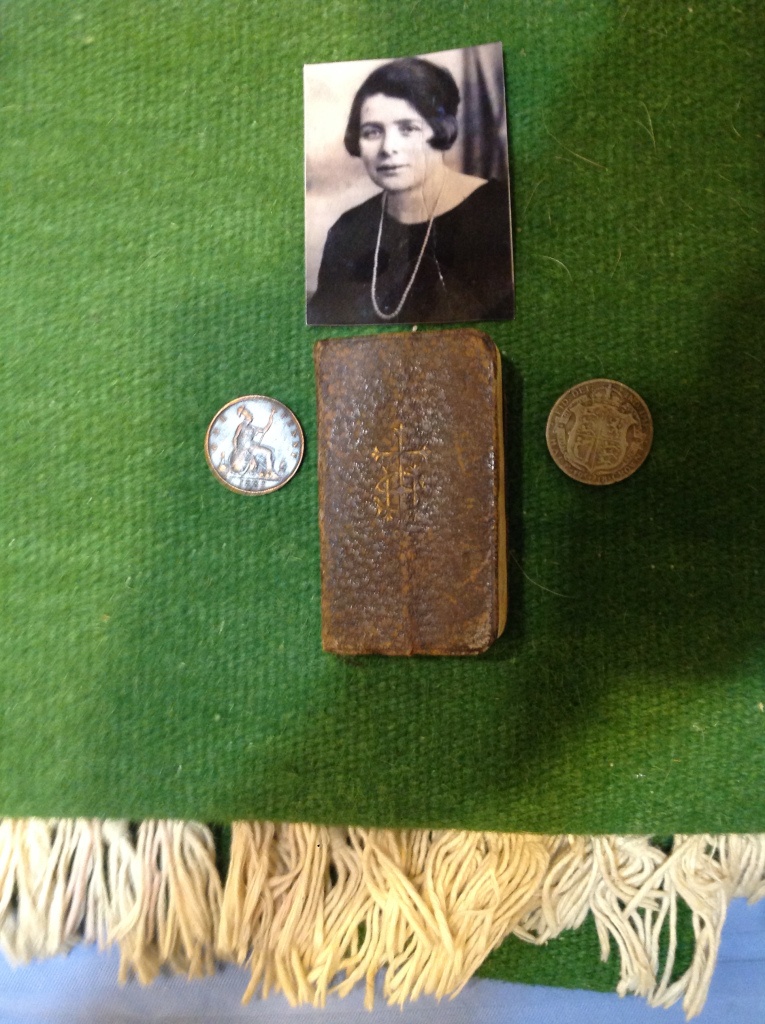
When my father graduated from high school, his grandfather, Jos Munro, his mother, his sister Johnny and his father and his cousin Jimmy Quigley were there. My grandfather gave my father five coins (coins I still have)One is a British Penny (1881) given to my grandfather when he went to sea when he was eight years old. It was all the money he had and his mother said, “Never spend it unless your life depends upon it. Naebody can every say Tommie Munro is penniless. ” He did not see his mother or family for eight years but he held on to the penny virtually his only possession.
Three of the coins were American silver dollars dating from the 1890s and 1920s. These were actual dollars his father and grandfather had earned as a worker in America. The last was very special; it was an English 1918 silver half-crown that my grandmother had sent my grandfather and he kept in his left tunic pocket in his missal. She gave him one for 1914, then another for 1915, then another for 1916, then another for 1917, and the last he had his pocket for Armistice Day 1918. When he returned to Scotland in May 1919 he turned it over to her and it was one of her prized possessions until her untimely death on March 7, 1942. She never saw the Allied victory nor her sons come home from the war. My father gave the missal and the coins to me after my mother died in 2001 and told me the story.
Ne obliviscaris -do not forget.
Mary Munro, the Missal and two of the coins.
SONNET 30
When to the sessions of sweet silent thought
I summon up remembrance of things past,
I sigh the lack of many a thing I sought,
And with old woes new wail my dear time’s waste:
Then can I drown an eye, unus’d to flow,
For precious friends hid in death’s dateless night,
And weep afresh love’s long since cancell’d woe,
And moan the expense of many a vanish’d sight:
Then can I grieve at grievances foregone,
And heavily from woe to woe tell o’er
The sad account of fore-bemoaned moan,
Which I new pay as if not paid before.
But if the while I think on thee, dear friend,
All losses are restor’d and sorrows end.
 Spirit of Cecilia
You must be logged in to post a comment.