BIOGRAPHY: Richard K. Munro April 4, 2023
I am a retired teacher of English, Spanish & history. I taught in public and Catholic schools for over 34 years. I am a California Certified teacher of Social Studies, Spanish and English. I was a Mentor Teacher in the Kern High School District.
I hold a BCC (Bilingual Certificate of Competence). I have always been interested in foreign languages and bilingualism probably from the time as a young man realized that the Roman Empire was a de facto bilingual empire (Latin and Greek) and from the experiences of my father who spoke Spanish and Tagalog as a US Army officer during World War 2. My father encouraged me to study Spanish as it was a practical and important universal language.
I attended public schools in New Jersey excelling in AP US history and AP Spanish. At the recommendation of my high school Spanish teacher, I began my university studies in Soria, Spain with the University of Northern Iowa. We American students lived with Spanish families and pledged not to speak English with each other or anyone else for the entirety of the course (10 weeks). I became aware of the value of total immersion in a foreign language. I am fluent in Spanish and Portuguese and have a good competency and reading knowledge of Latin, Italian, and many other languages. In my retirement, I am studying Greek via DUOLINGO and Teach Yourself Books.
Like my father, uncles, and other relatives who served during WW2, I volunteered to serve in the US military. I hold an honorable discharge from the US Marines. My parents were naturalized Americans and the first in their families to graduate from high school and go on to college. During WW2 my immigrant grandfather help build US Navy ships and Liberty Ships. My parents and grandparents impressed upon me from an early age the importance of national unity, patriotism and deep gratitude for the opportunities America has afforded us.
My specialty became English literacy for newcomers (emphasizing phonics, diction, and grammar) and sheltered English immersion Social Studies (history) for English learners.
I believe in voluntary high-quality Dual Immersion instruction and the importance of the teaching foreign languages. My daughter is a Dual Immersion Spanish/English k-6 teacher and my son is a AP Spanish teacher 9-12. I am married with three children. My wife is an immigrant and a naturalized US citizen.
For many years I was an AP Reader in Spanish (adjunct faculty) for ETS. In 2004-2005 I was the ISI Renshaw Fellow at UVA and a University Supervisor. I taught at Bakersfield College for four years as an adjunct professor in Spanish. I have a New Wine Credential; I taught high school catechism in English and Spanish for over 20 years. I voluntarily tutored many immigrants pro bono for citizenship tests and for those who attended junior college. My wife and I have co-sponsored immigrant families in our community who have gained US residency.
I studied history, political science, and Spanish at NYU (BA with honors) and was awarded the Helen M Jones Prize in history. I achieved my 5th Year teaching certificate at Seattle University and was certified as English teacher as well as Spanish and Social Studies. I hold an MA in Spanish Literature from the University of Northern Iowa. In addition to teaching, I have worked in private industry as a tour guide, a construction worker and as a customer service representative for the Bank of America (five years).
I have published articles in newspapers, Military History magazine, Calliope, and Cobblestone. I was author of “Spying for the Other Side, KIM PHILBY” which appeared in the McGraw Hill Anthology of World History. I have authored one-act plays for youth such as "Euripides' Trojan Women” (Calliope),"Romans on the Rhine", "Clad in Gold Our Young Mary" , "Beneath Alexandria's Sapphire Sky" among others.
I have edited galleys of several books and have done research for authors notably Andrew Roberts in CHURCHILL WALKING WITH DESTINY and his THE LAST KING OF AMERICA: GEORGE III.
I began my career primarily as a Spanish teacher specializing in Spanish for Native Speakers and AP Spanish and AP Spanish Literature teaching in Washington State and California. However, I also coached sports (baseball and soccer), advised for the local “We the People team” and filled in by teaching the occasional summer ESL or US history class.
As a bilingual teacher of course, I attended meetings and conventions for bilingual teachers. There Stephen Krashen and others taught that a student could be taught Math, Social Studies, Language Arts and Science in their native languages (rather than English) and that knowledge and literacy would “transfer.” I came to call this Phoney Bilingual Education or NENLI (Non-English Native Language Instruction) Many teachers I met favored a “late exit” approach which meant keeping students in so-called bilingual classes deep into high school. I was skeptical.
For me 1995-1996 was the turning point. I was asked to fill in for three ESL classes that had been previously taught by another bilingual teacher. I was shocked by what I found. The students were reading mostly in Spanish and doing journals (in ungrammatical Spanish) only. The students chatted in Spanish the whole period and English was rarely if ever heard. I was told the goal of ESL classes was literacy. I clashed with the local administrator who would not provide me English language dictionaries, bilingual dictionaries or English language material. I bought a box of American heritage dictionaries out of my own pocket and taught using newspaper articles and comics. I protested that the student transcripts indicated the classes were English classes so they should be taught and tested in English for those classes. To do otherwise was, in my opinion, intellectually dishonest, even fraudulent.
I continued to inform myself and read books and articles by Linda Chavez and Rosalie Porter especially FORKED TONGUE by Porter.
At the time our high school graduation rate was falling and one of the major reasons was students could not pass 11th grade US history or 12th grade Government and Economics. The Bilingual Coordinator had the answer: alternative paths mini-classes (all in Spanish) via Migrant Education. I was asked to teach US history and World History with Spanish language history books. These books were ordered via supplementary budgets and so evaded the normal book approvals via the district. I refused to use those books. Instead, I volunteered to teach US history with English language books (with numbered paragraphs and bilingual glossaries). The school was very divided on this issue; I had at one time the support of the Social Studies chairmen and the school principal but not the vice principal and bilingual coordinator. I was very successful, and the students were very grateful. In one history class, every single student passed his or her English proficiency test and graduated from high school.
Over time, however, I became increasingly at odds with the Bilingual Establishment some of whom accused me, publicly, for being a “racist”, “English-only”, a “white supremacist” and “anti-immigrant.” I responded of course that my conscience was clear as I had dedicated my life to help immigrants and newcomers of many races and religions, spoke Spanish and other languages, and that my wife was an immigrant!
In 1997 Ron Unz came to our town to promote his new referendum English for the Children. To my surprise, I felt sympathy for most of what he said and so volunteered. I actively campaigned with Unz , Henry Gradillas, and Jaime Escalante in English and Spanish for Bilingual Education reform with English for the Children in California 1997-1998. I helped produce bilingual radio commercials and appeared on Spanish-language and English-language television. During this period I met Rosalie Porter and later worked with her as an advisor in the successful English for the Children campaigns in Arizona and Massachusetts. I have been associated with ProEnglish for many years as an advisor eventually being invited to join the Board of PRO-ENGLISH.
I believe local communities should have some choice as to what kind of educational programs they want to provide and what languages they teach. I also deeply believe in La Conviviencia. La Conviviencia is an almost untranslatable Spanish concept. It means living, communicating and working together and thereby gaining mutual respect and comprehension. I believe in La Conviviencia; we must live together as good neighbors. We have many problems in this world, even enemies; but with our neighbors and friends we should live in peace. I believe in the policy of the Buen Vecino (the Good Neighbor) and in la Conviviencia (peaceful coexistence) of different cultures, languages, and religions.
Diane Ravitch wrote “a society that is racially diverse requires…a conscious effort to build shared values and ideals among its citizenry.” This includes the recognition that English is and should be our official national language. The language of the rule books, Federal courts and juries must be in English. In addition, the Uniform Code of Military Justice, contracts, official documents, our laws and constitutions must be in English though translations can be provided.
I believe English should be the official and national language of the United States. I do not believe we can or ought to be an officially bilingual or multilingual nation. This does not mean in any sense that languages other than English should not be taught or used, however. It should be clear that I have never been an English-only person but a multilingual person who is pro-immigrant and believes in voluntary multilingualism. America needs English but it also needs knowledge of other languages for cultural and educational reasons as well as for national security reasons. My entire family is multilingual and multicultural, and I hope we carry on this heritage into future generations of American Munros and Mendozas in a prosperous, peaceful and United States of America.
My Auld Pop (Thomas Munro, Sr 1886-1963) often spoke of integrity and used to say “Is fhearr an rath fada glan seo far am beil e na an rathad goirid salach” or “Tis far better the the long clean road (rath fada glan) than the short dirty one.” I remember Dorothy L. Sayers wrote in a letter to Muriel St, Clare Byrne :
“To make a deliberate falsification for personal gain is the last, worst depth to which either scholar or artist can descend in work or life.” (From the Letters of Dorothy L Sayers Vol 1 1899-1936.
I have been a proctor to hundreds of AP exams and other standardized exams. It never would have occurred to me for an instant to seek a bribe to falsify an exam. I studied very hard for my Spanish Achievement test and got a 730. My eldest child, many years later got a 760. Our middle child got a 770. Our youngest got a 800 (a perfect score). She also was an National AP Hispanic Scholar. She got a 5 on her AP Spanish literature and also her AP English prep. A friend asked what prep books she used to study. My daughter said, “I didn’t study. I just read the complete works of Oscar Wilde, Robert Louis Stevenson, George Orwell, Ray Bradbury, Dorthy L. Sayers plus the complete works of Garcia Lorca, Alarcon, Jose Camilo Cela, Cervantes, Tirso de Molina and Calderon de la Barca plus a few odd essays and stories.
I know my father played “rounders” in Scotland in the 1920’s besides football (soccer). My grandfather played shinty in the Highlands in the 1880’s and 1890’s and then went to sea. At that time football (soccer) was almost unknown in the Highlands so he never played football in his life. But he did play baseball in the USA and Canada. He mentioned a shinty ball is similar to a baseball and one threw up and hit the ball as one does playing pepper.
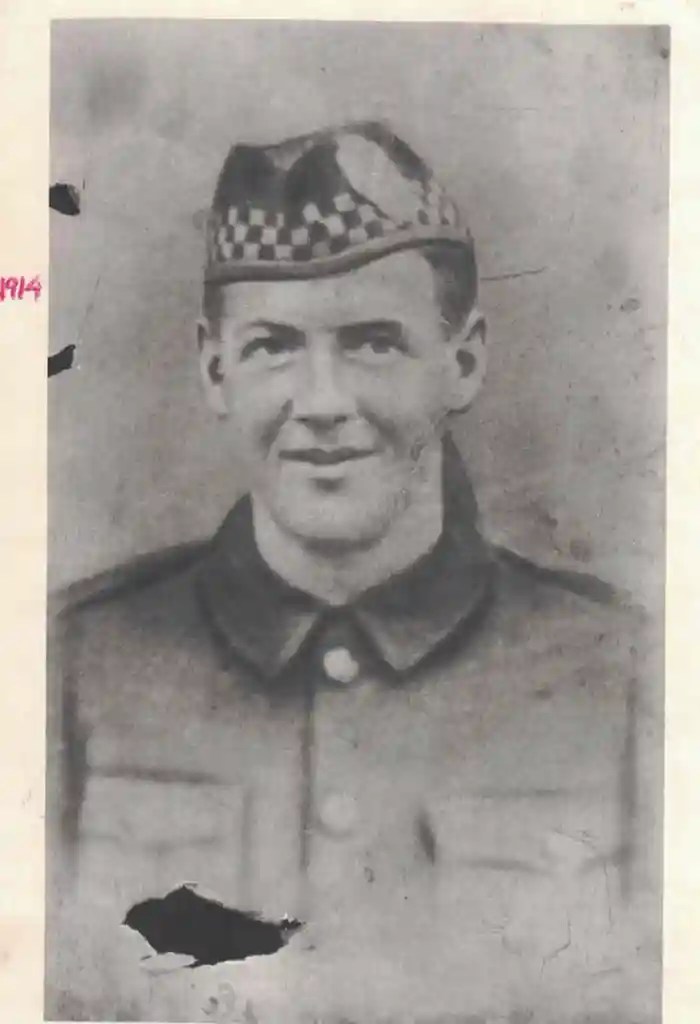
THE GOOD COMRADE THOMAS MUNRO SR 1886-1963 MM 2nd Ypres ASH
“Speaking Latin properly is indeed to be held in the highest regard – not just because of its own merits, but in fact because it has been neglected by the masses. For it is not so much noble to know Latin as it is disgraceful not to know it.” ― Cicero
Of course, old Latin itself, like some old grandfather or grandmother, sent away to retirement, is little heard or discussed today. I live in a county of almost 1 million people and there is not a single Latin teacher anywhere for over 100 miles in every direction.
And yet, I am surrounded by a sea of Spanish speakers and as every Spanish teacher knows Spanish is a Romance language derived from Latin. People sometimes forget that Spanish is a European language because European speakers are outnumbered by non-Europeans (of many races) by a factor of almost three to one. Since the Renaissance Spanish has borrowed extensively from French, Italian, Latin and Greek -“cultismos” (cultured or learned words) as well as borrowing some vocabulary from indigenous languages of the Caribbean, Mexico and Peru.
English word
Spanish word
Spanish cultismo
English cognate
iron
hierro
férrico
Ferric oxide
son
hijo
Filial
Filial
Fate (destiny)
Hado
fatal
fatal
Hunger (famine)
Hambre, hambruna
famélico
famine
Distaste (aversion)
Hastío
Fastidioso, exigente
Fastidious (partially false cognate); exigent
To stink
heder
Fétido (púdrido)
Fetid (putrid)
To flee
huir
fugaz
Fugacious
I could make a much longer list of cognates that Spanish and English have in common although there is an occasional linguistic difficulty as Spanish and English share roots that are false cognates such as the word “success” (a Latinate word) and “suceso” (event) as well as éxito (success not “exit”). In the last two centuries Spanish has borrowed many words from English (chiefly American English and not British English).
Nonetheless, it should be obvious that an educated Spanish speaker has a command of Latin roots and Latin words that could help him or her read and write academic English well. Latin lives through its Romance progeny. There is no reason a person cannot develop two or more languages well and be authentically bilingual. We raised all our children to speak Spanish as well as English and of course being totally fluent in English and Spanish means one can begin to learn Italian or German as well since one already has a base vocabulary for the other languages. One of the things that irritates me is when administrators call English learners (of any level) “bilingual” when in fact many are monolingual or if they are partially bilingual they are illiterate in one language or the other. And of course my parents were never bilingual; they were polyglots.
So I tell my Spanish-speaking English learners (I am today chiefly a teacher of English to English learners) they are very lucky if they command that “treasure of harmonies” (tesoro de harmonías) which is Spanish. Of course, they would be luckier if they were able to read, write and speak English because it is a cognate fact that English is the lingua franca of today. But there is no reason why one cannot cultivate an apple tree (representing English) and a lemon tree (representing Spanish) in one’s home and garden.
English is the one language that is known and spoken almost universally among educated people. In fact, soon -if it has not happened already- English speakers who are non-native will outnumber native English speakers of the Anglophone world. But Spanish isn’t going away and will continue to be useful particularly in the Americas.
One could make the case that if you already read, write and speak English you don’t need to know any other modern language. But then one could give good reasons why one doesn’t need a formal education beyond high school in many jobs and careers.
It is possible in the near future most higher education will be done by home study or online. Traditionalists may find that colleges and universities will become so inimical to their values (if they haven’t become so already) that attending most colleges do more harm than good especially as they have become so ridiculously overpriced as to burden young people with tens of thousands if not hundreds of thousands of school loans. We shouldn’t go to college merely for a credential or diploma but because of the marvelous value in learning new things, reading new books, hearing learned lectures, training our minds and of course broadening our horizons. We cannot study medicine at home or nursing or dentistry but unless one wants to become an academic credentials and diplomas are not crucial.
I encourage my students to be adventurous with languages When one learns the word “problem” one is not learning merely one word in one language but a common word in 20 or more languages. Before I knew the word for “wine” or “water” in Morocco or Greece I asked for “Coca-Cola” or “Cafe”.
My grandfather was not a formally educated man -he went to sea at age 8- but he was an avid reader of newspapers and the Bible. He was very wise in practical things what my father called “Argyll Trench Wisdom” or what Aristotle would call phronesis) When I was a small boy I asked him why we spoke English if we were’t English-especially outside the home- and he replied “Is e Beurla cànan nam bancaichean agus nan gunnaichean mòra” (English is the language of the banks and the long-range guns). “That’s why everyone speaks English including the English!”
] In other words English was the language of technology and money. We didn’t hear much German because the Kaiser and Hitler lost. He could speak several languages with a reasonable fluency including Hindi, French and his native Gaelic though he could not read and write these languages well, especially Hindi because all he knew was a soldier’s patois from close contact with Indian Army soldiers. They called him “Changa Gora Spahis” (the Good White Soldier) and “Changa Dhost” (the Good Comrade) Shikaaree Tommy (Tommy the Scout or Hunter).
Auld Pop, as we called him, always said, that knowing another language was one way to favorably impress your non-English comrades and associates about your respect for their culture and language as well as your seriousness of purpose and sincerity. To make good with the natives one must have tea and share meals with them, share photos, songs. And it helped enormously to greet them and speak to them in their native lingo.
It was not just fun; it really was often a matter of life of death. The bonds of the Highland soldier with the Indian Army soldiers particularly the Gurkhas and Sikh were very strong.
These were men who would lay down their lives for you, your friends, your King and your country. The Old Breed had served together on the Northwest Frontier prior to 1939 or 1914 for years. I am always taken by the fact whereas many Americans or Latin Americans have no idea about the differences between Scotsmen (Highlanders) and Englishmen, Indians and Nepalese almost ALWAYS know. They know what bagpipes are and who wears kilts.
Many Indian officers and NCO’s spoke English, of course, but the rank and file soldiers generally spoke, Hindi as well as their native dialect (Bengali or Punjabi).
But the Highlanders knew instinctively that Punjabi, in particular, was very close to Gaelic.
So the soldiers created their own English/Gaelic/Punjabi/Hindi patois. I learned some as a boy (I used to give commands to my toy Indian Regiments). Of course, I have regular contact with Indian immigrants and their families so I continue to pick up a few words and phrases.
Maiṁ zakhamī hāṁ (Me wounded I am) Tha mi a ’gearradh “zakahmi”
Ḍākaṭara sāhiba /doctor sahib
Ḍagaṭāṭa /Dugout
Maśīna gana (Machine gun)
topa (cannon) saila (shell)
Rā’īphala Enfield Enfield rifle
Mērī rā’īphala (my rifle)
Tuhāḍī rā’īphala (your rifle)
Baka (bunk)
Narasa (Nurse)
Hasapatāla (Hospital)
An-diugh (“today”) in Punjabi “AJA”.
Assalaam vaalekum (Greetings)
ek/ika (one) do (two) tina (three) cara (four) panj (five)
Malakē (excrement/caca)
Pēśāba (piss/urinate)
Laiṭarīna (latrine)
Zīrō (Zero)
Kō’ī nahīṁ (nobody)
Kujha nahīṁ (nothing)
Mahāna (Great)
Chōṭā (small/wee)
forest/jungle ( jagala )
Kairōsīna lao/ Bring Kerosene Thoir Kerosene
daytime (Dina dē dina) an-diugh an diugh Today/Today
Tha iad marbh a tha ann. ( Ha eeat marv a ha ow-n) They are dead all about -Gaelic) Uha mara ga’ē hana.
Śaila sadaka (Shell shock)
And the vital communication: 303 Gōlī lao. (Bring 303 ammunition) Panee Lao (Bring water) Nan lao (Bring bread/food) Chai lao (Bring tea) Garm chai lao (Bring warm tea)(goil tea /boiling tea) vhiskee lao (Bring whisky) Ram lao (Bring Rum) Drika lao (Bring drinks -alcohol) The Highlanders were not usually satisfied with rum and in the Salonika campaign they had plenty of opportunity to make their own poteen.
Give him covering fire! (Covering fire de-do! )” Covering Fire “Tabhair dha ” (Ta-ar da)
Cheldi /Cheldi (quickly quickly)
Changa sipāhī (good soldier)
Changa dhost (good comrade)
Patanī atē bacē (wife and children)
Yūrapī ādamī (European “Adam” Man)
Rasi (Rosary)
yeeshu (Jesus)
Raijamaiṇṭa (Regiment)
Karanala Colonel
Kapatāna (Captain)
Laiphaṭīnaiṇṭa (“left tenant” lieutenant)
Sārajaiṇṭa (Sergeant)
Lānsa kārapōrēla (lance corporal)
Pharānsīsī (Frenchman)
Briṭiśa (British)
Sakāṭiśamaina (Scotsman)
Yaiṅkī (Yankee) Amarīkī (American)
Sikha (Sikh)
Gōrakhā (Gurkha)
Turakasa (Turks)
Afarīkī (African)
Balagēīana (Bulgarians/Buggers)
Kaithōlika ādamī (Catholic “Adam” Man) Duine Caitligeach
Hā’īlaiṇḍa sipāhī (Highland Soldier)
Kuli (coolie)
Bāībala (Bible)
Sagrahi de-do (give him the bayonet)
Duśamaṇa māri’ā gi’ā hai The enemy is dead/slain
Kaidī Jaga (POW Prisoner of War)
Kill bad Jairmens (Germans). Jaramanaza mara nu maro.
Mahāna jaga ( Great War An Cogadh Mòr)
Āraminasa dina (Armistice Day)
Santi/Peace (sith)
Bara (Bar)
beeyar (beer)
Rajah ko ….Don rìgh /to the King!
Māta bhūmī (Motherland)
Tuhānū (Godspeed)
Huṇa la’ī ṭā ṭā (Ta ta for now/So long for now)
Ākharī pōsaṭa (last post) https://www.youtube.com/watch?v=I2FKGwZ9oMs Of course, I have been to Ypres (Wipers) and the Menin Gate where my grandfather and his Scottish pals and Indian comrades fought in the Ypres Salient. Many, many fell.
“Lucius Cassius ille quem populus Romanus verissimum et sapientissimum iudicem putabat identidem in causis quaerere solebat ‘cui bono’ fuisset.
The famous Lucius Cassius, whom the Roman people used to regard as a very honest and wise judge, was in the habit of asking, time and again, ‘To whose benefit?” ― Marcus Tullius Cicero
“Cicero was proud to consider himself the heir of the Republic’s noblest traditions. Chief among these was the age-old balance between ambition and duty. Should this be upset, then criminals might start to hack their way to the top, and tyrants to emerge. Catiline had been foiled––but he was bound to have successors. It was essential that they too be destroyed. After all, what hope was there for the Republic if the great were not the good?”
Rubicon: The Last Years of the Roman Republic, Tom Holland
I recall the remark by Chesterton that “birth control” meant really no birth and no control. Of course, in the West since at least the 1920’s artificial birth control has become the norm. I remember a young couple I knew almost broke up because the young man said he believed (he was Polish) that all birth control within the sacrament of marriage was wrong. As an older man I gave him my counsel . I asked him if his girlfriend wanted to have children. He said she did but she wanted to finish her MA before she had children. He said he wanted to get married right away. I told him he need to decide what was the most important to him. He could choose not to marry her right away and wait or choose not to marry her at all. I told him if they practiced non-chemical non abortifacient birth control they would be doing what the majority of American Catholics do who de facto ignore the Catholic Church’s teachings on this issue. He decided to compromise. They got married immediately. They did not have children for a few years. She wanted children and they eventually had two. Neither made much money but as teachers the two could work and thus could have a middle class lifestyle. As for myself the most important value my wife and I had in common is that we wanted to start a family as soon as possible. We married relatively late in life. I was 26 and she was 27. But we were blessed with three children. Two of our children are married and within a few years of marriage each has one so we have two grandchildren. All are gainfully employed and wish to have more children. If one gives children a happy childhood and if one teaches them to have a reverence for life one hopes they will choose well. Today that is the best one can hope for. The reality is one’s children could decide to be childless. For me that would be very sad. I did not exhort my children to have children. I just encouraged them and prayed. All my children love children and our grandchildren seem very happy and healthy. One cannot un-invent artificial birth control. One must, it seems to me, peacefully coexist with it knowing it could wipe out -if uncontrolled- your family tree.
THE SOLDIER’S RETURN: This was the music the band played i n Glasgow, May 1919 as the Argylls mustered out to join their families. Only a handful had made it through whole and hearty the grim gap of death and mutilation that was the Western Front. As I realize now AULD POP was one of those who survived almost miraculously to tell the tale though he carried with him the suffering and internal wounds his entire life.
My father was four years old but remembered it clearly and his first look at his father THOMAS MUNRO, SR. who seemed to him a huge bronze bemedalled hero- god in kilt and Glengarry. One of the THIN RED LINE OF HEROES.
THOMAS MUNRO SR ARGYLL AND SUTHERLAND HIGHLANDERS AUGUST 1914 One of the Scottish Pals.
For gold the merchant ploughs the main,
The farmer ploughs the manor;
But glory is the sodger’s prize,
The sodger’s wealth is honour.
The brave poor sodger ne’er despise,
Nor count him as a stranger:
Remember he’s his country’s stay, In day and hour o’ danger.
ROBERT BURNS
This was the music played i n Glasgow, May 1919 as the Argylls mustered out to join their families. My father was four years old but remembered it clearly and his first look at his father who seemed to him a bronze god in kilt and glengarry.



 Spirit of Cecilia
You must be logged in to post a comment.