BIOGRAPHY: Richard K. Munro April 4, 2023
I am a retired teacher of English, Spanish & history. I taught in public and Catholic schools for over 34 years. I am a California Certified teacher of Social Studies, Spanish and English. I was a Mentor Teacher in the Kern High School District.
I hold a BCC (Bilingual Certificate of Competence). I have always been interested in foreign languages and bilingualism probably from the time as a young man realized that the Roman Empire was a de facto bilingual empire (Latin and Greek) and from the experiences of my father who spoke Spanish and Tagalog as a US Army officer during World War 2. My father encouraged me to study Spanish as it was a practical and important universal language.
I attended public schools in New Jersey excelling in AP US history and AP Spanish. At the recommendation of my high school Spanish teacher, I began my university studies in Soria, Spain with the University of Northern Iowa. We American students lived with Spanish families and pledged not to speak English with each other or anyone else for the entirety of the course (10 weeks). I became aware of the value of total immersion in a foreign language. I am fluent in Spanish and Portuguese and have a good competency and reading knowledge of Latin, Italian, and many other languages. In my retirement, I am studying Greek via DUOLINGO and Teach Yourself Books.
Like my father, uncles, and other relatives who served during WW2, I volunteered to serve in the US military. I hold an honorable discharge from the US Marines. My parents were naturalized Americans and the first in their families to graduate from high school and go on to college. During WW2 my immigrant grandfather help build US Navy ships and Liberty Ships. My parents and grandparents impressed upon me from an early age the importance of national unity, patriotism and deep gratitude for the opportunities America has afforded us.
My specialty became English literacy for newcomers (emphasizing phonics, diction, and grammar) and sheltered English immersion Social Studies (history) for English learners.
I believe in voluntary high-quality Dual Immersion instruction and the importance of the teaching foreign languages. My daughter is a Dual Immersion Spanish/English k-6 teacher and my son is a AP Spanish teacher 9-12. I am married with three children. My wife is an immigrant and a naturalized US citizen.
For many years I was an AP Reader in Spanish (adjunct faculty) for ETS. In 2004-2005 I was the ISI Renshaw Fellow at UVA and a University Supervisor. I taught at Bakersfield College for four years as an adjunct professor in Spanish. I have a New Wine Credential; I taught high school catechism in English and Spanish for over 20 years. I voluntarily tutored many immigrants pro bono for citizenship tests and for those who attended junior college. My wife and I have co-sponsored immigrant families in our community who have gained US residency.
I studied history, political science, and Spanish at NYU (BA with honors) and was awarded the Helen M Jones Prize in history. I achieved my 5th Year teaching certificate at Seattle University and was certified as English teacher as well as Spanish and Social Studies. I hold an MA in Spanish Literature from the University of Northern Iowa. In addition to teaching, I have worked in private industry as a tour guide, a construction worker and as a customer service representative for the Bank of America (five years).
I have published articles in newspapers, Military History magazine, Calliope, and Cobblestone. I was author of “Spying for the Other Side, KIM PHILBY” which appeared in the McGraw Hill Anthology of World History. I have authored one-act plays for youth such as "Euripides' Trojan Women” (Calliope),"Romans on the Rhine", "Clad in Gold Our Young Mary" , "Beneath Alexandria's Sapphire Sky" among others.
I have edited galleys of several books and have done research for authors notably Andrew Roberts in CHURCHILL WALKING WITH DESTINY and his THE LAST KING OF AMERICA: GEORGE III.
I began my career primarily as a Spanish teacher specializing in Spanish for Native Speakers and AP Spanish and AP Spanish Literature teaching in Washington State and California. However, I also coached sports (baseball and soccer), advised for the local “We the People team” and filled in by teaching the occasional summer ESL or US history class.
As a bilingual teacher of course, I attended meetings and conventions for bilingual teachers. There Stephen Krashen and others taught that a student could be taught Math, Social Studies, Language Arts and Science in their native languages (rather than English) and that knowledge and literacy would “transfer.” I came to call this Phoney Bilingual Education or NENLI (Non-English Native Language Instruction) Many teachers I met favored a “late exit” approach which meant keeping students in so-called bilingual classes deep into high school. I was skeptical.
For me 1995-1996 was the turning point. I was asked to fill in for three ESL classes that had been previously taught by another bilingual teacher. I was shocked by what I found. The students were reading mostly in Spanish and doing journals (in ungrammatical Spanish) only. The students chatted in Spanish the whole period and English was rarely if ever heard. I was told the goal of ESL classes was literacy. I clashed with the local administrator who would not provide me English language dictionaries, bilingual dictionaries or English language material. I bought a box of American heritage dictionaries out of my own pocket and taught using newspaper articles and comics. I protested that the student transcripts indicated the classes were English classes so they should be taught and tested in English for those classes. To do otherwise was, in my opinion, intellectually dishonest, even fraudulent.
I continued to inform myself and read books and articles by Linda Chavez and Rosalie Porter especially FORKED TONGUE by Porter.
At the time our high school graduation rate was falling and one of the major reasons was students could not pass 11th grade US history or 12th grade Government and Economics. The Bilingual Coordinator had the answer: alternative paths mini-classes (all in Spanish) via Migrant Education. I was asked to teach US history and World History with Spanish language history books. These books were ordered via supplementary budgets and so evaded the normal book approvals via the district. I refused to use those books. Instead, I volunteered to teach US history with English language books (with numbered paragraphs and bilingual glossaries). The school was very divided on this issue; I had at one time the support of the Social Studies chairmen and the school principal but not the vice principal and bilingual coordinator. I was very successful, and the students were very grateful. In one history class, every single student passed his or her English proficiency test and graduated from high school.
Over time, however, I became increasingly at odds with the Bilingual Establishment some of whom accused me, publicly, for being a “racist”, “English-only”, a “white supremacist” and “anti-immigrant.” I responded of course that my conscience was clear as I had dedicated my life to help immigrants and newcomers of many races and religions, spoke Spanish and other languages, and that my wife was an immigrant!
In 1997 Ron Unz came to our town to promote his new referendum English for the Children. To my surprise, I felt sympathy for most of what he said and so volunteered. I actively campaigned with Unz , Henry Gradillas, and Jaime Escalante in English and Spanish for Bilingual Education reform with English for the Children in California 1997-1998. I helped produce bilingual radio commercials and appeared on Spanish-language and English-language television. During this period I met Rosalie Porter and later worked with her as an advisor in the successful English for the Children campaigns in Arizona and Massachusetts. I have been associated with ProEnglish for many years as an advisor eventually being invited to join the Board of PRO-ENGLISH.
I believe local communities should have some choice as to what kind of educational programs they want to provide and what languages they teach. I also deeply believe in La Conviviencia. La Conviviencia is an almost untranslatable Spanish concept. It means living, communicating and working together and thereby gaining mutual respect and comprehension. I believe in La Conviviencia; we must live together as good neighbors. We have many problems in this world, even enemies; but with our neighbors and friends we should live in peace. I believe in the policy of the Buen Vecino (the Good Neighbor) and in la Conviviencia (peaceful coexistence) of different cultures, languages, and religions.
Diane Ravitch wrote “a society that is racially diverse requires…a conscious effort to build shared values and ideals among its citizenry.” This includes the recognition that English is and should be our official national language. The language of the rule books, Federal courts and juries must be in English. In addition, the Uniform Code of Military Justice, contracts, official documents, our laws and constitutions must be in English though translations can be provided.
I believe English should be the official and national language of the United States. I do not believe we can or ought to be an officially bilingual or multilingual nation. This does not mean in any sense that languages other than English should not be taught or used, however. It should be clear that I have never been an English-only person but a multilingual person who is pro-immigrant and believes in voluntary multilingualism. America needs English but it also needs knowledge of other languages for cultural and educational reasons as well as for national security reasons. My entire family is multilingual and multicultural, and I hope we carry on this heritage into future generations of American Munros and Mendozas in a prosperous, peaceful and United States of America.
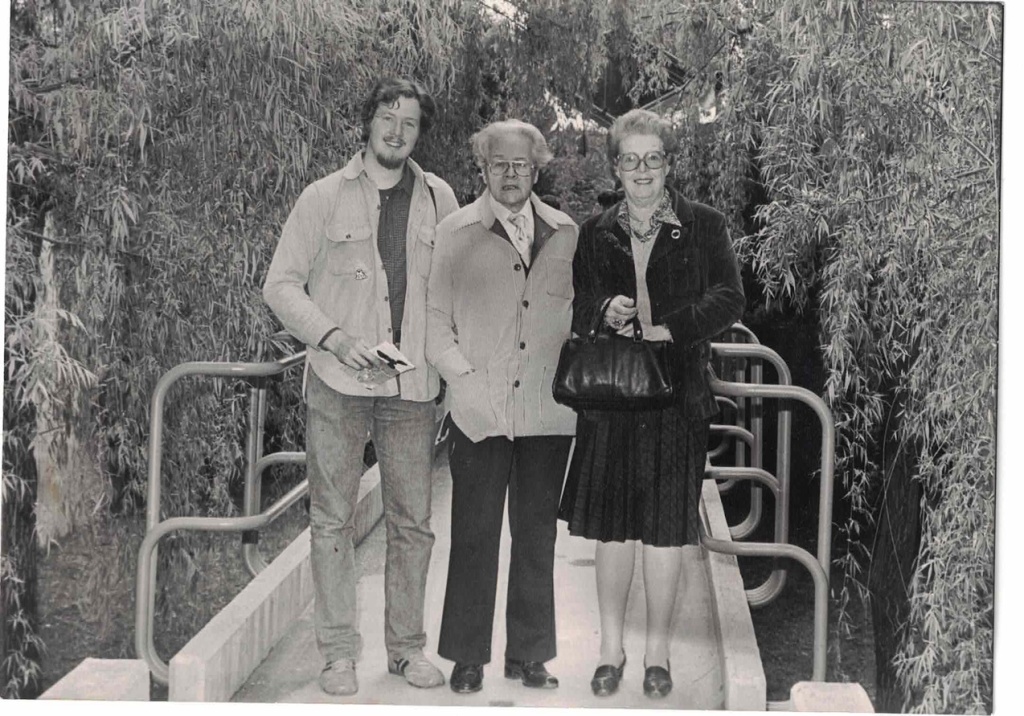
Richard K Munro, Thomas Munro and Ruth Munro in Spain circa 1980
If I had a freeway billboard I would post this famous quotation by EPICTETUS. For many years I had this quote reproduced in many languages including Spanish, Arabic and Chinese (made for me by students).
“We must not believe the many, who say that only free people ought to be educated, but we should rather believe the philosophers who say that only the educated are free.”
“Quando me’n vo’“, also known as “Musetta’s Waltz“, is a famous soprano aria a waltz in Act II of Puccini’s 1896 opera LA BOHEME. VICTORIA DE LOS ANGELES MADE A FAMOUS RECORDING circa 1959 (see below) Maria Callas made a famous recording circa 1958 (See below). There are also beautiful arrangements and instrumental versions.
It is sung by Musetta, in the presence of her friends, hoping to reclaim the attention of her occasional boyfriend Marcello.
This scene takes place at the Cafe MOMUS. Shortly after Mimì, Rodolfo, and their friends have taken seats for a drink. Mussetta grabs the spotlight, musically speaking, for a short self-promoting aria (Quando me’n vo’). It is a song directed at the people in the café as much as at the audience in the theater. Here we have the limits of art. Whatever Mussettals character her goddesslike beauty and charm overwhelm us.
Libretto
Quando me’n vo’ Quando me’n vo’ soletta per la via, la gente sosta e mira e la bellezza mia tutta ricerca in me da capo a piè …
Ed assaporo allor la bramosia sottil, che da gli occhi traspira e dai palesi vezzi intender sa alle occulte beltà. Così l’effluvio del desìo tutta m’aggira, felice mi fa!
E tu che sai, che memori e ti struggi da me tanto rifuggi? So ben: Le angoscie tue non le vuoi dir, ma ti senti morir!
When I walk When I walk all alone in the street, people stop and stare at me and look for my whole beauty from head to feet …
And then I taste the slight yearning which transpires from their eyes and which is able to perceive from manifest charms to most hidden beauties. So the scent of desire is all around me, it makes me happy!
And you, while knowing, reminding and longing, you shrink from me? I know it very well: you don’t want to express your anguish, but you feel as if you’re dying!
A. Filipello: Quattro cavai che trottano – Schweizer Jugendchor 2015
Lovely Swiss-Italian song. My father would call this an Italian Lollipop. I first heard this sung my KENNETH MCKELLAR about 1970. McKellar made many recordings of Italian songs as well as operatic arias though he was best known for songs of Burns, Scottish songs and Irish songs. He made a wonderful recording of the MESSIAH (see below)
Damasked means DEEP PINK interesting contrast of PERFUME with REEKS. Once again a good way to study word contrasts is by synonyms.
Pejorative (negative)
Neutral
Positive
reek
odor
Fragrance
stink
Aroma
scent
stench
aroma
Smell
IT is interesting that Shakespeare uses PERFUME and REEK as contrasts.
I suppose the lady’s breath smells of garlic or beer. This usage certainly seems humorous today though it may not have been as pejorative in Shakespeare’s time. Of course in Scots English it merely means “smoke”“ ”as the soldier turned to peer through the reek” Before Edinburgh was being lauded as the ‘Athens of the North,’ it was given the nickname The Auld Reekie, which means Old Smokey
SONNET 130
My mistress’ eyes are nothing like the sun;
Coral is far more red than her lips’ red;
If snow be white, why then her breasts are dun;
If hairs be wires, black wires grow on her head.
I have seen roses damasked, red and white,
But no such roses see I in her cheeks;
And in some perfumes is there more delight
Than in the breath that from my mistress reeks.
I love to hear her speak, yet well I know
That music hath a far more pleasing sound;
I grant I never saw a goddess go;
My mistress, when she walks, treads on the ground.
Very interesting essay on CHIDE SEE ANTHOLY LIEBERMAN which is a word of unknown origin though it seems to be of Germanic or Anglo-Saxon origin. The words are synymns but they have different nuances.
Anglo-Saxon Or Germanic Or Other (unknown)
Latin (French or Romance)
Greek
CHIDESYNONYM
Reprimand STRONGESTSYNONYM
criticizeSYNONYM
1)to criticize mildly for a fault or an offense; To correct (mildly)
1)to write an official report; make an official documented censure
1) to find fault with
2)”to knock”; to “rap” “to slap on the wrist”(minor punishment)
2) to rebuke (to criticize sharply; originally to strike with busche firewood)
2)
3)to scold
3) admonish
3)
ANTONYMTo praiseTo speak well of
ANTONYM To commend To laud
ANTONYM
With a smile and with encouragement he chided the boy for his sloppy writing.
The Major reprimanded the corporal for not following orders.
The old world BODY has many uses and meanings and is clearly the oldest word. Body snatcher is a funny term. I remember a character in Dickens who was a body snatcher called himself a “resurrectionist!”. Then there are many Latin/Romance synonyms related to the latin word “CORPUS” (body). Many of these are medical, legal or military. The Greek works are technical and academic most people will not readily know these word unless they are in the medical field.
Anglo-Saxon Or Germanic Or Other (unknown)
Latin (French or Romance)
Greek
BODY SYNONYM
Corporeal (bodily) SYNONYM
somaticSYNONYM
1) physical part of a person
1)corpse (dead body)or cadaver; carcass: dead body of an animal
1)relating to the body
2)group of individuals(organization)
2) corpus delicti (body of a crime) 3) Corps Diplomatic Corps Medical Corps Marine Corps (silent s from French) 4) corporal punishment 5) corporal (rank in army)
Many scientific and medical terms: Somatotherapy Somatotype Somotology=study of the body Anatomy=study of body structure.
3)main part of a book or essay
Corporation (legal person)
ANTONYMSpirit/soul
ANTONYMMental/not physical
ANTONYM
1)Body of water(mass of water)masa de agua 2)He earns enough money to keep body and soul together. Gana lo justo para vivir 3)Body snatcher (ladrón de cadavers)
Essay #3 Of course, most our words having to do with education or schools are Latin or Greek in origin but there are curiosities. A “Lore” house was originally a gloss on the Latin word school in other words a place where traditions were taught. And a “School of fish” is not, of course, a school at all but a shoal or group of fish. I would think the expression “shoal of fish” is the original expression.
Anglo-Saxon Or Germanic Or Other (unknown)
Latin (French or Romance)
Greek
School“lore”* house (originally Lat/Gr) (Grammar school/primary school) Or elementary school –k-6)SYNONYM
CollegeSYNONYM
#1Academy*SYNONYM
k-12 education Elementary school middle school High School escuela
1)undergraduate division of a university Universidad/colegio universitario
1)a school for special instruction such as the military academies. academia
2)all colleges and universities in general
2) in France or Spain an secondary school NOT supported by the state. Public schools are called lycée “ lyceum” could be a place where public lectures are presented
2) secondary school esp. a private one
3)SCHOOL OF ATHENS a group of people, esp. writers,philosophers,artists Whose thought,work or style demonstrates a common origin,belief or influence.
politics/religion;
Electoral College /College of Cardinals
3) can mean university life or higher education in general “academe”*
***4) a shoal or large group of aquatic animals swimming together : *“a school of fish”GRUPO/BANCO
The Lyceum of Aristotle
Plato’s Academy
There are several schools of thought on this issue Sobre este tema hay varias Corrientes de opinión
97% of English words come from three language sources.
Essay #2
Normally, Latin and French words are more educated or cultured than Anglo-Saxon words. However, sometimes the old English word has become archaic or literary itself as in the example of FOE or FOEMAN. Today ENEMY or ADVERSARY are probably more common words. NEMESIS or ANTAGONIST are definitely literary or academic words.
They are organized by SYNONYMS
40%ANGLO- SAXON (or Germanic) Basic English. Includes Norse and some native Celtic words.
30% LATIN Includes French and Romance languages ACADEMIC WORDS
30% GREEK Or Hellenic words. ACADEMIC WORDS
1) Foe*; foeman Expression: “Friend or foe?” “Who goes there?”
97% of English words come from three language sources GERMANIC (or “Anglo-Saxon”) , LATIN or GREEK.
For example, the beautiful word WILDERNESS is not a Greek or Latin word but from the old mother tongue ANGLO-SAXON. Wild+ Dior (animal) from which comes the word DEER a particular animal but originally all animals hence (cf Dear Mouse) . -Ness is an Anglo-Saxon suffice meaning state of being so WILDERNESS is literally a “wild animal place”! DESERT is a near synonym from Latin meaning a wasteland, wilderness, infertile area (wooded or not). Gradually it came to mean a “waterless, treeless area.” Of course, some people think the forest or rainforest is not a wilderness but a PARADISE (to use a Greek word going back to Xenophon and the Bible ). Here is a quote by Thoreau who uses Sahara as a synonym for wilderness or desert and then compares it to paradise :
Every important worker will report what life there is in him. It makes no odds into what seeming deserts the poet is born. Though all his neighbors pronounce it a Sahara, it will be a paradise to him; for the desert which we see is the result of the barrenness of our experience. [Thoreau, Journal, May 6, 1854]
COMMON ORIGINS OF ENGLISH:
40% ANGLO- SAXON
(or Germanic) Basic English. Includes Norse and some native Celtic words.
30% LATIN
Includes French and Romance languages Legal or ACADEMIC WORDS
30% GREEK
Or Hellenic words. ACADEMIC WORDS
1)Funny 2) fun (n.) 3) funnyman (person); joker, wag, wit
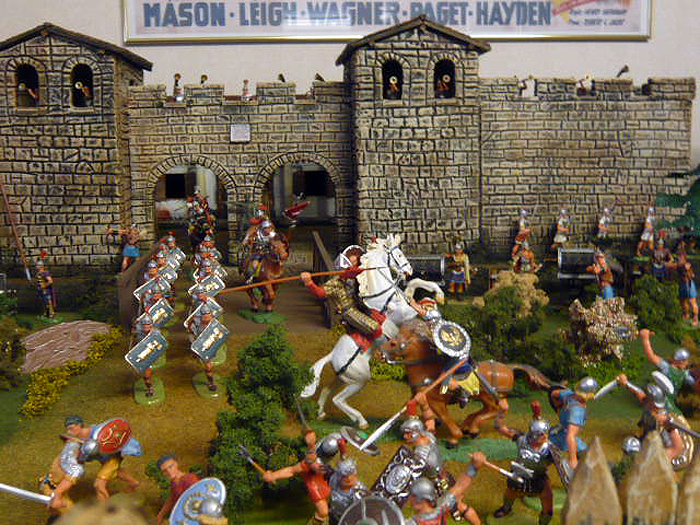
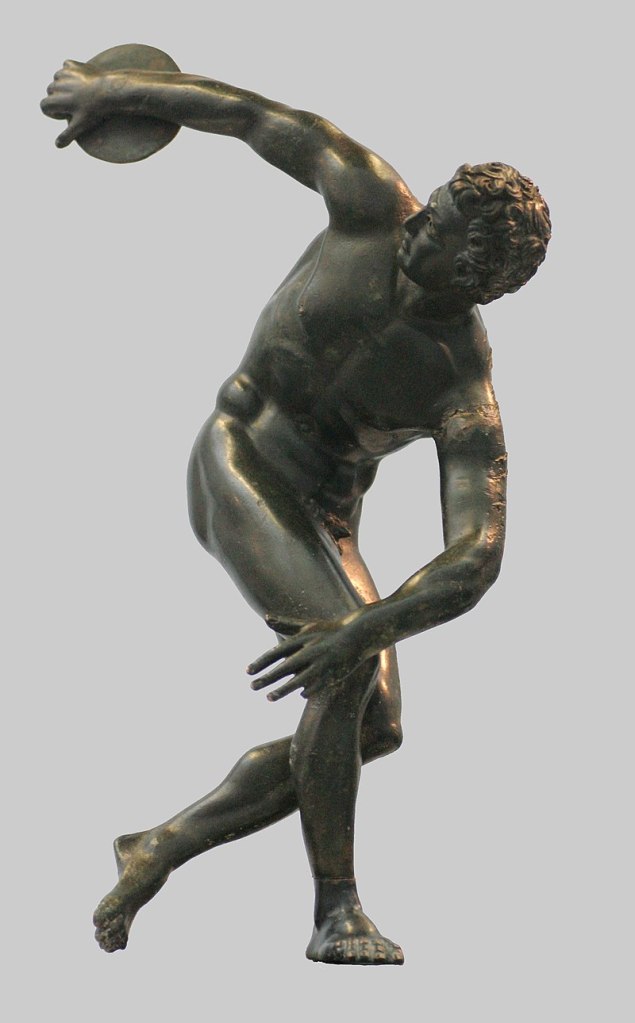
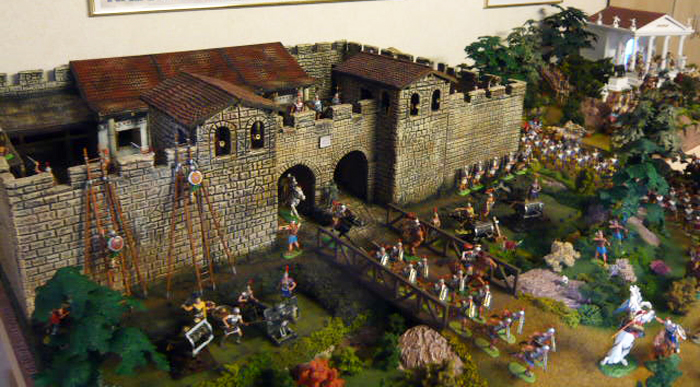
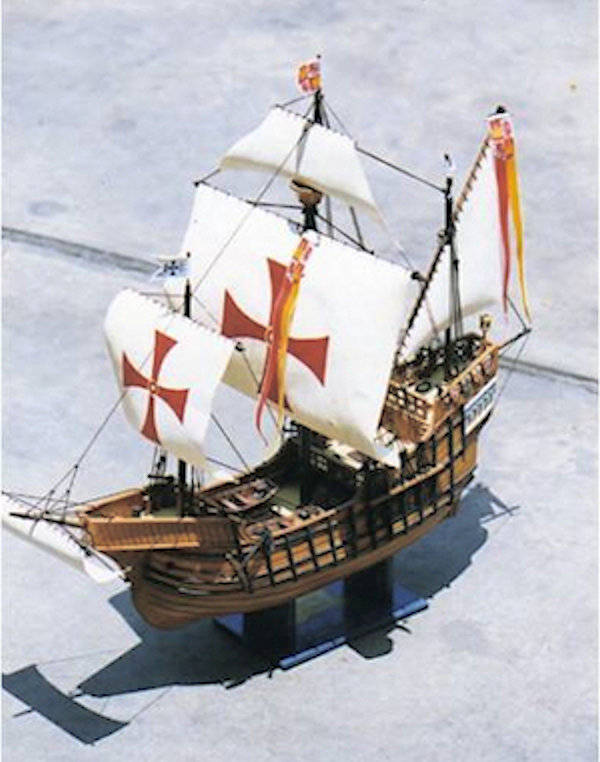
Elastolin dioramaThe Discus ThrowerSanta Maria model circa 1992 made by RUTH, IAN and RICHARD MUNRO at CHRISTMAS
The perfect Book Nook or private library has at least one plush leather chair preferably with a rocker and nice padded as I have in the corner. It is an old friend I have owned it for over 30 years and my father enjoyed using it. I always let my father have my best chair and I would sit in my mother’s chair, my second-best chair. It is a carpeted room. My chair has its own special lamp. I have a ceiling fan for the summer plus some built-in lights. My room has a table for study plus two desks and many bookshelves, some decorated with fossils, busts, baseball memorabilia, and toy soldiers. I have an electric pencil sharpener I use almost daily. I have over 60 composition notebooks filled with language notes and about 20 blank ones for future use. I have windows that look out towards the garden and in the summer, I see many birds and squirrels dancing about. We live in a very quiet neighborhood next to a nice park with trees, a pond, and paths to walk. To the left of my desk, I have a French door that opens to the covered patio which has chairs and a table on which I study on find days in the spring, fall, and early winter. It has a screen door from which I can hear music in my rooms. I have no TV in my book nook but I have a radio on my BOSE CD player and many CD’s chiefly classical. And of course, I sometimes watch YouTube videos on my laptop (but not often). My music is chiefly from SPOTIFY, but also via my phone and BOSE Microlink (Itunes) . In the Spring summer and Fall, I often listen to baseball games on the porch or in the library while reading or doing language studies. I used to listen to the radio a lot but now mostly listen to Audible books or podcasts.
There is plenty of storage for paper. I have a printer connected to the laptop. In my library I have about ten reems on the shelves and two in a drawer under the printer. I have a larger supply in reserve in the garage. I have three chairs besides the leather chair. Next to the leather chair, I have a side table that belonged to my father with a drawer. Another chair belonged to my mother and is about 65 years old. I have boxes for index cards and coffee mugs filled with #2 pencils, colored pencils Bausch and Lomb magnifying glasses. In a wooden box, I have a chrome Cross Pen that belonged to my father. The box has a spare cartridge I use the pen to sign personal letters or important documents. I have a phone next to my laptop and a brass hand winding, Tiffany clock, hydrometer, barometer, and thermometer. It is my backup case of a blackout, and it serves as a paperweight. I have two staplers on my desk It was a retirement gift to my father in 1976. Next to the phone is a reproduction of Myron’s Discobolus or “discus thrower”, Greek: Δισκοβόλος, Diskobólos). I picked this up at the Vatican circa 1972; they have a wonderful full-sized marble Roman copy found, I believe, at Hadrian’s Villa. The Greek original in bronze is lost but we know the work from numerous Roman copies. Munich there is a fine Roman bronze reproduction of Myron’s Discobolus, 2nd century AD. I have several busts of famous historical figures some American but mostly Greek, Roman, classical composers or literary figures.
I have a tall glass display case filled with a model of the SANTA MARIA, that my mother, my son and I put together one Christmas before her death (1992 I believe). My mother did the rigging. There are also “ruins” and dioramas of charging Elastolin Roman soldiers on food and horses, Huns, Goths, and Normans (the “Barbarians”. They date back to 1963-1971. There are a few I/R figures and French Starluxe mixed in. There are two chariots and some Roman siege weapons. On the mantle of my fireplace, I have cards, models, and toy soldiers. I have a Lewis and Clark Diorama I bought at a museum in Iowa in 2004 (it includes Sacagawea and York). I have followed almost the entire trail of Lewis and Clark starting in 1982 and finishing in 2004. On the walls I have art reproductions and historical photographs I have collected over the past 60 years such as Churchill holding a tommy gun I have for example a full-size museum replica of ATHENA MOURNING. At my main desk, I have books of quotations, reference books, and dictionaries. I use the Internet and electronic dictionaries but find book versions easier to study and for annotations. I have a variety of English dictionaries. The one I use the most is the 4edtion American Heritage. One of my favorites is the Oxford Companion to English Literature – a nice leather-bound edition. It is the 5th edition edited by Margaret Drabble which is the last edition to have complete commentaries on Walter Scott and other classic authors. I have an extensive library of English language books chiefly classics, biographies, and histories but also baseball books and large-sized art reproduction books. I also have a modest library of Latin books (many bilingual), Greek books including the Bible (I am studying Greek presently, Gaelic books (chiefly song books and poetry but some history and nonfiction), many (hundreds) of Spanish books, some Portuguese books, some French books, some German books. I have a German-Spanish dictionary for example and a Latin-Spanish dictionary. One of my favorite reference books is MAMMALS of the WORLD (1964) which is very useful for ascertaining the indigenous names of mammals in many languages and of course which has curious animal facts and thousands of black-and-white photographs.
I can’t say I have been EXTREMELY productive as a writer in my life but I have read and studied much and been able to teach many. Review reading via rote rehearsal is effective but it is always better to note take and create study cards from notes and use colors and pictures whenever possible. ’
I know Spanish very well, for example, and often speak it but I read and review Spanish at least 20-30 minutes a day (I don’t usually take any notes). For new languages such as Italian or Greek, I take notes sentences dialogues, and translations and write new vocabulary, I draw colored pictures and copy words that give me difficulty three times over and highlight them with yellow. I probably practice 5-7 languages a day. I read Portuguese very well but found I speak it less well since I have not used it daily for more than 40 years. But I practice listening and speaking via Duolingo and so have regained most of my former fluency. I never lost my ability to read but found my writing had declined due to lack of practice and when speaking I tended to fall into Spanish. My book nook is my quiet refuge from the world.



 Spirit of Cecilia
You must be logged in to post a comment.