
I first met Dave Brubeck when I was in my twenties, and writing my book on West Coast jazz. Dave deeply impressed me, and not just as a musician. How many celebrities have a marriage that lasts 70 years? I think Dave is the only one. He was a very caring family man, a good dad and husband – never a given in the entertainment industry. He was a pioneer on civil rights, threatening to cancel concerts when faced with complaints about his integrated band. He served his country as a soldier (at the Battle of the Bulge) and as both an official and unofficial ambassador. When Reagan met Gorbachev, Dave Brubeck was there, bringing people together with his music. I’ve talked to many of his friends over the years, and they tell stories of his kindness and loyalty. You could a learn a lot from Dave Brubeck just by watching how he conducted himself offstage. And then there is the public side of his music career, with all those concerts and recordings that reached tens of millions of people. I was privileged to know him, but many who simply experienced his artistry through his music will also miss him and grieve at his passing. God bless you, Dave!
— Read on blog.oup.com/
All posts by bradbirzer
Nietzsche and the Short Nineteenth Century ~ The Imaginative Conservative
The great ideas of the nineteenth century changed as well. One might even state without too much hyperbole, the great ideas not only changed, but they devolved. More than anything else, the greats of the western tradition of the nineteenth century narrowed the thoughts of those who had come before them. Whereas Jefferson, Edmund Burke, and Adam Smith—the great greats of the eighteenth century—began with the beginning, the nature of nature, the nature of natural law, and the nature of rights, the greats of the nineteenth century narrowed, narrowed, narrowed, and then exploded one truth to insanity, allowing it to overpower all other truths. With Karl Marx, everything was economic. With Charles Darwin, everything was biological. With Sigmund Freud, everything was psychological. True enough, the human being is, of course, economic, biological, and psychological. Yet, the human person is so much more than this, almost infinitely complex and various. Jefferson, Burke, and Smith not only fought systematic thoughts, men of system, and what would be called ideologies, but they also each contented themselves with the beginnings of the human person, not the ends of the human person. In other words, in contrast to their nineteenth-century inheritors, these eighteenth-century thinkers found the minimum equality necessary for a dignified life, allowing the individual person and community to make its own way through trial and error, success and failure, charity and failing.
Because the greats of the nineteenth century—each to his own varying degree—accepted one truth at the expense of all others and relied, entirely, on materialist explanations of the world, they fundamentally failed to understand the nature of the human person, the nature of existence, and the nature of history. This is not to deny their individual and particular brilliances, but rather only to note that by ignoring the spiritual element of humanity, they offer nothing that can be seen as successful in the long run of society. From Heraclitus forward, the greats of the western tradition have sought to understand both the material and spiritual elements of existence, recognizing the overwhelming complexities not only of life, but also of each individual life.
As such, history will, most likely, understand the nineteenth century as a failure in human thought, but it will also recognize that even the failures had successes, especially rather grand if temporary ones. To be sure, it would be nearly impossible (and utterly foolish) to dismiss the influence that Marx, Darwin, and Freud had on those who came after them.
— Read on theimaginativeconservative.org/2019/03/nietzsche-short-nineteenth-century-bradley-birzer.html
The web at 30: Apple’s place in history | Jason Snell
It seems so pedestrian today, but in 1993 the web browser was a revelation. The internet back then, for the few of us who were on it, was basically a wash of text. Services like Gopher let you move around the internet with hyperlinks, but it was basically plain text and arrow keys and long menus of options.
Then all of a sudden, I’m sitting on my couch in an apartment at UC Berkeley and there are pictures coming up on the screen of my PowerBook 160. (They were in grayscale because the PowerBook’s screen didn’t support color, but still—they were pictures.) There were underlined hyperlinks you could click on to go to other pages. It was, even by the standards of a couple years later, unbelievably primitive—but also fundamentally recognizable as the web. The internet was never, ever the same.
— Read on www.macworld.com/article/3365316/the-web-at-30-apples-place-in-history.html
My favorite tech writer, Jason Snell, reflects on three decades of the internet.
Behold the Demon: Nietzsche as Destroyer ~ The Imaginative Conservative
In his mockingly titled autobiography and final published work, Ecce Homo (1886), Friedrich Nietzsche presented himself as the prophet of modernity. His father a Lutheran pastor, Nietzsche rejected all that he had inherited in terms of faith at age twelve and dedicated himself to destroying the morality and ethics of Judaism and Christianity. As any Catholic knows, especially during the Lenten season, “Ecce homo” comes from Pontius Pilate’s presentation of a brutalized, bloody, and tortured Jesus to the bloodthirsty crowds of Jerusalem. “Behold the man,” Pilate stated.
No one should underestimate Nietzsche’s own vision of himself with the title. Intellectually brutalized, bloodied, and tortured, the nineteenth-century philosopher presented himself—in his final and last words to a world he wanted to overthrow. Behold the man. To be more accurate, behold the demon. To be sure, the man could write, the man could think, and the man could tell a great story. But, he was also descending into madness, and it is difficult—even for those who love Nietzsche—to know if one should take him seriously or not in the autobiography. His hubris is so over the top at times, that even his greatest supporters cringe when trying to give this book context.
— Read on theimaginativeconservative.org/2019/03/behold-demon-friedrich-nietzsche-destroyer-bradley-birzer.html
Establishment hates Tucker Carlson, loves Max Boot
The outrage is always fake, always selectively applied, and always intended to destroy. It is never sincere. Apologizing only makes it worse, which is why it was heartening to hear Carlson insist he would never “express the usual ritual contrition” (an excellent choice of words).
— Read on mailchi.mp/tomwoods/tucker-carlson
I’m not a Carlson fan. Indeed, I think he comes across as an ass, but Tom is dead right about the sudden outrage.
Our love affair with ebooks is over
There are a few reasons why ebook sales have been declining over the past four years. They doubled in price, when publishers gained control over pricing, instead of Amazon or Kobo charging their own. You cannot loan an ebook to a friend and cannot resell an ebook, once you have finished it. Lots of people have embraced Overdrive, and are borrowing ebooks from the public library. In 2018 65 different library systems each loaned out more than one million ebooks in the space of a year; one system, Harris County Public Library in Texas, loaned out more than two million ebooks.
— Read on goodereader.com/blog/e-book-news/our-love-affair-with-ebooks-is-over
Dozens indicted in alleged massive case of admissions fraud
Dozens of people — including college coaches and Hollywood actresses — indicted.
— Read on www.insidehighered.com/admissions/article/2019/03/12/dozens-indicted-alleged-massive-case-admissions-fraud
Standardized testing is nothing but conformist tripe. Always has been, always will be.
Why True Conservatism Means Anarchy | The American Conservative
First, let’s reflect on the nature of conservatism. Its master theoretician remains Russell Kirk, the founder of post-war American conservatism. I am fond of this Kirk quote: “The attitude we call conservatism is sustained by a body of sentiments, rather than by a system of ideological dogmata. It is almost true that a conservative may be defined as a person who thinks himself such. The conservative movement or body of opinion can accommodate a considerable diversity of views on a good many subjects, there being no Test Act or Thirty-Nine Articles of the conservative creed.”
Thus conservatism is really a habit of mind or orientation of sentiment. It is a way of thinking about man, society, and the relationship between the two. It has much more to say about how we treat these topics than what we say about them. It would be wrong to conclude that any position can be conservative so long as it is theorized in the “right” way. But it nonetheless remains true that conservatism is primarily a modifier, an adjective. This is why the phrase “conservative liberal” need not be a contradiction in terms. In fact, many of the greatest thinkers in the conservative tradition—Acton, Tocqueville, even Burke himself—are best classified under this label.
— Read on www.theamericanconservative.com/articles/why-true-conservatism-means-anarchy/
Conflicted But Redeemed: James Como’s Life of C.S Lewis ~ The Imaginative Conservative
Lewis was, as Dr. Como so correctly notes, always his own man, and his own forceful actions toward colleagues, friends, family, and students—tended to attract or repulse those around him, with little middle ground for neutrals. Those who loved him, loved him dearly. Those who despised, despised him just as dearly. Dr. Como brilliant explains Lewis’s playful and deep love of myth, his extraordinary charity (quite similar to that of Russell Kirk), his normalization of the genre of science fiction, his rather complex and sometimes downright bizarre relations with women, and his vast reading of every possible book. The latter, especially, matters to Lewis’s own writings, as many of his articles and books are really gothic autobiographical reflections of his readings (again, quite similar to that of Russell Kirk).
— Read on theimaginativeconservative.org/2019/03/james-como-introduction-cs-lewis-bradley-birzer.html
Mister miracle (image)
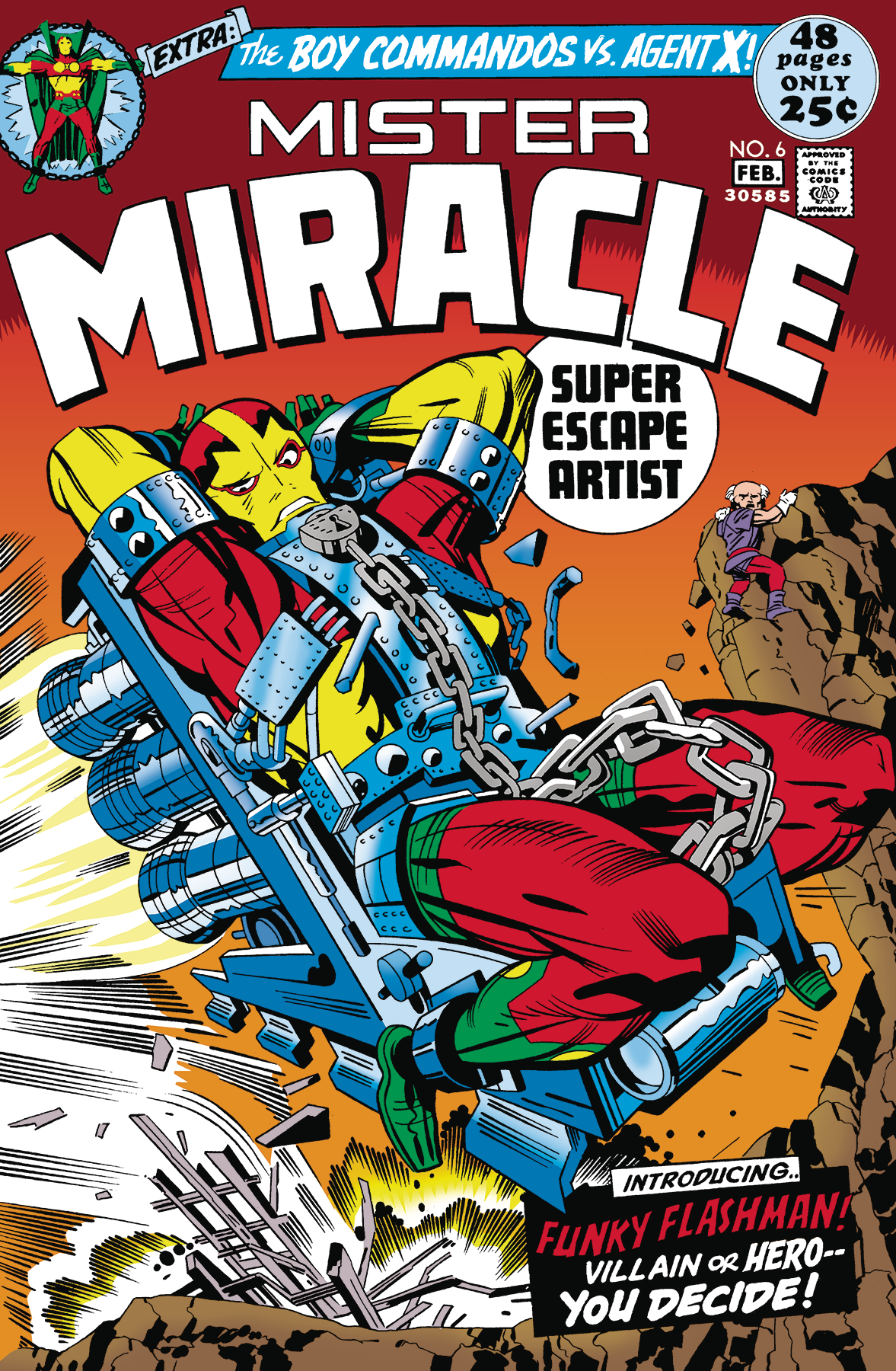
To the myth: man escapes the devil, does good, and gets the girl. God bless you, Jack Kirby.


You must be logged in to post a comment.