Category Archives: Faith

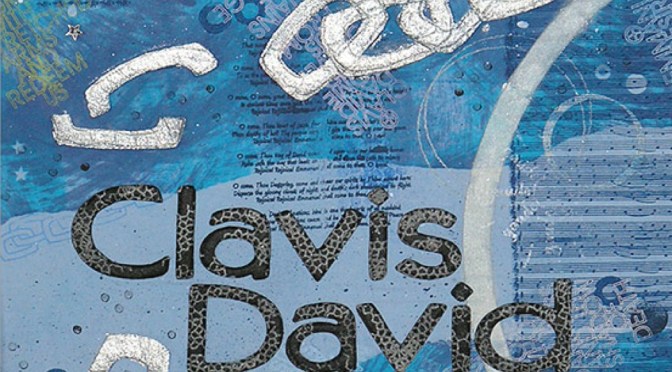
The O Antiphons: O Key of David

The O Antiphon for Magnificat at Vespers on December 20:

O Key of David and scepter of the house of Israel, you open and no one can close, you close and no one can open: come and rescue the prisoners who are in darkness and the shadow of death.

For their 2016 debut recording Drop Down, Ye Heavens, the London-based student-formed choir Siglo de Oro commissioned a new set of O Antiphons from various British composers, sung in English and set for choir and saxophone.  Here is Francis Pott’s rich setting of “O Key of David”:

O come, Thou Key of David, come,
And open wide our heav’nly home;
Make safe the way that leads on high,
And close the path to misery.

Rejoice! Rejoice! Emmanuel
Shall come to thee, O Israel!

— Rick Krueger

(Image: O Clavis David by Linda Henke, Te Deum Designs.)

The O Antiphons: O Root of Jesse

The O Antiphon for the Magnificat at Vespers on December 19:

O Root of Jesse, standing as an ensign before the peoples, before whom all kings are mute, to whom the nations will do homage: come quickly to deliver us.

Healey Willan (1880-1968), professor at the Royal Conservatory of Music in Toronto and organist at St. Mary Magdalene Church in the same city, composed a setting of The Great O Antiphons of Advent for the Lutheran Church-Missouri Synod’s Concordia Publishing House in 1957.  Here’s Willan’s setting of “O Root of Jesse,” as sung by the choir of Christ Church Cathedral in Vancouver, British Columbia:

O come, Thou Branch of Jesse’s tree,
Free them from Satan’s tyranny
That trust Thy mighty pow’r to save,
And give them vict’ry o’er the grave.

Rejoice! Rejoice! Emmanuel
Shall come to thee, O Israel!

— Rick Krueger

(Image: O Radix Jesse by Linda Witte Henke, Te Deum Designs.)

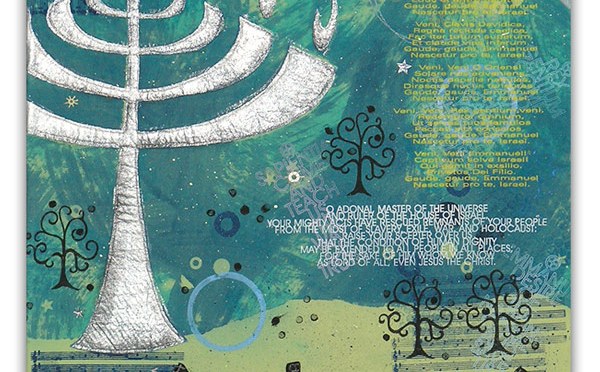
The O Antiphons: O Adonai

The O Antiphon for the Magnificat at Vespers on December 18:

O Adonai and ruler of the house of Israel, who appeared to Moses in the burning bush and gave him the Law on Sinai: come with an outstretched arm and redeem us.

Healey Willan (1880-1968), professor at the Royal Conservatory of Music in Toronto and organist at St. Mary Magdalene Church in the same city, composed a setting of The Great O Antiphons of Advent for the Lutheran Church-Missouri Synod’s Concordia Publishing House in 1957.  Here’s Willan’s setting of “O Adonai,” as sung by the choir of Christ Church Cathedral in Vancouver, British Columbia:

O come, O come, Thou Lord of might,
Who to Thy tribes on Sinai’s height
In ancient times didst give the Law
In cloud and majesty and awe.

Rejoice! Rejoice! Emmanuel
Shall come to thee, O Israel!

-Rick Krueger

(Image: O Adonai by Linda Witte Henke, Te Deum Designs.)


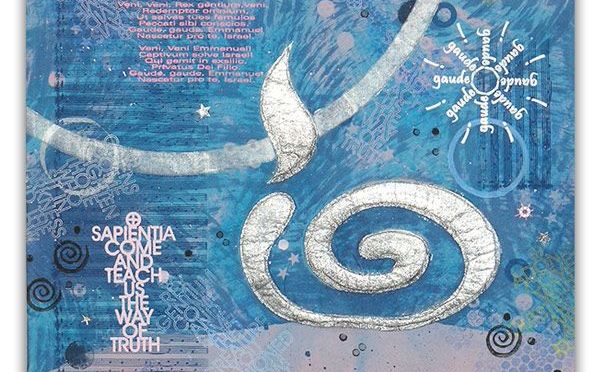
The O Antiphons: O Wisdom

From Kevin Hildebrand, kantor at Concordia Theological Seminary in Fort Wayne, Indiana:

An antiphon is a term we see in worship regularly. An antiphon is a refrain that is sung before (and sometimes after and during) a Psalm or other song, and it’s typically is a Bible verse or a historic liturgical text.

The origin of the O Antiphons is around the eighth century. In larger cities and monasteries, it was customary to have services daily (or several times a day), and in the seven days before Christmas Eve, it became a regular practice to sing the assigned O Antiphon before and after the Magnificat ( “My soul magnifies the Lord.”) at the evening Vespers service.

In the twelfth or thirteenth century, these antiphons were paraphrased into metrical, poetic verses which became the hymn, “O Come, O Come, Emmanuel.”

The initial O Antiphon, for Vespers on December 17:

O Wisdom, proceeding from the mouth of the Most High, pervading and permeating all creation, mightily ordering all things: come and teach us the way of prudence.

For their 2016 debut recording Drop Down, Ye Heavens, the London-based student-formed choir Siglo de Oro commissioned a new set of O Antiphons from various British composers, sung in English and set for choir and saxophone.  Here is Will Todd’s thrilling setting of “O Wisdom”:

O come, Thou Wisdom from on high,
Who ord’rest all things mightily;
To us the path of knowledge show,
And teach us in her ways to go.

Rejoice! Rejoice! Emmanuel
Shall come to thee, O Israel!

— Rick Krueger

(Image: O Sapentia by Linda Witte Henke, Te Deum Designs)


Ad Fontes #3

From Lutheran Service Book’s Daily Lectionary for December 8:

For you [,O Lord,] have been a stronghold to the poor,

a stronghold to the needy in his distress,

a shelter from the storm and a shade from the heat. (Isaiah 25:4 ESV)

Which, as sung and reshaped in the African-American tradition of Christian spirituals, became:

And, as repurposed by Bob Dylan, also became:

— Rick Krueger

New book clarifies beliefs and corrects misunderstandings about the papacy – Catholic World Report

New book clarifies beliefs and corrects misunderstandings about the papacy – Catholic World Report
— Read on www.catholicworldreport.com/2018/12/04/new-book-clarifies-beliefs-and-corrects-misunderstandings-about-the-papacy/

On St. Ambrose Day

From the Lutheran Church-Missouri Synod’s calendar of commemorations:

Ambrose of Milan, Pastor and Hymnwriter

Born in Trier in A.D. 340, Ambrose was one of the four great Latin Doctors of the Church (with Augustine, Jerome, and Gregory the Great). He was a prolific author of hymns, the most common of which is Veni, Redemptor gentium (“Savior of the Nations, Come”). His name is also associated with Ambrosian Chant, the style of chanting the ancient liturgy that took hold in the province of Milan. While serving as a civil governor, Ambrose sought to bring peace among Christians in Milan who were divided into quarreling factions. When a new bishop was to be elected in 374, Ambrose addressed the crowd, and someone cried out, “Ambrose, bishop!” The entire gathering gave their support. This acclaim of Ambrose, a 34-year-old catechumen, led to his baptism on December 7, after which he was consecrated bishop of Milan. A strong defender of the faith, Ambrose convinced the Roman emperor Gratian in 379 to forbid the Arian heresy in the West. At Ambrose’s urging, Gratian’s successor, Theodosius, also publicly opposed Arianism. Ambrose died on Good Friday, April 4, 397. As a courageous doctor and musician he upheld the truth of God’s Word.

The Collect of the Day:

O God, You gave Your servant Ambrose grace to proclaim the Gospel with eloquence and power.  As bishop of the great congregation of Milan, he fearlessly bore reproach for the honor of Your name.  Mercifully grant to all bishops and pastors such excellence in preaching and fidelity in ministering Your Word that Your people shall be partakers of the divine nature; through Jesus Christ, Your Son, our Lord, who lives and reigns with You and the Holy Spirit, one God, now and forever.  Amen.

And for an evening meditation to cap this very musical week of commemorations, St. Ambrose’s hymn O lux beata Trinitas (“O Trinity, Most Blessed Light,”) as set to the 16th-century German tune “O heilige Dreifaltigkeit” and translated into English by John Mason Neale:

— Rick Krueger

Pink Floyd, The Preacher

Dark Side of Moon

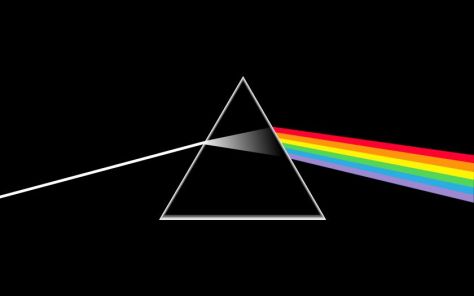
Greg West, at The Poached Egg, has a fascinating account of how a song from Pink Floyd’s classic Dark Side of the Moon album started him on a search for meaning that ultimately led to faith. Read the whole thing – it’s a nice example of how you can find evidence of God at work in the unlikeliest of places.

The Embodied Person as Gift ~ The Imaginative Conservative

First principle. The soul is “the principle of unity of the human being, whereby it exists as a whole—corpore et anima unus—as a person” (Veritatis splendor, 48). “It is in the unity of body and soul that the person is the subject of his… acts” (VS, 48). “The human person cannot be reduced to a freedom which is self-designing, but entails a particular spiritual and bodily structure” (VS, 48).

These statements, first of all, affirm the unity of the human being as a dual, or differentiated, unity of body and soul.
— Read on theimaginativeconservative.org/2018/12/embodied-person-gift-david-schindler.html

On St. Nicholas Day

From the Lutheran Church-Missouri Synod’s calendar of commemorations for December 6:

Of the many saints commemorated by the Christian Church, Nicholas (d. A.D. 342) is one of the best known. Very little is known historically of him, although there was a church of Saint Nicholas in Constantinople as early as the sixth century. Research has affirmed that there was a bishop by the name of Nicholas in the city of Myra in Lycia (part of Turkey today) in the fourth century. From that coastal location, legends about Nicholas have traveled throughout time and space. He is associated with charitable giving in many countries around the world and is portrayed as the rescuer of sailors, the protector of children, and the friend of people in distress or need. In commemoration of “Sinte Klaas” (Dutch for Saint Nicholas, in English “Santa Claus”), December 6 is a day for giving and receiving gifts in many parts of Europe.

Benjamin Britten’s cantata Saint Nicolas was written for the 1948 centenary of Lancing College in Sussex (an independent secondary boarding school on the south coast of England).  As Paul Spicer writes,

The cantata portrays the life of the fourth-century Bishop of Myra in a work of great poetry and sensitivity. It was conceived and composed with semi-amateur performance in mind and the technical demands of the choral and orchestral writing are appropriately straightforward. The audience also gets to join in two well-known hymns, “All people that on earth do dwell” and “God moves in a mysterious way.”

For Saint Nicholas’ day, enjoy this performance of the cantata by tenor Robert Tear, the Choir of Kings’ College Cambridge and the Academy of St. Martin in the Fields, all conducted by Sir David Willcocks:

You can find Eric Crozier’s complete libretto and further program notes for Saint Nicolas here.  An excerpt of the 6th movement,  “Nicolas from Prison”:

O man! The world is set for you as for a king!
Paradise is yours in loveliness.
The stars shine down for you, for you the angels sing,
Yet you prefer your wilderness.
You hug the rack of self,
Embrace the lash of sin,
Pour your treasures out to bribe distress.
You build your temples fair without and foul within:
You cultivate your wilderness.
Yet Christ is yours. Yours!
For you He lived and died.
God in mercy gave His son to bless you all,
To bring you life,
And Him you crucified
To desecrate your wilderness.
Turn away from sin! Ah!
Bow down your hard and stubborn hearts!
Confess, yourselves to Him in penitence
And humbly vow your lives to Him, to holiness.


— RIck Krueger