
It’s the end of the year, and 2018 is coming to a close. Over the course of the last several months, we’ve highlighted several useful Mac and…
— Read on www.macrumors.com/2018/12/21/best-mac-ios-apps-2018/amp/
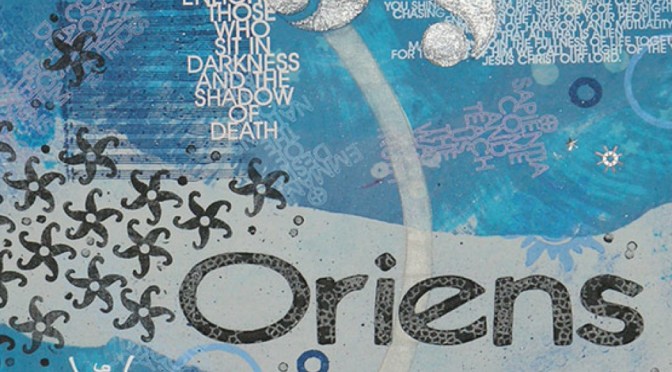
The O Antiphons: O Dayspring
The O Antiphon for the Magnificat at Vespers on December 21:
O Dayspring, splendor of light everlasting: come and enlighten those who sit in darkness and in the shadow of death.
One of the earliest sightings of the O Antiphons in English literature is in part 1 of Cynewulf’s Christ. This collation of Advent lyrics from before the 10th century incorporates four of the seven antiphons; Cynewulf paraphrases O Dayspring in lines 105-109 and 113-119. (A modern translation by Dr. Aaron K. Hostetter follows.)
Eala earendel, engla beorhtast,
ofer middangeard monnum sended,
ond soðfæsta sunnan leoma,
torht ofer tunglas, þu tida gehwane
of sylfum þe symle inlihtes! …
swa þec nu for þearfum þin agen geweorc
bideð þurh byldo, þæt þu þa beorhtan us
sunnan onsende, ond þe sylf cyme
þæt ðu inleohte þa þe longe ær,
þrosme beþeahte ond in þeostrum her,
sæton sinneahtes; synnum bifealdne
deorc deaþes sceadu dreogan sceoldan.
“Hail shining ray! Hail brightest of angels
and illumination of the soothfast sun
sent over middle-earth to all mankind,
more brilliant than the stars—always
you light up every season of your own self! …
so now needfully your own creation
abides you faithfully, so that you send us
the bright sun, and that you come yourself
to illuminate those who for the longest time,
shrouded in shadow and in darkness here,
reside in the everlasting night—
enfolded in our sins, they have had to endure
the dark shadows of death.”
If admirers of J.R.R. Tolkien feel a familiar frisson here — well, they should! In Cynewulf’s expansion of “O Dayspring” — specifically, in the word “earendel” — we find one of the deepest linguistic roots of Tolkien’s Middle Earth legendarium. From that word sprang the work of his heart that occupied him for nearly six decades — The Lord of the Rings, The Hobbit, and The Silmarillion. Tolkien even riffs on Cynewulf (and thus indirectly on today’s antiphon) on pp. 248-249 of The Silmarillion:
Hail Eärendil, of mariners most renowned, the looked for that cometh at unawares, the longed for that cometh beyond hope! Hail Eärendil, bearer of light before the Sun and Moon! Splendour of the Children of Earth, star in the darkness, jewel in the sunset, radiant in the morning!
Healey Willan (1880-1968), professor at the Royal Conservatory of Music in Toronto and organist at St. Mary Magdalene Church in the same city, composed a setting of The Great O Antiphons of Advent for the Lutheran Church-Missouri Synod’s Concordia Publishing House in 1957. Here’s Willan’s setting of “O Dayspring,” as sung by the choir of Christ Church Cathedral in Vancouver, British Columbia:
O come, Thou Dayspring from on high,
And cheer us by Thy drawing nigh;
Disperse the gloomy clouds of night,
And death’s dark shadows put to flight.
Rejoice! Rejoice! Emmanuel
Shall come to thee, O Israel!
— Rick Krueger
(Image: O Oriens by Linda Witte Henke, Te Deum Designs.)
Advent (Photos)

My (current) keyboard: Vortex Race 3 – Six Colors
Six Colors by Jason Snell and Dan Moren
— Read on sixcolors.com/post/2018/12/my-current-keyboard-vortex-race-3/
One of my storage obsessions is finding a great keyboard. After all, it is to writers what a guitar is to rock bands. Nice review from one of my favorite tech writers, Jason Snell.–Brad
The Appeal of a Well-Simmered Life | Front Porch Republic
The Appeal of a Well-Simmered Life | Front Porch Republic
— Read on www.frontporchrepublic.com/2018/12/the-appeal-of-a-well-simmered-life/
Light in the darkness | Kindred
It’s five a.m., and I’m wide awake. Again. Was it a dream that woke me or the Christmas lights shining in my window? Usually I can squeeze one more sleep cycle in before rising for the day. In fact, I haven’t consistently or voluntarily been up this early since high school, when my morning toilette…
— Read on kindredmag.com/2018/12/21/light-in-the-darkness/
“O Come, O Come, Emmanuel”
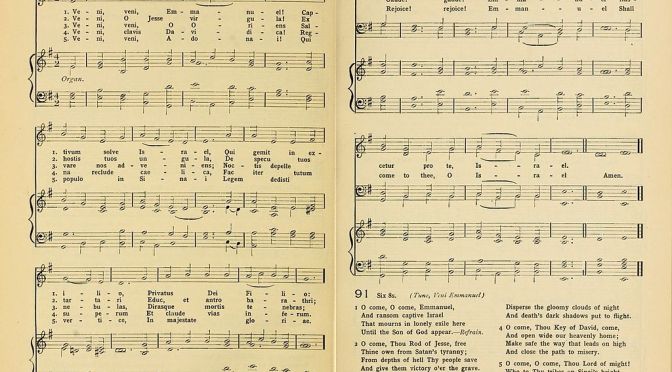
This is the hymn of the day for the Fourth Sunday in Advent across numerous Christian traditions. Written by the Rev. John Mason Neale, published in his and Thomas Helmore Hymnal Noted, Part II (1854), and revised by Neale in subsequent hymnals until his death, “O Come, O Come, Emmanuel” was based on the series of ‘O” antiphons sung at Vespers from December 17-23. In the original Latin, the second letters of the seven antiphons spell out the reverse acrostic “ERO CRAS” — “I shall be [with you] tomorrow”, as the Church prepares to celebrate Christ’s birth.
The tune of this hymn has an especially intriguing provenance. According to the magisterial New Oxford Book of Carols:
In an article of 1881, Helmore revealed that the source was in face a French missal [in the National Library at Lisbon, Portugal], and that Neale himself, now dead, had copied the tune … Searches failed to locate the hymn in the Lisbon library, and doubts about the authenticity of the tune were only laid to rest in 1966, when Mary Berry (then Mother Thomas More) discovered the tune in another French source, a fifteenth-century Franciscan processional, which was probably copied for a nunnery … Each verse is set out in binatim style on two pages, with the familiar melody on the left and a simple countermelody on the right.
Which (as transcribed and collated with the Latin hymnic version of the antiphons in the NOBC) sounds like this — recorded by the Taverner Consort in the style of a Franciscan procession:
And so — 1300 years on from the origin of the antiphons, 600 years after French nuns sang the hymn in procession, more than 150 years past Neale and Helmore’s translation and transcription — we watch for Christ’s coming with the Church of all ages, and sing:
O come, O come, Emmanuel,
And ransom captive Israel,
That mourns in lonely exile here
Until the Son of God appear.
Refrain
Rejoice! Rejoice! Emmanuel
Shall come to thee, O Israel!
O come, Thou Wisdom from on high,
Who ord’rest all things mightily;
To us the path of knowledge show,
And teach us in her ways to go. Refrain
O come, O come, Thou Lord of might,
Who to Thy tribes on Sinai’s height
In ancient times didst give the Law
In cloud and majesty and awe. Refrain
O come, Thou Branch of Jesse’s tree,
Free them from Satan’s tyranny
That trust Thy mighty pow’r to save,
And give them vict’ry o’er the grave. Refrain
O come, Thou Key of David, come,
And open wide our heav’nly home;
Make safe the way that leads on high,
And close the path to misery. Refrain
O come, Thou Dayspring from on high,
And cheer us by Thy drawing nigh;
Disperse the gloomy clouds of night,
And death’s dark shadows put to flight. Refrain
O come, Desire of nations, bind
In one the hearts of all mankind;
Bid Thou our sad divisions cease,
And be Thyself our King of Peace. Refrain
— Rick Krueger
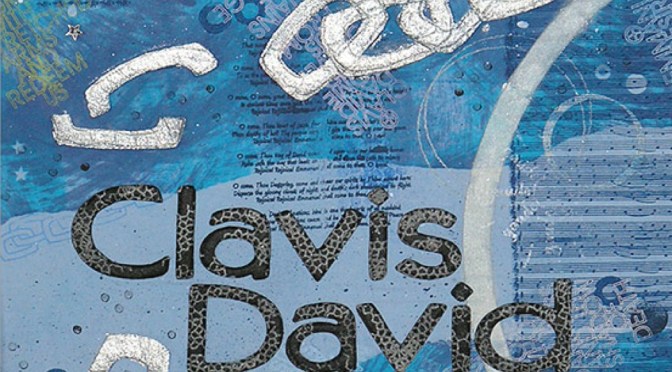
The O Antiphons: O Key of David
The O Antiphon for Magnificat at Vespers on December 20:
O Key of David and scepter of the house of Israel, you open and no one can close, you close and no one can open: come and rescue the prisoners who are in darkness and the shadow of death.
For their 2016 debut recording Drop Down, Ye Heavens, the London-based student-formed choir Siglo de Oro commissioned a new set of O Antiphons from various British composers, sung in English and set for choir and saxophone. Here is Francis Pott’s rich setting of “O Key of David”:
O come, Thou Key of David, come,
And open wide our heav’nly home;
Make safe the way that leads on high,
And close the path to misery.
Rejoice! Rejoice! Emmanuel
Shall come to thee, O Israel!
— Rick Krueger
(Image: O Clavis David by Linda Henke, Te Deum Designs.)

The O Antiphons: O Root of Jesse
The O Antiphon for the Magnificat at Vespers on December 19:
O Root of Jesse, standing as an ensign before the peoples, before whom all kings are mute, to whom the nations will do homage: come quickly to deliver us.
Healey Willan (1880-1968), professor at the Royal Conservatory of Music in Toronto and organist at St. Mary Magdalene Church in the same city, composed a setting of The Great O Antiphons of Advent for the Lutheran Church-Missouri Synod’s Concordia Publishing House in 1957. Here’s Willan’s setting of “O Root of Jesse,” as sung by the choir of Christ Church Cathedral in Vancouver, British Columbia:
O come, Thou Branch of Jesse’s tree,
Free them from Satan’s tyranny
That trust Thy mighty pow’r to save,
And give them vict’ry o’er the grave.
Rejoice! Rejoice! Emmanuel
Shall come to thee, O Israel!
— Rick Krueger
(Image: O Radix Jesse by Linda Witte Henke, Te Deum Designs.)
Geddy Lee: Neil Peart ‘Hasn’t Just Retired From Rush; He’s Retired From Drumming’ – Blabbermouth.net
“I’ve been working on this book for just over two years now, and it’s been great fun — it’s been passion project for me. And it’s been very good for my head. And, in a way, it was really a good break from everything that was going down with RUSH and from the end of that [last] tour, and it threw me into another obsession, which was educational, in terms of learning about my instrument, but also in terms of learning about making a book and what’s involved. So I enjoyed that. Now I will start thinking about what I’m gonna do next and I’ll start playing all those beauties” — referring to his bass guitars — “that are staring at me when I go into my studio.”
— Read on www.blabbermouth.net/news/geddy-lee-neil-peart-hasnt-just-retired-from-rush-hes-retired-from-drumming.html
 Spirit of Cecilia
You must be logged in to post a comment.