RE :Israel’s Challenge in Responding to a Brutal Surprise Attack

By David Petraeus and Andrew Roberts

Oct. 12, 2023 1:00 pm ET

“The U.S. may now be less interested in Islamist extremists than in China and Russia, but that does not mean the Islamist extremists have lost interest in us. Their lust for blood is undiminished. As soon as they have an opening, they will strike. “

ABSOLUTELY TRUE. THIS IS TRULY THE LONG WAR and the CLASH OF CIVILIZATIONS.   
Putin will die, sooner or later, and become a footnote in history.  Russia will recede into the sick man of Europe that it is.
But HAMAS hopes to become MARYTRS for the ages -and who knows they might be.   Like a poisonous weed, it will be difficult to extirpate them entirely.   
 Remember the enemy is within -PALESTINIANS have emigrated all over the world.
All we can hope to do is cull the herd periodically IMHO.
But I would place my money on the Jews -they are smart, brave, rich, and united. They have many many friends and admirers. 
ISRAEL HAS ENDURED AND WILL ENDURE.
 So many Empires oppressed the Jews and they are all in the trash bin of history now.
WHY?   
Because MONEY and POWER are not enough and because WISDOM is superior to terror and GOOD WILL TRIUMPH OVER EVIL.   
HAMAS IS EVIL.
PRAISE THE LORD and pass the ammunition. 
We are going to need plenty of both if we (Western Civilization) are going to survive this century.    If we are wise we will have plenty of both.   
JUSTICE WITH COURAGE as a Jew taught me IS WORTH TEN THOUSAND MEN.
great article.  INFORMATIVE, SOBER and WISE!  

RICHARD K. MUNRO Oct 12 2023

ON SHAKESPEARE

(MATTHEW ARNOLD)

MATTHEW ARNOLD

“Others abide our question. Thou art free.

We ask and ask—Thou smilest and art still,

Out-topping knowledge. For the loftiest hill,

Who to the stars uncrowns his majesty,

Planting his steadfast footsteps in the sea,

Making the heaven of heavens his dwelling-place,

Spares but the cloudy border of his base

To the foil’d searching of mortality;

And thou, who didst the stars and sunbeams know,

Self-school’d, self-scann’d, self-honour’d, self-secure,

Didst tread on earth unguess’d at.—Better so!

All pains the immortal spirit must endure,

All weakness which impairs, all griefs which bow,

Find their sole speech in that victorious brow.”

Shakespeare, Matthew Arnold

On the estranged friend who calls or writes not

By Richard K. Munro

TRUE FRIENDS NEVER PART ALL TOGETHER

We try to stay connected with friends. You hear an old friend with whom you have fallen out of close contact is seriously ill. You write to him and give him your phone numbers and email and tell him to call or write any time. You offer up a prayer for him and his family. But the rest is silence. Only God knows the reason.

Of course, it is sad to realize I cannot connect with some good friends except via prayer because they are dead.

No more contact is possible this side of paradise.

Classmates I knew in school are dead.

Some died in their 20’s, in their 30’s , in their 40’s some in their 50’s.

My next-door neighbor -a close acquaintance of 20 years but I considered him a friend. He was a really nice guy. He was only 62 younger than I. We are going to his funeral next week.

Three of my really close friends were killed in car accidents by drunk drivers. Two of them were killed within walking distance of my house. I don’t even like to drive that way anymore because that corner has bad associations.

Yes, who can know? Perhaps that person who doesn’t communicate is depressed or embarrassed or just doesn’t care. SCIRE NEFAS ..it is forbidden to know all. Not all can be known.

It is sad of course to be rejected by people but relationships are a two- way street.

Corresponding is difficult but picking up the phone is easy but it is also intimate. Some people don’t want to open up or give answers. So all you can do is be prepared to accept their phone call IF they call. I know someone I cannot call any longer because it is painful. The last four or five times I called that person just BANG hung up on me. So I will never call again. That was almost ten years ago.

All one can do is do the right and humane thing. Then offer up a prayer for our friend of yesteryear.

Many of the men I knew in school and in the Marines are gone -dead.

In 1976 a Sea Knight Helicopter crashed in Quantico and 23 Marines were killed. I didn’t see the crash but I saw the bird take off. The weather was turning bad so our Company Commander said -people grumbled- we would walk back to camp over 20 miles. We arrived when it was almost dark dirty and hungry. But that’s when we found out that one of the previous birds went down.

When on liberty on the USS Trenton there was a collusion and dozens of Marines were killed. I could have been on either one of those trips.

But when the door is closed, when the mail doesn’t arrive, when the phone doesn’t ring when the email box is empty all one can do is pray.

Some people are friends when it is convenient or useful or when they’re coworkers.

Some people are just ships passing in the night. Some signal and some go quietly by.

If one has a single true friend or a single loved one for any period of time one should be grateful. I think I have been luckier than most though less fortunate perhaps than many others.

But I am not jealous.

I am just grateful for the love and close relationships I have known.

And I am thankful for the great classics -the Bible, Shakespeare, Dante, Horace, Cervantes. In my retirement I have plenty of sun, plenty of quiet, baseball on the radio, plenty of music and plenty of books. I have enough money to be generous to our grandchildren -we are blessed to have them- and visit them from time to time. I don’t have the resources or the stamina to travel all over the world but I am very grateful that from 1961-2005 in particular I had the chance to visit many states and provinces and many countries in South America, the Caribbean ,and Western Europe. Next week I will have a chance to visit -again-Washington DC a city which I have visited dozens of times. I spent a year at the University of Virginia so I have seen most of the principal sights. But mostly I will enjoy seeing friends and remembering friends and loved ones. As Thomas Moore sang in the Meeting of the Waters.

Yet it was not that nature had shed o’er the scene
Her purest of crystal and brightest of green;
‘Twas not her soft magic of streamlet or hill,
Oh! no, — it was something more exquisite still.

‘Twas that friends, the beloved of my bosom, were near,
Who made every dear scene of enchantment more dear,
And who felt how the best charms of nature improve,
When we see them reflected from looks that we love.

Many years ago at the old 1407 Club Club in New York City (now long gone) my father and I met the tenor James McCracken. He had just released an album of Scottish and Irish songs -The Meeting of the Waters. He had finished his dinner and generously offered that we finish our coffee with him. My father, in particular, knew his work very well and had seen him perform at the Metropolitan Opera. But we talked about why he made his Scottish-Irish album and he said he had listened to McCormack, Frank Paterson and Kenneth McKellar his entire life and he loved the traditional and popular songs. He said it was important, he believed to cross over from classical to popular music. It was a nice moment. He loved being with genuine fans of his music We loved spending some time with him. From then on when I hear this song I remember my father and James McCracken. But also Thomas Moore and the sentiment of his poem.

THE MEETING OF THE WATERS (IRISH SONG)

My father had been a fine athlete in Scotland (winning a medal for best goalie in the city of Glasgow for his level youth team). But in America, he working at several jobs -almost full-time year-round – from his 12th birthday. So he had no time for sports. He turned ALL of his money to his mother and she would give him 25 cents for the subway and a Saturday movie


My father played on a legendary and ill-starred Football (soccer) team called the St. Anthony Ants of 1924-1925-1926-1927 when they were the champions every year or close to it.

The Ants first ground was a public park situated beyond the southern end of Hamilton Street (now Nethan Street) in Govan (South Glasgow.. It was a humble grass soccer field. It was unenclosed -cold and wet in the winter and had no pavilion, so the players had to change in the League of the Cross Hall in Hamilton Street.

Father Collins (parish priest of St. Anthony’s)and Bishop Donald Macintosh were both avid supporters of the team and helped the boys get shoes and equipment. Both men had studied at the Scots College (then at Valladolid, Spain and in Rome). Both were avid linguists and could speak Italian and Spanish as well as Gaelic, Scots and English. My father loved both men and they were friends of Uncle Johnny Dorian (his fourth-grade teacher and later headmaster of St. Anthony’s.). My father called him Uncle Johnny but he was really my grandmother’s sister’s son so my father’s cousin.

Father Collins married his parents, baptized my father on March 17, 1915, was at his first communion. Father Collins had a very strong influence on my father and his mother, brother and sister visited the Dorian household often and Father Collins and Bishop Macintosh were frequent visitors. My father, his family, and Johnny Dorian and his daughters and the Bishop would listen to recordings of Caruso and John McCormack, chiefly Italian opera but also English, Irish, and Scottish songs. Father Collins and Bishop Macintosh later became close friends with Father Sidney MacEwan, also of Govan and later a successful recording artist. When McCormack died MacEwan was by his side and sang to him the Highland song ISLAND MOON.

I believe my father’s love of languages and classical music, particularly opera began with those Sunday dinners in the 1920s. The legendary great years of the ill-starred ANTS:

Scottish Junior League Victory Cup Winners 1918/19, 1921/22
Glasgow Junior Cup Winners 1918/19, 1921/22,
Elder Cottage Hospital Charity Cup Winners 1923/24,
Scottish Junior Cup Runners-Up 1918/19, 1924/25

Why such a tragic team?

Because so many of their fathers had been killed in WWI and many of my father’s teammates were later killed themselves in WWII many at Dunkirk with the 51st Highland Division, North Africa, and Normandy.

Some died in Nazi slave labor camps. One of the few times I saw my father weep in public was when we went to the Scottish National War Memorial in Edinburgh in 1967. There was THOMAS CRAIG (Cameronians/Scottish Rifles) 4 Dec 1942 (North Africa) KILLED IN ACTION. His teammate and very best friend.

PATRICK QUIGLEY KILLED 10 October 1943 (HLI -Highland Light Infantry -his teammate and cousin)

Many of his Quigley kin had been killed in the Argylls or HLI in the First World War. There was also his “Uncle Johnny” (or American Johnny) Robertson his father’s best friend who had returned to Scotland in 1938 to retire. He was killed in the Glasgow Blitz -6 May 1941. I still have books that belonged to Robertson that he gave my father in 1938, Shaw, Kipling, and Burns. My father as he saw name upon name began to cry uncontrollably. I was frightened.

But I always remember the Scottish people there were very kind and sat with my father and talked to him and comforted him. My father said, “If I hadn’t come to America in 1927 my name would be in the books next to theirs. It was rifles against tanks and they didn’t have much chance. They were always in the front lines in the thick of the fight.” It left a strong impression on me and when we had teas and Empire biscuits afterward he spoke Johnny Robertson and his friends and kinsmen. Immigration had been good for my father but also had caused him personal suffering, pain ,and loneliness. My father always wanted to be an American but knew he was partially a permanent exile. In 1967 my father pointed out the Boer War memorial that that been bomb damaged on 6 May 1941 in Kelvin Grove Park. When I am Glasgow I always go back to visit that spot if only for a few moments. REMEMBRANCE.

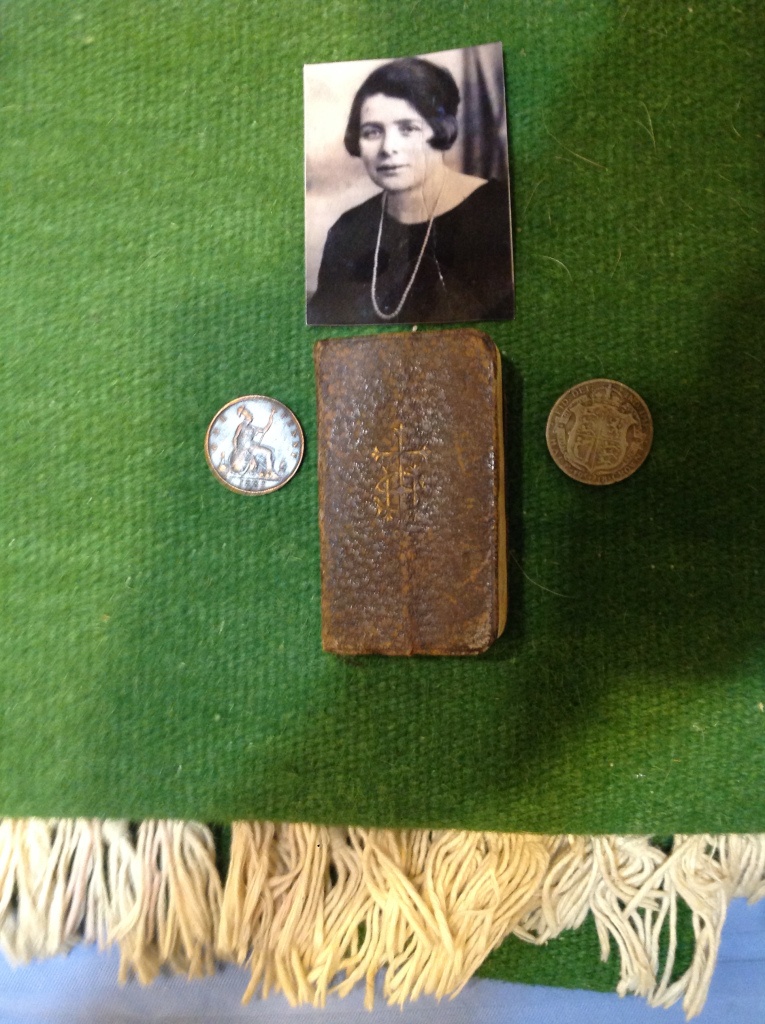
When my father graduated from high school, his grandfather, Jos Munro, his mother, his sister Johnny and his father and his cousin Jimmy Quigley were there. My grandfather gave my father five coins (coins I still have)One is a British Penny (1881) given to my grandfather when he went to sea when he was eight years old. It was all the money he had and his mother said, “Never spend it unless your life depends upon it. Naebody can every say Tommie Munro is penniless. ” He did not see his mother or family for eight years but he held on to the penny virtually his only possession.

Three of the coins were American silver dollars dating from the 1890s and 1920s. These were actual dollars his father and grandfather had earned as a worker in America. The last was very special; it was an English 1918 silver half-crown that my grandmother had sent my grandfather and he kept in his left tunic pocket in his missal. She gave him one for 1914, then another for 1915, then another for 1916, then another for 1917, and the last he had his pocket for Armistice Day 1918. When he returned to Scotland in May 1919 he turned it over to her and it was one of her prized possessions until her untimely death on March 7, 1942. She never saw the Allied victory nor her sons come home from the war. My father gave the missal and the coins to me after my mother died in 2001 and told me the story.

Ne obliviscaris -do not forget.

Mary Munro, the Missal and two of the coins.

SONNET 30

When to the sessions of sweet silent thought
I summon up remembrance of things past,
I sigh the lack of many a thing I sought,
And with old woes new wail my dear time’s waste:
Then can I drown an eye, unus’d to flow,
For precious friends hid in death’s dateless night,
And weep afresh love’s long since cancell’d woe,
And moan the expense of many a vanish’d sight:
Then can I grieve at grievances foregone,
And heavily from woe to woe tell o’er
The sad account of fore-bemoaned moan,
Which I new pay as if not paid before.
But if the while I think on thee, dear friend,
All losses are restor’d and sorrows end.

Look At The Flower Kings Now!

Flower Kings look

Welcome back, Spirit of Cecilia readers! In this post, Brad Birzer and Tad Wert discuss the new album from the Flower Kings, Look At You Now.

Tad: Brad, I know the Flower Kings are one of your favorite artists in music. They certainly are prolific – when they release an album, it’s usually a double-length one. Look At You Now clocks in at a relatively modest (for them) 67 minutes.

I’m not as big a fan of them as you are, but I certainly respect their talent. That said, I have to say that this album is really attractive to me. It seems more focused and energetic than previous releases. Right off the bat, “Beginner’s Eyes” is a song I bet Yes wishes they could produce these days. It’s majestic and inviting at the same time.

Brad: Dear Tad, you wrote this over a week ago, and I’m just now getting to it.  I’m so sorry, my friend.  It’s been crazily busy here, but not busy enough to warrant such neglect.  

Anyway, I’m so glad you’ve introduced us to the new Flower Kings album, Look at You Now.  I first came to the Flower Kings back in the year 2000.  A student (now a beloved colleague in the philosophy department)  leant me his copy of Flower Power, and I was utterly gobsmacked.  I couldn’t believe how nuanced the album was on disk one (the Flower Kings rarely do anything short), and I loved the “b-sides” of disk two.  From there, I worked backward and found my way through the band’s entire catalog.  

For twenty-three years now, I’ve been fully immersed in everything Roine Stolt (the founder of the band) has done–from the Flower Kings to Kaipa to Transatlantic to The Sea Within to Agents of Mercy.  The guy is astoundingly relentless and talented.  I’ve even tracked down and purchased–for my personal collection–Flower Kings rarities, all of them beautiful.

The latest album, Look at You Now, is much more laid back than I would’ve expected from the band.  If you look at something like Space Revolver (my favorite album from the band), the band is nearly unrestrainable.  But for this new album, the band is confident in its mellow state.  Even its mellowness, though, has a nice intensity to it.

Tad: Brad, I find it interesting that you characterize Look At You Now as laid back – my first impression was that it had more fire than usual! However, I haven’t heard Space Revolver, so I don’t have the same history to compare Look At You Now to that you do. As I mentioned in the intro to this post, I think “Beginner’s Eyes” is a great song that outdoes anything Yes has recorded in years. Stolt’s guitar really stings in his solo. Another song I found immediately appealing is “Scars”, with its gritty, bluesy intro and infectious groove it lays down. Once again, Stolt’s guitar work is outstanding (assuming he’s the lead guitarist here); the entire song reminds me of something Eric Clapton might have produced at his peak. 

I also appreciate the fact that almost all the tracks on this album are relatively short – more than half are under five minutes. Maybe it’s my age, but I’ve lost patience with songs that meander without resolution for more than six or seven minutes. I have a friend who went to a Phish show a couple of nights ago, and he said he had to leave after the first three songs took 45 minutes! Neal Morse is one of the few artists who can hold my interest over a long period of time; most others, not so much. Okay, rant over – as I said, I think the Flower Kings have done a great job paring every song on this album down to its essentials, and I think that makes for a really strong album overall.

Brad: Tad, thanks so much for a great response.  I love the rant.  I must admit, though, I’m a guy who likes meandering in my music.  Phish playing only three songs over forty-five minutes sounds wonderful to me.  I’m guessing I would’ve been immersed in the experience.

As to The Flower Kings, this new album is definitely a surprise, especially given the shortness of the songs.  But, I very much appreciate and like what the band is doing.  I think you’re absolutely right, any band–Yes or The Flower Kings–should be proud of a song like the album opener, “Beginner’s Eyes.”  What a delight it is.

As much as I love the dual vocals with the Flower Kings, I also especially like the instrumental passages, and one of my favorite tracks is “Dr. Ribedeaux.”  Despite the absence of lyrics, I think this song has the most classical Flower Kings feel to it.

I also love that The Flower Kings are willing to wear their influences so openly.  Obviously, “Mother Earth”’s introduction sounds like something Brian May of Queen might have done, and much of the album has a Yes fan–as you were implying above.

And, Tad, before we close this review, I must encourage you to listen to Space Revolver.  It’s most certainly a top 15 prog album for me.  It’s wacky and gorgeous, all at the same time.

Regardless, I’m so glad to have The Flower Kings in the world.  Roine Stolt is my favorite viking hippie!

Tad: Brad, I love “Sr. Ribedeaux” as well! A great instrumental workout. In sum, I think Look At You Now is a worthy addition to the extensive Flower Kings catalog. In my opinion, one of their best, and well worth checking out if someone isn’t familiar with their work. And I promise to give Space Revolver a listen – you have yet to steer me wrong with your music recommendations!

A Night at the Opry

“Country musicians first performed on radio in 1922, and, within a few years, radio stations initiated the first barn dances — ensemble variety programs with the relaxed, chatty atmosphere of a family gathering.”

— the Country Music Hall of Fame & Museum’s exhibit “The Dawn of Country.”

Heading south for our most recent vacation, we finished up in Nashville — and I wasn’t going to visit Music City without taking in at least one show. After catching Ringo Starr at the historic Ryman Auditorium proved prohibitively expensive, I pivoted to the spot all the travel guides (as well as local friends) had recommended in the first place — the weekly Saturday night performance at the Grand Ole Opry.

Make no mistake: coming up on its 98th year, the Opry is a well-tuned corporate machine, effortlessly parting multitudes from their cash with a smile — but it’s also an affordably priced, entertainingly old-school variety show. Broadcast live in multiple formats, the program consciously carries on traditions developed from its radio roots through country music’s ongoing breakout to the broader public (and if you’ve ever wondered where Garrison Keillor got the idea for A Prairie Home Companion, look no further). Regularly booking a mix of promising rookies and seasoned veterans, inviting rising stars to become “family members” and providing an environment open to impromptu guest shots and team-ups, the Opry deliberately claims a gatekeeper role, anointing a core of artists that cover a fairly broad spectrum of what country music is today. With no mass-culture superstars on the bill, September 23rd’s Opry was an enjoyable example of how all this works in practice.

To kick it all off, throwback quartet Riders in the Sky stepped to the mikes, blending smooth harmonies and lively instrumental work into affectionate renditions of vintage cowboy songs and Western swing. There were plenty of corny antics, too; bassist Too Slim provoked fiddler Woody Paul into a face-slapping “Dueling Banjos” duet as guitarist Ranger Doug and accordionist Joey the Cowpolka King looked on in bemusement. (It’s no surprise that, in his true identity of satirical college journalist Fred LaBour, Too Slim convinced the counterculture that Paul McCartney was dead back in 1969.) But after we’d laughed ourselves silly, these long-time Opry members cooled us down with the gorgeous title track off their latest album Throw A Saddle On A Star, then whipped up a fiddle-focused hoedown for an exhilarating finish.

Making her second Opry appearance, vocalist Riley Clemmons was an engaging bundle of nerves, nearly beside herself with excitement that she’d been asked to return. But emotions of the moment and self-deprecating jokes about her advanced age of 23 aside, Clemmons was all business, making the most of her short set. An enthusiastic crooner in the Carrie Underwood mold, she put across her faith-based songs “Church Pew” (her new album’s title track) and “Jesus Cries” with plenty of heartfelt sentiment, ably backed by the Opry’s onstage band and backup singers.

20-year-old singer/guitarist Sam Barber was next up, the first of two debut performers taking the leap from streaming services to the Opry stage. Exhibiting raw yet remarkably well-honed talent, Barber’s unsoftened Missouri accent (complete with occasional growl from the gut) and his determined strumming on “Straight and Narrow” (the first song he wrote, at the age of 16) grabbed the audience hard and strong in his acoustic solo slot.

Recent Opry inductee Charlie McCoy, one of those multi-instrumental Nashville cats who’s played on albums by everybody (Elvis, Dylan, Willie & Waylon, etc. etc. ) in the course of 12,000 sessions, brought the first half of the show to a rousing finish. After laconically drawling a humorous ditty about the consequences of “Thinking with My Heart” (“A heart doesn’t know how to figure out/ Whether to run or to jump/It ain’t got a clue; zero IQ/After all it’s just a pump”), McCoy pulled out his trademark harmonicas for a lyrical film score excerpt, then a lightning-fast “Orange Blossom Special” that nearly left the band eating his dust — and left the audience hungry for more. Cue the intermission!

Continue reading A Night at the Opry

VIN, Baseball, Auld Pop, my Dad and Me.

by RICHARD K. MUNRO

(SEPT 26, 2016)

So today was Vin Scully’s last game ever at Dodger stadium and there was a thrilling extra-inning game won by a clutch homer by Charlie Culberson. I wish my father and Auld Pop could have been here to enjoy it with us!

My cousin Helen Munro (born 1943) was discussing how she lived to keep score at home with Auld Pop and listening to Red Barber and then Vin Scully. She went many times to Ebbett’s Field as did my parents but I went only once (in utero in August 1955 (see my mother’s ticket below!)

My grandfather came to love baseball with his friend “American” Johnny Robertson and they saw many big league games and Texas league games together in the 1920’s and 1930’s. I know also they played shinty while with the Argylls in Greece and on at least one occasion played baseball with Canadians and Americans (while wearing kilts!!!).

To the left of my grandfather THOMAS MUNRO Sr. you can see AMERICAN JOHNNY ROBERTSON and to his right a very young boy his nephew JIMMY QUIGLEY

Auld Pop, it is said had quite a wallop. So I know he played the game in America probably pre 1910 and certainly in the 1920’s when he was in his early 30’s.

I know his favorite player was Zack Wheat and Wheat played for the Dodgers in the 1910’s and 1920′. Auld Pop’s favorite players were Wheat, Duke Snider (he passed on an autograph) , Jackie Robinson, Johnny Podres and Gil Hodges. He saw the Yankees play many times (he always rooted against them). He saw Bob Feller no-hit the Yankees and Joe Dimaggio in 1946 and some years ago my son and I met Bob Feller in Bakersfield and had a nice talk with him (he signed our books and memorabilia for no charge)

So Auld Pop saw many great moments at Ebbets field and even lived long enough to see them on color TV in 1959 and in April 1962 at Dodger stadium. So my father and Auld Pop saw (and met in person at the ballpark and in Brooklyn many Dodger players many future Hall-of-Famers).

But Auld Pop could only go to so many games; he followed the Dodgers on the radio day to day with Red Barber (up to 1953) and later Vin Scully and by reading the Daily News and Red Smith in the Herald Tribune.

But Vin Scully played a very important part of Auld Pop’s life.

One curiosity that my cousin told me about this past week is that Auld Pop would NEVER go to July 4th games or celebrations. He would stay home by himself and listen to Scully and Barber on the radio. he would retreat to my father’s cellar den which he called his dugout or bunker. It was soundproofed. He would sip on beer and Four Roses whiskey and smoke. He just couldn’t stand to hear fireworks or the noises of firecrackers and cherry bombs. My cousin Helene Munro -Auld Pop called her Buntie- said the noise made him very anxious and sometimes even give him uncontrollable tremors. She remembered seeing him on the edge of his bed, shaking and she would (she was just a girl at the time) say she would stay home with him and she ladled whiskey into him and held his hand until he calmed down or fell asleep. But listening to baseball was calming to him and he taught Helene and my father the basics of the game and how to keep score.

He used to read to me Red Smith articles just as much as comic books or the Bible and he used to show me the intricacies of the box score. One of my favorite books was the classic MY GREATEST DAY BASEBALL.

This was a gift from Auld Pop, December 25, 1959. After he died my father read it to me also. I still have my copy.
Edit

All reactions:
2You and Jorge Orrantia

I was thrilled that Auld Pop had seen so many greats players. Both my father and Auld Pop read the book to me. It was a gift from him for Christmas , 1959. After he died I cherished that book like I cherished his collection of Scottish records.

Life was tough on Auld Pop. He suffered the loss of many friends and loved ones and was lonely at the end of his life -he was the last surviving member of his squad, his company and his Regiment. He suffered the loss of the Dodgers when they left Brooklyn. But he always had baseball in the newspapers and on the radio.

Even on the 4th of July when he huddled alone or with my cousin in “the dugout” or “Jaja’s Bunker.” On those days, listening to Vin Scully, my cousin said Auld Pop would not drink to excess and even laugh and joke and tell stories. My cousin Buntie (little Button) and I were very close to Auld Pop as some of you know. As a little boy, I had no idea how his entire life had been an odyssey of survival and a veritable journey of the cross. Later I learned more. He went to the Western Front in January 1915 and at 2nd Ypres suffered 36 continuous days of vicious combat , ambushes and bombardment. For a few days he was missing in action in No Man’s Land doomed to death or a fate as German POW. But the Leal n’ True men and the Dins -led by American Johnny Robertson came to his rescue. So he survived.

And thanks to them my father, my cousin, my mother my sisters and I could enjoy so many great moments with Auld Pop. And some of the best were at the ballpark, with the newspaper and with Vin Scully and the other announcers on the radio (at later TV but in those days there were few games on TV).

Baseball was a very soothing hobby and pastime for Auld Pop and the sweetest cream was the dulcet voice , good humor and conviviality of Vin Scully whom my grandfather would see sometimes at a distance in Mass on Sundays in Brooklyn.

Vin always went to Mass with his mother and father and I think my Auld Pop told my cousin they would go Saturday night or Sunday morning. My Auld Pop -so my cousin told me- very much appreciated Vin’s salute to veterans on Memorial Day etc. And on the 4th of July when Auld Pop dare not leave the house there was Vin Scully “It’s time for Dodger baseball!

and

“Hi, everybody, and a very pleasant good (afternoon/evening) to you, wherever you may be.”

Next Auld Pop and Johnny Robertson, Vin Scully was the most beloved “legendary” heroes. He was the Bard of Brooklyn, and Irish Minstrel. He was the voice of the Dodgers and the voice of Baseball. Vin Scully was truly the Babe Ruth of sports broadcasting. Thanks for so many great memories as the announcer of so many games and six World Series.

Ne obliviscaris. Do not forget. You meant so much to veterans and disabled people who weak in limb and endurance could not go out as freely as they might have wished. You were their best friend and better than any whiskey or doctor or pill.

I close with some great Scully moments: It’s a mere moment in a man’s life between the All-Star Game and an old timer’s game.

During the 1980 Major League Baseball All-Star Game held at Dodger Stadium

It’s a passing of a great American tradition. It is sad. I really and truly feel that. It will leave a vast window, to use a Washington word, where people will not get Major League Baseball and I think that’s a tragedy.

(At the end of the last NBC Game of the Week, October 9, 1989).

Ah, yes, baseball is an acquired taste and it has to be taught and savored.

***

Scully: A little roller up along first; behind the bag! It gets through Buckner! Here comes Knight and the Mets win it!

Famous call from Game 6 of the 1986 World Series

***

(Roberto) Clemente could field the ball in New York and throw out a guy in Pennsylvania.

I saw Clemente play many times; hyperbole but almost the truth! Of course, he would have to be playing on the border!

***

And to me his most legendary call.

I heard this recording at the Hall of Fame with my father. My cousin (living in LA at the time and keeping score) heard it live.

This is from the radio transcript of 1965. This is Vintage Vin:

” It is 9:46 p.m.

Two and two to Harvey Kuenn, one strike away. Sandy into his windup, here’s the pitch:

Swung on and missed, a perfect game!

(Crowd cheering for 38 seconds)

On the scoreboard in right field it is 9:46 p.m. in the City of the Angels, Los Angeles, California. And a crowd of twenty-nine thousand one-hundred thirty nine just sitting in to see the only pitcher in baseball history to hurl four no-hit, no-run games. He has done it four straight years, and now he caps it: On his fourth no-hitter he made it a perfect game. And Sandy Koufax, whose name will always remind you of strikeouts, did it with a flourish. He struck out the last six consecutive batters. So when he wrote his name in capital letters in the record books, that “K” stands out even more than the O-U-F-A-X.”

Word-for-word transcription of Scully’s call of the ninth inning of Sandy Koufax’s perfect game on September 9, 1965.

***

There is only one word for Vin Scully: INVINCIBLE. Thanks for 67 years of companionship and laughs and much simple happiness and joy. We will miss you, Vin Scully and we will never forget you.

You will remain an American and a Dodger and a Baseball legend.

Ave et vale. Hail and farewell.

Or as they say in the Irish “slan leat gu brath!”

Steven Wilson’s The Harmony Codex

Harmony Codex

The always intriguing Steven Wilson has a new album coming out September 29: The Harmony Codex. Brad Birzer and Tad Wert share their thoughts on this new work by one of modern music’s most gifted artists.

Tad: Brad, I think you’ll agree with me that one thing we can expect from Steven Wilson is the unexpected. When he was in No-Man with Tim Bowness, he created an interesting amalgam of ambient/techno/pop that was unique. As the leader of Porcupine Tree, he spearheaded the resurgence of progressive rock in the 2000s that wasn’t afraid to pay homage to the “dinosaurs” of the ‘70s like Pink Floyd, Genesis, Emerson Lake and Palmer, and Yes. His solo career has been a rollercoaster ride – which I have enjoyed – where he has produced music in practically every style. I think he has deliberately worked to escape being pigeonholed as a “Progressive Rock” artist, and he asks his fans to simply appreciate him for his music, whichever mode it happens to be.

Which is my long-winded way of introducing our thoughts on his latest work, The Harmony Codex. The first time I listened to it, I wasn’t particularly struck by any song, as I immediately was with his earlier album, To The Bone. But then I listened again, this time with headphones, and holy cow! This is an amazing album. It really came alive when I heard the songs in the soundstage Wilson has crafted.

Brad: Tad, thanks so much for staring us off on this conversation.  As always, my friend, it’s an honor to talk music with you.  

I have not yet listened to The Harmony Codex with headphones.  What an excellent idea.  Maybe tonight I will do that.

In the meantime, I have listened to the album (so graciously provided by Steven Wilson’s PR firm) numerous times since we received the review copy the other day.  In some weird way, it’s become a part of me this week.

I agree with you that it didn’t do much for me on the first listen.  In fact, I thought it way too overproduced.  Our own Carl Olson has likened it to Kate Bush, but it struck me as far more Tears for Fears, Elemental-period.  I’m not sure I would say this now after so many listens, but I also wouldn’t say at this point that it’s overproduced.  The album has truly grown on me to the point that I absolutely love it.  Again, I couldn’t imagine the past week without it.  I am jealous of those who were able to hear the album in an Atmos-equipped room.  That must’ve been quite the experience.

I guess this takes me back, personally, to my own musical “relationship” with Steven Wilson.  I first heard “Trains” on an album rock radio station while doing some shopping in northern Indiana over two decades ago.  I immediately went to a very good store in Fort Wayne and purchased In Absentia as well as Up the Downstair Case and Signify.  Yes, it was a very good CD shop!  A kind student, finding out my new found-love love, then gifted me with Stars Die: The Delerium Years.  

I fell in love with Wilson and then proceeded to buy everything I could from him–everything from his contribution to OSI, to his No-Man work with Tim Bowness, to his later Blackfield albums.  When his first solo album, Insurgentes, came out I was thrilled.  

I now, twenty-one years later, have a huge Steven Wilson collection.  Everything he has written directly as well as probably 95% of what he’s remixed for other bands.  And, of course, I happily own the deluxe edition of his autobiography, etc.

All of this is a very long way of admitting, I wasn’t sure what to expect from Wilson on this new album.  To me, the absolute height of his profound musical ability can be found in Hand.Cannot.Erase, what I think is my second favorite album of all time.  His lowest point, though, was The Future Bites.  At least to me, though I know there are good things on that album.  Yet, the whole project came off as cynical.

Still, I very much worried that The Harmony Codex would be The Future Bites, Part II.  I am so very thankful that Wilson took his music in a different direction.  While I think The Harmony Codex shares some production values with The Future Bites, it is an album that stands on its own, far closer to, say, Grace for Drowning than to The Future Bites.

Anyway, I eagerly await the deluxe edition of The Harmony Codex I ordered from Burning Shed.

Tad: Brad, my love affair with Wilson’s music followed almost exactly the same path as you – I bought Fear of a Blank Planet, because Alex Lifeson of Rush played on it. I was hooked, and I quickly picked up every album I could find that Wilson was connected to. It didn’t hurt that Snapper/KScope was reissuing all of No-Man and Porcupine Tree at the time. Like you, I was exposed to OSI through Wilson’s vocals on their debut!

As far as The Harmony Codex goes, I wouldn’t say it’s his best, but it is very satisfying to listen to. I would like to know who and what influenced him while he was composing the music for this album. I hear Middle Eastern motifs in the first track, Inclination, classical minimalism in the intro to Impossible Tightrope, which then morphs into a jazz/rock fusion workout that sounds like something Herbie Hancock might do in the early ‘70s. The title track sounds almost baroque in its melody. For me, the weakest song is the single, Rock Bottom, but the other songs have set a very high bar. I think my favorite is the closing track, Staircase: nine and a half minutes of beautiful music that held me riveted from beginning to end. The break that features the bass bursting out of the mix is incredible!

You’ll notice that I haven’t spoken much about the lyrics – as I mentioned in an earlier dialogue of ours, a song’s melody has to attract me before I’ll invest any time in pondering the words. Wilson’s lyrics can be problematic for me, particularly from earlier in his career, because they dwell on some very dark subjects. In Absentia, for all its pleasant melodies, is about a serial rapist/killer. And I agree Hand.Cannot.Erase is an outstanding work of art. However, its subject matter – a young woman who dies alone in her apartment and isn’t missed for months –  is so heartbreaking that I have a hard time listening to it! You’re the lyrics man, so what are your thoughts on Wilson’s words in The Harmony Codex?

Brad: Yeah, Wilson can be really, really creepy when it comes to his lyrics, and he’s previously been obsessed with truly dark subject matter.  On not just one album, but several, he follows killers, drug addicts, and other miscreants.  

Hand.Cannot.Erase works so well for me, because he does have some hope at the end of the album, and I think he nails grief perfectly on that album.

As such, I think the weakest song on the new album is “Actual Brutal Facts.”  I can’t quite make out all the lyrics, but the muffled distorted  voice weirds me out quite a bit.  I like the music to the song, but the lyrics seem chilling.  Maybe I’m wrong on this, as I’ll need to wait until I see the lyric sheet.  As it is, the song tires me out.

And, Tad, I must admit, I’ve not been able to understand all the lyrics on the new album, so I can’t really pass judgment on them.  I will have to wait for the physical album to pass any real judgments.

Wilson employs that same creepy voice on the final track, “Staircase,” but it doesn’t seem as oppressive on this one.  In fact, I agree with you, Tad, this is an excellent track.

Maybe my ultimate answer to you about the lyrics, Tad, is this.  My favorite track on the album is the instrumental, “Impossible Tightrope.”  In an interview, Wilson mentioned that he followed Mark Hollis’s lead (from Spirit of Eden and Laughing Stock) in recording far more than needed and then edited the various pieces and contributions together.  He said the “Impossible Tightrope” on the bonus cd of the deluxe edition will sound very different from the one released on the main album.

Tad: That’s very interesting that Wilson openly talks about late-era Talk Talk being a big influence – I hope he does a surround sound remix of Spirit of Eden. That would be a dream come true for me!

I’ve been listening to The Harmony Codex a lot the past 24 hours, and I have a new favorite track: “What Life Brings”. It’s the shortest one on the album, and it has the prettiest melody Wilson has composed in years. Just when you think it’s going to be a predictable, fairly pedestrian song, he introduces a slight modulation in the key that raises it up to a thing of beauty. Wilson is the master of that.

I agree with you about “Actual Brutal Facts” – it leaves me cold. It sounds like he’s trying his hand at hip hop, and it doesn’t work for me. That said, on the whole I think The Harmony Codex is one of Wilson’s better albums. It has a nice flow overall, while covering quite a few different styles of music. It’s definitely “proggier” than his previous two albums. Personally, I enjoy his explorations into various styles – he’s such a gifted musician, anything he does sounds good!

Brad, as always, it’s a blast to do a dialogue with you – your enthusiasm and brilliant writing raises the bar for me!

Frost*: A Million Reasons to Love Milliontown

Milliontown

Greetings, Spirit of Cecilia readers! In this post, Brad Birzer and Tad Wert discuss a classic prog rock album that is a mutual favorite of theirs: Frost*’s debut, Milliontown.

Tad: Brad, I have you to thank for making me aware of this wonderful album. I think you mentioned it in some social media post years ago, and I replied, “What’s Frost*?”. You immediately sent me a link to a video of Jem Godfrey and Dec Burke playing an informal duet performance of Hyperventilate, and I was hooked. Fortunately, I was able to snag a copy of Milliontown before it became unavailable. 

So, Brad, to paraphrase John J. Miller, host of The Great Books podcast, “What makes Frost*’s Milliontown a great album?”

Brad: it’s always good to start with John J. Miller, bookmonger extraordinaire and a man possessing excellent taste in music!  He’s also great to have a beer with.  Someday, Tad, we have to get you up to Hillsdale so you can meet your true brothers!

As to what makes Milliontown such a great album–there are, throughout the album, a million things going on at once, and it all could’ve readily have devolved into pure chaos.  But Frost* always holds all things together.  Indeed, it’s the genius of the band.  And, by the time we’re immersed in the opening track, “Hyperventilate,” we’ve been happily flooded with a wall of sound as well as outrageous digressions.  Again, though, it all comes together as a beautiful whole.

I’m really glad I sent you that video of Godfrey and Burke.  To me, that clip captures the essence of Frost*.  Playful yet professional. 


Back to Milliontown as an album.  Strangely, the first time we hear a human voice on the album, it’s a distorted recording that opens track two, “No Me No You,” and then the singer sings with absolute urgency.

Things slow down considerably with “Snowman,” track number three.  This song has almost a ballad feel, something that could’ve been from Genesis’s And Then There Were Three.

Things revive, rather seriously, with track four, “Black Light Machine.”  Yet, the lyrics are dark–about a psychopath.  The lyrics here really get into Steven Wilson territory.  Still, this is probably the poppiest song on the album, even though it’s a little over 10 minutes in length.  Again, a paradox of Frost*–combining the poppiest tunes with the darkest lyrics.

The hyperness of Frost* continues with the penultimate track of the album, “The Other Me,” a funky prog song, sounding a bit like Thomas Dolby and a bit like mid-period Tears for Fears. [the order of these songs, by the way, is different on different releases of the album.  My review, here, reflects the song order as on 13 Winters]

And, of course, this brings us to the greatest track of the album, the magisterial 26-minute, “Milliontown,” Frost*’s equivalent of “Supper’s Ready” by Genesis.

So, Tad, what makes you think this is a great album?  And, what are your thoughts about the individual songs?

Tad: Brad, for me the test of whether an album is great or not is simple: do I listen to it again after my initial experience of it? When I get a new album, I typically enjoy it for a week or so, giving it half a dozen spins. After that, it gets filed away and I’m unlikely to pull it out again. Some albums, though, stand the test of time, and I never tire of them. Genesis’ Abacab, Yes’ Going For The One, Big Big Train’s The Underfall Yard (among other BBT masterpieces), Glass Hammer’s Ode To Echo, Spock’s Beard’s V, Gazpacho’s Night, Steven Wilson’s The Raven That Refused To Sing are all albums that I return to again and again, and I always find something new to delight in. Milliontown also falls into that group.

I think it’s the perfect balance of pop appeal with the – as you so aptly put it – barely controlled chaos that makes this album so compulsively listenable. “The Other Me” is a great example of this – it features a chorus that begs to be sung along to, while underneath all kinds of weird noises are percolating and bursting out at odd times. Atonal, screaming guitars compete with beautiful piano lines, while the vocals veer from a whisper to a scream. It is a raucous, glorious roar of music, and I love it.

“Snowman” is another favorite. As you mentioned, it slows things down, with its very simple, almost childlike melody, but I’m a sucker for a pretty tune, and this is one pretty tune! Jem Godfrey’s production is perfect, keeping things relatively spare and open, which allows the vocals to feel more intimate.

I agree with you that “Black Light Machine” is very poppy, and I love that. It’s just an aural rush of exhilaration, which, of course, belies its dark subject matter. No matter, I enjoy every second of its 10+ minute length. Dec Burke’s guitar solo is outstanding here, as well.

And then there is the epic title track. Wow! Burke’s vocals at the beginning are simply haunting, while Godfrey’s keyboards carry the gorgeous melody. I am in awe of how so many perfect melodies spill out in the course of this one song. Godfrey was definitely plugged into his muse when he composed this song. The time flies by every time I listen to it –  there’s a frantic, swirling climax of everyone hurtling to a final whoosh!, and when you think it’s over, Jem closes things out with a very sweet coda on solo piano.

In his notes to the reissue set of Frost*’s first three albums, he says that he wasn’t happy with the original mix of Milliontown, so he rerecorded some parts and remixed it. I have to agree that as good as the original version was, the new version that was released in 2020 is better. 

Like Glass Hammer, Frost* has featured a rotating cast of members, but the one constant, Jem Godfrey, has meant that there has always been a recognizable Frost* sound. I think the current guitarist/vocalist John Mitchell is a terrific partner for Godfrey, but Burke’s work on Milliontown is superb.

Brad: Wow, Tad, this is an awesome response.  You really nail the genius of Frost*. Thanks for your comments about the individual songs, especially.

And, you’re right, of course, the band really centers around Jem Godfrey and his rotating cast of brilliant musicians.  

Have you had a chance to listen to Island Live yet?  “Milliontown” sounds just as wonderful live as it does in the studio, though the vocals are a bit muted on the recording.

I’m also in complete agreement with you about what makes a great album.  I’m with you–most albums get a few weeks of time on my playlist, then get filed away.  I have shelves as well as boxes of CDs–my favorites displayed in a glass cabinet.  

Certain albums, though–and your list is very close to mine–find themselves in constant rotation, and I come back to them frequently.  I would also put Milliontown in that constant rotation category, though, frankly, every Frost* album fits in this category.  I probably come back to Falling Satellites and Day and Age as often as Milliontown, especially when I’m on not infrequent long car drives.

A few months ago, I posted my top 200 albums–all ones I consider more than mere moments of time.  Frost* featured prominently.

I’m eager to know what the band is doing next.

Tad: Brad, I just finished listening to Island Live, and you are right – it sounds wonderful. The 2-cd/Blu-ray is already sold out, and it just came out in June of this year!

I also listen to Falling Satellites and Day and Age as often as Milliontown – the former is more pop, albeit a far more elegant strain than what passes for “pop” today – while the latter was my favorite album of 2021. Mitchell’s love of classic Police really comes through on that album.

Well, Brad, I think we’ve done Milliontown justice – I hope readers who are unfamiliar with it are moved to check it out!

Special Notes on How to Learn English

By Richard K. Munro, MA

SPECIAL NOTES ON ENGLISH LEARNING

Do you believe that English is easy or hard? Most would say English is a very difficult language. It is like learning two languages at the same time.  Nabokov, who learned English as an adult said famously, “learning English was like moving from one darkened house to another on a starless night during a strike of candlemakers and torchbearers.” I think Nabokov captured exactly the fear and confusion of people trying to learn English from scratch. Yet, Nabokov following another ESL student Joseph Conrad survived and became one of the great English language authors. Yes, English can be weird(peculiar). It can be understood through tough thorough thought, though! (Yes, that is correct English!) Can anyone think that English is (facile) easy, that is to say, it can be learned by a little effort or effortlessly? No. The truth is this: some things about English are easy and others are, to put it mildly, devilishly difficult.

The grammar of English is relatively simple. The word order (syntax) of English is regular. However, spelling English words and pronouncing English words can be a challenge as compared to the Spanish German, or Italian languages which are mostly phonetic. The scope of English vocabulary and the variety of its dialects is daunting. Spanish has regional dialects but none is so far removed from standard Spanish as English or American dialects are from Standard English.

But English is not a remote or exotic language but a language firmly in the mainstream of European/Western languages.  Therefore, if we use an etymological or “historical” approach to vocabulary development it will help the English speaker learn Spanish or French words but, furthermore, since many common Spanish or French words have cognates in academic English. Similarly, a Spanish or French speaker can also better (ameliorate) his or her English vocabulary the same way.

Of course, English has a huge (enormous) vocabulary. It takes much reading and study to understand and acquire these words and learn to PRONOUNCE them clearly. But, compared to other languages its grammar is relatively simple.

On the other hand, though READING English words may be easy to recognize and interpret, you have four jobs with every English word:

1)to understand the basic sense or meaning of a word (denotation)

2)to know how to pronounce it correctly; its diction (orthoepy)

3)To know how to spell the word (orthography)

 4) To understand additional senses of meanings of a word (connotations) or words that sound alike (homophones and homonyms!)

Number one and two are the most critical.

Many people have difficulty with English spelling (#3) their entire lives. Spelling is just a matter of practice and simple memorization.

Spanish is like a disciplined Roman Army organized, regular with very few silent letters.  English is more like a chaos of tribes or charismatic church revival by the river or clandestine poker game in a speakeasy. No one would ever say English was uniform or behaved like an Anglican tea or church service! English is more like a rodeo! Or New York baseball fans crying in unison, “BUM! BUM! BUM!” when the umpire made a bad call.

Number four –connotations- is very important and comes from regular reading, study, and analysis of words. Besides learning the connotations of words the learner must learn many idioms (or expressions) plus attain a certain level of cultural literacy so as to understand references and allusions found in stories, articles, and books.

English has an extraordinary richness (or wealth) of vocabulary, idioms, and expressions. It is not unusual for a word to have many synonyms that mean the same or NEARLY the same thing but each word may have a different nuance or shade of meaning that gives that word a special tone or a positive or negative connotation.

A house is a basic need or shelter, as is a residence or a habitation but a shack, hovel, shanty, cabin, tenement, wickiup, wigwam, teepee and Motel 6 do not evoke the same meaning as palace, mansion, palazzo, villa, country house, chateau, townhouse, penthouse apartment or Hilton Hotel. It should be obvious to anyone that the first group represents very humble habitations while the second group represents domiciles of varying degrees of luxury.

Reading English is not that difficult but understanding spoken English and speaking English clearly are difficult problems.   

I will present shortly another essay specifically on HOW TO LEARN ENGLISH, to PRONOUNCE IT and TO SPELL IT.  

Glass Hammer Takes Off For The Cosmos

Arise

Having just finished posting a discussion of three classic Glass Hammer albums, comes news of the upcoming release of a new album! Arise is the title, and it is a completely new direction – thematically – from the Skallagrim Trilogy that took up their previous three albums.

If there is one constant in the career of Glass Hammer, it is change. I am not aware of any musical group that is always pursuing new directions, both lyrically and musically as Glass Hammer. The miracle of them is the consistent excellence of their output, regardless of the path they take.

Arise is a sci-fi epic, and I mean a true epic. It follows the voyage of an android sent to explore some deep space anomalies. The mission is called Android Research Initiative for Space Exploration. As we travel with our android ARISE, we encounter exoplanets: some beautiful (Arion), and some seemingly malevolent (Proxima Centauri B). There is also a “curious anomaly detected at WASP-12” – a rift in space where mysterious entities bent on destruction are entering our universe.

Communications from ARISE eventually cease, but strangely enough, “inexplicable sightings of the presumed-destroyed spacecraft Deadalus have emerged.” I don’t know if this indicates that the saga of ARISE will continue or not, but it looks like there could be more to come.

Musically, the album is not as heavy as the Skallagrim Trilogy, but it definitely rocks. Wolf 359 features Hannah Pryor on lead vocals again and she sings beautifully over a relentless beat. Arion (18 Delphini b) is a bright, upbeat song featuring Babb and Pryor trading lead vocals. Mare Sirenum is a brief instrumental in the spacey “Tangerine Dream” mode that GH has become so good at producing. Lost begins as a bluesy jam and then transforms into a very ear-friendly tune sung by Pryor. Rift at WASP-12 is my current favorite track – it’s a blistering rocker with a great hook. Proxima Centauri B is slow-burning heavy rocker that has Babb’s terrific bassline mixed up front, and it sounds great. Arise clocks in at 11:44, and it is quite a good epic. It features Pryor’s best vocals on the album. The song slowly builds in intensity and when she sings, “So little time left to say this/So little time is left for anything/There is a light up in heaven/There is a light shining down upon man/See Him, know Him, love Him/See, feel/And know eternal truth” it is a truly cathartic moment. The album closes with a long instrumental jam that holds the listener’s interest from the opening note to the last.

Besides Hannah Pryor, Reese Boyd is back on lead guitar. Randall Williams handles drums, and overseeing the entire project is Glass Hammer’s cofounder, Steve Babb. He outdoes himself here, tackling keyboards, rhythm and lead guitars, bass guitar. percussion, and vocals. Cofounder Fred Schendel plays drums and guitars on WASP-12.

Musically, ARISE is a winner, offering moments of serene beauty as well as ferocious rock. Hannah Pryor really shines on vocals throughout, and Steve Babb is still the most inventive bassist in rock. The concept of the album fascinates me, as well. The hero of the saga, ARISE, is an android – by definition an artificial human. Yet, in every song, he (she/it?) seems capable of perceiving a spiritual reality. In Wolf 359, ARISE sings, “They say that God is watching over me/I’m not sure what He wants or what He hopes to see.” And in Arion (18 Delphini b), “Thank God I found it/Thank God you’re standing here with me.” At the end, even though communication from ARISE seems to have ceased, it appears that he is returning to Earth – perhaps in a resurrected form? Hopefully, this is not the last we hear from this tale. As with every Glass Hammer album, the lyrics provide much food for thought. 

Music, Books, Poetry, Film