GeRtrude himmelfarb and victorians I knew and loved

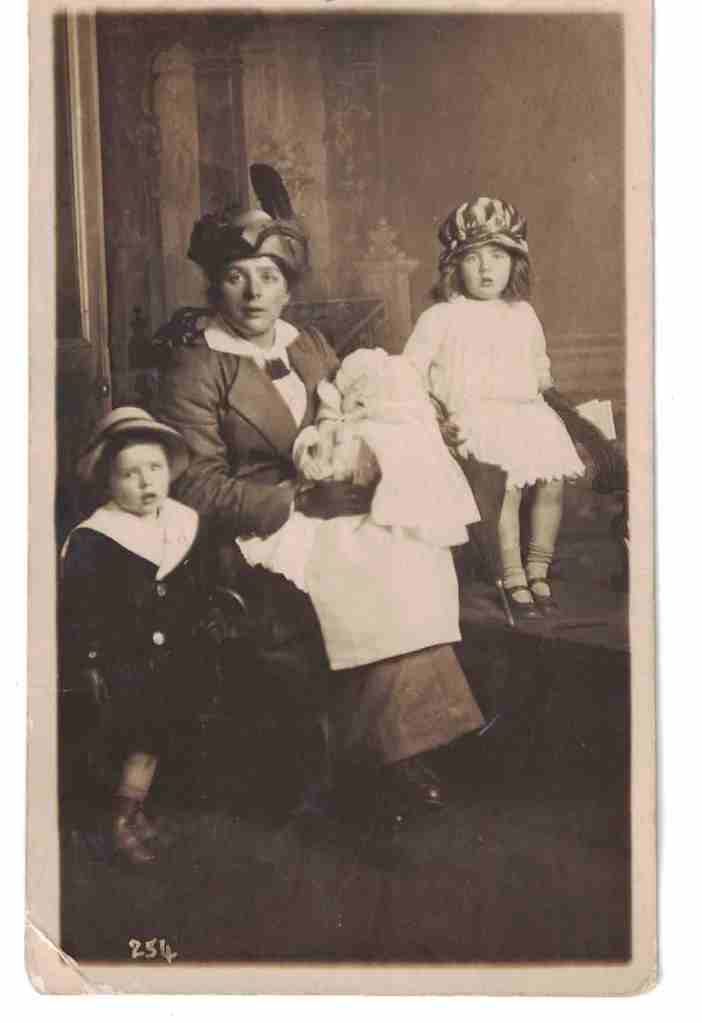
Mary Munro (nee Sweeney) March 17,1915 for the baptism of my father Thomas Munro, Jr. At the time her husband was serving in the Ypres Salient on the Western Front with her nephews, brothers and brother in law. When my father was born, March 10 1915, my grandfather was listed Missing in Action. As the story goes my grandmother prayed every day and soon she had a telegram that her husband had been rescued by his good friend Johnny Robertson and handful of “Dins”. My grandparents were forever grateful to the Indian soldiers of the Raj.

https://www.city-journal.org/gertrude-himmelfarb?fbclid=IwAR0BJJ5SmUz1wwQLgTtdPfWbO18aG2875EHo3-Q-8uEgk2VbDoGgURqZTb4

My godmother Kitty Tracy (nee Scally) and my father’s sister Helene (Nelsie) Munro
To the right, Thomas Munro, Sr while serving with the 1st Battalion Argyll and Sutherland Highlanders to the left is his nephew Jimmy Quiqley (his mother was my grandmother’s sister) Both men emigrated to America in the 1920’s and never returned to Scotland.

A very warm eulogy to Himmelfarb the scholar and author and Bea Kristol the wife, companion, friend and woman. I have read many of her books and have never ceased to be impressed by her learning and analysis. The Victorian age is not that far away from me. My grandparents were born in the Victorian Age. My grandfather told me about the The 1897 Diamond Jubilee; he was a boy apprentice in the Merchant Marine and saw some of the celebrations in India and China. He remembered her death in 1901. He told me that Queen Victoria was almost universally loved and admired especially in Scotland. Soldiers loved Queen Victoria because she honored them and the bravest among them with the Victoria Cross. She symbolized the motherland.When I think of my parents and grandparents I think of people who took responsibility for their lives. They were not wealthy or even middle-class but they worked hard to be RESPECTABLE lower upper working class even if that mean long stints at sea and working as birds of passage in Latin America, Canada and the United States. I never once heard my grandparents curse or use foul language. And to them the family was indeed, as Himmelfarb wrote, a :”sacred place”. My grandparents had little formal education; they could not read or write their native language but were reasonably literate in English. They were, by today’s standards, good readers. Both my grandmothers studied the Bible or Missal assiduously. My grandfather quoted Burns and Kipling freely. They were country folk by birth and so there were no doubts in their generation as to belief in God, his Commandments and heaven. They were tempted by Socialist and Marxist ideas in their youth but disagreed fundamentally with Socialism on issues like patriotism, the Empire and Christianity (all of which my grandparents were sure were benevolent and good). Both my grandfathers were heavy drinkers -when they got the chance- but their wives were completely teetotal.

It was the practice for the men not to drink heavily except Saturday nights. They routinely turned over all their wages to their wives (so did the children) and the wives handed out money for some amusement such as picnics, attendance at the movies, concerts or ball games. My paternal grandfather was proud of the history of his Regiment and showed me in the atlas they many places they fought and who among kinsmen and friends won decorations especially the Victoria Cross. They emulated and admired middle-class ethics and values. Courage, politeness, civility , graciousness, generosity and integrity were bywords for Victorians like my grandparents. The highest compliment was to be considered lady-like and for a man to a “a Highland gentleman.” So Himmelfarb was exactly right that the Balmoralism of the Queen and the Victorian values she represented were emulated by working class people.

I know they were all united by their love of the monarchy, the flag, the Empire and Commonwealth. My grandparents were separated only by war and be death. To them marriage vows were sacrosanct. I remember one of the worst things my grandfather would say of a man was “he has naepoosh” (no push/no ambition). The highest honor was to be a “leal n’ true mon.” (what Bea Kristol would probably call a “mensch”. It is not an exaggeration to say they probably attended church or religious gatherings over 200 times a year. My grandfathers were avid readers of newspapers and enjoyed military bands, concerts and recordings of famous artists like Marjorie Kennedy-Fraser, Caruso, Rachmaninoff or John McCormack. They were very proud to be British in origin (they became naturalized Americans) and very proud to have served as soldiers of the Queen in many famous Regiments (most now disbanded and with Yesterday’s Seven Thousand Years). When King and Country needed them in 1914 they answered the call (An Gairm) from far off India, Australia, America, Canada and so in Glasgow alone 200,000 men volunteered for service. A large percentage were men who were Canadian citizens or USA citizens who returned for what they considered “the cause of True honour” -defending the motherland.

They did not have much education but they valued education opportunities for their children and grandchildren. Thanks to my grandparents (maternal and paternal) my father was the first in his family to graduate from high school and then go to college (Brooklyn College as the fates would have it). My mother was the first in her family ever to graduate from high school and she went on to become a RN. My parents succeeded in life and their children and grandchildren too in part because of the values that were passed on.

Himmelfarb is right that poverty is “a matter of mind and spirit as of the pocket.” My father’s mother scrubbed and washed the steps of her tenement regularly. Her home was always immaculate. She made sure her husband and children had clean clothes to wear especially on a Sunday. She had to do all the washing by hand with a washboard and usually with cold water. She was proud that she always gave something at church. She and her generation sacrificed to send money to help build the Oban Cathedral (finished in 1959). Most of the money came from overseas Gaels. Wherever they went they help build churches and communities.

And yet these were people who suffered cold and real hunger many days of their lives. It was very common, at the end of the month or in a bad season, not to eat at all for days or merely eating turnips and porridge and hot tea without sugar. When my grandmother came to America by steamer everyone survived on crackers, butter, marmalade and hot tea, two or three times a day. But she never complained and always said grace at meals. One of the virtues she taught us was to HAVE GRATITUDE. Americans today could learn much by studying the lives and morals of Victorians and the works of Gertrude Himmelfarb. Victorians were brave, hard-working, tough, generous, noble, loyal, loving and ambitious. Even their failings leaned towards virtue’s side. They were not great, prosperous and free by accident. Himmelfarb recognized that the key to their greatness was moral principles and moral character which informed their lives and actions.

Ave et vale, julian castro and musings on bilingualism

By Richard K. Munro

So Julian Castro (have you noticed? ) is out of the 2020 presidential race. I can’t say I was ever impressed or intrigued by him. Mr. Castro’s lack of Spanish fluency was just one factor about his education and background. Another factor would be his diction in English and what kind of education or culture he displayed in his speeches. What logic he used. What values he has. Obviously, speaking and studying Spanish was not a high value for him. Everyone in our family speaks Spanish. Like our religious faith it is a high value for us. Yesterday we had dinner with friends and spent the entire afternoon talking and joking in Spanish. We are Hispanophiles or native Spanish speakers from Chile, Peru, Spain and Mexico. All of us are fluent in English and comfortable in the Anglosphere but there is no question that the ladies in the room felt more at home in Spanish, their home languages. In my extended family, Spanish and French are the predominant languages. Only a small cohort -those born and educated in the USA or Canada-are fluent English-speakers. So when we get together on holidays Spanish is the predominant language with some small lapses into French, Scots or Gaelic for some older people. As time goes by the Scots quotient diminishes to only one, two or three people (all over 60 years of age) I don’t expect most Irish Americans to speak Irish Gaelic or Scots to speak Scots Gaelic BUT their attitude towards the language IS important to me. It is hard for me to like someone who dislikes my language or my wife’s language. I don’t like crude nativism. For most of my life, I would say my language has been the subject of scorn, humor, and satire. People laughed. People thought it was useless, silly even ugly. They said it had absolutely no utility whatsoever. I have strong memories of being publicly mocked and the cruelty of my classmates.The end result is most of the time I keep my knowledge to myself. But I know this: those of us who are multilingual in my family started off speaking two or three languages and branched out from there. Being open to other languages made it easy and desirable to learn to read, write and speak in languages other than English. I realize few understand my language and fewer have any interest in it whatsoever. But I cherish my friends who love the old language, it’s music, literature and song.But knowing other cultures and speaking other languages seems very important to me. Someone who is so parochial as not to know any other language. -even a passing acquaintance or reading knowledge of a language- demonstrates to me a serious educational failing. Similarly, so one who demonstrates zero interest in religion or ethical values merely political ones seems a very flat personality to me. I am sure Julian Castro is a nice fellow and a man who seeks justice for others -good characteristics). However, I have to say he never impressed me by leadership, moral character or intellect. To me, he was just another marginally prepared and marginally educated politician. If I am mistaken I would be glad to be corrected by him or by others.

But I would need a lot of evidence to change my opinion.

Remembering the Virtues ~ The Imaginative Conservative

I suspect that much of the neglect of virtue comes as much from its inconvenience for the powermongers as much as it does from its necessary reliance on free will. “Men will be good or bad builders as a result of building well or building badly,” Aristotle claimed. “For if this were not so, there would have been no need of a teacher, but all men would have been born good or bad at their craft. This, then, is the case with the virtues also.” Somewhat horrifically, though, for the last two-hundred years, western civilization, in particular, has moved steadily away from a belief in real choices and toward determinisms of various types.

The virtues, however, are rooted in nature, in creation, and in God’s will for us. They can be forgotten, mocked, or distorted, but, being real and true and beautiful, they can never be conquered. Russell Kirk argued that virtue “is [the] energy of soul employed for the general good.” Thus, there is never a bad time to remember the virtues, and our society desperately needs them. God distributes these, then, according to His Will, through His Economy of Grace. “For just as in a single human body there are many limbs and organs, all with different functions,” St. Paul wrote, “so all of us, united with Christ, form one body, serving individually as limbs and organs to one another.” Gifts such as teaching, counseling, or speaking “differ as they are allotted to us by God’s grace, and must be exercised accordingly.” Our gifts should be for the common good, for the Body of Christ—that is, the Church.
— Read on theimaginativeconservative.org/2020/01/remembering-virtues-bradley-birzer.html

treasureoftradition.com/faceless-man

The Faceless Man finds safety only in the group think with which he must comply or be further alienated from society. He searches for meaning through membership in ideological tribes mistaking his shared beliefs for belonging. In fact, he is still a Faceless Man, a part of a movement, a cog in a wheel of godless religiosity that superficially and only temporarily numbs the awareness of his own loneliness.
— Read on treasureoftradition.com/the-faceless-man/

Are jews smart?

“And there is the understanding, born of repeated exile, that everything that seems solid and valuable is ultimately perishable, while everything that is intangible — knowledge most of all — is potentially everlasting.” Bret Stephens.

Having reverence for books, wisdom and knowledge is vital.

Controversial article? Jews are often smart. Tell me something I don’t know. This was an idea I thought about and discussed with my father almost 50 years ago. He said, and I think his approach has great wisdom, that the Jews had an ancient tradition of literacy (the most ancient in the world) and a great reverence for books, wisdom, and knowledge. Other peoples who similarly have developed or maintained a strong tradition of academic discipline and curiosity have excelled as well: we see this among many peoples but especially the ancient Greeks, Enlightenment Scots, Chinese and others. I consider myself an intellectual and I suppose I am. But both my father and I benefitted from having an education that was partially Jewish through our many Jewish teachers and professors. Next to the Jews, I would say many of my best teachers were Jesuits or Jesuit-educated professors. My grandparents were talented and hard-working people with little formal education not even finishing grade school and going to work as early as age eight. So my grandfather was (apparently) a talented linguist (he could communicate in Hindi, English, Punjabi and some French (as well as his native Gaelic and Scots) but he could not read most of these languages or write them. He was, however, an avid reader of newspapers and periodically and fascinated by geography, maps and atlases. He had an encyclopedic knowledge of baseball traditions and stories (he must have heard thousands of games on the radio and seen hundreds in person) and he remembered dates, names of battles, regiments etc. He also loved music and enjoyed Rachmaninoff, John McCormack whom he saw perform in person. But I don’t think he ever read an entire book in his life. So he knew something about music, poetry and songs but almost nothing about literature. He was very knowledgeable about Socialism and Marxism because he flirted with Socialism/Marxism and therefore Communism as a young man. He escaped the influence of the Red Clyde, however, and by the time I knew him he was a staunch anti-Communist. From my grandfather I developed a love of Scottish songs, military music and baseball. From my parents I was instilled with a reverence for books, music, languages and higher culture. I was aware it was a great privilege to be able to go to school and to afford to buy books and do some travel. Too often people are narrowly educated and stop thinking and reading into adulthood. One problem of education today is that it has become so easy to get (like a supply of freshwater) that young people take for granted the highly subsidized leisure time they have to study and improve their minds. As a teacher, I see the biggest difference between students is one of concentration and discipline and reverence for schooling and education. If one does not have good discipline and respect for education then one will not progress very far. I can’t understand how some people think they can learn a subject in depth without listening and without reading and studying.

Why DID ROME FALL

By Richard K. Munro

Rome conquered and endured due to its organization, superior communication systems, superior professional military and its basic legal and economic stability. One great weakness of Rome, however, was its lack of a formal system of executive succession. During the era of “Good Emperors,” the Emperors adopted the person thought best to succeed. This fell apart when Marcus Aurelius died and was succeeded by his son Commodus. Also for some reason, Rome stopped developing economically and technologically. Theoretical steam engines were invented but never used except as a parlor trick. The Romans had presses for olive oil and could have easily developed the printing press but did not. Perhaps their dependence on slave labor hampered or discouraged technological and economic innovation. Gibbon was convinced that Christianity destroyed the Empire by destroying its military virtue.

But the root cause, I believe is that philosophically and morally pagan Roman society was rotten to the core. Sex was for erotic pleasure only and the rearing and education of children were neglected. The Romans were extremely hedonistic and dedicated themselves to Bread and Circuses. In Rome by the 3rd century, there were over 180 festivals a year -which meant free food and games. I believe the Romans stopped thinking and working. The barbarians were numerous and warlike and increasing armed and trained in the Roman fashion. We forget that many of the barbarian leaders were Roman citizens and had been officers in the Roman army.

Nations and civilizations which discover how much easier and soft it is to live for ephemeral pleasures without worrying about anything permanent in the world of the mind and the soul, soon find their mental muscles turn to mush and they cannot think about difficult economic, social and political problems. They prefer emotional outbursts instead of thought and sustained the intellectual effort. Uneducated, indisciplined people become incapable of organizing their experience into a logical pattern and become impotent to plan or train for changes in the future or very important to recall the lessons of the past.

In short, only the educated are free and the uneducated will lack the wisdom to sustain and make a more perfect Union.  Surely, this must be considered a warning to our own “permanent” and “highly-advanced” civilization. In the years to come we may find out how fragile our civilization really is.

Book Review: Beyond Tenebrae: Christian Humanism in the Twilight of the West – Entering the Public Square

It is these defenders of order that Birzer seeks to highlight. For people like myself, it is easy to feel like you are alone, watching the world burn, but not knowing what to do about it. I live in a state with a very small Christian minority. While I am thankful for the Christians I have in my life, we all know that we are, in the words of Russell Moore, a prophetic minority. Birzer’s work serves as an antidote and an encouragement. There is a vast tradition of those who have looked into the abyss but have remained strong. In fact, they have done more than that, they have created. They have harnessed pieces of the Good, True and Beautiful and presented them to us for our fortification and enjoyment.
— Read on www.enteringthepublicsquare.com/blog/book-review-beyond-tenebrae-christian-humanism-in-the-twilight-of-the-west

C.S. Lewis and His Critics ~ The Imaginative Conservative

A more serious challenge came from English poet and historian Robert Conquest who charged Lewis and Charles Williams with holding and promoting totalitarian sympathies. While his criticism applied mainly to Williams, Lewis became a part of the controversy by praising Williams’s Arthurian poetry. The two men, Conquest claimed, willfully obscured the venerable mythology, thus rendering it and its story unintelligible to the average person. They turned the vast Arthurian legend into a “complex intellectual parlour game,” a gnostic jumble, accessible only to the Elect. In Williams (and, by inference, in Lewis), one finds “a genuine writer who has fully accepted a closed and monopolistic system of ideas and feelings, and what is more, puts it forthrightly with its libidinal component scarcely disguised.”[7] That which is intelligible advocates the use of violence “to bring in unbelievers” with human beings treated merely as a means to an end.[8] Lewis and Williams each promote a “psychology of totalitarianism—of hierarchy and sadism.”[9]
— Read on theimaginativeconservative.org/2019/12/cs-lewis-his-critics-bradley-birzer.html

If Orwell Had an Anthem, Pink Floyd Would Have Produced It | The American Conservative

One of the bestselling and most popular rock groups of all time, Pink Floyd—in its various incarnations—released 15 studio albums between 1967 and 2014. Throughout it all, the band never stopped experimenting with sound, pioneers in psychedelic and progressive rock. Their eighth album, Dark Side of the Moon, sold over 45 million copies and remained consistently on the album charts for a decade and a half. Their eleventh album, The Wall, sold over 23 million copies in the United States alone and many, many more worldwide.

Over the last year, Pink Floyd’s stalwart guitarist, David Gilmour, has emerged as the grand and genteel statesman and gentleman of the rock world, donating his guitar collection to charity. Gilmour raised an astounding $21 million from that auction, including from the sale of his famous black Stratocaster used for “Comfortably Numb.”

Gilmour’s chosen charity? ClientEarth, a nonprofit that seeks to radically and fundamentally alter economic activity toward a more sustainable and “green” future. “The global climate crisis is the greatest challenge that humanity will ever face,” Gilmour tweeted, “and we are within a few years of the effects of global warming being irreversible.”
— Read on www.theamericanconservative.com/articles/if-orwell-had-an-anthem-pink-floyd-would-have-produced-it/

Those Awkward Teenage Years – The 2010’s, pt. 10: 2019

Well, we’ve reached the end of the decade, and the end of our retrospective. Whew!

2019 proves that prog rock’s current renaissance is showing no signs of slowing down. We finish this decade with another year providing a surfeit of wonderful music. I’ve picked 11 representatives from 2019 for your listening pleasure. Here they are, in alphabetical order.

Big Big Train: The Grand Tour

Big Big Train went for the big ideas on this one. It’s loosely based on the concept of a “grand tour” that educated Europeans took in the 1700’s and 1800’s. They manage to pull together such disparate topics as St. Theodora, the poet Shelley, and the Voyager spacecraft. Believe it or not, it all works!

Cyril: The Way Through

Both Manuel Schmid and Marek Arnold are in Cyril, and I recently wrote a review of their excellent 2019 release, The Way Through. It’s about a man who has a near-death experience, and the struggles he has to overcome to reunite with his earthly body. A great prog effort!

Flying Colors: Third Degree

This supergroup just gets better and better. On their third album, Flying Colors branches out into a diversity of styles, and come up with one of the best of the entire decade.  “Last Train Home” is my favorite, “Geronimo” is funky blast of fun, and “Love Letter” sounds like a lost Raspberries classic.


Continuum Acceleration
In Continuum: Acceleration Theory

In Continuum is another Dave Kerzner project that rose from the ashes of a planned Sound Of Contact reunion. It is a concept album about an alien who falls in love with a human, before Earth is scheduled to be destroyed. Kerzner recruited the cream of the crop to play on this, and it is a fine addition to his already impressive resume.


Izz: Don’t Panic

Izz released one of the most enjoyable albums of 2019. “42” is about Jackie Robinson breaking baseball’s color barrier. While “Age Of Stars” features interweaving vocals and a driving beat. Their previous album, Everlasting Instant, was good, but Don’t Panic has more focus and confidence.


Moron Police
Moron Police: A Boat On The Sea

Goofy name, amazing music! These guys sound like a hybrid ska/prog/new wave band with an incredible vocalist. They have terrific playing chops, and their ability to switch styles mid-song makes my head spin. I found them via Tony Rowsick’s indispensable Progwatch podcast, and you can’t beat them if you just want to have something fun to listen to. “Captain Awkward” is a great track to start with, if you’re curious.


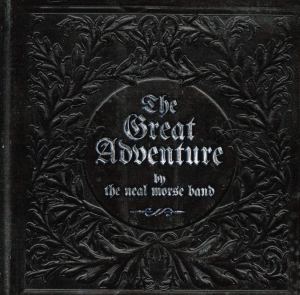
Neal Morse Band: The Great Adventure

The Neal Morse Band pick up the story where Similitude Of A Dream left off. In this installment, the son of the protagonist from Similitude must battle his own demons and find salvation. I actually like this album better than Similitude, because there is more variety in the songs. There are so many good ones, but “Vanity Fair” really stands out.


Pattern Animals
Pattern-Seeking Animals

Since Pattern-Seeking Animals consists of current and former Spock’s Beard members, you would expect this to sound somewhat Beard-like. However, the Pattern-Seekers come up with their own individual style that sets them apart. Ted Leonard is excellent on vocals and guitars, and John Boegehold steps up and takes a more visible role. “No One Ever Died and Made Me King” is the key track.


Bruce Soord: All This Will Be Yours

Often a much-loved album doesn’t make a positive first impression on me. That was the case with Bruce Soord’s (The Pineapple Thief) second solo album, All This Will Be Yours. On first listen, it is an unassuming set of songs, softly sung by Soord over a bed of mostly acoustic guitar and murmuring electronics. However, the more I listen to it, the more I am taken by it. “One Misstep” in particular is an engaging tune, with a mournful melody as Soord sings of his determination to make a broken relationship whole. As a matter of fact, I like this record better than the Thief’s much-acclaimed Dissolution, which was also released this year.


Tool: Fear Inoculum

This was the biggest news in progworld in 2019 – after more than a decade, Tool reunited and recorded this massive groove-laden record. All of the songs segue into each other, and the result is almost trance-inducing. I was not a huge fan of Tool’s early work, but I love this one. Maynard James Keenan seems to be rejuvenated these days (as last year’s Eat The Elephant illustrated), and that is good news.

Devin Townsend: Empath

After recording several albums with his Devin Townsend Project, Townsend decided to go solo for the highly personal Empath. Once again, his patented wall-of-sound production is in play, and his incorporates choirs, strings, and guitars. Lots of guitars. Devin can be inconsistent, but Empath is one of his best.

And that completes our look back at the decade from 2010 – 2019. There were some exciting new artists that emerged, like Damanek, Evership, Perfect Beings, and Southern Empire, while veterans like Big Big Train, Gazpacho, Glass Hammer, Katatonia, and Neal Morse released some of the best music of their careers. Several surprise reunions bode well for the future: it was great to see Kino, A Perfect Circle, Tool, and Slowdive back in action.

I hope this series of posts inspired you to check out somebody you may not have been aware of, or go back a revisit an old musical friend. If you are interested in hearing more prog news and music, check out the podcasts ProgWatch and The Prog Report. Both are excellent resources for learning about and hearing new music in progworld.

Merry Christmas, Happy New Year, and Happy New Decade!

Music, Books, Poetry, Film