
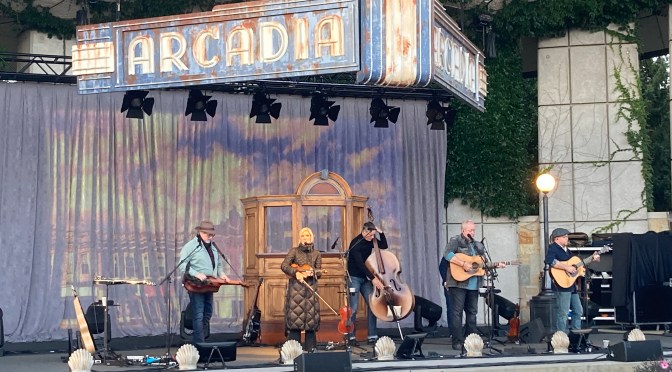
Alison Krauss & Union Station featuring Jerry Douglas, Meijer Gardens Amphitheatre, Grand Rapids, Michigan, September 5, 2025.
Over three decades, Alison Krauss has parleyed her singing and fiddling skills into an international career that (with the help of a Coen Brothers movie or two) brought bluegrass back to the masses and boosted her into an orbit of musical celebrity shared by few. But in the wake of her second collaboration with rock god Robert Plant, Krauss went back to her beginnings, reconvening her long-time band Union Station after a ten-year hiatus, with a new album and a six-month tour on the agenda. And that’s how, on the first genuinely chilly evening of Meijer Gardens’ concert season, Krauss and company wound up onstage in winter gear, getting down to business with relish, drawing a sold-out audience huddled beneath layers of Gore-Tex and fuzzy blankets toward their blossoming circle of musical warmth and light.
Not that Krauss & Union Station’s music is all sunshine, lollipops and rainbows. The tunes featured from their new album Arcadia were about (in this order): loneliness; a factory fire disaster; loneliness again; a mysterious stranger terrorizing a small town; and getting shut down on the make. In fact, some of the most compelling vocal moments were the darkest – Krauss’ spooky solo turn on “Ghost In This House”, Russell Moore’s bone-chilling folk narrative “The Hangman”. And there was melancholy galore in the mainstays of the band’s back-catalog: “Every Time You Say Goodbye”, “Let Me Touch You For A While” (“our one sexy song”, according to Krauss), revamped 1970s soul classic “Now That I’ve Found You”, and a spare, devastating cover of Willie Nelson’s “Angel Flying Too Close To The Ground.”
But while sad songs say so much, they weren’t the only emotion on offer; for every heartbreaker, there was an anthem to survival and resilience like the new “One Ray of Shine” and the classic “Forget About It.” In these tunes especially, Krauss showed her consummate range and interpretive skill, pattering out the verses to draw us into the story, then launching into the high lonesome choruses (often cradled by Union Station’s understated vocal harmony) to finish the job. While that sweet, supple voice is Krauss’ foremost calling card, she’s also consistently savvy with her vocal gift, knowing how to blend in tart, savory, even spicy flavors as the music requires.
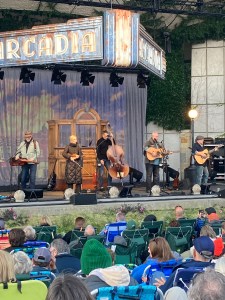
So there were humor and high spirits aplenty to set off all the sadness too. Whether commiserating with us about the weather (“You all look like Paw and Laura under the blankets in the back of the wagon”), or slyly teasing her bandmates (guitarist/banjo player/songwriter Ron Block was introduced as “our sexy librarian — and a recovering vegetarian”), Krauss combined downhome deadpan with a mischievous gleam in her eye whenever she addressed the audience. And when Union Station launched into hoedowns “Choctaw Hayride”, “Sawing On the Strings” and Bill Monroe’s “Cluck Old Hen”, she leaned right in, hunkering down on rhythm fiddle as Block, violin/mandolin wizard Stuart Duncan and dobro legend Jerry Douglas tore it up over Barry Bales’ resonating bass.
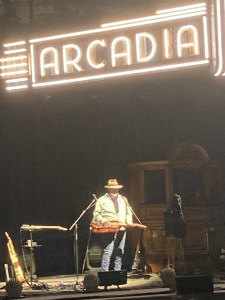
Douglas proved equally riveting in his extended solo spot, a weird and wonderful medley of Paul Simon’s brooding “American Tune” and Chick Corea’s festive “Spain”. Extra kudos go to Russell Moore as well: slotting into the male lead vocal spot formerly held by long-time stalwart Dan Tyminski, he brought home the bacon on both the back catalog and the upbeat “(Crazy ‘Bout A) North Side Gal” (which, in Krauss’ words, “covered three important topics – geographical location; mental wellness; and gender.”)

Ultimately, a concert by Alison Krauss & Union Station comes down to first-rate musicians playing and singing deceptively simple yet deeply affecting music, at the highest level of technical brilliance and visceral commitment, to stunning effect. But if anything, the extended encore, where the sextet gathered around a single microphone to harmonize with minimal instrumentation, sounded even richer depths. As the gentle love song “When You Say Nothing At All”, the weeper “Whiskey Lullaby”, the traditional spiritual “Down to the River to Pray” and Block’s moving confession of faith “There Is A Reason” wafted into the chill of the night, it settled over the rapt crowd like a bluegrass benediction to provide a thoroughly satisying finish. Put simply: hear and see them live if you can.
— Rick Krueger
Setlist:
- Looks Like the End of the Road
- Granite Mills
- Choctaw Hayride
- Sawing on the Strings
- Rain Please Go Away
- Every Time You Say Goodbye
- Cluck Old Hen
- The Lucky One
- Ghost in This House
- I Don’t Believe You’ve Met My Baby
- Baby, Now That I’ve Found You
- Wish I Still Had You
- Angel Flying Too Close to the Ground
- Let Me Touch You for Awhile
- American Tune (Jerry Douglas solo)
- Spain (Jerry Douglas solo)
- Dust Bowl Children
- The Boy Who Wouldn’t Hoe Corn
- Lie Awake
- The Hangman
- Orange Blossom Special
- One Ray of Shine
- Restless
- North Side Gal
- Forget About It
- Paper Airplane
- Gravity
- When You Say Nothing at All
- Whiskey Lullaby
- Down to the River to Pray
- A Living Prayer
- When He Reached Down His Hand for Me
- There is a Reason
 Spirit of Cecilia
You must be logged in to post a comment.