
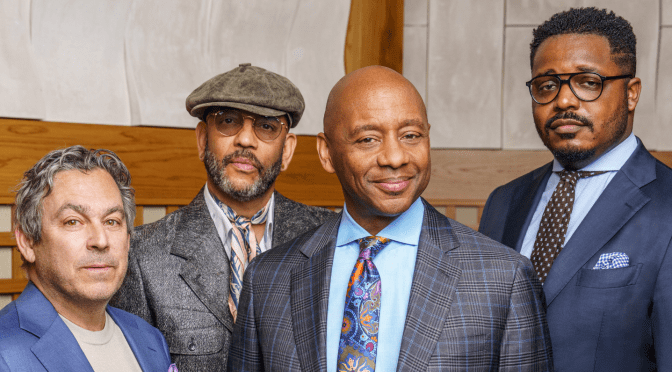
Hitting the St. Cecilia Music Center stage 20 years on from his last visit (and 40 years on from when I first heard him live with his brother Wynton, then with Sting), sax legend Branford Marsalis seemed relieved to have safely made it to Grand Rapids, just one night after two shows further north in snowbound Traverse City. (“Turned right at Cadillac and — whoa!! Where’s Santa?!?”)
But any fear that Marsalis’ tight quartet had been shaken by their brush with a spring blizzard soon vanished; loose and comfortable as their leader teased drummer Justin Faulkner about being the “birthday boy”, they were also focused and ready to play. With a flourish, pianist Joey Calderazzo launched into his postbop workout “The Mighty Sword” — and instantly, the band was in the moment, bringing the sold-out audience with them. Off the knotty head statement, Calderazzo built a two-handed solo to a simmering climax (both his legs were moving, too) that Branford took higher with volcanic soprano licks; meanwhile bassist Eric Revis pushed the pulse onward as Faulkner rolled and tumbled around and across his kit. On the edge of fully free expression, yet always locked into the underlying groove and listening hard to each other, the Quartet’s interplay was riveting and undeniable.
Keith Jarrett’s “‘Long As You Know You’re Living Yours” was up next. A funky highlight of Jarrett’s 1974 album Belonging (which the Quartet covered in full last year for Blue Note), it brought out a rambunctious streak in Branford, progressing from rhythmic subtones to frenetic sheets of sound; Calderazzo answered with deft, deeply swinging gospel. Which then dramatically transitioned into the rich lyricism of his “Conversation in the Ruins”, as both he and Marsalis took wing above Revis and Faulkner’s subdued, flickering rhythms.
Then, the history lesson. With Branford namechecking songwriter Fred Fisher (born Alfred Breitenbach in Germany before he emigrated to the USA), the Quartet timeslipped back to the primal years of jazz with “There Ain’t No Sweet Man That’s Worth the Salt of My Tears” (made famous by bandleader Paul Whiteman with Bix Beiderbeicke on cornet and Bing Crosby singing). Everyone soloed to powerful effect — Marsalis crooning on soprano, Revis gracefully, purposefully walking the bass, Faulkner delighting with a dynamic feast of accents and colors. It was only later that I realized: as bland, as polite – even as patronizing – as this music seems in retrospect, 100 years ago, it was on the cutting edge of American pop culture. Why not take it out for a spin today and see what happens?
“Why not?” turned out to be the throughline of everything the Marsalis Quartet did onstage, always leavened with affection for and attention to the music’s potential and each other. As the night went on, the crowd tuned into it, too: how Jarrett’s melancholic “Blossom” was elevated by Rives’ rhapsodic feature and Calderazzo and Branford’s insistent quotes from “Happy Birthday to You” (said one-upmanship bringing hysterical guffaws from Faulkner); how, nudged by the group’s thoughtful probing, Jimmy McHugh’s “On the Sunny Side of the Street” morphed from a hesitation shuffle through stop time to flat-out rock and back again.
And then, coming to an impasse onstage, Marsalis and Calderazzo asked the audience for multiple shows of hands : “Monk or Ellington?” (Branford after that vote: “Ellington wins. Ellington always wins.”) “Up or down?” (Up.) Which yielded a loping, speedy “It Don’t Mean A Thing (If It Ain’t Got That Swing)” as the last tune — and, announced as for the benefit of the “young musicians” from local high schools in the audience, a downtempo take on the same tune as the encore! Both ways, Branford smoked, Calderazzo swung, Rives flowed — but each drew on varying parts of their vocabulary, to vastly different effect. Though working in the same vein, Faulkner well and truly went to town throughout; his creatively minimalist solo choruses for the encore (first brushes on snare with quarter-note kicks, then entirely on floor tom, ranging from warm caresses to rim cracks to meaty thuds) proved an enticing riot of colors and syncopations. The standing ovations that followed each version were both earned and inevitable.
This lineup of the Branford Marsalis Quartet has worked together for more than a decade. As friend and fellow blogger Cedric Hendrix has observed, that’s rare in jazz circles; the consistent result, whether on record or live, is spectacular internal chemistry – which in turn provides extraordinary opportunities for the music to truly breathe, scaling ever-increasing heights of freshness, invention and resonance. To witness all that, generated by four masters at play, bringing a century’s worth of music to spectacular, technicolor life — well, it’s an experience I’m glad I shared with 600 + others last night!
— Rick Krueger
 Spirit of Cecilia