
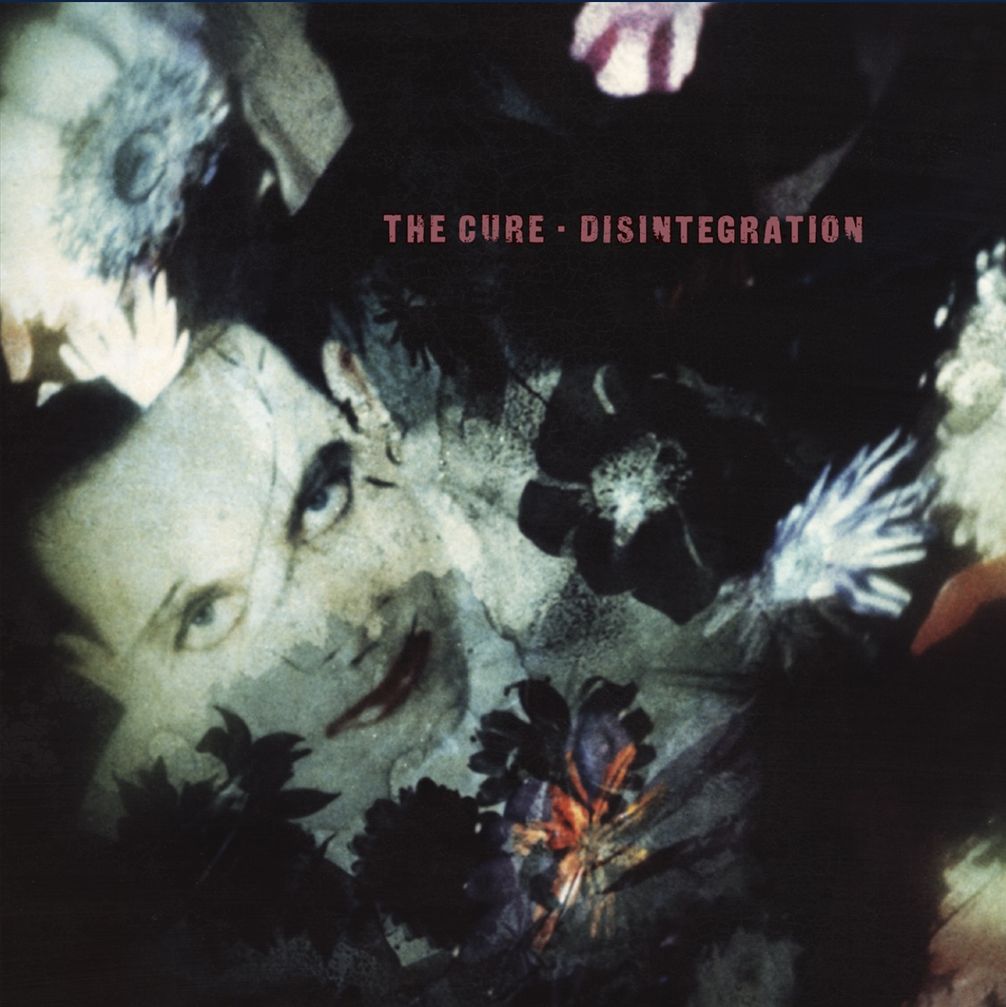
Greetings, Spirit of Cecilia readers! In this post, Brad Brizer and Tad Wert discuss their love for another classic album – in this case, The Cure’s Disintegration.
Tad: Brad, we’re reviewing this album at your suggestion, and I’m glad we’re giving it its due! I have to admit that Disintegration slipped by me at the time it was released. I was listening to the B-52s’ Cosmic Thing, Don Henley’s The End of Innocence, Paul McCartney’s Flowers In The Dirt, Todd Rundgren’s Nearly Human…in other words, a lot of “pop” music. Up to that point, the only Cure album I had listened to extensively was 1985’s The Head On The Door.
However, many years later I eventually caught a bug that only The Cure could fix (did you catch that? 🙂 and I dove into their entire catalog. Disintegration is definitely a peak of their long career. For me, it’s rare that an album creates an overall mood and atmosphere as consistently good as Robert Smith and company do with this album.
Brad: Dear Tad, thank you so much for agreeing (happily, I take it!) to review Disintegration. Ever since it came out–way back in 1989–I’ve been in love with the album. Indeed, from my first listen, it grabbed me rather hard and has held on for thirty-five years. It is, I think, the proggiest of The Cure’s albums, which helps explain why I like it so much. A kind of pop-prog or prog-pop, in the vein (though sounding nothing like) Pet Sounds by the Beach Boys or Skylarking by XTC.
The Cure is also famous for truly poppy songs–such as “Friday, I’m in Love.” I like these songs, but I don’t love them. These are almost entirely absent from Disintegration, which is another plus to my mind. I definitely much prefer a song like “Disintegration” to “Friday, I’m in Love.” I’d be pretty disappointed if the former didn’t exist in my life, but if I never hear the latter again, I won’t be upset.
Even the poppier songs on Disintegration–such as “Love Song”–aren’t that poppy, and they fit perfectly into the flow of the album. The album is almost perfectly produced, and the track order allows for the album to build and build (more on this in a later comment).
Again, I love this Disintegration as an album, and I always include it in my top 10 favorite albums of all time, along with several by Rush, Talk Talk, Kate Bush, Yes, Genesis, and Tears for Fears.
The album first came out in May 1989, at the very end of my junior year of college, and I was introduced to it by my great friend, Ron Strayer, then a student at the University of Kansas. We had been debate partners throughout high school, and we often shared our loves in common–science fiction novels, movies, and music. Ron’s tastes were always a little more poppier (in the alternative/college scene), and mine were always proggier (toward Genesis, Yes, etc.), but we mixed well.
This is, of course, the 35th anniversary of the album, but on the 20th anniversary, Roger O’Donnell of The Cure wrote an 11,000 (!!!) word reminiscence–complete with lots of great photos–of the making of the album.
I will admit, I’ve read this through twice, and I find it an amazing story. A weird story, but an amazing one.
Tad: Brad, thanks for sharing O’Donnell’s memoir of the recording of Disintegration. I love learning about the background of great albums. One thing he mentioned, and I kind of agree with, was his disappointment with the mastering – he says it sounded compressed and flat. He suggests that the live versions recorded at Entreat Plus (available on the 3-disc Deluxe Edition) are better representations. I don’t know about that, but the live versions are very good – a more open sound.
Okay, let’s discuss the songs. The one track that I absolutely love is “Lullaby”. Referring again to O’Donnell’s piece, I was surprised to learn that the band had all of the instrumental tracks completed before Robert Smith sang any lyrics. That means they had no idea that “Lullaby”, with its bouncy melody would end up being such a creepy song about spiders and death! Still, it is my favorite song on the album.
I also love the majestic opener, “Plainsong”. It is a perfect mood-setter for the entire album, with its massive, dirge-like chords that never relent. “Lovesong” is a nice respite from all the gloom, but I prefer the darker songs. I especially like “Prayers for Rain” – it slowly builds and builds into a beautiful edifice of sound. “Homesick” is one of the prettiest songs The Cure ever recorded, and “Untitled” is a wonderful closing track. It sounds like a musical postscript to a long letter, if that makes sense. [Brad: yes, this makes perfect sense]
I’m looking at the track times of these songs, and I never realized how lengthy they are! “Lovesong” at 3:29 is the shortest, while half of them are longer than 6 minutes. It’s a credit to the strength of the songs that I never feel like the album drags or is too long.
Brad: Excellent response, Tad. It’s funny (in a strange kind of way), I just finished Steven Hyden’s This Isn’t Happening: Radiohead’s Kid A . . . and I loved it.
But, it struck me several times in reading the book that when The Cure is experimental–especially as they were with Disintegration–they’re as innovative as the best of them.
You reminded me in email about our three-way conversation three years ago about whether or not The Cure were prog. In some ways, bands like The Cure and Radiohead are beyond prog. They simply are. They’re unique, and the music they create, overall, transcends musical boundaries.
Much of what The Cure has written has been very much in the pop vein, but much of it is just weird and experimental and wonderful and unique. One of my favorite collections is The Cure, Join the Dots, a four-disk exploration of their b-sides. Many of the b-sides are straight-up pop, but several are really experimental and proggy. Needless to write, The Cure’s b-sides would be almost anyone else’s a-sides.
Back to Disintegration. I’ve never noticed the mix as sounding flat or compressed, but I do love the dark consistency of the album. From the opening track, “Plainsong,” to the final track, “Untitled,” it feels as though we’re barely breathing–perhaps just on the surface of a lake, grasping for air. There’s a brilliant suffocation to the production of the album. The album, in some mysterious way, just feels “alive” but, again, grasping.
I wonder if Disintegration just happens to be the last of the great analog recordings, while digital would become the norm after 1989? I have no idea–just a thought.
Agreed, though, that The Cure sound amazing live. I’ve never seen them in concert in real time, but I own all the DVD/Blu-ray concerts the band has released, and they are among my favorites. Again, the pop songs are fun, but it’s the more intense, experimental songs live that really grab me. I love watching the interplay of the band members, especially on the more complicated songs.
Earlier, I mentioned how much I love the flow of Disintegration. The track order seems, in large part, to make this album. You’re absolutely right to call much of it “dirge like.” Again, I would call it grasping for life, perfect headphones in a dark room kind of music.
I especially appreciate the sequence of the second half of the album: “Fascination Street” to “Prayers for Rain” to “The Same Deep Water as You” to “Disintegration” to “Homesick” to “Untitled.” It’s as dark as dark can get, but so relentlessly driving. Even the one moment of hope, when it starts to rain at the beginning of “The Same Deep Water as You,” and after “Prayers for Rain,” begs the question: did our prayers get answered only to have us drown?
Even the transition from “The Same Deep Water as You” to “Disintegration” is treacherous. After all, the couple seems to die kissing in the former, but in the latter we have:
Yeah, I miss the kiss of treachery
The shameless kiss before I feed
The stench of a love for younger meat
And the sound it makes when it cuts in deep
The holding up on bended knees
The addiction of duplicities
As bit by bit, it starts the need
To just let go, my party piece
Brutal. And, together, the two songs take up nearly 18 minutes of the album.
Tad: Brad, thanks for making me aware of Join The Dots; now I have something else to add to my wishlist!
I agree with you that The Cure is best when they aren’t trying to be anything except experimental. And your Radiohead comparison is most apt. I originally thought The Head On The Door and Kiss Me, Kiss Me, Kiss Me were better than Disintegration, but over time I’ve reversed my opinion. On the first two, I get the feeling they are deliberately striving for a more pop sound, while on Disintegration, they had no plans to make a bestseller (if O’Donnell’s memory can be trusted!). I hated Kid A when it first came out, thinking it was pretentious and noisy. Now, it is my favorite album of theirs.
You also capture the same feeling I have when I listen to Disintegration – it is almost suffocating in its density. I mean that in a good way, believe it or not. All of its songs are of a piece, and it is one of those albums that is an album – every track adds to the whole, and the sum is much greater than its parts. In this age of streaming, I don’t believe artists think in terms of albums any more – except for proggers. Maybe that’s why you and I are so enamored of that genre; it’s still creating suites of songs that should be listened to as albums, and not as separate tracks.
Well, my friend, I think we’ve done The Cure’s Disintegration justice. As the years go by, it seems to gain in stature, and rightfully so. And to our Spirit of Cecilia readers, thanks so much for stopping by. If you have any suggestions for what you’d like us to discuss, let us know in the comments!

 Spirit of Cecilia
You must be logged in to post a comment.