
It’s time for a review of some classic music, and Brad Birzer suggested we take on four of the first six albums of the ‘80s group, Echo and the Bunnymen. Tad and Kevin join him for a conversation on them.
Tad: Brad, you know I love all things ‘80s; I think it’s the greatest decade for music in terms of diversity and creativity. I even have a Spotify playlist of favorite songs from around 1978 to 1991 that includes some big hits but mostly more obscure ones. It’s seventeen and a half hours long! However, I’m ashamed to admit that there’s a huge hole in my knowledge of new wave/alternative artists: Echo and the Bunnymen. I’ve had their best-of compilation, Songs to Learn and Sing, for years, but I’ve never delved into their albums proper until you urged me to do so. I’m glad you did! I’m looking forward to discussing Heaven Up Here, Porcupine, Ocean Rain, and Reverberation with you.Where do you want to start?

Brad: Seventeen and ½ hours! That’s brilliant, Tad. Is there a way to trade Spotify lists? I’d love to see yours. Of course, I would need to sign up for Spotify. For better or worse, I subscribe to Apple Music–which I assume is similar.
Echo. Where to start? I first encountered Echo and the Bunnymen when I was in high school through–if I remember properly–a John Hughes movie. The first song I heard from them was “Bring on the Dancing Horses.” For better or worse, my first Echo album was Songs to Learn and Sing, a greatest hits collection. I loved it, and I immediately bought their earlier albums. I was never taken with their first album, Crocodiles, though I should give it another listen, all these years later. I was, however, immediately taken with their next several albums: Heaven Up Here, by far their proggiest album; Porcupines, their most angular (like the Fixx) and claustrophobic album; and Ocean Rain, their most artful pop (much like XTC or Tears for Fears). Reverberations came out several years later, in 1990, and features a new singer, but I think it’s a truly excellent and immensely clever rock album, full of fun lyrics and really clever hooks.
I also happily own the four-disk deluxe, Crystal Days, 1979-1999, boxset. I own it mostly because it has the definitive version of my favorite Echo song, “The Killing Moon” (All Night Version) and several live tracks. Definitely worth the $100 I paid for it.
I wouldn’t even know how to classify Echo’s music overall. I realize they’re always lumped in with post-punk, but that doesn’t quite seem to capture them. As I mentioned above, I see elements of prog, New Wave, art rock, and straight forward pop rock in them. To be sure, they admired The Doors and the darker side of The Rolling Stones. And, Will Sargeant has admitted that he has a strong affinity toward prog. He even wrote a prog album under the name, Poltergeist. They only released one album, but it’s really good.
I’ve got so much I want to say about the particular albums we’re reviewing and covering, but, Tad, I’d love to know your thoughts–especially since you’re relatively new to the band. I’ve happily been listening to them for over forty years.

Tad: Okay, I have listened to Heaven Up Here several times over the past few days, and I definitely hear the Doors influence in Ian McCulloch’s vocals. However, I always thought the Doors were overrated, and I don’t think that’s the case with Echo and the Bunnymen. What hits me first on Heaven Up Here is the terrific guitar work of Will Sergeant. He has an angular style that is similar to U2’s Edge, but still unique. It dances on the edge of dissonance, but it is always faithful to the song’s melody. I really like Over the Wall, with its lengthy, almost ambient intro – as a matter of fact, it sounds like it was produced by Brian Eno. Of course, the single, A Promise, is a standout track. The way the tension builds inexorably to the release of the chorus is wonderful. The title track is a blistering rocker right off the bat that never lets up, and I love it. It’s followed by the brief and subdued The Disease. As a matter of fact the pacing of this album is very interesting – they seemed to enjoy creating contrasts between successive tracks: energetic and fast, then relaxed and somber. Finally, I really like No Dark Things, with its slashing guitar riffs.
One thing I am impressed with is how much this album hasn’t dated itself. By 1981, everyone was cranking out synth-heavy music with booming drums. Heaven Up Here could have been recorded today, and it really wouldn’t be out of place. As you mentioned, it’s also very proggy, or at least as prog as a group could get in the early ‘80s!
Brad: What a great analysis. Thank you. And, you’re right–especially about noting the progginess of Heaven Up Here, but only to a point–as you so well note, as proggy as someone could be in 1981. Part of the progginess comes from the linking of the first three tracks, one bleeding into another. (Tad: Absolutely, Brad – I love the trilogy of the first three tracks!)
I have to make a personal note here. While I’ve been listening to this album since roughly 1985 (the local music store owner in my hometown of Hutchinson, Kansas, first recommended it to me), it wasn’t until eighteen years ago that the album really came to mean something deep to me. Shortly after our Cecilia Rose was stillborn (she would’ve been eighteen this year), I was playing this album in the car. Crazily enough, my wife (more of a Cars and U2 person) really liked the album. When I told her it was called “Heaven Up Here,” she responded: “Of course it is, just like our daughter.” I’m sure Echo never meant for this album to comfort a set of grieving parents, but it did and does. There’s something about the music–especially in those first three tracks–that is musically and lyrically relentless and driving, unstoppable. I absolutely love the buildup of those three tracks. So anxious and yet so confident. “Bounds? Of course we know no bounds.” When we finally get to “Over the Wall,” we’re really accomplished something. Somehow, we’ve breached the fort, and we’re in hand-to-hand combat with the enemy. And, they are astounded by our ferocity.
I also think “All My Colours” is, by far, the proggiest song on the album. A brilliant dirge. The lyrics are trippy:
Hey, I’ve flown away
Hey, I’ve flown away (Zimbo, zimbo, zimbo, zimbo, zimbo)
That box you gave me (Zimbo, zimbo, zimbo, zimbo, zimbo)
Burned nicely (Zimbo, zimbo, zimbo, zimbo, zimbo)
That box you gave me (Zimbo, zimbo, zimbo, zimbo, zimbo)
Burned nicely (Zimbo, zimbo, zimbo, zimbo, zimbo)
Hey, I’ve flown away (Zimbo, zimbo, zimbo, zimbo, zimbo)
Hey, I’ve flown away (Zimbo, zimbo, zimbo, zimbo, zimbo)
All my colours (Zimbo, zimbo, zimbo, zimbo, zimbo)
And, “Turquoise Days” is beautiful, too.
Kevin: Coming of age in the 80s, I gained most of my knowledge about the post-punk movement from MTV. Echo was no exception. I remember the videos for “Crystal Days,” “The Cutter” and especially “Rescue” & “The Killing Moon.” They had a rough intensity that was appealing and if I remember correctly, some of these were live clips. But it wasn’t until college that I actually heard the album Ocean Rain in all of its glory! The band I was in at Notre Dame played both “Rescue” and “The Killing Moon” (both of which were highlighted by the very cool dancing, front and center, of Brad, our friend Tim, and my soon-to-be wife, Lisa). I bought Ocean Rain and fell in love with it immediately and if I remember correctly it was Brad who made tapes for me of their earlier stuff. I enjoyed the raw energy of the early recordings, but nothing was quite like Ocean Rain for my compositional sensibilities. Hearing well-crafted string parts with post-punk rock was an incredible combination and of course, the songwriting was stellar at that point in their career. So they were great songs, with great arrangements and spectacular vocals!

Tad: Kevin, since you brought up Ocean Rain, let’s talk about that album. I notice that it was released 3 years after Heaven Up Here, and, to my ears, it’s a much slicker production. I still like it a lot. The first track, Silver, has strings and a guitar solo that sounds like it could be played on a sitar. It seems to me to be full of joy.
Brad: Kevin, those are great memories. And, it must be noted, though I knew prog extremely well when you and I met in the fall of 1986, I really knew very little New Wave beyond Kate Bush, Thomas Dolby, Echo, Simple Minds, and The Fixx. And, much of what I knew came from watching the movies of John Hughes. You’re the one who introduced me to a load of post-punk bands, and I very much loved the introductions. So, again, I’m a bit surprised (and pleased) that my influence went in that awesome direction!
Yes, Tad, I’d love to talk about Ocean Rain. Frankly, it’s an album without a flaw. It is perfect pop, perfect art, perfect art rock. Though I would rather listen to Heaven Up Here, I can’t but help recognize the brilliance that is Ocean Rain. It ranks up there with Pet Sounds, Hounds of Love, Songs From the Big Chair, Colour of Spring, and Skylarking. All some of the best pop ever written. From that opening guitar strum meshing immediately into the strings and then McCulloch’s crooning voice, the first song, “Silver,” just screams perfection. “The sky is blue, my hands untied . . .” Even the “la, la, la”s work well.
I’d be really curious to know who wrote what on this album. Did McCulloch write all the lyrics and Sergeant all the music? Was it a collaboration? Who wrote the string lines?
“Nocturnal Me” is as claustrophobic as anything on Heaven Up Here or Porcupines. I presume the song is about vampires, though I’m never sure. Definitely gothic in its tone. The piano is especially good on the track.
“Crystal Days” is a great followup to “Nocturnal Me.” It’s as sunny as the previous track was dark. “Purify our misfit ways, and magnify our crystal days.” As always, amazing lyrics. The guitar also really anticipates the shoegaze pop of the late 80s and early 90s–music by the Cocteau Twins and others.
“The Yo Yo Man” is bizarre by any standard. The guitar sounds like something you might hear on the Texas-Mexican border, but the lyrics are about the frozen north, I presume? “Cold is the wind that blows through my headstone.” So, a rumination on death.
I’ve never totally understood “Thorn of Crowns.” I would assume that McCulloch, in some drug-addled way, is acting in persona Christi. This is the Passion if addled by LSD. Certainly, there’s a mystic strain to the lyrics (one person shifting into another), and the music has a middle-eastern feel of a Led Zeppelin song; that is, this is the New Wave equivalent of a “Kashmir.”.
So ends side one. Then, we get to side two, a side so cohesive in its four songs that it could be considered akin to side two of Kate Bush’s Hounds of Love.
Arguably, “The Killing Moon” is the finest rock song ever written. Certainly it’s in the top five. It really is perfection. My only complaint is that the song isn’t long enough. As it is on the album, it’s so angular, and it needs time to breathe. For what it’s worth, I highly recommend listeners seek out the all-night version of the song. Frankly, this is the song in its Platonic form.
Echo And The Bunnymen – The Killing Moon (All Night Version) (Digitally Re-Mastered)
“Seven Seas” is the poppiest song on the album, musically. Again, though, lyrically it’s just glorious. “Seven seas, swimming there so well, glad to see, my face among them, kissing the tortoise shell.” There’s just so much joy in this song, and it allows the listener to breathe.
“Burn the skin off and climb the rooftop” and we’re in “My Kingdom,” the penultimate track. I have no idea what this song is about, but I would assume this is side two’s answer to “Thorn of Crowns.” Again, McCulloch is offering us an acid trip of a mystical journey. And, yet, unlike “Thorn of Crowns,” this song ends in bitter destruction.
B-b-burn the skin off, climb the roof tops
Thy will be done
B-b-bite the nose off and make it the most of
Your k-k-kingdom, k-k-king
B-b-b-burn the skin off and climb the roof tops
Thy will be done
B-b-bite the nose off and make the most of
Your king, kingdom, kingdom, kingdom
You’re a bitter malignous person
And the d-d-death is well overdue
And, we finally reach the conclusion, “Ocean Rain,” a song of deep contemplation and near utter calm. Yes, again, crazily disturbing lyrics. While the music seems to suggest a baptism and redemption, the sailor actually finds himself suffocating and sailing into dark harbors.
“All hands on deck at dawn
Sailing to sadder shores
Your port in my heavy storms
Harbours the blackest thoughts”
After listening to this whole album–now for the umpteenth time–I’m both satisfied and exhausted.
Kevin: I’d like to offer a somewhat nuanced take on Ocean Rain. I would agree with Brad that some of the songs are structured as artful pop. “Silver”, “Crystal Days”, “Seven Seas”, and certainly “The Killing Moon” stand out as well-crafted tunes that generally follow a verse/chorus/bridge type of construction.
But others venture into exploratory waters, both musically and lyrically. “Nocturnal Me” trips through dark and wild territory, “The Yo Yo Man” and “Thorn of Crowns” both drift around angular melodies, middle-eastern guitar counterpoint, and punk vocal aesthetics. But “Thorn” in particular has an adventurous edge that almost feels like a return to 60’s prog–like Sid-era Pink Floyd.
In fact, Brad’s reference to the Doors, reminds me that much of Echo does seem like a nod to the beginnings of rock opening into the avant garde. This live performance from the BBC program The Tube gives an excellent introduction to where the band were just before the release of the album. Even without the studio bells and whistles, the performance carries the music through. And once the 35-piece string orchestra is deftly and richly applied to these beautiful tunes, it no longer seems appropriate to apply the “pop” moniker.
And lastly, the title track is just gorgeous, classic songwriting. “Ocean Rain” could comfortably find a home in the Sinatra catalogue. I would agree that by their follow up, the eponymous Echo and the Bunnymen record, they had clearly sailed into the pop world, but this formative time just before remains for me in more of a “progressive” musical space.
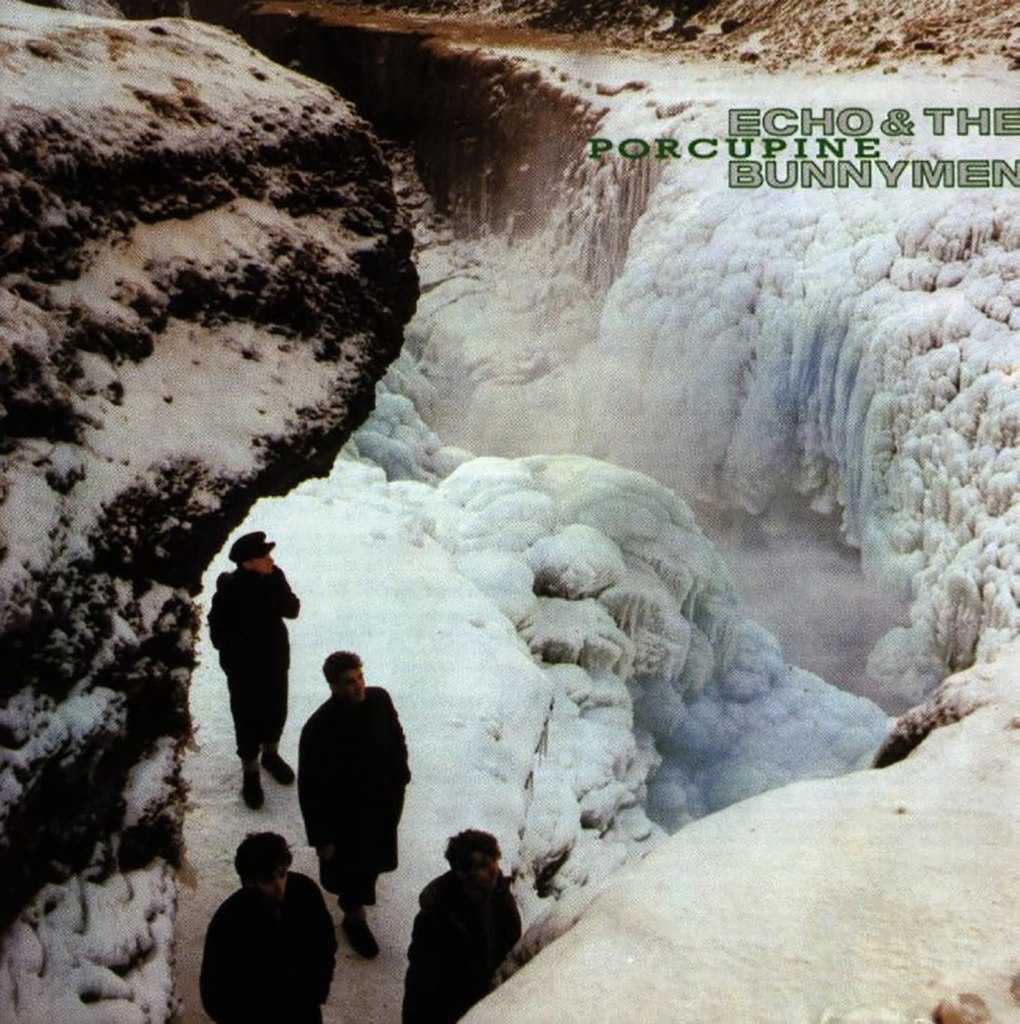
Brad: A great discussion, guys. Thank you. I’d like to turn to Porcupine. Porcupine, the band’s third album, is the most angular, the most New Wave of all their work. I get definite The Fixx vibes as I listen to this album. It’s also–in terms of music and lyrics–by far the most claustrophobic of the band’s albums.
Track one, “The Cutter,” has a blistering string intro before quickling melding into a blistering guitar, drum, and bass attack. It’s a great track, to be sure, but, I must admit, it’s hard for me to listen to, too often. Frankly, I’ve just played it too many times in my life. A good problem to have.
Track two, “The Back of Love” continues the blistering attack, but adding what sound like horns. I have no idea if those are real horns or the keyboards synthesizing horns. The lyrics matter, but they also become instruments in their employment on the song. That is, McCulloch’s voice is a blistering attack, too.
Things slow down, dramatically, with the beginning of the third track, “My White Devil,” an atmospheric song that becomes aggressive about 54 seconds in. The bass work in the song is especially strong.
Things speed up again with the fourth track, “Clay.” McCulloch’s lyrics are especially mind boggling and playful and ornery.
Am I the half of half-and-half
Or am I the half that’s whole?
Got to be one with all my halves
It’s my worthy earthly goal
Again, the song, musically and lyrically, is like a cat chasing its own tail.
The title track, “Porcupines,” track five on the album, has a funeral dirge feel to it, an anxious feeling, building slowly toward something very dark. The guitar work is especially strong, reminiscent of the soundtrack for The Good, The Bad, and the Ugly, but also very David Gilmour-esque as found on Dark Side of the Moon.
“Heads Will Roll,” the sixth track, is a song of longing.
Partly politic
Heads will roll
Mostly politic
God must call
‘Til the winning hand
Does belong to me
What if no one’s calling?
There’s no real answer to McCulloch’s anxiety, and he concludes that God must be missing.
“Ripeness,” track seven, is the most nondescript song on the album, an amalgamation of the other songs on the album.
The next two songs, “Higher Hell” and “Gods Will Be Gods” are brilliant, however. Contemplative and pregnant with anticipation, each builds to a satisfying conclusion, the lyrics mixing so well with the music. Again, the guitar work–so very angular–works so well here.
The final track, “In Bluer Skies,” plays with some wild percussion and offers a very dour ending to the album. Like with “Ocean Rain,” I’m tired after listening to this album. It’s a good and healthy tired, in that I’ve immersed myself in the art. But it’s being tired nonetheless. The album demands much of its listener. It gives much, too, but it definitely demands a lot. Yet, there’s no victory at the end of Porcupine. Rather, I feel like I’m trapped in a nightmare.
Tad: Kevin, thank you for your perceptive thoughts on Ocean Rain. Like I mentioned, I’m somewhat new to the music of these guys – hearing the albums as they came out in real time must have been fascinating, as the group matured.
Brad, I think Porcupine might be my favorite of these albums we’re discussing. The opening one-two punch of “The Cutter” and “Back of Love” is hard to beat. And even though the energy is less in the second half, I love the droniness (is that a word?) of “Gods Will Be Gods” and “In Bluer Skies”.
I’d also like to say a word about the cover art – I think the covers for Heaven Up Here, Porcupine, and Ocean Rain are outstanding, especially the glacial setting of Porcupine. It really fits the music. Whoever their art director (or directors) was deserves a lot of praise. It’s covers like these that make me appreciate the vinyl era.
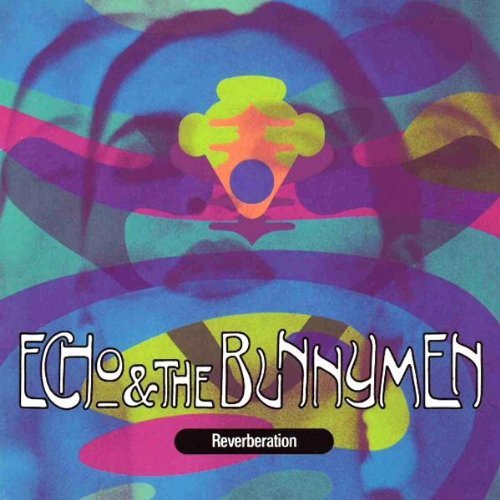
Brad: Great thoughts, guys. Thank you. Last, I’d like to turn to Echo’s 1990 Reverberation album. And, yes, I realize we’re skipping Crocodiles, the band’s first album, and the self-titled Echo and the Bunnymen from 1987. I like, but don’t love either. I do, however, really love Reverberation, perhaps their most bizarre album. It’s the only album not to feature Ian McCulloch on vocals, and it also is missing the incredible drummer Pete de Freitas who passed away in 1989. As such, it’s really only half of Echo in 1990.
Despite all these personnel changes, though, Reverberation is a beautiful album, musically as well as lyrically (which very cleverly tie together a huge number of cliches). Coming out in 1990, it’s a slice of neo-psychedelia that, I presume, had its impetus if not its origin in the extremely successful Oliver Stone movie, The Doors.
The album opens with contemplative strings that immediately transform into a rocking pop song, the guitar earnest and energetic. The new singer, Noel Burke, sounds nothing like McCulloch, but his voice is gloriously deep and crooning.
Track one immediately (without a break) segues into track two, “Enlighten Me,” thus creating a singular 9 minute opening to the album. “Enlighten Me” continues the neo-psychadelia as well as the cliched lyrics. “I’ll be, I’ll be, I’ll be enlightened,” Burke assures the listener.
Track three, “Cut and Dried,” is good, but track four, “King of Your Castle” is simply gorgeous. An anti-abuse song, lyrically, it grips the listener from the opening moments with its pulsating bass line. This is probably the best track on the album.
The next track that really soars is track seven, “Freaks Dwell.” It just simply rocks in every possible way.
Lost your reason
Lost your game plan
Sit you down
I’ll set the scene man
Brilliant
Bronze bohemians
Thought they were
A football team man
Let me take you to a hell
Where all the freaks dwell
Passed my god of woe
Pleasure pasture
Business sometimes
One more embrace
For the good times
Self-made man will
Unmake beds sure
Gagged and bound
And fights like hellock
Let me take you to the hell
Where all the freaks dwell
Passed my god of woe
I’m not totally sure what the song is about, but I assume the title should be taken literally.
Track eight, “Senseless,” is much more contemplative than “Freaks Dwell,” but still very good.
Track nine, “Flaming Red,” could easily have been a Doors’ track off of LA Woman.
The final track, “False Goodbyes” is not the strongest track on the album by any means, but it’s still really good. The strings are especially well done as the album concludes.
I realize that for most true Echo fans, Reverberation just doesn’t count because of the absence of Pete de Freitas and Ian McCulloch. And, the album was brutally bashed by reviewers when it first came out. But, I would ask any music lover to give it a second chance. There’s truly much to love here. A really brilliant pop-rock album with neo-psychedelia flourishes. Thirty-five years later, this music still stands up very well.
Tad: Brad, I can’t add anything to your brilliant and comprehensive analysis of Reverberation, except to say that when I first listened to it, it was much better than I expected. I knew McCulloch had left and they had recruited a new vocalist, and I think he does a fine job taking the group in a new direction. It’s definitely more open, bright, and poppier, and I thoroughly enjoyed listening to it.
Here’s my ranking of the albums we’ve discussed here:
- Porcupine
- Heaven Up Here
- Ocean Rain
- Reverberation
I went ahead and listened to Crocodiles and Echo and the Bunnymen, and I agree that they just aren’t up to the high standard of the other albums. Thanks for helping me fill this hole in my ‘80s alternative music knowledge!
Brad: Thanks so much, Tad and Kevin. I don’t think we ever really defined the genre that Echo best represents, but we sure had fun talking about it.
As always, we encourage you to buy your Echo from Burning Shed!
 Spirit of Cecilia
You must be logged in to post a comment.