I think it important to have pastimes and hobbies. I enjoy reading, listening to baseball games on the radio, listening to music and studying languages. My sister has an expression “being lost in grammar land” by what she means doing language study and being completely engrossed in it.
I am currently listening to SPOTIFY (BRAHMS) in a few minutes I will be back in my easy chair reviewing languages and studying new ones. I review GERMAN, PORTUGUESE, SPANISH every day for about 10-15 minutes each then dedicate time to study ITALIAN, MODERN GREEK and SCOTTISH GAELIC. I primarily use DUOLINGO but also have dictionaries and Teach Yourself Books to read and study points of grammar and vocabulary. With Duolingo I am more active than merely reading because I have to LISTEN, to REPEAT, to WRITE and RESPOND. I usually do it after some morning reading. I sip on coffee or tea. I do my oral review first and then I go to my notebooks and I keep track of new vocabulary (often drawing pictures in color). English is always in pencil and the target language in a dark color. I use red for emphasis. Especially for Greek it is important to practice writing. My goal is to advance to read the New Testament and then Homer so I have years ahead of me. I already read Spanish and Portuguese poetry as well as Latin and I enjoy German art songs and Gaelic Orain Mora (big songs). When I am reading and studying languages while listening to classical music I am truly in another world. No commercials. No interruptions. No phone calls. I check any texts afterwards. I find it very satisfying and soothing. And of course if the spirit calls the end of the afternoon I may sing along or recite a poem. Some of the songs and poems I have known for forty or fifty years and of course have fond associations with people and places I have known.
Very interesting essay on CHIDE SEE ANTHOLY LIEBERMAN which is a word of unknown origin though it seems to be of Germanic or Anglo-Saxon origin. The words are synymns but they have different nuances.
Anglo-Saxon Or Germanic Or Other (unknown)
Latin (French or Romance)
Greek
CHIDESYNONYM
Reprimand STRONGESTSYNONYM
criticizeSYNONYM
1)to criticize mildly for a fault or an offense; To correct (mildly)
1)to write an official report; make an official documented censure
1) to find fault with
2)”to knock”; to “rap” “to slap on the wrist”(minor punishment)
2) to rebuke (to criticize sharply; originally to strike with busche firewood)
2)
3)to scold
3) admonish
3)
ANTONYMTo praiseTo speak well of
ANTONYM To commend To laud
ANTONYM
With a smile and with encouragement he chided the boy for his sloppy writing.
The Major reprimanded the corporal for not following orders.
The old world BODY has many uses and meanings and is clearly the oldest word. Body snatcher is a funny term. I remember a character in Dickens who was a body snatcher called himself a “resurrectionist!”. Then there are many Latin/Romance synonyms related to the latin word “CORPUS” (body). Many of these are medical, legal or military. The Greek works are technical and academic most people will not readily know these word unless they are in the medical field.
Anglo-Saxon Or Germanic Or Other (unknown)
Latin (French or Romance)
Greek
BODY SYNONYM
Corporeal (bodily) SYNONYM
somaticSYNONYM
1) physical part of a person
1)corpse (dead body)or cadaver; carcass: dead body of an animal
1)relating to the body
2)group of individuals(organization)
2) corpus delicti (body of a crime) 3) Corps Diplomatic Corps Medical Corps Marine Corps (silent s from French) 4) corporal punishment 5) corporal (rank in army)
Many scientific and medical terms: Somatotherapy Somatotype Somotology=study of the body Anatomy=study of body structure.
3)main part of a book or essay
Corporation (legal person)
ANTONYMSpirit/soul
ANTONYMMental/not physical
ANTONYM
1)Body of water(mass of water)masa de agua 2)He earns enough money to keep body and soul together. Gana lo justo para vivir 3)Body snatcher (ladrón de cadavers)
Essay #3 Of course, most our words having to do with education or schools are Latin or Greek in origin but there are curiosities. A “Lore” house was originally a gloss on the Latin word school in other words a place where traditions were taught. And a “School of fish” is not, of course, a school at all but a shoal or group of fish. I would think the expression “shoal of fish” is the original expression.
Anglo-Saxon Or Germanic Or Other (unknown)
Latin (French or Romance)
Greek
School“lore”* house (originally Lat/Gr) (Grammar school/primary school) Or elementary school –k-6)SYNONYM
CollegeSYNONYM
#1Academy*SYNONYM
k-12 education Elementary school middle school High School escuela
1)undergraduate division of a university Universidad/colegio universitario
1)a school for special instruction such as the military academies. academia
2)all colleges and universities in general
2) in France or Spain an secondary school NOT supported by the state. Public schools are called lycée “ lyceum” could be a place where public lectures are presented
2) secondary school esp. a private one
3)SCHOOL OF ATHENS a group of people, esp. writers,philosophers,artists Whose thought,work or style demonstrates a common origin,belief or influence.
politics/religion;
Electoral College /College of Cardinals
3) can mean university life or higher education in general “academe”*
***4) a shoal or large group of aquatic animals swimming together : *“a school of fish”GRUPO/BANCO
The Lyceum of Aristotle
Plato’s Academy
There are several schools of thought on this issue Sobre este tema hay varias Corrientes de opinión
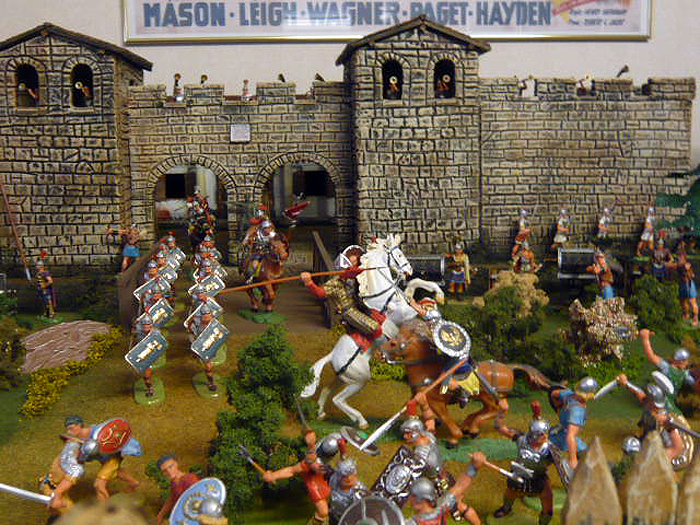
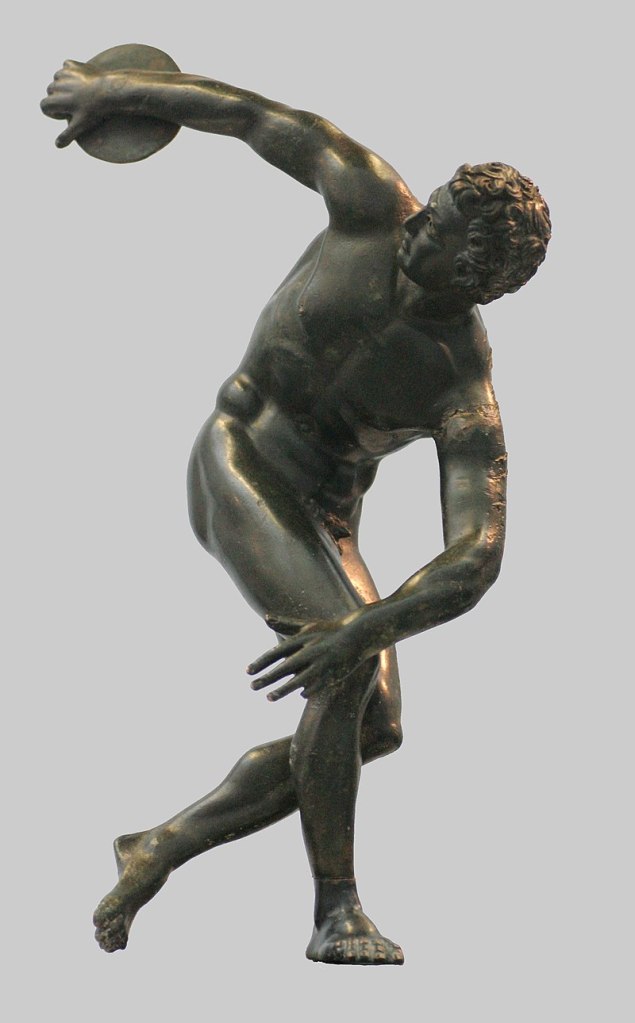
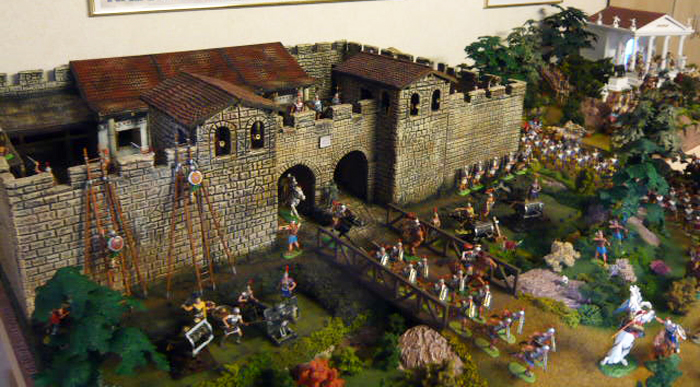
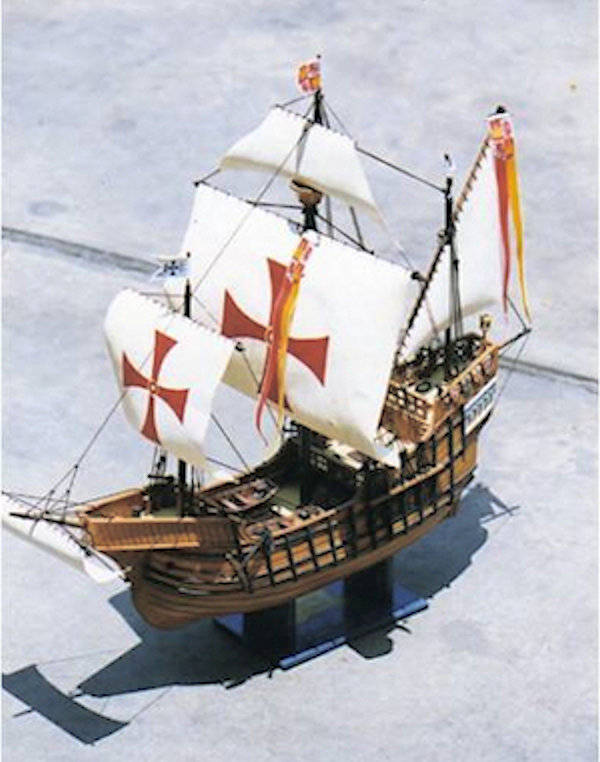
Elastolin dioramaThe Discus ThrowerSanta Maria model circa 1992 made by RUTH, IAN and RICHARD MUNRO at CHRISTMAS
The perfect Book Nook or private library has at least one plush leather chair preferably with a rocker and nice padded as I have in the corner. It is an old friend I have owned it for over 30 years and my father enjoyed using it. I always let my father have my best chair and I would sit in my mother’s chair, my second-best chair. It is a carpeted room. My chair has its own special lamp. I have a ceiling fan for the summer plus some built-in lights. My room has a table for study plus two desks and many bookshelves, some decorated with fossils, busts, baseball memorabilia, and toy soldiers. I have an electric pencil sharpener I use almost daily. I have over 60 composition notebooks filled with language notes and about 20 blank ones for future use. I have windows that look out towards the garden and in the summer, I see many birds and squirrels dancing about. We live in a very quiet neighborhood next to a nice park with trees, a pond, and paths to walk. To the left of my desk, I have a French door that opens to the covered patio which has chairs and a table on which I study on find days in the spring, fall, and early winter. It has a screen door from which I can hear music in my rooms. I have no TV in my book nook but I have a radio on my BOSE CD player and many CD’s chiefly classical. And of course, I sometimes watch YouTube videos on my laptop (but not often). My music is chiefly from SPOTIFY, but also via my phone and BOSE Microlink (Itunes) . In the Spring summer and Fall, I often listen to baseball games on the porch or in the library while reading or doing language studies. I used to listen to the radio a lot but now mostly listen to Audible books or podcasts.
There is plenty of storage for paper. I have a printer connected to the laptop. In my library I have about ten reems on the shelves and two in a drawer under the printer. I have a larger supply in reserve in the garage. I have three chairs besides the leather chair. Next to the leather chair, I have a side table that belonged to my father with a drawer. Another chair belonged to my mother and is about 65 years old. I have boxes for index cards and coffee mugs filled with #2 pencils, colored pencils Bausch and Lomb magnifying glasses. In a wooden box, I have a chrome Cross Pen that belonged to my father. The box has a spare cartridge I use the pen to sign personal letters or important documents. I have a phone next to my laptop and a brass hand winding, Tiffany clock, hydrometer, barometer, and thermometer. It is my backup case of a blackout, and it serves as a paperweight. I have two staplers on my desk It was a retirement gift to my father in 1976. Next to the phone is a reproduction of Myron’s Discobolus or “discus thrower”, Greek: Δισκοβόλος, Diskobólos). I picked this up at the Vatican circa 1972; they have a wonderful full-sized marble Roman copy found, I believe, at Hadrian’s Villa. The Greek original in bronze is lost but we know the work from numerous Roman copies. Munich there is a fine Roman bronze reproduction of Myron’s Discobolus, 2nd century AD. I have several busts of famous historical figures some American but mostly Greek, Roman, classical composers or literary figures.
I have a tall glass display case filled with a model of the SANTA MARIA, that my mother, my son and I put together one Christmas before her death (1992 I believe). My mother did the rigging. There are also “ruins” and dioramas of charging Elastolin Roman soldiers on food and horses, Huns, Goths, and Normans (the “Barbarians”. They date back to 1963-1971. There are a few I/R figures and French Starluxe mixed in. There are two chariots and some Roman siege weapons. On the mantle of my fireplace, I have cards, models, and toy soldiers. I have a Lewis and Clark Diorama I bought at a museum in Iowa in 2004 (it includes Sacagawea and York). I have followed almost the entire trail of Lewis and Clark starting in 1982 and finishing in 2004. On the walls I have art reproductions and historical photographs I have collected over the past 60 years such as Churchill holding a tommy gun I have for example a full-size museum replica of ATHENA MOURNING. At my main desk, I have books of quotations, reference books, and dictionaries. I use the Internet and electronic dictionaries but find book versions easier to study and for annotations. I have a variety of English dictionaries. The one I use the most is the 4edtion American Heritage. One of my favorites is the Oxford Companion to English Literature – a nice leather-bound edition. It is the 5th edition edited by Margaret Drabble which is the last edition to have complete commentaries on Walter Scott and other classic authors. I have an extensive library of English language books chiefly classics, biographies, and histories but also baseball books and large-sized art reproduction books. I also have a modest library of Latin books (many bilingual), Greek books including the Bible (I am studying Greek presently, Gaelic books (chiefly song books and poetry but some history and nonfiction), many (hundreds) of Spanish books, some Portuguese books, some French books, some German books. I have a German-Spanish dictionary for example and a Latin-Spanish dictionary. One of my favorite reference books is MAMMALS of the WORLD (1964) which is very useful for ascertaining the indigenous names of mammals in many languages and of course which has curious animal facts and thousands of black-and-white photographs.
I can’t say I have been EXTREMELY productive as a writer in my life but I have read and studied much and been able to teach many. Review reading via rote rehearsal is effective but it is always better to note take and create study cards from notes and use colors and pictures whenever possible. ’
I know Spanish very well, for example, and often speak it but I read and review Spanish at least 20-30 minutes a day (I don’t usually take any notes). For new languages such as Italian or Greek, I take notes sentences dialogues, and translations and write new vocabulary, I draw colored pictures and copy words that give me difficulty three times over and highlight them with yellow. I probably practice 5-7 languages a day. I read Portuguese very well but found I speak it less well since I have not used it daily for more than 40 years. But I practice listening and speaking via Duolingo and so have regained most of my former fluency. I never lost my ability to read but found my writing had declined due to lack of practice and when speaking I tended to fall into Spanish. My book nook is my quiet refuge from the world.
The Gilbert Highet SocietyPublic group · 224 membersJoin GroupWe try to stay true to the spirit of the late Gilbert Highet. Gilbert Highet was a patriot, an educator, critic and writer. Before WWII he served in M…
We try to stay true to the spirit of the late Gilbert Highet. Gilbert Highet was a patriot, an educator, critic and writer. Before WWII he served in MI6 while visiting Nazi Germany with his wife who had an MA in German. Highet himself was fluent in German and several other languages. During WWII he was a Colonel in British Intelligence (his true role has never been completely revealed but I surmise he contributed to interpretation of ULTRA intelligence). He may have been an agent for MI6 (military intelligence during the war and even before the war). Therefore his true contribution to the Allies has never been publicly acknowledged. He and his wife, author Helen MacInness were naturalized Americans -Americans by choice-having emigrated from Scotland. Their son Keith Highet was a veteran of the US Marines who served in Korea and a noted legal scholar. Highet is best known for his book “The Classical Tradition,” a generous, lucid survey of the Western Canon.He also was the translator of PAIDEIA by Werner Jaeger, one of the best books ever written on Greek culture and literature. In the 1950’s he had a radio program on WQXR and later turned his radio scripts into books of essays (still outstanding reads). His book MAN’S UNCONQUERABLE MIND still makes compelling reading; many have called him the Scottish-American Cicero. But beyond all of this, his writing was jargon-free and confident. It is a style and manner that is sorely missed. Gilbert Highet. wrote Robert Ball, “taught the classics for 40 years, also believed in the importance of great books, which he brought to life in class and in print through a humane form of scholarship. He concentrated on those aspects of the classics that he thought made them worth studying—their truth, beauty, and wisdom, and the imagery and language that inspired him—without burying the texts under a technical, theoretical superstructure.”
In addition to all this Professor Highet recorded many radio programs on general culture and some of these recordings are commercially available. This group celebrates the best in non-fiction writing, fiction, history, literature poetry and culture.”I believe that much of the maladjustment in our societies is caused, not by malevolence and corruption, but simply by ignorance.” GILBERT HIGHET We also post things that would interest Mr. Highet such as literature, history, poetry and Scottish things as well as aticles and pictures of HELEN MACINNES, his wife, the well-known 20th century suspense author whose books were made into well-known films such as THE SALZBURG CONNECTION.



 Spirit of Cecilia
You must be logged in to post a comment.