
In this crazy post, Tad and Brad think hard and deep about Spock’s Beard’s fifth album, appropriately named V. Tad and Brad (my gosh, we rhyme) think the world of this album. As Tad will note, it’s what brought him back to the genre of progressive rock, and Brad will affirm that he loves all things, Spock’s Beard, never having actually left prog rock. Indeed, if truth be told, Birzer thinks that he first encountered Spock’s Beard, THE LIGHT, sometime in 1994, even though the official literature claims a 1995 release date. . .
Brad. My gosh, it was 2000, that year of mystery and chaos that saw the release of the fifth Spock’s Beard album, V. The album, even subconsciously, seems to think that prog needs a new release, a new introduction to the world. Even the opening track wants to invite all new adherents to all things proggy.
At the end of the day, you’ll be fine!!!!!!!!!!!!!!!!!!!!!!!!!
And, to be sure, prog was coming into its third phase. Spock’s Beard, The Flower Kings, and Porcupine Tree had all ushered the genre into its newest phase.
Tad: Brad, it’s hard to believe that V is more than 20 years old! Yes, this one album reintroduced me to the world of prog. I still remember exactly how I discovered it: at the time I read Mojo Magazine regularly, and they had an issue with a Genesis cover story. There was an inset article about “current prog artists to check out”. One of them was Spock’s Beard, so I went to Tower Records (remember when there were record stores?) and, low and behold, there was a copy of V. I popped it into my car’s CD player, and I couldn’t believe the incredible music that poured out!
Up to that point, I was listening to practically every style of music except prog. In high school, I enjoyed Yes, Genesis, ELP, Jethro Tull, Pink Floyd, etc., but once the 80s hit, I quit following that genre. I was flabbergasted to hear a band like Spock’s Beard unapologetically playing progressive rock, but with an updated, contemporary sounding style.
I think what impressed me the most was Neal Morse’s gift for melody. He obviously loved the Beatles, but he didn’t imitate them. Rather, he incorporated their sense of harmony and melody into massive epics that never seemed overlong. I remember in March of 2021 we went down to Florida for Spring Break, and all I listened to for a week was Spock’s Beard! And from there an entire new world of music opened up for me.
Brad: Wow, Tad, what a wonderful memory. Florida and Spock’s Beard! Very nice.
In the early 1990s, I remember wondering what had happened to progressive rock and encountering–through Tracks Records in Bloomington, Indiana–a revival of the genre through Spock’s Beard, The Light.
As I noted above, it seems–at least in memory–to be sometime in 1994. I was a graduate student at Indiana University, then, and I was quite the customer for Track’s. I remember the manager telling me about The Light, but I remember it in the fall of 1994.
For whatever reason, SB remembers the albums as coming out in 1995. Somewhere–and I don’t know where–there’s a discrepancy. At the time, I was thrilled with The Light, and I wanted more. From that point forward, I followed the band. Except for the embrace of the f-word, I absolutely loved The Light.
It’s funny, but since the band was so abrupt in its language, Neal Morse has since sent out a warning about the music. Honestly, though it was his attack on Catholicism–especially through his album Sola Scriptura, that warned me more than his embrace as had the f-word. I don’t mind my kids hearing the f-word, but it was his attack on Roman Catholicism that really chilled me.
As it was, the band, Spock’s Beard, produced some great prog rock and some real straight-forward rock after 1995. It was V, however, that really reminded us all that progressive rock was not only alive but thriving. It was, by far, the most progressive album the band had released since its second release, Beware of Darkness. Yet, to be sure, V is nothing compared to its successor, Snow, which really embraced not only progressive rock, but the Catholic Church (its priests, in particular) as well.
When V came out, I was blown away,. Album number 5 from the band was simply brilliant, and I was so glad to have the progressive rock genre come back in full force. Indeed, when you bring into account the early Flower Kings, it and Spock’s Beard really introduced us to the third wave of progressive rock. Both, somehow, brought us all into the fold of a whole new take on the classic genre.
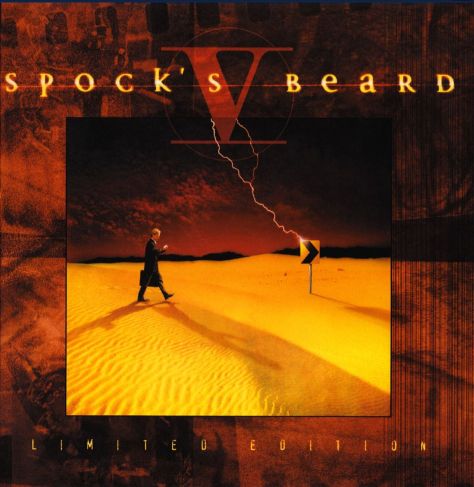
Tad: Before we get into discussing the music, I want to give a shoutout to the artwork. At first glance, it looks like a businessman walking in a desert past a traffic sign (a sideways V) telling him to go forward while a forked lightning bolt (making a V) pierces the sky behind him. But on closer inspection, you realize he has two shadows (making a V), he must be on an alien planet! The whole scene is worthy of Hugh Symes’ best work for Rush. I love it!
Brad: Agreed. The art is excellent and reminiscent of Hugh Symes. A wonderful comparison.
What surprises me most, however, Tad, is how much of a solo album for Neal Morse this fifth album from Spock’s Beard actually is. If we take the liner notes seriously–and I have no reason not to–Morse wrote every lyric and every song with the exception of the excellent. THOUGHTS (Part II), the most Morse-like of all the tracks! Indeed, the original “Thoughts” appeared on the second Spock’s Beard album, Beware of Darkness, and is credited to. . . no surprise. . . Neal Morse! Indeed, looking over the first six Spock’s Beard’s albums, what is shocking is that all seem to have been written by Neal Morse and Neal Morse almost (not always) solo!
This means, of course, that V really is a Neal Morse album with Spock’s Beard as a mere backing band. I will admit, I’m rather shocked to realize this. I had always thought the band contributed much more to Spock’s than this.
As such, Testimony is a Neal Morse album without Spock’s as a backing band!
That said, and attributed, Spock’s Beard V is an astounding album, whether a Morse album or not. Everything just works perfectly on V. The art, the lyrics, the music, the sequence of songs. All of it, just perfect.
And, though Morse wrote all of this, I’m quite happy with the band. Nick D’Virgilio is especially great at drumming so appropriately for this album.
Tad: Yes, the first six Beard albums were almost entirely Neal Morse projects. I have a DVD, The Making of V, that chronicles his production of V, and it’s very illuminating. It’s clear he has a very specific vision of how he wants every song to sound. He meets with each member of the group to go over their parts. They make minor suggestions, but by and large he is calling all the shots. Even that little woo-wah guitar sound that Alan Morse makes 12 minutes into “At The End of the Day” is due to Neal’s urging.
Speaking of “At the End of the Day”, let’s dive into the songs on this album. “At the End of the Day” is one of my favorite opening tracks, ever. It has it all – driving rock, acoustic passage with soft vocals, and time changes all over the place! At 16:28 in length, it’s not a quick listen, but the time flies – I never get fatigued whenever I listen to it. As with every Morse composition, the catchy melodies fall over themselves as they spill out of my speakers – they are endlessly engaging and captivating. I love this song!
You mentioned “Thoughts (Part II)”, and this song led me to explore the music of classic Gentle Giant, because somewhere I read that the a cappella sections were inspired by that group (I think by “Knots”, off of their Octopus album). I also hear a lot of Kansas in this song. It is another highlight.
Actually, there isn’t a bad track on V. I skipped over “Revelation”, but it deserves some praise – at first listen, you think it’s a relaxed, soft rock ditty, but then it morphs into some of the heaviest rock Spock’s Beard ever produced.
Even though V was only released on CD, I’ve always thought of “All On A Sunday” as kicking off “side 2”. This is such a happy, welcoming song for me. Once again, Morse’s gift for a catchy melody really shines here. “Goodbye To Yesterday” is more sombre, but still beautiful. This song is a showcase for the Beard’s knack for gorgeous vocal harmonies. You can hear how good a singer Nick D’Virgilio is here.
I’ve rambled enough – you’re our resident lyrics expert; what do you think of Morse’s words on V?
Brad: Tad, thanks for such good thoughts. I think your analysis is simply awesome. Fantastic. The DVD “The Making of “V”” sounds excellent. I’ll have to check it out.
I must admit, Tad, when it comes to Neal Morse lyrics, I’m always a bit conflicted. I love his music–composition, tone, flow, etc.–but I find his lyrics less persuasive as it were. Some of this is simply poor bias on my part. I loved the music of The Light, but I was less than taken with the lyrics. As mentioned above, I just think the “f-word” is totally avoidable in songs. To me, its employment is always and everywhere a sign of a lack of imagination. Since then, I’ve been skeptical about his lyrics. I especially disliked the lyrics of Sola Scriptura.
Specifically, as to V, however, I generally like the lyrics, though I find them–again–unpersuasive. When I listen to Big Big Train, for example, I always assume my prevailing attitudes and ideas will be challenged. As I hear V, though, the lyrics are just random words that sound good with the music. In no way have I been challenged in basic assumptions or ideas. I’m more moved by the insertion of a dirty organ than I am by the words.
Here’s section III of the “Great Nothing.”
Come up breathing
Up from the water
Man, he was so submerged
Where’s the feeling?
It must be way under
Far from the spoken word
No, no – no corporate ladder
No hometown parade
The fat cats just keep getting fatter
What does it matter
The thing must be played…
One note timeless…
Don’t let the buzz get you down
Don’t lose your memory or you’ll sink fast and drown
But you can’t seem to sleep for the thoughts in your mind
Since you can’t stand to think you have one hell of a time
Hanging with submergers you drink yourself blind
You think it’s fine
You’ve got time…
What is this all about? I have no idea, and, worse, I’m not that interested in knowing or figuring it out.
Again, Tad, don’t get me wrong. I really like Morse’s music, I just feel less taken with his lyrics. An exception to this is his lyrics for Testimony and Testimony 2. I loved and devoured these lyrics–as they told a story.
Tad: Brad, your points are well taken. As far as the lyrics to “The Great Nothing” go, I believe Morse wrote them as a tribute to his friend and fellow musician, Kevin Gilbert. He was enormously talented, but the music industry never knew how to promote him. He died not too long before V was recorded.
As I’ve mentioned before, I have a hard time paying attention to lyrics , except as they add to the overall sound of a song. It’s a failing of mine – I’m too lazy to get into them! Like you, though, I don’t have a lot of patience for gratuitous profanity when it occurs.
As far as “The Great Nothing” goes, I think, musically, it is one of the greatest songs Spock’s Beard ever recorded. It is one I never tire of listening to, with its various sections of melody. Dave Meros’ bass is outstanding on it, as is Nick D’Virgilio’s drums.
There is one section (the “You missed your calling” one) that sounds like something Paul McCartney could write – it’s that catchy. When I first heard this epic, I had to stop what I was doing and hit “Rewind” on my CD player several times!
They say that hindsight is 20/20, but I get the sense that Morse intended for V to close a chapter in Spock’s Beard’s career. I couldn’t wait for the next album, Snow, but I was very disappointed with it. It sounded so different from anything else they had recorded, and the story kind of creeped me out. Like you, I thought Testimony was a tremendous album – one of Morse’s all-time best. But that’s a topic for another post!
Brad: Thanks so much, Tad. You have excellent responses, of course, and I had no idea that Morse was referring to the work of Kevin Gilbert. Next time I listen to V, I’ll keep that in mind.
Tad: It’s always a blast to bounce thoughts and reactions with you, Brad! I hope our readers take some time to listen to V. It is not available on Spotify (apparently Morse doesn’t like their payment structure), but it is on Apple Music. Here is “The Great Nothing”, via YouTube:
 Spirit of Cecilia
You must be logged in to post a comment.