Well, it’s that time. That glorious time. Two weeks later, and Friday. This means that Big Big Train has updated, once again, its Passenger’s Club membership-only fan service. And, for this third update, I am reminded yet again how good BBT is. This week’s update comes in four (well, really five) parts.
First, there’s a new song, one written by Greg roughly ten to twelve years ago. It’s a love ballad for his wife, Kathy. Tender and fluid, “Sundial” might have ended up on Bard. Thus, it can probably be regarded as a “b-side,” if BBT created such things. I like the song quite a bit, and it fits nicely onto the Master Passengersonglist/album I’m slowly compiling as BBT releases each new song.
Second, there are a number of really nice photos taken during the Grand Tour rehearsals. Honestly, when the Passenger Club first emerged on February 14, I thought this was the weakest part of the service. But, I’m proven wrong here. There are no weak parts to the service, and these photos are really interesting. I’m not sure if I’m allowed to repost them, so I’ll refrain from doing so. But, I like them—really nice captures of the band.
Third, Nick Shilton give us yet another fascinating look into the marketing and branding side of the Big Big Train business. Shilton has a winsome writing style, and he clearly understands that the band must continue to innovate as entrepreneurs as well an innovate as artists. He sums up everything best about BBT in his final sentences of his update: “The BBT ethos is to strive for top quality in everything that the band does. If on occasion we fall short of that with the Club, we’re sure that you will let us know and we will always seek to rectify any issue as soon as possible.”
Fourth, BBT has released not one but TWO new videos! One is of the orchestration conducted at Abbey Road Studios, and the other is a “Behind the Scenes” look at the creation of the “Make Some Noise” video. When this first came out, I loved Dave Gregory’s “Slash” hat. If anything, I love it even more seven years later. There’s something quite humorously rebellious and defiant about the hat.
Well, there you have it. Granted, the world kind of reeks at the moment, and we’re either suffering or waiting to suffer—but that doesn’t negate the importance and permanence of the good, the true, and the beautiful. No matter how miserable things might get, BBT reminds us yet again that excellence really does matter.
The Bardic Depths offers an interesting combination of genres. At its core, the band plays a progressive rock that revels in subtlety, as even the heavier riffs are gentle and easy on the ears. However, you will find that some of the tracks are akin to progressive electronic/ambient, so not “rock” at all. Even further, and as the album progresses, you will find a huge portion of jazz fusion in the mix, so be ready for quite a lot of saxophone and bassy grooves. Somehow, the band puts this all together and makes it work well.
— Read on theprogmind.com/2020/03/13/the-bardic-depths-the-bardic-depths/
This was, to be sure, a more innocent time. And, to be certain, there was even a time in my high school years—a less jaded time—in which I assumed most Americans were raised in the same manner and believed as I did. President Reagan, Prime Minister Thatcher, and Pope John Paul II were normal leaders of the West, not extraordinary ones. Many of my teachers—clearly the children of the New Left and the 1960s—revealed to me a blatant hypocrisy. While they shouted for love, they behaved as would-be tyrants, hypocrites . . . not all . . . but many.
Somehow, and in a myriad of disturbing ways, my delusions and illusions and wishes and hopes and dreams and subjective realities collapsed over the years. Not that I lost faith in liberty, but I’ve certainly lost faith that others kept the faith, if they ever actually had it.
The evidence is more than clear. Communism, socialism, and progressivism have each made huge comebacks, re-entering political discourse blatantly and, just as importantly, very quietly, over the past decades. Even the very words “socialism,” “communism,” and, especially, “progressivism,” have reacquired respect and a semblance of dignity in many circles of public thought and discourse.
— Read on theimaginativeconservative.org/2020/03/revival-socialism-bradley-birzer.html
SDE: What is it, do you think, about the album, that resonates so much with people? Is it just the fact that it’s got massive hit singles on it, or is it something more than that?
RO: I think… I mean, at the time it felt completely disjointed, that we were clutching at straws regarding available songs. We started off with two or three songs and bits of b-sides and within one month I came up with ‘Shout’, ‘Everybody Wants to Rule the World’, and ‘I Believe’. And I think it was when we did ‘Shout’ that we really moved to a completely different gear.
The secrets are in the arrangement and production, because it really is superb
One of the reasons it was called ‘Songs from the Big Chair’, I probably told you this a million times, is that it felt disparate; it wasn’t like The Hurting which was almost like a life work for us. Albeit we were teenagers. Hence the title ‘Songs’ because it just seemed to me like eight separate songs, and even the track ‘Listen’ was an Ian Stanley [keyboard player] demo and made while we were recording The Hurting. But I don’t know why… I think it was possibly the fact that we’d done our initial first demo’s in Ian’s house in Bath. And then he won a little bit of money from the publishing, we built the studio there in a bigger room, in his house. And I think it was almost like coming back to the West Country and even [producer] Chris Hughes had links to Bath, because his mum lived there. So, I think getting out of the huge studios and into this real intimate [setting], the birthplace of Tears for Fears almost, which was Ian Stanley’s house. I think that created this, you know, more of a calm but hot-housed environment. Plus, this massive input of new technology, like the Fairlight, the Synclavier and the Drumulator. We had all these cutting-edge sounds to play with and I think that the secrets are in the arrangement and production, because it really is superb.
— Read on www.superdeluxeedition.com/interview/tears-for-fears-roland-orzabal-in-the-big-chair-the-sde-interview/
In the past you made also albums with Salander and Birzer Bandana. Can you give us an inside how this got together? I recorded the Salander albums with my friendDave Curnowas a fun project. They were recorded in my home studio and mixed to a very basic level by me so we released them to BandCamp as pay as you like or pay nothing at all. When I moved out here, I continued writing so asked my professor friend and prog enthusiastBrad Birzerif he would write some lyrics for me. Two albums were made under the Birzer Bandana name. Again, recorded at home and mixed to a certain level but nowhere near professional quality although there are some good ideas there. I am thinking about trying to remix them.
In the past you made also albums with Salander and Birzer Bandana. Can you give us an inside how this got together? I recorded the Salander albums with my friendDave Curnowas a fun project. They were recorded in my home studio and mixed to a very basic level by me so we released them to BandCamp as pay as you like or pay nothing at all. When I moved out here, I continued writing so asked my professor friend and prog enthusiastBrad Birzerif he would write some lyrics for me. Two albums were made under the Birzer Bandana name. Again, recorded at home and mixed to a certain level but nowhere near professional quality although there are some good ideas there. I am thinking about trying to remix them.
We will return to this point shortly. Brad Birzer’s Beyond Tenebrae is subtitled Christian Humanism in the Twilight of the West, which lets the reader in on the main thrust of the work. As Russell Amos Kirk Professor of History at Hillsdale College, Dr. Birzer’s breadth of knowledge is more than equal to the task. Much of the book reads like a sophomore survey course, with Dr. Birzer taking the reader on a tour of people who express what he is trying to convey. He covers a lot of terrain in this survey, including characters expectable and unusual. There are scholars (Christopher Dawson, Eric Voegelin) and artists (Willa Cather, Flannery O’Connor, Ray Bradbury); social critics (Russell Kirk, Alexander Solzhenitsyn), and politicians (Ronald Regan, Edmund Burke); the prominent (J.R.R. Tolkien, C.S. Lewis), and the obscure (Dr. Birzer’s own grandparents, as well as one of his Notre Dame instructors). All are chosen because each exemplifies some aspect or principle of the true humanism that Dr. Birzer is trying to convey. The examples are woven into a tapestry to illustrate his points—indeed, if the book has a weakness, it is that the weaving is at points not as smooth as it could be. But even that serves to illuminate the point that comprehending humans as human means surrendering the wish for everything to work out as smoothly as a mathematical formula or well-designed computer algorithm.
— Read on theimaginativeconservative.org/2020/03/beyond-tenebrae-brad-birzer-roger-thomas.html
But it did not make me hate all the Jews, perhaps to the contrary.
By RICHARD K. MUNRO
OCTOBER 1969 When I knew for certain I would never attend Columbia University.
Dennis Prager has been a great influence on my faith life and in my appreciation for Jewish religious culture and traditions. Like my father he went to Brooklyn College and like my uncles went to Columbia; like them he was deeply alienated by Columbia’s increasing radicalism and secularism from mid 1960’s on. Like my father both in Glasgow and in Brooklyn, Prager came into close contact with persons of the Far Left as well as the Orthodox Jewish community. My parents had Jewish friends their entire lives. My father played football as a boy against Jewish schools in Glasgow and many Jews served in the British Army in WWI and WWII both in Scottish and English regiments. My father’s best friend and neighbor of almost 50 years was Manny Sussman, an emigrant from England who served in the RAF during WWII. They often discussed Commentary Magazine, the news of the day, books and authors. They attended concerts at the local YMHA (as it was called then).
Moses Hades and Jacques Barzun circa 1940 My uncles knew both men at Columbia in the 1940s and 1950s.The Trillings my uncles and parents knew them and heard them give talks.
GILBERT HIGHET AT COLUMBIA circa 1954
Gilbert Highet and Mrs Highet (Helen MacInnes). My uncle knew Highet at Columbia and my father corresponded with Professor Highet though they were not close friends by any means. Because of my uncle and father those Columbia University professors had a strong influence on me via their books even though I never attended Columbia like my two uncles. My father attended Brooklyn College and after the War NYU and I attended NYU for my undergraduate work. After the ROTC building at Columbia was bombed (my uncle Norman narrowly missed being killed) Columbia was off limits to me, I visited briefly in the late 70’s to hear a talk by Diane Ravitch but otherwise avoided Columbia and Barnard as one would avoid a nest of vipers. I visited Columbia with my uncle and sister in 1965, 1966, 1967, 1968, 1969. We visted ROTC buildings.
1969, there were significant events related to the ROTC (Reserve Officer Training Corps) at Columbia University. Here are some notable incidents: Firebombing at ROTC Supply Room (Peden Stadium): In 1969, a firebombing occurred at the ROTC supply room located in Peden Stadium. The incident caused an estimated $4,000 in damage. The FBI was called in to investigate this attack1. Attempted Bombing at ROTC Building: On January 18, 1970, a couple named Bissell was arrested by campus police for allegedly placing a bomb under the steps of the ROTC building. Fortunately, the bomb did not explode. The Bissells were charged with conspiracy to destroy government property and possession of a destructive device2. Peaceful Sit-In at ROTC Lounge: In 1970, Eric Holder, who would later become the Attorney General, participated in a peaceful sit-in at a Columbia University residence hall ROTC lounge. This event was part of a five-day occupation by a group of black students. They demanded that the former ROTC office be renamed the “Malcolm X Lounge” in honor of the civil rights leader. However, it’s important to note that this was not an armed occupation3. These incidents reflect the charged atmosphere during that period, with student activism intersecting with issues related to the military and civil rights. While some actions were peaceful, others involved more extreme measures. The events at Columbia University during this time left a lasting impact on the campus community.My Scottish grandfather in January 1919 in Constantinople. Fourth from the right. He heard horrific stories from Greeks and Armenians of Turkish massacres of civilians. He had many Greek, Armenian and Jewish friends in Salonika and Constantinople and later in Brooklyn NY like Pete Campetes whom I knew very well. His family came from Turkey.
Recently I wrote to an Israeli friend of mine about the resurgence of anti-Jewish hatred and propaganda. Anti-Semitism is like a many-headed hydra of ignorance and prejudice. Courage and knowledge are needed to combat it so as not to repeat the catastrophic mistakes and omissions of the past. I believe anti-Semitic hatred is like Socialism ultimately rooted in jealousy and deep envy.
There is a fable, recounted by Gilbert Highet in THE CLASSICAL TRADITION of a dispute between a spider and a bee.
The spider reproaches the bee, who has broken his web, with being a homeless vagabond with no possessions, living on loot; and he boasts that he himself is the architect of his own castle, having both designed it and spun the material out of his own body. (This was the reproach which the moderns aimed at the ancients, calling them copyists, the thieves of other’s thoughts. while themselves claimed to be entirely original in all they wrote). The bee replies that it is possible to rely exclusively on one’s own genius, but that any creative artist who does will produce only ingenious cobwebs, with the addition of the poison of selfishness and vanity; while the bee, ranging with infinite labour throughout all nature, brings home honey and wax to furnish humanity with sweetness and light.
p285-286 The Classical Tradition
Cultures like the Palestinian Arab culture which are too inward or closed, feeding and engendering on themselves alone are often marked with hubris and the deep venom of prejudice and hatred for others who are more successful politically, militarily, technically or economically. The bee is a metaphor for not only the indefatigable worker but the undogmatic cosmopolitan thinker who ranges with infinite labor throughout the whole world and its history and thought. Swift, to whom we owe the fable did not directly mention Horace but Highet detected in his work the echo of Horace’s poem in which “he compared himself to the hard-working bee, gathering sweetness from innumerable flowers.”
I have an ancient and proud heritage, but my people did not invent the alphabet nor the Ten Commandments.
I am in awe of the Gifts of the Jews, the Greeks and the Romans and the English people too and the Americans who are my adopted people. The life of the mind we owe to the Greeks. The life of political order and justice we owe to the Romans, English and Americans. The life of love and faith we owe to the Jews and the Great Teacher, Jesus of Nazareth, who was, of course, a Jew.
If we believe falsely that we owe nothing to others or other nations we are vain and wrong. Hamas apologists and so-called Palestinian nationalists cannot admit their own culpabiilty for their situation and cannot bring themselves to admit the Jews, not they, are the true indigenous people of the Holy Land. Judaism and Christianity thrived in the Holy Land long before the arrival of the Arabs and Islam in the 7th century AD.
It is truthful and humble to admit that the heritage of mankind is very diverse but there are great apogees of cultural achievement of which my race and line were only observers and minor players.
I could of course, “hate all the Jews” also because it is easy to do. I have suffered slights at the hands of individual Jews. I got turned down for a date once by a beautiful Jewish woman who thought I was “medieval” (too traditional). She laughed at me. Another time I accompanied a Jewish girl home to the South Bronx from a party at NYU -just as courtesy- and the father would not let me in and said to my daughter cannot and will not ever date a Goy. I was shocked and somewhat insulted as I was not even dating the young woman in question merely escorting her home. (Later in class the young woman apologized for her father and tried to explain his feelings). But it did not make me want to “hate all the Jews” but instead learn more about their traditions and culture.
My father had Scottish relatives who were killed in Palestine in the 1940s and probably were assassinated by Irgun gunmen. Very sad. We also had relatives killed in Northern Ireland by IRA gunmen. Very tragic when you think those soldiers were sympathetic to the plight of the Jews in Palestine and to the Irish in Northern Ireland. They had liberated the Concentration Camps in 1945 and as Catholic Gaels they sympathized with the plight of the Irish Catholics in Northern Ireland. But they were Unionists and British soliders and it was war. I am not going to hate all the Irish because of the actions of a few extremists. I am not going to hate all the Jews for all time because of one personal slight or the tragic death of a doomed British soldier long ago. He was just an orphan of Empire waiting out his military service and hoping to emigrate to Brooklyn to be sponsored by my family. And war killed him. It was not a Jewish conspiracy. He just as easily could have been killed by an Arab Nationalist. He just was doing his duty and was in the wrong place at the wrong time.
Perhaps one thing my primitive people (the Gaels) -we were as Toynbee noted the last White Barbarians of Europe- gave to the world was a sense of justice, deep loyalty, deep memory and deep courage in defense and above all a willingness to make the supreme sacrifice for our families, our communities our nation our gallant allies.
Yes, perhaps the Gael has been eclipsed by other more talented, more temperate and inspired nations in most fields of human endeavor. But in the ancient Mire-catha (Battle Frenzy) in the cause of his brothers and sisters, in the cause of freedom and Independence others perhaps equal the Gael in righteous combat but none surpasses him. ‘
We may not understand all the wisdom of the great but we love and revere great discoverers and minds greater than our own. Yes, many people surpass the Gaels in many things but in gratitude to our teachers, friends and forefolk and in remembrance of their achievements and sacrifice few equal our passion, devotion and love.
The great compliment, my grandfather taught me was to be a Highland Gentleman, a leal n’ true mon (an duine dileas).
A Highlander is leal n’ true to his word,to his Regiment,to his family clan, his Nation, his nation’s Allies, to his God. “Dread God and obey his commandments; that is the whole duty of man.” That is the Munro motto and the oldest Bible reference I ever knew.
From my earliest boyhood I knew the foundation of our civilization and moral culture began with the Old Book which my father called the Hebrew Scriptures.
I knew the Bible was not an English book at all but a translation from the Jews, Romans and Greeks.
I have tried to understand anti-Semitism but it never made any sense to me that any Christian should be an anti-Semite because Mary, Jesus and Joseph and all the apostles and their ancestors and family were Jews.
But I think my people (I am speaking of the Gaels or Scots) were a cosmopolitan hard-working people who ranged throughout the world. They knew English was not the only language nor the oldest language of the world so they learned other languages wherever they went.
They knew England was beautiful,admirable in many ways, successful, rich and powerful but it was not the only country in the world nor was it best at ALL THINGS; in fact the genius of the British people was that it adapted the best of many peoples.
They knew there was much to admire and love in other countries were they lived and worked -Canada, the USA, Australia, New Zealand, Chile, Cuba, Spain, Italy, India and Africa. It is, perhaps peculiar to the Scot (or Gael) of all classes, that he remembers and cherishes the memories of his forefolk good or bad; and there burns in him a sense of identity with the dead of his race and line even to the tenth or twentieth generation. “Cuimhnich air na daoine bho tainig tusa” (remember the people you came from was a saying I heard hundreds of times until it was etched into my memory and soul).
My Israeli friend said to me: “I’m not sure where to start so as to answer your beautifully written post, so I’ll start by saying that you are too modest!
Every nation has good people and bad people and, while it is true that the percentage of Jewish Nobel Prize winners is extremely high for the very small percentage of the Jewish population in the world, there is a beautiful IJewish saying (I learned from Dennis Praeger).:
“Behaving correctly comes before studying the Torah.”
We are (were?) the People of the Book, but it is far more important to be leal’n true like your brave nation, the Gaels .”
Aye an’ when one kens what that means and has meant it gars ane to greet. (stirs the bosom and brings tears to the eyes, aye saut tears blin’ the e’e).
“La a’bhlair, ‘s math na cairdean”
THE DAY OF BATTLE ‘TIS GOOD TO HAVE FRIENDS ; this every Highland soldier knew. And it was a terrible burden for the survivors to remember the courage, sacrifice, suffering, blood, toil, sweat and tears all for the sake of freedom and independence. Freeman’s blood and tears have always told our story. Bydan Free (forever free!)
NE OBLIVISCARSIS…not not forget. My father’s best friend TOMMY CRAIG killed in North Africa in 1942. The played soccer (football) together against Jewish and Protestant schools in Glasgow in the 1920s.
Yes, if there is one thing I learned from my father and grandfather who were both Scotsmen born and bred with deep roots in Gaeldom, it was that the highest and most noble virtue a man could aspire to was being a good man, a brave man, a loving man, a generous man and a man who was “leal n’ true” to those who loved him and whom he loved. Until the death. From my father and grandfather I learned poems and songs and traditions. They loved music and poetry:
OUT of the womb of time and dust of the years forgotten, Spirit and fire enclosed in mutable flesh and bone, Came by a road unknown the thing that is me forever, The lonely soul of a man that stands by itself alone.
This is the right of my race, the heritage won by my fathers. Theirs by the years of fighting, theirs by the price they paid, Making a son like them, careless of hell or heaven, A man that can look in the face of the gods and be not afraid.
Poor and weak is my strength and I cannot war against heaven. Strong, too strong are the gods; but there is one thing that I can Claim like a man unashamed, the full reward of my virtues, Pay like a man the price for the sins I sinned as a man.
Now is the time of trial, the end of the years of fighting, And the echoing gates roll back on the country I cannot see If it be life that waits I shall live forever unconquered. If death I shall die at last strong in my pride and free.
Vimy Ridge, 1916
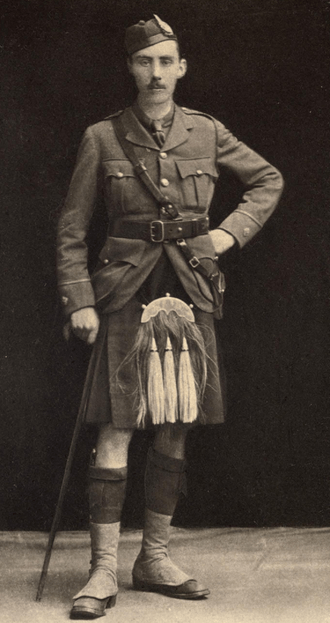
From “CREED” in A Highland Regiment (1917) Ewart Alan Mackintosh (TOSH) Lieutenant Ewart Alan MackintoshMC -TOSH- to his men (4 March 1893 – 21 November 1917) was a war poet and an officer in the Seaforth Highlanders from December 1914. Mackintosh was killed whilst observing the second day of the second Battle of Cambrai, 21 November 1917. NE OBLIVISCARIS…do not forget.







 Spirit of Cecilia
You must be logged in to post a comment.