Tag Archives: progressive rock

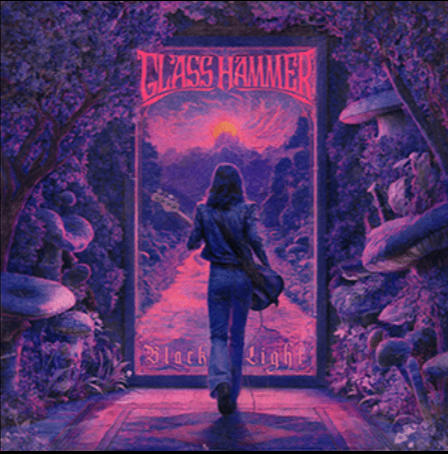
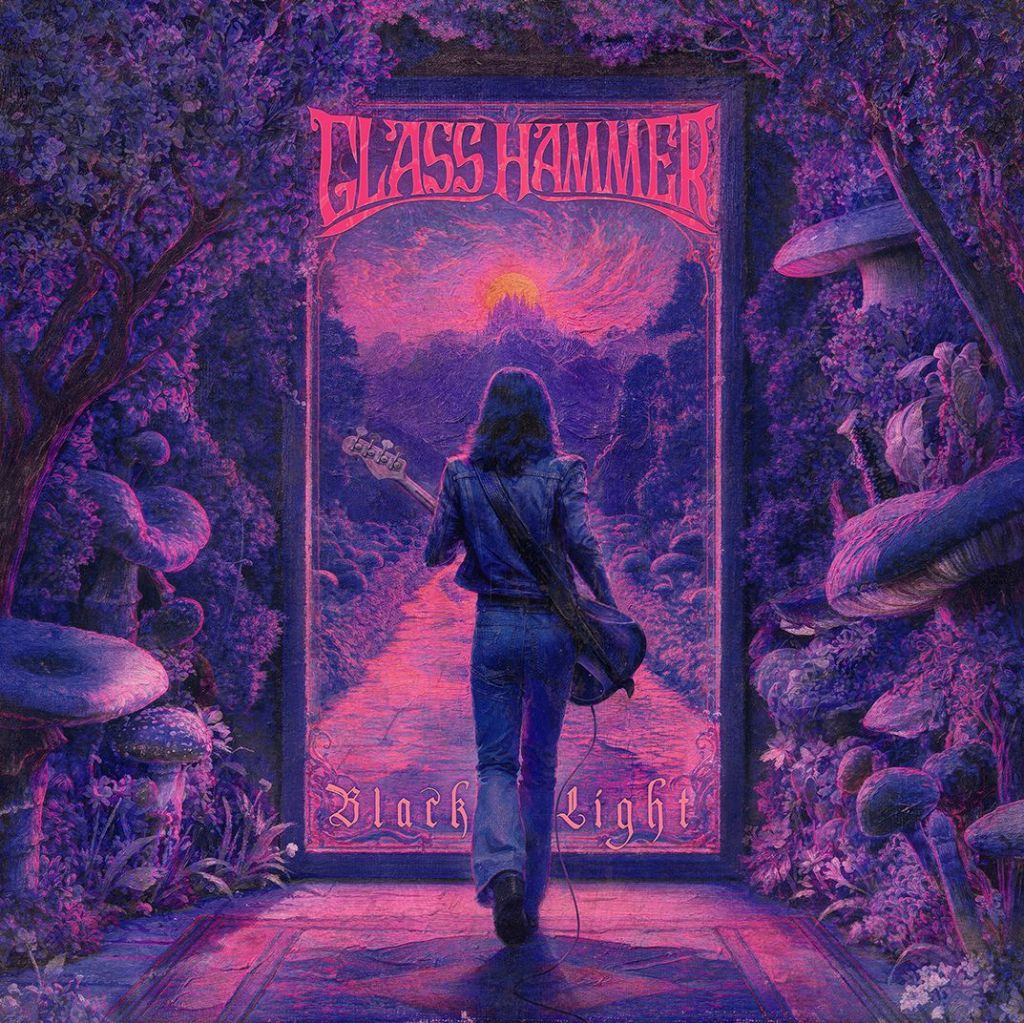
Glass Hammer’s Black Light: A Groovy Prog Treat

Tad: Hello Brad! It’s been awhile since we’ve had the time to collaborate. We’re both educators, and summer is supposed to be a time to catch our breath, but it wasn’t for either of us this year, was it? Anyway, there’s a very good reason for us to get together, and that’s the announcement from Glass Hammer that they are releasing a new album! You and I both love this band, which is pretty much founder Steve Babb’s project now. We’ve been avid fans for many years, and they have never made a dud of an album in my opinion, even though they have recorded in an amazingly wide variety of styles. But that’s what I like about them: they aren’t afraid to try new things, and they never get stuck in a musical rut.

Their new album is Black Light, and I’ve listened to it four times back to back now. Musically and lyrically, it’s another big change from Rogue, Arise, and the Skallagrim Trilogy. My first impression is how lively and playful these songs sound. What do you think, my friend?

Brad: Hello, Tad.  Man, I’ve missed you, and I’ve missed our dialogues.  Admittedly, the summer got in the way–a daughter’s wedding, some writing, a vacation, a number of talks. . . but, still!  I missed you.  Glad to be connecting again, as always, my great friend.

Yes, I’m totally with you.  I’ve listened to Black Light twice now, and I’m very much in love with it.  Babb has always been a brilliant bassist, lyricist, poet, novelist, and song writer (there are no limits to the guy’s creativity and drive), but, with this album, he’s become something much greater than all of these things: he’s become a composer.  Truly, the composition of this album is just staggering.  The flow is immaculate, the intensity is everything a prog fan would want, and yet, somewhat like Frost*There is a bit of witty whimsy here, too.

Tad: Brad, I think your comparison to Frost* is quite apt; these guys sound like they’re having fun, and the concept itself is even a tongue-in-cheek wink at some of progressive rock’s pretentiousness: a young rock musician in 1979 sees an intriguing black light poster in his band’s rehearsal space, and suddenly he’s inside the poster! In this trippy, dayglo world, he meets up with characters from throughout the career of Glass Hammer, which makes for a delightful experience for us longtime GH fans. I read through the liner notes, and they are hilarious! For example: Part 1. Concept-Album Excess – It Begins (In which I find myself stuck in a psychedelic dreamworld, a fluorescent paradise. For reasons unexplained, I begin singing, and stuff happens!)

I think my favorite track is the second one, Lost Horizons, which is a twelve-minute minisuite containing several beautiful passages. I think the three vocalists, Christopher Galen, Trevor Laake, and Olivia Tharpe, are all outstanding throughout. 

There’s a definite ‘70s vibe to the melodies and instrumentation, and there are quite a few sections where the band just jams. If I had to describe it, it’s as if Jethro Tull, Boston, and Kansas all got together and created a hybrid band. Every song has a delicious hook, especially on Return to The Shadowlands, which is a funky Celtic rocker, if that makes sense. Ferran Ligero’s guitar work is outstanding here.

Also in his notes, Steve Babb tells of his recent surgery to remove a (thankfully) benign brain tumor. I think that experience must have liberated him in many ways. He’s even said that he believes the surgery has altered the way he approaches composing now. All I can say is how much fun and enjoyable this album is, and how thankful I am that Babb is creating such great art. Speaking of which, I am a sucker for good bass (Chris Squire was my favorite member of Yes), and Babb really cuts loose on the closing track, Kaleidoscope Skies

Brad: Tad, thanks so much for this.  An excellent synopsis.  As you and I have said many, many times–so many times it should be an iron rule of prog–a band is only as good as its bassist.  And, man, is Babb a brilliant bassist.  I love his bass lines.  So thrilling and so captivating.

Tad, if you don’t mind, I have to recount my history with the band.  I was at a conference many, many years ago now, and one of my favorite colleagues in the history field, Amy Sturgis, knew how into music and especially prog I was.  She mentioned knowing two guys from Tennessee in the prog band, Glass Hammer, who had just released an album called LEX REX.  I had never heard of them or the album, but, of course, true to form, I immediately bought LEX REX, and I fell instantly in love with it.  I couldn’t believe the mixing of music with the profundity of the lyrics.  And, they weren’t afraid to be counter-cultural, especially in their embrace of tradition and Christianity.  But, it was an intelligent and artful Christianity, not an over the top in your face evangelicalistic propaganda which I find so deeply troubling.  If we really love Christ, our music doesn’t need to be about Christ, but we very much need to use the gifts Christ has given us in the music.  Glass Hammer did exactly this.

As I had done with my hero worship of Greg Spawton, I decided to take a chance and email Steve Babb to strike up a friendship.  Amazingly enough, he reciprocated.  When chance had it that I was to lecture in Tennessee, Steve and I met for dinner–the first time we had met in person.  I liked him instantly, and I think he felt the same.  Even though I’m a historian and he’s a musician, there was a definite kinship right away.  I thank God for that meeting and his friendship.

Being totally and unabashedly OCD, I immediately ordered all of Glass Hammer’s back catalogue, including a live concert DVD–which made me love the band even more–after I first heard LEX REX.  And, on one of those DVDs, Steve’s amazing and beautiful wife, Julie, showed up.  I was blown away by how extremely cool and normal Steve and his family were.

Admittedly, it doesn’t hurt that Steve and I view much of the world in exactly the same way–which, of course, make me love his music all the more.  Plus, the guy is an entrepreneur, a dad, a husband, a poet, and a novelist.  Is there anything he can’t do?

All of this leads me to Black Light.  As I mentioned previously, there’s something immensely special about Black Light.  This is not just another prog release, but a prog moment.  The album is equally parts intense, whimsical, creative, and brilliant.  Steve is so clearly having the time of his life.  As you mentioned, Tad, he’s just come out of major brain surgery.  You’d never know it except to say that Steve is so very, very happy to be alive.  It comes through in every note of Black Light.

Tad: Brad, I love hearing the back stories of how you first encounter different groups. I got into Glass Hammer because of your recommendation. Perilous was the first CD of theirs I bought. I then picked up Cor Cordium, and I assumed Jon Davison was their consistent vocalist. As I acquired more and more of their albums, I soon realized that Glass Hammer is more of a collective, organized around Steve Babb and Fred Schendel – a lot like Steely Dan was centered on Donald Fagan and Walter Becker. 

Anyway, I think we both enthusiastically give Black Light our “thumbs up”. It is one of Babb’s best efforts, and I am really excited to see the direction he is taking his music.

You can order Black Light directly from their store at https://glasshammer.com/. Support independent music and buy physical media!
New Glass Hammer Album Announced

Glass Hammer, the progressive rock vehicle of founder and multi-instrumentalist Steve Babb, announces the release of Black Light for November 6th.
Created in the months after Babb underwent surgery to remove a brain tumor, Black Light marks one of the most personal and stylistically distinct entries in Glass Hammer’s long catalog.
Centered around a quirky, surreal story of a young prog-rocker drawn into a 1970s black-light poster, the album explores themes of nostalgia, longing, and the dual worlds of artistic inspiration.
Black Light features an updated lineup and a vibrant, psychedelic sonic palette while remaining rooted in the band’s symphonic progressive style.

The updated lineup includes:

Christopher Galen – Lead & backing vocals
Trevor Laake – Lead & backing vocals
Olivia Tharpe – Lead & backing vocals
Ferran Ligero – Lead & rhythm guitar
Ken Kristiansen – Drums
Oliver Day – Acoustic guitar
Steve Babb – Keyboards, bass, percussion and
backing vocals


The album will be available on CD and digital platforms. Run time is 56 minutes.
Pre-order information and further details will be available at www.glasshammer.com.

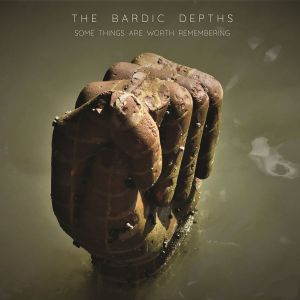
The Bardic Depths: Some Things Are Worth Remembering

Some Things Are Worth Remembering  is the fourth album from The Bardic Depths. Dave Bandana once again takes the reins, with lead vocals, bass, keyboards, and overall production, while Gareth Cole returns on acoustic and electric guitar, Tim Gehrt handles drums and percussion, and Peter Jones sings and plays sax and keyboards. The ever-clever and polyhistoric Brad Birzer supplies most of the lyrics, which, as the album’s title suggests, are full of reminiscences, longing, and nostalgia.

I’ve listened to Some Things Are Worth Remembering several times now, and my overall impression of the album is one of mellowness. There is a gentle vibe to most of the songs that wouldn’t be out of place on a early-to-mid-70s rock album. Given that I pretty much came of age in the 70s, I find Some Things Are Worth Remembering a most pleasant and entertaining listening experience.

The opening track, “Islands”, is, according to the notes provided by Mr. Bandana, Brad Birzer’s tribute to the classic Big Big Train song, “The Underfall Yard”. In that track, BBT expressed their admiration for the Victorian engineers who surveyed and constructed the railways that crisscrossed the UK. BBT sang how those engineers “using available light, they could see far”.  Birzer’s lyrics are a worthy tribute to the spirit of “The Underfall Yard”, as he writes, 

The song that longs to linger in our souls

Long after we’ve heard the last notes

A memory so pure so delicate

The song that cries to the skies

The song that hovers over that moment

Away from eternity

The music of “Islands” has a nice jazzy feel, thanks to the excellent saxophone work of Peter Jones. 

Next up is the very melodic “Fallen Leaves”, featuring beautiful wordless vocal harmonies that conjure memories of CSNY and The Beach Boys. 

Things get a little funky on the third track, “Arribabok”. Birzer’s lyrics explore how language is like a living thing, always evolving and mutating. I really like Bandana’s bassline on this song, and Cole’s sinuous electric guitar solo. The arrangement reminds me a bit of classic Peter Gabriel – shades of “Secret World”.

Side One closes with my favorite track, “October Sun”, which is Birzer’s ode to Michigan autumns. Maybe because autumn is my favorite season, this song really speaks to me with its evocation of “greens and reds and yellows and browns”. There is more to the song than mere colors, however:

The veil between this world and the next

Is ever so thin

It’s always twilight here

October holds its breath

In the dusk of it all

And on the verge of death

October sun shines through

I may be reading too much into these lyrics, but they remind me of Ray Bradbury’s memoir of small town America, Dandelion Wine, where natural beauty coexists uneasily with darker undercurrents. The music for “October Sun” is outstanding as well, with the final half consisting of an instrumental workout. Peter Jones’ sax and Gareth Cole’s guitar play a game of tag in the October sun!

Side Two opens with Peter Jones’ composition, “From Empty Trees”. He plays keyboards on this one, and it brings to minds Barleycorn-era Traffic. It’s a very fun track with a lot of drive.

The next song, “A View”, is, according to Bandana,  “about a man in space who awakes after his craft has been attacked and after finding out he is the only one left on board sees the Earth below in a totally different light.” Appropriately enough, the melody captures the longing and homesickness of that astronaut perfectly. 

“Harder to See” is the portrait of a man who is not the most likeable person. Bandana wrote the lyrics on this one, and he describes someone who is trying to find himself:

You make it I’ll break it you bake it I’ll take it

You grow it I’ll blow it you know it I’ll throw it

It’s not easy to please me it’s harder to see me

I like you can’t find me no ties to confine me

I need to get me a plan find out if I really can

I need to see where I am… see where I am as a man

Some Things Are Worth Remembering  closes with “Rewind”, which is Bandana’s recounting of attending a 1975 Genesis concert in London. Once again, there is a sense of longing for something that can never be recaptured.

I wish I could easily rewind my brain

All of the sights and the smells of old London Town

Sit and wait for the lights to die down

Music and drama and spells before our eyes

Stories of strange folk behind a disguise

I was there but I can’t remember now

Cole’s acoustic guitar work is outstanding, cleverly bringing to mind Steve Hackett from A Trick of the Tail-era Genesis. Cole also provides a muscular electric guitar solo that provides an intro to a beautiful vocal interlude. And when you think the song is over, we are given a wonderful pastoral coda that lasts almost five minutes. 

All in all, Some Things Are Worth Remembering is a fine addition to The Bardic Depths’ discography. I especially enjoyed Peter Jones’ saxophone work throughout, and Tim Gehrt’s work on drums and percussion is excellent. As I stated at the beginning of this review, this album is mellow – it’s a genuinely pleasurable listening experience that is perfect for a lazy Sunday afternoon (in October!). Even though there isn’t an explicit concept – such as the Inklings in their previous album, What We Really Like In Stories – a common thread of nostalgia and longing runs throughout all the songs. 

Finally, I noticed that the back cover has a disclaimer stating that, “No AI was used in the making of this album”. It’s a shame artists have to make that clear, but these are the time we live in. I hope Bandana, Cole, Jones, Gehrt, and Birzer continue to produce authentic music far into the future.

You can preorder Some Things Are Worth Remembering here.


Tad’s Best of 2025

Kruekutt set the table for looking back at 2025 with his excellent post listing his favorite classical and jazz releases of that year. In the same spirit, here are my favorite albums from 2025.

Maybe it’s a function of getting old, but I tended to stick with familiar artists this past year. There are a few that I trust to always produce excellent music, and I usually devote my limited listening time to keeping up with them. 

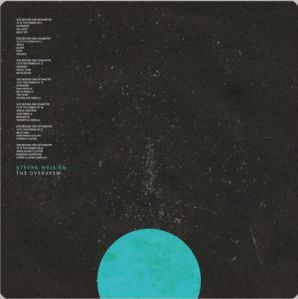
10. Steven Wilson: The Overview
I love everything Wilson releases, even his so-called “pop” albums. The Overview is unabashedly progressive, though, with two side-long tracks that overflow with beautiful melodies. Here’s a conversation Brad Birzer and I had about it.

9. Kevin Keller: Arcadia
This is more classical than rock, and it is simply beautiful. Here’s my review of it when it was first released.

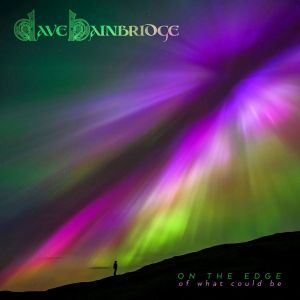
8. Dave Bainbridge: On the Edge of What Could Be
Bainbridge is a phenomenal guitarist with an immediately recognizable style. He combines Celtic, jazz, and rock elements to create a unique sound. On the Edge of What Could Be is a double album chock full of fantastic songs.

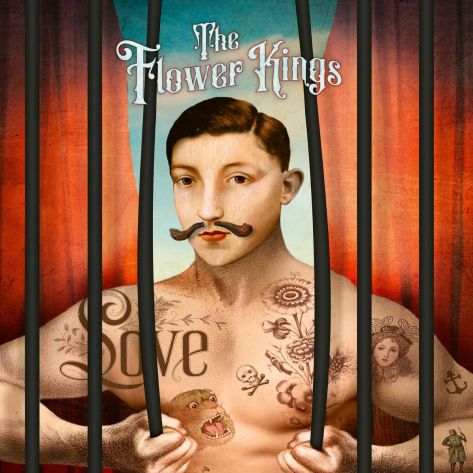
7. The Flower Kings: Love
Another excellent album from the Flower Kings. I think they are making the best music of their long career. Here’s the conversation I had with Brad Birzer about our love for Love.

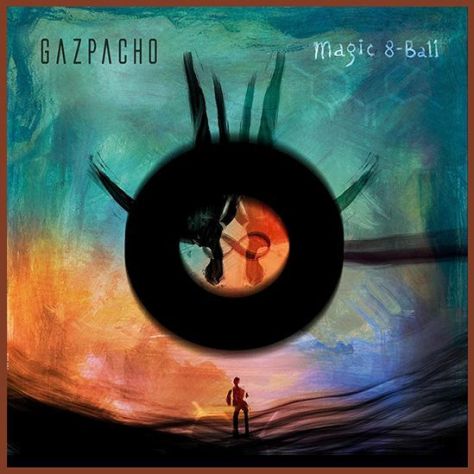
6. Gazpacho: Magic 8 Ball
Another one from some old favorites. However, they sound like they’re having a party this time! Here’s the link to our conversation about it.

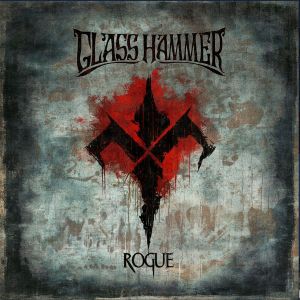
5. Glass Hammer: Rogue
Speaking of old favorites, Glass Hammer is a perennial one! Rogue is a fascinating story of a man at the end of his life looking back. Here’s my longer review.

4. Karmakanic: Transmutation
Here’s a new one (for me, at least!). This album has spent quite awhile on my stereo, and I think it’s a beautiful work. Led by Jonas Reingold of Sweden, it features John Mitchell on vocals. The epic title track is terrific.

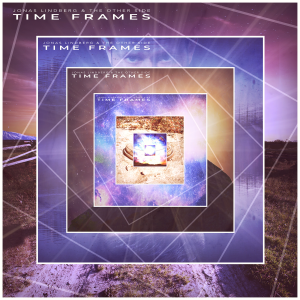
3. Jonas Lindberg and The Other Side: Time Frames
Another set of songs that is bursting with fun melodies and top notch musicianship. I had the pleasure of interviewing Jonas, and you can read it here.

2: Echolyn: TimeSilentRadioII & VII
Echolyn returns after a long absence with two of their best albums ever. The edit from “Water In Our Hands” is my favorite song of 2025. Here’s our conversation about these albums.

1. Lunatic Soul: The World Under Unsun
My favorite album of 2025 (at least for today!). A double disc of uniformly wonderful songs. Everything Mariusz Duda has done under the Lunatic Soul moniker comes to fruition on this fantastic album.

Check out the extraordinarily informative interview our own Erik Heter conducted with Duda here.

I hope you’ve enjoyed this list of albums from 2025 – it was a very good year! Let us know what your favorites were in the comments. Thanks for reading, and I hope you have a wonderful 2026.


Gazpacho’s Magic 8 Ball: A Magical Musical Showcase

Greetings, Spirit of Cecilia readers! In this post, we share our thoughts on the latest album from a group we have long admired – Norway’s Gazpacho.

Tad: Brad, the first Gazpacho album I picked up was Missa Atropos (2010), and I have to admit, I couldn’t get into it. Jan-Henrik Ohme’s vocals seemed kind of weird, and none of the songs had memorable melodies, to my ears. However, on your recommendation, I bought their fourth album, Night (2007), and I fell in love with it. Their use of repetitive riffs throughout the entire album had a hypnotic effect on me, and it remains a favorite of mine.

They’ve just released their twelfth album (not counting a few live sets), Magic 8 Ball, and I think it is one of their best. It sounds like they have decided to embrace their talent for writing excellent “pop”-style songs, and this album includes eight thoroughly enjoyable tracks. After the deep and  philosophical musings of 2020’s Fireworker, Magic 8 Ball strikes me as a more lighthearted and accessible offering. I love it!

Brad: Tad!  Always a pleasure, my awesome friend.  And, to imagine that we get time to talk and write about things we absolutely love.  Life doesn’t get much better than this.

Yeah, I’m just a few years short of two decades of loving Gazpacho.  Sometime in the early 2000s, I really fell in love with Kscope and started purchasing everything the label was putting out.  To this day, I have a pretty strong Kscope collection.  

At the time, if you remember, the label was also putting out samplers.  On one of those samplers, in 2007, I was exposed to Gazpacho’s Night, and I purchased it immediately.  To say that I was taken with it would be an understatement.  Though I have loved everything Gazpacho has released, Night and Tick Tock remain my absolute favorites–standards by which I not only judge Gazpacho but all bands and all prog.  Once I encountered Night, I went back and purchased Bravo, When Earth Lets Go, and Firebird.  Those first three are much more art pop and art rock than their later stuff.  Beginning with Night, the only real way to describe their music is prog or post-prog.  

To be sure, I’ve never missed an album.  Each new release is a treat, to be sure.  Crazily enough, I even bought Introducing Gazpacho–a best of collection–simply because I wanted to support the band.  I even have a specific shelf in my home office in which I display my most prized music.  Gazpacho sits beautifully next to my Talk Talk, Big Big Train, Marillion, The Flower Kings, and Glass Hammer collections.

Somewhat infamously (at least in my household and with my wife), I was so taken with Fireworker at St. Croix, the previous Gazpacho album, that after purchasing the stand-alone CD, I purchased the blu-ray of the album.  Then, I was so taken with the blu-ray, I purchased the deluxe book/boxset of the album.  So, I have all three different versions of that glorious album!  So, yes, I’m a bit of a Gazpacho nut.

Now we have Magic-Eight Ball and it fits into its own category.  Indeed, this new album strikes me as a cross between their prog and post-prog albums post Night and their art pop albums, pre Night. The first five tracks really fit well within the prog and post-prog realm, but the last three tracks–especially “Magic Eight Ball” and “Immerwahr”–really feel like the first few albums.  That is, they’re more art pop or art rock than prog or post-prog.

That said, I really love this new album, though on my first few listens, I was a bit taken aback by “Magic Eight Ball” and “Immerwahr.”  I’m just no longer used to Gazpacho being pop!

Tad: Brad, I think you’ve hit on something – Magic 8 Ball really is a summation of what Gazpacho has done, going back to the beginning. Let’s talk about the songs themselves. The album opens with the stately “Starling”, which pulls me in with Ohme’s warm and intimate vocals. The instrumentation is primarily piano with some gorgeous violin work from Mikael Krømer. There is a sense of longing to the melody as it slowly builds in intensity. By the end of its 9-minute length, the guitars are roaring, but it’s never overwhelming. I love the gentle closing lyrics: Oh, let us be reborn. It’s one of my favorite opening tracks in the entire Gazpacho discography.

The second track, “We Are Strangers”,  is one of my favorites of the album, and it’s a great choice for a single. Don’t laugh, but when I first heard it, I kept thinking it reminded me of something, and then it hit me: the chord changes and Ohme’s vocals are very much in the vein of classic Duran Duran! I mean that as a compliment; I think Duran Duran made some of the best pop music of the ‘80s.

The third track, “Sky King” is another relatively hushed and intimate track. Once again, Gazpacho has come up with an incredibly beautiful melody that is sung with delicacy by Ohme. Even when Jon-Arne Vilbo’s guitars come crashing in, it sounds like Ohme is whispering in my ear. The mix of this album is masterful – every instrument is clearly delineated, even during moments of glorious guitar-heavy noise. 

So, three tracks in, and I’m already hopelessly in love with this album! 

Brad: Thanks, Tad.  An excellent analysis.  I love how track four, “Ceres,” begins with a haunted-sounding piano, and it continues throughout the song.  The rhythm of the song is extraordinary, especially the percussive elements mixed with the vocals.  The whole thing sounds simply driving, but in a properly gentle way.

Track five, the bizarrely titled “Gingerbread Men,” in contrast to the previous track, begins hesitatingly, playfully hinting at a loss of direction, before the guitar comes confidently in and persuasively centers the song.  There’s some really unusual sounds–maybe someone playing piano strings as percussion?  I like the lyrics, though I’m not sure what they’re supposed to mean:

Through the haze
Swallows flying high
While we sleep
In a world of steel
There’s no peace

It is my belief
That my life has been discreet
Door slammed shut
The big bad wolf of night
Fragments of hope in this endless climb
Lit up by traffic lights
Broken dreams
Parading gingermen
Aftermath
Turn away
From them

And:

And now the cars go by
Silver ghosts
Of all the gingermen
Washing out
Washed away
With the rain

You bettеr pack a suitcase
Escape beyond thе city limits
Or watch your old self disappear
Before the end is writ in dough
It can only be delayed

Track six, “Eight Ball” is shocking and discordant, only because it’s so poppy, contrasting with not only most of Gazpacho’s post-Night music but with the first half of this album in particular.  Indeed, “Eight Ball”’s actually downright whimsical, something that would not be out of place in an 1890’s carnival or early twentieth-century musical.  I’m getting Ray Bradbury vibes, mixed with some animated classic Disney!  Despite being poppy, “Eight Ball”’s really good, and it makes me realize that I should never box Gazpacho into any particular category.

The poppy feel continues with the seventh track, “Immerwahr,” though not the whimsy.  This sounds a lot like a Marillion song–especially with the guitar on it.  I especially like the lyrics:

Leaving Chekhov in the drawer
Throw the bankers at the window
Where the panic and the fear
Palest moonlight ever
Silver everywhere
Was the greater meaning
Hiding in the past
Did we send it all to bed
While the spirits of the poor
Jitterbug on judgement day

Track eight, “Unrisen,” finishes the album.  While more poppy than the first five tracks of the album, it’s the least poppy of the final three songs.  The strings are especially gorgeous, and I had no idea if they’re real or synthesized.  There’s a definite playful quality to the keyboards, too.  And, once again, I really like the lyrics, though I’m not sure what they mean.

Now you’re an astronaut lost in endless universe
Within thosе lines are older days of othеrs, I withhold the nameless why
In glass and velvet green

Mystic cryptic secret whispers
Let them be the dreamless sleep for you

See how they drift in clouds and
See how they smile
Higher, higher into the deep blue
Sail the sea of tranquility

They remind me of the lyrics from the earliest Gazpacho albums.

Tad, I’m not sure how to conclude this.  I really like the new Gazpacho, and I think it’s a fine addition to their output as a whole.  What really draws me to Gazpacho, though, are their concept albums.  As such, while I’ll certainly and happily return to Magic-Eight Ball, I’ll probably return more often to Night, Tick Tock, Missa Antropos, etc.

Tad: Brad, thank you for sharing those lyric excerpts. I have a hard time understanding the meaning of most Gazpacho songs; I think they aim more for a mood or atmosphere than for a specific message.

I’m glad you noted the whimsical nature of the title track – when I first heard it, I also thought of a carnival ride! It’s somewhat unique in their catalog, and I like it a lot. Now that you mention it, I think the entire album is suffused with whimsy, including the title. Did you ever have one of those magic 8 ball toys? You asked a question, shook it, and an answer would float up to a little window: “Maybe”, “Definitely so”, etc.

I’d like to also give some praise for the opening bars of the closing track, “Unrisen”. With the keyboards and violin accompanying Ohme’s vocals, it sounds downright baroque to my ears – like something Vivaldi or Thomas Tallis might have composed. I swear, I can even hear a harpsichord in the background! Anyway, that’s just an example of the many musical delights I’m enjoying on this album.

While I share your love for their concept albums, I think Magic 8 Ball is one of their strongest collection of tunes. They sound really energized and confident on every track, and I am impressed with how they keep pushing the envelope after twelve albums. Here’s to hoping they record many more!

Kate Bush’s Aerial Turns Twenty

Tad: Hello, Brad! Brad recently pointed out that Kate Bush’s album, Aerial, has turned 20 which is a good excuse to have a conversation about it. I have enjoyed seeing all the new fans Ms. Bush has acquired thanks to the inclusion of “Running Up That Hill” in the soundtrack of Stranger Things. That song is off my favorite album of hers, The Hounds of Love, but Aerial is a close second, in my estimation.

The two discs have different titles: Aerial: A Sea of Honey, and Aerial: A Sky of Honey. Listening to them recently rekindled my love for this sprawling set of songs. As a math teacher, I have to express my love for the track, “Pi”, in which Kate recites the digits of that ineffable irrational number and makes it sound seductive.

Brad: Hello, Tad!  So great to be talking with you.  A pleasure and an honor.  I’m writing this on the Feast of All Souls, the weather is gorgeous, and I got to sleep in an extra hour this morning.  It all seems so appropriate as I praise Kate Bush.

I have fond memories of first hearing about Bush in 1985.  I had missed her earlier albums, but I very well remember the release of Hounds of Love in the early fall of 1985.  It was my senior year of high school, and I was utterly blown away not only by side one–especially “Running Up That Hill,” “Hounds of Love,” “Big Sky,” and “Cloud Bursting.”  It was side two, “The Ninth Wave,” however, that completely gobsmacked me.  Here was pure unadulterated prog, all from an incredibly talented pop mistress.  I was in love (it didn’t hurt that Bush is incredibly attractive and possesses an angelic voice).

A year later, during my first semester at the University of Notre Dame, the compilation, The Whole Story, came out.  It, too, was excellent, and it made me start looking through Bush’s previous albums.  

Then, my very close friend, Greg Scheckler, now a renowned professional artist in New England, made for me a mixed tape of everything prior to Hounds of Love, complete with Greg’s own doodles.  It was glorious, and I wore that tape out!  Too bad–given Greg’s subsequent fame, his doodles might very well be worth something.  

Two years later, in the spring of 1988, one of my favorite movie directors, John Hughes, came out with one of his best films, She’s Having a Baby, and during the most emotional moment of the movie, Hughes used (and commissioned, I assume) Bush’s “This Woman’s Work.”  As much as I had loved Bush prior to this, this song and scene solidified my permanent loyalty to Bush.  Yes, at that point, I became obsessed with her as an artist.  And, I remain so to this day.

Though I very much liked The Sensual World and The Red Shoes, it was 2005’s Aerial that, once again, gobsmacked me.  Disk one was truly clever prog-pop, artistic to the nth degree, but it was disk two that blew me away.  42 minutes of pure prog, akin to what Bush had done with “The Ninth Wave,” but perhaps even better.  I loved side two, “A Sky of Honey,” that I played it on my iPod night after night as I fell asleep.  At the time, I was working on my biography of Christopher Dawson, and I was having a heck of a time shutting down my brain and sleeping.  Aerial: A Sky of Honey worked wonders on me–calming me down and serving as a potent but non-addictive Ambien!

Tad: Well, Brad, I didn’t immerse myself in Kate Bush’s music as much as you did – I think I was negatively influenced by that infamous Rolling Stone Record Guide that panned her work and compared her voice to a vacuum cleaner! Needless to say, I’ve revised my opinion of practically every artist those small-minded critics at RS dismissed.

Anyway, my thoughts on disc one of Aerial are all positive (with the exception of “Mrs. Bartolozzi”, which is a little too maudlin for me). “King of the Mountain” starts off sounding like a Windham Hill album with its synthesized/indigenous rhythms, and I absolutely love the way it transforms into a straight-ahead rocker. It’s a fantastic opener! I’ve already mentioned how much I like “Pi”, and the other highlight of the first disc is “How To Be Invisible”, another great rock song with a snaky, bluesy guitar hook that is wonderful. Her vocals dance over, under, and around the other instruments and demand I pay attention to her. It’s a wonderful song that I can listen to over and over again. “Joanni” and “A Coral Room” lower the temperature a bit and are a nice way to close out the disc.

I wonder if Ms. Bush would say she’s been influenced by Joni Mitchell? “A Coral Room” in particular sounds like late-70s Mitchell to my ears. 

Brad, give us your thoughts on disc one of Aerial, and start the discussion of disc two!

Brad: It’s worth remembering that when Aerial came out in November 2005, Bush hadn’t released anything since 1993’s The Red Shoes.  That’s a huge gap.  Beautifully, Bush spent those years raising her family rather than pursuing her career.  

Still, that was a long, long time for her fans to wait.  To be sure, though, it was worth waiting for.  

I really don’t know which album is better, Hounds of Love or Aerial.  When I list my all-time favorite albums (and I always list them without letting any artist/band have more than one entry), I always list Hounds of Love.  Most recently, I listed it as my 12th favorite album of all time.  I could just’ve as easily named Aerial.  I guess, in the long run, they’re pretty interchangeable in the grand scheme of excellence.

Like you, Tad, I thoroughly love disk one.  The Elvis-like confident sway of “King of the Mountain,” the quirky intensity of “Pi”, the Renaissance sound of “Bertie,” the insistence of the washing machine of “Mrs. Bartolozzi,” the truly clever pop of “How to be Invisible” with its incredible basslines, the profound and fetching tribute to St. Joan of Arc in “Joanni,” and the deep despair mixed with hope in the melancholic “A Coral Room” all contribute to this masterpiece of a release.

I think that what impresses me most about Bush is that she is always her own person, her own artist.  She sounds only, gloriously, like Kate Bush, even when she’s playfully imitating Elvis on the first track of the album.

But, for me, it’s disk two that makes this album truly extraordinary.  At 42 minutes, “A Sky of Honey” is simply perfection itself.  When folks talk about albums that demand headphones for a full appreciation, this is that album!  

From the child whispers and bird sounds of the opening moments to the anticipatory keyboards and string to Bush’s lush vocals with meaningful lyrics to the spoken expositions, this is a complete and total celebration of life in all its varied mysteries and profound wonders.  

Tad, as you and I have talked about, it’s often the bass that makes a great album a great album.  The bass work on “A Sky of Honey” is spectacular.  Combined with Bush’s vocal lilt, everything builds and builds until the music itself is ready to explode–the tension as thick as can be–in the last 15 or so minutes of the album.  Stunning.  Just simply stunning.

If Bush had released “A Sky of Honey” as a stand-alone album, I have no doubt that it would rank up there with Close to the Edge or The Colour of Spring.

Tad: Brad, you hit on something crucial when it comes to understanding Kate Bush; you said “she is always her own person, her own artist”. I remember reading an article about the recording of Hounds Of Love, and her record label was worried about marketing it, because it was so different from her earlier work. I believe she recorded it in her home studio, and she completely disregarded her label’s suggestions (to our benefit, I would add!). She is an artist who is fearless and blazes her own trail, not giving any thought to current musical fashions. Will people be listening to Taylor Swift’s music 50 years from now? I doubt it. Will people be listening to Kate Bush’s? Absolutely!

As far as my thoughts on “A Sky Of Honey”, I am in complete agreement with you. I think of it as a musical suite that chronicles a day – the chirping birds in the intro are greeting the dawn, and it closes with “Nocturn”. However, I’m not sure how the title track, “Aerial”, fits in with my theory! It’s a fairly raucous track that, as you so aptly describe it, is ready to explode.

Also, thank you for pointing out that “Joanni” is referring to St. Joan of Arc. Once I understood that, it clicked into place. 

And so, dear readers, if you aren’t familiar with Aerial, we recommend you check it out. It is timeless and beautiful music!

An Interview with Jonas Lindberg

Jonas Lindberg & The Other Side’s 2022 album, Miles From Nowhere, burst onto the prog scene and made a lot of “Best of” lists. They are about to release the follow-up, Time Frames, and it does not disappoint. Lindberg was kind enough to take a few minutes and chat with me via Zoom.

Hi Jonas, thanks for taking the time to talk with me about your new album. Miles from Nowhere was my favorite album of 2022, and I am liking Time Frames just as much. Was the recording process for Time Frames the same as for Miles From Nowhere?

Pretty much – the recording process is the same, which means I do a full production demo, and then remove the drums. So Jonathan [Lundberg] records the drums, and he sends them to me, and I record almost everything, and then I go around and record vocals and lead guitars with the others.

So, the difference this time is that I actually have a studio to work in! I actually have recorded this one entirely in the studio. With Miles From Nowhere, most of my overdubs were recorded in my living room. So that’s the difference!

Well, Miles From Nowhere still sounds good, for being recorded in your living room!

Yes, it’s about where to put the mikes, and to understand that the room sounds weird.

I came of age in the ’70s, and I loved artists like Todd Rundgren, Boston, and Styx, and I’m hearing a lot of that style of rock in your music. Am I off-base with that?

Probably not. I haven’t listened to a lot of that, really. My influences are more – in the progressive genre – more Spock’s Beard. But they have probably listened to those bands, you know. I got that question earlier – it’s like it’s a new generation of influences. Of course, Pink Floyd has always been a big influence for me.

Yes, I can definitely hear early Spock’s Beard in your music. 

So, what are some of the lyrical topics in Time Frames?

Well, I tend to write about things that have happened to me. If I don’t have a clear idea what I want to write about, I take something that is evident or around me at the time. Some of the lyrics ended up being about parenting, you know, or my daughter, because I was on parental leave when I wrote the lyrics. A lot of the lyrics come from thoughts or things that happened during that time. So that might be a kind of overarching topic. But then you also have something like “Galactic Velvet”, for example, that’s completely different – it’s about space! [Chuckle]

I’m glad you brought that up; that’s one of my favorite songs. I love Jenny Storm’s singing on that. 

Yeah, she’s awesome. She’s really easy to work with, and she’s also incredibly fast at getting the right takes. For example, she sings a part in “The Wind” – the epic – her performance there was done in three takes.

What other musicians besides Jenny are on the new album?

Well, mostly friends of mine from university days. Jonas [Sundqvist], who is the other lead vocalist, we’ve known each other going back twenty years ago. We’re always writing music together, and we hang out together. We found each other through a Sting project that he had, doing Sting covers. And we went to school with Nicklas Thelin, who plays guitars; we went to the same classes at university. There’s Jonathan on drums, who I got to know better when I moved down to Stockholm and we ended up playing in a few different projects. Around the same period I met Calle [Schönning], the other guitar player who plays most of the lead guitar on the album. He’s just an incredible guitar player. Everything he plays, you know, everything is great! And then, also of course, my brother, [Joel Lindberg] plays guitar on a couple of songs. And my girlfriend Maria Olsson plays percussion.

Do you guys have any plans to tour?

I hope so, but it’s hard to tour, because I don’t really have a booking agent to make that happen. So I’m kind of doing everything myself! Right now, I’m more focusing on releasing the album, and then I’m planning on doing at least one or a couple of release concerts, somewhere in Sweden some time next year – I’m aiming for springtime. Then we’ll have to take it from there and see what happens. – how the album is received, you know.

Maybe you could do a pay-per-view streaming concert, or something like that.

Yeah, some kind of live film I’ve had in my head. Just an idea, but I haven’t anything set in stone – I’m just sketching at this point.

What are you listening to right now, besides your own music?

Right now, I’m in a little Steven Wilson period. I’ve been listening back through his catalog. When I was mixing this album, The Overview came out. And, being a fan of Pink Floyd, I was like, “Oh! Yes! That’s perfect for me.” Then I started going back, and I found all these albums that I had never listened to. That’s what I’ve been doing, mostly.

I’ve been a Steven Wilson fan since his Porcupine Tree days. I think my favorite solo album of his is his first, Insurgentes.

I haven’t gotten that far back yet!

Anything else you’d like to share, Jonas?

Go check out the album at my website, and I hope you like it!

Many thanks to Jonas for taking the time to talk with me, and we wish him lots of success with this new album – it’s really good! If you love progressive rock with a classic rock feel, you will not be disappointed with Time Frames. It is already one of my favorite albums of the year.

Jonas Lindberg and the Other Side’s official website is:  www.lindbergmusic.com/shop

Here’s the video for the single “Faces Of Stone”:

Lifesigns Live In The Netherlands: Instantly Classic Prog

The British group, Lifesigns, released a 2-disc live album recorded in the Netherlands back in 2023. Brad and Tad have a conversation about why this is a fantastic live album and why Lifesigns is a fantastic group.

Tad: Brad, I’m so glad you suggested we review this album. It’s been out a couple of years, but it didn’t get the attention it deserves. I became a fan of Lifesigns when they released Altitude in 2021, which was one of my favorite albums of that year. Live In The Netherlands features live renditions of almost that entire album, which is definitely a plus!

On listening to it, I am impressed with how well they replicate the studio versions of the songs, while adding a lot of energy. 

Brad: Thanks so much, Tad.  From what I can tell, Lifesigns is pretty huge in Europe but just does get enough attention here in the U.S.  Our loss!  Back when we were at Progarchy, John Young got ahold of me and let me know about Lifesigns.  I knew about Young, of course–he’s a huge name in the prog and rock worlds–and I was honored, to be sure, to communicate with him.  He’s not only a gentleman, but I believe he is truly a good, good soul.  And, obviously, what a talent.  So, I’ve been proudly following Lifesigns from the beginning, being introduced to them with their first amazing album, the self titled Lifesigns.  

My first and lasting impression of that album is that it’s one of prog joy, much more closely related to, say, a Transatlantic album, than, say, Storm Corrosion.  There’s a real beauty as well as real innocence to the music that I deeply admire.  

When I say it’s related to Transatlantic, I don’t mean in sound, but in atmosphere.  While I wouldn’t call Lifesigns a Christian band, I would say they’re most certainly not adverse to Christianity and all it entails.  And, the fact that the openly Christian Dave Bainbridge is now a part of the band certainly doesn’t hurt this reputation.  It’s definitely not an in-your-face Christianity like some of Neal Morse’s work tends to be, but rather music and lyrics inspired by Christianity.  Again, the best way I can explain it is that Lifesigns radiates joy.

There’s also something humorous about what I just said.  When I became Facebook friends with John Young, back in 2013, I also became friends with the first bassist of the band, Nick Beggs.  Beggs, of course, is well known in the prog world, especially given his work with Steven Wilson.  Almost immediately after I became friends with Beggs, he posted a number of pictures of himself in the buff.  I will admit, I was utterly shocked and, in no uncertain terms, made my horror quite plain on social media!  Ha.  There’s a puritan streak in me, to be sure.  Young, however, gently reprimanded Beggs and suggested this might not be the best way to introduce the band to the public.  It all turned out well.

Tad: Brad, that is hilarious! Beggs is definitely a prankster, but he is an amazingly talented bassist.

Let’s talk about Lifesign’s Live In The Netherlands. It features an excellent playlist, with the first half of the show devoted to old favorites like “N” and “At the End of the World”. It’s the second half that really gets me excited, where they perform the entire Altitude album. They are an incredibly tight unit, and Dave Bainbridge really shines on guitar.

Like you, Altitude was a favorite of mine the year it came out, and I immediately picked up all of their other albums. I still think Altitude is their best, but they haven’t released a weak album to date. I love the title track, which runs a generous 15:49, but never lags. John Young does a fantastic job on keyboards and vocals. “Last One Home” is one of my all-time favorite songs, regardless of genre. I think it is just beautiful in its perfect melding of song and lyrics. The version on Live In The Netherlands is outstanding, with Bainbridge turning in a wonderful guitar solo reminiscent of Gilmour at his best. 

It’s interesting you find Lifesigns reminding you of Transatlantic, and I can certainly hear that in terms of atmosphere, as you say. When I listen to Lifesigns, I am reminded of the classic prog band, UK – especially their eponymous debut album that featured Alan Holdsworth on guitar. I think it’s because Young’s vocals remind me of the late, great John Wetton’s. Also, Young’s melodies have a way of turning a phrase that brings to mind late ‘70s prog. 

Anyway, I think for someone who enjoys melodic and uplifting prog, Lifesigns is hard to beat, and Live In The Netherlands is the perfect introduction to their music. It covers the best songs from their first two albums as well as including an excellent performance of their complete third album. Lifesigns doesn’t have much music on the streaming services, so I encourage people to support them by buying hard copies of their albums. 

Brad: Tad, what a great analysis.  I’d not thought of Lifesigns resembling late 1970s proggers like UK.  Now that you’ve said that, I can’t unsee it.  I think you’re absolutely right.  Maybe John Young has a particular 1970s sound that I’ve never quite realized. 

Again, for me, it’s best summed up as “joy” rather than overly precious or overly intricate or overly self-involved.  For whatever reason, John Young and his music inspires me to be a better person, to approach my own art with a love of life and a gratitude for all that made my own life possible.  Hence, I think of it as being Christian adjacent rather than out and out Christian.  Again, we know Bainbridge’s Christianity, but if someone told me that Young was also serious about his faith, I wouldn’t be surprised.

And agreed, Lifesign’s three (only three!) studio albums are all excellent, and I very much love the two live releases.  I suppose, if pushed, I would say that Lifesigns (the debut album from 2013) is my favorite, only because it was my introduction to them.  In terms of quality of music and lyrics and vocals, I would rank all three equally.  Again, this music just makes me want to be a better person. 

We haven’t explicitly mentioned Cardington, and I would like to praise that album as well for being every bit the equal of Lifesigns and Altitude.

If I had one complaint, it would be that I want more Lifesigns music!  Call me greedy, but I would love more than three albums over a decade.  Still, I’m sure that John has a ton of things going on, so I’m deeply appreciative of what we do have.

Though I’d not thought of this as having a late 1970s sound until you mentioned it, I would love for more prog to have this feel and atmosphere to it.  There are a hundred Radiohead and Porcupine Tree inspired bands, where are the John Young inspired bands?  I would love more of this kind of music: classy and classic, beautifully constructed, and majestically orchestrated.  The lyrics are perfect and compelling as is the music itself.

For me, Tad, Live in the Netherlands perfectly captures all of this.  Indeed, in terms of sound quality, I’m especially impressed, as the live album sounds just like the studio release, despite being in an uncontrolled environment.  I love the first set of older material and the second set of newer material.  My only complaint is that all of the banter has been removed from the live release.  I’m sure that John spoke to the audience, and I would love to know what he had to say.  Specifically, given what a gentleman he is, I’m sure that he’s an excellent frontman.

John, Jon, Steve, Frank, and Dave: if you’re reading this, please know that you are loved, and my desire to have more music from you is meant in the best possible way.  Thank you, hugely, for everything you’ve given us already.  Now, we just need to get all Americans to listen to you. . . .

Tad: From your keyboard to John Young’s ears, Brad! Yes, I wish they released more music, because the contemporary music scene needs more like it. And, dear readers, you can find all of Lifesigns’ music and merchandise at https://lifesignsmusic.co.uk/. Check them out!

Tim Bowness’s My Hotel Year: A Worthy and Meaningful Beginning

Please forgive the brevity of this review.  Maybe we could call it a micro-review.  I’ve been a huge Tim Bowness fan ever since first encountering him through his extraordinary work in No-Man.  Indeed, it was about 23 years ago that I first encountered him, finding him because of his association with Steven Wilson.  Again, I’ve been a huge fan ever since.  If anyone inherited the mantle of Mark Hollis, it’s either Tim Bowness or Kevin McCormick.  Everything Bowness touches is just achingly beautiful.  Gifted with a very handsome voice, he brings a certain longing to all his vocals.  I should also note, like Hollis (Bowness has a better voice than Hollis, but I will never fault Hollis for that—he gave everything he had), Bowness understands the sheer importance of meaningful lyrics to music.  Writing all of this right now, reminds me that I would love to write a long article on the many excellences of Tim Bowness.  He deserves so much more than this micro-review.  Sadly (or brilliantly actually), I’m in between big writing projects on the Declaration of Independence as well as on sociologist Robert Nisbet and on writer Ray Bradbury.  That stated, my afternoon sound track has been Bowness’ s first album, My Hotel Year, originally released in 2004.  I was surprised to find Bowness’s own negative recollection and assessment of the album on his personal website.  “Along with Wild OperaMy Hotel Year is the least loved album I’ve ever made and, in some ways, it’s the album of mine I love least as well,” Bowness confesses. “Although 2003-2004 wasn’t a particularly bad time for me, the resulting album seemed lyrically sad and musically monochromatic. No matter what was done to sonically soften the blows, the album had an innate bleakness that seemed to dictate itself.”  There’s no doubt that the album is lyrically sad, but it’s incredibly and movingly authentic.  And, I would never call the music monochromatic.  Rather, I would say that the music is presented in a rather cohesive fashion.  That is, it’s an album rather than a collection of eleven songs.  Every song bleeds into every other song, regardless of the silence between thetracks.  While I like Bowness’s other albums better, I would encourage anyone and everyone to go back to this foundational album, My Hotel Year.  For what it’s worth, I think it’s glorious, and it certainly inspired my other writing this afternoon.  For that, I’m deeply grateful.

To order My Hotel Year, always buy from my favorite on-line retailer, The Burning Shed.

The Flower Kings’ Latest: A Hymn to Love

Hello Spirit of Cecilia Readers, it’s with great pleasure that Tad and Brad review the latest release from their beloved Flower Kings, Love (Insideout Music).  Here are their thoughts.

Brad: As always, a great pleasure to do this with you, my friend.  As you and I have talked before, I’ve been a Flower Kings fanatic (and yes, I mean a fanatic, a hyper fan!) for twenty-five years now.  A wonderful student–now one of my colleagues in the philosophy department at Hillsdale–let me borrow his copy of the band’s 1999 Flower Power.  I immediately fell in love with it, bought it, and bought my favorite album by the band, Space Revolver, to me one of the absolutely quintessential prog albums of all time.  Once I had Flower Power and Space Revolver, I bought everything before that: Stolt’s The Flower King, Back In the World of Adventures, Retropolis, Stardust We Are.  From Space Revolver to the present, I’ve bought every studio album, every DVD, every live album, every compilation, and both box sets on the day each has been released. I have two of their fan release albums, too, and two of their official bootlegs, but they’re really hard to come by.  Every once in a while they pop up on Ebay, andI pounce on them.  My point being, though, I’m a definite completist when it comes to Roine Stolt, just like I am with Steven Wilson.  Proudly so.  Both, absolutely amazing talents.

Through Facebook, I’ve had a few moments of correspondence with Stolt, and he’s a total gentleman.  Frankly, he’d be a blast over a beer.

But, Tad, let’s start with you.  You’re relatively new to the Flower Kings.  What made you change your mind about them, or what made you finally embrace them?

Tad: Brad, it is great to discuss this group’s music with you, and I have you to thank for introducing me to them. I knew about them for years, but I really didn’t get into their work until I picked up Space Revolver in a used record store. All of a sudden, things clicked, and I was able to appreciate what Stolt and his fellow Flower Kings were doing. I have since acquired all of their albums (but not the bootlegs and limited editions you have).

I have to say, they are some of the most prolific artists working today. They release an album practically every year, which are often two-disc sets. Even their single-disc albums are filled to the brim, including their latest, Love, which contains 71 minutes of music. What are your initial impressions of this one?

Brad: Tad, so glad you found and fell in love with Space Revolver.  Definitely a top-20 all time album for me, maybe even a top 15.  I certainly think it’s a classic of third-wave prog.  Everything just works on that album–the music, the shifts, the tone, the lyrics, the playfulness.  Yeah, I just love that album no matter how many times I’ve listened to it.

And, yes, I’m really happy with the new album.  It’s mellower, overall, than most previous Flower King’s releases, and it’s relatively tame, again compared to the band’s previous releases.

I had received the promo copy of the album from Inside Out, and I pretty much fell in love on the first listen, but, then, to make it even greater, my physical copy arrived.  I was so surprised to open up the CD and have the beautiful portrait of Mary and the Child staring up at me!  I’ve thoroughly enjoyed Stolt’s lyrics going all the way back to The Flower King (1994), and he’s always been respectful of Christianity.  His Christianity–at least as it comes across in his lyrics–is more mythic and symbolic than tangible and concrete.  Stolt especially loves making references to the “Holy Mother.”  I assume that’s Mary, but I’m not sure, of course.  Being Swedish, Stolt almost certainly comes for a Lutheran background.  As much as Luther loved Mary (he did, adamantly), Lutherans generally don’t put much emphasis on her.  So, one of the mysteries of Stolt and the Flower Kings.  

Here are two examples of Stolt’s rather hippyish and cosmic take on Christianity.  First, in his thank yous on Love, he writes “Remember: War is just fear and failure, FEAR manifested in small people with shady political or religious agendas–LOVE is always the winner.”

And, again, take the lyrics for track two of the album, “The Elder”:

You found your way – So come what may

You found your way – So come what may

So I have made it here

A distant light getting near

if you just knew where to begin

This holy mess you’re in – Waiting on a dream

I’ve made my peace with those who’d done me wrong

Those broken dreams that followed me along

So no more worries – If we could bury hate –

There’s nothing greater than the love we save

Betting on the love you save

Betting on the love you crave

So open up those doors – letting out the waters

And now you’re waiting on a tide

I once had a vision – behold them lights

The lights of salvation

So you look in his eyes – resurrection –

He’s risen – Came down upon me –

is it real what I’m feelin’

We can get much higher – We can start a fire

Turn away from lies – Looking eye to eye

We can catch a light – Brighten up this night

We will never die – We will never die

What you get is what you are

So give away a shiny star

Keep it closer to your heart

Do never sway – Don’t break no parts

What you give is what you are!

What was given – looking closer – Taint your soul

It’s unforgiven – cause the world has plans for you

Is it real – is it fiction? – Crucifixion

The world may soon just set you free

Here we are in silent trenches

Come this far – lived life let reckless

Waiting for the lights to change

I’m waiting for the outbound train

You found your way – So come what may

You’ve found your way

Notice, of course, the use of salvation, risen, resurrection, Crucifixion.  None of it is blatant theologically, but it is blatantly symbolically and mythically.

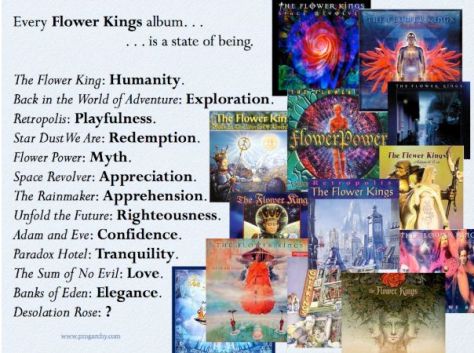
I once tried to outline all of the albums up through 2013.  It would be nice to update this, as the Flower Kings have released a lot since 2013.  But, here, at least is what I thought up to that point:

And, I have to note as well, Tad, that I once had huge aspirations of writing a book about the Flower Kings, using each album as a chapter and inspiration, a theme pregnant with whole worlds.

Tad: Brad, I love your Aristotelian classification of their discography! You have some updating to do, though, don’t you? I hope you follow through on that book – I think prog fans would love it.

I also noticed and appreciated those lyrics in “The Elder” the first time I heard that track. It is one of my favorites on the album. My overall impression of Love is one of all-encompassing joy and optimism – which is not surprising, given the album’s title! The first song, “We Claim The Moon”, bursts out with a happy sound of guitars and keyboards that conjures up classic Traffic. The line, “I’ll never get over the way you brought down the moon” brings to mind Jimmy Stewart and Donna Reed in It’s a Wonderful Life

I agree with you that this album is mellower, but, paradoxically, I think there is a lot of energy in the performances. The vocals on Love strike me as some of their best ever, with Hans Froberg and Roine Stolt trading leads and harmonizing beautifully, especially in “The Phoenix”. I love the way that track starts out acoustically with a celtic feel, and then features an outstanding guitar solo from Roine. 

Another highlight is the final song, “Considerations”, which is written by Michael Stolt and Jannica Lund. It is a truly majestic track that I admire more and more as I listen to it. The “Shine on, shine on love” section is one of my favorite musical moments.

I also appreciate the way the Kings have created a unified whole from these twelve tracks. Musical motifs reappear throughout the album, as well as lyrical themes – did you notice that “Love Is” (track 10) has the line, “How can you leave us now?”, which is the title of the album’s third track! It’s little details like that that tell me Love is meant to be listened to in its entirety to fully appreciate its message. And what a message – despite all the negative forces in our world, love can conquer all. I really appreciate how bravely Flower Kings go against the cultural grain of our time: instead of complaining about hatred and division, they choose to celebrate the power of human (and spiritual) love.

Brad: You put that all so beautifully, Tad.  I really like the idea that the album is really love calling on love, inspiring  us to be our best.  Frankly, I think that’s a perfect summation of Roine Stolt’s artistry and what he’s accomplished over the past 31 years.  All rather stunning and motivating.  And, so once again, I’m brought back to the beginning–I’m extremely proud to be a fanatic when it comes to the Flower Kings.

As always, we encourage you to buy your Flower Kings merchandise from the best online retailer, Burning Shed.