

One of Brad Birzer’s favorite musical artists is The Flower Kings, and one of his favorite albums of theirs is Space Revolver. In this dialog, he and Tad Wert discuss that album and its place in their discography.
Tad: Brad, it’s good to be interacting with you again on Spirit of Cecilia! I chose this classic album, because I know it’s a favorite of yours.
My first exposure to The Flower Kings was their album, Stardust We Are, which I bought because of a Mojo Magazine article on “the new wave of progressive rock”. I have to admit that I tried repeatedly to listen to the whole album, and it never held my interest enough for me to do so. I know that you love Roine Stolt and his Flower Kings, so every time a new album was released, I gave it a try, but there were always other artists’ music that took my attention.
Then, last week, I found an inexpensive copy of Space Revolver, and I don’t know exactly why, but I picked it up. Once I heard the opening chords of I Am The Sun Pt. 1, I was immediately taken with this album! I think Stolt (in my humble opinion), had hit upon a very good balance between power and grace in his music. As I continued to listen to the rest of the album, I was gratified to hear that that high quality of songwriting continued throughout.
Brad: Dear Tad, it’s been too long, my friend. What have I been doing? Too much teaching of the American founding period and too much grading! Ha. No, of course, I love my teaching and my students, but they are distractions from my love of reviewing albums with you and my love of progressive rock! So glad to be done with the semester (and, frankly, it was a great one!!!) and back to reviewing with you. Ahh. . . the good life.
Yes, I’ve been a fan of The Flower Kings for a long time, now, and I’ve been an evangelist of the band just as long. Way back in the year 2000, a former student (now the head of our philosophy department) leant me a copy of Flower Power. I was immediately taken with it, and I bought everything available at the time by the band. I fell in love with everything. Absolutely everything, including Roine Stolt’s solo album, The Flower King (which, I assume is just a hippy-ish name for Jesus).
Crazily enough, the band released Space Revolver on July 4th of that year. Coincidence? I have no idea, but it struck me as a perfect Fourth of July album. Especially with those queer lines in the first track–”I left my heart in San Francisco. I left my mind in San Francisco Bay.” Wow, did I laugh hard or what!!! 24 years later, the line still cracks me up.
I’ve had the chance to correspond a bit with Stolt, and I even sent him some books on economics (by Wilhelm Roepke) before a longish tour he took. As far as I know, he took the books with him! How great is that? Frankly, I’d be happy to be his book supplier. At the time I sent him the Roepke books, he was really interested in an anti-Marxist form of economics, that is, the creation of more private property (small family farms) rather than less. Again, how great is that? “Ride this bitch, that is power!”
Anyway, Tad, this is a long way of saying, I love the music, and I love the band. I think the world of both.
Tad: Okay, Brad, your off-hand remark about the Flower King being Jesus is something that I’ve wondered about for a while: is Roine a Christian? The 1994 album, Roine Stolt’s The Flower King, is steeped in religious imagery, specifically Christian, and, of course, he has collaborated with Neal Morse in Transatlantic. Anyway, if true, it helps make sense of a lot of his music!
Also, here’s something else that came to me while listening to Space Revolver – to my ears, it is a huge leap forward in songwriting from Stardust We Are, and I was wondering what might have caused it. Then it hit me: Space Revolver was written and recorded a few months after Stolt was involved in the first Transatlantic album SMPTE! I think Neal Morse must have had an influence on Stolt; that opening piano riff in I Am The Sun Pt. 1 is very Morsian (to coin a word!). Chicken Farmer Song, Underdog, A Slave To Money, and A King’s Prayer all feature outstanding melodies – they’re downright power poppish in their catchiness. Even the jam that closes out A King’s Prayer is focused and tight, with nary a wasted note.
The tootling mellotron that opens I Am The Sun Pt. 2 is one of my favorite moments of the entire album. I hear it, and I can’t help but smile and bob my head. Actually, the whole atmosphere of this album is one of joy. Stolt seems to be having the time of his life, and he wants the world to know it.
I also want to single out Ulf Wallander’s soprano saxophone work for praise. I love that instrument, but in the wrong hands it can be very annoying. Wallander does a great job zipping off very pleasant improvisations that add a lot to the overall feel.
The only misstep on this album, in my opinion, is Hans Froberg’s You Don’t Know What You’ve Got, which sticks out like a sore thumb. It just doesn’t fit in with the rest of the album. That said, it’s not a bad song, it just doesn’t work for me in the context of the other tracks.
Okay, I’ve raved enough; your turn!
Brad: Tad, what a fun writeup. Thank you–I think you clearly identify the joy and playfulness that is so prevalent in Space Revolver. Stolt was clearly having the time of his life. I love all the other albums – in fact, I made a meme a years ago expressing what I loved about each album (see below) – and I’m especially taken with Flower Power (the first of theirs I heard) and Paradox Hotel. I really like Stardust We Are, too–but each of these other albums lacks the extreme playfulness of Space Revolver.

[I made the above meme back when Desolation Rose came out. I was rather blown away by the album when it was released, but mostly because it was so intense and lacked the characteristic mischievousness of the previous albums. Indeed, when we were really active at Progarchy, I even planned out a book on the Flower Kings (never realized, except for some snippets, here or there), following the meme’s albums’s themes. I was planning on arguing that The Flower Kings were to Europe what Big Big Train was to England and what Glass Hammer was to America.
The book would’ve come out before my Neil Peart biography and even before what you and I, Tad, wrote on Big Big Train. I was, at the time, emailing with Stolt, and I was rather taken with him (still am) as an artist and as a human being. He was extremely active on Facebook at the time, as was his wife, and they were always interesting. We disagreed radically on the meaning and legacy of President Obama, but, again, he was always a total and intelligent gentleman.
It’s about the time I sent him the Roepke book.
I did try to interview Stolt about Rush, but he very kindly responded that he didn’t know enough about the band to offer anything substantive. He was genuine, kind, and humane in his response.
One of many grand schemes never realized. . .]
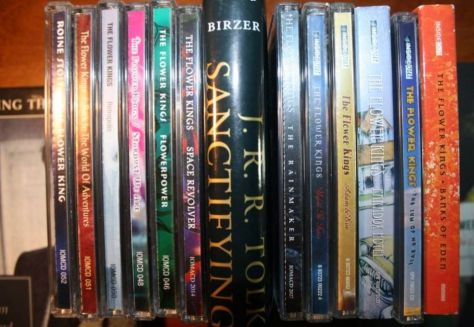
[Above photo, my fantasizing. In the middle of my then-Flower Kings collection, I’ve placed three of my own books, my biographies of (right to left) Christopher Dawson, J.R.R. Tolkien, and Charles Carroll of Carrollton. Yes, I desperately wanted my work to be tied to Roine Stolt and the Flower Kings. I thought–and still do–that if any of my biographies could reach the majesty of Stolt’s artistry, I would truly have made a mark on the world.]
A few responses to you directly, Tad. It’s funny, I had always assumed that Neal Morse was influenced by Roine Stolt, rather than the other way around. And, Stolt, to me, seems deeply influenced by King Crimson, Yes, and Genesis. This seems especially clear on his solo, The Flower King, and Retropolis, both of which came before Transatlantic. But, I assume this is like a chicken or the egg question. At this point (2024), the two must’ve influenced each other so completely that one can’t any longer disentangle which idea or person came first. Together, Stolt and Morse are the heart of rambunctious third-wave prog.
As to Stolt being Christian, I have no idea. In our brief correspondence, I obnoxiously asked him directly about his faith, and he never responded or hinted, one way or the other. Being Swedish, he was almost certainly raised nominally Lutheran, even if the Swedes only attend services on Easter and Christmas.
Regardless, Stolt employs Christian symbolism frequently, especially in the early The Flower King’s albums. Again, I think that “The Flower King” is a sort of hippie Cosmic Christ. Here are the lyrics from the first album:
Falling out of the sky, falling into a dream
All I need is the heart where it all can begin
It’s just a matter of time, it’s just a matter of trust
It’s just a matter of faith when we all sleep in the dust
Don’t deny, just verify the genius of it all
It’s the cycle of all living thing, hear the children
Hear the children call !
“We believe in the light, we believe in love every precious little thing
We believe you can still surrender you can serve the Flower King”
Going out into the grey, into purple and red
See, all the beautiful shapes flowing out of my head
It’s just a matter of time, it’s just a matter of trust
It’s just a matter of faith when we all sleep in the dust
Don’t deny, just verify the genius of it all
It’s the cycle of all living, hear the children
Hear the children call !
“We believe in the light, we believe in love every precious little thing
We believe you can still surrender you can serve the Flower King”
“We believe in the heart, we believe in healing in a house where angels sing
We’ll unite the divided and the fallen one will serve the Flower King”
“We believe in the heart, we believe in healing in a house where angels sing
We’ll unite the divided and fallen one will serve the Flower King”
Again, I don’t quite think this is the orthodox Jesus Christ of Christian faith, but a rather humanistic but still supernatural Flower King. When the band becomes “The Flower Kings,” they’re not divinizing themselves but rather becoming disciples.
What strikes me most, though, is that Stolt’s use of mythological symbols is not Lutheran, but deeply Roman Catholic.
On track four of Space Revolver, “Monster Within,” Stolt sings “Mother Mary, she’s left the building crying/silent tears rolling down her cheek.” Granted, this could just be a Beatles’ reference, but Mary, here, seems more supernatural than Paul McCartney’s mother. After all, Mary is the opposite of some kind of demagogue trying to seduce our children and who feeds on power and who controls the bats.
One of my favorite The Flower King’s albums, Unfold the Future, posits a war between the devil and Mary. On the final track:
Clueless
Living in a business cluster, predator to suit your needs
Raven sitting on your shoulder, lurking the suburban weeds
Think I saw you in the bank, think I saw you in a talkshow
Swear I saw your mindless grin, justify the final blow
Swallowing the endless laughter, cultivate the deadly sins
Getting even altogether, hiding from the Holy Mother
This is how you raise the Cain, this is what you teach our children
Back on duty dog eat dog, they’re clueless in the Devil’s playground
Then, of course, on Space Revolver, on track 6, “Underdog,” there’s that really weird line/sound byte: “John Paul’s pizza, the biggest pizza you’ve ever seen.” When this album came out, in the year 2000, the only John Paul that mattered was John Paul II.
So, is Stolt Christian? I have no idea, but he’s an awesome ally, a man of integrity, and a grand myth maker. Taken together, this is so much what I love about Stolt and the band. Never once I have listened to them without my imagination being stimulated, expanded, and made manifest!
Tad: Wow, Brad! I knew you were a fan of Stolt, but I wasn’t aware of all the thought you’ve put into his music. I now have a much greater appreciation for his overall oeuvre than before. I think you’re probably correct about who influenced whom – Morse had to be aware of Stolt while he was in Spock’s Beard, and Stolt had to be aware of Morse. They likely influenced and appreciated each other, which led to the formation of another outstanding prog group, Transatlantic.
I kind of like it that Stolt is mum about his faith; it allows different interpretations of his music. What’s important to me is that he seems to be a light-bearer, as opposed to a dark nihilist like so many Scandinavian death metal artists. Stolt is always positive and optimistic, even when he is singing about something he’s unhappy about. In that regard, Desolation Rose seems to be his “darkest” work, and it is still uplifting to my ears.
So here’s my takeaway on Space Revolver: it is the perfect introduction to The Flower Kings for someone who is new to them. In it, the group hits the perfect combination of melodicism, progginess, and improv jamming. Once you’ve absorbed this album, all the others make sense. They’ve had an amazingly productive run the past 30(!) years, and I hope they go for 30 more!
 Spirit of Cecilia
You must be logged in to post a comment.