Category Archives: fiction

Willa Cather’s My Antonia: A Beautiful Ode to Prairie Life

I’ve been intending to read Willa Cather’s My Antonia for a few years, since my writer and historian friend, Bradley Birzer, raved about it. (You can read his brilliant take on Cather here.) It’s in the public domain, so I had no excuse and downloaded a free copy. And here I have to confess that I regret having waited so long to read it! From the opening sentence, I was captivated by Cather’s clear and succinct prose. 

The Antonia of the title is a young Czech woman whom the narrator, Jim Burden, sees on a train heading out to Nebraska in the late 1800s, probably around 1880. Jim is ten years old, both his parents have died, and he is leaving his home in Virginia to live with his grandparents on their farm on the prairie. Antonia Shimerdas is fourteen, and she is traveling with her family – newly arrived to America – who hope to make a new life farming in the same vicinity as the Burden’s. Her family consists of her father, mother, older brother Ambrosch, and her little sister, Yulka. From the start, they are at a disadvantage, because they overpaid for a sod house and land that they hope to farm. Poor Mr. Shimerdas is out of his depth – he was a skilled weaver back in Eastern Europe, and he knows nothing about farming. Ambrosch is a haard worker, but mistrustful and a little devious. Mrs. Shimerdas is very proud and has an extremely difficult time adjusting to their new circumstances. For Antonia, however, life is a grand adventure. She and Jim immediately strike up a friendship, and she quickly picks up English. Her openness and sincere delight in everyone and everything around her are her best qualities. 

As I read My Antonia, I was really struck by how important community was to prairie dwellers. During the first winter, a severe snowstorm hits, and Jim’s grandmother, Jim, and their indefatigable hired hand, Otto, brave the elements to bring some food and supplies to the Shimerdas. It’s no exaggeration to say this act of neighborly kindness saves Antonia’s family from starvation.

The prairie itself is a major character in the book. I loved Cather’s vivid descriptions of it in all seasons. Here’s one set in autumn:

All those fall afternoons were the same, but I never got used to them. As far as we could see, the miles of copper-red grass were drenched in sunlight that was stronger and fiercer than at any other time of the day. The blond cornfields were red and gold, the haystacks turned rosy and threw long shadows. The whole prairie was like the bush that burned with fire and was not consumed.
(Location 488, Standard Ebooks Edition)

Each chapter is a self-contained vignette that adds up to a powerful and satisfying whole. Jim’s grandparents decide to rent their farm and move to the local town of Black Hawk, so Jim can attend school. Antonia doesn’t go to school, because Ambrosch insists she work on their farm, as well as hire herself out to other farms when they need an extra hand. She is very proud of her ability to do a man’s work, but she regrets not getting a good education.

Grandfather Burden gets Antonia a job keeping house for his neighbors in town, the Harlings, and Antonia thrives there. She helps with the children, the cooking, and the cleaning. She also falls in love with dancing under a big tent that is set up in the town square for that purpose. Jim also enjoys dancing with the girls and Antonia on the weekends. Their friendship deepens as they both grow older, but it never tips over into romance. It comes close, though! 

Another important aspect of prairie life was faith. Here’s how the Burden’s celebrate one Christmas:

On Christ­mas morn­ing, when I got down to the kitchen, the men were just com­ing in from their morn­ing chores—the hors­es and pigs al­ways had their break­fast be­fore we did. Jake and Ot­to shout­ed “Mer­ry Christ­mas!” to me, and winked at each oth­er when they saw the waf­fle-irons on the stove. Grand­fa­ther came down, wear­ing a white shirt and his Sun­day coat. Morn­ing prayers were longer than usu­al. He read the chap­ters from St. Matthew about the birth of Christ, and as we lis­tened, it all seemed like some­thing that had hap­pened late­ly, and near at hand. In his prayer he thanked the Lord for the first Christ­mas, and for all that it had meant to the world ev­er since. He gave thanks for our food and com­fort, and prayed for the poor and des­ti­tute in great cities, where the strug­gle for life was hard­er than it was here with us. Grand­fa­ther’s prayers were of­ten very in­ter­est­ing. He had the gift of sim­ple and mov­ing ex­pres­sion. Be­cause he talked so lit­tle, his words had a pe­cu­liar force; they were not worn dull from con­stant use. His prayers re­flect­ed what he was think­ing about at the time, and it was chiefly through them that we got to know his feel­ings and his views about things.
(Location 951, Standard Ebooks Edition)

Life was very hard, yet for most people young Jim came into contact with, there was much joy. People had few possessions, yet they had rich lives. As the quote above makes clear, those living on the prairie considered themselves better off than city dwellers. They were responsible for their own entertainment; for example, Mrs. Harling and her daughters were accomplished pianists who loved to play for people. When a traveling troupe comes to town one summer to offer dancing lessons, all the families flock to them and make it a festive event. I would say the defining feeling of the time was optimism – in a relatively young America everyone had boundless hope and a belief that they could succeed.

In the final section of the book, Jim – who has gotten a law degree and moved to New York City – returns to Nebraska to see if he can find Antonia. He does, and he gives us this tender portrait of her in her middle age:

She was a battered woman now, not a lovely girl; but she still had that something which fires the imagination, could still stop one’s breath for a moment by a look or gesture that somehow revealed the meaning in common things. She had only to stand in the orchard, put her hand on a little crab tree and look up at the apples, to make you feel the goodness of planting and tending and harvesting at last.
(Location 3684, Standard Ebooks Edition)

My Antonia  is deservedly a classic of American literature. As Jim and his friends mature, so does the country, becoming less agricultural and more urban. The pace of life increases, and modernity begins to intrude. My Antonia is a paean to a bygone era of American life when life was fraught with peril, but also held out almost infinite promise. In our own day, it’s common for neighbors on the same street of a city to not know each other at all. In Antonia’s time, everyone knew everyone and felt some responsibility for each other’s welfare. At the close of the first quarter of the twenty-first century, we have so much in terms of material comfort, but we have lost much, as well.
SciFi/Fantasy Meets Prog (and the result is glorious)

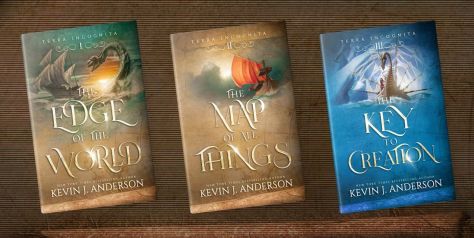
Acclaimed author Kevin J. Anderson, is beginning a Kickstarter campaign tomorrow (March 11, 2025) to reissue his three-volume Terra Incognita project. The books have been previously published in paperback, but have been out of print. Anderson plans to rerelease them as a deluxe set of hardcovers in a slipcase.

Accompanying the books is a trio of albums featuring the cream of progressive rock. Just check out the lineup for the soon-to-be released third album, Uncharted Shores:

• Michael Sadler (SAGA)
• Dan Reed (Dan Reed Network)
• Doane Perry (Jethro Tull)
• Ed Toth (Doobie Brothers, Vertical Horizon)
• Jonathan Dinklage (Rush Clockwork Angels, Lady Gaga, Barbra Streisand)
• Greg Bissonette (David Lee Roth, Ringo Starr All Stars)
• Anneke van Giersbergen (European vocalist)
• Ted Leonard (Spock’s Beard, Pattern-Seeking Animals)

Be on the lookout for an in-depth review of this album soon. Meanwhile, check out the Kickstarter campaign – it will be the only means of acquiring this historic literary/musical project, and it only runs from March 11 through April 4!

[This post was updated to reflect the fact that all three novels have been published in paperback, and the personnel for the third Terra Incognita album was incorrect. The post now has the correct lineup.]

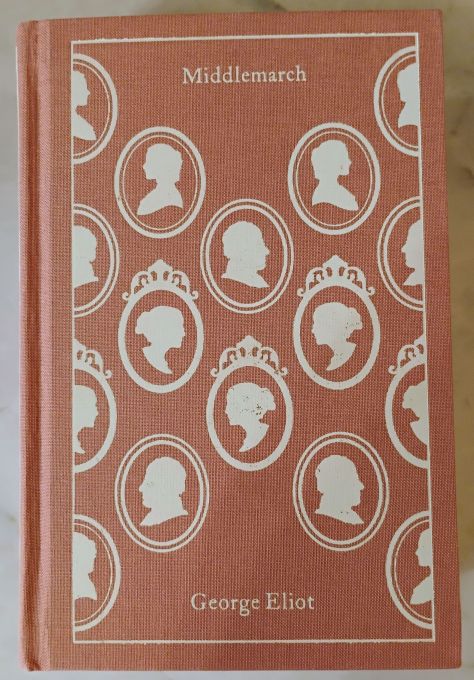
George Eliot’s Middlemarch – The GOAT of British Literature?

George Eliot’s masterpiece,  Middlemarch, is a massive and complex portrait of rural England at the time of the 1830s Reform Bills. The BBC lists it as the greatest British novel of all time. You can read my thoughts on it here.

Raphael and the Noble Task: A Modern Christmas Classic

Raphael

In 2000, when our daughters were 10 and 6, I saw a list of new Christmas-themed books that included Catherine Salton’s Raphael and the Noble Task. I found it at the local bookstore and was immediately taken with David Weitzman’s beautiful illustrations. I read it aloud to the family, and we all enjoyed it very much. Even though it’s technically a children’s book, it will appeal to readers of all ages, much like C. S. Lewis’ Narnia series.

Raphael and Alchemist
Raphael speaks with The Alchemist, another of his cathedral’s statues

I decided advent 2024 was as good a time as any to revisit this charming tale of a Gothic cathedral’s chimère (French for a statue of a chimera) named Raphael and his quest to find a Noble Task to justify his existence. Raphael is a griffin, placed above the cathedral’s main entrance. He has a lion’s body and legs, eagle’s wings, and the head and neck of a dragon. He is bored and lonely, and he visits the statue of an alchemist who refers to an older cathedral guardian named Parsifal who is no longer around. It is the alchemist who plants the idea of a noble task in Raphael’s head.

Once Raphael decides he needs to perform a noble task, he decides to ask other members of the cathedral statuary what he should do. He first goes to a couple of tomb effigies of a knight and his wife, but they’re so busy bickering they can’t help him. Next, he approaches a gargoyle who is near his niche, but, like all gargoyles, this one – named Madra-Dubh (Black Dog) – is very rude and condescending:

Raphael steeled his resolve. “You see, I’m trying to find something, and I think you might know where it is,” he said as quickly as possible.

“Oooh, and it’s trying to find something,” crowed Madra-Dubh as the others cackled gleefully. “Not good enough for the fawning idle-headed dewberry to sit in its donkey-spotted behind and do its right job, mark me! Nooo, it’s got to go thumping about pestering the working folk with foolish don’t-you-knows. Go drop some feathers, ye molting chicken-witted dragglebeak, and leave us in peace, then.” (pages 21 – 22)

Raphael eventually finds the scriptorium (library), and even though he can’t read, he sees an illustration in an illuminated manuscript. It depicts a knight in silver armor slaying a dragon. Because Raphael resembles the dragon, he begins to doubt his own integrity and wonder if he is actually evil. At this point in the story, there is beautiful scene set in a side chapel where Raphael, tortured by gnawing self-doubt, encounters a statue of Mary with her child Jesus, and he is immediately set at peace.

A young woman with a gentle expression gazed out at him from the darkness. Her plain blue gown fell in folds to her bare feet, and her hair was unbound, spreading over her shoulders in rippling veil. In her arms she cradled a baby, who reached up with one small hand to touch her face in a gesture of cam devotion. As Raphael stood wondering, his head cocked to one side, he felt as if his hurt and disappointment were being softly lifted away. For the young woman seemed to speak to him in a manner he did not fully understand; she did not move, nor did she actually say a word, but all the same, she told Raphael a long and beautiful story. In the icy darkness of that chapel, she spoke gently to Raphael alone. She spoke of joy in good times, and patience in hard, and of hope even in the bleakest hours of all. (page 41)

Once he has returned to his niche over the main portal, though, his self-doubt returns. And then one day, he sees a young woman in desperate straits hurry up the steps to leave her baby in the “foundling” box – a place for babies whose parents can’t feed them or care for them. In a flash Raphael has found his noble task!

What follows is great fun, as various communities in the cathedral all work together to help Raphael take care of his new charge. The gargoyles, the churchmice, and the pigeons all manage to put aside their differences and learn to cooperate.

Of course, the situation cannot last forever, and Raphael is faced with a terrible choice: his true noble task. Salton does a terrific job of weaving together the lives of the monks and other inhabitants of the village with the clandestine doings of the cathedral statuary, armies of mice, and flocks of pigeons. The whole tale is a marvelous allegory of how, despite the best of human (and chimère) intentions, without a little Divine intervention things would rapidly turn into tragedy. However, as Salton quotes Julian of Norwich at the very beginning of the book, “All shall be well, and all manner of things shall be well.”

Raphael and the Noble Task is a wonderful book for families to read aloud at Christmastime. It’s relatively short: 157 pages, and as I mentioned before, David Weitzman’s illustrations are fantastic. It deserves a place alongside other Christmas classics like Dickens’ A Christmas Carol  and O’Henry’s The Gift of the Magi.

Tolstoy’s Anna Karenina


Karenina

I could say 2024 is the year I rekindled my love of Russian literature: I reread Tolstoy’s War and Peace, and discovered the beauty of Turgenev’s Fathers and Sons. Like War and Peace, I read Tolstoy’s Anna Karenina when I was much younger – 21 years old. At the time, I thought it was a pretty good story, but a little melodramatic. Now, with the benefit of having been happily married for 38 years with two wonderful daughters, I can appreciate Tolstoy’s mastery of the novel form as he chronicles the tragic arc of marital infidelity. I now understand so much better the psychological and emotional torture his protagonists put themselves and those around them through.

Anna Karenina is a perfect example of why I enjoy reading classics so much: they are time machines. While reading it, I was able to get a glimmer of what life was like in 19th century Russia – the lifestyles of the peasants; the mores and conventions of the upper class; how hard life was for women, regardless of class; how perilous childhood was – if one survived infancy, he or she could easily die from illness or accident; how slow and difficult getting from one place to another was; the elaborate rules of courtship, and on and on. Tolstoy vividly conveys his world through small details that resonate over decades. I really feel like I have experienced a visit to pre-revolutionary Russia.

The story begins with one of the greatest opening sentences in all of literature: “Happy families are all alike; every unhappy family is unhappy in its own way.” We begin with Prince Stepan (Stiva) Oblonsky getting up one morning, bursting with good health and benevolent feelings for those around him. He is a government functionary who doesn’t really do anything, and he’s quite happy about it. He knows all the “right” people, he is considered quite a wit, and he has a bright future ahead of him. The only blot on his horizon is the fact that he has been having an affair with his children’s governess, and his wife has found out about it.

His best friend is Konstantin (Kostya) Levin, who is a man of simpler pleasures. He is a relatively successful landowner who is uncomfortable when he’s in the big city. He has come to Moscow to ask Kitty Shtcherbatskaya to marry him. Kitty is the sister of Stepan’s wife, Dolly. She is also in love with the dashing young military officer, Count Alexey Vronsky. He is an up-to-date man who considers wooing young noblewomen great sport:

In his Petersburg world all people were divided into utterly opposed classes. One, the lower class, vulgar, stupid, and, above all, ridiculous people, who believe that one husband ought to live with the one wife whom he has lawfully married; that a girl should be innocent, a woman modest, and a man manly, self-controlled, and strong; that one ought to bring up one’s children, earn one’s bread, and pay one’s debts; and various similar absurdities. This was the class of old-fashioned and ridiculous people.

But there was another class of people, the real people. To this class they all belonged, and in it the great thing was to be elegant, generous, plucky, gay, to abandon oneself without a blush to every passion, and to laugh at everything else.

LEO TOLSTOY. Anna Karenina (Kindle Locations 2797-2802). Delphi Classics. Kindle Edition.

Stepan’s sister, Anna Karenina, is coming to visit him – with the ulterior motive of reconciling Stepan and Dolly. She is married to an very important statesman, Alexei Karenin, and they have an eight-year-old son, Sergei (Seryozha). Vronsky happens to see her as she arrives at the Oblonsky’s and immediately is smitten with her.

Levin proposes to Kitty, but she turns him down, thinking Vronsky is about to propose to her. However, at a ball later on Kitty sees how Vronsky can’t keep his eyes off of Anna, and she realizes to her shame that she has been discarded.

Anna enjoys the attention Vronsky gives her at the ball, but realizes she must remove herself from Moscow and return to her husband and son in Petersburg. On the train home, she runs into Vronsky (who had deliberately followed her), and, to her horror, is gratified and excited to see him. Once in Petersburg, Vronsky slowly and methodically insinuates himself into a circle of oh-so-advanced nobles and thinkers that includes Anna. Here’s a typical conversation:

But why was it you didn’t come to dinner?” she said, admiring him.

“I must tell you about that. I was busily employed, and doing what, do you suppose? I’ll give you a hundred guesses, a thousand… you’d never guess. I’ve been reconciling a husband with a man who’d insulted his wife. Yes, really!”

“Well, did you succeed?”

“Almost.”

“You really must tell me about it,” she said, getting up. “Come to me in the next entr’acte.”

“I can’t; I’m going to the French theater.”

 “From Nilsson?” Betsy queried in horror, though she could not herself have distinguished Nilsson’s voice from any chorus girl’s.

“Can’t help it. I’ve an appointment there, all to do with my mission of peace.”

“Blessed are the peacemakers; theirs is the kingdom of heaven,’” said Betsy, vaguely recollecting she had heard some similar saying from someone. “Very well, then, sit down, and tell me what it’s all about.”

And she sat down again.

LEO TOLSTOY. Anna Karenina (Kindle Locations 3121-3133). Delphi Classics. Kindle Edition.

And so the die is cast for this classic tale of all-consuming passion and selfishness. Like a Shakespearean tragedy, the reader knows things cannot possible end well, yet he or she can’t stop reading. Anna and Vronsky are doomed, yet you can’t look away.

Even after their affair has been consummated, and Vronsky has told Anna she means the world to him, he really can’t think of anyone except himself. After he loses a horse race due to a riding mistake he commits that causes his horse to fall, he handles his setback poorly:

“A — a — a!” groaned Vronsky, clutching at his head. “Ah! what have I done!” he cried. “The race lost! And my fault! shameful, unpardonable! And the poor darling, ruined mare! Ah! what have I done!”

A crowd of men, a doctor and his assistant, the officers of his regiment, ran up to him. To his misery he felt that he was whole and unhurt. The mare had broken her back, and it was decided to shoot her. Vronsky could not answer questions, could not speak to anyone. He turned, and without picking up his cap that had fallen off, walked away from the race course, not knowing where he was going. He felt utterly wretched. For the first time in his life he knew the bitterest sort of misfortune, misfortune beyond remedy, and caused by his own fault.

LEO TOLSTOY. Anna Karenina (Kindle Locations 4795-4800). Delphi Classics. Kindle Edition.

Meanwhile, Konstantin Levin is doing what he enjoys most: managing his estate and not worrying about city matters. He even joins his peasants as they mow a meadow:

Another row, and yet another row, followed — long rows and short rows, with good grass and with poor grass. Levin lost all sense of time, and could not have told whether it was late or early now. A change began to come over his work, which gave him immense satisfaction. In the midst of his toil there were moments during which he forgot what he was doing, and it came all easy to him, and at those same moments his row was almost as smooth and well cut as Tit’s. But so soon as he recollected what he was doing, and began trying to do better, he was at once conscious of all the difficulty of his task, and the row was badly mown.

LEO TOLSTOY. Anna Karenina (Kindle Locations 5974-5978). Delphi Classics. Kindle Edition.

All of this happens in the first quarter of the novel, meaning Tolstoy spends the majority of it exploring the effects of Anna’s and Vronsky’s adultery on those around them. One of Tolstoy’s most striking talents is his ability to describe and analyze the psychological motivations of his characters. As I read of Anna’s anguish as she slowly realized the impossible situation she had put herself in, I was able to sympathize with her more and more. Conversely, as Vronsky’s true character came to light, he became more and more repugnant. Anna’s husband, Alexei Alexandrovich, develops from a stiff and priggish man into a compassionate and sensitive one. Konstantin Levin undergoes many changes as he struggles to understand a reason for living and working. Kitty Shtcherbatskaya matures into a thoughtful and intelligent young woman, whose faith never wavers.

Anna Karenina is also a study in contrasts: the decadent moral relativism of upper class society in Petersburg vs. the more traditional morality of Moscow; the spendthrift lifestyle the cities encourage vs. the economies of country life; the useless and parasitical occupations of the governing class vs. the difficult but productive work of the peasants; and, overarching the entire novel, the deeply satisfying holy marriage of Levin and Kitty vs. the decaying and troubled relationship Anna and Vronsky try to convince themselves is a marriage.

Where Levin and Kitty devote themselves to their newborn child and delight in his every move, Anna barely acknowledges her and Vronsky’s daughter. When Dolly visits Anna and asks to see little Annie, Anna doesn’t even know that she has some new teeth. While Levin and Kitty spend their honeymoon learning how to fuse their separate lives into one, and they sometimes quarrel, there is never any doubt about their abiding love for each other. Because Anna and Vronsky’s relationship is not grounded in a true marriage, she succumbs to paranoid jealousy, to the point that she cannot comprehend reality. The end result is truly tragic.

Tolstoy’s Anna Karenina deserves its reputation as one of the greatest novels ever written. In it, he plumbs psychological depths to a degree most authors couldn’t dream of doing. Whether he is describing the feelings of a nobleman, a peasant, a woman, a dilletante, or an intellectual, every character is fully fleshed out and someone the reader can have empathy with. Even Vronksy is revealed to truly and faithfully love Anna. No one is all bad, and no one is all good. Much like real life!

Standard Ebooks has an excellent (and free) edition of Anna Karenina that you can download here.


Some Early Stories From Ray Bradbury

Bradbury

One of my all-time favorite authors is Ray Bradbury. Beginning with The Martian Chronicles, which I read when I was in junior high, I fell in love with his imaginative writings. Wildside Press has collected 15 science fiction tales that Bradbury wrote early in his career for pulp magazines, circa 1944 – 1951. While the first few stories aren’t the greatest things he’s written, for $0.99 the collection is still a great bargain. 

Included is a stone-cold Bradbury classic, The Creatures That Time Forgot, the story of a group of humans and their descendants who are stranded on a planet with properties that cause them to live their entire lives in the span of eight days. Born one day, reaching adulthood by the third day, they die of old age on the eighth. Even though it sounds implausible, even for science fiction, Bradbury makes it entirely believable and paints a realistic picture of the struggles a community would undergo to survive under such conditions. 

To continue reading, click here.

Charles Williams’ The Greater Trumps – Marvelous Fantasy from an Inkling

Trumps

Continuing my exploration of Charles Williams’ series of fantasy novels, The Greater Trumps is the fourth of his I have read. (You can read my reviews of War In Heaven here, Many Dimensions here, and The Place of the Lion here.) Williams was an Inkling, that marvelous group of writers and thinkers that included C. S. Lewis, J. R. R. Tolkien, and Owen Barfield. HIs tales are set in contemporary England (or rather England of the 1930s, when he wrote them), and they are darker than Lewis’ and Tolkien’s work. Each one is suffused with Christian values, but without any obvious or superficial references. Williams must have been an incredibly well educated man, as he refers to ancient and medieval philosophers and myths while expecting the reader to understand them.

So far, The Greater Trumps is my second favorite novel of Charles Williams, just a little behind his first, War In Heaven. The story is centered on a small cast of characters: Nancy Coningsby – a young woman engaged to Henry Lee; her father, Lothair Coningsby – “Warden of Lunacy”, which I take to mean warden of an insane asylum; Lothair’s sister, Sybil; his son, Ralph; Henry’s grandfather, Aaron; and Aaron’s sister, Joanna.

Lothair, Sybil, Nancy, and Ralph all live together, and, like any family, they get on each other’s nerves. Lothair doesn’t particularly like Henry, even though he is a barrister. He has gipsy blood and thus Lothair doesn’t really trust him. Nancy is consumed with passion for Henry and only dreams of their life together. Ralph is somewhat self-centered as most young men naturally are. Sybil, the unmarried sister of Lothair, is one of Williams’ most interesting and charming characters ever. She is imperturbable, simply enjoying life in all its wondrous beauty. Of course, Sybil’s sheer joy and love of others annoys the pragmatic and practical Lothair.

The story begins when Henry discovers that Lothair has been bequeathed an ancient set of Tarot cards. When Lothair shows them to Henry, he realizes that they are the original deck of Tarots, which possess incredible power. These include the twenty Greater Trumps: The Juggler, The Empress, The High Priestess, The Hierophant, The Emperor, The Chariot, The Lovers, The Hermit, Temperance, Fortitude, Justice, The Wheel of Fortune, The Hanged Man, Death, The Devil, The Falling Tower, The Star, The Moon, The Sun, The Last Judgment, The Universe, and the unique and mysterious Fool. I don’t know anything about Tarots, but apparently there are four suits: scepters, swords, cups, and coins. The Greater Trumps are like the standard Jack, Queen, and King, but with an extra member in each suit. The Fool stands alone, having no number.

It turns out Henry’s grandfather, Aaron, is the keeper of an ancient set of golden “images”, figures which carry out a mysterious dance on a golden base and are connected to the original set of Tarots that Lothair now owns. If Henry can get Nancy to join him in manipulating the Tarots, he will be able to foretell the future and gain enormous power. Unfortunately, Lothair has no intention of giving up the gift his late friend left him. So, Henry arranges it so that everyone travels to Aaron’s isolated house in the country to spend Christmas in the hopes that he can do away with Lothair and gain possession of the deck of Tarots.

Throughout all of this scheming and jockeying, Sybil blithely observes and delights in everything she sees. For example, when Aaron shows the Coningsbys the golden figures, they appear to be moving in a complex dance, while The Fool is stationary in the center. However, Sybil perceives The Fool to be moving with incredible speed and grace amongst the other figures. She is the essence of humility, and, as a result ends up being the one person with the most power:

‘She’s got some sort of a calm, some equanimity in her heart. She — the only eyes that can read the future exactly, and she doesn’t want to know the future. Everything’s complete for her in the moment.’

Charles Williams. The Greater Trumps (Kindle Locations 1398-1399). Delphi Classics. Kindle Edition.

Henry attempts to use the Tarots to kill Lothair when he goes for a walk. Henry invokes a deadly snowstorm with hurricane force winds. Sybil puts on her coat and goes outside to rescue her brother. When she brings him safely back, the storm’s fury is concentrated on Aaron’s house, because that is where Lothair, its target, is now. All hell breaks loose in the house, and Henry gives in to despair.

Meanwhile, Joanna, Aaron’s sister, is a madwoman who has been searching for the son she lost in childbirth. She is convinced he was destined to be a messiah, and when he was taken from her she went mad and reverted to Egyptian paganism. Only Sybil’s otherworldly peace and understanding is able to break through Joanna’s rage.

There is a wonderful passage when Nancy is able to tap into Sybil’s overpowering love of creation and rescue Henry. Nancy becomes self-aware of her failings and realizes that her own attitude has had a lot to do with her difficult relationship with her father.

The Greater Trumps continues a common theme of Williams: what would happen if an ancient talisman of power was loosed upon our modern world? The various characters’ reactions to all the metaphysical chaos that Henry and Aaron unleash are telling. Sybil accepts what is happening with faith that “all is well, all is most well.” Nancy grows in wisdom and sees that love encompasses everything. Joanna loses what little sanity she has and lashes out in violence. Aaron and Henry retreat into hopelessness. Lothair and Ralph, God bless ’em, insist that everything must have a logical explanation:

‘Whereabouts are we?’ Mr. Coningsby asked. ‘
Where we were, I suppose,’ Ralph said. ‘By that doorway into the study or whatever it was. I’ve not done much moving since, I can tell you. Funny business this.’
‘It’s a wicked and dangerous business,’ Mr. Coningsby cried out. ‘I’m looking for Nancy. That fiend’s left her alone, after trying to kill me.’
‘What fiend?’ Ralph asked, even more bewildered. ‘Who’s been trying to kill you?’
‘That devil’s bastard Henry,’ Mr. Coningsby said, unwontedly moved as he came to speak of it. ‘He said so. He said he raised the storm so as to kill me.’
‘Henry!’ Ralph exclaimed. ‘Raised a storm. But I mean — O, come, a storm!’
‘He said so,’ Mr. Coningsby repeated. ‘And he’s left Nancy in that room there with that gibbering hag of an aunt of his. Come on with me; we’ve got to get her out.’
‘I see,’ said Ralph. ‘Yes; O, well, let’s. I don’t mind anything so long as it’s firm. But raised a storm, you know! He must be a bit touched. I always thought he was a trifle gibbery himself.’
‘O, everyone’s mad in this damned house,’ Mr. Coningsby said.

Charles Williams. The Greater Trumps (Kindle Locations 3193-3203). Delphi Classics. Kindle Edition.

The Greater Trumps is one of Charles Williams’ best works (of the four I’ve read so far), and in the character Sybil he has given us an extraordinarily beautiful model of what true Christian faith and humility can accomplish. It’s really a shame he is not as well known as his fellow Inklings Lewis and Tolkien. I hope my review piques others’ curiosity enough for them to give him a try.

At the Stratford Festival: Get That Hope (To the True North, Part 8)

Daddy wants to win the lottery, Mommy is still bitter about getting knocked up at twenty, Simeon has war-related PTSD, and Rachel just wants to get out of her parents’ place and have a home of her own, but first there are a few things she’s got to get off her chest. It’s Jamaica’s Independence Day, Toronto is sweltering, and everyone is on edge–then the air-conditioner breaks.

— publishers’ blurb for Get That Hope

If the above sounds like a downer — well, on stage it didn’t turn out that way! While playwright/screenwriter Andrea Scott explicitly claims Eugene O’Neill’s famously depressing Long Day’s Journey into Night as inspiration for Get That Hope, her new play (currently in previews for its world premiere next month) has too much of the milk of human kindness to leave its audience shattered. There’s misapprehension and conflict shot throughout her bittersweet portrait of the Jamaican-Canadian Whyte family, but as individuals’ secrets are revealed and each character gathers the courage to be honest, the play becomes an affirmation of how the ties that seem to confine can also bind together — in love (however clumsily and reluctantly expressed), in sympathy, in mutual support.

With only five characters, each actor has to make their portrayal count — and each steps up to the challenge. Conrad Coates’ Richard Whyte works hard to be carefree as the head of the family– maybe a little too hard, as he dismissively tries to keep the lid on everyone’s tensions and just have a party. Kim Roberts (a pioneer in Canadian stage, film and TV) vividly portrays the challenges Richard’s wife Margaret faces, both to recover her health and to relate to the household’s adult children. Celia Aloma as Richard’s daughter Rachel bears the brunt of the Whytes’ situation; providing most of the family income, she longs for respect and independence. And son Simeon, sketched with quiet intensity by Savion Roach, wrestles with demons acquired while serving overseas, locked into inaction by his suppressed pain, fear and frustration. Jennifer Villaverde’s Millicent Flores — the family’s Filipino neighbor, Margaret’s care worker, everybody’s confidant — seems to be the glue holding the Whytes together; but a secret that’s only revealed as Act II begins threatens to blow all these tense relationships completely apart.

Misunderstanding between generations and cultures breaks out in the open; Rachel slams into her parents for not living up to her expectations, Richard and Margaret react with disbelief and defensiveness, Millicent has to stand up for herself while Simeon confronts his own emotional paralysis. What’s true to life here — what Scott, director Andre Sills and the company bring home powerfully — is that none of these problems are solved with a pat therapeutic answer, or even a melodramatic apology. Everyone in this circle stands their ground — but everyone also realizes that all they have is each other. And as painful as their vulnerabilities are, leaning on each other, letting go of built-up resentment, is how they’ll get through whatever might come their way, with the play’s final moments hinting at both further suffering and (just perhaps) reasons to hang on.

I found Get That Hope to be a solid slice-of-life drama, resonant in its forthright assertion of how we need each other in the face of adversity — whether it’s eaten at you for years or comes at you from out of nowhere. Come to this new play with an open mind and heart; you won’t be disappointed.

— Rick Krueger

Get That Hope is currently in previews at the Stratford Festival’s Studio Theatre; it officially opens on August 10, playing through September 28. For production information and ticket availability, click here.

At the Stratford Festival: Romeo & Juliet (To the True North, Part 7)

This is why my wife and I return to Stratford. The bells and whistles of featured musicals like Something Rotten are typically engaging, farcical fun; our mileage will vary on time-travel takes on classics (like the current “Summer of Love” production of Twelfth Night) and unsubtly Urgent Cultural Message plays (looking at you, La Cage aux Folles). But what draws us here again and again is what Sam White’s production of Romeo and Juliet provides in plenty: Shakespeare’s archetypal tragedy, presented with unwavering commitment, designed with minimalist period flair, expertly staged and acted. This is a refreshingly down and dirty exploration of a play that resonates down the centuries, not only in its high-spirited vision of young love, but in its taut portrayal of the fears and passions that ultimately thwart its star-crossed lovers.

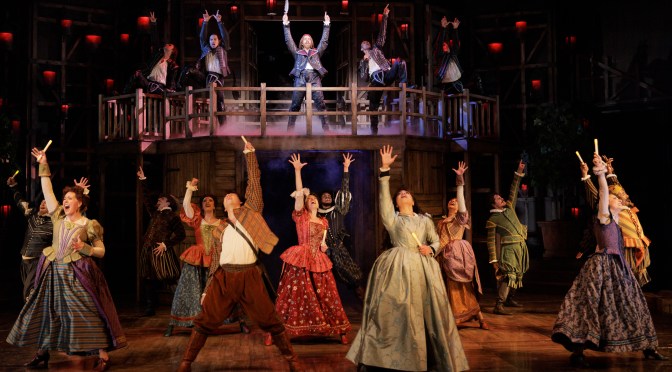
Members of the company in Romeo and Juliet. Stratford Festival 2024. Photo: David Hou.

A sung prologue sets the table for a whirlwind first half, with White’s deft command of the intimate, surprisingly bare Festival Theatre stage was powerfully evident. Whether in the opening scene’s street brawl or at the masquerade where Romeo meets Juliet, crowd movements are vibrant, organic, purposeful, frequently cued by Graham Hargrove & Jasmine Jones-Ball’s thrusting onstage percussion. Individuals’ speeches fluently unpack each character’s motivation and reactions: a blustering Tybalt (Emilio Vieria), a cautious Benvolio (Steven Hao), the exasperation of Prince Escalus (Nick Dolan), the defensive crouch of the senior Capulets and Montagues — all establish the underlying powder keg of anger and resentment, ready to go off at an antagonist’s tiniest slight to personal honor.

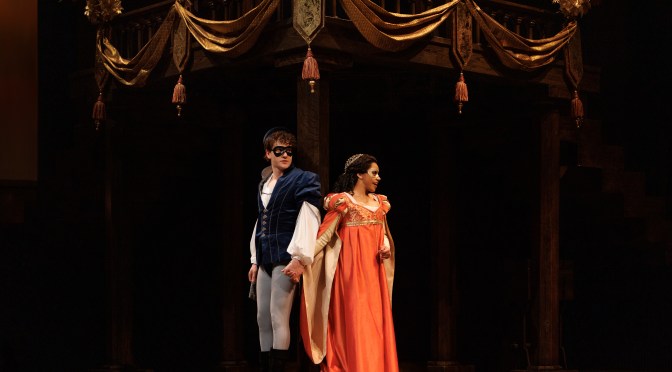
Jonathan Mason as Romeo and Vanessa Sears as Juliet in Romeo and Juliet. Stratford Festival 2024. Photo: David Hou.

Which is the reason Jonathan Martin’s lovesick Romeo and Vanessa Sears’ passionate Juliet stand out; in clans obsessed with judgment and rejection of the other, their soliloquies mark how they crave hope, yearn for a lasting acceptance. And when they find each other, the attraction is immediate, magnetic, unstoppable. The inspired duet of their balcony scene exhilarates; their capricious browbeating of Friar Laurence (consummate Festival veteran Scott Wentworth) into a clandestine wedding feels inevitable in the sweep of their mounting passion. But then, the explosion: with the hair-trigger murders of Andrew Iles’ Mercutio by Tybalt and Tybalt by Romeo — tumbling over each other in a brutal, riveting flash of violence — fear wins out, tragedy gathers momentum. Blackout!

From left: Emilio Vieira as Tybalt, Andrew Iles as Mercutio and Derek Kwan as Tybalt Follower in Romeo and Juliet. Stratford Festival 2024. Photo: David Hou.

This was the moment when my stomach knotted — and even though I’ve known this play since high school, as the second half slammed one door after another and the lovers’ scheming grew more desperate, it refused to untwist. When Graham Abbey’s Capulet compels Juliet’s consent to marry Austin Eckert’s Paris by callous words and physical force; when Juliet threatens suicide, then grasps at the straw of Friar Laurence’s stupefying potion; when Glynnis Ranney’s Nurse keens an anachronistic snatch of Henry Purcell (testimony to White’s love for opera) over Juliet’s grave; when Romeo’s turbulent emotions solidify around his own suicide mission, the tension ratchets up and up, to unbearable heights.

Scott Wentworth as Friar Laurence in Romeo and Juliet. Stratford Festival 2024. Photo: David Hou.

Which is why the final bloodbath in the Capulet vault — as Paris, then Romeo, then Juliet die at the hands of misdirected honor and folly under pressure, to the belated horror of Capulets, Montagues and Prince alike — ultimately feels inescapable, and remarkably universal. In White’s sure, determined hands, this tragedy could be playing out anywhere at anytime, be it Renaissance Mantua or 21st-century Detroit (where her mother kickstarted her passion for Shakespeare at the age of 8, as a disciplinary consequence for catching her listening to Salt’n’Pepa). As she tosses out to close her program notes: “Remember what happens when we don’t love our neighbor as ourselves. Just saying.”

I’m deeply grateful for this production of Romeo & Juliet — its primal commitment to Shakespeare as an artist speaking across and into multiple cultures, its understated opulence and fleet pace, its vivid characterizations and exuberant performances, its cataclysmic clash of the deepest forces at work in our fallen, idealistic, conflicted psyches and societies. For those with ears to hear and eyes to see, it’s a thrill, a warning, and maybe even a necessary passage from heights of joy through depths of despair to chastened, repentant grief. Above all, it’s well worth your time and travel to experience.

— Rick Krueger

Romeo & Juliet plays at Stratford’s Festival Theatre through October 26. Click here for production information. Click here for ticket availability.

At the Stratford Festival: Something Rotten! (To the True North, Part 6)

I thought there were three genuinely great things about the Tony Award-winning musical Something Rotten, as currently playing at the Stratford Festival:

1. Mark Uhre’s frenetic take on struggling Elizabethean playwright Nick Bottom. Between his oversized desire for fame, his strained interactions with enterprising wife Bea (a confident Starr Dominque) and poetic little brother Nigel (Henry Firmston in the boy-next-door role), and his obsessive drive to take down William Shakespeare and win the Renaissance fame game, Nick is desperation personified, thoroughly uncomfortable in his own skin and all the funnier for it. Uhre plays him as a live-action version of Daffy Duck, spluttering with unbounded rage at his situation, and thus completely susceptible to any bizarre idea that crosses his path – like inventing the musical – and thus totally willing, no matter how insane the consequences that follow, to “commit to the bit”.

2. The thing is, in this universe, Nick’s right! Framing Shakespeare as a vain, manipulative rock star (continuing the parallel, think Bugs Bunny without redeeming qualities) is Something Rotten’s masterstroke. Trailed by his own theme song and a crew of dancing Bard Boys, basking in the adulation of a solo stadium gig (with hilariously low-tech special effects), scheming against Nick to the point of donning a fatsuit disguise and a Northern accent, stealing Nigel’s best lines and passing them off as his own, Jeff Lillico is a utter hoot, England’s greatest dramatist as an egotistical, over-the-top pantomime villain. Even when he lets his guard down in his big solo “Hard to Be the Bard”(“I know writing made me famous, but being famous is just so much more fun”) , this is a Shakespeare you can love to hate.

3. Speaking of over-the-top, director Donna Feore and her creative team absolutely chose the right path by leaning into the Broadway musical’s inherent absurdities, as foreseen by cut-rate soothsayer Nostradamus (Festival veteran Dan Chameroy in a giddy, disheveled supporting turn):

You could go see a musical
A musical
A puppy piece, releasing all your blues-ical
Where crude is cool
A catchy tune
And limber-legged ladies thrill you ’til you swoon
Oohs, ahhs, big applause, and a standing ovation
The future is bright
If you could just write a musical

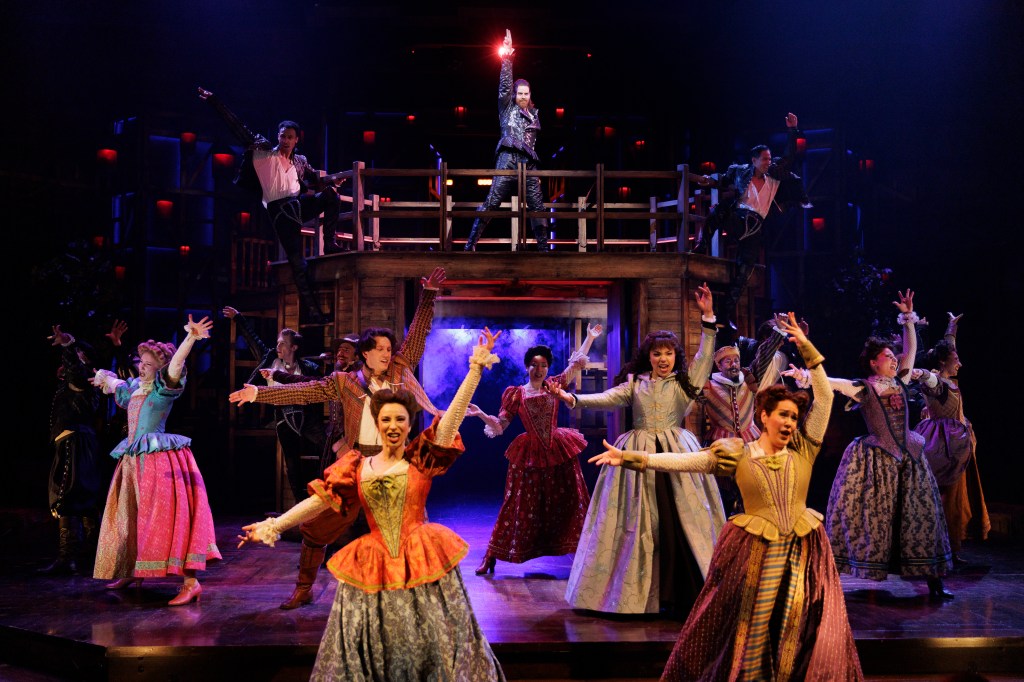
Dan Chameroy as Nostradamus with members of the company in Something Rotten!. Stratford Festival 2024. Photo: David Hou.

Every possible cliché you can think of is there onstage for those six minutes: Sung recitatives (with self-mocking asides)! Bawdy double-entendres and suggestive choreography! Costume changes (including nonsensical hats and wigs)! Jazz hands! Synchronized high-kicking (with callbacks goofing on Feore’s 2016 Festival production of A Chorus Line)! It all worked to perfection at this matinee, the capacity audience (including your scribe) yelling and applauding for more (which the company obligingly provided) as if Pavlov had just rung his biggest, shiniest bell. And the places Nick and Nostradamus find themselves going in the second act’s big number scale even zanier heights. Complete the sentence yourself: “When life gives you eggs . . .” Then imagine the costumes!

Where Something Rotten falls short? Compared to the sublime ridiculousness of the main story, the supporting characters’ arcs bog down in vapid sentimentality and already-stale contemporary memes. Bea’s occasional empowerment shoutouts pale in comparison to what she actually does out of love for her husband and his brother, subtly undercutting her role as the true hero of the piece. Nigel’s emergence from Nick’s shadow is a bit of a damp squib; his main solo turn “To Thine Own Self Be True” proves an shallow, unearned manifesto of self-actualization instead of a rite of passage. And the meet-cute romance between Nigel and Portia (Olivia Sinclair-Brisbane, winningly portraying a budding poetry fangirl under the thumb of Juan Chioran, a Puritan father given to pre-Freudian slips) sputters, toggling between aren’t-we-transgressive smuttiness and, in “We See the Light”, a Big Message about tolerance, tediously staged as a clumsy cross between Sister Act and Rent — Feore’s only directorial misfire.

But that said, Something Rotten’s full-on commitment to farce and totally bonkers energy (with Feore, Uhre, Lillico and Chameroy setting the pace for a young, frisky cast) carries the day. Productions about Shakespeare at the Stratford Festival are typically on or about at the same level as their productions of Shakespeare, and this delightfully nutty escape into a toe-tapping alternate version of the Renaissance is no exception.

Members of the company in Something Rotten!. Stratford Festival 2024. Photo: David Hou.

— Rick Krueger

Something Rotten continues at Stratford Festival’s Theatre, with its run now extended through November 17th. Click here for ticket availability.