
Category Archives: Philosophy

Bernard Wall’s Blistering Christian Humanism, 1934

Though few remember him now, especially in North America, the great Englishman Bernard Wall (1908-1974) stood resolutely for an unadulterated Christian Humanism in the interwar period.  Wielding a brutal pen, he attacked the alternatives in the journal he co-founded and co-edited with Christopher Dawson, COLOSSEUM. 

Below are quotes from his 1934 Christian Humanist screed against the reigning ideologies of the day. His targets: fascism; communism; and liberalism. There’s a hint of Patrick Deneen here.

***

Wall’s autobiography.

“The conflict between Christianity and Marxism—between the Catholic Church and the Communist party—is perhaps the vital issue of our time. It is not a conflict of rival economic systems like the conflict between Socialism and Capitalism, or of rival political ideals—as with Parliamentarianism and Fascism: it is a conflict of rival philosophies and of rival doctrines regarding the very nature of man and society” (17).

“He seems to have regarded it, not as a dangerous rival, but as a dying force which belonged essentially to the past. In his historical theory Catholicism is bound up with feudalism: it is the ideological reflection of feudal society, and consequently it has little significance for the modern world…”(17).

The 21st Century: A World of Confusions ~ The Imaginative Conservative

The fascists and the anti-fascists of our day are, of course, both fascist, their tactics of bullying and violence indistinguishable in type or result. The anti-capitalists and capitalists, too, are often just capitalists, universally corrupt and willing to use whatever power exists in whatever form and to whatever degree for their own benefit. Certainly, those who riot against capitalism use the very tools and products of capitalism to challenge it. Perhaps the Apple Watch on the wrist of every protestor in Portland is just the piece of rope the capitalist is willing to sell to hang himself and his fellow profit-seekers
— Read on theimaginativeconservative.org/2018/12/21st-century-confusions-bradley-birzer.html

When Winston, Gleaves, and I Met: A Humanist Platoon

When Gleaves Whitney, Winston Elliott III, and I came together for the first time, 19 years ago. Our little platoon.

“As I’ve had the chance to note several times, here and elsewhere, I first met the Publisher of The Imaginative Conservative, Winston Elliott, back in the summer of 1995. I still remember that meeting rather clearly, even though the Houston humidity should’ve created a haze around the moment. I’ve also noted how Gleaves Whitney’s 1991 Intercollegiate Review piece on decadence introduced me to serious cultural and conservative criticism. I devoured that article on a transatlantic Christmas flight to meet my then girlfriend (now, just friend) in Denmark. I have not, however, had a chance to write about the first time I finally stood in the same room and ate at the same table as Winston and Gleaves. This first meeting of the three of us was in the summer of 1999, once again in Houston.”

https://theimaginativeconservative.org/2018/12/meeting-christian-humanism-bradley-birzer.html

How Rush Kept Me Alive | The American Conservative

To say that the album changed my life would be a trite understatement. It radically altered my understanding of the world, not only by its words but by its example. To this day, I can remember the smell of that album sleeve, glossy, thick, and oily, quite different from the cheap paper-thin sleeves prevalent among so many commercial albums. With three kinetic photos of the band members on the right side of the sleeve, white lettering giving credit on a black ground on the left side, and all of the lyrics on the alternate side, I devoured every word and image. Something profound spoke to my eager and open 13-year-old mind.
— Read on www.theamericanconservative.com/articles/how-rush-kept-me-alive/

On the Surface, Hungary Is a Democracy. But What Lies Underneath? – The New York Times

Hungary has the trappings of a 21st-century European democracy, but uses its devices to exert the same kind of control as the autocracies of the Cold War.
— Read on www.nytimes.com/2018/12/25/world/europe/hungary-democracy-orban.html

The NYT is absolutely obsessed with Hungary. Sadly, it ignored the country while under communist rule.

Guardini on the Incarnation

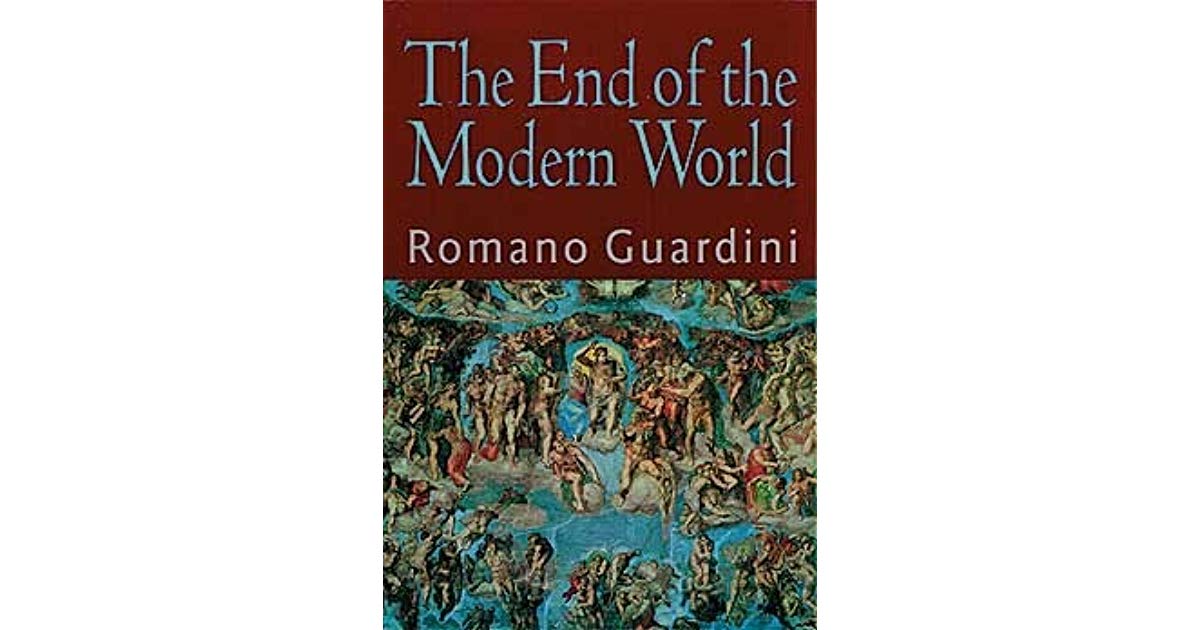
The. End of the Modern World

As we quickly exit Advent and even more quickly approach the 12 days of Christmas, I can’t help but think of one of my favorite writers, the Italian-German Romano Guardini, on the meaning of time and the Incarnation.

The world, time, history had begun with Creation; they reached apotheosis in the Incarnation of the Son of God-“the fullness of Time”-and all shall end with the destruction of the world and the Last Judgment. . . . [as such], each moment of time was etched against the sweeping panorama of history.  Each present moment gained its uniqueness from the impact of the Incarnation with marked the piercing of time itself by eternity. —The End of the Modern World

May we never take for granted that the “fullness of time” reached its culmination and happened tonight, two thousand years ago, when a humble Jewish mother gave birth to the Son of God. Not in a palace, but in a dung-filled manger, surrounded by the most humble. Thus came our Lord.