
Category Archives: Poetry

The O Antiphons: O Wisdom

From Kevin Hildebrand, kantor at Concordia Theological Seminary in Fort Wayne, Indiana:

An antiphon is a term we see in worship regularly. An antiphon is a refrain that is sung before (and sometimes after and during) a Psalm or other song, and it’s typically is a Bible verse or a historic liturgical text.

The origin of the O Antiphons is around the eighth century. In larger cities and monasteries, it was customary to have services daily (or several times a day), and in the seven days before Christmas Eve, it became a regular practice to sing the assigned O Antiphon before and after the Magnificat ( “My soul magnifies the Lord.”) at the evening Vespers service.

In the twelfth or thirteenth century, these antiphons were paraphrased into metrical, poetic verses which became the hymn, “O Come, O Come, Emmanuel.”

The initial O Antiphon, for Vespers on December 17:

O Wisdom, proceeding from the mouth of the Most High, pervading and permeating all creation, mightily ordering all things: come and teach us the way of prudence.

For their 2016 debut recording Drop Down, Ye Heavens, the London-based student-formed choir Siglo de Oro commissioned a new set of O Antiphons from various British composers, sung in English and set for choir and saxophone.  Here is Will Todd’s thrilling setting of “O Wisdom”:

O come, Thou Wisdom from on high,
Who ord’rest all things mightily;
To us the path of knowledge show,
And teach us in her ways to go.

Rejoice! Rejoice! Emmanuel
Shall come to thee, O Israel!

— Rick Krueger

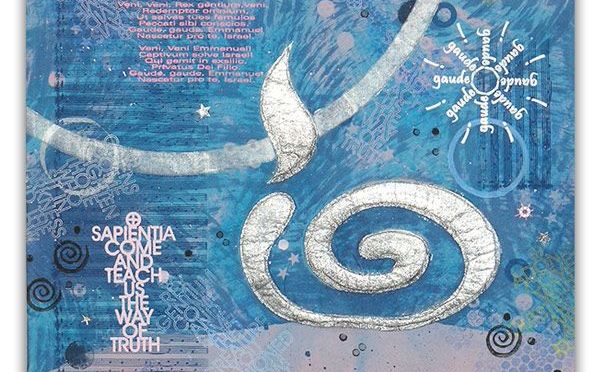
(Image: O Sapentia by Linda Witte Henke, Te Deum Designs)


Ad Fontes #3

From Lutheran Service Book’s Daily Lectionary for December 8:

For you [,O Lord,] have been a stronghold to the poor,

a stronghold to the needy in his distress,

a shelter from the storm and a shade from the heat. (Isaiah 25:4 ESV)

Which, as sung and reshaped in the African-American tradition of Christian spirituals, became:

And, as repurposed by Bob Dylan, also became:

— Rick Krueger

On St. Ambrose Day

From the Lutheran Church-Missouri Synod’s calendar of commemorations:

Ambrose of Milan, Pastor and Hymnwriter

Born in Trier in A.D. 340, Ambrose was one of the four great Latin Doctors of the Church (with Augustine, Jerome, and Gregory the Great). He was a prolific author of hymns, the most common of which is Veni, Redemptor gentium (“Savior of the Nations, Come”). His name is also associated with Ambrosian Chant, the style of chanting the ancient liturgy that took hold in the province of Milan. While serving as a civil governor, Ambrose sought to bring peace among Christians in Milan who were divided into quarreling factions. When a new bishop was to be elected in 374, Ambrose addressed the crowd, and someone cried out, “Ambrose, bishop!” The entire gathering gave their support. This acclaim of Ambrose, a 34-year-old catechumen, led to his baptism on December 7, after which he was consecrated bishop of Milan. A strong defender of the faith, Ambrose convinced the Roman emperor Gratian in 379 to forbid the Arian heresy in the West. At Ambrose’s urging, Gratian’s successor, Theodosius, also publicly opposed Arianism. Ambrose died on Good Friday, April 4, 397. As a courageous doctor and musician he upheld the truth of God’s Word.

The Collect of the Day:

O God, You gave Your servant Ambrose grace to proclaim the Gospel with eloquence and power.  As bishop of the great congregation of Milan, he fearlessly bore reproach for the honor of Your name.  Mercifully grant to all bishops and pastors such excellence in preaching and fidelity in ministering Your Word that Your people shall be partakers of the divine nature; through Jesus Christ, Your Son, our Lord, who lives and reigns with You and the Holy Spirit, one God, now and forever.  Amen.

And for an evening meditation to cap this very musical week of commemorations, St. Ambrose’s hymn O lux beata Trinitas (“O Trinity, Most Blessed Light,”) as set to the 16th-century German tune “O heilige Dreifaltigkeit” and translated into English by John Mason Neale:

— Rick Krueger

On St. Nicholas Day

From the Lutheran Church-Missouri Synod’s calendar of commemorations for December 6:

Of the many saints commemorated by the Christian Church, Nicholas (d. A.D. 342) is one of the best known. Very little is known historically of him, although there was a church of Saint Nicholas in Constantinople as early as the sixth century. Research has affirmed that there was a bishop by the name of Nicholas in the city of Myra in Lycia (part of Turkey today) in the fourth century. From that coastal location, legends about Nicholas have traveled throughout time and space. He is associated with charitable giving in many countries around the world and is portrayed as the rescuer of sailors, the protector of children, and the friend of people in distress or need. In commemoration of “Sinte Klaas” (Dutch for Saint Nicholas, in English “Santa Claus”), December 6 is a day for giving and receiving gifts in many parts of Europe.

Benjamin Britten’s cantata Saint Nicolas was written for the 1948 centenary of Lancing College in Sussex (an independent secondary boarding school on the south coast of England).  As Paul Spicer writes,

The cantata portrays the life of the fourth-century Bishop of Myra in a work of great poetry and sensitivity. It was conceived and composed with semi-amateur performance in mind and the technical demands of the choral and orchestral writing are appropriately straightforward. The audience also gets to join in two well-known hymns, “All people that on earth do dwell” and “God moves in a mysterious way.”

For Saint Nicholas’ day, enjoy this performance of the cantata by tenor Robert Tear, the Choir of Kings’ College Cambridge and the Academy of St. Martin in the Fields, all conducted by Sir David Willcocks:

You can find Eric Crozier’s complete libretto and further program notes for Saint Nicolas here.  An excerpt of the 6th movement,  “Nicolas from Prison”:

O man! The world is set for you as for a king!
Paradise is yours in loveliness.
The stars shine down for you, for you the angels sing,
Yet you prefer your wilderness.
You hug the rack of self,
Embrace the lash of sin,
Pour your treasures out to bribe distress.
You build your temples fair without and foul within:
You cultivate your wilderness.
Yet Christ is yours. Yours!
For you He lived and died.
God in mercy gave His son to bless you all,
To bring you life,
And Him you crucified
To desecrate your wilderness.
Turn away from sin! Ah!
Bow down your hard and stubborn hearts!
Confess, yourselves to Him in penitence
And humbly vow your lives to Him, to holiness.


— RIck Krueger

Colosseum Books Poetry Series – Franciscan University Press | Franciscan University of Steubenville

Colosseum Books is an annual series of volumes of new poetry and poetry criticism that exhibit spiritual and intellectual depth and an understanding of verse as a craft guided by enduring tradition, metrical rigor, and a commitment to the well-made thing. Each Colosseum book will be published by the Franciscan University at Steubenville Press.

In the ancient world, the civilizational achievements of Rome were transformed and leavened by the spirit of Christianity. The Colosseum stood as a symbol of the struggle and suffering such a new birth entailed, but also of final victory and union, as Christendom emerged to take possession of the treasures of Athens and Jerusalem with Rome as its spiritual capital. In the modern age, the English writer Christopher Dawson edited the review Colosseum as a forum for the Catholic intellectual world to engage contemporary arts and culture. In its pages such great minds as Dawson, Jacques Maritain, and E.I. Watkin studied and discussed the literary achievement of T.S. Eliot, Sigrid Undset, and other writers of the Catholic literary revival and beyond.
— Read on www.franciscan.edu/press/colosseum-books/

–James M. Wilson is an excellent poet, brilliant thinker, and good ally. Very happy to see him as editor of this new series.

“Savior of the Nations, Come!”

Among his numerous contributions to the Christian church, the hymns of St. Ambrose, bishop of Milan (340-397) have pride of place.  Veni redemptor gentium (Come, Redeemer of the Gentiles), indirectly attributed to Ambrose by St. Augustine, remains in the Roman Liturgy of the Hours to this day, as the hymn for the Octave before Christmas.

Veni, redemptor gentium,
ostende partum Virginis;
miretur omne saeculum:
talis decet partus Deum.

O come, Redeemer of the earth,
and manifest thy virgin-birth.
Let every age in wonder fall:
such birth befits the God of all.

Particularly popular in medieval Germany, Veni redemptor gentium was one of the initial hymns Martin Luther (1483-1546) adapted for congregational use in the wake of the Reformation.  Translated into German as Nun komm, der Heiden Heiland with a metricized melody, it first appeared in the Erfurt Enchiridion of 1524.   Swiftly, it became the Hymn of the Day for the First Sunday in Advent in Lutheran churches; over the centuries, it’s been set for organ and/or choir by numerous composers.  Of course, the cantata and chorale prelude settings by Johann Sebastian Bach (1685-1750) stand out:

But the legacy of this ancient hymn continues into the modern day, with organ settings by modern composers such as Paul Manz (1919-2009) …

… and its numerous English translations, including the composite version found in 2006’s Lutheran Service Book.  In the video below, the hymn begins at 1:57, following a Luther quote spoken over a chorale prelude by Dietrich Buxtehude (1637-1707).

Savior of the nations, come, Virgin’s Son, make here Your home!
Marvel now, O heav’n and earth, That the Lord chose such a birth.

Not by human flesh and blood, By the Spirit of our God,
Was the Word of God made flesh—Woman’s offspring, pure and fresh.

Here a maid was found with child, Yet remained a virgin mild.
In her womb this truth was shown: God was there upon His throne.

Then stepped forth the Lord of all / From His pure and kingly hall;
God of God, yet fully man, His heroic course began.

God the Father was His source, Back to God He ran His course.
Into hell His road went down, Back then to His throne and crown.

For You are the Father’s Son / Who in flesh the vict’ry won.
By Your mighty pow’r make whole / All our ills of flesh and soul.

From the manger newborn light / Shines in glory through the night.
Darkness there no more resides; In this light faith now abides.

Glory to the Father sing, Glory to the Son, our king,
Glory to the Spirit be / Now and through eternity.

— Rick Krueger


Ad Fontes #2

From Lutheran Service Book’s Daily Lectionary for November 30:

‘In the year that King Uzziah died I saw the Lord sitting upon a throne, high and lifted up; and the train of his robe filled the temple. Above him stood the seraphim. Each had six wings: with two he covered his face, and with two he covered his feet, and with two he flew. And one called to another and said:

“Holy, holy, holy is the LORD of hosts; the whole earth is full of his glory!”

And the foundations of the thresholds shook at the voice of him who called, and the house was filled with smoke.’  (Isaiah 6:1-4)

Or, to put it another way (especially if you’re Martin Luther assembling his Deutsche Messe in the 1520s):

Isaiah, mighty seer, in days of old
The Lord of all in Spirit did behold
High on a lofty throne, in splendor bright,
With robes that filled the temple courts with light.
Above the throne were flaming seraphim,
Six wings had they, these messengers of Him.
With two they veiled their faces, as was right,
With two they humbly hid their feet from sight,
And with the other two aloft they soared,
One to the other called and praised the Lord:
“Holy is God, the Lord of Sabaoth!
Holy is God, the Lord of Sabaoth!
His glory fills the heavens and the earth!”
The beams and lintels trembled at the cry,
And clouds of smoke enwrapped the throne on high.

(English translation from The Lutheran Hymnal, 1941, alt.)

— Rick Krueger

Christopher Tolkien and the legacy of his father J.R.R. Tolkien: The Steward of Middle-earth

Now, after more than 40 years, at the age of 94, Christopher Tolkien has laid down his editor’s pen, having completed a great labor of quiet, scholastic commitment to his father’s vision. It is the concluding public act of a gentleman and scholar, the last member of a club that became a pivotal part of 20th-century literature: the Inklings. It is the end of an era.
— Read on www.weeklystandard.com/hannah-long/christopher-tolkien-and-the-legacy-of-his-father-j-r-r-tolkien-the-steward-of-middle-earth

An excellent review by Hannah Long. Enjoy. And, God bless, the Tolkiens!

Ad Fontes

From Lutheran Service Book’s Daily Lectionary for November 22:

Then I heard what seemed to be the voice of a great multitude, like the roar of many waters and like the sound of mighty peals of thunder, crying out,

“Hallelujah!
For the Lord our God
the Almighty reigns.” (Revelation 19:6)

Or, to put it another way (especially if you’re George Frederic Handel (and his librettist Charles Jennens):

But wait, there’s more …

Then I saw an angel standing in the sun, and with a loud voice he called to all the birds that fly directly overhead, “Come, gather for the great supper of God, to eat the flesh of kings, the flesh of captains, the flesh of mighty men, the flesh of horses and their riders, and the flesh of all men, both free and slave, both small and great.” (Revelation 19:17-18)

Or, to put it another way, if you’re Genesis with Peter Gabriel:


— Rick Krueger