Heartfelt and Intelligent: Auto Reconnaissance by The Tangent

In the not so distant past, I had the opportunity (and, perhaps, the gall) to label Andy Tillison the “G.K. Chesterton of progressive rock.” As I listen to the latest release by Tillison’s band, The Tangent, I can only nod in approval at my earlier assessment.  He has always been a master of story, but, on Auto Reconnaissance, he reveals himself as a master of story telling. Light your pipe, sip from your pint, and pull yourself up next to the fire. Tillison has several tales to tell, and he does so in the best way, as a friend rather than a teacher.

Auto Reconnaissance begins with the discovery of radio—not just its function, but it’s essence—on “Life on Hold.”  It’s a short piece, by The Tangent standards, but it offers the perfect introduction to an album that demonstrates the wonder of life.

The second track, the second longest on the album, “Jinxed in Jersey,” tells the story—quite convoluted at times—of Tillison’s journey to the Statue of Liberty. Naturally, the story can be understood at many different levels, the literal but also the symbolic. If, on track one, the boy Tillison discovered the workings of radio, on track two, the adult Tillison discovers the realities and complexities of America.  The renaissance—or was that reconnaissance?—continues.

The third song, “Under Your Spell,” has a Tears for Fears feel, akin to “Working Hour” on Songs from the Big Chair.  Melancholic in theme, the song is tasteful to the extreme.

“The Tower of Babel,” track four, is the shortest on the album, but it’s intense and unrelenting with its disco-esque beat. A clever look at the techno-babble of the modern world, as the song’s title indicates, Tillison wonders just how we manage to speak to one another with so many types of technologies (where is that simple radio of track one!?!?) and so much noise in our modern whirligig of a very human (and very flawed) world.  “The system is human, too!”

At nearly one-half of an hour long, “Lie Back and Think of England,”—a jazzy, pastoral meditation—provides the brilliant backbone to the album.  Where are those hills and those dales?  On this track, especially, Tillison proves his title as the Chesterton of the prog world.  The song’s structure harkens back to the first two albums of The Tangent, and it is a gorgeous harkening, filled with passionate solos and musical lingerings and wild segues.

The final track of the album, “The Midas Touch,” provides the proper conclusion to such a complex album, offering a jazz-fusion odyssey.

The previous two The Tangent albums were deeply (and, at times, distractingly) political, but this album is appreciatively cultural. Indeed, it is Tillison and the band at its absolute best.  Heartfelt, clever, tasteful (yes, I know I’ve used this word already in this review) and, most of all, intelligent, Auto Reconnaissance is a true work of art, taken as a whole and even analyzed in parts.  Tillison proves that he remains England’s red-headed mischievous genius.

In The DropBox: Rikard Sjöblom’s Gungfly & Pain of Salvation

For the past week I have been listening to new albums from Rikard Sjöblom’s Gungfly and Pain of Salvation. They are labelmates on InsideOut, and they are both excellent efforts.

I’m familiar with Sjöblom through his stellar work with Big Big Train, and he also led Beardfish. Gungfly is now his outlet for his solo work. For their second release, he has pared down Gungfly to a trio with Petter and Rasmus Diamant on drums and bass respectively, while Rikard tackles everything else – and “everything else” covers a lot of instruments!

Overall, it’s a rocking effort with Sjöblom’s vocals running the gamut from a warm and intimate tenor to a harsh low-register rasp. The first track, Traveler, immediately grabs the listener with a driving rhythm that conveys an urgent sense of movement. Sjöblom sings of the difficulties of traveling and being away from family. The fact that its more than 13-minute length feels much briefer is a testament to how well it is constructed.

Happy Somewhere In Between, the first single, is a catchy rocker with a bit of a hoedown feel to it. The rhythm section of the Diamant brothers really shines on this track, effortlessly keeping pace with some very tricky changes.

Clean As A Whistle is a pleasant change of pace with an acoustic guitar opening and a beautiful melody worthy of Nick Drake. It slowly builds in intensity until it explodes into a synthesizer/electric guitar jam.

Alone Together is a song that tugs at the heartstrings. It is a sensitive portrayal of the emotional turmoil parents of mentally ill children have to deal with. Sjöblom’s guitar solos remind me of Steve Howe’s work on Relayer. 

After the brief folky interlude of From Afar, the album closes with the epic On The Shoulders Of Giants. In this delightful track, Sjöblom pays tribute to his prog forebears:

“What happened to me?
The boy who listened to Frank Zappa
And said, ‘This is what I want to be.'”

Sjöblom makes good use of nearly all of its 15 minutes length with some fine guitar work that showcases his talent. Alone Together is a very solid effort from Gungfly, and it illustrates Sjöblom’s mastery of guitar and keyboards as well as his maturity as a lyricist.

Pain Of Salvation’s Panther opens with a chugging, synth-heavy riff on Accelerator. It could fit right in with current “Synthwave” scene with its slightly retro sound paired with contemporary production. As always, Daniel Gildenlöw’s vocals are outstanding – his energy and passion never flagging for a moment.

Unfuture opens with a snaky acoustic blues riff that soon explodes into a full metal treatment which then retreats into a more subdued passage as Gildenlöw sings (as far as I can decipher), “Welcome to the new world/Which sounds sublime/A better and improved world/For our mankind.” This is a song dripping with menace and foreboding, yet sounding seductive and enticing.

In Gildenlöw ‘s words, “Panther is an album with many layers, but at the heart of it you will find my lifelong struggle to calibrate my interface towards mankind, trying to calculate the offset to a species that I have on some levels always felt myself estranged to. A feeling I think many can relate to. ”

His alienation comes through loud and clear throughout the album, which covers an extraordinary range of musical styles. There isn’t a single clunker in the bunch, either. It’s very hard to pick a favorite song, but I  particularly like the title track with its 16(!) tracks of guitar and chorus of “How does it feel to be you?” she once asked me
I said “I feel like a panther trapped in a Dog’s world”.

Another highlight is Species, with the lines, “I stopped watching the news/It was hurting me so/All that matters beats through/Like plutonium glow.” A relentless and addictive guitar riff underpins his frustration with modern media manipulation.

Panther closes with the epic Icon, which, now that I consider it, is the best track on the album. Okay, I admit it – every dang song on this album is irresistible! With Panther, Pain of Salvation have come up with a masterpiece that perfectly captures our current state of isolation and anxiety. It is an artistic triumph, and one of the best releases of 2020.


The Sacrificial Love of Saint Maximilian Kolbe – The Imaginative Conservative

As the man pleaded his case, Father Maximilian Kolbe came forward and offered his life for the one pleading. The German commandant of Auschwitz—probably rather shocked—agreed, and Kolbe, with nine others, stripped naked and entered the 3-foot high concrete bunker… (essay by Bradley J. Birzer)
— Read on theimaginativeconservative.org/2010/08/sacrificial-love-saint-maximilian-kolbe-bradley-birzer.html

“Nothing Human is Alien to Me”: The Liberality of Rational Choice

What makes economics a liberal discipline? Answer: the rationality postulate. Armed with rational choice, the economist can confidently say, “Nothing human is alien to me”: https://egnatiavia.blogspot.com/2020/08/nothing-human-is-alien-to-me-liberality.html

The Pilgrim’s Regress by C.S. Lewis

During the thirty-one years that Lewis practiced Christianity, he offered three stories—or variations on a single story, depending on the angle one wishes to take—regarding the reason for his conversation. Critically, too, the three stories overlapped and played off one another. The first, the fulfillment of his paganism and paganism, in general. The second, his regress from modernity. And, third, the persistence of joy.

One may find the second version of Lewis’s conversion in his fascinating but somewhat erratic allegory, The Pilgrim’s Regress (1933), the book that really began Lewis’s career as recognizably “the C.S. Lewis” who would soon become so famous as the world’s foremost Christian apologist. In it, Lewis fictionally traces his own autobiographical intellectual and faith journey. “On the intellectual side my own progress had been from ‘popular realism’ to Philosophical Idealism; from Idealism to Pantheism; from Pantheism to Theism; and from Theism to Christianity.”[1] Stunningly, he wrote the entire work in two weeks while staying with Arthur Greeves in August 1932. It’s original title was: The Pilgrim’s Regress, or Pseudo-Bunyan’s Periplus: An Allegorical Apology for Christianity, Reason, and Romanticism.[2]

Though drastically uneven in its ability to convey Lewis’s successes (and failures), The Pilgrim’s Regress possesses not a dull moment, though, in parts, it is viciously scathing toward opponents of Christianity and those Lewis dislikes. Upon writing it originally, he claimed to be mocking “Anglo Catholicism, Materialism, Sitwellism, Psychoanalysis, and T.S. Eliot.”[3] At times, the book is gentle, and, at times, brutal, especially in its descriptions of immorality and its attacks upon ideas and persons Lewis disliked. “The sole merit I claim for this book is that it is written by one who has proved them [his opponents] all to be wrong,” he explained in 1943. “There is no room for vanity in the claim: I know them to be wrong not by intelligence but by experience, such experience as would not have come my way if my youth had been wiser, more virtuous, and less self-centered than it was.” [4] Lewis believed, in the interwar period, that while all of the various schools of thought hated one another, they set aside their personal dislikes for their general hatred of anything that seemed, however slight, romantic, dismissing romanticism as mere “nostalgia.”[5]  

The Pilgrim’s Regress also possesses all the strengths and weaknesses of an allegory. Some allegorical elements are obvious to the reader, while others are frustratingly obscure. Given that Lewis’s rightful claim to fame came from his ability to explain complex ideas in a way understandable by all, The Pilgrim’s Regressis a failure, though a heady one. “In fact all good allegory exists not to hide but to reveal: to make the inner world more palpable by giving it an (imagined) concrete embodiment,” Lewis wrote ten years after the book’s first publication, admitting his own failure to create a convincing allegory.[6]

The story begins in Puritania, a thinly-veiled Ulster, in which the protagonist is given a list of rules. Should he not follow the rules—assuming the Landlord discovers such breaches—he will spend eternity in a “black hole full of snakes and scorpions as large as lobster.”[7] Everyone in Puritania wears masks when performing religious ceremonies, masks that allow them to be something they are not, and to give them courage to enforce the seemingly draconian rules of the Landlord. As the protagonist, John, flees from Puritania, he meets Mr. Enlightenment (there are several claiming the title), the Clevers (the in-crowd Lewis despised in prep school), Reason, Vertue (the Stoic), Mother Kirk (the Christian Church), Mr. Neo-Angular (Wydham Lewis or T.E. Hulme?), Mr. Neo-Classical (T.S. Eliot and his authors who wrote for his journal, The Criterion), Mr. Humanist (Irving Babbitt), The Guide, and a myriad of others. In his seemingly ceaseless journeys, he visits not just Puritania (his origin), but also Claptrap, Luxuria, Thrill, Hunch, Wisdom, the Grand Canyon, Superbia, and Ignorantia. Whether the story ends on a happy or disastrous note is up to the reader, and it is equally up to the reader to decide if the entire story was real or merely a dream.[8]

At first, the book sold poorly, and its publisher, J.M. Dent and Sons, sold the publication rights to Frank Sheed, the whirlwind behind the Catholic publishing house, Sheed and Ward. Sheed and Ward published the second and third editions of the book, but Lewis was furious at having to work with a Catholic publisher.

My other bit of literary news is that Sheed and Ward have bought the Regress from Dent. I didn’t much like having a book of mine, and especially a religious book, brought out by a Papist publisher: but as they seemed to think they could sell it, and Dents clearly couldn’t, I gave in. I have been well punished: for Sheed, without any authority from me, has put a. blurb on the inside of the jacket which says ‘This story begins in Puritania (Mr Lewis was brought up in Ulster)’—thus implying that the book is an attack on my own country and my own religion. If you ever come across any one who might be interested, explain as loudly as you can that I was not consulted and that the blurb is a damnable lie told to try to make Dublin riff-raff buy the book.[9]

Of course, if Puritania is not Ulster, the allegory completely falls apart, and, if nothing else, Lewis’s bias against Catholics just proved Frank Sheed’s blurb to be quite true.  One of Lewis’s students remembered his frustration as well: “Then Sheed and Ward took it over, and I’m not sure he was entirely happy that Sheed and Ward took it over, because Sheed and Ward were a Roman Catholic publisher, and I think Lewis, who of course came from Northern Ireland—at that time, probably would have thought it was not best to have his book put out by a Roman Catholic firm.”[10]

Reviews, though, offered a rather nuanced view of the book.  The Time Literary Supplement, for example, reported the poetry found within The Pilgrim’s Regress a grand success, evoking a holy joy. Yet, the review cautioned, “though Mr. Lewis’s parable claims to reassert romanticism, it is the romanticism of homesickness for the past not of adventure towards the future.”[11]  Jane Spence Southron, reviewing the second (Sheed and Ward) edition for The New York Times, found the book a delight, “a fresh wind blowing across arid wastes.”[12]


[1] CSL, Afterword to Third Edition, Pilgrim’s Regress, 200.

[2] Sayer, Jack, 136.

[3] CSL to Guy Pocock, January 17, 1933, in CSL Collected Letters, Vol. 2: 94.

[4] CSL, Afterword to Third Edition, Pilgrim’s Regress, 203.

[5] CSL, Afterword to Third Edition, Pilgrim’s Regress, 205.

[6] CSL, Afterword to Third Edition, Pilgrim’s Regress, 208.

[7] CSL, The Pilgrim’s Regress, 5.

[8] One of CSL’s greatest friends and students, George Sayer, claims The Pilgrim’s Regress ends in great joy. He might very well be right. See Sayer, Jack, 137.

[9] CSL to Greeves, December 7, 1935, in CSL Collected Letters 2: 170.

[10] Interview with Harry Blamires [student of CSL’s], WCWC.  Interviewer: Lyle W. Dorsett.  Date: October 23, 1983.  Location: Wade Center, Wheaton College.

[11] “Pilgrim’s Regress,” Times Literary Supplement (July 6, 1933), 456.

[12] Jane Spence Southron, “The Pilgrim’s Regress and Other Works of Fiction,” New York Times(December 8, 1935), pg. BR7.

Hillsdale College Had Graduation During Coronavirus

Many high schools and colleges across America canceled in-person graduations during the Wuhan coronavirus pandemic, but Hillsdale College decided to host an in-person ceremony a few months late. The college approached state and local authorities, worked with the local health department and four epidemiologists, and hosted a crowd of roughly 2,000 people on July 18. More than two weeks later, no new coronavirus cases have been traced to the ceremony.
— Read on pjmedia.com/culture/tyler-o-neil/2020/08/04/hillsdale-college-had-graduation-during-covid-and-the-black-plague-of-death-didnt-descend-n733768

A Time for WhisKY

Richard K. Munro's avatarSpirit of Cecilia

By Richard K. Munro

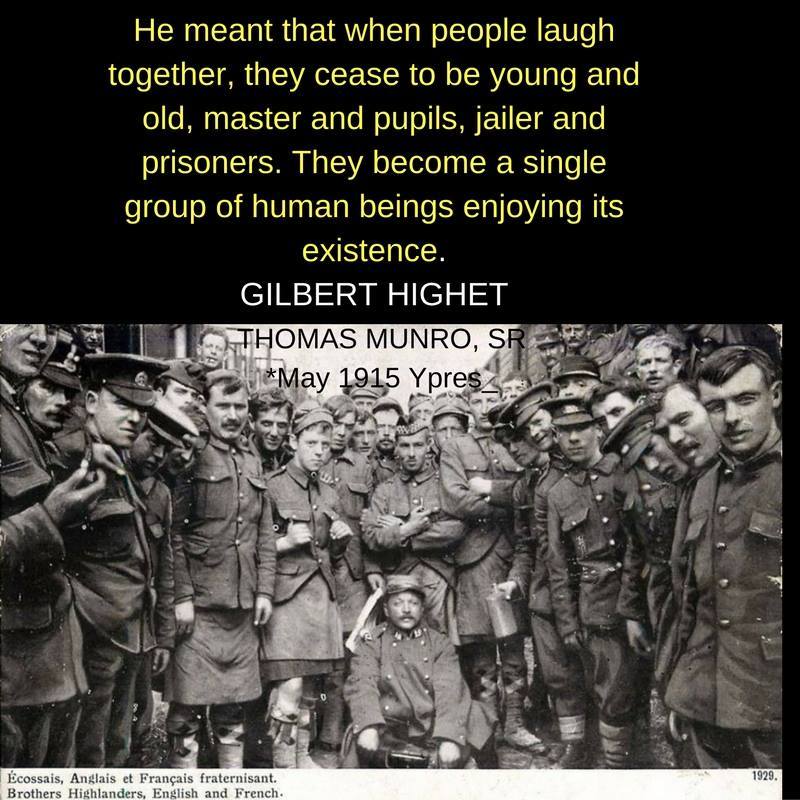
Thomas Munro, Srto his left “AMERICAN JOHNNY Robertson to his right the young boy is his nephew Jimmy Quigley 16 at the tjme.

It’s Five O’Clock. “Whisky is liquid sunshine.” said Shaw.

Like most Highland natives, Auld Pop had a vague knowledge of a thing called barbecue, but had never actually eaten any. He was, however, intimately familiar with whiskey. In fact from 1914-1933 he often made his own. I do not know and have no knowledge if he ever sold any of his poteen. I do know he used to say, “Prohibition? What’s that? No excise officer ever kept a Highland man from his dram.” “Does love make the world go around? Well aye, mon. “Strrruth! . But whiskey makes it go around twice as fast. Aye! An’ gies a mon a sonsie gizz, aye! ThAAt’s a sonsie face – a jolly, smiling face!.

He…

View original post 698 more words

Spanish memories: anchovies, music, laughter and Coca Cola

by Richard K Munro rmunro3@bak.rr.com

I taught AP Spanish for years and Spanish for Native Speakers. One of the works I taught was PYGMALION (in Spanish) plus many other plays from the Quintero brothers and others. I always taught 2-3 plays per semester and fragments of novels as well as short stories newspaper articles and essays. Usigli was popular but no question the most popular plays were from Shaw and the Quintero brothers. I knew about Spanish versions of the Quiet Man, the Sound of Music and of course MY FAIR LADY from my years of living and studying in Spain. I studied four summers in Spain and lived in Madrid for two years. Ironically if I had not married I probably would have stayed in Madrid much longer. A bonnie place wi’ a sporran fu’ of Yankee siller. Madrid es buena cuando la bolas suena. Like the character in A Song of Sixpence by A. J. Cronin about the coming to manhood of Laurence Carroll and his life in Scotland and Spain. I had a brief moment in paradise in Spain (studying in Valladolid, Soria, Salamanca and Madrid). It was in the Cronin book I learned about the Scots College (formerly in Vallodolid now in Salamanca). Most of the teachers and priests of my father’s parish in Scotland 1915-1927 were educated there including FATHER COLLINS. Not a great book but very entertaining with some lyrical descriptions.

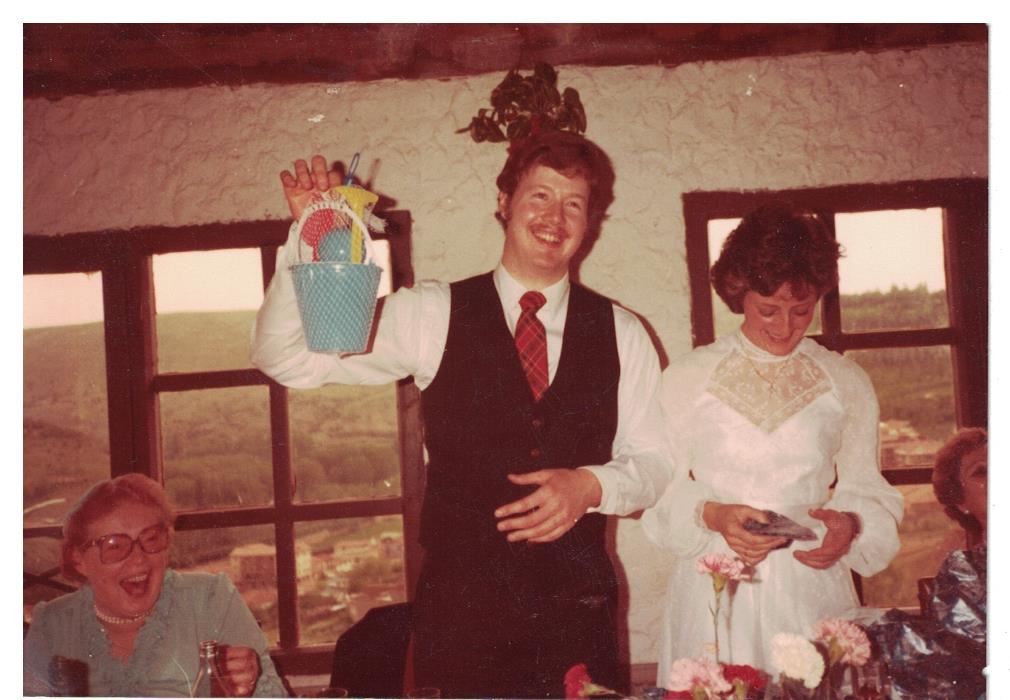
Ruth Munro, Richard K Munro and Mrs. Munro on St. Columba’s Day June 9, 1982 the happiest day of my life Soria , Spain. Auld Pop was not there and Don Benigno was not there. I like to think they met in heaven on that day for a dram or too.

Spanish memories: my wife and used to listen to light classics and zarzuelas at her Grandparent’s house in Soria, Spain (c. July 1973) and drink Coca-Cola and eat anchovies. Don Benigno was a very cultivated man.

Don Benigo a retired country doctor was the only Spaniard I ever met who knew immediately Munro was a Scottish Highland name (and not Italian). I said how did he know that? He got up and got a book from his shelf and started to read to me THE LAST OF THE MOHICANS (in Spanish) Three of the main characters were Scottish Munros. He said, in a joke, that all his life he was waiting to meet an authentic Scottish Munro. We all laughed.

Later my wife gifted me the book which I still have. I now think that Don Benigno hoped I would marry his granddaughter. Many happy memories of visiting his house, listening to classical music, and playing chess. The tapas were always great! He never served me alcohol though I was only 17.

In memory, I can taste the rich old cane sugar Coca-Cola (I haven’t tasted the like in many years) and the salty anchovies.

In memory, I hear the ghost of a tune CONCIERTO ARANJEZ.

What is the greatest distance between two points?

Time of course. But it is wonderful to have had over 50 years of continuous memories and friendship.

Nothing like it.

another old favorite I used to sing with my mother. She said it was true in my case as I only found love outside the Anglosphere. Why? Perhaps because the Spanish lassies were a little more traditional. They helped me survive the 20th century which was not easy for me despite my massive “privilege”

Music, Books, Poetry, Film