

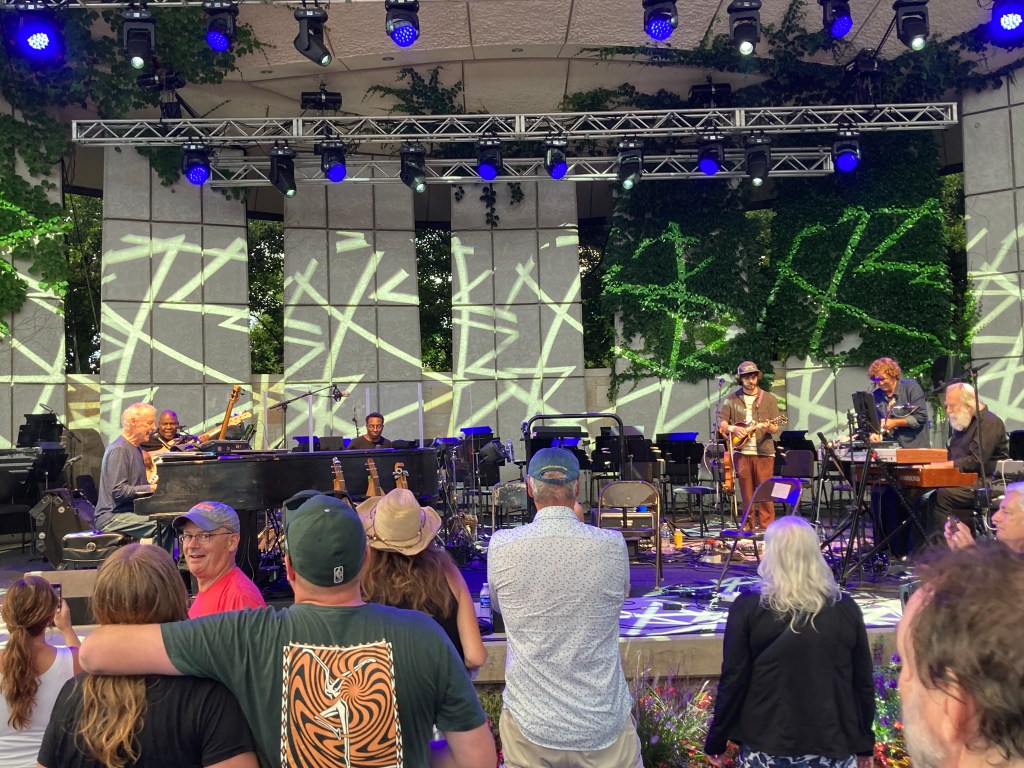
Bruce Hornsby and the Noisemakers with the Grand Rapids Symphony, Frederik Meijer Garden Amphitheater, July 11, 2024.
You know, you can’t wing it with an orchestra!
— Bruce Hornsby, fielding requests onstage
So far, so good: after a week where their shows were cancelled and rescheduled due to vocal troubles, Bruce Hornsby and his Noisemakers had hit the amphitheater stage. The Grand Rapids Symphony, ably conducted by Bob Bernhardt, were teasing out plush, precise orchestral backdrops for jauntily sardonic opener “Life in the Psychotropics”, Bon Iver collaborations “Cast Off” and “Meds” and a fresh, reflective arrangement of early hit “Every Little Kiss”.
The ballad “Here We Are Again” stood out as prime latter-day Hornsby: a haunting melody arching over extended harmonies and pointillistic piano/orchestral splatters, effortlessly meshed with lyrics unfolding a time-travel love story by way of cutting-edge physics. While Bruce’s singing had some rough edges, the performers were tuning in; the capacity crowd was listening raptly; the evening was gathering momentum.
Then the heavens opened: remnants of Hurricane Beryl that had been circling let loose persistent, soaking rain and uncomfortably close rumbles of thunder. As Hornsby launched into one of his solo piano hymns, management pulled the orchestra offstage. Calling an audible with the hit “Mandolin Rain”, Bruce then asked the audience to help with the high-pitched shout chorus he admitted he couldn’t manage; from his response, you could tell we’d covered it to his satisfaction.
And oddly enough, that was where the fun really started! Cued by the lyrics “listening to the bluegrass band”, John Mailander on mandolin and Gibb Droll on guitar served up a tasty breakdown, working off of Bruce’s hand signals and head nods; free associating on the playout, Hornsby served up an apropos snippet of early Paul McCartney: “That would be something/To meet you in the falling rain, mama”, indeed!
Then organist J.T. Thomas joined in the merriment for a groovily funky “Country Doctor”; unleashed from balancing with the orchestra, bassist J.V. Collier and drummer Chad Wright gleefully bumped up the low end up a notch. Even with Hornsby announcing a rain delay, from the eye contact and the smiles between all the musicians you could tell the Noisemakers didn’t want to call it a night.
The clouds and the rain stayed stuck in place, but after twenty minutes of roadies looking at the sky, checking weather apps, and bringing out multiple dulcimers, Bruce and the band came back to strut a bit more of their stuff: “Prairie Dog Town,” a outlandish mash-up of bro-country and hip-hop, followed by the streetball throwdown “Rainbow’s Cadillac” reimagined to the music of The Spinners’ “Rubberband Man”! “The Way It Is”, played straight up but stretched out with features by Mailander on fiddle, Droll, Thomas, and Wright served as an encore, a wry acknowledgment of circumstances beyond control, and a final showcase for what these superb players could do.
Ultimately, Bruce Hornsby and the Noisemakers made the best of a tough situation, keeping their drenched fans engaged until Meijer Gardens called a halt. With no tracks from the album they’re touring behind (1998’s Spirit Trail) and only a smattering of the symphonic goodies promised, the show certainly didn’t turn out as advertised; nevertheless, it turned out to be a surprising, satisfying night on the town.
— Rick Krueger

 Spirit of Cecilia
You must be logged in to post a comment.