Tag Archives: Bruce Hornsby

In Concert: Listening In on Bruce Hornsby

Most artists wouldn’t start their live set with an obscure song from an now-obscure 20-year-old album (arguably a major label’s desperate attempt to justify their investment by breaking said artist back into the mainstream, via celebrity duets with Sting and Eric Clapton). Most artists definitely wouldn’t follow that up with another obscure song from his follow-up collaboration with a generational bluegrass talent.

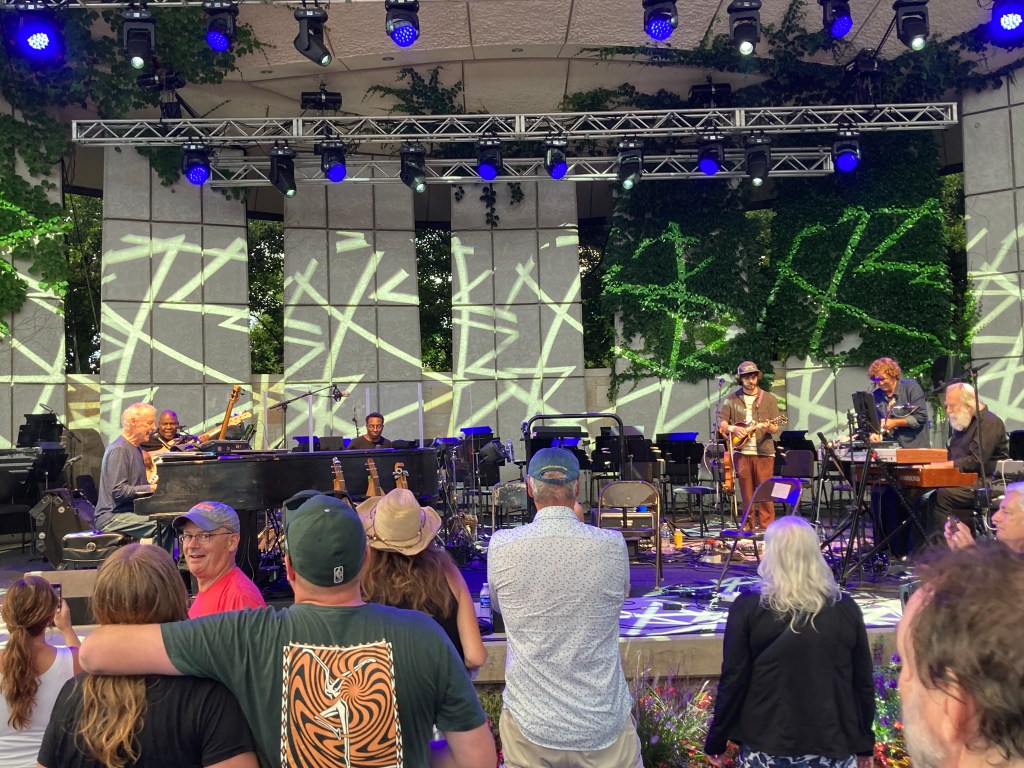
But then, this is Bruce Hornsby we’re talking about. Seated at the grand piano stage left, facing his Noisemakers – J.T. Thomas on keyboards, Gibb Droll on guitar, J.V. Collier on bass, John Mailander on mandolin and fiddle, and Chad Wright on drums – grouped in a half circle, Hornsby launched into an extended, exploratory take on Halcyon Days’ “Circus on the Moon“, followed by “Gulf of Mexico Fishing Blues” from his duet album with Ricky Skaggs.

While a familiar track from Hornsby’s Top 40 years, “Look Out Any Window“, was up next, only the chords and the lyrics recalled the original recording. Instead of facing the audience, intent on making maximum impact, Hornsby and the Noisemakers seemed to invite us into a space where, though grateful for our company, their focus would be on the music. And the near-capacity crowd went there, leaning in to listen as Hornsby worried at the melody and the band took the tune’s structure new places, scaling heights of delicate interplay and spanning depths of ensemble groove.

The next stretch of songs, from the new album Indigo Park, confirmed that impression; “Ecstatic”, “Memory Palace”, and the title track continually blazed unexpected trails, individual Noisemakers stepping forward and pulling back, Hornsby choreographing with eye contact and hand gestures. And the hits were forthcoming – but only on Hornsby‘s terms. A wildly atonal piano prelude spanning the length and breadth of the keyboard gave away to a decorous, romantic waltz, eventually teasing Hornsby’s breakthrough song “The Way It Is”. At which point he turned to the audience and said, “You want the pretty version or the jammin’ version?“ The whoop of recognition and the crowd’s spontaneous rise to its feet decided the question in favor of a jam; and with Hornsby again scatting around the melody and extending the jazz piano breaks, the result bore only faint resemblance to that long-ago hit single.

By that point, Hornsby was in his comfort zone and ready to take multiple chances. The minor hit “Across the River”, his first recorded collaboration with the Grateful Dead’s Jerry Garcia, drew a warm ovation from the crowd. They also ooh’d and ah’d when the band unplugged and came forward, Hornsby picked up a dulcimer, and Wright donned a washboard vest for two more deep tracks, followed by an appealing, muted take on “Mandolin Rain”.

Appropriately, the high point of the night was the climax of the set: “Rainbow’s Cadillac“, jazzed up and stretched out; “The Show Goes On”, where a passionate piano/vocal solo morphed into a full on, full-band power ballad; and a tribute to Hornsby‘s Grand Rapids debut 40 years ago, Bruce strapping on his accordion to rock out the first track from his debut album, “On the Western Skyline “.

Throughout the night, Hornsby and his Noisemakers welcomed you into their world – but very much on their terms. If the instrumental jamming went on a bit too long, you could focus on how each person on stage was listening hard, adding their bit or laying out as required. Or you could focus on how Hornsby – whose voice now lacks the power of his youthful salad days, but brings to bear all kinds of canny tricks as he sings – constantly played with the tunes, twisting and turning them, familiar words perceived from fresh melodic angles. And whether any given moment moved toward stasis, languor or excitement, you could tell that, flashing and flickering, Music was there on this serene summer evening, leaning over, taking Hornsby, the Noisemakers, and all of us into its confidence.

— Rick Krueger

  • Circus on the Moon
  • Gulf of Mexico Fishing Blues
  • Look Out Any Window
  • Ecstatic
  • Memory Palace
  • Indigo Park
  • Piano Solo/The Way It Is
  • Across the River
  • M.I.A. in M.I.A.M.I
  • North Dakota Slate Roof
  • Mandolin Rain
  • Rainbow’s Cadillac
  • The Show Goes On
  • On the Western Skyline

In Concert: Bruce Hornsby Makes Noise in the Mandolin Rain

Bruce Hornsby and the Noisemakers with the Grand Rapids Symphony, Frederik Meijer Garden Amphitheater, July 11, 2024.

You know, you can’t wing it with an orchestra!

— Bruce Hornsby, fielding requests onstage

So far, so good: after a week where their shows were cancelled and rescheduled due to vocal troubles, Bruce Hornsby and his Noisemakers had hit the amphitheater stage. The Grand Rapids Symphony, ably conducted by Bob Bernhardt, were teasing out plush, precise orchestral backdrops for jauntily sardonic opener “Life in the Psychotropics”, Bon Iver collaborations “Cast Off” and “Meds” and a fresh, reflective arrangement of early hit “Every Little Kiss”.

The ballad “Here We Are Again” stood out as prime latter-day Hornsby: a haunting melody arching over extended harmonies and pointillistic piano/orchestral splatters, effortlessly meshed with lyrics unfolding a time-travel love story by way of cutting-edge physics. While Bruce’s singing had some rough edges, the performers were tuning in; the capacity crowd was listening raptly; the evening was gathering momentum.

Then the heavens opened: remnants of Hurricane Beryl that had been circling let loose persistent, soaking rain and uncomfortably close rumbles of thunder. As Hornsby launched into one of his solo piano hymns, management pulled the orchestra offstage. Calling an audible with the hit “Mandolin Rain”, Bruce then asked the audience to help with the high-pitched shout chorus he admitted he couldn’t manage; from his response, you could tell we’d covered it to his satisfaction.

And oddly enough, that was where the fun really started! Cued by the lyrics “listening to the bluegrass band”, John Mailander on mandolin and Gibb Droll on guitar served up a tasty breakdown, working off of Bruce’s hand signals and head nods; free associating on the playout, Hornsby served up an apropos snippet of early Paul McCartney: “That would be something/To meet you in the falling rain, mama”, indeed!

Then organist J.T. Thomas joined in the merriment for a groovily funky “Country Doctor”; unleashed from balancing with the orchestra, bassist J.V. Collier and drummer Chad Wright gleefully bumped up the low end up a notch. Even with Hornsby announcing a rain delay, from the eye contact and the smiles between all the musicians you could tell the Noisemakers didn’t want to call it a night.

The clouds and the rain stayed stuck in place, but after twenty minutes of roadies looking at the sky, checking weather apps, and bringing out multiple dulcimers, Bruce and the band came back to strut a bit more of their stuff: “Prairie Dog Town,” a outlandish mash-up of bro-country and hip-hop, followed by the streetball throwdown “Rainbow’s Cadillac” reimagined to the music of The Spinners’ “Rubberband Man”! “The Way It Is”, played straight up but stretched out with features by Mailander on fiddle, Droll, Thomas, and Wright served as an encore, a wry acknowledgment of circumstances beyond control, and a final showcase for what these superb players could do.

Ultimately, Bruce Hornsby and the Noisemakers made the best of a tough situation, keeping their drenched fans engaged until Meijer Gardens called a halt. With no tracks from the album they’re touring behind (1998’s Spirit Trail) and only a smattering of the symphonic goodies promised, the show certainly didn’t turn out as advertised; nevertheless, it turned out to be a surprising, satisfying night on the town.

— Rick Krueger

Bruce Hornsby, American Original

It’s been nearly forty years since pianist-singer-songwriter Bruce Hornsby had the number 1 song on Billboard’s Hot 100, the title track of his debut album, The Way It Is:

For all the ways this song fit right into the radio soundscape of the time — smooth drum machine propulsion, synthesized bass licks and string pads — two novelty factors made it stand out musically: Hornsby’s strong yet laid-back baritone, earnestly surveying our society’s gap between legal equality and ongoing, prejudiced perception; and his extended piano solo steeped in jazz, channeling the supple lyricism of heroes like Keith Jarrett. The man could unquestionably sing and play; and supported by his rootsy backing band The Range, he had no hesitation about going for his own sound, both in the studio and live.

More hits followed, but by the second time I saw Hornsby in concert in 1990 (the first live show I caught in my new hometown), the pop trajectory of his career was already tapering off. Still, as the hot new piano player on the scene, he’d already had a series of collaborations that yielded hauntingly lyrical recordings with Don Henley (“The End of the Innocence”) and Bonnie Raitt (“I Can’t Make You Love Me”) and pulled in stellar guests from the jazz, folk and bluegrass worlds for his third album with The Range, A Night on the Town. The single from that album “Across the River” (Hornsby’s last Top 20 hit) featured a spirited guitar solo by Jerry Garcia of The Grateful Dead; after Dead keyboard player Brent Mydland passed away unexpectedly that year, Hornsby joined the hippie legends for roughly 100 gigs — and the freedom from audience expectations he found in that band has been the guiding star for his musical path ever since.

Dissolving The Range, Hornsby consistently expanded the reach of his music in the 1990s — building extended jazz and bluegrass interludes into his new songs, writing in the idiom of classic soul a la The Drifters and Sam Cooke, recording with a head-spinning variety of all-stars from pop marquee names Phil Collins and Chaka Khan to killer players Branford Marsalis and Pat Metheny. Then came 1998’s Spirit Trail: with Hornsby sharpening his keyboard skills to master an intricate two-handed style and cracking open his Tidewater Country heritage for deepened lyrical content, the result was a double album of quirky, compelling character sketches set off by a dizzying variety of sonic frames — driving boogie-woogie, greasy funk, proto-classical minimalism, pensive Appalachian balladry — with fuller piano and grittier vocals at the forefront. To cop from another American original: the album was large, it contained multitudes.

Continue reading Bruce Hornsby, American Original