Tag Archives: Charles Williams

Charles Williams’ All Hallows Eve – Stranger Things Meets Rosemary’s Baby

The First Edition

All Hallows Eve is Charles Williams’ seventh novel, and one of his best. In 2024, I began working my way through all of the novels of this member of The Inklings, the famous literary group of friends that included J. R. R. Tolkien and C.S. Lewis. Williams’ fiction is definitely darker and more philosophical than the writings of either of the his more well known colleagues.

All Hallows Eve begins with a startling scene: a young woman, Lester Furnival, is standing on a street in nighttime London, and there are none of the usual sounds and traffic around her. She soon realizes that she is dead. She and a friend, Evelyn Mercer, were supposed to meet each other for a get-together, but they were killed by a plane crashing into the area. It appears that Lester and Evelyn are in some sort of purgatory – they can interact with each other, but they do not perceive any other beings. The only way they know it’s night is when the lights come on in the houses around them. There is no sun or moon, just a diffuse, gray light.

Back in the land of the living, Lester’s grieving husband, Richard, visits his artist friend, Jonathan Drayton. Drayton is a talented painter who shows Richard his latest work: a painting of a charismatic religious leader who goes by the moniker Simon the Clerk, or Simon Leclerc. It has been commissioned by Lady Wallingford, a devoted disciple of Simon. Jonathan Drayton is in love with her daughter Betty, but she will not allow them to get engaged.

Lady Wallingford drops by to view the painting, and she is extremely disappointed. In her eyes, Simon looks malevolent, and the people in the congregation look like insects. Later, Simon himself visits Drayton to view the painting, and he proclaims it a masterpiece that captures him perfectly.

What follows is a very dark tale of necromancy and all-consuming greed for power. Simon was conceived and born during the French revolution, and he has plans for world domination that involve breaking through to the spiritual plane where Lester and Evelyn are. Lady Wallingford’s daughter, Betty, is the hinge through which this will happen. Things get very creepy as the story unfolds – I was put in mind of Rosemary’s Baby as the pieces fell into place.

As a favor to Jonathan, Richard Furnival agrees to attend a meeting of Simon’s followers, and see if he is legitimate. Simon uses some sort of spell to put everyone under his will. At the end of the meeting, Simon speaks to Richard, and Richard recounts their disturbing conversation to Jonathan:

“He [Simon] said: ‘I won’t keep you, Mr. Furnival. Come back presently. When you want me, I shall be ready. If you want your wife, I can bring her to you; if you don’t want her, I can keep her away from you. Tell your friend I shall send for him soon. Good-bye.” So then I walked out.

He lifted his eyes and looked at Jonathan, who couldn’t think of anything to say. Presently Richard went on, still more quietly: “And suppose he can?”

“Can what?” asked Jonathan gloomily.

“Can,” said Richard carefully and explicitly, “do something to Lester. Leave off thinking of Betty for a moment; Betty’s alive. Lester’s dead, and suppose this man can do something to dead people?

CHARLES WILLIAMS. All Hallows’ Eve (Kindle Locations 1850-1855). Delphi Classics. Kindle Edition.

As the story unfolds, there is a contrast between the characters who grow and mature, and the ones who degenerate. Betty, who is initially a slave to Simon’s will, gradually comes into her own and is able to resist him. Lester also matures spiritually as she learns to navigate the purgatory she is in. Both she and Richard remember their brief marriage, regret the mistakes they made, and come to a much deeper love than they had when she was alive. Even Jonathan’s art takes on a life of its own, becoming more transcendent.

On the other side, Lady Wallingford becomes less and less of an individual with actual agency, Evelyn undergoes a horrific degeneration into petty hatred, and Simon Leclerc reaps the rewards of his dark magic.

All Hallows Eve is one of Williams’ most accessible reads, as well. In a few of his earlier novels, particularly Descent Into Hell, his prose was very dense and unwieldy, and his dialog hard to follow. Every conversation in All Hallows Eve is terse and to the point. I thoroughly enjoyed this novel, even though it creeped me out at times. I wonder if the creators of Netflix’s Stranger Things are familiar with it, since there are definite similarities in the basic premise of both tales. Anyway, for fans of fantasy with a very dark edge (but a happy ending), I highly recommend All Hallow Eve.

Charles Williams’ The Greater Trumps – Marvelous Fantasy from an Inkling

Trumps

Continuing my exploration of Charles Williams’ series of fantasy novels, The Greater Trumps is the fourth of his I have read. (You can read my reviews of War In Heaven here, Many Dimensions here, and The Place of the Lion here.) Williams was an Inkling, that marvelous group of writers and thinkers that included C. S. Lewis, J. R. R. Tolkien, and Owen Barfield. HIs tales are set in contemporary England (or rather England of the 1930s, when he wrote them), and they are darker than Lewis’ and Tolkien’s work. Each one is suffused with Christian values, but without any obvious or superficial references. Williams must have been an incredibly well educated man, as he refers to ancient and medieval philosophers and myths while expecting the reader to understand them.

So far, The Greater Trumps is my second favorite novel of Charles Williams, just a little behind his first, War In Heaven. The story is centered on a small cast of characters: Nancy Coningsby – a young woman engaged to Henry Lee; her father, Lothair Coningsby – “Warden of Lunacy”, which I take to mean warden of an insane asylum; Lothair’s sister, Sybil; his son, Ralph; Henry’s grandfather, Aaron; and Aaron’s sister, Joanna.

Lothair, Sybil, Nancy, and Ralph all live together, and, like any family, they get on each other’s nerves. Lothair doesn’t particularly like Henry, even though he is a barrister. He has gipsy blood and thus Lothair doesn’t really trust him. Nancy is consumed with passion for Henry and only dreams of their life together. Ralph is somewhat self-centered as most young men naturally are. Sybil, the unmarried sister of Lothair, is one of Williams’ most interesting and charming characters ever. She is imperturbable, simply enjoying life in all its wondrous beauty. Of course, Sybil’s sheer joy and love of others annoys the pragmatic and practical Lothair.

The story begins when Henry discovers that Lothair has been bequeathed an ancient set of Tarot cards. When Lothair shows them to Henry, he realizes that they are the original deck of Tarots, which possess incredible power. These include the twenty Greater Trumps: The Juggler, The Empress, The High Priestess, The Hierophant, The Emperor, The Chariot, The Lovers, The Hermit, Temperance, Fortitude, Justice, The Wheel of Fortune, The Hanged Man, Death, The Devil, The Falling Tower, The Star, The Moon, The Sun, The Last Judgment, The Universe, and the unique and mysterious Fool. I don’t know anything about Tarots, but apparently there are four suits: scepters, swords, cups, and coins. The Greater Trumps are like the standard Jack, Queen, and King, but with an extra member in each suit. The Fool stands alone, having no number.

It turns out Henry’s grandfather, Aaron, is the keeper of an ancient set of golden “images”, figures which carry out a mysterious dance on a golden base and are connected to the original set of Tarots that Lothair now owns. If Henry can get Nancy to join him in manipulating the Tarots, he will be able to foretell the future and gain enormous power. Unfortunately, Lothair has no intention of giving up the gift his late friend left him. So, Henry arranges it so that everyone travels to Aaron’s isolated house in the country to spend Christmas in the hopes that he can do away with Lothair and gain possession of the deck of Tarots.

Throughout all of this scheming and jockeying, Sybil blithely observes and delights in everything she sees. For example, when Aaron shows the Coningsbys the golden figures, they appear to be moving in a complex dance, while The Fool is stationary in the center. However, Sybil perceives The Fool to be moving with incredible speed and grace amongst the other figures. She is the essence of humility, and, as a result ends up being the one person with the most power:

‘She’s got some sort of a calm, some equanimity in her heart. She — the only eyes that can read the future exactly, and she doesn’t want to know the future. Everything’s complete for her in the moment.’

Charles Williams. The Greater Trumps (Kindle Locations 1398-1399). Delphi Classics. Kindle Edition.

Henry attempts to use the Tarots to kill Lothair when he goes for a walk. Henry invokes a deadly snowstorm with hurricane force winds. Sybil puts on her coat and goes outside to rescue her brother. When she brings him safely back, the storm’s fury is concentrated on Aaron’s house, because that is where Lothair, its target, is now. All hell breaks loose in the house, and Henry gives in to despair.

Meanwhile, Joanna, Aaron’s sister, is a madwoman who has been searching for the son she lost in childbirth. She is convinced he was destined to be a messiah, and when he was taken from her she went mad and reverted to Egyptian paganism. Only Sybil’s otherworldly peace and understanding is able to break through Joanna’s rage.

There is a wonderful passage when Nancy is able to tap into Sybil’s overpowering love of creation and rescue Henry. Nancy becomes self-aware of her failings and realizes that her own attitude has had a lot to do with her difficult relationship with her father.

The Greater Trumps continues a common theme of Williams: what would happen if an ancient talisman of power was loosed upon our modern world? The various characters’ reactions to all the metaphysical chaos that Henry and Aaron unleash are telling. Sybil accepts what is happening with faith that “all is well, all is most well.” Nancy grows in wisdom and sees that love encompasses everything. Joanna loses what little sanity she has and lashes out in violence. Aaron and Henry retreat into hopelessness. Lothair and Ralph, God bless ’em, insist that everything must have a logical explanation:

‘Whereabouts are we?’ Mr. Coningsby asked. ‘
Where we were, I suppose,’ Ralph said. ‘By that doorway into the study or whatever it was. I’ve not done much moving since, I can tell you. Funny business this.’
‘It’s a wicked and dangerous business,’ Mr. Coningsby cried out. ‘I’m looking for Nancy. That fiend’s left her alone, after trying to kill me.’
‘What fiend?’ Ralph asked, even more bewildered. ‘Who’s been trying to kill you?’
‘That devil’s bastard Henry,’ Mr. Coningsby said, unwontedly moved as he came to speak of it. ‘He said so. He said he raised the storm so as to kill me.’
‘Henry!’ Ralph exclaimed. ‘Raised a storm. But I mean — O, come, a storm!’
‘He said so,’ Mr. Coningsby repeated. ‘And he’s left Nancy in that room there with that gibbering hag of an aunt of his. Come on with me; we’ve got to get her out.’
‘I see,’ said Ralph. ‘Yes; O, well, let’s. I don’t mind anything so long as it’s firm. But raised a storm, you know! He must be a bit touched. I always thought he was a trifle gibbery himself.’
‘O, everyone’s mad in this damned house,’ Mr. Coningsby said.

Charles Williams. The Greater Trumps (Kindle Locations 3193-3203). Delphi Classics. Kindle Edition.

The Greater Trumps is one of Charles Williams’ best works (of the four I’ve read so far), and in the character Sybil he has given us an extraordinarily beautiful model of what true Christian faith and humility can accomplish. It’s really a shame he is not as well known as his fellow Inklings Lewis and Tolkien. I hope my review piques others’ curiosity enough for them to give him a try.

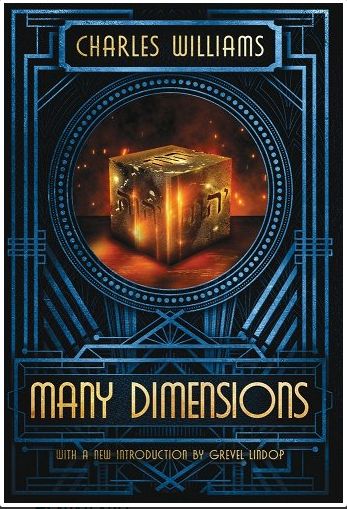
Charles Williams’ Many Dimensions – Excellent Fantasy from an Inkling

I have just finished reading Charles Williams’ second novel, Many Dimensions, and the more I read of his, the more I like it. Even though his fellow Inklings Tolkien and Lewis are more well known, Williams deserves to be more widely read. He stakes out a unique territory of weird fantasy that is imbued with his Christian faith. Here’s my review of it.