What if “Magick” was an accredited science with the most prestigious universities offering courses of study in it? What if Dante, Orpheus, Virgil, et al. really did descend to Hell, and their writings were nonfiction accounts of their experiences? What if T. S. Eliot’s The Wasteland was a travelogue of a real place? Those are the assumptions behind Rebecca Kuang’s enormously entertaining novel, Katabasis.
Cambridge University’s most renowned professor of magick, Jacob Grimes, has died accidentally in a spell gone horribly awry. His two most promising and dedicated graduate students, Alice Law and Peter Murdoch, decide to go to Hell to bring him back. Unbeknownst to each other, they each consider themselves responsible for Professor Grimes’ death. On earth, they have been bitter rivals for Grimes’ attention and favor. Down below, they have to figure out how to work together as they traverse the eight courts of Hell. Based on my description, I admit Katabasis sounds like a young adult fantasy novel. However, it is definitely written for an adult audience, and Kuang’s story gets very dark, very fast.
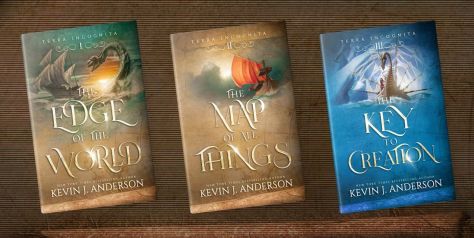
Acclaimed author Kevin J. Anderson, is beginning a Kickstarter campaign tomorrow (March 11, 2025) to reissue his three-volume Terra Incognita project. The books have been previously published in paperback, but have been out of print. Anderson plans to rerelease them as a deluxe set of hardcovers in a slipcase.
Accompanying the books is a trio of albums featuring the cream of progressive rock. Just check out the lineup for the soon-to-be released third album, Uncharted Shores:
• Michael Sadler (SAGA) • Dan Reed (Dan Reed Network) • Doane Perry (Jethro Tull) • Ed Toth (Doobie Brothers, Vertical Horizon) • Jonathan Dinklage (Rush Clockwork Angels, Lady Gaga, Barbra Streisand) • Greg Bissonette (David Lee Roth, Ringo Starr All Stars) • Anneke van Giersbergen (European vocalist) • Ted Leonard (Spock’s Beard, Pattern-Seeking Animals)
Be on the lookout for an in-depth review of this album soon. Meanwhile, check out the Kickstarter campaign – it will be the only means of acquiring this historic literary/musical project, and it only runs from March 11 through April 4!
[This post was updated to reflect the fact that all three novels have been published in paperback, and the personnel for the third Terra Incognita album was incorrect. The post now has the correct lineup.]
In 2000, when our daughters were 10 and 6, I saw a list of new Christmas-themed books that included Catherine Salton’s Raphael and the Noble Task. I found it at the local bookstore and was immediately taken with David Weitzman’s beautiful illustrations. I read it aloud to the family, and we all enjoyed it very much. Even though it’s technically a children’s book, it will appeal to readers of all ages, much like C. S. Lewis’ Narnia series.
Raphael speaks with The Alchemist, another of his cathedral’s statues
I decided advent 2024 was as good a time as any to revisit this charming tale of a Gothic cathedral’s chimère (French for a statue of a chimera) named Raphael and his quest to find a Noble Task to justify his existence. Raphael is a griffin, placed above the cathedral’s main entrance. He has a lion’s body and legs, eagle’s wings, and the head and neck of a dragon. He is bored and lonely, and he visits the statue of an alchemist who refers to an older cathedral guardian named Parsifal who is no longer around. It is the alchemist who plants the idea of a noble task in Raphael’s head.
Once Raphael decides he needs to perform a noble task, he decides to ask other members of the cathedral statuary what he should do. He first goes to a couple of tomb effigies of a knight and his wife, but they’re so busy bickering they can’t help him. Next, he approaches a gargoyle who is near his niche, but, like all gargoyles, this one – named Madra-Dubh (Black Dog) – is very rude and condescending:
Raphael steeled his resolve. “You see, I’m trying to find something, and I think you might know where it is,” he said as quickly as possible.
“Oooh, and it’s trying to find something,” crowed Madra-Dubh as the others cackled gleefully. “Not good enough for the fawning idle-headed dewberry to sit in its donkey-spotted behind and do its right job, mark me! Nooo, it’s got to go thumping about pestering the working folk with foolish don’t-you-knows. Go drop some feathers, ye molting chicken-witted dragglebeak, and leave us in peace, then.” (pages 21 – 22)
Raphael eventually finds the scriptorium (library), and even though he can’t read, he sees an illustration in an illuminated manuscript. It depicts a knight in silver armor slaying a dragon. Because Raphael resembles the dragon, he begins to doubt his own integrity and wonder if he is actually evil. At this point in the story, there is beautiful scene set in a side chapel where Raphael, tortured by gnawing self-doubt, encounters a statue of Mary with her child Jesus, and he is immediately set at peace.
A young woman with a gentle expression gazed out at him from the darkness. Her plain blue gown fell in folds to her bare feet, and her hair was unbound, spreading over her shoulders in rippling veil. In her arms she cradled a baby, who reached up with one small hand to touch her face in a gesture of cam devotion. As Raphael stood wondering, his head cocked to one side, he felt as if his hurt and disappointment were being softly lifted away. For the young woman seemed to speak to him in a manner he did not fully understand; she did not move, nor did she actually say a word, but all the same, she told Raphael a long and beautiful story. In the icy darkness of that chapel, she spoke gently to Raphael alone. She spoke of joy in good times, and patience in hard, and of hope even in the bleakest hours of all. (page 41)
Once he has returned to his niche over the main portal, though, his self-doubt returns. And then one day, he sees a young woman in desperate straits hurry up the steps to leave her baby in the “foundling” box – a place for babies whose parents can’t feed them or care for them. In a flash Raphael has found his noble task!
What follows is great fun, as various communities in the cathedral all work together to help Raphael take care of his new charge. The gargoyles, the churchmice, and the pigeons all manage to put aside their differences and learn to cooperate.
Of course, the situation cannot last forever, and Raphael is faced with a terrible choice: his true noble task. Salton does a terrific job of weaving together the lives of the monks and other inhabitants of the village with the clandestine doings of the cathedral statuary, armies of mice, and flocks of pigeons. The whole tale is a marvelous allegory of how, despite the best of human (and chimère) intentions, without a little Divine intervention things would rapidly turn into tragedy. However, as Salton quotes Julian of Norwich at the very beginning of the book, “All shall be well, and all manner of things shall be well.”
Raphael and the Noble Task is a wonderful book for families to read aloud at Christmastime. It’s relatively short: 157 pages, and as I mentioned before, David Weitzman’s illustrations are fantastic. It deserves a place alongside other Christmas classics like Dickens’ A Christmas Carol and O’Henry’s The Gift of the Magi.




 Spirit of Cecilia
You must be logged in to post a comment.