Tag Archives: Greg Spawton

It’s Easy to Like “The Likes Of Us”

BigBigTrain_TheLikesOfUs (1)

There are a select few artists that Spirit of Cecilia will always love and greet with joy any new release. One of them is Big Big Train, who have just released a new album, The Likes Of Us. Big Big Fanboys Brad Birzer and Tad Wert discuss this latest chapter in their long and varied career, and what it means for BBT’s future.

Tad: Brad, my fellow Progling and good friend, it’s always big news when Big Big Train graces us with new music. I have you to thank for making me aware of this wonderful group of musicians. It was when The Underfall Yard had just been released, and we were connecting via social media. You insisted I check them out. I had never heard of BBT, and it was an ear-opening experience to explore all of their music. I fell in love with The Difference Machine along with The Underfall Yard, and the rest is history.

As I became familiar with their career, I soon learned that The Underfall Yard was the first album to feature vocalist David Longden. He, along with founding member Greg Spawton, went on to produce some of the finest albums of the 2010’s: English Electric, Folklore, Grimspound, Grand Tour, Common Ground. And then tragically, David Longden passed away. I was afraid this was the end for BBT as we knew them. 

However, they found a new vocalist, Alberto Bravin, and have recorded a new album! Brad, I’m really interested in hearing your first impressions of this iteration of BBT. Is it a worthy successor to previous ones?

Brad: Dear Tad, thank you so much for this, and my apologies (as usual) for being late in replying.  Things have been chaotic (good and bad chaos, it turns out–one so quickly and readily becomes the other) in the Birzer household.  Let’s just say, I’m not unhappy to see February 2024 in the rear-view mirror, and that all ills (flu and otherwise) have found happy resolutions!

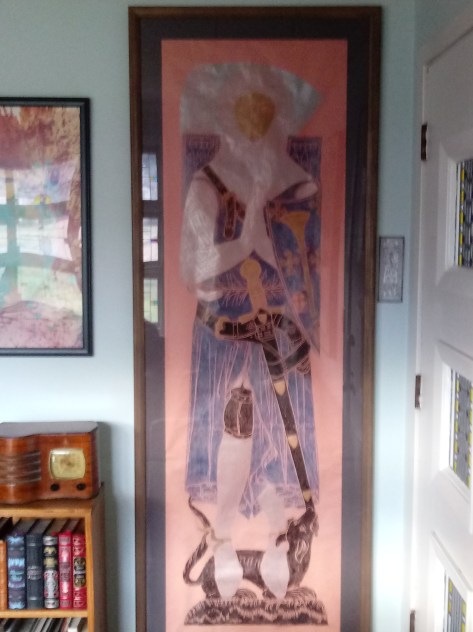
As I type this on my laptop, I sit beneath an original Jim Trainer painting from The Underfall Yard that proudly adorns my college office.  Below it is an award I won over twenty years ago, and above it is an original photo of Geronimo.  Next to it is a signed and framed autograph from Neil Peart.

I first encountered The Underfall Yard fifteen years ago.  Our very own Carl Olson sent me a mix of his favorite tracks of 2009, and a song from the TUY album was included.  To say I was floored would be the understatement of my adult life.  I immediately ordered the full album, and I was completely blown away by its brilliance, its creativity, and its unique voice.  As to the latter, there’s nothing quite like a classic BBT sound–a perfect mixture of exhilaration and melancholy.  I also immediately emailed Greg Spawton, who kindly responded. For years, we had a fairly serious correspondence.  We even sent each other books we each loved.  I cherish those emails and that friendship.

From there, I closely followed the band, and, as I’ve noted elsewhere, we founded Progarchy originally as a BBT fansite.  Years later, you and I collected our various essays on the band and e-published Dream of the West through Amazon.  That little e-book did very well, I’m proud to say, and I’m deeply honored that our names will always be linked together, Tad.  I also had the chance to praise them at National Review, at The Imaginative Conservative, and elsewhere.

This is all a very long way of stating that I’ve followed the band as closely as possible for a decade and a half.  I’ve cheered with and for them, and, with the immense loss of David Longdon, I’ve mourned with and for them.

They’ve been a part of my life as much as anything else (except for family) over the past fifteen years.

This past weekend, BBT played its very first show in the United States.  It was in Fort Wayne, Indiana–just a 1.5 hour drive for me–but I was, crazily, already committed to leading a seminar/conference in Philadelphia, a commitment I made.

Big Big Train | Trieste, May 2023 | ph Massimo Goina

Ok, Birzer, shut up and tell us about the new album!!!

To be sure, BBT has had a rough couple of years, and many folks have wondered if the band could recover after the tragic loss of vocalist David Longdon.  Additionally, many of the essential bandmates–such as David Gregory–had left the band for a variety of reasons.

The Likes of Us proves that BBT is more than the sum of its parts, an idea and concept as much as a concrete band.  Whereas the band was once incredibly and quirkily English, it is now quite cosmopolitan and, well, trans-Atlantic.  I write this last bit with only the slightest bit of irony, as the new album has, in part, a Neal Morse/Spock’s Beard feel to it.

Tad: Brad, as always, I appreciate the context you provide for your love of BBT. I think you have hit the nail on the head with your preceding paragraph: Big Big Train is an idea and concept now, much like King Crimson and Yes are. The personnel may change, but there is definitely a constant thread through all of their albums that makes each one a uniquely “BBT” work. 

As I write this, I am listening to “Beneath the Masts”, Greg Spawton’s ode to the radio masts that dominated the landscape of his childhood. As long as Greg is involved, BBT will always be BBT. He truly has been the anchor of the band, regardless of who sings or plays guitar. 

I am intrigued with your reference to Neal Morse/Spock’s Beard. I love their music as well, but it has always been more, hmm… turbulent, than BBT’s in my opinion. BBT’s music has, until this album, always struck me as being pastoral. Kind of like Vaughan Williams’ music is in the classical realm. I could see BBT performing “The Lark Ascending”, but never Spock’s Beard, if that makes sense!

Okay, let’s talk about The Likes Of Us! I love the opening chords of the first song, “Light Left In The Day” – the acoustic guitars are reminiscent of Steve Hackett-era Genesis. It soon develops into quite a majestic production, and, now that you’ve mentioned it, I really hear that Morse influence in it. Another favorite moment is the seamless segue into “Oblivion”, which is a terrific rocker. According to my Spotify app, I’m not alone in really liking this track – it far and away has the most listens. I think it’s a great choice for the single, because the melody is so appealing. Bravin’s vocals are superb here, and despite my initial impulse to compare him unfavorably to Longdon, I think he does a fantastic job leading the band. He’s a wonderful choice to replace an irreplaceable artist, and I am excited for BBT’s future.

“Beneath the Masts” is the big epic, clocking in at 17:26. I have to admit that after several listens, this one hasn’t resonated as deeply with me as previous long-form BBT songs have. It’s very pretty, and there is nothing to not love, but for some reason it’s just not sticking in my memory. However, I do especially like the bit at around the 15:00 minute mark where, after a relatively quiet section, the whole band comes in again and Bravin lets loose with some very good vocals. 

“Skates On” reminds me the most of “classic Big Big Train”. It’s just a delightful little tune with wonderful vocal harmonies. The lyrics celebrate going out and having some fun: “Enjoy the Ride/It’s time to get your skates on/We’re here then gone”. I think the more I listen to the album, the more I enjoy this track.

Alright, I’ve written enough – what are your thoughts on the new songs?

Brad: What a wonderful and thoughtful response, Tad.  Thank you.  Whenever I get a new album–especially if you and I decide to review it–I immerse myself into it fully, allowing it to wash over me multiple times before writing about it.  For whatever reason, I had a really hard time getting into The Likes of Us the first few times I listened to it.  I definitely heard a Spock’s Beard influence (the new singer sounds VERY much like Nick D’Virgilio), but my initial thoughts were that the band–now labeled as an “international progressive rock collective” had lost its distinctive English voice and that the band was producing someone one might call “generic prog.”

As I’ve continued to listen to the album, though, I think I was very wrong in my initial assessment.  The band has definitely lost its distinctive English voice, but it has also adopted a new one and one that is truly international.  And, frankly, it’s quite beautiful in its own, new way.  The band really has become something more than it was.

And, you’re right, of course, Tad.  The center of the band–from its beginning–has always been Greg Spawton.  He’s the touchstone and fountainhead of all things BBT.  With his bass, his songwriting, and his voice, he will always define BBT whatever other members are there.  I’m so glad you reminded all of us of that.

This said, I’m now utterly taken with the first three tracks of The Likes of Us: “Light Left in the Day” (a pastoral gem for the first few minutes), “Oblivion” (a NVD rocker), and the magisterial “Beneath the Masts” (what BBT does best–long-form prog).  Like you, Tad, I love the segue between tracks one and two, and I also agree that “Beneath the Masts,”  while excellent, does not quite live up to “Broken English,” “The Wide Open Sea,” or “The Underfall Yard.”  Still, it’s close, and, frankly, it’s a privilege to hear such prog beauty, especially when it comes from Spawton’s pen.

As you note, “Skates On” is simply a delight, something that might have appeared on Grimspound or The Second Brightest Star.

Tad:  Brad, I’m glad you have had a slight reassessment of the album, and it looks like you and I are in agreement that the first “side” (if albums can have “sides” these days) is really nice. As far as the final four tracks go, “Miramare” is the standout song for me. The vocal harmonies are wonderful, and the guitar solo is very tasteful.

In the press release that came with the album, the band remarks that this is the first time in a long time that the members recorded the songs together in the same room: In May 2023, six members of Big Big Train left their homes in England (Spawton and Lindley), the United States (D’Virgilio), Sweden (Sjöblom) and Norway (Holldorff) to gather for a week in Bravin’s home town of Trieste in north eastern Italy, at Urban Recording, a studio recommended by Alberto, to lay down the basic tracks. Being face to face in a room, as opposed to emailing sound files, the intimacy of the process generated moments of inspiration that would otherwise have gone unheard.

 The process would prove emotional. “There were some tears; I cried a few of my own,” recalls Nick D’Virgillio, the band’s drummer since 2009. “There are many reasons to explain why we hadn’t worked that way in quite a while, but the process brought out the best in everybody.”

I’m glad that they took the time and trouble to work in person – that bodes well for future music. I always think songs are improved when musicians can bounce ideas off each other in real time.

Well, I think that is a good place to wrap this one up, Brad. I’m going to say that The Likes of Us will probably be thought of as a transitional album when put in the context of their long career; they have successfully incorporated a new vocalist/songwriter into the fold, while maintaining ties to their past. It will be interesting to see what they produce in the years to come!

The Underfall Yard

I make no apologies–“The Underfall Yard” is arguably one of the four or five greatest rock tunes ever written. Only “Supper’s Ready” by Genesis really challenges it for the number one spot.

Enjoy the 2020 remixed version of Big Big Train’s best.

Beauty’s Lease: Big Big Train

Nothing Big Big Train does is unimportant in the world of music or in the larger world of art. As such, its most recent release, Summer’s Lease, is an important cultural marker, a signal act of beauty in a terribly—at least at the moment—ugly world. It’s as though Spawton, Longdon, and Co. are stating: hold on just a bit longer. . . we’ll all make it.

The album begins with the enchanting and pastoral instrumental, “Expecting Snow,” followed by a majestic—and reworked—version of “Kingmaker,” one of the oldest songs in the BBT canon, but a song that never tires and never grows old or out of style. The song is approaching, quickly, its thirtieth anniversary.  Again, though, it only gets more interesting with age.

From here, BBT jumps forward two years, to 1995, and offers us a glorious reworking of the very first track to appear on CD, “Wind Distorted Pioneers.” Danny’s delicate-turned-jazz piano work and Rachel’s lush strings (as opposed to heavy guitar) make this a track to behold and celebrate. Truly, this track is a thing of wonder.

The band then gives us an in-studio live version of Swan Hunter’s rather sensuous and pondering “Summer’s Lease” and a subtly reworked version of track two of The Underfall Yard, “Master James of St. George.”

To conclude disk one, BBT offers a slightly shorter version of “London Song.”  What was once barely over 34 minutes is now, with a bit of pruning and reworking, just barely under 34 minutes. Each version though—whether the original download or this CD version—is simply outstanding, a manifest demonstration of BBT’s compositional skills and dedication to excellence.

Disk two is, for the most part, much more straight forward with few surprises: “Victorian Brickwork”; “Judas Unrepentant”; “East Coast Racer”; “Curator of Butterflies”; “Swan Hunter”; “Transit of Venus Across the Sun”; Nick’s latest song; and “Brave Captain”.

On disk two, the only real surprise is the just-mentioned Nick D’Virgilio’s latest song, the undeniably mesmerizing “Don’t Forget the Telescope,” a track of seemingly endless possibilities, a tangle of love intertwined in a spirit of exploration. The song feels live, and it feels as though we’re listening to it an Irish baptism or wake (you know, the kind wake that celebrates life) being held on the south side of Chicago in the 1920s.  Glorious.

Finally, I must write something about the packaging.  BBT understands well that its fan base likes tangible things, and this package does not disappoint.  Each of the two CDs come in nice cloth sleeves, the booklet is long (though, in Japanese!), and Sarah Ewing’s artwork is. . . well, just perfect and fantastic. Indeed, this is now my favorite BBT album cover. I would love to own a print of it.

No matter how bleak the world looks at the moment, Big Big Train wields the light, encouraging us to keep going, no matter the cost and no matter the doubt.

Forthcoming: Genesis 1967-1975, The Peter Gabriel Years

[Our friend and ally, Greg Spawton, has begun a book publishing firm, Kingmaker, and has announced the first book, Genesis, 1967-1975: The Peter Gabriel Years. Here’s the announcement, with the pre-order link at the bottom–}

Two of the almost constant elements of my life have been music and books. On the music side of things I am a member of Big Big Train, but involvement in book publishing remained an unfulfilled dream. However, last year I formed a company with journalist Nick Shilton which has a goal of publishing high-quality books about music. Our first book is now available for pre-order from our official store Burning Shed. The book has been written by Italian author and journalist Mario Giammetti and is called Genesis 1967 to 1975: The Peter Gabriel Years. 

I have read of lot of books about rock bands and music in general and I have to say that this volume is an absolute gem. It tells the story of the early years of one of progressive rock’s most important bands. It is full of original interviews with band members and associates which have never before been published in English. There are photographs and insights in the book that cannot be found anywhere else. Most importantly, while the Genesis story is an interesting one full of personalities, the focus throughout the book remains on the most important thing of all: the music. 

I would like to thank Mario for trusting us with his wonderful words. I would like to thank Octavia Brown who translated the book into English from the original Italian and has put her heart and soul into this project. I would like to thank Geoff Parks who proof-read the book with his customary eye for detail. Finally, I would like to thank Nick for being a most excellent publishing partner. 

–Greg Spawton (of Kingmaker and Big Big Train)

If you would like to pre-order the book (a highly recommended course of action!) the Burning Shed link is here:

https://burningshed.com/store/kingmaker/mario-giammetti_genesis-1967-to-1975_book?fbclid=IwAR2O8m6y4InDxAsAsCxnY0qttnyKFohRekyNyZWxRXV_Zl4hJ43gUGDkHaU

The Overshadowed Child of Big Big Train

I freely admit that I am an Anglophile. When I was 13, my father took a one-semester sabbatical from Vanderbilt University – where he was a materials science professor – to do research at Cambridge University. He loved to tell me how he worked in the same lab where J. J. Thomson discovered electrons. Our family lived in a house in Cambridge, and I went to school at Comberton Village College. The few months we were there were some of the happiest of my life.

I don’t know how we first learned about brass rubbing, but we quickly adopted it as our family hobby while we lived in England. Brasses are engraved plates of brass that were placed over tombs in English churches. They were popular from the 1200’s until Victorian times, and they were often quite ornate representations of the person they commemorated. Many are over six feet long and portray knight crusaders. Others are more modest in size, and they might represent prosperous merchants or accomplished academics.

Brass rubbing is the same as putting a penny under a piece of paper and rubbing it with a crayon. As you rub, all the details of the penny emerge onto the paper. With a medieval brass, it’s same principle, just on a much larger scale.

My family had a book that catalogued all of the brasses in Europe and Great Britain. Every week, we would locate a promising brass somewhere within driving distance and spend a Saturday afternoon making rubbings of it. Some small country churches had many beautiful examples, hidden under old rugs in the aisles, or atop sarcophagi in side chapels.

I wasn’t aware of it at the time, but our family hobby ended up being a marvelous way of visiting out-of-the-way villages all over East Anglia. We even got fairly proficient at spotting churches that were likely to contain hidden brass treasures. While we worked, the local vicar would often stop by to chat with us and share the history of the church and the person under the brass. To my 13-year-old eyes and ears, these impossibly old churches and the persons buried in them came to life, and I grew to love British culture and history.

A brass rubbing of Sir Roger de Trumpington, 1289

Which is a convoluted way of explaining why I also love Big Big Train, possibly the most “British” group working today. In song after song, they sing of forgotten heroes and heroines, everyday Britons who labored without complaint to make their communities safe and prosperous. As an American, I don’t understand all of the references in their lyrics, but, God bless ‘em, their albums contain enough notes for me to get the gist of what they are trying to convey.

One of Big Big Train’s albums that is most grounded in English life is English Electric Part One. (Even the title is a reference that is easily missed by a non-Britisher. English Electric manufactured diesel engines for trains.) It is also one of the strongest set of songs they ever recorded.

Released in September of 2012, it came two years after BBT’s Far Skies, Deep Time EP, and three years after The Underfall Yard. So BBT fans were eager to hear new music from them, and English Electric did not disappoint. From the energetic opener The First Rebreather to the immensely satisfying closer Hedgerow, there is not a weak track on this perfectly sequenced album. Even the cover art, featuring Matt Sefton’s close up photos of rusted and worn metal surfaces, contributes to the sense of past glories and forgotten men and women.

The Underfall Yard was the first album that featured vocalist/flutist David Longdon, and with English Electric Part One, he is a fully integrated member of the group. Drummer Nick D’Virgilio is also officially on board, so the original core trio of Greg Spawton, Dave Gregory, and Andy Poole is now a quintet.

The First Rebreather is a tale of diver Alexander Lambert, who, in 1880, used an experimental “rebreather” (like today’s scuba equipment) to rescue some workmen who were trapped in an underground tunnel. While they were digging the tunnel, they struck a spring which quickly flooded their exit. Lambert used the rebreather to swim 1000 feet in total darkness to reach the trapped workers. Greg Spawton brilliantly imagines Lambert as a “mummer” (a British folk actor who brings dead characters to life). The guitar-driven melody features a beautiful string interlude composed by Dave Gregory. The musical tension builds inexorably until it is blessedly released with the spring water bursting out to the words “Here she comes/the sleeper wakes/ten thousand years/she lay in wait for this.”

After the intense drama of The First Rebreather, we need a little relief, and Longdon’s Uncle Jack is the perfect song for that. It starts with a down-home banjo riff that is soon augmented with fiddle, keyboards, double bass, and melodica. It features one of the most infectious melodies BBT has ever recorded, particularly when Lily and Violet Adams chime in on background vocals to sing, “Rose Hips/Haw Berries/Hedgerow/Dry Stone/Dog Rose/Honeysuckle/Blackbirds/Red Wing” – all inconspicuous and mundane sights of an outdoor stroll, but to Longdon’s coal miner Uncle Jack they are magical elements that cannot be taken for granted. Spending hours toiling underground makes any time in the sun outdoors infinitely precious.

Spawton’s Winchester From St. Giles’ Hill is a beautiful ode to the historic town of Winchester. Its heritage goes back to ancient times of chalkhills and Alfred. Danny Manners’ piano and Longdon’s flute combine for an exquisite duet on this celebration of a quintessentially British town.

Judas Unrepentent is a tribute to Tom Keating, a frustrated artist who turned to painting forgeries of masters’ works to undermine the art establishment. He left clues in all his works, and he was eventually found out. He has since passed away, but he has the last laugh, as his art now fetches high prices. “So now we can all buy/Real genuine fakes/That’s posthumous fame/It’s always the same”. Another Longdon composition, this track features an insistent rhythmic base supporting an irresistible melodic hook and cascading vocal harmonies. It is one of the most enjoyable songs in BBT’s entire catalog.

Summoned By Bells is a gentle celebration of Spawton’s mother’s hometown of Leicester. Spawton’s lyrics describe the nostalgia and disorientation one feels when returning to a place of one’s childhood after it has changed and evolved: “A stone’s throw from the line/some of the old places survive/ a golden thread in time.” Once again, Danny Manners’ piano playing is masterful, and a musical theme emerges that will be heard again in the finale, Hedgerow.

Upton Heath is a Spawton/Longdon collaboration, and it draws on the strengths of both songwriters. The melody conveys a yearning that cannot be put into words, yet the lyrics complement it perfectly. Ethereal voices sing, “And all that we are/And all that we shall be/Walk with me/Up on Upton Heath” and transform the simple activity of strolling through the countryside into a sacramental act. The instrumentation is all acoustic – this is timeless folk music, and like the best folk music, it manages to evoke contradictory emotions. Listening to it makes me melancholy and joyful at the same time. It is a masterpiece, plain and simple.

From the heavenly heights of Upton Heath, we are brought down to earth with a crash by the harrowing A Boy In Darkness. This song begins with a clear-eyed depiction of the horrors of child labor in 19th century British coal mines and fast forwards to the suffering of abused children in our supposedly more enlightened times. It is a fearless and unflinching song, performed with sensitivity. It doesn’t preach; it just makes its case. You have to have a heart of stone to not say a prayer for the young innocents who suffer after hearing this song.

English Electric Part One finishes with another masterpiece, the Longdon/Poole/Spawton composed Hedgerow. An ebullient guitar riff kicks it off, and before you know it, we’re off on another jaunt outdoors with Uncle Jack. Musical and lyrical motifs from Uncle Jack, Summoned By Bells, and Upton Heath pop up, tying together the entire album into a satisfying whole. It is the perfect conclusion to a song cycle that celebrates all that is good (and weeps for some that is bad) in England.

I titled this reflection on English Electric Part One The Overshadowed Child Of Big Big Train, because one year later they released English Electric Part Two, and a few months after that they combined both (with a few extra tracks) into English Electric: Full Power. Full Power is a gorgeous two-disc package with a huge full-color booklet featuring explanatory notes on every song, brief bios of all the contributors, and beautiful photos. It makes sense to plunk down the money for the two-disc set, right?

Well, yes, but I also want to make the case for English Electric Part One as a major work that deserves its own place in the BBT pantheon. As I stated at the beginning of this essay, it is a perfectly sequenced album, moving effortlessly from peak to musical peak. Spawton and Longdon both subsume their individual songwriting styles to serve the needs of the group, and as a result come up with some of their finest efforts ever. There is quite a large supporting cast of musicians (including future official members Danny Manners and Rachel Hall), but every song sounds intimate, like someone tapping you on the shoulder and asking, “Can I share with you a story about this place you might find interesting?”

In these times of streaming music, you can create endless playlists of your favorite songs of your favorite artists, but back in 2012, Big Big Train released an album that they obviously lavished great care on. Do them a favor and listen to it as they originally intended. Uncle Jack would appreciate it.