
Tag Archives: Reese boyd

Glass Hammer Takes Off For The Cosmos

Arise

Having just finished posting a discussion of three classic Glass Hammer albums, comes news of the upcoming release of a new album! Arise is the title, and it is a completely new direction – thematically – from the Skallagrim Trilogy that took up their previous three albums.

If there is one constant in the career of Glass Hammer, it is change. I am not aware of any musical group that is always pursuing new directions, both lyrically and musically as Glass Hammer. The miracle of them is the consistent excellence of their output, regardless of the path they take.

Arise is a sci-fi epic, and I mean a true epic. It follows the voyage of an android sent to explore some deep space anomalies. The mission is called Android Research Initiative for Space Exploration. As we travel with our android ARISE, we encounter exoplanets: some beautiful (Arion), and some seemingly malevolent (Proxima Centauri B). There is also a “curious anomaly detected at WASP-12” – a rift in space where mysterious entities bent on destruction are entering our universe.

Communications from ARISE eventually cease, but strangely enough, “inexplicable sightings of the presumed-destroyed spacecraft Deadalus have emerged.” I don’t know if this indicates that the saga of ARISE will continue or not, but it looks like there could be more to come.

Musically, the album is not as heavy as the Skallagrim Trilogy, but it definitely rocks. Wolf 359 features Hannah Pryor on lead vocals again and she sings beautifully over a relentless beat. Arion (18 Delphini b) is a bright, upbeat song featuring Babb and Pryor trading lead vocals. Mare Sirenum is a brief instrumental in the spacey “Tangerine Dream” mode that GH has become so good at producing. Lost begins as a bluesy jam and then transforms into a very ear-friendly tune sung by Pryor. Rift at WASP-12 is my current favorite track – it’s a blistering rocker with a great hook. Proxima Centauri B is slow-burning heavy rocker that has Babb’s terrific bassline mixed up front, and it sounds great. Arise clocks in at 11:44, and it is quite a good epic. It features Pryor’s best vocals on the album. The song slowly builds in intensity and when she sings, “So little time left to say this/So little time is left for anything/There is a light up in heaven/There is a light shining down upon man/See Him, know Him, love Him/See, feel/And know eternal truth” it is a truly cathartic moment. The album closes with a long instrumental jam that holds the listener’s interest from the opening note to the last.

Besides Hannah Pryor, Reese Boyd is back on lead guitar. Randall Williams handles drums, and overseeing the entire project is Glass Hammer’s cofounder, Steve Babb. He outdoes himself here, tackling keyboards, rhythm and lead guitars, bass guitar. percussion, and vocals. Cofounder Fred Schendel plays drums and guitars on WASP-12.

Musically, ARISE is a winner, offering moments of serene beauty as well as ferocious rock. Hannah Pryor really shines on vocals throughout, and Steve Babb is still the most inventive bassist in rock. The concept of the album fascinates me, as well. The hero of the saga, ARISE, is an android – by definition an artificial human. Yet, in every song, he (she/it?) seems capable of perceiving a spiritual reality. In Wolf 359, ARISE sings, “They say that God is watching over me/I’m not sure what He wants or what He hopes to see.” And in Arion (18 Delphini b), “Thank God I found it/Thank God you’re standing here with me.” At the end, even though communication from ARISE seems to have ceased, it appears that he is returning to Earth – perhaps in a resurrected form? Hopefully, this is not the last we hear from this tale. As with every Glass Hammer album, the lyrics provide much food for thought. 
Through A Glass Hammer, Darkly

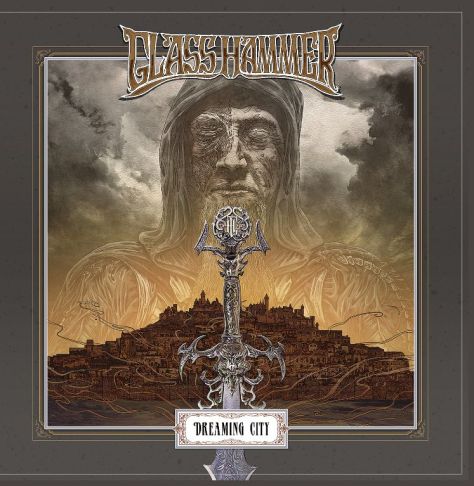
One thing I’ve learned in my eight years of being an avid Glass Hammer fan is to expect the unexpected. While every album of theirs is consistently excellent, there is not a consistent style that runs from their debut through to their latest offering, Dreaming City. So, I shouldn’t have been surprised at the onslaught of metal that greeted my ears when I cranked up the first track, The Dreaming City. Wait, is this the same group that gave us the light-hearted Chronomonaut last year? Yes, it is, and I like it. Actually, I love it! Under the massive guitar attack I can still hear Steve Babb’s melodic bass pounding away, and Fred Schendel’s keyboards providing bursts of furious punctuation.

The core group of Babb (lead vocals, bass), Schendel (guitars, vocals, keyboards), drummer Aaron Raulston, and singer Susie Bogdanowicz have augmented themselves with Reese Boyd (guitars, vocals), John Beagley (vocals), Brian Brewer (guitars), Joe Logan (vocals), James Byron Schoen (more guitar!), and Barry Seroff (flute). Dreaming City features the largest cast of contributors of any Glass Hammer album I am aware of, yet it doesn’t sound crowded or too busy. It’s a surprisingly lean production, with every instrument locked into the overall groove.

Dreaming City is the soundtrack to a very dark fantasy adventure, with the songs seamlessly flowing into each other, much like 2012’s Perilous. Our hero is a lowly thief, Skallagrim, who awakes in the land of Pagarna,  ruled by an evil sorcerer who has kidnapped his love. While in the Dreaming City, he is surrounded by evil ones who want to kill him. At the last possible moment, a sword appears over his head, which he grasps and uses it to save himself.

The sword, named Terminus, is possessed by an angel who provides the hero strength and hope during his daunting quest to rescue his love:

“And the sword is hope that comes from without by divine design, not from within.”

I won’t relate any more of the story, but there is a wonderful twist to it at the end which took me by surprise.

Musically, this is one of the most diverse and satisfying set of songs Glass Hammer has blessed us with. They are brimming with confidence and invention, and every track is a delight to listen to. The aforementioned opener, The Dreaming City, is the heaviest thing GH has ever recorded, while The Lonely World is an aural dose of pure pop. The angelic-voiced Susie Bogdanowicz sings lead on the beautiful October Ballad, while the epic closing track, The Watchman On The Wall, is a glorious and triumphant song that recalls the heyday of Permanent Waves-era  Rush.

I could rave about every single song, but I must single out Terminus for special praise. If Rush and  The Alan Parsons Project had a love child, Terminus would be it. A propulsive beat and a fantastic synth line serve a hook-laden melody to combine for a compulsive listen. Other highlights include the atmospheric instrumental tracks, Threshold of Dreams and The Tower, both of which are reminiscent of classic Tangerine Dream. But, as I wrote, every single song is outstanding.

What is most impressive about Dreaming City is how all the tracks come together to create a most satisfying whole. This is an album to listen to in its entirety, as it tells the compelling tale of an unlikely hero thrust into a desperate quest to overcome evil, and in the process find hidden strength within himself – with a little divine assistance. In Babb’s words, “This is all about evil people robbing us of our joy – holding it hostage. There can be unfortunate episodes in life where that happens and you can barely even remember what “joy” was like – may even become resigned to the thought that you may never know it again in this life, but determine to look for it nonetheless. So this was an important story for me and I hope it brings encouragement to many.”

Dreaming City is an extraordinary and career-defining work from one of America’s finest rock groups, and I can’t wait to hear what unexpected delights they have in store for us in the future.