
In his own day and age, George Washington was the greatest and best-known man in all of Western Civilization. Washington (1732-1799), indeed, served as a pillar of Atlantis, recognized not only for his willingness to sacrifice his life for the great Republic, but also as the founder of the first serious Republic a weary world had witnessed since the martyrdom of Cicero. A true genius when it came to geometry, trigonometry, and surveying, he also read deeply in military history, biography, agricultural science. His loves, though, were hunting, adventure (as in traveling), and farming. Surveying, especially, allowed him to combine many of these loves into one. Ironically, given the status he attained as a living hero or demigod in his own lifetime, Washington suffered from a lack of liberal education, strange by the standards of his day. Much of what he knew of the classical world came not from a study of Greek and Latin (as with many of the founding fathers), but from his reading of biography and, especially, from his love of the Joseph Addison play, Cato: A Tragedy. Despite this, he earned innumerable classical titles during his lifetime, including: the American Achilles, the American Cicero, the American Aeneas, and the American Cincinnatus.
— Read on theimaginativeconservative.org/2020/02/george-washington-american-aurelius-bradley-birzer.html
Monthly Archives: February 2020

Dave Brubeck: A Life in Time
I remember something the philosopher Gerald Heard told me. The first thing a man is aware of, he said, is the steady rhythm of his mother’s heartbeat and the last thing he hears before he dies is his own. Rhythm is the common bond of all humanity: it is also the most pronounced and readily misunderstood ingredient of jazz.
— Dave Brubeck
We’ve waited way too long for a serious biography of Dave Brubeck — but at last we’ve got it, and it’s a good one. British music journalist Philip Clark’s Dave Brubeck: A Life in Time rises to the challenge of portraying the pianist/composer in his fullness — his days, his works, his friendships, and his ideals.
Fittingly, Clark plays with time to unlock the rich pageant of Brubeck’s 92 years. Pivoting off a extended interview conducted on a 2003 British tour, the narrative unpacks Brubeck’s career in progress, building from West Coast beginnings through growing popularity coupled with critical puzzlement on the jazz scene to the mass culture break-out of Brubeck’s classic quartet (with Paul Desmond on sax, Eugene Wright on bass and Joe Morello on drums) via 1959’s “Take Five” and the Time Out album. It’s only the strangely muted reception of Brubeck’s ambitious 1962 cantata The Real Ambassadors (a sly satire expressly written for Louis Armstrong) that sends Clark doubling back again — to Brubeck’s upbringing in rural California and the influences that forged him as musician and man.
Democrats 2020: Two CS Lewis Villains, and a Bunch of Tom Wolfe Lampoons | The Stream
The lesser Democrats (Warren, Buttigieg, Klobuchar, and now Biden) are minor comic figures from one of Tom Wolfe’s satires. (Think of The Bonfire of the Vanities.) Each has clawed his way to the top of a different greasy political ladder that stops well short of the presidency. And each now waves around his 10-point, single-spaced resume, crowing about how he followed all the rules, so now it’s his turn. It’s only fair. Watching such stunted people flail around at the end of their tethers is ultimately kind of … sad.
But Bernie Sanders and Mike Bloomberg are different. They’re major characters, and from a more important writer. Each of them could have sprung from the pen of C.S. Lewis, and stepped out of the pages of the dystopian satire That Hideous Strength. In fact, the two candidates seem like colleagues at the conspiratorial think-tank, the National Institute for Co-ordinated Experiments (N.I.C.E.).
— Read on stream.org/democrats-2020-two-c-s-lewis-villains-and-a-bunch-of-tom-wolfe-lampoons/
The Passengers' Club by Big Big Train
While most of the western world celebrated Friday, February 14, as the secularized Feast of St. Valentine, preparing for a Cinema Show of epic proportions and armed with chocolate surprises, I celebrated it as International Big Big Train Day.
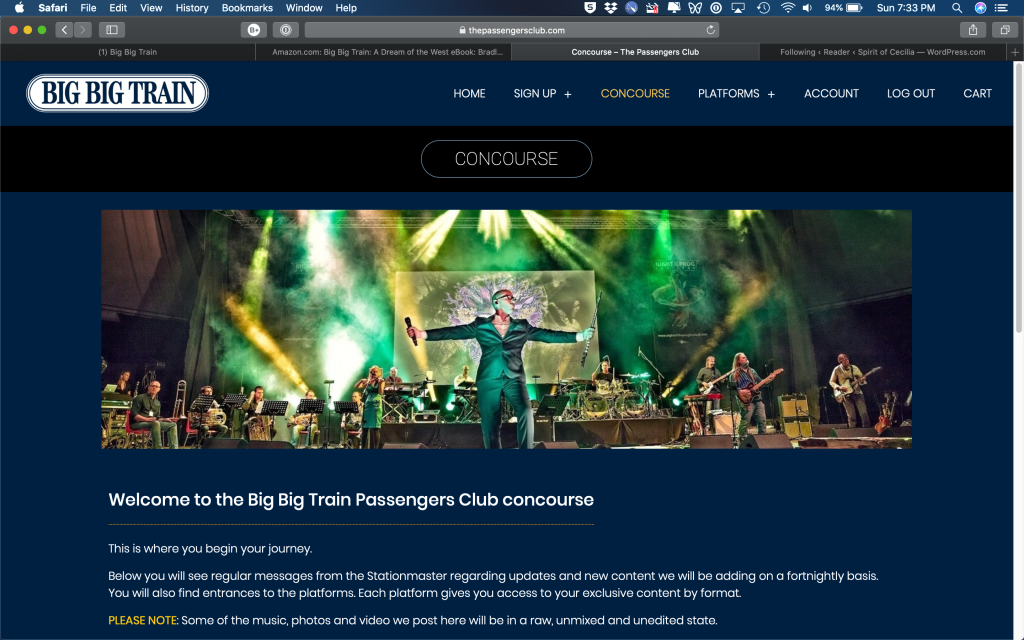
Granted, by international, I mean several counties in Michigan, but still. . .
On Friday, February 14, Big Big Train launched its much anticipated web-based fan service, The Passengers’ Club. Let me state immediately: this is, by far, the best such service I have seen. While I belong—rather proudly—to Marillion’s fan service, I have never been totally satisfied with it. As much as I adore Marillion, I think the service is a tease. More than anything else, I feel like my subscription subsidizes their advertisements to sell me more stuff. Granted, I buy it, but I am less than completely satisfied with the service as a whole. Most frustrating by far, though, is Neal Morse’s fan service. I belonged to it for years—happily receiving several cds and dvds a year. Then, suddenly, it all just stopped, switching all of the great releases to mere downloads. Honestly, I feel as though I was totally ripped off. As such, I finally quit my membership about six months ago. I subscribed for a year too long. Trust me, don’t go near Morse’s service. Admittedly, I still love Morse’s music and his integrity, but he needs a serious reexamination of his attitude toward his followers.
BBT’s, however, is extraordinary. The service offers three levels of subscription: one year; two years; and lifetime. Though I am alone to blame, I initially only saw the first two subscription options, and I went for the two year. Had I been thinking properly and had I been observing what should’ve been observed, I would’ve signed up for the lifetime subscription (Patron). If you’ve yet to subscribe, don’t overlook the Patron option.
Through the service, BBT is offering music, videos, essays, and photos. Admittedly, the photos did not do that much for me (though, they’re fine photos), but I’ve thoroughly enjoyed the other three sections (“platforms” in the presentation).
The brightest highlight of The Passengers’ Club, though, is the music platform. Indeed, the two songs released thus far are worth the entire subscription price. The first two songs are the 17-minute “Merchants of Light” and the (almost) three-minute long demo, “Capitoline Venus.” BBT promises new music and new content every two weeks for the next year and claims that we’ll be receiving four full CDs worth of music over the next two years. Though I’m only speculating, I’m assuming this is the equivalent (perhaps, a 1:1 perfect correspondence) of the long-discussed Station Master’s release.
The second brightest highlight (close to the second brightest star, it turns out) is Greg’s writeup about the songs. Stunning stuff, to be certain. Not surprisingly, Greg is a master of the word—whether in essays or in lyrics. I’d share some of what he’s written with you, but I agreed not to when I signed up for The Passengers’ Club, and, believe me, this is a trust I hold sacred.
Here’s hoping I’ll see you at the Concourse.
Go here to subscribe: https://thepassengersclub.com
Brad Birzer Discusses Rush on Political Beats Podcast

Our own Dr. Brad Birzer joins hosts Scott Bertram and Jeff Blehar for an in-depth discussion of Rush on their Political Beats podcast. The more than 2 1/2 hour conversation begins with Rush’s debut album and continues all the way through Clockwork Angels. It’s a lot of fun to listen to, even if you aren’t a Rush fanatic. Jeff Blehar had never heard a single Rush song before he listened to their entire discography in preparation for this episode, and his takes on their various albums are refreshingly honest and fair.
Click here to play the episode.
Tears For Fears’ Songs From The Big Chair Set For Reissue
Looking back at the album, Roland Orzabal commented, “Pop music was still a growth industry. It hadn’t sort of stagnated, stalled, diversified into streaming like it is nowadays. We were young, we were both good-looking and we had the right music. As we move further and further from that decade and you keep hearing ‘Everybody Wants To Rule The World’, in various forms I do think it is an era-defining album”.
Curt Smith “You would never normally get three songs that strong in an album. But balance that out with tracks like ‘Listen’, ‘The Working Hour’; all those things that give it air and give it time to breathe I think is what makes it something more than just the sum of its parts. I think the album had a lot more depth than a lot of those other albums of that time. And albums of more depth tend to stick around longer”.
— Read on www.udiscovermusic.com/news/tears-fears-big-chair-reissue/
Brad Birzer writes lyrics for progressive rock album – Hillsdale Collegian
Track 1: “The Trenches.” Underscored by ambient whistling, rifle shots, and single notes struck on a piano, Brad Birzer’s voice fades in softly at first, repeating, and echoing over itself. He speaks C.S. Lewis’s description of his experience in World War I: “The frights, the cold, the smell of human excrement, the horribly crushed men still moving like crushed beetles…”
Then, cue an electric guitar intro, a chorus of “This is war!” and, finally, drop in some heavy metal drumming.
These are the opening lines and sounds of the progressive rock epic chronicling the meeting, developing relationship, and, ultimately, failed friendship between J.R.R Tolkien and Lewis. Birzer, professor of history, wrote this seven-track album, “The Bardic Depths,” in collaboration with progressive rock musician Dave Bandana.
— Read on hillsdalecollegian.com/2020/02/brad-birzer-writes-lyrics-for-progressive-rock-album/
New I Am The Manic Whale Coming Soon

One of the highlights of 2017 was I Am The Manic Whale’s second album, Gathering the Waters.
Here’s their press release for the upcoming third album, Things Unseen:
|
|

T.E. Hulme on the Religious Attitude ~ The Imaginative Conservative
To transcend or to break through this delusion of progress, a true scholar, Hulme continued, must attempt to see the gaps in both senses, recognizing them and allowing them to exist. In other words, much like Friedrich Hayek will proclaim with the “knowledge problem” several decades later, true scholars must be humble and be content with knowing what we do not know. The modernist, of course, hates ignorance more than anything else, and in his blind zeal to know all things, he will create “knowledge” where no knowledge is possible, thus truly derailing centuries upon centuries of fine work and of understanding of the human person. Ironically, in his hatred of religion, the modernist merely creates a new, shallow, and false religion. The modern, Hulme understood, is nothing short of a full-fledge Gnostic, ultimately seeing the universe as pre-determined, mechanistic, and absent of free will.
— Read on theimaginativeconservative.org/2020/02/te-hulme-religious-attitude-bradley-birzer.html
Was he nae poet? Robert burns
http://robertburns.org/works/61.shtml’
FROM ” Epistles to J . Lapraik”
Lapraik was a minor Scottish songwriter and poet but he was a lover of Scottish songs and poems and hence a man after Burns’ heart. Here Burns describes his method at producing poetry straight from the heart. Burns shows great sincerity, honesty, modesty and courage. Burns had earlier made an apology in the Preface to the Kilmarnock Edition at his lack of Latin and Greek. Burns also had very little knowledge of French or Gaelic (but certainly more than many as proved by his French quotations and Gaelic names and titles). Burns states his natural response to the world might have more poetic relevance than the (by then) almost hackneyed references to classical allusions. Burns humorously compares his poetic talents to those of university educated scholars whom he says in brilliant imagery go in as “stirks” (Bullocks) and come out as asses! How amusing, now to think people thought Burns semi-literate and unable to distinguish between the genres of poetry or prose (he as a master of both). These epistles are rich in the “lallans” (lowland) vocabulary of the Scots. Only Shakespeare, I believe, had contributed as many unique phrases and vocabulary to English and Burns essentially translated an entire Scots tradition in English with his own unique combination of rich Scots expressions and English. He valued the harmonic poetic and music treasures of the Scots thus preserving forever ,as a kind of causeway, English literature and ancient Scots literature making them one tradition.
***
I am nae poet, in a sense;
But just a rhymer like by chance,
An’ hae to learning nae pretence;
Yet, what the matter?
Whene’er my muse does on me glance,
I jingle at her.
Your critic-folk may cock their nose,
And say, “How can you e’er propose,
You wha ken hardly verse frae prose,
To mak a sang?”
But, by your leaves, my learned foes,
Ye’re maybe wrang.
What’s a’ your jargon o’ your schools-
Your Latin names for horns an’ stools?
If honest Nature made you fools,
What sairs your grammars?
Ye’d better taen up spades and shools, (taken up spades and shovels)
Or knappin-hammers. (stone-breaking hammers)
A set o’ dull, conceited hashes
Confuse their brains in college classes!
They gang in stirks, and come out asses, (the go in bullocks…)
Plain truth to speak;
An’ syne they think to climb Parnassus (since)
By dint o’ Greek!
Gie me ae spark o’ nature’s fire,
That’s a’ the learning I desire;
Then tho’ I drudge thro’ dub an’ mire (puddles and mud)
At pleugh or cart, (plough/plow)
My muse, tho’ hamely in attire,
May touch the heart.
Burns who “jingled” at his Muse later (Second Epistle To J. Lapraik) has the Muse assume the form of a worn-out servant girl.
The tapetless, ramfeezl’d hizzie, (Heedless, wornout hussy or wench)
She’s saft at best an’ something lazy: (Soft)
Quo’ she, “Ye ken we’ve been sae busy
This month an’ mair,
That trowth, my head is grown right dizzie,
An’ something sair.”
***
Nature, according to Burns places little value on material wealth. Amusingly he says the rich will return as savage, hungry wolves and the poor as gentle souls united by love and friendship. Clearly the meek shall inherit the earth.
***
O mandate glorious and divine!
The ragged followers o’ the Nine,
Poor, thoughtless devils! yet may shine
In glorious light,
While sordid sons o’ Mammon’s line
Are dark as night!

 Spirit of Cecilia
You must be logged in to post a comment.