This is, of course, the highest and most important day in the liturgical calendar. And, since this website is named for the patron saint of music, it’s only fitting that we consider a few Easter tracks.
Enjoy.
Happy Easter!

This is, of course, the highest and most important day in the liturgical calendar. And, since this website is named for the patron saint of music, it’s only fitting that we consider a few Easter tracks.
Enjoy.
Happy Easter!
In an unexpected turn of events, a new supergroup has been formed. It’s a quartet featuring some of the most impressive musicians today — Steve Vai, Adrian Belew, Tony Levin, and Tool drummer Danny Carey. Called Beat, the band will play King Crimson music and they’ve been announced by none other than the King Crimson mastermind Robert Fripp. Read more…Easily one of the most mind-blowing lineups you can ever come up with.
Greetings, Spirit of Cecilia readers! In this post, Brad Birzer, Erik Heter, and Tad Wert revisit three progressive classics: Discipline, Beat, and Three of a Perfect Pair, from King Crimson.
Tad: Brad and Erik, I am so looking forward to hearing your thoughts on these albums! We haven’t really delved into the incredibly large and diverse discography of King Crimson, and Discipline is a personal favorite of mine. It came out in 1981, after most fans assumed Robert Fripp had put King Crimson to rest for good. As a matter of fact, on their previous album, the 1974 live set USA, Fripp put R.I.P. on the back cover. That album is another favorite of mine, featuring the formidable lineup of Fripp (guitar), Bill Bruford (percussion), John Wetton (bass and vocals), and David Cross (violin). This is the same group that recorded Lark’s Tongues In Aspic (with Jamie Muir added on percussion) and Starless and Bible Black. This group was ferocious in its ability to improvise, but apparently it was exhausting for all involved.
So it was quite surprising when word got out that Fripp was rehearsing a new lineup for King Crimson: Bruford (again), Tony Levin (bass and stick), and Adrian Belew (guitar and vocals). I was a subscriber to Musician magazine at the time, and it started running a series of “diary” entries from Fripp that detailed his excitement (and worries) about the music they were creating.

As interested as I was in what this new iteration of KC was going to sound like, nothing could have prepared me for Discipline. I was familiar with Belew from his work with Talking Heads and David Bowie, but I hadn’t heard him sing before. I knew Tony Levin was a much-in-demand bassist, but I didn’t realize how much of a pioneer he was with the Chapman Stick. The shift in style from Starless and Bible Black to Discipline is one of the most radical metamorphoses in rock history. And what is so impressive is that they pull it off – pleasing long time fans and attracting new wave listeners.

When it came out, I was in college, and one of my suitemates got a copy. We listened to it several times in one evening, trying to understand what Fripp et al. were doing. To my ears, it was the perfect marriage of challenging, yet accessible rock. The cover art was understated and perfect: Bright red with a basic silver font simply stating, “King Crimson Discipline”, and a Celtic knot that isn’t easily untangled. Rhythmically, it was very straightforward. Melodically, it was almost minimalist in its composition, but it fit in comfortably with what groups like Talking Heads, The Police, Ultravox, and Simple Minds were producing. The more I listened, the more I was taken with it.
Okay, I’ve rambled on for too long! How did Discipline strike you, Brad, when you first heard it?
Brad: Tad, what a wonderful way to start us off. Thank you so much for your many good thoughts on this. Sadly, I won’t be able to match your good introduction. Yet, I loved reading about yours.
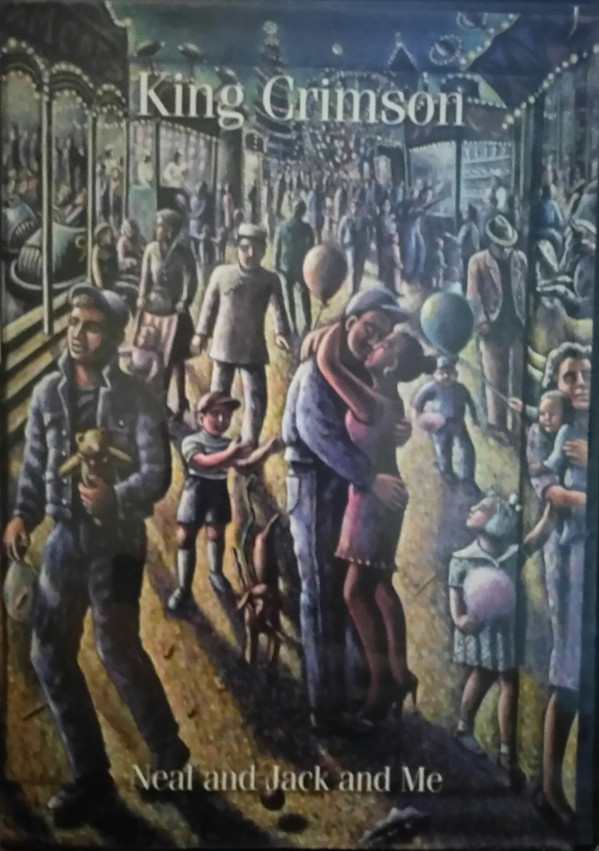
Though I grew up with progressive rock–Yes, Jethro Tull, and Kansas, in particular–I knew nothing about King Crimson until my college years. I didn’t start college until 1986 (and the three Discipline-era albums had already come out), and I first encountered the band through a radio station copy of Beat and, in particular, the song “Neal and Jack and me”–which I instantly fell in love with.
I remember being taken with the minimalist cover and diving into the music.
After encountering it at the radio station, I purchased a copy of Beat, and, from there, I bought Discipline and Three of a Perfect Pair. To me, these three albums have to go together, one followed by another. I really have a hard time thinking of any one of the three–red, blue, and yellow–in isolation from the other. As such, I came VERY late to In the Court of the Crimson King, and the albums had progressed so much that I had a very hard time thinking of “my” King Crimson as the King Crimson of “In the Court. . .” Much later, I would buy Thrak–which has far more in common with Discipline-era King Crimson than the original King Crimson albums.
I knew very little about Adrian Belew or Robert Fripp, but I’d been a long time fan of Bill Bruford because of Yes and Tony Levin because of Peter Gabriel. So, I was really curious as to what they were up to.
Additionally–should I admit this here???–though I never had a religious fundamentalist phase, I was returning to my childhood Catholicism (I’m what’s called a “revert” in Catholic circles) at the same time that I first encountered Discipline, Beat, and Three of a Perfect Pair, and I was really freaked out that the band named themselves after the devil! I thought, what a crazy thing to do. Why would you even mess with such a thing?
That stated. . .
I’ll do my best to focus on Discipline, though, for this dialogue. Tad, for better or worse, I often think of Discipline-era King Crimson as New Wave Prog, in the same way I think of Rush’s Power Windows, Yes’s Drama, or The Fixx’s Reach the Beach. It’s definitely progressive, but in such an early 1980s way.
Tad: Brad, I agree that Discipline, Beat, and Three of a Perfect Pair make a seamless trilogy. It must have been deliberate – look at the artwork for them: same font with a single icon on each. As a lover of symmetry, I have always been bowled over by this series of album covers. I even framed them when I was first married, and my understanding wife let me hang them on our den wall!

Your characterization of this music as New Wave Prog is perfect. I think you’ve created a hitherto unknown genre of music, but one that, with hindsight makes sense! At the time, it seemed to just fit in with all the weird and crazy music being produced in the early 80s.
Okay, let’s discuss the songs on Discipline. It opens with “Elephant Talk”, in which Belew bellows,
“Talk, it’s only talk
Arguments, agreements, advice, answers
Articulate announcements
It’s only talk”
while his guitar emits sheets of cascading sound. Levin lays down nimble basslines on his Stick, and Bruford plays a cacophonous yet steady racket on drums. All the while, Fripp is furiously pushing out scales on his guitar and creating a soundbed for the others to play on. Each verse is a list of synonyms for verbalizing in alphabetical order: the first is all A’s, the second all B’s, etc. This illustrates an aspect that I love so much about this iteration of KC: their sense of humor. Even though the music can be crushingly dense at times, there is a feeling of fun and sheer joy in it.
Erik: Like you, Brad, I was a latecomer to King Crimson – for the most part anyway. I do remember hearing Discipline once or twice when it first came out, but to use a Heinlein-ism, I absolutely did not grok it at all. So I put it aside for well over a decade and a half before finally revisiting it. In the meantime, I had purchased In the Court of the Crimson King, Lizard, and most importantly (for the purposes of priming the pump for Discipline), Larks Tongues in Aspic. While the latter is quite different from Discipline-era Crimson, if one listens close enough they can hear a few stylistic threads connecting them (and indeed, Three of a Perfect Pair includes Larks Tongues in Aspic Part III). If anything, I think the music of Discipline and the subsequent two albums is where they would have ended up anyway if they hadn’t broke up in 1974.
Another thing Brad – like Tad, I think your description of Discipline-era Crimson as New Wave Prog hits the nail on the head. The music has so much of that quality in other 80’s music that was described by the phrase once uttered by Yes’s Tony Kaye – dimensionally sparse. No previous Crimson album ever left as much space between the instruments as Discipline and its two successors did. This description applies to a majority of the album, with the notable exceptions of Indiscipline and Thela Hun Ginjeet. Because of this approach, Discipline fit in with the contemporaneous music of the early 80’s as well as the early Crimson albums fit in with that of the early 70s.
What makes these albums familiar to Crimson fans was the presence of Fripp and Bruford, who were well-established by the release of Discipline. What made them fresh was the presence of newcomers Belew and Levin. Belew brought in the quirky, New Wave-y 80s vocal stylizations that he learned during his time with the decidedly non-prog Talking Heads. Meanwhile, Levin brought in not only a new way of playing bass, but also introduced to Crimson the Chapman stick and the new sounds that came with it. When it was all thrown into the same pot, the result was a type of music that was eclectic and often intricate.
If I had to pick some favorite songs off of the album, there are three that really stand out to me. First is the easy, breezy Matte Kudasai, the uptempo romp of Thela Hun Ginjeet, and the instrumental The Sheltering Sky. The latter two of these tracks include some of the best percussion work Bill Bruford has ever performed in any of the bands he’s been in – which is quite a statement considering his pedigree. In Thela Hun Ginjeet, Brufords drumming comes in fast and furious yet with exquisite precision. In The Sheltering Sky, Bruford’s percussion is almost understated and yet still manages to demand the listener’s attention. This track also includes both Belew and Fripp on the weird, wonderful guitar synthesizer.
I’m still relatively new to the latter two albums of this trio, so I’ll visit those in my next entry. For now, back to you guys!
Tad: Erik, thank you for your insights on this album! I’m glad you brought attention to Bruford’s contributions. One thing I remember from those articles Fripp published in Musician is how he kept trying to rein in Bruford, because he wanted this music to be disciplined.
If I had to pick my favorite songs, it would be “Frame By Frame” and “The Sheltering Sky”. In the former, I really like the relentless groove that Fripp, Levin, and Belew set up, while Belew’s and Levin’s vocals hover delicately above it all.
I agree with you about Bruford’s excellent percussion work in “The Sheltering Sky” – I have a DVD of a concert they performed at the time this album came out, and Bruford is masterful on congas while Fripp wigs out on guitar. I love the way the song takes its time building – it’s quite a while before Levin enters on Stick, and when he does, it brings the music to another level. I don’t think Fripp ever had another guitarist as empathetic as Belew was with him. The two of them traded phrases off each other as if they were of one mind.
Fun fact: “Thela Hun Ginjeet” is an anagram for “Heat In The Jungle”!
Brad: Dear Tad and Erik, what excellent responses. One of the things I love most about Discipline is that it starts off with the utterly bizarre “Elephant Talk.” The band could’ve easily and victoriously started the album with the much more radio and listener friendly “Frame by Frame.”
Instead, they begin with the offbeat one. Again, I love this about the band. They definitely define their own path.
I’m not sure I have specifics about this album. Again, to me, it’s an intimate part of a trilogy of releases, and, Tad, I love that you had the artwork displayed. What would we do without our loving and forgiving wives!
And, I would agree, my favorites among these tracks are “Frame by Frame” with its relentless roar, and “The Sheltering Sky” which feels like a Talk Talk song from the same period, at least in terms of its rhythm.
I mentioned this above, but my favorite album of the trilogy is Beat, as it combines the weirdness of “Elephant Talk” with the accessible and intense sounds of “Frame by Frame.”
“I’m a 1952 Studebacker coupe!”
But, I also really love the title track of Three of a Perfect Pair. So wonderfully quirky.
Tad: It’s a tough call, but I think this iteration of King Crimson is my favorite. At least, I come back to these three albums more than any others in Crimson’s long, long career. I don’t think Fripp ever assembled a more talented crew than these four guys, and they are at the top of their game. I never saw them live, but as I mentioned, I have a couple of concerts on DVD, and they make this difficult music look effortless.
As I have revisited this trio of albums in order, I’m struck by how much the “accessible” songs sound more accessible, while the “out-there” songs are more and more out-there. Brad, maybe that’s why Beat is your favorite – it hits the sweet spot between pop and experiment. While it contains beautiful and gentle love songs like “Heartbeat” and “Two Hands” it also has the atonal and terrifying “Requiem”. I think that’s why this iteration of King Crimson packed it in after Three of a Perfect Pair; by the third album, “things fell apart; the center couldn’t hold” (to paraphrase Yeats!). That album contains their most pop song ever, “Sleepless”, while also giving us “Industry”, which is close to pure noise in places.
Erik: While my familiarity with Discipline dates back to about the mid-90s, Beat and Three of a Perfect Pair are both relatively new to me. Yet one thing that strikes me is the consistency of sound across these albums – it’s almost as if they could have all been released as one triple album instead of as three separate albums. From a production standpoint, these albums really stand out as being of a particular time. One odd thought I’ve had listening to these – particularly Beat – is how similar the production (not the music!) was to the first two solo albums of Robert Plant. Indeed, I had to go back and look it up to find out who the respective producers were, but they were different. It must have been just something in the air at the time.
Another observation about these three albums – they mark some of the best, if not the best work of Bill Bruford in his entire career. As a hardcore Yes fan, I do not say that lightly. One great example of this is Sartori in Tangier from Beat (which, for some reason, I keep reading as Santoni the Tiger … I think I need some Frosted Flakes, but I digress). Another is Sleepless from Three of a Perfect Pair. Sleepless is also one of the songs in this trio that includes Tony Levin’s use of the Chapman Stick, along with Neurotica and The Howler (from Beat), as well as Industry and the title track of Three of a Perfect Pair.
All that said, by the end of Three of a Perfect Pair, I start to hear a certain sameness in the music, and thus it’s not surprising to me in retrospect that Fripp broke up the band again. Maybe that’s just how Fripp worked best, in bursts followed by long breaks. I do get the impression he wasn’t easy to work with, and have read that both Bruford and Belew were a bit miffed when Fripp split them up again in 1984.
That being said, I don’t want to close on a sour note, so here goes. You guys, being in the same age range as me, might remember the early 80s TV show Fridays, which was basically ABCs attempt at creating their own version of Saturday Night Live. Both had the same format – sketch comedy, a “news” break, and musical guests. And on one glorious night during the 81-82 timeframe, they had as their musical guests Fripp, Belew, Levin and Bruford, under their collective name of King Crimson – preserved for posterity thanks to YouTube. Enjoy!
BY RICHARD K MUNRO


When I feel disappointed or have negative feelings I turn to literature. I like to re-read Stoic Philosophers and the Bible. I have a wonderful little book called LINCOLN’S DEVOTIONAL which was edited by Carl Sandburg. I also write little quotes in the book which I review from time to time. O often carry it in my pocket when walk in the park. I wrote (from Ovid) Temporis ars medicina fere est (Time is a great medicine or healer). Yes, this too shall pass. I have an other quote by TR: “Do what you can where you are with what you have.”We have a situation in our life: We are older and feel more pain and have less energy. But we count our blessings- we can still walk and hear and see and think reasonably well. If my eyes are sore I use eyedrops. If I am still fatigued or have a headache I listen to Audible Books or music. Sometimes I just sing an old song from memory.I remember my father used to say. “God made man strong only for a while so we can help others.” As Romans said. “We that are strong ought to bear the infirmities of the weak and not to please ourselves.”
When weaker people we despise, we do the great Redeemer wrong. For God, the gracious and the wise receives the feeble and the strong.Let us do good to all men especially to those in the household of faith. (Galatians).We have people in our lives who worry us and disappoint us. Arguing and accusing does nothing positive. Sometimes one has to be patient and listen and pray for that person.Praying for the well-being of a person is often more effective that fighting with that person. Why am I frustrated with that or this person? Is it because I really care about that person or is it because I find it embarrassing for me personally?So following Epictetus it is NOT THAT PERSON who spoils or affects my life. It is how I emotionally think about the situation. I can be angry and confrontative OR I can be philosophical and patient and pray with sincere love. I can tell the person I will be there in reserve any time I am needed. Ultimately you cannot do that person’s exams or work. You cannot force them to stay home or stay sober. You cannot force that person to love you our be your friend.All you can do is encourage them to make good choices. You choose how you want to respond. I like to think of the good side. This person is not dead. This person is not sick or injured (he survived a car wreck). This person did not hurt or kill anybody else. It is unfortunate to total a car and lose the use of it but the car is just so much rust and metal anyway. This person could have parked the car on the street, clean and shiny and in good repair and then walked across the street and been killed by a passing bus. What is better to have the person you love or a late model car? We all have ups and downs in life and hopefully and thankfully we can learn from mistakes and do better in the future.We choose how we spend our hours of lucidity and reasonable health. It does not good to be sad and bitter that we do not have the energy when had when we were 25 or 35. Be glad you worked hard in youth to provide some security in your old age! Quien joven no trabaja viejo duermo sobre paja (If you don’t work when you are young you will regret it -suffer humiliations even homelessness when you are old.).I remember my father always had two great worries:
1) being evicted and then homeless
2) not having enough to eat or fresh water to drink.
3) not having a regular job.I used to call him on the phone long distance, and he would always say “HOW’S YOUR WEE JO-AB? (job). He figured if you were working you are in reasonable health and gaining a reasonable security. He also advised me NEVER TO SPEND my “bottom dollar” (better to go hungry) and try to have always a free and clear car, some food on hand (even if it was just peanut butter and crackers or oatmeal) and enough money for gas or transportation.Your next goal was to own your own home. In itself it was a good investment (or could be ) and forced savings. I am glad I took an economics class in high school and one year of economics in college! I am very glad that when I studied to be a teacher I was working FULL TIME at a Bank (including nights and weekends) to provide insurance and some security for my family but ALSO TO LEARN about CREDIT, INTERESTS RATES,
FRAUDS, IDENTIFY THEFT, BANKRUPTCY and FINANCE.We started modestly with a condominium then a home in a reasonable neighborhood (we were considered rich) than a home in a nicer neighborhood (we were considered poor!). My son was a boy scout in his old school. When we moved to the new neighborhood he had to join another troop. He wasn’t accepted. Each parent had to organize activities. Ours were not fancy enough. Once we organized an outing to the local minor league baseball team. No one showed up. My son was very disappointed be we had a good time. He decided to quit the Boy Scouts. But instead he took SPORTS OFFICIATING and later made money officiating SOCCER, BASEBALL and BASKETBALL. He played soccer, basketball and baseball in high school. In college he played on an all-boys practice basketball team against the Varsity Girl team. He did that for one year. He tried to get scholarship. They didn’t offer him one so he quit that and played on intramural teams. Eventually he became a teacher and a successful coach in baseball and soccer. His knowledge and experience prepared him for a satisfying career which he enjoys very much. His coaching led to him meeting people in professional baseball and now (part-time) he tutors and mentors rookie players from Spanish-speaking countries.None of our children had cars in high school. But many of their classmates had luxury cars of their own and had active hedonistic social lives. Parties, ski trips, secret drinking. When our children were in college they helped pay their own way. When they had jobs and NEEDED a car for safe transportation, we helped them by sharing our second car with them or helping them buy a used car. It turned out, over the years, we never have a second car for ourselves which mean I did not have my own personal car. But we lived perfectly happy.
By working during college our children reduced their school debt to a minimum and gained a great appreciation for studies and leisure time. Our children paid their own rent and daily expenses themselves. We helped them 1) get their first car -a used car 2) we gave them AAA cards and gas credit cards (FOR EMERGENCIES ONLY). They never abused the privilege and in fact I remember my daughter would send tip money to my wife to help pay the Chevron bill. We never paid a penny of interest on those cards!Children have to learn the value of money and the value of work early in life. By 18 a youngster should be contributing to his or her upkeep. The most important thing is to get EXPERIENCE and to develop the DISICPLINE of getting up every day and showing up on time for work. That means sometimes working nights or weekends.Yes, it is hard to work and easier to play and sleep in.But we choose how to respond to our problems in life and if we work hard and are sober and judicious we can create the outcomes we want or at least outcomes that are better if we had not planned and made good choices. In each life some rain shall fall But if we have a roof over our heads, an umbrella, a hat and a raincoat we will get through the storm more easily
I wish I had profound things to write after the untimely death (he was only 66) of World Party’s Karl Wallinger. Though I’ve listened to Goodbye Jumbo too many times to count, I’ve never written about Wallinger or World Party. This seems bizarre to me, especially as I regard Goodbye Jumbo as one of the finest pop statements ever conceived.
My great friend, Kevin McCormick, first discovered World Party and turned them on to me back in 1989 or 1990. While I don’t think that Wallinger ever quite topped Goodbye Jumbo, I do very much like everything he recorded
From the opening notes of the album, Goodbye Jumbo, Wallinger invites us into his basement for a private concert. At least that’s how the album feels to me.
.
Wallinger somehow mixed anxiety with hope, turning us onto the larger world and finding our humanity within it.
Though it came on a later album, Bang, my favorite Wallinger song is his ode to western civilization, “Is it Like Today?” I always encourage my western heritage students to listen to it.
Again, I have nothing profound to say, except thank you, Karl. You’ve definitely made my world brighter over the past thirty-four years. May you rest in peace.

There are a select few artists that Spirit of Cecilia will always love and greet with joy any new release. One of them is Big Big Train, who have just released a new album, The Likes Of Us. Big Big Fanboys Brad Birzer and Tad Wert discuss this latest chapter in their long and varied career, and what it means for BBT’s future.
Tad: Brad, my fellow Progling and good friend, it’s always big news when Big Big Train graces us with new music. I have you to thank for making me aware of this wonderful group of musicians. It was when The Underfall Yard had just been released, and we were connecting via social media. You insisted I check them out. I had never heard of BBT, and it was an ear-opening experience to explore all of their music. I fell in love with The Difference Machine along with The Underfall Yard, and the rest is history.
As I became familiar with their career, I soon learned that The Underfall Yard was the first album to feature vocalist David Longden. He, along with founding member Greg Spawton, went on to produce some of the finest albums of the 2010’s: English Electric, Folklore, Grimspound, Grand Tour, Common Ground. And then tragically, David Longden passed away. I was afraid this was the end for BBT as we knew them.
However, they found a new vocalist, Alberto Bravin, and have recorded a new album! Brad, I’m really interested in hearing your first impressions of this iteration of BBT. Is it a worthy successor to previous ones?
Brad: Dear Tad, thank you so much for this, and my apologies (as usual) for being late in replying. Things have been chaotic (good and bad chaos, it turns out–one so quickly and readily becomes the other) in the Birzer household. Let’s just say, I’m not unhappy to see February 2024 in the rear-view mirror, and that all ills (flu and otherwise) have found happy resolutions!
As I type this on my laptop, I sit beneath an original Jim Trainer painting from The Underfall Yard that proudly adorns my college office. Below it is an award I won over twenty years ago, and above it is an original photo of Geronimo. Next to it is a signed and framed autograph from Neil Peart.
I first encountered The Underfall Yard fifteen years ago. Our very own Carl Olson sent me a mix of his favorite tracks of 2009, and a song from the TUY album was included. To say I was floored would be the understatement of my adult life. I immediately ordered the full album, and I was completely blown away by its brilliance, its creativity, and its unique voice. As to the latter, there’s nothing quite like a classic BBT sound–a perfect mixture of exhilaration and melancholy. I also immediately emailed Greg Spawton, who kindly responded. For years, we had a fairly serious correspondence. We even sent each other books we each loved. I cherish those emails and that friendship.
From there, I closely followed the band, and, as I’ve noted elsewhere, we founded Progarchy originally as a BBT fansite. Years later, you and I collected our various essays on the band and e-published Dream of the West through Amazon. That little e-book did very well, I’m proud to say, and I’m deeply honored that our names will always be linked together, Tad. I also had the chance to praise them at National Review, at The Imaginative Conservative, and elsewhere.
This is all a very long way of stating that I’ve followed the band as closely as possible for a decade and a half. I’ve cheered with and for them, and, with the immense loss of David Longdon, I’ve mourned with and for them.
They’ve been a part of my life as much as anything else (except for family) over the past fifteen years.
This past weekend, BBT played its very first show in the United States. It was in Fort Wayne, Indiana–just a 1.5 hour drive for me–but I was, crazily, already committed to leading a seminar/conference in Philadelphia, a commitment I made.

Ok, Birzer, shut up and tell us about the new album!!!
To be sure, BBT has had a rough couple of years, and many folks have wondered if the band could recover after the tragic loss of vocalist David Longdon. Additionally, many of the essential bandmates–such as David Gregory–had left the band for a variety of reasons.
The Likes of Us proves that BBT is more than the sum of its parts, an idea and concept as much as a concrete band. Whereas the band was once incredibly and quirkily English, it is now quite cosmopolitan and, well, trans-Atlantic. I write this last bit with only the slightest bit of irony, as the new album has, in part, a Neal Morse/Spock’s Beard feel to it.
Tad: Brad, as always, I appreciate the context you provide for your love of BBT. I think you have hit the nail on the head with your preceding paragraph: Big Big Train is an idea and concept now, much like King Crimson and Yes are. The personnel may change, but there is definitely a constant thread through all of their albums that makes each one a uniquely “BBT” work.
As I write this, I am listening to “Beneath the Masts”, Greg Spawton’s ode to the radio masts that dominated the landscape of his childhood. As long as Greg is involved, BBT will always be BBT. He truly has been the anchor of the band, regardless of who sings or plays guitar.
I am intrigued with your reference to Neal Morse/Spock’s Beard. I love their music as well, but it has always been more, hmm… turbulent, than BBT’s in my opinion. BBT’s music has, until this album, always struck me as being pastoral. Kind of like Vaughan Williams’ music is in the classical realm. I could see BBT performing “The Lark Ascending”, but never Spock’s Beard, if that makes sense!
Okay, let’s talk about The Likes Of Us! I love the opening chords of the first song, “Light Left In The Day” – the acoustic guitars are reminiscent of Steve Hackett-era Genesis. It soon develops into quite a majestic production, and, now that you’ve mentioned it, I really hear that Morse influence in it. Another favorite moment is the seamless segue into “Oblivion”, which is a terrific rocker. According to my Spotify app, I’m not alone in really liking this track – it far and away has the most listens. I think it’s a great choice for the single, because the melody is so appealing. Bravin’s vocals are superb here, and despite my initial impulse to compare him unfavorably to Longdon, I think he does a fantastic job leading the band. He’s a wonderful choice to replace an irreplaceable artist, and I am excited for BBT’s future.
“Beneath the Masts” is the big epic, clocking in at 17:26. I have to admit that after several listens, this one hasn’t resonated as deeply with me as previous long-form BBT songs have. It’s very pretty, and there is nothing to not love, but for some reason it’s just not sticking in my memory. However, I do especially like the bit at around the 15:00 minute mark where, after a relatively quiet section, the whole band comes in again and Bravin lets loose with some very good vocals.
“Skates On” reminds me the most of “classic Big Big Train”. It’s just a delightful little tune with wonderful vocal harmonies. The lyrics celebrate going out and having some fun: “Enjoy the Ride/It’s time to get your skates on/We’re here then gone”. I think the more I listen to the album, the more I enjoy this track.
Alright, I’ve written enough – what are your thoughts on the new songs?
Brad: What a wonderful and thoughtful response, Tad. Thank you. Whenever I get a new album–especially if you and I decide to review it–I immerse myself into it fully, allowing it to wash over me multiple times before writing about it. For whatever reason, I had a really hard time getting into The Likes of Us the first few times I listened to it. I definitely heard a Spock’s Beard influence (the new singer sounds VERY much like Nick D’Virgilio), but my initial thoughts were that the band–now labeled as an “international progressive rock collective” had lost its distinctive English voice and that the band was producing someone one might call “generic prog.”
As I’ve continued to listen to the album, though, I think I was very wrong in my initial assessment. The band has definitely lost its distinctive English voice, but it has also adopted a new one and one that is truly international. And, frankly, it’s quite beautiful in its own, new way. The band really has become something more than it was.
And, you’re right, of course, Tad. The center of the band–from its beginning–has always been Greg Spawton. He’s the touchstone and fountainhead of all things BBT. With his bass, his songwriting, and his voice, he will always define BBT whatever other members are there. I’m so glad you reminded all of us of that.
This said, I’m now utterly taken with the first three tracks of The Likes of Us: “Light Left in the Day” (a pastoral gem for the first few minutes), “Oblivion” (a NVD rocker), and the magisterial “Beneath the Masts” (what BBT does best–long-form prog). Like you, Tad, I love the segue between tracks one and two, and I also agree that “Beneath the Masts,” while excellent, does not quite live up to “Broken English,” “The Wide Open Sea,” or “The Underfall Yard.” Still, it’s close, and, frankly, it’s a privilege to hear such prog beauty, especially when it comes from Spawton’s pen.
As you note, “Skates On” is simply a delight, something that might have appeared on Grimspound or The Second Brightest Star.
Tad: Brad, I’m glad you have had a slight reassessment of the album, and it looks like you and I are in agreement that the first “side” (if albums can have “sides” these days) is really nice. As far as the final four tracks go, “Miramare” is the standout song for me. The vocal harmonies are wonderful, and the guitar solo is very tasteful.
In the press release that came with the album, the band remarks that this is the first time in a long time that the members recorded the songs together in the same room: In May 2023, six members of Big Big Train left their homes in England (Spawton and Lindley), the United States (D’Virgilio), Sweden (Sjöblom) and Norway (Holldorff) to gather for a week in Bravin’s home town of Trieste in north eastern Italy, at Urban Recording, a studio recommended by Alberto, to lay down the basic tracks. Being face to face in a room, as opposed to emailing sound files, the intimacy of the process generated moments of inspiration that would otherwise have gone unheard.
The process would prove emotional. “There were some tears; I cried a few of my own,” recalls Nick D’Virgillio, the band’s drummer since 2009. “There are many reasons to explain why we hadn’t worked that way in quite a while, but the process brought out the best in everybody.”
I’m glad that they took the time and trouble to work in person – that bodes well for future music. I always think songs are improved when musicians can bounce ideas off each other in real time.
Well, I think that is a good place to wrap this one up, Brad. I’m going to say that The Likes of Us will probably be thought of as a transitional album when put in the context of their long career; they have successfully incorporated a new vocalist/songwriter into the fold, while maintaining ties to their past. It will be interesting to see what they produce in the years to come!

I’m not very familiar with contemporary fantasy, having only read (and loved) The Lord of the Rings and some Stephen Lawhead works. However, I taught…
V. E. Schwab’s Dark Fantasy: A Darker Shade of Magic
 Spirit of Cecilia
You must be logged in to post a comment.