Abiding Wisdom from a Lunatic Soul:  Our Latest Interview with The Duda, aka Mariusz

Mariusz Duda, or as we call him around these parts, The Duda, never stays still for very long.  From various solo projects and his band Riverside, it seems that he always has something going on.  The fruits of his most recent labor, The World Under Unsun by Lunatic Soul, can be found in your trick-or-treat bag upon its release tomorrow, Halloween 2025. 

Ahead of The Duda’s latest release, we were fortunate once again to catch up with him and talk for a while.  We spent plenty of time discussion the new album, but also delved into the fate of Lunatic Soul itself, the creative process, and some of the other future possibilities for The Duda’s artistic output. 

I can tell you it was a great conversation, but you would be better served to just read on and see for yourself as you dig into your Halloween candy.  So let’s get on with it.

SoC:     In a recent Facebook post, you said the current album is somewhat of a prequel to Walking on a Flashlight Beam.  Can you elaborate on both albums and the connection between the two?

MD:     Oh my goodness. I’m not sure if they have time for that, but long story short. The whole concept, it’s called The Circle of Life and Death. That have six main albums, and we have two additional ones. Their albums are put on the circle, are in the circle, and three of them are on the side of death, and three of them are on the side of life. Okay, it’s kind of definitely side of life, because this story is about the journey, about the hero who dies. He travels to the afterlife, then he revives, going back to life. And then he dies again, and then going back to life and stuff like that.  He is just in a loop. Okay. That is why on The World Under Unsun, there is a song which is called Loop of Fate. Anyway, I wanted something about the loop. And there’s the thing, that he wants to escape from this loop, and that’s the main plot of the whole album.

In general, if you listen in a proper order, it’s like: the main character dies at the beginning of Lunatic Soul I, then Lunatic Soul II, then Through Shaded Woods, and then he goes on the side of life. We have Fractured, we have Under the Fragmented Sky, and some of the most depressing ones. In work on the plot, the main character, you know, jumps off the cliff into the waves, as you can see on the prophecy. He dies in the water.  It’s basically a story about reviving and changing.

The thing is The World Under Unsun is post‑Fractured why the first song sounds like Fractured and is a prequel to Walking on a Flashlight Beam.  That why the waves you hear at the start of this album are the same waves you hear at the beginning of Walking the Flashlight Beam. Everything is connected. We don’t have to go into all the details, but the main character is an artist who always has a choice: does he want to remember his previous life or not? He always chooses to lose his memories, which is why he is forgotten in the whole world.

On the Impressions album, there is the song “Gravestone Hill” which reveals the main character’s choice. Imagine you’re an artist: you don’t want to lose your memories because you want to remember the best things you created and develop them across lives. However, you always remember how you die—that’s the problem. He asks himself, should I be afraid of the waves this time again? Long story short, he’s in a circle. One time, when he’s on the side of life, he realizes the sun doesn’t look like the sun anymore;  something has changed and the world becomes darker and darker. It’s like Back to the Future II when Marty doesn’t belong in the place he knows. The album reflects that feeling. The title The World Under Unsun reflects the hero’s mental state: he doesn’t feel well, he’s in a toxic relationship and wants to leave it. The whole process of trying to get out of this place is on the album.

SoC: Is that kind of a metaphor for something in your life as an artist?

MD:  I guess there is always something connecting the fiction with the truth.  I usually use music as a form of therapy, and the fiction is always mixed with fragments of my personal life. I don’t keep an exact ratio, you don’t need to know the exact percentage of that mixture.  That’s only my own thing.

SoC: Do you even know it?

MD: I know it (laughs).  It’s like, in one song, there is 16% of my personal life and 84% fiction  – I’m just joking.  No, but I try to balance it in a proper way.

SoC: Shifting gears, when you come up with a concept, how do you decide on the style of music that is the foundation?  For example, on the previous Lunatic Soul, Through Shaded Wood, it was very folky.  This one is more electronic.  So what is it that drives you that says “I’m going to go this way with the music”?

MD:  I guess I started this project mostly to fill it with my favorite genres. If you, uh, think about it, it’s always connected with ambient cinematic kind of stuff, a bit of electronic music, folk oriental things, and rock, maybe a bit of metal type of thing.  So that’s it. So this is the whole Lunatic Soul.  And, I think the new album shows the entire range of genres because you can find all these elements in the music.  And then there were the albums that were more oriental than the others, like Lunatic Soul 1 and 2 more like that condensed. Then there was Fractured, which was more electronic. And Through Shaded Would was more folky, more organic.

Yeah. I just wanted to, you know, this is just like, some albums should have their own identities., I was really close to one border on another album. I was really close to another border. But it’s more about this connection between electronic music, folk oriental stuff and rock.

I believe that the new album is more um, rock oriented or even alternative oriented. I don’t know. There’s more distortion. With some exceptions, of course. And it’s dark.

When I start doing an album, I always start from the story, the cover, the title, but it’s just like writing the script of the movie that you want to direct or just preparing a concept for book that you want to write.  And this is what I do. I don’t think about, I don’t keep coming up with the ideas first and then I, oh, maybe I should do something with that. No, I just, I’m telling stories. I’m just creating the stories. And then I always, I want to make them a bit different than the others. So I said, okay, so this one should be more electronic because it’s about fractured. Uh, it’s a world, uh, so if it’s fractured, there’s a, there’s lots of sharp objects. So I see this more like electronic stuff.

And if it comes from the green color connected with woods, trees, organic stuff, let’s make it more organic or folky. So everything starts with the, you know, the title, the main vibe. And I’m just following this and that’s it.

SoC:  So you did say that, you know, out of the 8 Lunatic Soul albums, 6 of them are telling the story. Which ones are not part of the story?

All albums are the part of the story, but the Impressions album that was released after Lunatic Soul 1 and 2 and Under the Fragmented Sky, they are sort of like the bonus material for the albums, the main albums.  Impressions is like something connected with Lunatic Soul 1 and 2.  And the three of them are kind of connected. And Under the Fragmented Sky, these are the leftovers from Fractured. And the bonus for Through Shaded Woods was already on the album. I didn’t do the separate release because I have it ready already on the album at that time. Yeah.  The leftovers for Impressions or Under the Fragmented Sky were not ready yet. So that’s why I just released that later on.

And this time, I didn’t want to do another bonus material. I wanted to create the classic double album, for people who have time to listen to music these days.

SoC:  So you set out to create the double album?

MD: Yes, from the very beginning. Okay. It was very important for me because I first  wanted to fill the gaps with all these, you know, answers for the questions. Speaking of the plot, the story. And also I wanted to show all the genres, and I just thought that if I do, you know, the 50 minutes long album with all these, you know, electronic, folky mental stuff, it would be too intense, too much for it to be a pleasure to listen to. So I just said that maybe if I do more space here, do more space there, and extend this, it will be more natural. We don’t have to be in a rush. You know, we can create something longer.

So tell me, someone can tell me, these days, it’s really hard to play to record that kind of long because people don’t have time to listen to them. Then don’t listen to them!

The album for the people who have time to listen to music. So I don’t care if this is 40 minutes or 90. But on the other hand, the previous album, 3 Shade Woods, had 39 minutes, so come on, I know what, how to do short albums as well.

SoC:  Well, also, Riverside ADHD was only what, 47?

MD: 44

SoC: Getting back to the concept of the present album, I know part of it’s the story, but do you think some of it is kind of informed by what is going on in the world? There’s a lot of turmoil going on. Is that affecting your character or affecting how you’re writing these things?

Um, actually, I always have 3 layers in terms of writing lyrics. The 1st layer is actual, the fiction, the story that I’m coming up with. The 2nd phase, it’s my personal life, my personal experience. The 3rd is, uh, what’s going on all over the world. You know, the outside world. It has to be important sometimes because, you know, I don’t know.  Let’s say, if there is a war, I don’t want to record the album that doesn’t fit to this whole situation. Yeah. Well, um, all these layers are blended sort of the way. I try to avoid political subjects.  However, from time to time, I do this. ID Entity [the most recent Riverside album] was full of that. But it was also very direct. Yeah. Whereas between Riverside and Lunatic Soul is that Lunatic Soul is more metaphysical, more like, you know, inner journey. And um, uh, that is why I didn’t want to write about, like, on social media, for instance. It’s more about live, death, love, loneliness, solid, some mystical things.

And, there’s one song, uh, which is called Torn in Two. I have to admit, I wrote the lyrics after, um, the results of the presidential election in Poland.  So, yeah, the thing, like, and it was inspired by, let’s say, something that was outside than inside.

SoC:  Ok, I’ve seen some things online – word is that this is the last Lunatic Soul album – is that true?  If so, what drove the decision to make this the last album?

MD: There’s a beauty of PR, you know, beauty of public relations. This is the chapter of the story, right? Yeah. So sometimes I don’t have to add that this is the word chapter. This is the last look. So it sounds much more powerful in the news. I believe that this is the, but I agree. This is the last Lunatic Soul in that form. Okay. And if I will bring Lunatic Soul back to life, it will be different kind of form. If I can just, you know, it’s like, for instance, King Crimson. That’s a good example of the lineups, the vibes, the moods, the approach to music. So maybe he will not be so. And next life he will have electric guitar because, uh, that’s very important information for many people that they don’t know Lunatic Soul. This is the project without the electric guitar. I wanted to distinguish this from Riverside. I didn’t want to have those, you know, David Gilmour kind of solos.  In music, I made these limits mostly to trying to be try to make myself innovative and creative in different areas. So that’s a reason for that.

SoC:  So what you’re saying then is we might see something else that has the title of Lunatic Soul, but it’s not necessarily going to be within this story.

MD:  Maybe this is story of life and death is done. So, uh, I’m not sure if, for instance, if Lunatic Soul will exist somewhere else, if I would change everything: “Now I will talk about social media.” No, no. The thing is that this kind of music from different kind of dimensions, I like it very much. I would like to continue this vibe, but definitely it will be different kind of story.

SoC:  So that leads me to: What’s next? Might there be another Lunatic Soul album, but outside this story, might there by another Mariusz Duda solo album or something like that?

MD:  I don’t know that yet. Now it is completed the cycle. The last song of the last, let’s say, Lunatic Soul of this cycle is The New End. It’s a reference to the first song on the first album, which was The New Beginning. Yeah. Can you begin with the new end? So this is something that I always use, for instance, in Riverside, we had After, Before, Lost and Found, The Night Before, now we have The New Beginning and The New End. The circle is closed. What’s next? We will see what the future brings.

SoC: Do you think you’ll do more cycles? You did that with the first three  Riverside albums and then the second three could be kind of a cycle as well. And then Lunatic Soul here has been a cycle. So you really want people to listen for a long time!

MD: I also did in the pandemic, I did some kind of like very initial electronic project and I did like something just called the Lockdown Trilogy. Oh, yeah, that’s right. That was another trilogy. That’s some weird experimental music instrumental. Probably, yes. It’s always nice. It’s just like, you know, when you, I like series. Yeah. I’m a huge movie fan and I’m inspired by the cinema. I’m always cherish, you know, if the director or the creator on the scriptwriter, they have something like, you know, five parts of something, four parts of something, Rocky, Rambo, Back to the Future, Star Wars, whatever. Harry Potter. It’s cool.   It’s simply cool because on the shelf it looks nice and it’s a part of something bigger, right?

SoC: I remember when I talked to you another time after Wasteland [the Riverside album of the same name], you were, you’d been kind of inspired by the spaghetti westerns and the music had a lot of the spaciousness of the sound.

MD: We had the trilogy, right? It’s yeah. So probably, yes! All right. Probably yes.

SoC: Okay, well, looking forward to it how you record something when you’re like the only player? You’re the only guy doing an instrument. So how do you manage to have all those tracks playing in your head and then get them down on tape or recorded somehow?

MD: I have I have guests on this album, on drums, on saxophone, and to the guitar. So I didn’t play everything by myself. But most of the things I did by myself, yeah. It started with my love for electronic music when I was a kid. And my love to keyboards with sequencer. It’s the fact that I started to compose the songs by myself, having the sequencer at home.

So I just, you know, started from drums [vocalizes drum sounds].  Okay. And now it’s at bass [vocalizes bass sounds].  Okay, we’ve got it. Now keyboards [vocalizes keyboard sounds]. And I did always the same, and my sequencer is in my brain. And when I create that, I always put some layers, you know. I don’t have use keyboards anymore. I’m going to the studio and see those layers and if there’s something that I can play by myself, I do this by myself. If I want to achieve something else, then I ask someone to make it.

So that’s the thing, you know, that’s the problem with me. Sometimes I find it like a virtue, sometimes it’s a flaw. Because I’m not that kind of guy who’s just taking an instrument and let’s play for fun. I always had to create something, you know, like something bigger. But I liked it. I got used to this and of course, it’s cool stuff. During the stories, this is just like writing books, you know, when I see that Stephen King wrote another book and I said, my goodness, I need to record another album. That is why I don’t like this system that’s going on in the music business. Like, you’re listening an album, and then you have to go for two years for playing live shows because you need to earn money.  What about the art of creation? What happened? Why in the 70s, for Christ’s sake, people were releasing the albums every year or why the Beatles released two albums every year? What’s going on? Why? Why can’t I be in the studio all the time? Because I have to play shows.

So I’m being a rebel and sometimes I prefer to be more in the studio. I know that some people says, yeah, but what about the money? If you do lots of stuff in the studio, you can have the money as well.  I don’t want to have the house with the pool. in the suburbs. I’m pretty happy with my average life. It’s just the fact that I don’t have these urges inside of me that they’re crazy. So that’s the thing that I truly love doing stuff and recording. And as I said before, this is like my therapy. So it helps me. To not take pills. So I have to do this.

SoC: Well, that’s a good therapy. I’m glad you’re doing that because we can enjoy that much more than we would enjoy you taking pills!

MD: Thank you!

SoC: I guess we’ll wrap it up. Do you have any other projects lined up or anything you’re thinking about doing after this?

MD: And you know, I was thinking you’ll maybe go back to my electronic world, but this time after this album, I feel that I have an urge with me that it’s, I want to go back to songs. I want to go back to something organic, especially in the AI days. I’m not sure if I want to continue this, you know, instrumental projects because AI can make it. But I think it still struggles with the basic classic normal songs that comes from your heart. So I want to focus on the classic structures of the songs and, well, we’ll see, which name it would be.

But with Riverside I wanted to take a break now, especially from the live shows, which is really important for me. I turned 50 this year, so I kind of deserve to make a time to rethink something. Always have to be this way. Like, I don’t know, lockdown or COVID forces us to stop. Yeah. So I did force myself to just stop. Yeah, but I probably want to create something new, but maybe, as we said, the new shape of Lunatic Soul will appear. Okay.

In Poland, I do some kind of promotional meetings, meet and greet kind of stuff. I should do that in more countries. But, you know, this is another limit. And I’m going to play, I talk about the album. I’m going to play like a few tracks acoustically as well. So maybe that will be like the transition to something new. We’ll see.

SoC: Thanks again for talking to us and I hope I hope to hear from you again someday very soon.

MD: Thank you so much, Erik, for your time. Wish you all the best. Thank you very much. Bye bye.

An Interview with Jonas Lindberg

Jonas Lindberg & The Other Side’s 2022 album, Miles From Nowhere, burst onto the prog scene and made a lot of “Best of” lists. They are about to release the follow-up, Time Frames, and it does not disappoint. Lindberg was kind enough to take a few minutes and chat with me via Zoom.

Hi Jonas, thanks for taking the time to talk with me about your new album. Miles from Nowhere was my favorite album of 2022, and I am liking Time Frames just as much. Was the recording process for Time Frames the same as for Miles From Nowhere?

Pretty much – the recording process is the same, which means I do a full production demo, and then remove the drums. So Jonathan [Lundberg] records the drums, and he sends them to me, and I record almost everything, and then I go around and record vocals and lead guitars with the others.

So, the difference this time is that I actually have a studio to work in! I actually have recorded this one entirely in the studio. With Miles From Nowhere, most of my overdubs were recorded in my living room. So that’s the difference!

Well, Miles From Nowhere still sounds good, for being recorded in your living room!

Yes, it’s about where to put the mikes, and to understand that the room sounds weird.

I came of age in the ’70s, and I loved artists like Todd Rundgren, Boston, and Styx, and I’m hearing a lot of that style of rock in your music. Am I off-base with that?

Probably not. I haven’t listened to a lot of that, really. My influences are more – in the progressive genre – more Spock’s Beard. But they have probably listened to those bands, you know. I got that question earlier – it’s like it’s a new generation of influences. Of course, Pink Floyd has always been a big influence for me.

Yes, I can definitely hear early Spock’s Beard in your music. 

So, what are some of the lyrical topics in Time Frames?

Well, I tend to write about things that have happened to me. If I don’t have a clear idea what I want to write about, I take something that is evident or around me at the time. Some of the lyrics ended up being about parenting, you know, or my daughter, because I was on parental leave when I wrote the lyrics. A lot of the lyrics come from thoughts or things that happened during that time. So that might be a kind of overarching topic. But then you also have something like “Galactic Velvet”, for example, that’s completely different – it’s about space! [Chuckle]

I’m glad you brought that up; that’s one of my favorite songs. I love Jenny Storm’s singing on that. 

Yeah, she’s awesome. She’s really easy to work with, and she’s also incredibly fast at getting the right takes. For example, she sings a part in “The Wind” – the epic – her performance there was done in three takes.

What other musicians besides Jenny are on the new album?

Well, mostly friends of mine from university days. Jonas [Sundqvist], who is the other lead vocalist, we’ve known each other going back twenty years ago. We’re always writing music together, and we hang out together. We found each other through a Sting project that he had, doing Sting covers. And we went to school with Nicklas Thelin, who plays guitars; we went to the same classes at university. There’s Jonathan on drums, who I got to know better when I moved down to Stockholm and we ended up playing in a few different projects. Around the same period I met Calle [Schönning], the other guitar player who plays most of the lead guitar on the album. He’s just an incredible guitar player. Everything he plays, you know, everything is great! And then, also of course, my brother, [Joel Lindberg] plays guitar on a couple of songs. And my girlfriend Maria Olsson plays percussion.

Do you guys have any plans to tour?

I hope so, but it’s hard to tour, because I don’t really have a booking agent to make that happen. So I’m kind of doing everything myself! Right now, I’m more focusing on releasing the album, and then I’m planning on doing at least one or a couple of release concerts, somewhere in Sweden some time next year – I’m aiming for springtime. Then we’ll have to take it from there and see what happens. – how the album is received, you know.

Maybe you could do a pay-per-view streaming concert, or something like that.

Yeah, some kind of live film I’ve had in my head. Just an idea, but I haven’t anything set in stone – I’m just sketching at this point.

What are you listening to right now, besides your own music?

Right now, I’m in a little Steven Wilson period. I’ve been listening back through his catalog. When I was mixing this album, The Overview came out. And, being a fan of Pink Floyd, I was like, “Oh! Yes! That’s perfect for me.” Then I started going back, and I found all these albums that I had never listened to. That’s what I’ve been doing, mostly.

I’ve been a Steven Wilson fan since his Porcupine Tree days. I think my favorite solo album of his is his first, Insurgentes.

I haven’t gotten that far back yet!

Anything else you’d like to share, Jonas?

Go check out the album at my website, and I hope you like it!

Many thanks to Jonas for taking the time to talk with me, and we wish him lots of success with this new album – it’s really good! If you love progressive rock with a classic rock feel, you will not be disappointed with Time Frames. It is already one of my favorite albums of the year.

Jonas Lindberg and the Other Side’s official website is:  www.lindbergmusic.com/shop

Here’s the video for the single “Faces Of Stone”:

Silver and the Sunday Cypher: A Fun Thriller

After slogging my way through the enjoyable but lengthy Bleak House, I decided to pick up a new book that Amazon’s algorithm recommended to me: Jack Gatland’s Silver and the Sunday Cypher. It turned out to be the perfect follow-up to a relatively dark Victorian masterpiece.

Silver and the Sunday Cypher is a fun and fast-paced thriller that features 64-year-old widow, Laura Carlyle, who is thrust into a cloak and dagger world of secret societies, murder, espionage, and international diplomacy. It begins with the assassination by poisoning of Harry Farrell in broad daylight in front of a London church. Farrell has been compiling a dossier on a shadowy group that is called The Calendar. Its members go by days of the week (shades of G. K. Chesterton’s The Man Who Was Thursday), with a mysterious “Mr. Sunday” at the top of The Calendar’s hierarchy.

To continue reading, click here.

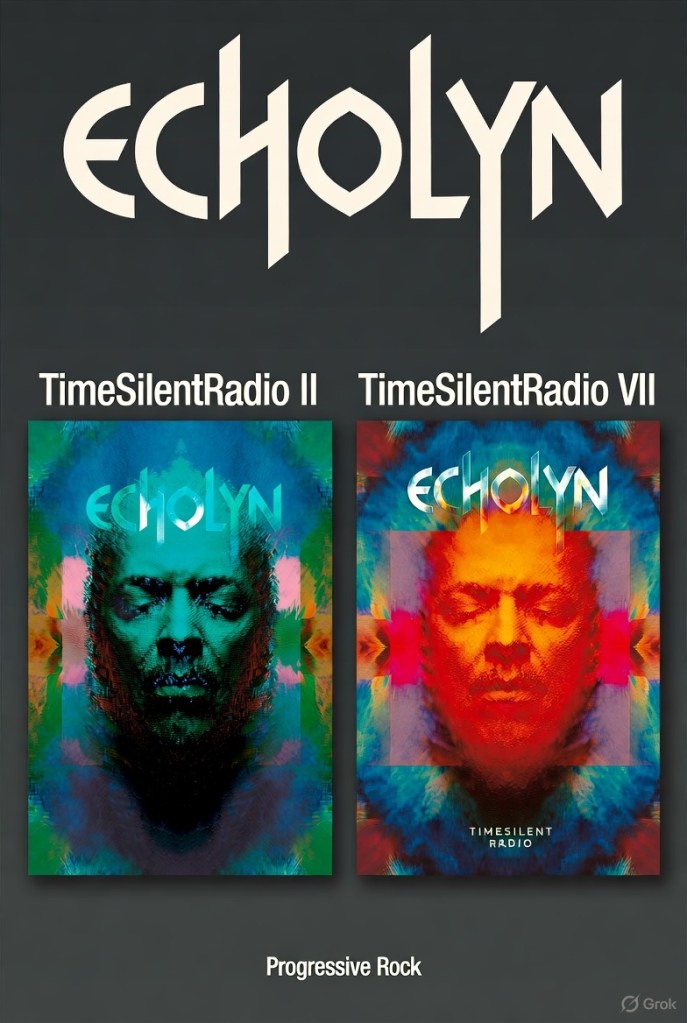
Echolyn’s TimeSilentRadio Duo Releases

In this post, Brad Birzer and Tad Wert discuss the recent releases from Echolyn: TimeSilentRadio II and TimeSilentRadio VII.

Tad: Brad, I am really excited about discussing these two albums with you. I discovered Echolyn back in 2012 with their eponymous album (I call it the “Windows Album”, because of its cover art), which knocked me out with its beauty and melodicism. They followed that one up with the excellent I Heard You Listening in 2015, and, except for the extraordinary Accumulated Blur single, there was nothing. I thought perhaps they had quit making new music, when, lo and behold, they graced us with not one but two full-length albums! 

TImeSilentRadio II features two songs: Time Has No Place (16:37) and Water In Our Hands (28:51), while TimeSilentRadio VII has seven tracks. I’ll start things off with stating how much I love Time Has No Place – it brings to mind side two of the Beatles’ Abbey Road, with its relatively short sections that combine into a powerful suite of music. I also hear hints of The Band, believe it or not, in a general “rootsiness” to the playing. Chris Buzby, Ray Weston, and Brett Kull have never sounded better, in my opinion, than they do now. These are seasoned, incredibly talented musicians at the top of their game. It doesn’t hurt that they also compose such catchy melodies!

What are your thoughts on this first song?

Brad: Tad, as always, a pleasure to talk with you about our favorite bands.  And, Echolyn is certainly a favorite band.  I’m in total agreement with you regarding the “Windows Album” from 2012.  It’s excellent, and its sound is so much more evolved than the band’s earlier work.  Truly a gorgeous progression and transition of the band overall from their beginnings through now.  I also really love Mei and I Heard You Listening.  Their work is incredibly complex, compelling, and mature.

I first came across Echolyn during graduate school in Bloomington, Indiana.  It was right after I finished my coursework and began to formulate my dissertation that I came across a copy of As the World.  Frankly, that CD–one of the first CDs I ever bought, along with The Hurting by Tears for Fears and October by U2–came into constant rotation, and I absorbed every aspect of it.  To be sure, it’s a weird CD, a real hodgepodge of lyrics and ideas and musical styles.  It was clear, however, that the band had absolutely poured themselves into As the World and, from almost every perspective, the album was simply “over the top” in its earnestness.  Of course, this only endeared the CD even more to me.

It should be remembered that Echolyn emerged at the same time as Hogarth-led Marillion, Roine Stolt’s The Flower Kings, and Neal Morse’s Spock’s Beard.  To put it simply, prog was in the air, and this was the very beginning of third-wave prog, led, in the beginning, by an equal number of European/English and American acts.  While grunge was dominating in the United States, there were also acts like Phish and Dave Matthews that weren’t prog, but they were prog-adjacent.  Soon, of course, the European culture would embrace prog a million times more than the American culture would, but that’s another post.  Echolyn were a bunch of young guys from the East Coast, and they were making stunningly complex music, theatrical to its core. 

So, frankly, Echolyn arrived in my life at a truly critical point.  I’d finished my coursework, but I’d not started the dissertation; I was working for the Organization of American Historians as a full-time editor, and I was still single, two years away from meeting Dedra.  Plus, I was deeply searching for meaning in all the music I listened to–whether Talk-era Yes, Brave-era Marillion, Happy Days-era Catherine Wheel, or As the World-era Echolyn.  Each of these albums was dramatically shaping my soul, my artistic outlook, and, especially, my approach to writing.  Frankly, it was a lonely but glorious time, full of adventure as well as full of challenges.

The lyrics of As the World–much like earlier Rush and Talk Talk had done–joyfully encouraged me to find my own path, to ignore the crowd, and to embrace creativity against a tapioca conformity.

So, I don’t mean to be sappy, Tad, but I simply wouldn’t be who I am today without Echolyn as those other bands just mentioned.  

As such, when Echolyn releases a new album–or, as it turned out–two new albums, I’m fully in the moment, absorbing everything I can.

Though rooted in the progressive rock tradition, Echolyn is very much their own band.  If pushed, though, I would say I hear in all their music, a huge amount of Hackett-era Genesis, a lot of Kansas, a bit of Styx, and a lot of the Tin Spirits.  The latter might just be coincidence rather than direct influence.  Or, the influence might go the other way.

But, this has been a long digression, Tad, as you only asked me for my opinion about the first track on TimeSilentRadioII, “Time Has No Place.”  Well, I love it.  From that opening guitar riff, sounding like something from the Allman Brothers, I’m completely hooked.  And, the lyrics are tone poems, invoking a myriad of images.  Yeah, Tad, this is something truly special, musically as well as lyrically.

Tad: Brad, as always, I love hearing how various artists and albums have impacted your life. I can say the same about a few albums – Roxy Music’s Avalon and Todd Rundgren’s Something/Anything?, to name a couple.

Okay, we both love “Time Has No Place”. Once again, I’ll point out how wonderfully the Beatlesque melodies pour out in this one track – it’s a blast, and it sounds like the band had a great time putting it together.

The second track on TimeSilent Radio II  is “Water In Our Hands”, and it’s almost 30 minutes long. It strikes me as more weighty and serious. I have listened to it several times, and I love the way it develops. It also contains what it probably my favorite stretch of music out of both albums: “Water In Our Hands, Part VI”, which is the final seven minutes. I must not be alone in my admiration of this section, because Echolyn made an official video for it:

There seems to be a lot of emotion in their performance, and I find it very moving. It’s just a beautiful piece of music, and one of my favorite tracks of 2025.

Brad: Thanks, Tad.  I would love to hear the story of Avalon and Something/Anything and what they mean to you.  Sounds like a great story.

I will admit, I was a bit taken aback with “Water in Our Hands.”  At 28plus minutes, I so desperately wanted to love the heck out of this track.  I wanted it to be the 2025 equivalent of 2009’s “The Under Fall Yard.”  And, for the most part I do love it.  

But, I must also admit–though this may just be the inner Puritan speaking–I hate the employment of the F word and the sort of growling presentation of it.  I just don’t understand the necessity for it.  It’s such a violent word, and it really disrupts the beauty of this song.  Echolyn is better than this, and so is its audience.  We demand beauty, truth, and goodness!

Ok, this quip aside, it’s a truly gorgeous track that flows, for the most part, immaculately, word to word, idea to idea, and tune to tune.

And, totally agreed, the last seven minutes are just simply glorious.  So perfectly Beatlesque.  

So, Tad, what do you think of the second CD, TimeSilentRadio VII?  As strong as the first disk?

Tad: Brad, at first I thought TimeSilentRadio VII was not as strong as TSR II, but the more I listen to them (and I have been listening to them as a pair), I find myself drawn to the shorter songs in TSR VII. It starts off with such an enjoyable bang with “Radio Waves”. The vocal harmonies are spot-on, and Buzby’s piano work is absolutely stellar. It’s right at 7 minutes long, but it seems much shorter. Maybe because it’s fairly fast-paced.

“Silent Years” is just as good, with some gritty guitar riffing paired with piano. Jordan Perlson’s drumming is rock-solid on this track, while the vocal harmonies are outstanding (again). As a matter of fact, I don’t recall any Echolyn album featuring vocal arrangements this complex and beautiful.

I love how “Cul-de-Sacs and Tunnels” has a really atmospheric intro that soon bursts into an energetic middle section before subsiding into a calmer conclusion. The last couple of minutes (“She’s still burning bright”) are just gorgeous. 

“Boulders on Hills” is about, I believe, domestic strife due to financial stresses. It’s an appropriately tense track. “I want more/I’ve got nothing left to give” is the sound of two desperate people. “Our Brilliant Next” is a relatively easygoing track, while “On We Blur” is a fun and bouncy tune that I find myself irresistibly singing along to. This is another song they’ve released a video for:

Trigger warning, Brad – there’s an f-bomb in it! I agree with you that it’s discouraging how the use of that language is getting normalized, but I think Echolyn are being strategic in its deployment. That said, I’d rather not hear it. 

TSR VII closes with “Tiny Star”, another song accompanied with an official video, and what a great song to wrap things up with! This is the strongest track on the album, and it encapsulates everything that is good about Echolyn: delightfully catchy melodies with interesting twists, tight-as-a-tick musicianship, and layers of vocal harmonies. “Tiny Star” is one of their best songs ever. 

Brad, I’ve rambled on a bit, but to summarize, I would say both TSR II and TSR VII are essential additions to Echolyn’s discography. It’s as if no time has passed since their last release, and they sound better than ever. Finally, I think they are two parts of an indivisible whole. I can’t imagine listening to just one album; they complement each other perfectly and need to be taken as one suite of music.

Brad: A brilliant synopsis of TimeSilentRadio VII, Tad.  Thank you.  And, I totally agree with you on these two releases.  There really couldn’t be one without the other, and I’ve been happily listening to both over the past few weeks.  I had the same thought as you–that II was better than VII, but the more I listen to it, the more I think they are equal and necessary, one to the other.  An excellent decision on the part of Echolyn to release both.

And, each adds not only something gorgeous to my Echolyn collection (and, yes, as with anything I love, I am a completist and rather hyper about it) but to my overall music collection.  As I look back over the last twenty-plus years of third wave prog, America might not quite compete in terms of volume with Europe, but it certainly does in quality.

Readers can order the new Echolyn releases here or here.

Echolyn’s New Video: On We Blur

Progressive Rock legends Echolyn share video for “On We Blur”
from TimeSilentRadio vii Two albums, TimeSilentRadio II &TimeSilentRadio vii, are both out now
Progressive Rock legends Echolyn released their two critically acclaimed new albums TimeSilentRadio vii & TimeSilentRadio II earlier this year on March 7, 2025 ~ coincidentally on the 30th Anniversary of their 1995 Sony/Epic Records release As The World.  The band recently shared a performance video for “Water In Our Hands, part 6” from #TRSII, and are now pleased to share another new video from #TSRvii for the track “On We Blur,” premiering today on The Prog Report.The band shared this about the track:“The lyrics to “On We Blur” deal with bad bosses and upper management and how their lack of leadership and communication, coupled with zero signs of empathy towards others, can turn a great staff of workers into a really bad one. Sometimes you try pushing through the dark days, but eventually even that becomes way too much to handle. Working angry and bitter is not healthy for anyone. “All the voices tell me to ignore it, but my own won’t let it be; the air don’t care whose lungs it’s filling, so on we blur…” It’s an upbeat, in-your-face, contemporary track that features echolyn’s classic multi-part vocal harmonies, clever and intricate instrumental counterpoint, and infectious melodies you’ll be humming for days.You can watch the video for “On We Blur” here:
https://youtu.be/oBgsNxjRehA
Rave reviews for both albums continue to roll in, with online music resources like Progressive Music Planet saying “echolyn have outdone themselves with not one but two amazing albums. Prog rock fans need to hear both of these albums. TimeSilentRadio vii features 7 classic wonderfully melodic tracks that harken back to the band’s rich history…while TimeSilentRadio II has two epic songs that rank with any classic prog-rock epics from the 70s. If you need proof that prog is alive and well, echolyn has the evidence.”Both new #TSR albums can be purchased on CD thru the band’s website echolyn.com (stateside in the US) and via multiple European & Japanese distributors overseas, or via digital download at echolyn.bandcamp.comTimeSilentRadio vii tracklist:1.Radio Waves
2.Silent Years
3.Cul-de-Sacs and Tunnels
4.Boulders on Hills
5.Our Brilliant Next
6.On We Blur
7.Tiny StarTimeSilentRadio II tracklist:1.Time Has No Place
2.Water in Our Hands
Recent album reviews by fans also continue to sing the praises of both TSR albums: “Music that echoes with some of the most beautiful, profound, and deeply contemplative emotions that exist within the human soul. When all that’s left is time, we reflect upon the past as we work through traumas and live for a beautiful tomorrow.” (Andy Ryan) “echolyn have been in my life since the 1990’s when I was blown away by ‘as the world.’ Ever since then they have continued to put out thoughtful, creative music but on these latest albums it’s like a rich gravy that has been reducing over a low flame. I am simply blown away by the taste, restraint, musicality and heart in this collection of songs. ‘Water in Our Hands’ is a fitting finale to an epic achievement.” (Jon Dahms) and “The two TSR albums are my favorite new music in 2025. The lyrics are great and the band is tight. I have recommended the albums to many of my friends, particularly musicians.” (Jim Peacock) 
Echolyn is: 
Brett Kull – guitar, lead vocals, backing vocals
Ray Weston – lead vocals, bass, backing vocals
Chris Buzby – keyboards, backing vocals
Jordan Perlson – drums & percussion, backing vocals
ECHOLYN online:
BANDCAMP
WEBSITE
FACEBOOK
INSTAGRAM
X

Dickens’ Bleak House: One of His Best

Almost thirty years ago, I picked up Charles Dickens’ first novel, The Pickwick Papers, more out of curiosity than anything, and immediately fell in love with it. I went ahead and spent the better part of a year reading all of his novels in the order of publication. Since then, I’ve reread Pickwick and his final complete novel, Our Mutual Friend, but not any others. I know that Bleak House often tops people’s lists of The Best Dickens Novels, and when I first read it, I thought it was very good, but not one of his best. I decided to give it another chance, and, once again, I find that I have a much greater appreciation for a book now that I am older.

You can read the rest of my review here.