In Memoriam, 2025

In honor and memory of Cecilia Rose Birzer, we repost Kevin McCormick’s beautiful tribute to St. Cecilia, whose Feast Day is today.

St. Cecilia’s Day

Annals of the ages
preserve no evidence,
not a trace esconced
in the walls of titular tombs.

‘Twas her spirit that guided
the hand of history
to the bones of her testament

in her name,
carved in stone
of a sepluchre in the catacomb.

she lives,
enlivened by the virginal joy
not given over
to earthly ecstacy.

Hers, the empassioned embrace
of the sacrificial body.

Hers, the voice
ringing out the sweet sounds
of certainty.

A life, emboldened to stand
firm in the face of gallows,
flourishes,
runs free
into welcoming elysian fields.

The haunting gaze of conviction
urges us to run abreast,
yet fixed souls stand in awe
of such simple,
wondrous,
radiance.

This, the heart of the saint.
This, the incantation of eternal love,
a wordless aria
soaring to heaven.

And so she is here,
as present as you and I
as we, in unearthly voices,
sound the passing knell

to cast the thundering waves
of joy—the light engaged
to cast aside the trappings
that sustain the worldly
mammon and the madness

Faith and light and trembling
hope—the voice
sung out to angels,
the censorial sonance to the cold
hand of the rex legem

Condemned now,
the responding smile
opens the heart
to the flowing blood of truth.

There, the bejeweled
backdrop of gilded stones,
reveals the maiden betrothed,
not defiled.

Eyes cast aloft,
her soul ascends
through winds divine

and just below,
the angelic gaze,
a perfect alabaster nape
which twice and again
the henchman cleaved
but could not sever.

A final sign
of love revealed,
of three in one—
her love now sealed.

Kevin McCormick
22 November, 2018

“The Artist” From Big Big Train; New Concept Album!


Big Big Train announce first ever narrative concept album ‘Woodcut’; launch first single “The Artist”Photo credit: Cécile LopesBig Big Train, the award-winning, international progressive rock band, will issue their 16th studio album via InsideOutMusic on February 6th, 2026. Woodcut is a landmark release for the international group, whose line-up draws together members from England, Scotland, Italy, the USA, Sweden and Norway, in that it marks their first ever full-length conceptual piece – quite a statement given the musical depth and storytelling qualities of a band formed in Bournemouth way back in 1990. Woodcut is a continuous narrative exploring creativity, sacrifice and the thin line between inspiration and madness.

The band recently teased the new record with the launch of a short passage of music, which can now be revealed as the album’s introductory piece ‘Inkwell Black’. Today they are also pleased to reveal the first single from the album, ‘The Artist’, which is accompanied by a stunning video created by Crystal Spotlight. Watch it now here: https://youtu.be/lu2Xm2gMMWYBassist Gregory Spawton comments: Woodcut tells the story of a character we call The Artist, who is struggling with his creativity and with life. One day he is able to fashion a woodcut which he considers to be beautiful and different. Maybe it’s a dream or maybe it’s real life, but he finds himself stepping into the woodcut scene and into an alternative world.”

Woodcut sees all seven band members making stunning contributions, with frontman Alberto Bravin taking the lead as producer: “This time it’s kind of a new statement for the band. ‘Woodcut’ is a big step forward for us,” Bravin comments. With more than 400 individual recorded tracks of music to edit, streamline and piece together, and also with the connectivity of the album’s storyline and its themed instrumental sections to consider, this was a task of gargantuan proportions.

“I felt a huge sense of relief when Alberto took over as producer,” says Spawton, the band’s final original co-founding member. “Although this is only Alberto’s second studio album with BBT, he is very aware of the traditions of the band and has also brought his own sense of energy to the music.”Woodcut feels like a Big Big Train record quite unlike any that came before—an assured union of music, storytelling and visual invention. The album is graced with a striking cover design from Dorset (England) based artist Robin Mackenzie – a black and white woodcut print, of course, derived from a woodcut which the band commissioned from him specifically for the album.

Available as a Limited CD + Blu-ray edition, including extensive liner notes as well as Dolby Atmos & 5.1 Surround Sound mixes by Shawn Dealey of Sweetwater Studios, the album will also be available as a stunning Gatefold 180g 2LP with special embossed cover, Standard CD Jewelcase & Digitally in both Stereo and Dolby Atmos versions.Pre-orders are now available here: https://bigbigtrain.lnk.to/Woodcut-Album

Featuring 16 tracks across 66-minutes of runtime, Woodcut feels epic without outstaying its welcome. From the intimacy of ‘Inkwell Black’ to the grandeur of ‘Counting Stars’, Woodcut is a defiant analogue statement in a digital age—a handcrafted, deeply human exploration of art, faith and endurance.

The full track-listing is as follows:

1.         Inkwell Black 00:56
2.         The Artist 07:16
3.         The Lie of the Land 02:55
4.         The Sharpest Blade 04:16
5.         Albion Press 05:46
6.         Arcadia 05:46
7.         Second Press 00:37
8.         Warp and Weft 03:45
9.         Chimaera 05:37
10.       Dead Point 05:28
11.       Light Without Heat 03:22
12.       Dreams in Black and White 02:34
13.       Cut and Run 06:19
14.       Hawthorn White 01:54
15.       Counting Stars 05:40
16.       Last Stand 03:34

ALBERTO BRAVIN – Lead vocals, guitar, keyboards
NICK D’VIRGILIO – Drums, percussion, 12-string acoustic guitar, vocals
OSKAR HOLLDORFF – Keyboards, vocals
CLARE LINDLEY – Violin, acoustic guitar, vocals
PAUL MITCHELL – Trumpet, piccolo trumpet, vocals
RIKARD SJÖBLOM – Guitars, keyboards, vocals
GREGORY SPAWTON – Bass, bass pedals, 12-string acoustic guitar, Mellotron, vocalsBIG BIG TRAIN online:
www.bigbigtrain.com
https://www.facebook.com/bigbigtrain/
https://twitter.com/bigbigtrain

www.instagram.com/bigbigtrainINSIDEOUT MUSIC online:
www.insideoutmusic.com
www.youtube.com/InsideOutMusicTV
www.facebook.com/InsideOutMusic
www.twitter.com/InsideOutUSA
www.insideoutmusic.store
Spotify Prog Rock Playlist

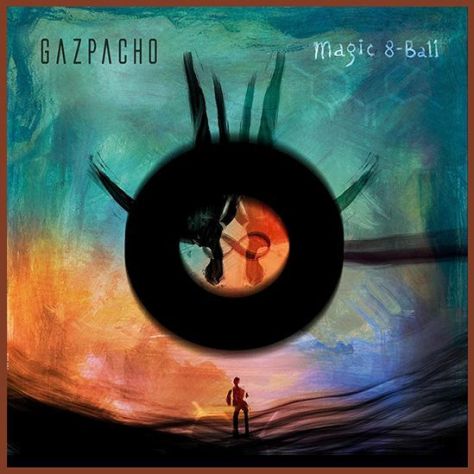
Gazpacho’s Magic 8 Ball: A Magical Musical Showcase

Greetings, Spirit of Cecilia readers! In this post, we share our thoughts on the latest album from a group we have long admired – Norway’s Gazpacho.

Tad: Brad, the first Gazpacho album I picked up was Missa Atropos (2010), and I have to admit, I couldn’t get into it. Jan-Henrik Ohme’s vocals seemed kind of weird, and none of the songs had memorable melodies, to my ears. However, on your recommendation, I bought their fourth album, Night (2007), and I fell in love with it. Their use of repetitive riffs throughout the entire album had a hypnotic effect on me, and it remains a favorite of mine.

They’ve just released their twelfth album (not counting a few live sets), Magic 8 Ball, and I think it is one of their best. It sounds like they have decided to embrace their talent for writing excellent “pop”-style songs, and this album includes eight thoroughly enjoyable tracks. After the deep and  philosophical musings of 2020’s Fireworker, Magic 8 Ball strikes me as a more lighthearted and accessible offering. I love it!

Brad: Tad!  Always a pleasure, my awesome friend.  And, to imagine that we get time to talk and write about things we absolutely love.  Life doesn’t get much better than this.

Yeah, I’m just a few years short of two decades of loving Gazpacho.  Sometime in the early 2000s, I really fell in love with Kscope and started purchasing everything the label was putting out.  To this day, I have a pretty strong Kscope collection.  

At the time, if you remember, the label was also putting out samplers.  On one of those samplers, in 2007, I was exposed to Gazpacho’s Night, and I purchased it immediately.  To say that I was taken with it would be an understatement.  Though I have loved everything Gazpacho has released, Night and Tick Tock remain my absolute favorites–standards by which I not only judge Gazpacho but all bands and all prog.  Once I encountered Night, I went back and purchased Bravo, When Earth Lets Go, and Firebird.  Those first three are much more art pop and art rock than their later stuff.  Beginning with Night, the only real way to describe their music is prog or post-prog.  

To be sure, I’ve never missed an album.  Each new release is a treat, to be sure.  Crazily enough, I even bought Introducing Gazpacho–a best of collection–simply because I wanted to support the band.  I even have a specific shelf in my home office in which I display my most prized music.  Gazpacho sits beautifully next to my Talk Talk, Big Big Train, Marillion, The Flower Kings, and Glass Hammer collections.

Somewhat infamously (at least in my household and with my wife), I was so taken with Fireworker at St. Croix, the previous Gazpacho album, that after purchasing the stand-alone CD, I purchased the blu-ray of the album.  Then, I was so taken with the blu-ray, I purchased the deluxe book/boxset of the album.  So, I have all three different versions of that glorious album!  So, yes, I’m a bit of a Gazpacho nut.

Now we have Magic-Eight Ball and it fits into its own category.  Indeed, this new album strikes me as a cross between their prog and post-prog albums post Night and their art pop albums, pre Night. The first five tracks really fit well within the prog and post-prog realm, but the last three tracks–especially “Magic Eight Ball” and “Immerwahr”–really feel like the first few albums.  That is, they’re more art pop or art rock than prog or post-prog.

That said, I really love this new album, though on my first few listens, I was a bit taken aback by “Magic Eight Ball” and “Immerwahr.”  I’m just no longer used to Gazpacho being pop!

Tad: Brad, I think you’ve hit on something – Magic 8 Ball really is a summation of what Gazpacho has done, going back to the beginning. Let’s talk about the songs themselves. The album opens with the stately “Starling”, which pulls me in with Ohme’s warm and intimate vocals. The instrumentation is primarily piano with some gorgeous violin work from Mikael Krømer. There is a sense of longing to the melody as it slowly builds in intensity. By the end of its 9-minute length, the guitars are roaring, but it’s never overwhelming. I love the gentle closing lyrics: Oh, let us be reborn. It’s one of my favorite opening tracks in the entire Gazpacho discography.

The second track, “We Are Strangers”,  is one of my favorites of the album, and it’s a great choice for a single. Don’t laugh, but when I first heard it, I kept thinking it reminded me of something, and then it hit me: the chord changes and Ohme’s vocals are very much in the vein of classic Duran Duran! I mean that as a compliment; I think Duran Duran made some of the best pop music of the ‘80s.

The third track, “Sky King” is another relatively hushed and intimate track. Once again, Gazpacho has come up with an incredibly beautiful melody that is sung with delicacy by Ohme. Even when Jon-Arne Vilbo’s guitars come crashing in, it sounds like Ohme is whispering in my ear. The mix of this album is masterful – every instrument is clearly delineated, even during moments of glorious guitar-heavy noise. 

So, three tracks in, and I’m already hopelessly in love with this album! 

Brad: Thanks, Tad.  An excellent analysis.  I love how track four, “Ceres,” begins with a haunted-sounding piano, and it continues throughout the song.  The rhythm of the song is extraordinary, especially the percussive elements mixed with the vocals.  The whole thing sounds simply driving, but in a properly gentle way.

Track five, the bizarrely titled “Gingerbread Men,” in contrast to the previous track, begins hesitatingly, playfully hinting at a loss of direction, before the guitar comes confidently in and persuasively centers the song.  There’s some really unusual sounds–maybe someone playing piano strings as percussion?  I like the lyrics, though I’m not sure what they’re supposed to mean:

Through the haze
Swallows flying high
While we sleep
In a world of steel
There’s no peace

It is my belief
That my life has been discreet
Door slammed shut
The big bad wolf of night
Fragments of hope in this endless climb
Lit up by traffic lights
Broken dreams
Parading gingermen
Aftermath
Turn away
From them

And:

And now the cars go by
Silver ghosts
Of all the gingermen
Washing out
Washed away
With the rain

You bettеr pack a suitcase
Escape beyond thе city limits
Or watch your old self disappear
Before the end is writ in dough
It can only be delayed

Track six, “Eight Ball” is shocking and discordant, only because it’s so poppy, contrasting with not only most of Gazpacho’s post-Night music but with the first half of this album in particular.  Indeed, “Eight Ball”’s actually downright whimsical, something that would not be out of place in an 1890’s carnival or early twentieth-century musical.  I’m getting Ray Bradbury vibes, mixed with some animated classic Disney!  Despite being poppy, “Eight Ball”’s really good, and it makes me realize that I should never box Gazpacho into any particular category.

The poppy feel continues with the seventh track, “Immerwahr,” though not the whimsy.  This sounds a lot like a Marillion song–especially with the guitar on it.  I especially like the lyrics:

Leaving Chekhov in the drawer
Throw the bankers at the window
Where the panic and the fear
Palest moonlight ever
Silver everywhere
Was the greater meaning
Hiding in the past
Did we send it all to bed
While the spirits of the poor
Jitterbug on judgement day

Track eight, “Unrisen,” finishes the album.  While more poppy than the first five tracks of the album, it’s the least poppy of the final three songs.  The strings are especially gorgeous, and I had no idea if they’re real or synthesized.  There’s a definite playful quality to the keyboards, too.  And, once again, I really like the lyrics, though I’m not sure what they mean.

Now you’re an astronaut lost in endless universe
Within thosе lines are older days of othеrs, I withhold the nameless why
In glass and velvet green

Mystic cryptic secret whispers
Let them be the dreamless sleep for you

See how they drift in clouds and
See how they smile
Higher, higher into the deep blue
Sail the sea of tranquility

They remind me of the lyrics from the earliest Gazpacho albums.

Tad, I’m not sure how to conclude this.  I really like the new Gazpacho, and I think it’s a fine addition to their output as a whole.  What really draws me to Gazpacho, though, are their concept albums.  As such, while I’ll certainly and happily return to Magic-Eight Ball, I’ll probably return more often to Night, Tick Tock, Missa Antropos, etc.

Tad: Brad, thank you for sharing those lyric excerpts. I have a hard time understanding the meaning of most Gazpacho songs; I think they aim more for a mood or atmosphere than for a specific message.

I’m glad you noted the whimsical nature of the title track – when I first heard it, I also thought of a carnival ride! It’s somewhat unique in their catalog, and I like it a lot. Now that you mention it, I think the entire album is suffused with whimsy, including the title. Did you ever have one of those magic 8 ball toys? You asked a question, shook it, and an answer would float up to a little window: “Maybe”, “Definitely so”, etc.

I’d like to also give some praise for the opening bars of the closing track, “Unrisen”. With the keyboards and violin accompanying Ohme’s vocals, it sounds downright baroque to my ears – like something Vivaldi or Thomas Tallis might have composed. I swear, I can even hear a harpsichord in the background! Anyway, that’s just an example of the many musical delights I’m enjoying on this album.

While I share your love for their concept albums, I think Magic 8 Ball is one of their strongest collection of tunes. They sound really energized and confident on every track, and I am impressed with how they keep pushing the envelope after twelve albums. Here’s to hoping they record many more!

Ivanhoe – A Tale from the Age of Chivalry

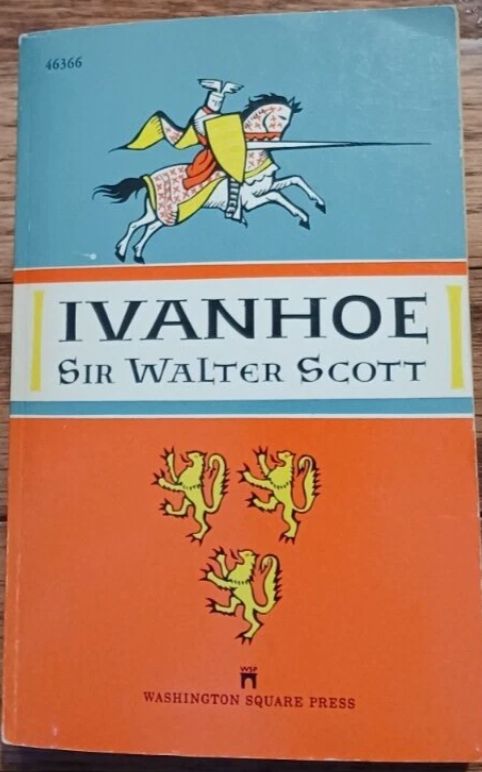
I read Sir Walter Scott’s Ivanhoe when I was in high school back in the 1970s. Was it required reading? Nope, I just picked it up in my local bookstore because the cover looked interesting and it was $0.95. With a 5% sales tax, it cost me a dollar even, which was a bargain. I soon got caught up in Scott’s fast-paced tale of a valiant and honorable knight who was treated wrongly. I’ve been rereading literary classics that I first read when I was much younger to see how much more meaning I get from them now, and I decided to dive into Ivanhoe.

The Paperback version I bought 50 years ago.

The Paperback version I bought fifty years ago.

Scott published it in 1820, and it was a big hit. It is set in the late 1100s, in Britain, after the Normans had established their conquest of it. There remain a few Saxon nobles, but almost all power resides in the Norman landowners. Richard the Lionhearted is king, but he hasn’t been seen for years, since he left for a Crusade, and it’s rumored he is being held prisoner in Europe. His brother, John, sits on the throne, and he is doing everything he can to consolidate his power.

You can read the rest of this review by clicking here.

Kate Bush’s Aerial Turns Twenty

Tad: Hello, Brad! Brad recently pointed out that Kate Bush’s album, Aerial, has turned 20 which is a good excuse to have a conversation about it. I have enjoyed seeing all the new fans Ms. Bush has acquired thanks to the inclusion of “Running Up That Hill” in the soundtrack of Stranger Things. That song is off my favorite album of hers, The Hounds of Love, but Aerial is a close second, in my estimation.

The two discs have different titles: Aerial: A Sea of Honey, and Aerial: A Sky of Honey. Listening to them recently rekindled my love for this sprawling set of songs. As a math teacher, I have to express my love for the track, “Pi”, in which Kate recites the digits of that ineffable irrational number and makes it sound seductive.

Brad: Hello, Tad!  So great to be talking with you.  A pleasure and an honor.  I’m writing this on the Feast of All Souls, the weather is gorgeous, and I got to sleep in an extra hour this morning.  It all seems so appropriate as I praise Kate Bush.

I have fond memories of first hearing about Bush in 1985.  I had missed her earlier albums, but I very well remember the release of Hounds of Love in the early fall of 1985.  It was my senior year of high school, and I was utterly blown away not only by side one–especially “Running Up That Hill,” “Hounds of Love,” “Big Sky,” and “Cloud Bursting.”  It was side two, “The Ninth Wave,” however, that completely gobsmacked me.  Here was pure unadulterated prog, all from an incredibly talented pop mistress.  I was in love (it didn’t hurt that Bush is incredibly attractive and possesses an angelic voice).

A year later, during my first semester at the University of Notre Dame, the compilation, The Whole Story, came out.  It, too, was excellent, and it made me start looking through Bush’s previous albums.  

Then, my very close friend, Greg Scheckler, now a renowned professional artist in New England, made for me a mixed tape of everything prior to Hounds of Love, complete with Greg’s own doodles.  It was glorious, and I wore that tape out!  Too bad–given Greg’s subsequent fame, his doodles might very well be worth something.  

Two years later, in the spring of 1988, one of my favorite movie directors, John Hughes, came out with one of his best films, She’s Having a Baby, and during the most emotional moment of the movie, Hughes used (and commissioned, I assume) Bush’s “This Woman’s Work.”  As much as I had loved Bush prior to this, this song and scene solidified my permanent loyalty to Bush.  Yes, at that point, I became obsessed with her as an artist.  And, I remain so to this day.

Though I very much liked The Sensual World and The Red Shoes, it was 2005’s Aerial that, once again, gobsmacked me.  Disk one was truly clever prog-pop, artistic to the nth degree, but it was disk two that blew me away.  42 minutes of pure prog, akin to what Bush had done with “The Ninth Wave,” but perhaps even better.  I loved side two, “A Sky of Honey,” that I played it on my iPod night after night as I fell asleep.  At the time, I was working on my biography of Christopher Dawson, and I was having a heck of a time shutting down my brain and sleeping.  Aerial: A Sky of Honey worked wonders on me–calming me down and serving as a potent but non-addictive Ambien!

Tad: Well, Brad, I didn’t immerse myself in Kate Bush’s music as much as you did – I think I was negatively influenced by that infamous Rolling Stone Record Guide that panned her work and compared her voice to a vacuum cleaner! Needless to say, I’ve revised my opinion of practically every artist those small-minded critics at RS dismissed.

Anyway, my thoughts on disc one of Aerial are all positive (with the exception of “Mrs. Bartolozzi”, which is a little too maudlin for me). “King of the Mountain” starts off sounding like a Windham Hill album with its synthesized/indigenous rhythms, and I absolutely love the way it transforms into a straight-ahead rocker. It’s a fantastic opener! I’ve already mentioned how much I like “Pi”, and the other highlight of the first disc is “How To Be Invisible”, another great rock song with a snaky, bluesy guitar hook that is wonderful. Her vocals dance over, under, and around the other instruments and demand I pay attention to her. It’s a wonderful song that I can listen to over and over again. “Joanni” and “A Coral Room” lower the temperature a bit and are a nice way to close out the disc.

I wonder if Ms. Bush would say she’s been influenced by Joni Mitchell? “A Coral Room” in particular sounds like late-70s Mitchell to my ears. 

Brad, give us your thoughts on disc one of Aerial, and start the discussion of disc two!

Brad: It’s worth remembering that when Aerial came out in November 2005, Bush hadn’t released anything since 1993’s The Red Shoes.  That’s a huge gap.  Beautifully, Bush spent those years raising her family rather than pursuing her career.  

Still, that was a long, long time for her fans to wait.  To be sure, though, it was worth waiting for.  

I really don’t know which album is better, Hounds of Love or Aerial.  When I list my all-time favorite albums (and I always list them without letting any artist/band have more than one entry), I always list Hounds of Love.  Most recently, I listed it as my 12th favorite album of all time.  I could just’ve as easily named Aerial.  I guess, in the long run, they’re pretty interchangeable in the grand scheme of excellence.

Like you, Tad, I thoroughly love disk one.  The Elvis-like confident sway of “King of the Mountain,” the quirky intensity of “Pi”, the Renaissance sound of “Bertie,” the insistence of the washing machine of “Mrs. Bartolozzi,” the truly clever pop of “How to be Invisible” with its incredible basslines, the profound and fetching tribute to St. Joan of Arc in “Joanni,” and the deep despair mixed with hope in the melancholic “A Coral Room” all contribute to this masterpiece of a release.

I think that what impresses me most about Bush is that she is always her own person, her own artist.  She sounds only, gloriously, like Kate Bush, even when she’s playfully imitating Elvis on the first track of the album.

But, for me, it’s disk two that makes this album truly extraordinary.  At 42 minutes, “A Sky of Honey” is simply perfection itself.  When folks talk about albums that demand headphones for a full appreciation, this is that album!  

From the child whispers and bird sounds of the opening moments to the anticipatory keyboards and string to Bush’s lush vocals with meaningful lyrics to the spoken expositions, this is a complete and total celebration of life in all its varied mysteries and profound wonders.  

Tad, as you and I have talked about, it’s often the bass that makes a great album a great album.  The bass work on “A Sky of Honey” is spectacular.  Combined with Bush’s vocal lilt, everything builds and builds until the music itself is ready to explode–the tension as thick as can be–in the last 15 or so minutes of the album.  Stunning.  Just simply stunning.

If Bush had released “A Sky of Honey” as a stand-alone album, I have no doubt that it would rank up there with Close to the Edge or The Colour of Spring.

Tad: Brad, you hit on something crucial when it comes to understanding Kate Bush; you said “she is always her own person, her own artist”. I remember reading an article about the recording of Hounds Of Love, and her record label was worried about marketing it, because it was so different from her earlier work. I believe she recorded it in her home studio, and she completely disregarded her label’s suggestions (to our benefit, I would add!). She is an artist who is fearless and blazes her own trail, not giving any thought to current musical fashions. Will people be listening to Taylor Swift’s music 50 years from now? I doubt it. Will people be listening to Kate Bush’s? Absolutely!

As far as my thoughts on “A Sky Of Honey”, I am in complete agreement with you. I think of it as a musical suite that chronicles a day – the chirping birds in the intro are greeting the dawn, and it closes with “Nocturn”. However, I’m not sure how the title track, “Aerial”, fits in with my theory! It’s a fairly raucous track that, as you so aptly describe it, is ready to explode.

Also, thank you for pointing out that “Joanni” is referring to St. Joan of Arc. Once I understood that, it clicked into place. 

And so, dear readers, if you aren’t familiar with Aerial, we recommend you check it out. It is timeless and beautiful music!

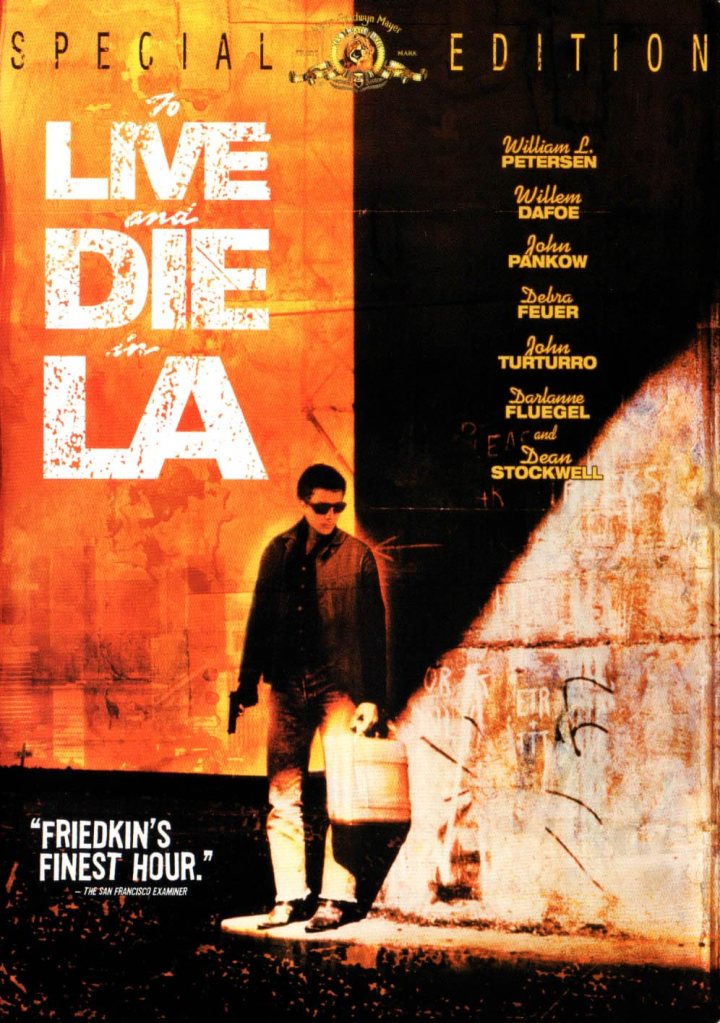
To Live and Die in LA at 40

Way back in the fall of 1985, I was working part time as a D.J. for our local AM radio station–KWHK–in my hometown of Hutchinson, Kansas. Though the format of the station was Adult Contemporary Rock, KWHK had flirted for a bit with New Wave/College Rock. As such, we still received all the possible New Wave and College Rock promos. No body at the station wanted them, so I inherited a truly glorious set of vinyl. My prized possession was XTC’S Skylarking.

I very much remember when Wang Chung’s To Live and Die in L.A arrived. At the time, I didn’t think much of Wang Chung. Being somewhat of a snob and privileging anything that even smacked of progressive rock, I didn’t really take dance music too seriously. Thus, I didn’t think too much of Wang Chung.

Then, I previewed To Live and Die in L.A. Immediately I was taken with it–how complex, how driving, how smart, how utterly cinematic the music was. This wasn’t dance music–which is what I expected from Wang Chung–but something much close to, say, Yes’s Drama, Rush’s Power Windows, or The Fixx’s Reach the Beach. This was the real deal. The transition from track three, “Wake Up Stop Dreaming,” to track four, “Wait,” was especially proggy, something worthy of “Trees” and “Xanadu” on Exit Stage Left. The whole first side of the album brilliantly builds and climaxes with “Wait.”

True to form, side one of the album contains all the songs with lyrics, while side two is purely instrumental. Both sides are excellent.

For forty years now, I have thoroughly enjoyed this soundtrack. Once I switched to CDs–away from vinyl–To Live and Die in L.A. was one of the first CDs I purchased. I return to it several times a year and remember fondly that period of the first half of the 1980s when Prog and New Wave so beautifully blended into one.

What about the movie? When it first arrived in Hutchinson, 40 years ago this week, my closest friend and debate colleague, Ron Strayer, and I went to an early showing. We were suitably blown away from it. It was one of the most intense and violent movies I’d seen up to that point in my life, and I was rather taken with it. Watching it now, I see its flaws, and it doesn’t grab me like it used to.

Still, nostalgia grips me when I think of the movie, and I very much remember the glory of the 1980s.