
We will return to this point shortly. Brad Birzer’s Beyond Tenebrae is subtitled Christian Humanism in the Twilight of the West, which lets the reader in on the main thrust of the work. As Russell Amos Kirk Professor of History at Hillsdale College, Dr. Birzer’s breadth of knowledge is more than equal to the task. Much of the book reads like a sophomore survey course, with Dr. Birzer taking the reader on a tour of people who express what he is trying to convey. He covers a lot of terrain in this survey, including characters expectable and unusual. There are scholars (Christopher Dawson, Eric Voegelin) and artists (Willa Cather, Flannery O’Connor, Ray Bradbury); social critics (Russell Kirk, Alexander Solzhenitsyn), and politicians (Ronald Regan, Edmund Burke); the prominent (J.R.R. Tolkien, C.S. Lewis), and the obscure (Dr. Birzer’s own grandparents, as well as one of his Notre Dame instructors). All are chosen because each exemplifies some aspect or principle of the true humanism that Dr. Birzer is trying to convey. The examples are woven into a tapestry to illustrate his points—indeed, if the book has a weakness, it is that the weaving is at points not as smooth as it could be. But even that serves to illuminate the point that comprehending humans as human means surrendering the wish for everything to work out as smoothly as a mathematical formula or well-designed computer algorithm.
— Read on theimaginativeconservative.org/2020/03/beyond-tenebrae-brad-birzer-roger-thomas.html
All posts by bradbirzer
What it means to be conservative
To begin, I want to offer the most profound thanks possible to several people: Martha Shernick, Ann Carlos, Doug Bamforth, and Steve Leigh. Also Kim Bowman and Clint Talbott and Christian Kopff. I’m a bit overwhelmed by the generosity and the kindness of everyone. I must state—and I hope this sounds as humble as I mean it to be—it’s wonderful to be wanted. Really, truly wonderful. So, thank you.
As to the now, I’ve been asked to speak just a bit about my position as the second holder of the titles Scholar in Residence and Visiting Scholar of Conservative Thought and Policy.
[Yes, try to say this five times in a row]
Two weeks ago, my college roommate and still one of my closest friends, asked me what it felt like to be entering a place with CONSERVATIVE tattooed on my forehead.
He knows me well, and he also knows that from our first conversations in the fall of 1986 (our first semester in college) I despise labels. I always have, and I probably always will. And, Kevin (my friend) agrees with me.
Almost all labels, even well intended ones, tend to allow us to categorize one another, to consider one aspect of an extremely (incomprehensibly) complex person as the sum total of that person, or, when not well intended, to dismiss another—more often than not in history because of the accidents of birth.
Regardless of intent, labels almost always diminish rather than elevate.
But, here I am in front of you, bearing the mark of “Conservative” in one of my two CU bestowed titles. Perhaps it’s emblazoned in neon or mere ink. I’m not sure.
And, I do bear the title proudly. And, why not? I have a great job, I’m surrounded by amazing people endowed with seemingly limitless amounts of energy (Martha, Ann, and Kim, in particular, seem like forces of nature; and I’m hoping to write a Celtic ode to them before the end of the academic year), and I’m speaking in what is arguably one of the prettiest spots in all of North America, if not in the world.
But, what about that label, “conservative”? Well, let me explain—as I see it—what a conservative is NOT.
A real conservative is not a loud, platinized, remade and plastically remolded talking head on Fox.
A real conservative is not that guy on the radio who seems to hate everything and everyone.
A real conservative is not the head of the Westboro Baptist Church.
And, a real conservative never wants to bomb another people “back to the stone age.”
My own tradition of conservatism—whether I live up to it or do it justice—is one that is, for all intents and purposes, humanist.
Indeed, I believe there is a line of continuity from Heraclitus to Socrates to Zeno to Cicero to Virgil to St. John to St. Augustine to the Venerable Bede, Alcuin, and the Beowulf poet, to Thomas Aquinas to Petrach to Thomas More to Edmund Burke.
The last one hundred years saw a fierce and mighty revival of the humanist tradition, embracing and unifying (more or less) T.E. Hulme, Paul Elmer More, Irving Babbitt, Willa Cather, G.K. Chesterton, Christopher Dawson, Sigrid Unset, Nicholas Berdayeev, Sister Madeleva Wolff, T.S. Eliot, Romano Guardini, Dorothy Day, Gabriel Marcel, Jacques Maritain, Etienne Gilson, J.R.R. Tolkien, C.S. Lewis, Leo Strauss, Flannery O’Connor, and Russell Kirk, to name a few.
George Orwell, both shocked and impressed by the movement, noted in December 1943 that it was nothing more than neo-reactionary: a strange mix of traditionalism in poetry and literature, religious orthodoxy in ethics, and anarchy in politics and economics.
I must admit, though I’ve never called myself a neo-reactionary, almost all of those who Orwell reluctantly admired are certainly heroes of mine.
But as I see it, the conservative or humanist—or, the conservative humanist, if you will, only possesses one job and one duty, when all is said and done, and she or he performs it to the best of her or his ability: a conservative attempts to conserve what is most humane in all spheres of life: in economics, in education, in the military, in the culture, in faith, in business, in government, and in community. The conservative is, at the most fundamental level, a humanist, reminding each and every one of us what it means to be human.
And, empirically, we can state that the record of humanity over the last 100 years (considering this is the 100th anniversary of the outbreak of World War I is a fitting time to announcing the beginning of our own “time of troubles” as Kirk liked to argue) is rather mixed.
Think of several persons over the past one hundred years:
Perhaps you are a Japanese American watching the California business and home of your parents auctioned off as you and your family are forcibly removed to the deserts of Idaho, under the sanction of Executive Order 9066 from the U.S. President.
Or, perhaps you’re in the second row of Carnegie Hall, listening to Miles Davis perform “Teo” in 1961.
Or, perhaps you are a nurse on the early morning shift at the Shima Medical Facility on August 6, 1945. Little do you know that at any moment the wind will increase to 600mph and the heat to 4,000 degrees Fahrenheit—all stamped with “Made in America” across them.
Or, could you are lounging on the couch in pure leisure with a wealthy Tennessee couple, as a young handicapped Georgian reads her latest story, “The Misfit.”
Or, perhaps you might be overwhelmed by the smell of bodies, alive, dead, and somewhere in-between, as a railway car carries you to a supposed “health resort” in semi-rural Poland.
Or, perhaps, you’re sitting next to a young man from St. Louis in an Irving Babbitt seminar at Harvard, the young man—you, like everybody else, calls him “Old Tom”—is joking about poems about cooking eggs, hippos, and waste lands.
Or, perhaps, you’re holding hands with hundreds of others, signing a hymn after Sunday service, facing very angry looking armed men with water cannons and attack dogs, hungering to “put you in your place.”
Perhaps, you’ve just escaped from the hell that is Pol Pot’s Cambodia, made it to America to resume not only a medical practice but even begin an acting career. Perhaps you’ve even won the Academy Award for Best Actor, 1985, only to be gunned down on the driveway in an LA gang slaying.
Perhaps you are holding your breath as the third movement ends and you anticipate the fourth as a five-hundred person choir in Bloomington, Indiana, along with a full orchestra pays homage to an early nineteenth century German composer.
Or, maybe it’s not all that dramatic, at least in terms of world changing events. Perhaps you’ve simply come home to the happy exclamations of children, rushing to you to tell you of the day and assume—quite rightly—that you will hug them with all the love that is in you.
This is humanity. This is the human condition. The tragic, the noble, the accidental, the willful, the good, the evil, the true, the false, the ugly, and the beautiful.
Each one of us in this room, each one of us at this university, each one of us in existence is unique in time and space, clothed with particular ethnicities, languages, religious faiths, and a million other things.
Yet, however different, each person is connected to every other person, from the beginning of time to the very end.
This continuity, this universal quality of human existence, is a blessing, pure and simple. When we speak, we speak not just to our neighbor, but to Socrates, and he to us. When we speak, we speak to our children and our grand children and their grandchildren. What Perpetua did in the Roman area or Thomas More in the Courts of Henry VIII do not become trapped only in that time and place, but resonate across, through, over, below, and next to the ages.
In a spirit of overwhelming gratitude, the humanist looks out upon the world, sighs in frustration at the horrors of the past, and cautiously anticipates what good can come next.
In our first duty—the duty to be human, we must be humane. We must love, and we must cherish. We must, when warranted, give thanks. We must celebrate creativity and peace.
Today, in this room, with this audience, and in this time and place, I thank you.
Big Big Train's Passenger Club: Update #2
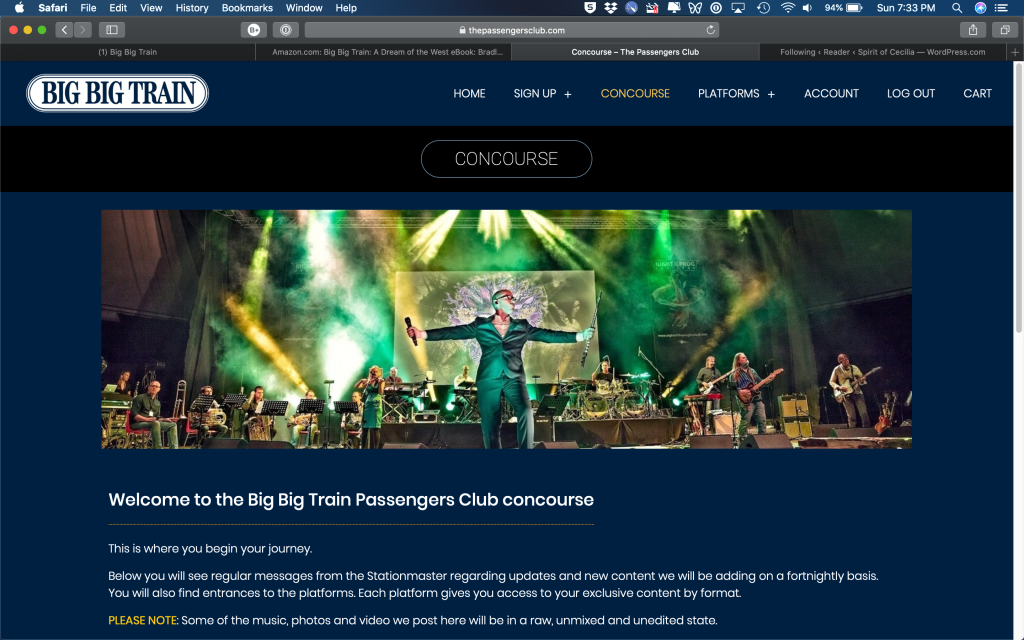
It’s that time again–the time (every two weeks) when Big Big Train updates its brand new, shining, glimmering, and more than meaningful web service, The Passenger’s Club.
Update #2 again reminds us of how important and how well done this web service is. In my previous update, I mentioned two other fan services that were, rather, lacking, and I’ll keep this one more positive. Let me just reiterate: BBT does it EXACTLY right.
The highlight of the new material is the achingly beautiful demo track, “Hope Prologue.” It contains everything that makes BBT. . . well, BBT. Soaring guitar, Mission-like flute, bizarre rhythms, tasteful keyboards and brass, and David Longdon’s simply perfect vocals. Even the lyrics–though all too brief–evoke mystery.
Two other additions are here as well. We get a fascinating look at the business side of the band, in Nick Shilton’s masterful “Building a Bigger Bigger Train” (which should’ve been titled, “Building a Better Better Train).
Finally, we also get a confessional video–thoughts from the band members on their first appearance and arrival in Peter Gabriel’s Real World Studios.
If you’ve subscribed to this service, amen. If not, do so immediately. I’m also really glad to see that BBT is not erasing what it released two weeks ago. The new material is an addition, not a replacement. Thus, all of the older material remains accessible.
As I’ve typed many, many times before: Ave, Spawtonius and friends!
Whether you’re a fan of BBT, specifically, or prog, generally, this service is excellent. Enjoy.
Depths of Soul: Tolkien, Lewis, and Grace
For those of you who are interested, here is our second single from our album, THE BARDIC DEPTHS (same name as the band).
This one is a fairly straight-forward rocker, “Depths of Soul,” about Tolkien, Lewis, and their ideas of grace. Here’s hoping you enjoy!
Forthcoming Glass Hammer
The Tennessee-based prog rock band extraordinaire, Glass Hammer, has announced its next studio album, DREAMING CITY.

From the band’s official description:
Glass Hammer returns to the world of THE INCONSOLABLE SECRET with 2020’s DREAMING CITY. Perhaps the group’s most powerful musical statement to date, DREAMING CITY tells the story of a “desperate man…as doomed as they come” who must fight his way through a spectrum of horrors to rescue his lover. We find out early in the album that the protagonist has only three days to find her before she dies; a dilemma which sets the stage for all that is to come and guarantees an emotional roller-coaster ride for the listener.
For my own longish take on the band:
America’s single most innovative and interesting rock band is also, sadly, one of its least known and appreciated. This needs to end, and the sooner, the better for all concerned. Amazingly enough, the band Glass Hammer is now celebrating its 26th birthday, and it’s about to release its seventeenth studio album. This is an astounding achievement in the world of art and, especially, in the world of rock. To add even more accolades, the band exists because its two founders were and are perfectionists, refusing to compromise on their own vision of what excellence is.
The Bardic Depths – The Bardic Depths BACKGROUND MAGAZINE Review
Getting to a higher musical level meant that this time around Bandana wasn’t the only musician playing on this album. Yes, he still plays instruments such as keyboards, guitars, bass, flute, harmonica and sings the lead vocals. But when he asked other musicians to contribute to the songs that he had written, the music sounded more professional than on the earlier released Birzer Bandana albums. He got some musical assistance from people such as Peter Jones (Camel, Tiger Moth Tales, Red Bazar) on vocals and saxophone, Gareth Cole (Under A Banner, Tom Slatter band, Fractal Mirror, Mike Kershaw) on guitar, Kevin McCormick on guitar, Tim Gehrt (Streets, Steve Walsh) on drums, Paolo Limoli on keyboards, Glenn Codere on backing vocals, John William Francis on Marimba, Mike Warren on Cello and Robin Armstrong (Cosmograf) on keyboards, guitars, bass, drum programming and backing vocals. Together they came up with a rather strong progressive rock album which is full of soundscapes and has musical references with bands such as Pink Floyd and Talk Talk. But also, I can hear influences from another band. Namely Freedom To Glide. A band from the UK which also makes concept album about war and conflicts around the world in general! They pay tribute to the fallen soldiers in meaningless wars.
— Read on www.backgroundmagazine.nl/CDreviews/TheBardicDepthsTheBardicDepths.html
Forthcoming: Genesis 1967-1975, The Peter Gabriel Years
[Our friend and ally, Greg Spawton, has begun a book publishing firm, Kingmaker, and has announced the first book, Genesis, 1967-1975: The Peter Gabriel Years. Here’s the announcement, with the pre-order link at the bottom–}

Two of the almost constant elements of my life have been music and books. On the music side of things I am a member of Big Big Train, but involvement in book publishing remained an unfulfilled dream. However, last year I formed a company with journalist Nick Shilton which has a goal of publishing high-quality books about music. Our first book is now available for pre-order from our official store Burning Shed. The book has been written by Italian author and journalist Mario Giammetti and is called Genesis 1967 to 1975: The Peter Gabriel Years.
I have read of lot of books about rock bands and music in general and I have to say that this volume is an absolute gem. It tells the story of the early years of one of progressive rock’s most important bands. It is full of original interviews with band members and associates which have never before been published in English. There are photographs and insights in the book that cannot be found anywhere else. Most importantly, while the Genesis story is an interesting one full of personalities, the focus throughout the book remains on the most important thing of all: the music.
I would like to thank Mario for trusting us with his wonderful words. I would like to thank Octavia Brown who translated the book into English from the original Italian and has put her heart and soul into this project. I would like to thank Geoff Parks who proof-read the book with his customary eye for detail. Finally, I would like to thank Nick for being a most excellent publishing partner.
–Greg Spawton (of Kingmaker and Big Big Train)
If you would like to pre-order the book (a highly recommended course of action!) the Burning Shed link is here:
Pat Metheny : News: NEW ALBUM ‘FROM THIS PLACE’ AVAILABLE NOW
Music continually reveals itself to be ultimately and somewhat oddly impervious to the ups and downs of the transient details that may even have played a part in its birth. Music retains its nature and spirit even as the culture that forms it fades away, much like the dirt that creates the pressure around a diamond is long forgotten as the diamond shines on.
— Read on www.patmetheny.com/news/full_display.cfm
Jazz is alive and doing well
Jazz is alive and well. Stunning piece of work from Pat Metheny.
New Lectures Available
Hey everyone, I got caught up and uploaded four new videos to our Youtube channel yesterday. Here they are:
The Christian Humanism of Willa Cather:
American Slavery:
George Washington, American Demigod:
The French Revolution:


You must be logged in to post a comment.