All posts by Erik Heter

In my professional life I am a patent agent, writing and prosecuting patent applications in the field of electrical engineering for high-tech corporate clients. In my home life I am a husband and a father of one son, football fan (the American kind, that is), a reader of history and many other things (avidly when time permits) and a lover of music (progressive rock in particular), among other things. I'm also a former submariner in the U.S. Navy.

Abiding Wisdom from a Lunatic Soul:  Our Latest Interview with The Duda, aka Mariusz

Mariusz Duda, or as we call him around these parts, The Duda, never stays still for very long.  From various solo projects and his band Riverside, it seems that he always has something going on.  The fruits of his most recent labor, The World Under Unsun by Lunatic Soul, can be found in your trick-or-treat bag upon its release tomorrow, Halloween 2025. 

Ahead of The Duda’s latest release, we were fortunate once again to catch up with him and talk for a while.  We spent plenty of time discussion the new album, but also delved into the fate of Lunatic Soul itself, the creative process, and some of the other future possibilities for The Duda’s artistic output. 

I can tell you it was a great conversation, but you would be better served to just read on and see for yourself as you dig into your Halloween candy.  So let’s get on with it.

SoC:     In a recent Facebook post, you said the current album is somewhat of a prequel to Walking on a Flashlight Beam.  Can you elaborate on both albums and the connection between the two?

MD:     Oh my goodness. I’m not sure if they have time for that, but long story short. The whole concept, it’s called The Circle of Life and Death. That have six main albums, and we have two additional ones. Their albums are put on the circle, are in the circle, and three of them are on the side of death, and three of them are on the side of life. Okay, it’s kind of definitely side of life, because this story is about the journey, about the hero who dies. He travels to the afterlife, then he revives, going back to life. And then he dies again, and then going back to life and stuff like that.  He is just in a loop. Okay. That is why on The World Under Unsun, there is a song which is called Loop of Fate. Anyway, I wanted something about the loop. And there’s the thing, that he wants to escape from this loop, and that’s the main plot of the whole album.

In general, if you listen in a proper order, it’s like: the main character dies at the beginning of Lunatic Soul I, then Lunatic Soul II, then Through Shaded Woods, and then he goes on the side of life. We have Fractured, we have Under the Fragmented Sky, and some of the most depressing ones. In work on the plot, the main character, you know, jumps off the cliff into the waves, as you can see on the prophecy. He dies in the water.  It’s basically a story about reviving and changing.

The thing is The World Under Unsun is post‑Fractured why the first song sounds like Fractured and is a prequel to Walking on a Flashlight Beam.  That why the waves you hear at the start of this album are the same waves you hear at the beginning of Walking the Flashlight Beam. Everything is connected. We don’t have to go into all the details, but the main character is an artist who always has a choice: does he want to remember his previous life or not? He always chooses to lose his memories, which is why he is forgotten in the whole world.

On the Impressions album, there is the song “Gravestone Hill” which reveals the main character’s choice. Imagine you’re an artist: you don’t want to lose your memories because you want to remember the best things you created and develop them across lives. However, you always remember how you die—that’s the problem. He asks himself, should I be afraid of the waves this time again? Long story short, he’s in a circle. One time, when he’s on the side of life, he realizes the sun doesn’t look like the sun anymore;  something has changed and the world becomes darker and darker. It’s like Back to the Future II when Marty doesn’t belong in the place he knows. The album reflects that feeling. The title The World Under Unsun reflects the hero’s mental state: he doesn’t feel well, he’s in a toxic relationship and wants to leave it. The whole process of trying to get out of this place is on the album.

SoC: Is that kind of a metaphor for something in your life as an artist?

MD:  I guess there is always something connecting the fiction with the truth.  I usually use music as a form of therapy, and the fiction is always mixed with fragments of my personal life. I don’t keep an exact ratio, you don’t need to know the exact percentage of that mixture.  That’s only my own thing.

SoC: Do you even know it?

MD: I know it (laughs).  It’s like, in one song, there is 16% of my personal life and 84% fiction  – I’m just joking.  No, but I try to balance it in a proper way.

SoC: Shifting gears, when you come up with a concept, how do you decide on the style of music that is the foundation?  For example, on the previous Lunatic Soul, Through Shaded Wood, it was very folky.  This one is more electronic.  So what is it that drives you that says “I’m going to go this way with the music”?

MD:  I guess I started this project mostly to fill it with my favorite genres. If you, uh, think about it, it’s always connected with ambient cinematic kind of stuff, a bit of electronic music, folk oriental things, and rock, maybe a bit of metal type of thing.  So that’s it. So this is the whole Lunatic Soul.  And, I think the new album shows the entire range of genres because you can find all these elements in the music.  And then there were the albums that were more oriental than the others, like Lunatic Soul 1 and 2 more like that condensed. Then there was Fractured, which was more electronic. And Through Shaded Would was more folky, more organic.

Yeah. I just wanted to, you know, this is just like, some albums should have their own identities., I was really close to one border on another album. I was really close to another border. But it’s more about this connection between electronic music, folk oriental stuff and rock.

I believe that the new album is more um, rock oriented or even alternative oriented. I don’t know. There’s more distortion. With some exceptions, of course. And it’s dark.

When I start doing an album, I always start from the story, the cover, the title, but it’s just like writing the script of the movie that you want to direct or just preparing a concept for book that you want to write.  And this is what I do. I don’t think about, I don’t keep coming up with the ideas first and then I, oh, maybe I should do something with that. No, I just, I’m telling stories. I’m just creating the stories. And then I always, I want to make them a bit different than the others. So I said, okay, so this one should be more electronic because it’s about fractured. Uh, it’s a world, uh, so if it’s fractured, there’s a, there’s lots of sharp objects. So I see this more like electronic stuff.

And if it comes from the green color connected with woods, trees, organic stuff, let’s make it more organic or folky. So everything starts with the, you know, the title, the main vibe. And I’m just following this and that’s it.

SoC:  So you did say that, you know, out of the 8 Lunatic Soul albums, 6 of them are telling the story. Which ones are not part of the story?

All albums are the part of the story, but the Impressions album that was released after Lunatic Soul 1 and 2 and Under the Fragmented Sky, they are sort of like the bonus material for the albums, the main albums.  Impressions is like something connected with Lunatic Soul 1 and 2.  And the three of them are kind of connected. And Under the Fragmented Sky, these are the leftovers from Fractured. And the bonus for Through Shaded Woods was already on the album. I didn’t do the separate release because I have it ready already on the album at that time. Yeah.  The leftovers for Impressions or Under the Fragmented Sky were not ready yet. So that’s why I just released that later on.

And this time, I didn’t want to do another bonus material. I wanted to create the classic double album, for people who have time to listen to music these days.

SoC:  So you set out to create the double album?

MD: Yes, from the very beginning. Okay. It was very important for me because I first  wanted to fill the gaps with all these, you know, answers for the questions. Speaking of the plot, the story. And also I wanted to show all the genres, and I just thought that if I do, you know, the 50 minutes long album with all these, you know, electronic, folky mental stuff, it would be too intense, too much for it to be a pleasure to listen to. So I just said that maybe if I do more space here, do more space there, and extend this, it will be more natural. We don’t have to be in a rush. You know, we can create something longer.

So tell me, someone can tell me, these days, it’s really hard to play to record that kind of long because people don’t have time to listen to them. Then don’t listen to them!

The album for the people who have time to listen to music. So I don’t care if this is 40 minutes or 90. But on the other hand, the previous album, 3 Shade Woods, had 39 minutes, so come on, I know what, how to do short albums as well.

SoC:  Well, also, Riverside ADHD was only what, 47?

MD: 44

SoC: Getting back to the concept of the present album, I know part of it’s the story, but do you think some of it is kind of informed by what is going on in the world? There’s a lot of turmoil going on. Is that affecting your character or affecting how you’re writing these things?

Um, actually, I always have 3 layers in terms of writing lyrics. The 1st layer is actual, the fiction, the story that I’m coming up with. The 2nd phase, it’s my personal life, my personal experience. The 3rd is, uh, what’s going on all over the world. You know, the outside world. It has to be important sometimes because, you know, I don’t know.  Let’s say, if there is a war, I don’t want to record the album that doesn’t fit to this whole situation. Yeah. Well, um, all these layers are blended sort of the way. I try to avoid political subjects.  However, from time to time, I do this. ID Entity [the most recent Riverside album] was full of that. But it was also very direct. Yeah. Whereas between Riverside and Lunatic Soul is that Lunatic Soul is more metaphysical, more like, you know, inner journey. And um, uh, that is why I didn’t want to write about, like, on social media, for instance. It’s more about live, death, love, loneliness, solid, some mystical things.

And, there’s one song, uh, which is called Torn in Two. I have to admit, I wrote the lyrics after, um, the results of the presidential election in Poland.  So, yeah, the thing, like, and it was inspired by, let’s say, something that was outside than inside.

SoC:  Ok, I’ve seen some things online – word is that this is the last Lunatic Soul album – is that true?  If so, what drove the decision to make this the last album?

MD: There’s a beauty of PR, you know, beauty of public relations. This is the chapter of the story, right? Yeah. So sometimes I don’t have to add that this is the word chapter. This is the last look. So it sounds much more powerful in the news. I believe that this is the, but I agree. This is the last Lunatic Soul in that form. Okay. And if I will bring Lunatic Soul back to life, it will be different kind of form. If I can just, you know, it’s like, for instance, King Crimson. That’s a good example of the lineups, the vibes, the moods, the approach to music. So maybe he will not be so. And next life he will have electric guitar because, uh, that’s very important information for many people that they don’t know Lunatic Soul. This is the project without the electric guitar. I wanted to distinguish this from Riverside. I didn’t want to have those, you know, David Gilmour kind of solos.  In music, I made these limits mostly to trying to be try to make myself innovative and creative in different areas. So that’s a reason for that.

SoC:  So what you’re saying then is we might see something else that has the title of Lunatic Soul, but it’s not necessarily going to be within this story.

MD:  Maybe this is story of life and death is done. So, uh, I’m not sure if, for instance, if Lunatic Soul will exist somewhere else, if I would change everything: “Now I will talk about social media.” No, no. The thing is that this kind of music from different kind of dimensions, I like it very much. I would like to continue this vibe, but definitely it will be different kind of story.

SoC:  So that leads me to: What’s next? Might there be another Lunatic Soul album, but outside this story, might there by another Mariusz Duda solo album or something like that?

MD:  I don’t know that yet. Now it is completed the cycle. The last song of the last, let’s say, Lunatic Soul of this cycle is The New End. It’s a reference to the first song on the first album, which was The New Beginning. Yeah. Can you begin with the new end? So this is something that I always use, for instance, in Riverside, we had After, Before, Lost and Found, The Night Before, now we have The New Beginning and The New End. The circle is closed. What’s next? We will see what the future brings.

SoC: Do you think you’ll do more cycles? You did that with the first three  Riverside albums and then the second three could be kind of a cycle as well. And then Lunatic Soul here has been a cycle. So you really want people to listen for a long time!

MD: I also did in the pandemic, I did some kind of like very initial electronic project and I did like something just called the Lockdown Trilogy. Oh, yeah, that’s right. That was another trilogy. That’s some weird experimental music instrumental. Probably, yes. It’s always nice. It’s just like, you know, when you, I like series. Yeah. I’m a huge movie fan and I’m inspired by the cinema. I’m always cherish, you know, if the director or the creator on the scriptwriter, they have something like, you know, five parts of something, four parts of something, Rocky, Rambo, Back to the Future, Star Wars, whatever. Harry Potter. It’s cool.   It’s simply cool because on the shelf it looks nice and it’s a part of something bigger, right?

SoC: I remember when I talked to you another time after Wasteland [the Riverside album of the same name], you were, you’d been kind of inspired by the spaghetti westerns and the music had a lot of the spaciousness of the sound.

MD: We had the trilogy, right? It’s yeah. So probably, yes! All right. Probably yes.

SoC: Okay, well, looking forward to it how you record something when you’re like the only player? You’re the only guy doing an instrument. So how do you manage to have all those tracks playing in your head and then get them down on tape or recorded somehow?

MD: I have I have guests on this album, on drums, on saxophone, and to the guitar. So I didn’t play everything by myself. But most of the things I did by myself, yeah. It started with my love for electronic music when I was a kid. And my love to keyboards with sequencer. It’s the fact that I started to compose the songs by myself, having the sequencer at home.

So I just, you know, started from drums [vocalizes drum sounds].  Okay. And now it’s at bass [vocalizes bass sounds].  Okay, we’ve got it. Now keyboards [vocalizes keyboard sounds]. And I did always the same, and my sequencer is in my brain. And when I create that, I always put some layers, you know. I don’t have use keyboards anymore. I’m going to the studio and see those layers and if there’s something that I can play by myself, I do this by myself. If I want to achieve something else, then I ask someone to make it.

So that’s the thing, you know, that’s the problem with me. Sometimes I find it like a virtue, sometimes it’s a flaw. Because I’m not that kind of guy who’s just taking an instrument and let’s play for fun. I always had to create something, you know, like something bigger. But I liked it. I got used to this and of course, it’s cool stuff. During the stories, this is just like writing books, you know, when I see that Stephen King wrote another book and I said, my goodness, I need to record another album. That is why I don’t like this system that’s going on in the music business. Like, you’re listening an album, and then you have to go for two years for playing live shows because you need to earn money.  What about the art of creation? What happened? Why in the 70s, for Christ’s sake, people were releasing the albums every year or why the Beatles released two albums every year? What’s going on? Why? Why can’t I be in the studio all the time? Because I have to play shows.

So I’m being a rebel and sometimes I prefer to be more in the studio. I know that some people says, yeah, but what about the money? If you do lots of stuff in the studio, you can have the money as well.  I don’t want to have the house with the pool. in the suburbs. I’m pretty happy with my average life. It’s just the fact that I don’t have these urges inside of me that they’re crazy. So that’s the thing that I truly love doing stuff and recording. And as I said before, this is like my therapy. So it helps me. To not take pills. So I have to do this.

SoC: Well, that’s a good therapy. I’m glad you’re doing that because we can enjoy that much more than we would enjoy you taking pills!

MD: Thank you!

SoC: I guess we’ll wrap it up. Do you have any other projects lined up or anything you’re thinking about doing after this?

MD: And you know, I was thinking you’ll maybe go back to my electronic world, but this time after this album, I feel that I have an urge with me that it’s, I want to go back to songs. I want to go back to something organic, especially in the AI days. I’m not sure if I want to continue this, you know, instrumental projects because AI can make it. But I think it still struggles with the basic classic normal songs that comes from your heart. So I want to focus on the classic structures of the songs and, well, we’ll see, which name it would be.

But with Riverside I wanted to take a break now, especially from the live shows, which is really important for me. I turned 50 this year, so I kind of deserve to make a time to rethink something. Always have to be this way. Like, I don’t know, lockdown or COVID forces us to stop. Yeah. So I did force myself to just stop. Yeah, but I probably want to create something new, but maybe, as we said, the new shape of Lunatic Soul will appear. Okay.

In Poland, I do some kind of promotional meetings, meet and greet kind of stuff. I should do that in more countries. But, you know, this is another limit. And I’m going to play, I talk about the album. I’m going to play like a few tracks acoustically as well. So maybe that will be like the transition to something new. We’ll see.

SoC: Thanks again for talking to us and I hope I hope to hear from you again someday very soon.

MD: Thank you so much, Erik, for your time. Wish you all the best. Thank you very much. Bye bye.

Political Beats – Yes!!

Our founder, Brad Birzer, recently did a two-part episode of National Review’s music podcast, Political Beats. If you are not familiar, this podcast usually features a guest and a discussion of a particular band.
For this two-parter, Brad and the normal panel discuss the career of progressive rock giants Yes, album-by-album. I’ve conversed with Brad in a group chat about the episode, and he liked my comments enough to ask me to present them here. As such, here they are, unedited save for a few interjections.

First comment, after listening fully to Part 1 and a little bit of Part 2 (in italics, my additional interjections in brackets]:

Hi Brad – I just finished listening to the first Yes episode and have listened up through the discussion on GFTO in the second episode. I loved the discussion on TFTO, and I think “beautiful failure” is an apt description, although I would also add it was a necessary failure. They found their limits on that album because they tested those limits, and I think that allowed them to be more concise and focused with their next two albums. [Tales from Topographic Oceans was Yes’s most ambitious album, and to paraphrase what Jon Anderson said about it, it was the meeting of high ideals and low energy. It certainly has some brilliant music on it but also has a lot of mindless noodling. Most of the panel thought the first and last pieces of the album – The Revealing Science of God and Ritual, respectively – were the best pieces. For my money, it’s actually the second piece, The Remembering, which holds together best (although even it suffers a little from needless padding). On that note, I think the bass playing in that piece is brilliant, often subtle and understated (not often a Chris Squire trademark), and he says as much that he was proud of that in YesStories by Tim Morse]

I also liked the observation that at times on TFTO, they were fitting the art to the format instead of just letting it flow organically. That’s one reason I’m not as down on the digital formats as some are today, because it essentially removes such restraints an allows the artist to just create without having to adapt the art to the format. I think Gazpacho’s Night is a great example of that, as I just don’t think it would flow anywhere near as well if it had to be adapted to (and possibly compromised by) the LP format. [In line with the discussion above, I think a lot of the problem with TFTO was directly related to this observation. Multiple panelists stated this album could have been better with some editing, but such editing within the limitations of the LP format would have been much more difficult.]

I would have been a slightly dissenting voice in the GFTO discussion with regard to Awaken, which I think is pure, magical, utter freakin’ brilliance and even in a catalog that includes Close to the Edge, it’s my favorite Yes composition. The production, the dynamics of the piece, the playing, the shifts in mood … all of that adds up to me as just an incredible musical journey that leaves me satisfied every time I hear it, and yet wanting more of it at the same time. [This was my biggest dissent with the panel. Not that they disrespected Awaken, but they certainly didn’t see it the way I do. Progressive rock (particularly, symphonic progressive rock) was often described as the fusion of rock and classical music, and this piece more than any exemplifies that fusion in its best form to my ears. The tone and timbre of the instrumentation here (especially with the harp and the church organ) really give it a classical feel in a way that exceeds event hat of Close to the Edge. The crescendo that consumes the second half of the piece, beginning with a few quiet plucks of the harp by Anderson is brilliance, slowly, patiently building to a powerful conclusion. Give it another try. On the other hand, I loved that they all showed so much love to Parallels, my second favorite song on this album, which features incredible playing (and interplay) among Howe’s guitar, Squire’s bass, and Wakeman’s keyboards. I had a lot more to say about this album some years ago on Progarchy, that piece can be found here.]

Will let you know what I think of the rest of it when I finished. Really looking forward to the discussions of Drama and 90125.

Second Comment after listening to Part 2:

Finished the second episode now. Definitely enjoyed the discussion and agreed with a majority of the takes. After Magnification, the only Yes album that has interested me is Fly From Here: Return Trip because of the Drama connection. Drama, BTW, might be my favorite Roger Dean cover. I love the album, although I will admit that the overselling of “Yes” on Tempus Fugit wore on my after a while (but instrumentally, it’s an incredible song). [That’s about my only issue at all with Drama, which is a great album in its own right. I share the sentiments with others on the panel that wonder what might have been had that lineup continued.]

Thought the observation that some of the ideas on Tormato were good ideas poorly executed was a good one. My pick for that would by Onward, which I actually liked much better on Keys to Ascension when Howe brought in the nylon string guitar in place of the electric in the studio version. [Onward is one of many pieces by bands I love that seem to come off better live than in the studio, and Howe’s nylon string guitar on the KTA version is the reason why here. Gates of Delirium is another Yes piece l like better live than in the studio due to some production issues (although the Steven Wilson remaster seemed to fix most of those).]

As for Release Release, I’ve always preferred a cover by Shadow Gallery (from the tribute album Tales from Yesterday) to the original studio version, as it has the punch that the original was lacking. [That song just needed to rock more. While Howe was excellently versatile in many styles of guitar, he didn’t seem to have an affinity for the kind of bone-crunching power chords that song needed, or at least he saved that for Machine Messiah on the next album]

Like you and the rest of the panel, I was pretty disappointed with Big Generator, other than Shoot High Aim Low, it was pretty forgettable. Trivia note: I heard a Rabin interview where he stated that Love Will Find a Way was a song he had originally written for Stevie Nicks, but the rest of the band wanted to keep it for themselves. [Yeah, what a disappointment after 90125. On the other hand, I loved the discussion of 90125, and was happy that nobody on the panel was such a prog snob that they dismissed the album as other prog snobs are wont to do. Sure, it was a lot different from their previous work, but it was undoubtedly Yes, and it was the kind of reinvention that only a band like Yes could pull off in such a spectacular fashion.]

If you’re a Yes fan and haven’t listened to these this two-part episode, I strongly recommend you do so. You won’t be sorry!

90125 at … 40??

In the immortal words of Ferris Bueller, life comes at you fast. In this case, it was 10 years that came at us fast – for it was 10 years ago that I wrote the piece linked below about one of the seminal albums of the 1980s. Those 10 years have allowed for additional perspective to develop.

If anything, my appreciations for this album has only grown. As the original piece notes, 90125 brought in scores of new fans of both Yes the band and the genre of prog in general. In the latter area, I would be hard pressed to name an album whose ripples had more of an effect than 90125. Moving Pictures from Rush might give it a run for its money, but that’s the only one I can name that’s really in the same ballpark. 90125 attracted millions of fans who would have had no reason to pay attention to the genre and who now are aficionados of the same.

Many people (myself most definitely included) love to talk about albums that had a lasting impact. Sgt. Peppers by The Beatles is certainly one that gets a lot of ink spilled, as does Led Zeppelin IV and Pink Floyd’s Dark Side of the Moon. And by Yes themselves, Close to the Edge is often cited as an album whose impact has continued to resonate long past its release date. And now, 40 years after its release, I think its time we put 90125 on the same shelf. And now, let’s move onto the main topic of discussion to learn some of the reasons why.

The Caravel and the Starship

Prior to the 15th century, European maritime adventures were primarily limited to coastal navigation outside the Mediterranean Sea.  In the late 15th century, spearheaded by Henry the Navigator, the Portuguese developed a new type of ship called the caravel.  The caravel had capabilities beyond other sailing ships of the day, and because of its design, was capable of voyages on the open ocean.  On August 3rd, 1492, the caravels Nina, Pinta and Santa Maria departed from Palos de la Fronterra, Spain, heading westward into the Atlantic Ocean.  On October 12th, they made landfall on an island that is now part of the Bahamas.  Months later, the Nina sailed into the port of Lisbon with news of the discovery.  It was an epochal moment.  The world has never been the same.

Today, on the Gulf Shore of Southeast Texas, the world witnessed the first launch of the caravel of the Space Age.  Starship, boosted by the Super Heavy first stage (the largest, most powerful rocket ever built) cleared the pad and roared into the skies over the Gulf of Mexico.  While the flight did encounter what Elon Musk refers to as a “rapid unscheduled disassembly, one should not view this test as a failure.  This is particularly true when considering the iterative engineering process of SpaceX – and its mantra of “Move fast, break things.”  The flight hit several important milestones while also yielding valuable data which SpaceX engineers will use to further refine the design, fix flaws, and get the next iteration of this rocket on the pad within a few months.  Keep in mind that SpaceX is the same company now has over 100 consecutive successful, propulsive landings of the Falcon 9 booster – many of them re-used multiple times.  There was a time when the “smart” people said such a thing was not even possible.  And yet, here we are – propulsive landings of the Falcon 9 first stage are nearly as routine as successful airplane landings.  When a company has a track record like that, it’s foolish to bet against them.

Why is Starship significant? Just as the caravel was designed to carry people across the oceans of Earth, Starship was designed for carrying people across the oceans of empty space.  And just as the caravel took many too the new world, the motivation for designing Starship was the same, with Mars being the prime target (a variant will also take astronauts back to the moon).  It will be entirely reusable, capable of returning to the world from which its journey started, just as the Nina did.  No other such crewed spacecraft currently exists or has ever existed. Starship will be the first. Furthermore, it will further reduce launch costs.  Falcon 9 can already put approximately the same amount of payload into the same orbit as the Space Shuttle could – but at 1/20th of the cost.  A fully operational Starship promises at least another order of magnitude reduction in that cost.  Thus, in both cost and capability, Starship will be the vehicle that truly opens the final frontier, not just for a few astronauts that can meet NASA’s exacting standards, but for ordinary people.  When Starship lands on Mars with humans on board, it will be every bit as epochal as the moment when Columbus realized the significance of his discoveries.

Like the 1960’s, we live in tumultuous times.  But also, like the 1960’s, we live in exciting times, certainly when it comes to advances in spaceflight.  Whereas the previous era was driven by governments and the impetus of the Cold War, the advances of the present era are being driven by the private sector, and without many of the non-technical limitations of the former era.  While looking at some of the goings-on in the world today is rather depressing, the world of spaceflight is as exciting as it has been at any time since the build-up to Neil Armstrong’s call of “Tranquility Base here – the Eagle has landed.”  

To be sure, there is a long way to go, as the ending of today’s test flight attests.  But I am more confident than ever that we will see Starship take humans to Mars, and maybe even beyond; that we will see the first trickle of a migration that was once as inconceivable as the migrations to the New World were in 1491.  What an incredible time to be alive.

Godspeed, Starship.

Riverside … on Riverside (Drive, that is)

Riverside at Come and Take It Live, Austin, TX, February 22, 2023

Members of the band helpfully direct concertgoers to the venue

Sometime in the mid-to-late 00’s, I was surfing the internet looking for new music.  I happened upon this Polish band named Riverside who was creating a lot of buzz in the prog community.  I ended up purchasing their second album, and have been a fan ever since.  Unfortunately, the chance to see them never seemed to materialize, as what little touring they did in the U.S. never seemed to be near my home.  That almost changed in February 2022, when Riverside had a show scheduled here in Austin.  But almost as quickly as it was scheduled, it was canceled for some reason.  They promised on Facebook they would make it on the next tour, and I crossed my fingers.  And almost a year to the date after their originally scheduled show, they delivered on that promise.

Appearing at a venue with one of the most Texas names ever, Come and Take It Live (which, serendipitously, is located on East Riverside Drive in Austin), the band put on a two hour show that was just about flawless.  The setlist was quite interesting, and if there is such a thing as a concept album, I suppose this show could have been called a concept concert.  The band performed six of the seven songs off of their latest album, ID. Entity (I’m Done With You being the lone exception).  A number of other songs dovetailed nicely with the theme of ID. Entity.  These songs included the show opener #Addicted (from Love, Fear, and the Time Machine), Left Out and Egoist Hedonist (from Anno Domini High Definition), and We Got Used to Us (from Shrine of New Generation Slaves). Outside of that, the only two songs that didn’t really fit in thematically with the rest of the set were O2 Panic Room (from Rapid Eye Movement) and Conceiving You (from Second Life Syndrome). 

The performances were as excellent as one would expect from this group of musicians, delivered with high energy and intensity.  Delivery of Egoist Hedonist and Left Out were especially powerful, both including jams that extended their respective durations over their studio counterparts.  Mariusz Duda, in addition to being a great player, was engaging with the audience, and proved to be every bit the cool guy I had the good fortune of interviewing three times during my days at Progarchy.  The Duda indeed abides. 

The other musicians were in top form as well.  I continue to be impressed with Maciej Meller’s ability to play the parts of Piotr Grudziński with the right balance between faithfulness to the original and his own individual style.  Michał Łapaj was in the zone all show long, playing to the high standards prog fans expect of their keyboard heroes.  And Piotr Kozieradzki did not disappoint on drums.

In addition to enjoying the show myself, I managed to introduce Riverside to a friend and co-worker I brought along, one who is as much of a prog-head as I.  He left impressed, and was enticed by the lyrics of ID. Entity enough to spend $100 on a special edition of the album that included the main disk, the bonus disk, a 5.1 surround sound disk, vinyl-sized artwork, and booklet.  That’s a pretty nice way to start a journey of discovery of the Riverside catalog.  I’m kind of envious that he’s going to get to hear all their music for the first time.

It’s a few days after the show as I write this, but I’m still buzzing.  Their performance was so good, so tight, so energetic, and just so much fun.  There are a few other Riverside fans that contribute to this site, and a few more that read it.  So if their tour manages to stop close by, I highly recommend you go see them.  You will not be disappointed.

Who Are We?  A Review of Riverside’s ID. Entity

It’s been a long four and a half years since we last heard from Riverside.  In 2018, the band was still in recovery mode from the untimely loss of Piotr Grudzinski and, as a three-piece, released the spacious-sounding Wasteland, which thematically dealt with the apocalypse, on levels both personal and civilizational.  The present year finds Riverside releasing another thematically bi-furcated album. ID. Entity deals with the themes of the impact of social media and, more broadly technology, and its impact at the level of the individual and society as a whole.  Given the present zeitgeist, ID. Entity is the timeliest thing they’ve ever done, which is saying something for a band that has albums like Anno Domini High Definition (ADHD) and songs like #Addicted (from Love, Fear and the Time Machine) in the repertoire.

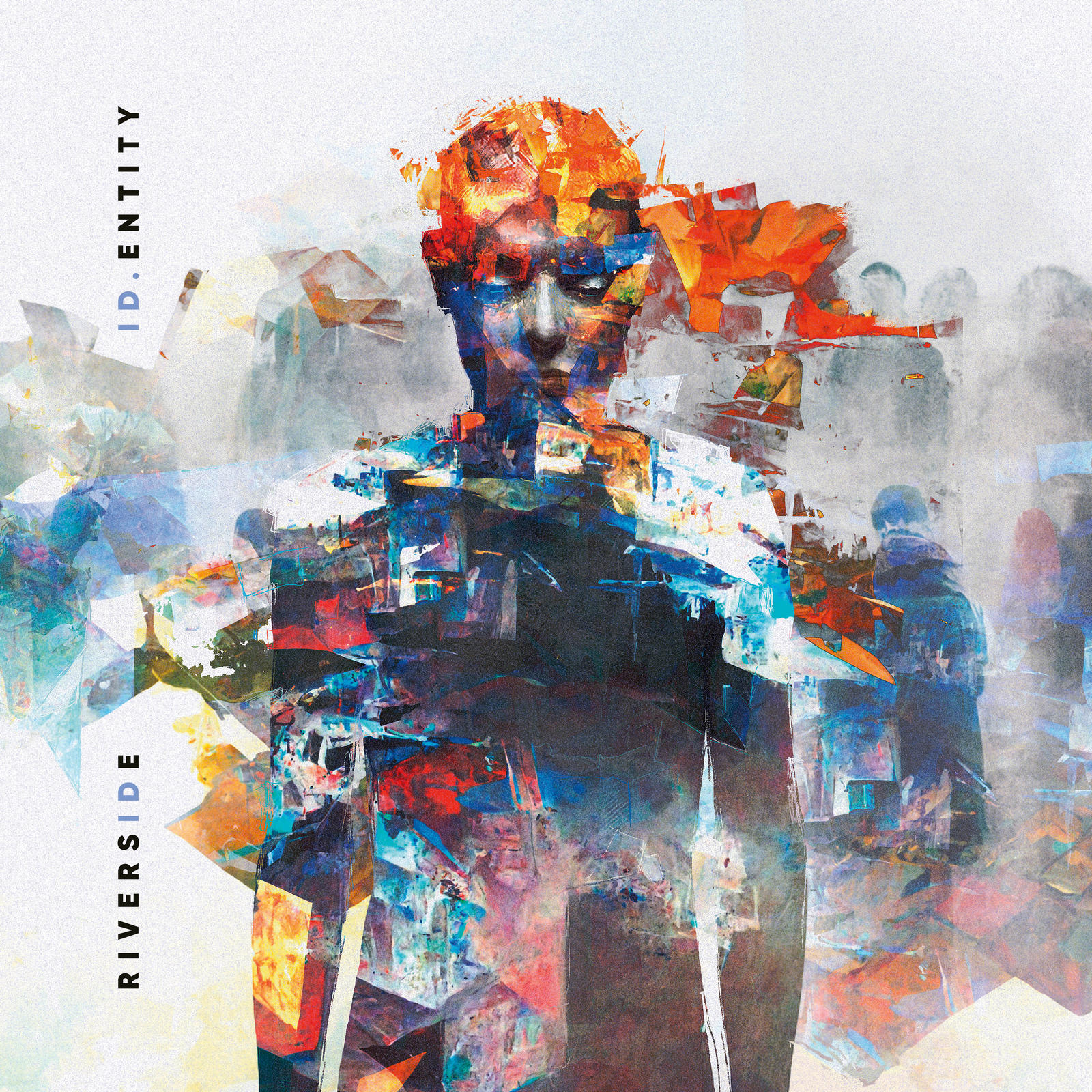
Musically, ID. Entity has a palette as broad as its cover.  That’s no coincidence, as bassist/lead vocalist Mariusz Duda has more or less said in a number of interviews regarding the album.  Sounds ranging from synth-pop, heavy metal, electronica, and 70’s prog, among others, can be found in what is Riverside’s most musically diverse collection of songs yet.  But still, the music has certain threads running through the album that make it unmistakably Riverside.

Friend or Foe kicks off the album, with much of the first half of the song extracted from the 80’s, with synthesizers, a prominent bass line, and a steady drumbeat, before new guitarist Maciej Meller brings a few meaty riffs to the party.  And speaking of Meller, the band has done an excellent job of integrating him into the fold.  Stylistically, there are enough similarities that he fits in with what Riverside does, while still allowing him enough space to be his own guy.  Meanwhile, Duda ponders what the present is doing to our own identities:

Who is behind the filter?

Who Who’s behind the mask?

How much of yourself is left in you?

Landmine Blast follows, a quirky mix of hyper-kinetic electronic keyboards, pounding bass, and guitar that ranges from long leads to power chords.  There is a nice mix of dynamics in this song, loud juxtaposed with quiet, fast with momentary interludes of breath-catching.  In some respects, this song channels some of the same energy from ADHD, but updated for the present.  

The title of Big Tech Brother leaves no questions about its message, beginning with a sarcastic ‘Terms of Service,’ followed by a musical introduction that even includes some brass – a first for Riverside.  Lyrically, allusions to Huxley and Orwell are mixed with those of the present for a potent message, underscored by the dark, pounding music.  Post Truth musically turns things down a notch, but just a notch.  This song seems to point its criticism at the media, traditional and social, and the constant stream of BS that emanates from both.  Meller’s guitar work on this song is particularly good, at times hinting at Alex Lifeson and other times sounding somewhat like the work of his predecessor in Riverside. 

The most overtly prog composition on the album is the 13-minute mini-epic, The Place Where I Belong.  This song has some strong 70’s prog influences, including the use of the Hammond by Michal Lapaj, and within the structure of the piece itself.  The quiet interlude in the middle is an especially good touch.  I’m Done With You follows, with plenty more of the Hammond and lots of prog-metal goodness while Duda pontificates on cutting poison people out of one’s life. The album closer, Self Aware, begins as a straight-ahead rocker, but has a nice keyboard- and bass-driven quiet jam at the end.  It also has a little bit of reggae-beat worked in, reminding me a little of Rush’s Vital Signs.

If you were like me and bought the deluxe edition, you are treated to single edits of Friend or Foe and Self Aware, along with two new instrumental tracks, Age of Anger and Together Again.  Both are worthy additions and worth the extra money. 

In summary, ID. Entity finds Riverside’s music branching out into new areas and new sounds while still maintaining all of their trademarks that have made them one of the best 3rd wave progressive rock bands around.  It’s no accident that they are my favorite band to emerge in the last 20 years or so, but even if they don’t hold that lofty position for you, this album is still worth checking out. 

Thoughts on Afghanistan from an anonymous military officer

I found this over at Instapundit this morning, and I won’t copy the whole thing here so as to drive the traffic to them they deserve. I will leave a few choice quotes from the piece though – but you should go read the whole thing. Nevertheless, this is a great critique of our current military “leadership” (yes, the quotes are intentional and mean what you think they mean), with some critiques of the politicians thrown in. I’m not sure if there is any difference between the two at this point.

We should blame President Bush, not for the decision to attack into Afghanistan following 9-11, but for his decision to “shift the goalposts” and attempt to reform Afghanistan society. That was a fool’s errand any student of history would have recognized. And yes, we should place blame on President Obama for his decision to double down on failure when he “surged” in Afghanistan, rather than to withdraw.

However, most of the blame belongs to the leadership of the US military, and the Army in particular. The Washington Post’s “Afghanistan Papers” detailed years of US officials failing to tell the truth about the war in Afghanistan, “making rosy pronouncements they knew to be false and hiding unmistakable evidence the war had become unwinnable.” That report was two years ago, and the stories within it began more than a decade before that. Afghanistan was, and always will be, “unwinnable”.

In fact, Afghanistan was worse than Vietnam in that at least the Vietnam War was tangentially related to the effort to stop the global spread of communism during the Cold War. Afghanistan was worse than Vietnam in another respect: the military’s leaders of the Vietnam era had no precedent to dissuade them from a disastrous path. Today’s military leadership has the precedent of not just Vietnam, but also Iraq, Lebanon, Libya, Syria, and Yemen. That much obtuseness must be punished and removed from the system.

Let me conclude with one last thought: the generals, the intelligence analysts, the defense contractors, and the pundits all leveraged America’s rarest resource: the American serviceman and woman. They are the ones who fought, and sweat, and bled, and died for what is now clearly a failed strategy and a doomed mission. Even after its failure was apparent to their leaders, they continued to enlist and reenlist, largely because their superiors—the experts—assured them that success was possible. It was not. It never was. Absent American support, Afghanistan collapsed over the length of a long weekend. That is proof enough that the last 20 years were in vain, and proof enough that the system is broken from within.


As I said, hit the link and go read the whole thing.

America Returns to Space

It seemed on one hand to be so familiar … and on the other hand, so new.  Launching astronauts into orbit?  Been there, done that.  Launching a new type of capsule-type nasa-spacex-crew-dragon-launch-may-2020-1spacecraft into orbit?  Started doing that in 1961.  Two astronauts in a spacecraft?  Gemini 4, with two astronauts, took off from the Cape in 1965.  Launching astronauts into orbit from Pad 39A of Cape Canaveral?  Many times starting in the 1960’s … including the most famous liftoff of all time.  And despite all that … it was all so new.
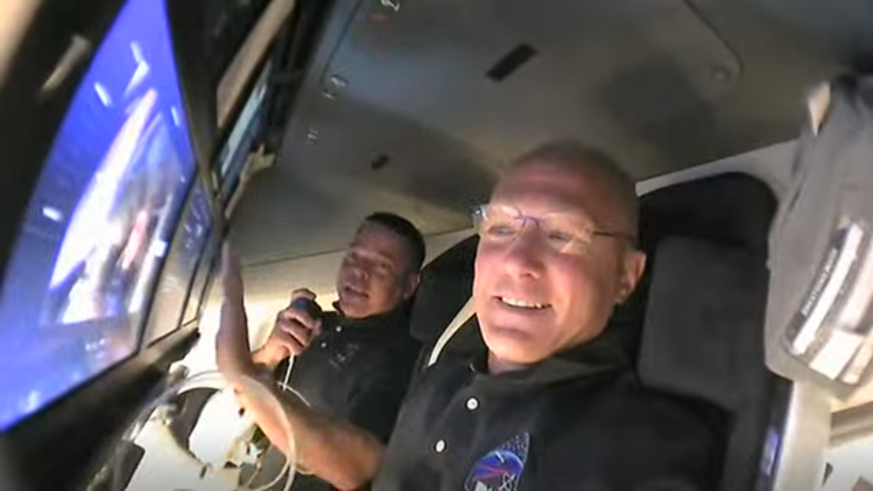
It was new in large part because of who was doing it.  SpaceX is not a traditional NASA contractor.  The Falcon 9 rocket which pushed Bob Behnken and Doug Hurley into orbit today was developed almost entirely with private funding, and without any guarantee of a NASA contract for services rendered.  It was the same for the Dragon spacecraft that flew atop the Falcon 9.  The propulsive-landing first stage was also developed by SpaceX.  Thus, in another first, the successful landing of the Falcon 9 first stage marked the first human spaceflight in which the booster stage was propulsively landed, with the possibility of use again in the future.

The Dragon spacecraft itself was something that is sleek, new, and modern, even for the Space Age.  Replacing a dizzying array of switches, buttons, knobs, and analog gauges were an array of touchscreens, neat, clean, and orderly.  The tour of the Dragon given to us by the astronauts earlier this evening showed a spacecraft that is much roomier than the Apollo command module could ever hope to be.  And the entirety of the assembly that roared off Pad 39A was smoother than any crewed launch vehicle to date.

But more than that, this just felt different.  For a mission that was, on one hand, not much more than a simple mission of sending astronauts to the International Space Station, it attracted an inordinate amount of attention.  This might not have been like watching Apollo 11 leave for the moon, but it did seem to garner the same level of interest present when John Young and Robert Crippen took the space shuttle Columbia on its maiden flight in 1981.  There are reasons – transcendental ones – that go well beyond the historic nature of a private company developing and successfully launching a rocket and crewed spacecraft, largely independent of any governmental space agency, that made this mission different.

Elon Musk and SpaceX have made space cool.  Sure, there was a lot of interest in the topic when I was a kid, growing up during and later, in the wake of the Apollo moon landings.  Back then, space was seen as the proper province of government programs and not private entrepreneurs.  And kids like me that were interested in it, well, we were kind of the nerdy ones.  Then public interest faded for decades, with only us die-hards maintaining any real interest in the goings-on off-planet.  Nowadays, Musk’s tireless advocacy for truly opening up the final frontier – backed by his actions in founding SpaceX and leading it to and through days like this – is having a cultural impact that could go far beyond that of Apollo.  Culturally, the impact of that program began fading when Armstrong and Aldrin left the moon on that glorious July day in 1969.  It fell straight off a cliff when Eugene Cernan and Harrison Schmitt left the moon for what was (at least for now) the final time in December 1972, relegating Apollo to museums and history books.

Instead, Musk has got people talking about space.  Not just tech geeks, but average people with no particular reason to be interested in the topic.  My wife, for one, received a text message from another housewife friend today letting her know that the launch was imminent.  That came from a source I would not have expected, which made it’s arrival all the more satisfying.

Moreover, through the heavy lifting (pardon the pun) that Musk and SpaceX are doing, people can now actually talk about sending humans to Mars and living there BB14OBbJpermanently without the snickering and eye rolls of what not too long ago was considered pie-in-the-sky naivety.  When a guy says he wants to send people to Mars and then founds his own rocket company that designs and builds rockets and crewed spacecraft and actually sends them into space, you can no longer brush it off with snide remarks.  When he crushes launch costs and leaves former industry heavyweights like Boeing and Lockheed in the dust, it’s time to stop laughing.  At that point, it’s time to stand up and take notice.

In that vein, one of the most satisfying phenomena I observed today was something that occurred multiple times on Facebook.  Pictures, posted in various groups and pages, by proud parents of their young children, dressed up in homemade space suits, manning the controls of their makeshift spacecraft, waiting for this real-world launch to undoubtedly be followed by their own (for now) imaginary journeys into space.  One little girl even used an iPad for an instrument panel, which was particularly fitting given the description above of the Dragon spacecraft.

You’ll have a hard time convincing most parents that their kids taking such an interest in opening the final frontier is a bad thing, especially given all of the focused study and knowledge that one needs to attain to get there.  Thanks to Musk and his brilliant employees at SpaceX, these kids – unlike the generation of Apollo – may actually get to see the final frontier truly opened, the door kicked in never to be closed again.  These kids, thanks to happenings like the one today, have a real chance of making their dreams into a permanent reality.

Godspeed and Ad Astra.

A Long and Winding Road to Freedom – The Girl with Seven Names: A North Korean Defector’s Story, by Hyeonseo Lee

Every now and then you read a book that really impacts you.  A book that simply sticks with you, one that, for days after you finish, you can’t get it out of your head – and don’t The Girl with Seven Nameswant to.  It can be a novel, or maybe a non-fiction book, maybe something about history that makes you look at the world in a different way, or stretches you mind into a previously unknown shape.  It may also become something about which you feel absolutely compelled to tell others.  For me, the book that currently occupies that space is the incredible story of a defector from the prison-state of North Korea.

Originally published in 2015, Hyeonseo Lee’s The Girl with Seven Names is not merely a harrowing tale, it is a collection of them.  These are stories that are all too real for the millions born in North Korea and for the intrepid few who dare to seek freedom by attempting escape from its bondage.

Ms. Lee’s book is subdivided into three parts.  The first part chronicles her life from birth until her eventual escape.  It includes multiple moves until her family finally settles in the town of Hyesan, on the North Korean border with China and within sight of the city of Changbai – the brighter lights of which eventually became a lure to the author.  Some of what is revealed is unsurprising – the forced indoctrination, the public executions, the atomization of society, the forced reverence for the pathetically insecure “Dear Leader”.  Other aspects were more surprising – such as a border with China that was frequently crossed in both directions, the amount of smuggling that occurs, and so on.  In retrospect, one should not be surprised that a system as oppressive as that in North Korea produces so much bribery, black market commerce, and general corruption that filters all the way down to the lowest levels of society.

And speaking of the levels of society, the author educates the reader on the North Korean system of songbun, in which people are ranked within society in one of fifty-one gradations spanning over three broad categories – loyal, wavering or hostile.  Ms. Lee rightfully notes that the system of songbun had created a society more stratified than that of a feudal society, and one in which upward movement is nearly impossible.  Like all communist animal farms, that of North Korea is one in which all animals are equal, but some are most definitely more equal than others.

As Part One nears its conclusion, the author’s disillusionment with her home country grows, particularly during the famine of the mid-90’s which left about a million dead.  Nearing the end of her high school years, facing college and adulthood, and the aforementioned allure of the lights of Changbai, the Ms. Lee decides to take a short trip across the river to get just a small taste of freedom before returning home to begin the next phase of life.  As this first part ends with a walk across the frozen Yalu River, in what eventually became a one way journey.

Part Two chronicles Ms. Lee’s life as an illegal in China.  In short order, the author finds out that while she is technically free from the bonds of North Korea, she is still not truly free.  In addition to a myriad of other human rights abuses, the Chinese government’s miserable record on human rights includes the repatriation of North Korean defectors, sending most of them to a back to their prison-state and leaving them to a fate of hard labor, execution, or both.  Thus, the author’s existence during her decade in China was a precarious one, forcing her to adopt new identities with the frequency of a spy in a John LeCarre novel (hence the seven names to which the title refers).  In numerous instances she is nearly caught, escaping arrest with a combination of guile and luck.  To complicate matters further, she managed to stay in communication with her mother and brother back in North Korea, bearing the weight of guilt regarding loved ones left behind.  More than once her mother implored her to come home, assuring her the right people could be bribed to make her return a safe one.

I’ve mentioned elsewhere that my own mother is a defector from East Germany, crossing into West Berlin with her family when she was age 10.  While the train ride she and her family took in 1953 was not without risks, their freedom was assured once they had crossed into West Berlin.  Such was not the case for Ms. Lee, as crossing the border into China was only the beginning of a very long journey, one that was fraught with danger every step of the way.  The fact that she did not go home despite the continuous hazard of being an illegal in China is a testament to her courage – and the incredible difficulty of escaping North Korea.

The third part of the book finds the author finally making it to Seoul, South Korea, and her eventual convincing of her mother and brother to defect.  She returns to China and the border near her hometown and escorts them over 2000 miles into Laos.  Along the way, the hazards of being caught are as ever present as they were in her previous decade as a Chinese illegal, only with higher stakes by having her mother and brother in tow.  In Laos, her mother and brother are arrested and held in jail for months, although thankfully, not repatriated (apparently even the government of Laos is more humane than that of China – a low bar to hurdle).  After exhausting all her options and running out of money to bribe the Laotion authorities, serendipity intervenes in the form of an Australian man who decides to help for no other reason than it was the right thing to do.  Even a hardened misanthrope would have to reconsider his outlook after reading about this incident.  With Ms. Lee receiving the funds she needs, she is able to spring her family from jail and finally get them into Seoul.  Free at last.

Today, Ms. Lee spends a lot of her time as an activist for North Korean defectors and human rights in general.  She wants the world to know the true fate of North Koreans, both those that remain and those that defect – both successfully and unsuccessfully.  She has done multiple TED talks, one of which is embedded below.  While North Korea still suffers under the boot of a third generation “leader” in Kim Jong-Un (or, as I refer to him, Pudgy Bucket of Baby Fat with the Worst Haircut Ever), Lee and others like her seek to shine the light of the international community on the horrible conditions imposed on North Koreans, the savage human rights abuses, and above all, a form of government for which no decent, civilized human being should give any quarter.  Her goal is to see the Korean peninsula re-united, with the people of the North living under the banner of freedom.  We should all say a prayer for the North Korean people, and root for Ms. Lee to one day to witness the realization of her dream.