Category Archives: Faith

SEEKING CHRISTENDOM Now Available

I’m very proud to announce our third publication for SPIRIT OF CECILIA books, SEEKING CHRISTENDOM: AN AUGUSTINIAN DEFENSE OF WESTERN CIVILIZATION.

This was a book–roughly 82,000 words–I wrote over Christmas break, 2002-2003, and then revised four times between 2003 and 2008. I wrote it in between writing the biographies of J.R.R. Tolkien and Christopher Dawson as a way to understand Christian Humanism. I wanted to know its scope as well as its limits, hoping to find something to move well beyond the simple and deceptive left-right spectrum.

Here’s the opening to the original version:

The nineteenth century witnessed the flourishing of progressivist thought in social relations, politics, religion, and biology.  Everything was evolving, or so it seemed, toward the better.  Smiles were more frequent, and lives just kept getting happier, as the citizens of the world were becoming one, homogenized, contented mass.  The blessings of modernity entangled everything, East to West, claiming that no more perfect offerings needed to be made.  Once properly educated and the childhood superstitions of the race outgrown, the prophets of modernity assured us, the masses collectively would speak as a god.  In a word, according to intellectuals such as Bernard Shaw and H.G. Wells, it would soon be “utopian.” 

It was a lie.  

Modernity was a trap, and we were its greatest victims.  We failed to resist, and it greedily fed on us.  In democratic regimes, the brightly colored and candy-coated machines of bureaucracy and large corporations mechanized us, making us far less than human.  In non-democratic regimes, the damage proved much worse, nearly irreparable.  Beginning with the assassination of a relatively minor figure by an equally obscure terrorist group in 1914, the twentieth century drowned in its vast killing fields, gulags, holocaust camps, trench warfare, and weapons of mass destruction.  Whether in the camps of the European or Asian ideologues, some humans, convinced of the righteousness of their cause, viewed all other human persons as nothing more than a collection of parts, ready to be dismembered and reassembled in a Picasso-esque fashion, or perhaps simply quartered and then quartered again.  Armed with the ideological doctrines of fascism, National Socialism, and Communism, the twentieth-century became a century of the inverted vision of Ezekiel: wheels within wheels, endlessly spinning, the abyss ever expanding, ever within reach.  All that was sacred became irrelevant.  All who remained relevant were shot.  And, the State and its faithful companion, War, demanded the sacrifice of much blood to the restored gods.  Demos, Mars, and Leviathan became ascendant, taking possession of the field, and claiming victory, their appetites insatiable.

And, the Logos wept.

If you’re interested, here’s the link to the amazon Kindle version ($4.99). If you’re interested in a copy to review for a print or online publication, please let us know through the contact button.

Thanks! And, enjoy.

Sermon: Feast of St. Stephen

From: T.S. Eliot’s MURDER IN THE CATHEDRAL.

The Archbishop preaches in the Cathedral on Christmas morning, 1170.

Sermon
“Glory to God in the highest, and on earth peace, good will toward men.” The fourteenth verse of the second chapter of the Gospel according to Saint Luke. In the name of the Father, and of the Son, and of the Holy Ghost. Amen.

Dear children of God, my sermon this morning will be a very short one. I wish only that you should ponder and meditate on the deep meaning and mystery of our masses of Christmas Day. For whenever Mass is said, we re-enact the Passion and Death of Our Lord; and on this Christmas Day we do this in celebration of His Birth. So that at the same moment we rejoice in His coming for the salvation of men, and offer again to God His Body and Blood in sacrifice, oblation, and satisfaction for the sins of the whole world. It was in this same night that has just passed, that a multitude of the heavenly host appeared before the shepherds at Bethlehem, saying, “Glory to God in the highest, and on earth peace, good will toward men”; at this same time of all the year that we celebrate at once the Birth of Our Lord and His Passion and Death upon the Cross. Beloved, as the World sees, this is to behave in a strange fashion. For who in the World will both mourn and rejoice at once and for the same reason? For either joy will be overcome by mourning or mourning will be cast out by joy; so that it is only in these our Christian mysteries that we can rejoice and mourn at once for the same reason. But think for a while on the meaning of this word “peace.” Does it seem strange to you that the angels should have announced Peace, when ceaselessly the world has been stricken with War and the fear of War? Does it seem to you that the angelic voices were mistaken, and that the promise was a disappointment and a cheat?

Reflect now, how Our Lord Himself spoke of Peace. He said to His disciples: “My peace I leave with you, my peace I give unto you.” Did He mean peace as we think of it: the kingdom of England at peace with its neighbors, the barons at peace with the King, the householder counting over his peaceful gains, the swept hearth, his best wine for a friend at the table, his wife singing to the children? Those men His disciples knew no such things: they went forth to journey afar, to suffer by land and sea, to know torture, imprisonment, disappointment, to suffer death by martyrdom. What then did He mean? If you ask that, remember that He said also, “Not as the world giveth, give I unto you.” So then, He gave to his disciples peace, but not peace as the world gives.

Consider also one thing of which you have probably never thought. Not only do we at the feast of Christmas celebrate at once Our Lord’s Birth and His Death: but on the next day we celebrate the martyrdom of his first martyr, the blessed Stephen. Is it an accident, do you think, that the day of the first martyr follows immediately the day of the Birth of Christ? By no means. Just as we rejoice and mourn at once, in the Birth and Passion of Our Lord; so also, in a smaller figure, we both rejoice and mourn in the death of martyrs. We mourn, for the sins of the world that has martyred them; we rejoice, that another soul is numbered among the Saints in Heaven, for the glory of God and for the salvation of men.

Beloved, we do not think of a martyr simply as a good Christian who has been killed because he is a Christian: for that would be solely to mourn. We do not think of him simply as a good Christian who has been elevated to the company of the Saints: for that would be simply to rejoice: and neither our mourning nor our rejoicing is as the world’s is. A Christian martyrdom is no accident. Saints are not made by accident. Still less is a Christian martyrdom the effect of a man’s will to become a Saint, as a man by willing and contriving may become a ruler of men. Ambition fortifies the will of man to become ruler over other men: it operates with deception, cajolery, and violence, it is the action of impurity upon impurity. Not so in Heaven. A martyr, a saint, is always made by the design of God, for His love of men, to warn them and to lead them, to bring them back to His ways. A martyrdom is never the design of man; for the true martyr is he who has become the instrument of God, who has lost his will in the will of God, not lost it but found it, for he has found freedom in submission to God. The martyr no longer desires anything for himself, not even the glory of martyrdom. So thus as on earth the Church mourns and rejoices at once, in a fashion that the world cannot understand; so in Heaven the Saints are most high, having made themselves most low, seeing themselves not as we see them, but in the light of the Godhead from which they draw their being.

I have spoken to you today, dear children of God, of the martyrs of the past, asking you to remember especially our martyr of Canterbury, the blessed Archbishop Elphege; because it is fitting, on Christ’s birthday, to remember what is that peace which he brought; and because, dear children, I do not think that I shall ever preach to you again; and because it is possible that in a short time you may have yet another martyr, and that one perhaps not the last. I would have you keep in your hearts these words that I say, and think of them at another time. In the name of the Father, and of the Son, and of the Holy Ghost. Amen.

End of Sermon

For Christmas Day: “My Lord Has Come” by Will Todd

Shepherds, called by angels,
called by love and angels:
No place for them but a stable.
My Lord has come.

Sages, searching for stars,
searching for love in heaven;
No place for them but a stable.
My Lord has come.

His love will hold me,
his love will cherish me,
love will cradle me.

Lead me, lead me to see him,
sages and shepherds and angels;
No place for me but a stable.
My Lord has come.

Blessed Christmas to all!

— Rick Krueger

For Christmas Midnight: “What Sweeter Music” by John Rutter

What sweeter music can we bring
Than a carol for to sing
The birth of this our Heavenly King?
Awake the voice! Awake the string!

Dark and dull night fly hence away!
And give the honour to this day
That sees December turn’d to May.

Why does the chilling winter’s morn
Smile like a field beset with corn?
Or smell like a meadow newly shorn,
Thus on a sudden?  Come and see
The cause why things thus fragrant be:
’Tis He is born, whose quickening birth
Gives life and lustre, public mirth,
To heaven and the under-earth.

We see Him come, and know Him ours,
Who with his sunshine and his showers
Turns all the patient ground to flowers.
The darling of the world is come,
And fit it is we find a room
To welcome Him.

The nobler part
Of all the house here is the heart,
Which we will give Him; and bequeath
This holly and this ivy wreath 
To do Him honour, who’s our King
And Lord of all this revelling.

— Robert Herrick (1591-1674)

For Christmas Eve: “A Spotless Rose” by Herbert Howells

A spotless Rose is growing,
Sprung from a tender root,
Of ancient seers’ foreshowing,
Of Jesse promised fruit;
Its fairest bud unfolds to light
Amid the cold, cold winter,
and in the dark mid-night.

The Rose which I am singing,
Whereof Isaiah said,
Is from its sweet root springing
In Mary, purest Maid;
For through our God’s great love and might
The Blessed Babe she bare us
In a cold, cold winter’s night.

“O Herbert, that cadence to A Spotless Rose is not merely ‘one of those things’.  Brainwave it certainly is, but it is much more than that.  It is a stroke of genius.  I should like, when my time comes, to pass away with that magical cadence.”

— Howells’ fellow composer Patrick Hadley

Blessed Christmas Eve to all!

— Rick Krueger

The O Antiphons: O Emmanuel

The O Antiphon for the Magnificat at Vespers on December 23:

O Emmanuel, our king and our Lord, the anointed of the nations and their Savior: come and save us, O Lord our God.

Healey Willan (1880-1968), professor at the Royal Conservatory of Music in Toronto and organist at St. Mary Magdalene Church in the same city, composed a setting of The Great O Antiphons of Advent for the Lutheran Church-Missouri Synod’s Concordia Publishing House in 1957.  Here’s Willan’s setting of “O Emmanuel,” as sung by the choir of Christ Church Cathedral in Vancouver, British Columbia:

O come, O come, Emmanuel,
And ransom captive Israel,
That mourns in lonely exile here
Until the Son of God appear. 

Rejoice! Rejoice! Emmanuel
Shall come to thee, O Israel!

— Rick Krueger

(Image: O Emmanuel by Linda Witte Henke, Te Deum Designs.)

The O Antiphons: O King of the Nations

The O Antiphon for Magnificat at Vespers on December 22:

O King of the nations, the ruler they long for, the cornerstone uniting all people: come and save us all, whom you formed out of clay.

For their 2016 debut recording Drop Down, Ye Heavens, the London-based student-formed choir Siglo de Oro commissioned a new set of O Antiphons from various British composers, sung in English and set for choir and saxophone.  Here is Gareth Wilson’s yearning setting of “O King of the Nations”:

O come, Desire of nations, bind
In one the hearts of all mankind;
Bid Thou our sad divisions cease,
And be Thyself our King of Peace.

Rejoice! Rejoice! Emmanuel
Shall come to thee, O Israel!

— Rick Krueger

(Image: O Rex Gentium by Linda Henke, Te Deum Designs.)

Cecilian Ode #3 (Sort Of): “In Terra Pax”

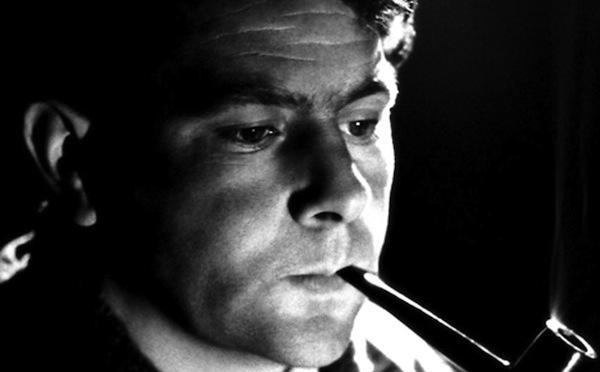
The British composer Gerald Finzi (1901-1956, pictured above) did write a “ceremonial ode” For St. Cecilia in 1946-47, setting a text by Edmund Blunden (1896-1974).  But, with your indulgence, this month’s Cecilian Ode post veers in a different direction!  According to his publisher, Finzi’s “Christmas scene” In terra pax, composed in 1954-56:

conflates Robert Bridges’s poem Noel: Christmas Eve, 1913 and Luke 2: 8–14. Finzi suggested that the Nativity ‘becomes a vision seen by a wanderer on a dark and frosty Christmas Eve, in our own familiar landscape’. In terra pax is a masterpiece in miniature, Finzi’s pacifism at its heart, and his belief that men and women of goodwill should live harmoniously. Weaving through the music are three ideas: the pealing of the bells with their joyous message, a phrase from the carol The First Nowell, and the alleluia refrain from the hymn ‘Lasst uns erfreuen’.

Why not spend 16 minutes with this ravishingly beautiful evocation of the first Christmas in the here and now?  The complete text of In terra pax follows the work:

A frosty Christmas Eve when the stars were shining
Fared I forth alone where westward falls the hill,
And from many a village in the water’d valley
Distant music reach’d me peals of bells aringing:
The constellated sounds ran sprinkling on earth’s floor
As the dark vault above with stars was spangled o’er.

Then sped my thoughts to keep that first Christmas of all
When the shepherds watching by their folds ere the dawn
Heard music in the fields and marveling could not tell
Whether it were angels or the bright stars singing.

And there were shepherds, abiding in the fields, keeping watch over their flocks by night.

And, lo, the angel of the Lord came upon them, and the glory of the Lord shone round about them: and they were sore afraid.

And the angel said unto them, Fear not: for, behold, I bring you good tidings of great joy, which shall be to all people.

For unto you is born this day in the city of David a Saviour, which is Christ the Lord.

And this shall be a sign unto you; Ye shall find the babe wrapped in swaddling clothes, lying in a manger.

And suddenly there was with the angel a multitude of the heavenly host praising God, and saying, Glory to God in the highest, and on earth peace, good will toward men.

But to me heard afar it was starry music
Angels’ song, comforting as the comfort of Christ
When he spake tenderly to his sorrowful flock:
The old words came to me by the riches of time
Mellow’d and transfigured as I stood on the hill
Heark’ning in the aspect of th’ eternal silence.


(This is an appendix to a series exploring the Cecilian Ode, a uniquely English poetic and musical genre that spans the centuries from the late 1600s to the present. Check out previous Odes here and here; look for a new ode on or about the 22nd of each month!)

— Rick Krueger

The O Antiphons: O Dayspring

The O Antiphon for the Magnificat at Vespers on December 21:

O Dayspring, splendor of light everlasting: come and enlighten those who sit in darkness and in the shadow of death.

One of the earliest sightings of the O Antiphons in English literature is in part 1 of Cynewulf’s Christ.  This collation of Advent lyrics from before the 10th century incorporates four of the seven antiphons; Cynewulf paraphrases O Dayspring in lines 105-109 and 113-119. (A modern translation by Dr. Aaron K. Hostetter follows.)

Eala earendel, engla beorhtast,
ofer middangeard monnum sended,
ond soðfæsta sunnan leoma,
torht ofer tunglas, þu tida gehwane
of sylfum þe symle inlihtes! …

swa þec nu for þearfum þin agen geweorc
bideð þurh byldo, þæt þu þa beorhtan us
sunnan onsende, ond þe sylf cyme
þæt ðu inleohte þa þe longe ær,
þrosme beþeahte ond in þeostrum her,
sæton sinneahtes; synnum bifealdne
deorc deaþes sceadu dreogan sceoldan.

“Hail shining ray! Hail brightest of angels
and illumination of the soothfast sun
sent over middle-earth to all mankind,
more brilliant than the stars—always
you light up every season of your own self! …

so now needfully your own creation
abides you faithfully, so that you send us
the bright sun, and that you come yourself
to illuminate those who for the longest time,
shrouded in shadow and in darkness here,
reside in the everlasting night—
enfolded in our sins, they have had to endure
the dark shadows of death.”

If admirers of J.R.R. Tolkien feel a familiar frisson here — well, they should!  In Cynewulf’s expansion of “O Dayspring” — specifically, in the word “earendel” — we find one of the deepest linguistic roots of Tolkien’s Middle Earth legendarium.  From that word sprang the work of his heart that occupied him for nearly six decades — The Lord of the Rings, The Hobbit, and The Silmarillion.  Tolkien even riffs on Cynewulf (and thus indirectly on today’s antiphon) on pp. 248-249 of The Silmarillion:

Hail Eärendil, of mariners most renowned, the looked for that cometh at unawares, the longed for that cometh beyond hope! Hail Eärendil, bearer of light before the Sun and Moon! Splendour of the Children of Earth, star in the darkness, jewel in the sunset, radiant in the morning!

Healey Willan (1880-1968), professor at the Royal Conservatory of Music in Toronto and organist at St. Mary Magdalene Church in the same city, composed a setting of The Great O Antiphons of Advent for the Lutheran Church-Missouri Synod’s Concordia Publishing House in 1957.  Here’s Willan’s setting of “O Dayspring,” as sung by the choir of Christ Church Cathedral in Vancouver, British Columbia:

O come, Thou Dayspring from on high,
And cheer us by Thy drawing nigh;
Disperse the gloomy clouds of night,
And death’s dark shadows put to flight.

Rejoice! Rejoice! Emmanuel
Shall come to thee, O Israel!

— Rick Krueger

(Image: O Oriens by Linda Witte Henke, Te Deum Designs.)

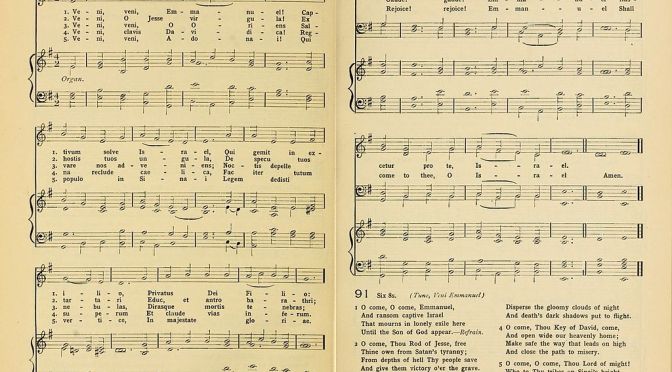
“O Come, O Come, Emmanuel”

This is the hymn of the day for the Fourth Sunday in Advent across numerous Christian traditions. Written by the Rev. John Mason Neale, published in his and Thomas Helmore Hymnal Noted, Part II (1854), and revised by Neale in subsequent hymnals until his death, “O Come, O Come, Emmanuel” was based on the series of ‘O” antiphons sung at Vespers from December 17-23.  In the original Latin, the second letters of the seven antiphons spell out the reverse acrostic “ERO CRAS” — “I shall be [with you] tomorrow”, as the Church prepares to celebrate Christ’s birth.

The tune of this hymn has an especially intriguing provenance.  According to the magisterial New Oxford Book of Carols:

In an article of 1881, Helmore revealed that the source was in face a French missal [in the National Library at Lisbon, Portugal], and that Neale himself, now dead, had copied the tune … Searches failed to locate the hymn in the Lisbon library, and doubts about the authenticity of the tune were only laid to rest in 1966, when Mary Berry (then Mother Thomas More) discovered the tune in another French source, a fifteenth-century Franciscan processional, which was probably copied for a nunnery … Each verse is set out in binatim style on two pages, with the familiar melody on the left and a simple countermelody on the right.

Which (as transcribed and collated with the Latin hymnic version of the antiphons in the NOBC) sounds like this — recorded by the Taverner Consort in the style of a Franciscan procession:

And so — 1300 years on from the origin of the antiphons, 600 years after French nuns sang the hymn in procession, more than 150 years past Neale and Helmore’s translation and transcription — we watch for Christ’s coming with the Church of all ages, and sing:

O come, O come, Emmanuel,
And ransom captive Israel,
That mourns in lonely exile here
Until the Son of God appear.

Refrain

Rejoice! Rejoice! Emmanuel
Shall come to thee, O Israel!

O come, Thou Wisdom from on high,
Who ord’rest all things mightily;
To us the path of knowledge show,
And teach us in her ways to go. Refrain

O come, O come, Thou Lord of might,
Who to Thy tribes on Sinai’s height
In ancient times didst give the Law
In cloud and majesty and awe. Refrain

O come, Thou Branch of Jesse’s tree,
Free them from Satan’s tyranny
That trust Thy mighty pow’r to save,
And give them vict’ry o’er the grave. Refrain

O come, Thou Key of David, come,
And open wide our heav’nly home;
Make safe the way that leads on high,
And close the path to misery. Refrain

O come, Thou Dayspring from on high,
And cheer us by Thy drawing nigh;
Disperse the gloomy clouds of night,
And death’s dark shadows put to flight. Refrain

O come, Desire of nations, bind
In one the hearts of all mankind;
Bid Thou our sad divisions cease,
And be Thyself our King of Peace. Refrain


— Rick Krueger