
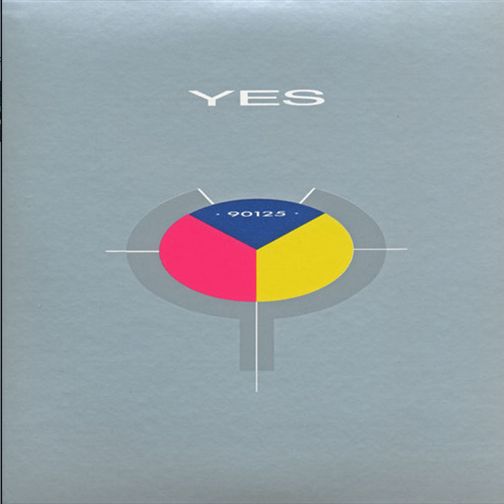
Once again, the resident music aficionados of Spirit of Cecilia (Brad Birzer, Tad Wert, Erik Heter, Kevin McCormick, and Carl Olson) turn their gazes onto a prog classic – this time discussing Yes’ best-selling album, 90125.
Tad: Gentlemen, this album came out 40(!) years ago. In 1983, I was a senior at Vanderbilt University and compact disc players were just beginning to become affordable. Against all common sense, I bought a Sanyo player for $399 and three cds: Roxy Music’s Avalon, Pink Floyd’s The Final Cut, and Yes’ 90125. I still remember the awed looks on my dormmates’ faces when I popped in 90125 and “Owner of a Lonely Heart” came blasting out of my stereo without any preliminary hiss or scratching from a vinyl lp.
At the time, this album was a huge hit for Yes, and it jumpstarted their career after it had flagged somewhat (even though I would argue that its predecessor, Drama, was a terrific work). However, we now know that the recording of 90125 was not all sweetness and light. In fact, I believe it wasn’t even supposed to be a Yes album! But I’ll let someone else who is more knowledgeable give us the details of that.
Erik: Sometime around August, 1983, I was hanging out in the rec room of one of the barracks at the ASW (anti-submarine warfare) base in San Diego, a city where I had spent several months prior and would spend a few more learning the intricacies of submarine sonar. Someone had left a music magazine hanging around, it might have been Rolling Stone, but I’m not 100% sure on that. Anyway, I picked it up and started thumbing through it and saw a news item entitled “Yes – No.” A picture of Steve Howe accompanied the short piece, which relayed the news that Yes was reforming, with Jon Anderson on vocals, Chris Squire on bass, Alan White on drums, and newcomer Trevor Rabin on guitar. While much of the piece focused on Howe’s disapproval of the new lineup, I swept that aside for the news of a Yes reunion – I was absolutely thrilled.
Later, in October of that year, I departed San Diego, training complete, and headed back to what was then home in Charlotte, NC, for a few weeks of leave before, in late November, I would make my way to my boat (the USS Olympia, SSN 717) that was then under construction in the shipyard at Newport News, VA. During my leave, Yes released the first single from the new album, followed a few weeks later by the album itself.
Oddly, I was a little bit hesitant when I first heard Owner of a Lonely Heart. While the voice was familiar, as was the bass tone, this was something radically different from anything they had done before. This one particular song was more commercial sounding than anything they had done, although it was hardly a lowest-common denominator hit. And the guitar sound (especially that solo) was nothing like I’d ever heard on a Yes album. There was, however, a bit of a fear that the sound of the album would be so unrecognizable as to not sound anything like Yes.
That fear was firmly put to rest the night before the album’s release. Listening to one of the local FM rock stations, a DJ started talking about the new Yes album, 90125, and decided to play another song off the album – Leave It. I was hooked before they even finished the first verse with that huge, wall of sound vocal harmony that opened the song. After that, I was ecstatic as I was bombarded to “doos” and “dums” and “deets” coming at me from different vocalists in a number of different directions in a vocal arrangement so complex, innovative, and interesting that only a band like Yes could even dream such a thing up, much less execute it so flawlessly. This was the music I had been waiting for since the Drama album of three years prior.
The next day (of course!) I wasted no time getting to the mall record store to buy the first of many copies of the album in cassette format that I would own – many copies because I tended to wear them out from so many listens. In my days of using a Sony Walkman, there isn’t another album that spent as much time being wound and rewound as 90125.
The first listen to the full album was absolutely magical, revealing a perfect mix of sounds that were simultaneously familiar to Yes fans and yet totally new and different. Moreover, the sound was very 1980’s contemporary. And yet even now, 40 years later, the album holds up very well without sounding dated. 90125 showed that Yes could adapt to changing times, that they were anything but dinosaurs as critics had accused them of being. It showed they could innovate in ways even Yes fans – accustomed to musical innovation – couldn’t have imagined. It showed they could be commercially relevant in a new decade without devolving into banal hitmaking.
Oh sure, there were many old school Yes fans that didn’t like the album, the ones who were probably hoping for a redux of Tales from Topographic Oceans. You can count me out of that group though, because I am one old school fan that loved the album and couldn’t get enough of it. And while there is some debate about whether the album itself should be classified as prog, the importance of 90125 to the genre cannot be overstated. A whole new generation of fans was lured in by this album, fans that began venturing into the band’s back catalog and then into the wider world of prog. Even when I consider the contemporaneous output of another one of my favorite bands – Rush – it’s hard for me to think of a single album that did more to keep the prog flame alive in the 1980’s after critics had gleefully – and, obviously, prematurely – declared the genre dead at the end of the 1970’s.
I’ll get into more of the particulars of the album itself in my next entry, but for now I’m going to turn the floor over to another one of the distinguished participants.
Carl: By reason of age, chance, and the mysterious forces of radio whims, “90125” was my introduction to Yes. I was fourteen and was just getting into pop and rock music, to the horror of my parents, who that same school year—1983-84—made me throw away some cassettes gifted by a friend. Those deeply subversive albums were by Elton John (early, mellow Elton), Pat Benatar, and Foreigner (4, of course). There was only one rock station that reached my small town in western Montana—a bucolic village with a population of 1100, no stop lights, no fast food, and (shockingly) no music scene.
I recall, quite clearly, being at church youth group one evening and someone, after the more serious stuff, cranking said radio station in their car, doors open in the parking lot. “90125” came on. It immediately grabbed my attention. “What is that?!” I thought. And then came the breakdown, and I was hooked. This was interesting music! It took a while, but I eventually got a tape of the album, and I started to learn more about the convoluted history of Yes and its connections to another favorite group: Asia. Styx, Kansas, Supertramp, Queen, and ELP all followed. I was officially into prog! (And my parents finally gave up trying to control my musical tastes.)
My years in college—split between Phoenix (1987-88), southern Idaho (1988-89), and Saskatchwan, Canada (1989-91) were filled with musical exploration, ranging from brief flirtations with metal and Bruce Springstreen to more serious dives into Pink Floyd, Rush, Rick Wakeman, Steve Howe, Steve Morse, Queensryche, Kerry Livgren, and so forth. But Yes was always a constant, and I gradually became acquainted with all the earlier work, as well as Trevor Rabin’s excellent solo album “Can’t Look Away” (1989), which I literally wore out. Then, in 1991, having moved to Portland and living with my cousin for a while, I bought my first CD: “90125”. That was a great choice, of course, because it’s a sonic marvel, with Trevor Horn (who I knew a bit about because of his previous work with Yes) at the helm.
Erik mentioned Rabin’s guitars. As I’ve listened to the album a few times in recent days, they stand out the most to me; they mark the biggest difference between Yes with Howe and the “90125”-era Yes. That’s not a knock on Howe, of course, who is fantastic in countless ways. But the stylistic differences are immense. That, in turn, informs the songs, which are more anthemic and are simply BIG in sound and intention, while containing plenty of complicated parts, harmonies, and arrangements. We’ve all read about how the album came about, how many challenges there were, and how Anderson kind of slipped into the mix; it’s a tribute to Horn and the musicians that they could overcome so much discord and paralyzing circumstances to create one of the great prog-rock albums of the 1980s.
If Rabin’s guitars set it apart, it is, in my view, Anderson’s vocal contributions that hold it together and make it a real Yes album. It would have been very good without Jon; it is a classic with him. And, again, there is the work of Horn, whose production genius is impossible to overstate. Ironically (or perhaps fittingly?), the same year (1991) I bought “90125” on CD, I discovered the first Seal album and was instantly hooked. It was, of course, produced by Horn, who has been at the helm for several Seal albums—the first three, for me, being one of the finest pop/rock trifectas ever created.
Kevin: Somehow my first memory of 90125 was the hype for the world-premier of their new music video on MTV. “Owner of a Lonely Heart” immediately received heavy rotation on the channel, in part due to the relatively-high production values for a single by an “old” group like Yes were in 1983. The avant-garde film-noir theme seemed an unlikely pairing with the lyrics but somehow it worked and captured a huge new following for the band. But it was simply a great new sound for the band and for the times.
I was fascinated with this new sound and found it to be an engaging blend of progressive and pop. Being in my mid-teens at the time, I don’t think I was as keenly aware of the importance of the “production” of a studio-recorded song, but I was aware that this was definitely a new adventure for Yes. I missed hearing Steve Howe’s guitar, but I also intuited that without Trevor Rabin in the mix this would be a completely different song.
I wholeheartedly concur with both Erik and Carl, that Rabin’s guitar really stands out on that opening track and throughout the album. I love the way the opening track begins with the “heavy distortion” Rabin sound and then quickly pulls back to the clean sound more reminiscent of Howe’s earlier contributions for the band. Whether intentional or not, it was a great way of signaling that this was something new and yet it retains those components that make it Yes.
I caught them live for this tour in Austin in 1984, and they did a great job of capturing that same energy on stage. Rabin seemed comfortable in his new role and had no trouble filling Howe’s shoes on the older material. It was a different style for those tunes, but they were well-played. This being my first chance to catch them live, I had no direct comparison, but I thought it was a tremendous performance.
But that brings up a component of this that I don’t want to miss. I’ve read various articles about Rabin and Yes and their early incarnation as Cinema. Some accounts claim that Rabin came in with much of the album finished and the band just kind of recorded what he wrote. This is an unjust assessment and really underplays what makes the album so exciting. I know this not because I was there, but because in 2003 Rabin released his demos as 90124. You can find some of them on YouTube–though I no longer see some of the tracks that better illustrate the point.
What is clear from the demos when compared to the final recording is that his ideas were seeds (some of them quite plain) waiting to be nurtured and to sprout into full bloom. There was plenty of fluff needing to be pared down. There were plenty of tweaks needed. This was not a collection of hit songs waiting to be recorded; it was a mishmash of some good ideas that needed the rest of the band to make great. Not only did Squire and White bring these germs to life with a powerful rhythm section, but Trevor Horn’s production makes every track completely blossom. Then Jon Anderson arrived in the last few weeks of recording and, as Carl noted, turned a good album into “a classic.” His lyrical contributions alone changed the whole tenor of the work and his vocals are captivating in a way that is simply not there without him.
This was a band effort, an incredible symbiotic musical creation worthy of review forty years on. It will be remembered because it captured and launched the sound of the times both into the prog realm and beyond.
Tad: Kevin, thank you for providing the context in which Trevor Rabin’s contributions were made. It’s interesting to me how a consistent thread in all of our reminiscences has emerged: about how crucial Trevor Horn’s production was. I was a fan of his from his Buggles days – when he and Geoff Downes joined Yes for Drama I was really surprised, because I thought of them as synthpop artists, not progressive rockers! I ended up buying everything Horn produced for his ZTT record label: Frankie Goes To Hollywood (they have not aged well), Propaganda (amazing German group – A Secret Wish remains a favorite 80s album), Art of Noise, and Grace Jones (Slave to the Rhythm). Anyway, I agree that without Horn, 90125 would not be the success it is.
Okay, I’d like to share what my favorite moments on this album are! First, on “Owner of a Lonely Heart”, the opening muffled drum fill that is overtaken by Rabin’s clean guitar riffing, punctuated by Horn’s stabs of synthesized orchestral noise. That mix still sounds new and exciting to me 40 years later.
Second, the massive vocal harmonies on “Hold On” around the 4-minute mark, where they sing “Sunshine, shine on, shine on you”.
Third, the intro to “Changes” where a motif on vibes is played as various other instruments enter playing King Crimson-esque patterns until Rabin’s guitar takes control and gets the proper melody underway.
Fourth, all of “Leave It”. This song is such a vocal and instrumental tour de force! A wall of sound that leaves me wishing it would never end.
Finally, the moment at 5:30 into “Hearts” where the melody transforms from an aggressive, plodding riff to a beautiful, warmhearted tune that is carried by some of Jon Anderson’s finest vocals.
As is my wont, I need to remark on the artwork – what an iconic representation of early 80s fascination with technology! It’s obviously computer-generated graphics that, at the time, seemed futuristic and edgy. And the title came from the catalog number assigned to the album by the label. About as far as you can get from Roger Dean’s fantasy landscapes.
All in all, just a superb album, and I’m thankful all the musicians with their various agendas were able to gel into a cohesive unit and get it done.
Brad: Well, I’m late coming to this conversation, but I love seeing what Tad, Kevin, Erik, and Carl have all contributed. Thanks to you each for such great thoughts.
I have this album on CD now as well, but I very much remember buying the vinyl back in early November 1983. I loved the Apple-esque cover of the album (though, I grew up loving Roger Dean’s work, especially for Yessongs), and, like all of us, I was already taken with “Owner of a Lonely Heart.” I had grown up with Yes (but had somehow misse free d Tormato and Drama, I wouldn’t come back to both until after 90125). One of my fondest memories is listening to 90125, whole and complete, with my headphones on during that November and December of 1983. The lights off in my bedroom, the headphones on, and Yes playing beautifully, me absorbing it all..
As much as I loved “Owner of a Lonely Heart” at the time, it was the album as a whole that really grabbed me. I remember being utterly moved by “Hold On”–”constitution screwup, shattering the dreams” and thinking it one of the deepest songs I’d ever encountered.
Talk the simple smile, such platonic eye
How they drown in incomplete capacity
Strangest of them all, when the feeling calls
How we drown in stylistic audacity
Charge the common ground
Round and round and round, we living in gravity
Shake – We shake so hard, how we laugh so loud
When we reach, we believe in eternity
I believe in eternity.
These were (and remain) pretty heady lyrics for a sixteen year old. Yes’s 90125 made me realize the possibilities of rock music, just as Rush’s Grace Under Pressure soon would
Then, “It Can Happen”:
You can mend the wires
You can feed the soul apart
You can touch your life
You can bring your soul alive
It can happen to you
It can happen to me
It can happen to everyone eventually
Followed by the brilliant “Changes.”
Flip the record over.
Side two, roaring into life with “Cinema.” As I understand it, this was originally the introduction to what might have been a twenty-minute epic, “Time.” As it was, though, it stood alone in its gorgeous production, leading into the magisterial “Leave It.”
“Our Song” is a great rocker.
Toledo was just another good stop
Along the good king’s highway
My fortification took me by surprise
And hit me sending me sideways
Spellbound – Roundly – Good for sunshine
Can’t help thinking
Singing the Rule Britannia
And this is where it grabs you
There’s method in the key of C
Toledo’s got to be the silver city
In this good country
“City of Love” and “Hearts” perfectly close the album.
Many moons cascade one river
They light from side to side
As we cross in close proximity
Like rivers our hearts entwine
How we talk – How we teach our children
How we move – We direct our eyes
All the senses tuned discovery
As and as and when our hearts decide
Be ready now – Be ye circle
Be the central force ye life
As the game extends the cycle
Be ready to move
Kevin, I’m jealous that you got to see them live in 1984. I’m sure that was an extraordinary concert, capturing all the energy of a reborn-band. Speaking of which, I’ve always liked 9012-Live: The Solos, the live album that came out in 1985. Again, it just exudes energy and creativity, a band at its best.
Erik: Great comments all, and a lot of fodder to work off of as I discuss the album proper.
We’ve talked about Rabin’s guitar, it’s contrast to Howe’s work, and its impact on the music. But there is another contribution that is also quite notable, and that’s Rabin’s contribution to the vocal landscape of this album. I am adamant in my opinion that from a purely vocal perspective, the Rabin-era lineup is far and away the best Yes lineup. Consider a few of the songs. First, Leave It is simply not possible without Rabin. Not only does he trade lead vocals with Anderson, but his contributions to the harmonies are critical. Changes is another song that is not possible without Rabin, due to the lead vocalist role alternating between him and Anderson. And the “talk the simple smile” section of Hold On is yet another harmony that would not sound anywhere near as good without Rabin’s contribution.
This ability to switch back and forth between Rabin and Anderson on lead vocals, as well as the ability to create the vocal harmonies that permeated 90125 made Rabin’s vocals an excellent addition to the Yes sound. It’s almost as if Rabin was put on this Earth to harmonize with Anderson and Squire, because his voice fits with them so perfectly. It’s another reason why the version of the pre-Rabin Yes classic I’ve Seen All Good People from 9012Live is my favorite version of this song – Rabin’s contributions to the vocal harmonies makes what is primarily a vocal-driven song all that much better.
I’ll also throw in more on Horn’s production with regard to a couple of additional observations to go with those given above by Tad, Carl, and Kevin. First, neither Rabin nor the band in general was all that fond of Owner of a Lonely Heart in its demo form, but Horn would have none of it. While he wanted a reworking of the lyrics, he nevertheless recognized the song as a hit – in part due to the intro, and in part due the chorus – where the band did not. Horn didn’t merely want this song on the album, he insisted on it. Working with the band to rewrite some of the lyrics (for which Horn himself received partial credit) as well as arrangements on the final recording, Horn helped mold the song into the first #1 single Yes ever had, and one that propelled this album into the stratosphere (also, the band’s only #1 album).
Another aspect where Horn excelled as the producer of 90125 was the underappreciated role of track sequencing, upon which he conducted a clinic of how it’s done. The sequence of songs begins by a delightful punch to the listener’s face (and ears!) with Owner of a Lonely Heart, especially with the intro guitar riff, before moving into the slow but heavy Hold On. Similarly, the beginning of side 2 with the instrumental Cinema flowing seamlessly into Leave It is just chef’s kiss perfection. And closing the album with Hearts was a fitting conclusion to Yes’s 80’s rebirth. Overall, every track on the album feels like it is placed exactly where it should be. While such sequencing always seems obvious to us in retrospect, the producer had to start with a collection of songs and figure out what would go where. To ask Horn to do a better job than he did on 90125 is to ask the impossible.
I also like Kevin’s observation with regard to Anderson’s impact on the album. Like him, I’ve listened to the demos, and the contrast between those and the finished product is striking, with Anderson’s influence being undeniable. It was his presence and his contributions that made 90125 truly a Yes album and not just an album performed by some musicians who had been in that band. There are lyrical passages throughout the album that the seasoned Yes fan will instantly recognize as Anderson’s words.
As far as some of the other tracks go, I’ll first start with It Can Happen, a track which I absolutely love. This is one track that encapsulates the old Yes spirit of the 1970’s into the new Yes sound of the 1980’s. Tying to the previous paragraph, this song is one that really demonstrates Anderson’s imprint on the lyrics when compared to the pre-Anderson demo.
Hearts pulls off the same feat of encapsulating the old spirit in the new sound in a different form, hinting at some of Yes’s earlier long-form epics while keeping things economical. I love the “explosion” in the middle of that song that leads into the “who would believe you, wise men do” section. Our Song is a deep cut favorite, featuring a driving, tour de force performance by Squire on bass. Changes was a perfect FM radio staple for the era, with an ear-catching introduction and huge, dynamic swings between the quiet and heavy sections, along Rabin singing lead on the verses while Anderson takes the lead role on the choruses.
I’m going to cut myself off right here, because I could go on and on (and on) about this album and I need to give some space for the rest of you. I enjoy reading your contributions as much as I like writing mine! But in conclusion, when I think of albums of the 80’s that really define the decade (at least for me personally), this one is alway at or near the top. And as a Yes fan, I continued to be thrilled all these decades later that they were able to pull off an album like this, a commercial and artistic triumph that happened in the context of the band navigating a radically different musical landscape from the one in which they had achieved their previous great successes.
Tad: Erik, I think your remarks are the perfect way to conclude this discussion. Gentlemen, it’s been a blast revisiting this album!













 Spirit of Cecilia
You must be logged in to post a comment.