Category Archives: Philosophy

The Seventh Art: My early life with my family and classic Hollywood movies.

by Richard K. Munro rmunro3@bak.rr.com
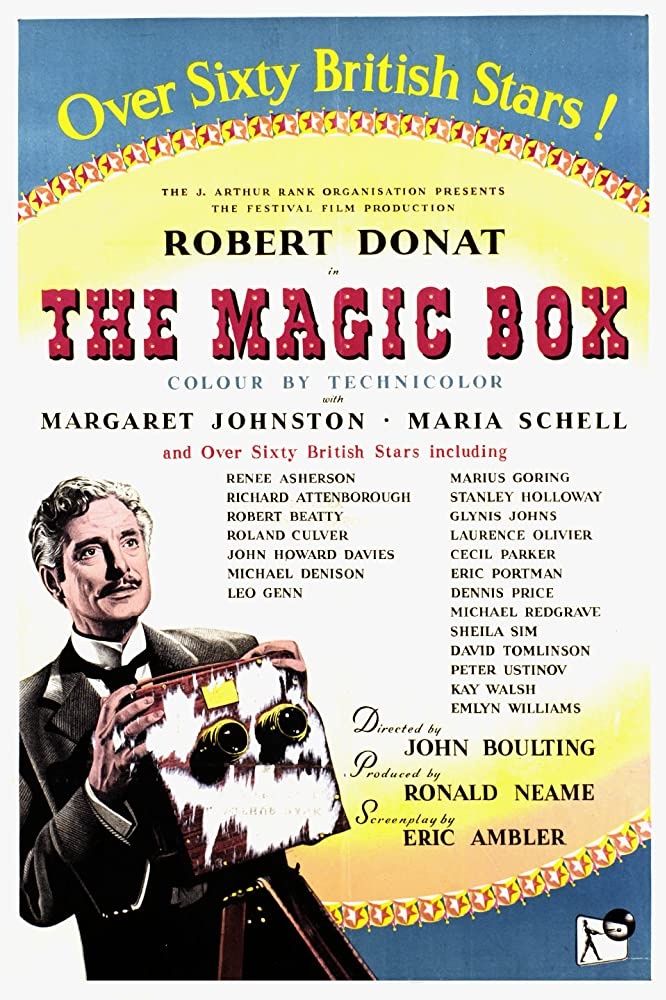
We Munros were a theater, concert, art and movie-loving family. I have always loved movies but it was not until 1978-1979 that we began collecting movies on VHS and later DVD and BLUE RAY. I still prefer having a pristine version of a classic movie with all the extras so that I can learn the back story of the film, the director and the actor. I have a book that belonged to my father and there is an inscription that says: “To Dad and his magic box and all the joys it unlocks.” Dad always called the VCR “Munro Theater” or the “Magic Box.” That is an allusion to an old British Technicolor film with Robert Donat as William-Friese-Greene, one of the pioneers of movies and color film. Of course, it is an example of a movie my father talked about and when it came on TV he encouraged us to watch it. My parents loved all the arts but music, drama, and poetry were their favorites. But it had to be the Seventh Art (the movies) they loved the most and they shared this love with the family from our earliest years.

By contrast, my father had a very utilitarian view of cars. He had a free and clear 1954 Ford for almost 20 years. Then he bought a red Opal. He bought a 1964 Chrysler Station wagon for my mother that we had for years and Pamela drove it off to California where it died. The only time I went to the car dealership with my father was twice. Once in 1972 when he bought a Chrysler New Yorker, new. A nice car but not super luxurious. Then my father some years later went to a VW dealer who offered my father $50 for the used Chrysler, a V-8 engine in good condition -only about 60,000 miles. My father said, “You have to be kidding.” The man said, “No one wants a gas guzzler like that anymore.” My father turned to me and said, “Do YOU have $50?” I said, “Probably not, maybe $30.” My father said, “Give me the money!” I did -in front of the salesman. My father said the car is yours.” That car I eventually drove west via Texas. The point is my father didn’t care about ostentatious cars. He did care about art, literature, books, theater, and good movies. And that plus travel is where he spent most of his money.

My father and mother must have visited Greece two or three times, Italy two or three times, Spain about half a dozen times, France several times, and Germany, where my sister and brother-in-law eventually lived about twenty times. My father saw the best opera in all the great European capitals. We saw plays in Dublin, London, and New York. They went to Shakespeare Festivals. My father never once as far as I know, saw an NBA basketball game or an NHL Hockey game but he was very fond of baseball saw many World Series Games (1949-1969), and enjoyed World Cup Soccer as well, which was his favorite sport as a boy. But my father always had a great love of the movies, not television per se but the movies.

My parents went to see a movie on their first date (Wendy Hiller in MAJOR BARBARA with Rex Harrison and Robert Morley). Kay Brennan and Ruth Munro went to the movies and theater after graduating from Manual Training High School in 1933. My father also graduated from MTHS the same year and they had some of the same teachers but did not have any classes together and they did not meet until 1940!

But one of my father’s many jobs in the 1930s was as a movie usher in a cinema (I forget which one I think it was the Roxy in Manhattan a huge movie palace). So he learned something about projecting movies and saw many movies dozens of times. In those days a hit movie might run for 26 weeks 52 weeks or more! So when it came the top movies of the 1930s Dad was practically an expert. He knew when they premiered and where and which one was a hit and which one won Oscars etc. He saw Hollywood Stars in person such as Clark Gable who was promoting a new movie called Red Dust (later remade in color as Mogambo by John Ford).

In those days Hollywood stars would make personal appearances in the big movie houses (that had 2500-4000 seats or more) in big cities like New York, Philadelphia, Chicago, and San Francisco. And of course in those days almost all the stars began on Broadway. Today there are stars like Kristen Bell (FROZEN) who began on Broadway but also Meryl Streep (whom we saw live on the stage on Broadway in 27 Wagons Full of Cotton and Chekov’s THE CHERRY ORCHARD. My father saw Leslie Howard and Humphrey Bogart in the original stage version of Sherwood’s excellent play THE PETRIFIED FOREST, he saw Walter Houston on the stage (and met him), ABE LINCOLN OF ILLINOIS (also by Sherwood) with Raymond Massey (he reprised the role for the film) both my parents saw Maxwell Anderson’s fine play Mary of Scotland (1933-1934) with Helen Hayes; Katherine Hepburn played Mary in the movie version (1936).

 My mother and father were fond of British films so I was familiar with many of the stars in the show like Robert Donat (The 35 Steps; The Ghost Goes We West; The Inn of the Sixth Happiness) Peter Ustinov (Spartacus; Quo Vadis; the Sundowners), Laurence Olivier (Rebecca, 49th Parallel, Spartacus) Glynnis Johns (49th Parallel, Mary Poppins, The Sundowners, Rob Roy the Highland Rogue) Dennis Price (Kind Hearts and Coronets), Marius Goring (A Matter of Life and Death or Stairway to Heaven). My father considered these the great directors: David Lean, John Ford, Alfred Hitchcock, Billy Wilder, John Houston, Charlie Chaplin, Fritz Lange, Stanley Kubrick, Frank Capra, George Cukor, William Wyler, Richard Attenborough, and Michael Powell. He never cared really for Cecil D. Demille (The Ten Commandments).

We always looked for stars and my father and mother talked about them and gave us a backstory. Such as Hollywood star Robert Montgomery ( NIGHT MUST FALL/ HERE COMES MR. JORDAN; THEY WERE EXPENDABLE; he was the father of Elizabeth Montgomery of Bewitched). Montgomery was a volunteer ambulance driver during the Dunkirk evacuation in 1940, a US Naval officer in the Pacific, and at D-Day; my father knew him during WWII and had a framed picture that said, “To Tom from Bob Montgomery.” Later Montgomery was a media TV advisor to President Eisenhower, and you can see him in the first-ever color broadcast of a president on 22nd May 1958. The USA started broadcasting color in late 1953 and some live news events or sports events were broadcast in color such as the World Series. Color videotaping began in the USA in 1958 and the footage with Montgomery and Eisenhower is the earliest known color videotape to exist. It is interesting to me that my kinsmanNorman Eliasson knew Ike personally at Columbia in the later 1940s and my father had met Robert Mongomery who was one of his favorite actors.

Another WWII veteran we heard about was Jimmy Stewart (IT’S A WONDERFUL LIFE; THE SHOP AROUND THE CORNER) who enlisted in the Army Air Corps and led bombing missions over Nazi Germany. Sadly his stepson, also a patriot, was killed in action during the Vietnam war. Clark Gable was considered the King of Hollywood; both Dad and Kay saw him in person in New York. Kay took this photo in about 1940.

  Gable had been married to CAROL LOMBARD one of the most elegant beauties and comediennes. She was killed in a plane crash while selling war bonds. He was to have gone on an early flight but she and others gave up their seats to servicemen. She never lived to see the triumph of her last film TO BE OR NOT TO BE one of the funniest satires of theater, WWII and the Nazis ever made. After her death, CLARK GABLE, though over 40 years old volunteered for the US Army Air Corp where he supervised training films and also flew combat missions over Nazi Germany.

Claude Raines (Casablanca), Ronald Colman, and Basil Rathbone (Robin Hood/Sherlock Holmes, The Last Hurrah) were all decorated WWI veterans serving in the London Scottish and Liverpool Scottish. Roland Colman was a real family favorite in films like LOST HORIZON, TALE OF TWO CITIES, CHAMPAGNE for CAESAR, A DOUBLE LIFE -his Oscar-winning role. Colman also recorded all the Sonnets of Shakespeare and my father had all his records and later made tapes. I used to make my father laugh by imitating Colman’s dreamy English accent. “My dear…perhaps I could be a WRITER. And if I were king, I would to all the world happiness bring.”I have listened to Colman’s recordings of Shakespeare dozens of times.

One of the nice things about Audible is the chance to hear educated British speakers and some of Colman is available also. We always had some books or poems on records but cassettes really were somewhat cumbersome and fragile. You couldn’t take them in cars because they literally would melt with the heat! LPs are in fact more durable and have better sound.

Another WWII veteran we heard about was David Niven (SEPARATE TABLES his Oscar-winning role with Wendy Hiller (also won an Oscar) Rita Hayworth, Deborah Kerr, Burt Lancaster, Rod Taylor, AROUND THE WORLD in 80 DAYS, 55 Days At PEKING, The Guns of Navarone, ENCHANTMENT and one of my mother’s favorite movies STAIRWAY TO HEAVEN or A MATTER OF LIFE AND DEATH. Niven was a REAL hero, not just a movie hero (he served as a Major in the Commandos as well as the HLI serving in total of 11 years in the British Army.

If you read my friend Andrew Robert’s great biography on Winston Churchill, which I helped edit in 2017-2018, you will see a few Hollywood and movie star mentions. On page 697 Andrew added Tyrone Power as the star of BLOOD AND SAND (which was a favorite of Churchill’s. These Hollywood details were not in the original manuscript. I think I was more familiar with classic movies than Professor Roberts but of course much of this knowledge I owed to my father. I told Roberts Tyrone Power was a star on Broadway but like Niven, he was the kind of man Churchill would have admired -he left Hollywood to volunteer as a Marine aviator, saw action in the Pacific (shot down at Iowa Jima), and remained in the Marine Reserves until the end of his life (even during the Korean War). I also believe Churchill saw Power on the stage in the 1950s in MISTER ROBERTS (He was not in the movie version). I learned this from my father so Dad would have smiled to see the reference. It is the same with the references of Leslie Howard who personally knew Churchill and who worked undercover for MI6 in Spain and Portugal. Page 426 has a note I suggested. Churchill made an allusion in one of his letters to “Gone with the Wind” and the note says “Margaret Mitchell’s novel, published in 1936 was in the process of being made into an Oscar-winning movie, starring Clark Gable, Churchill’s favorite actress Vivian Leigh and his friend Leslie Howard.” On page 760 Roberts says “the splendid propaganda movie IN WHICH WE SERVE” which I also suggested as both a fine movie and one of the great WWII films. I double-checked every date, literary reference, and movie reference in the book and many many commentaries and suggestions some of which were incorporated or which influenced his final manuscript. Roberts was very appreciative and said, in his dedication to my autographed edition, “Thank you for helping SO MUCH with this book.” So some footnotes on Condor FW planes, the Punic Wars, John F. Kennedy, and the USA electoral college owe a lot to me. It is a great book and Roberts deserves all the credit in the world but I did help on what will probably be the greatest Churchill biography of this century. It is a modest feather in my cap.

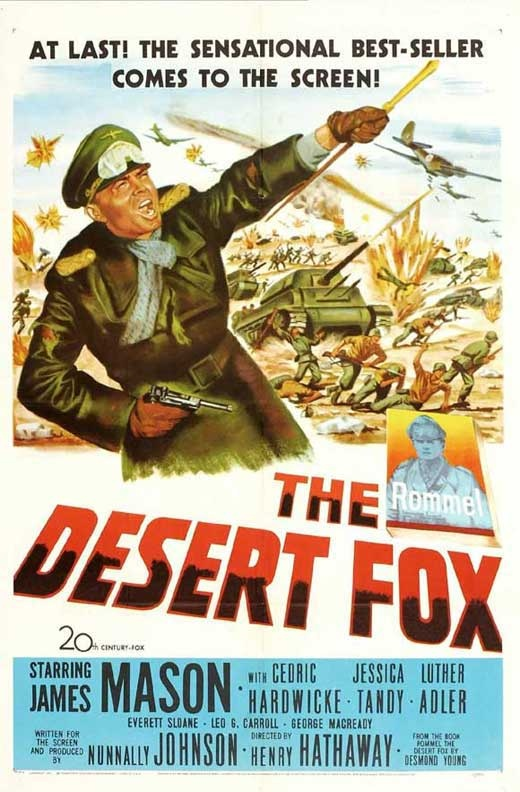
My father bought his first color TV in late 1959. For most of my early life, we had only one TV so we usually watched things together, especially on Saturday night. Saturday mornings Pat and I as I have mentioned elsewhere often would see cartoons (many in color but not all). NBC Saturday Night at the Movies was the first TV show to broadcast in color relatively recent feature films from major studios though most were still Black and White The series premiered in 1961 and ran until October 1978 so it covered my entire youth before VHS or DVDs or cable was available. It began with a roll of drums (later they gave it other theme songs) . It was probably our favorite all-family activity and I remember some of the movies vividly such as the tip-top western GARDEN OF EVIL (with Gary Cooper, Susan Hayward, and Richard Widmark), directed by Henry Hathaway That was one of those films that never seemed to be on TV again and I think I only saw it twice my entire life until I bought the DVD (it was never on VHS). I remember seeing THE DESERT FOX also directed by Henry Hathaway (the Story of General Rommel with James Mason) and it made a great impression because it had the July 20, 1944, Hitler assassination plot but also because my father told stories of guarding Afrika Korps prisoners in 1943 in New Orleans when he was a Sgt in the Military Police. And Auld Pop (Thomas Munro, Sr) talked about when he took German prisoners at 2nd Ypres (He had good relations with German Pow’s and had some trench art -ashtrays- made of artillery shells. The following week I went to the local hobby store to buy packs of AIRFIX AFRIKA KORPS and 8th Army toy soldiers. I refought dozens of desert battles plus Tobruk, El Alamein, and so on. A curious detail is Mrs. Rommel gave her husband’s scarf for Mason to use in DESERT FOX and in its quasi-sequel THE DESERT RATS.
 I used to play toy soldiers with Christ Tabbert (our neighbor) who was the son of tenor William Tabbert (of South Pacific fame). I loved war movies like WWI WHAT PRICE GLORY (John Ford) with James Cagney, adventure movies like DESTINATION GOBI (Richard Widmark), spy movies like FIVE FINGERS (James Mason). My mother liked musicals (I paid less attention to them usually playing with toy soldiers on the carpet) but WITH A SONG IN MY HEART (Susan Hayward) and There IS NO BUSINESS LIKE SHOW BUSINESS. One of my favorites was the baseball comedy IT HAPPENS EVERY SPRING with Ray Milland (DIAL M FOR MURDER). I was so taken by it that I read the book by Valentine Davies when I was only seven or eight years old. I was a precocious reader. I read Caesar’s Gallic Wars when I was 9 and Xenophon’s Anabasis when I was 10. I read Alan Moorehead’s books (from my father’s library) on the Desert War (the March to Tunis).
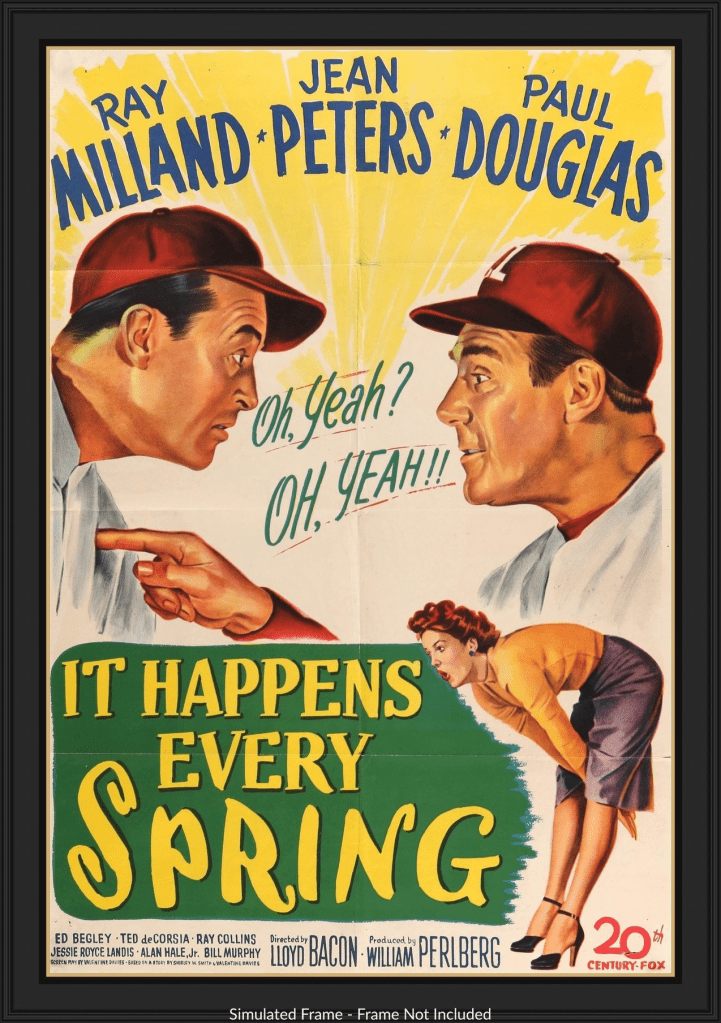
IT HAPPENS EVERY SPRING was by the same author Valentine Davies who wrote MIRACLE AT 34th Street. I didn’t see Miracle at 34th Street on NBC because I think all “holiday movies” (Wizard of Oz etc) were on CBS usually once a year at Christmas or Thanksgiving. I know I saw the DESERT RATS (1953) because it starred again James Mason, the 8th Army and the Afrika Corps. Another great WWII thriller was DECISION BEFORE DAWN with Richard Basehart and Oskar Werner about a German soldier volunteering to be a spy for the Allies. One might have thought Kay Brennan would say something about this as she had lived in Hungary, Germany and Austria but when it came to her mysterious life and spy pictures she was completely closed mouth. She talked garrulously of baseball films or Bogart films or Westerns but not spy films. My uncle (cousin) Norman Eliasson, who worked for the DOD for 30 years said, Kay Brennan my godmother and her friend Jack Stewart were both spies with the CIA. I knew Jack Stewart well. -I had dinner with his wife (a great baseball fan) many times at his NY apartment. Once, just by chance, I saw him with two younger men walking in Washington DC near Lafayette’s Square. Jack was very surprised to see me but he was very friendly. He introduced each man as Agent X and Agent Y (he used real names I don’t know if they were fake or not). But it was very peculiar. He spent his life at the UN (I had drinks with him there several times(and traveling around the world for the US government. But Norman said the real undercover agent was Kay Brennan. Her cover was she was a photographer and she lived off the rent from the pharmacy and building in Brooklyn she had inherited from her father. But Norman said, for a Commerical photographer, she didn’t have a lot of published works (I did see an exhibition at the Kennedy Center featuring her photos of the Middle East). And she visited almost every British and American Embassy in the world and was on a first-name basis with the Ambassadors. She brought back exotic hats (some of which I have) and fossils.

We may never know.

All I know is when I published an article on Kim Philby (a major Communist spy) she did not congratulate me. She said she didn’t like it. Maybe someone gave her heat for it. She certainly never spilled any beans about him to my parents or me. But she was the very last US citizen to have a drink with him (he escaped by jumping off the balcony then he fled to Russia but some rat line). So who knows? It is one of those Munro family mysteries. We have our share of heroes, madmen, spies, and black guards. Two common strands are pride and boldness (sometimes reckless). The other might be gluttony and periodical laziness unless prodded.’

There were only a few ways to see movies when I was a kid:

1) see it first run at the cinema (if in New York City or Philadelphia, this was a very special event or in the local cinemas in Livingston or Montclair NJ

2) see it on TV usually CBS or NBC if it was a “big movie”

3) see it in an art theater in New York City like the Little Carnegie. NYC used to have a love of “art movie houses” that played older classics, British and Foreign movies. After 1978 we began to watch VHS movies my father taped or professional VHS tapes we bought once the prices came down.

I have great memories of going OUT to the Cinema as a kid (it was a special event) but also watching movies at NBC Saturday Night at the Movies or The CBS late show. Of course, MILLION DOLLAR movie was a series which began in NYC, on local station WOR-TV 9, in 1955 and ran until 1966 It featured top-tier movies (GARY COOPER/ JIMMY STEWART/ JOHN WAYNE) and each feature would run for an entire week, airing twice nightly. So literally, if I were on vacation I could see a movie several times in a week. I also liked the so-called show “The Sons of Hercules” which were color but cheaply made Italian sword-and-sandal films by giving them a standardized theme song for the opening and closing titles. So you could see the same movie two or three times. The theme music was the Tara Theme from GONE WITH THE WIND but I didn’t know this until I saw GONE WITH THE WIND for the first time in 1967 in a cinema.

But rarely if ever did we see movies at school though I can remember a few exceptions. In grade school, we saw DRUMS ALONG THE MOHAWK (1939) a John Ford film (quite good) about the American Revolution, and in Junior High (Heritage Junior High) we saw two films (after school in the auditorium) I think that were quite popular but campy) FANTASTIC VOYAGE (a science fiction movie) and ONE MILLION YEARS BC. Both films featured RAQUEL WELCH who was the number one sex symbol at that time. In One Million Years BC she said only a few words but showed off her stunning figure in an animal-skin bikini. It seemed every adolescent kind had her poster from that movie. I never had a poster myself but I saw it many times! In High School, the only movie I can remember seeing was LOS OLIVIDADOS which we saw on a field trip to a Spanish movie theater in New York City.

    EARLY MEMORIES of memorable movie outings included seeing Cinerama movies. These were treated as a big theatrical event, with reserved seating and printed programs, sometimes a live show (such at the RKO Music Hall), and audience members often dressed in their best attire for the evening. People didn’t dress like slobs in those years especially going to the theater or church. I remember seeing movies at the old CRITERION on 1514 Broadway. The very last movie I saw there was with my boyhood friend Tommy Hess and the movie we saw was PATTON (1970) and the year before we saw TRUE GRIT (1969) with his parents who lived in Connecticut. We would sometimes meet in NYC or I would take the train to Stanford. It was a long drive and my parents visited only once or twice. The Criterion was big it had over 1500 seats.

Another theater I remember was the Warner Theater at W. 47th st. My father took my and my school friends to see the 70 mm version of “It’s a Mad, Mad, Mad, Mad World. for my 8th birthday in December 1963. I remember he drove us in his station wagon (which he parked at the Port of Authority) and then we stopped at Walgreen’s store so we could buy candy bars to (sneak) into the movie theater. My father didn’t mind paying top dollar for a premiere run but not $5.00 for a chocolate bar. I bought a giant Baby Ruth bar that lasted me the whole movie. When I was a kid I like Juicy Fruit gum, Hershey’s Chocolate, and Baby Ruth bars.

Once we went to the Boyd Theatre in Philadelphia. I think my father had a business associate nearby. The Boyd Theater was the only venue for 3-strip Cinerama movies in the 1950s and 1960s. I remember we visited Independence Hall and saw the Liberty Bell in the morning and then in the late afternoon after a lunch at the legendary BOOKBINDERS we went to see the Western Blockbuster HOW THE WEST WAS WON with Jimmy Stewart, Gregory Peck, John Wayne, Walter Brennan and Debbie Reynolds -SINGING IN THE RAIN)

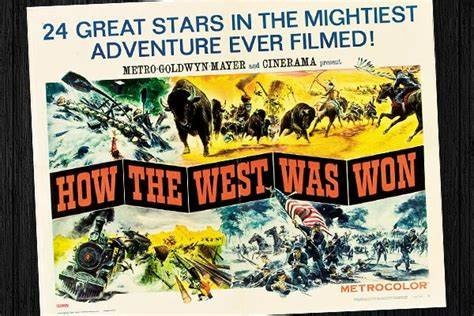
“How the West Was Won” in 1963 ran for 39 weeks to sold-out houses. My parents had to buy the tickets weeks in advance. Previously The Boyd Theatre hosted many of Philadelphia’s first run 70mm Roadshows like “Ben Hur” (with Charlton Heston appearing in-person to promote the film, 1959), “Judgment at Nuremberg”(1961), “Becket”(1964) and “Doctor Zhivago”(1965). But except for DR ZHIVAGO I didn’t see any of those movies at that time I only heard about them. But my father as he traveled around America (he financed construction and mining equipment as well as diners) he saw movies in all of America’s great movie houses. I know he saw THE SEARCHERS in Chicago with his partner Herb Katcher who was the brother of Leo Katcher (Hollywood writer). I remember them talking about it at the 1407 Club and other great films they saw together. The went on business trips Herb never flew after WW2 and they took the train so they saw films in Chicago or Atlanta like Exodus (my father thought it was only so so), Ben Hur, NORTH BY NORTHWEST, EL CID, The LAST HURRAH, and Judgment at Nuremberg with Spencer Tracey.

We weren’t far from Philadelphia and we went to museums and ballgames there later when my sister Pat went to Swarthmore and after college, she lived in Pennsauken, NJ (South Jersey).
One memorable movie memories was seeing THE LONGEST DAY in December 1962 in NYC also for my birthday. I think I saw it two or three times (once in New York and later in New Jersey). John F. Kennedy loved THE LONGEST DAY and the early JAMES BOND MOVIES. In fact, he helped popularize the James Bond novels in America in the 1950’s and early 1960’s. The last film he ever saw at the White House was FROM RUSSIA WITH LOVE.

I didn’t see the early James Bond films like DR NO and FROM RUSSIAN WITH LOVE. But my father did on his business trips. I think my parents thought the films were too sexy for me. They wouldn’t let me see LORD OF THE FLIES either But I do remember GOLDFINGER which we saw sometime after Christmas, 1964 at the DeMille Theater in New York City. To promote the film, the two Aston Martin DB5 sports cars were also showcased at the 1964 New York World’s Fair (which we saw). I had a little toy gold Austin Martin with its ejector sheet. Naturally, I added this car to my African armies and shot out German soldiers dozens of times from high places. I still have it and the ejector seat still works!

Following the opening at the DeMille Theater, demand for the film was so high that the theater stayed open twenty-four hours a day for around-the-clock showings from Christmas Eve straight through until after New Year’s Day. That was unheard of then and would be impossible today but the Demille Theater was the only theater in New York (and I think North America) showing the movie. They say people flew from London or Montreal Canada to see GOLDFINGER. It was a lot of fun a popcorn movie but of course, it was not really a serious movie at all.

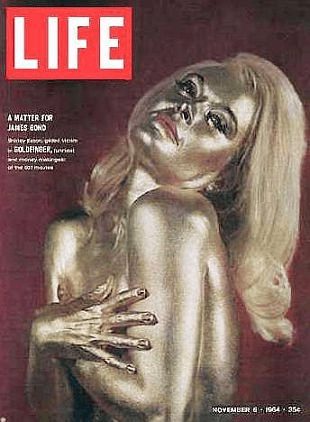
I remember the LIFE MAGAZINE ISSUE with cheesecake photos of the Golden Girl. Those movies were quite risque for its time and it was the first time I heard the expression PUSSY GALORE which to me was just a name. A pussy was a cat. My parents laughed but didn’t explain it to me. I didn’t find out until years later when I was in basic training in the Marine Corps.

But that is another story. Let me say I never heard my parents or grandparents curse or use ethnic slurs though occasionally they had to explain them. My mother used to say (of Mr. Brown), “He is a nice Negro gentleman” or “Be kind to the Negro Gentleman.” That was considered polite circa 1960-1963. It was considered bad manners to say “Black” or “African” and no one ever said, “African American”. Some people -my mother’s mother said “Colored People” but my parents told me even that was old-fashioned. They never used the N-word. The first time I heard it was in the movie TO KILL A MOCKINGBIRD with Gregory Peck (1962).

In the later ‘60s and early ‘70s, the era of these big blockbusters was ending. We saw MY FAIR LADY and MARY POPPINS and they were big hits. But the GREATEST STORY EVER TOLD (1965) was not. We went to see the FALL OF THE ROMAN EMPIRE (1964) not bad really but in a practically empty movie theater.

The same was true with KHARTOUM ( a good film with Charlton Heston) though his PLANET OF THE APES was a big hit). We saw the BATTLE OF BRITAIN (1969) but no one went to see it. I remember seeing YOUNG WINSTON (1972)- an excellent film- twice or more but each time in a practically empty theater. When I was in college I saw ISLANDS IN THE STREAM (good film) but now one went to see it and it almost vanished. I also saw THE BRIDGE TOO FAR (a 1977 war drama) but it was a bust (though a fine film); everyone wanted to see STAR WARS which I liked but thought was childish. I always liked STAR TREK more. I remember going alone because I couldn’t even get a date to go with me. But I wanted to see it in a big screen so I did. I now have it’s DVD and of course I read the Cornelious Ryan book it is based on.


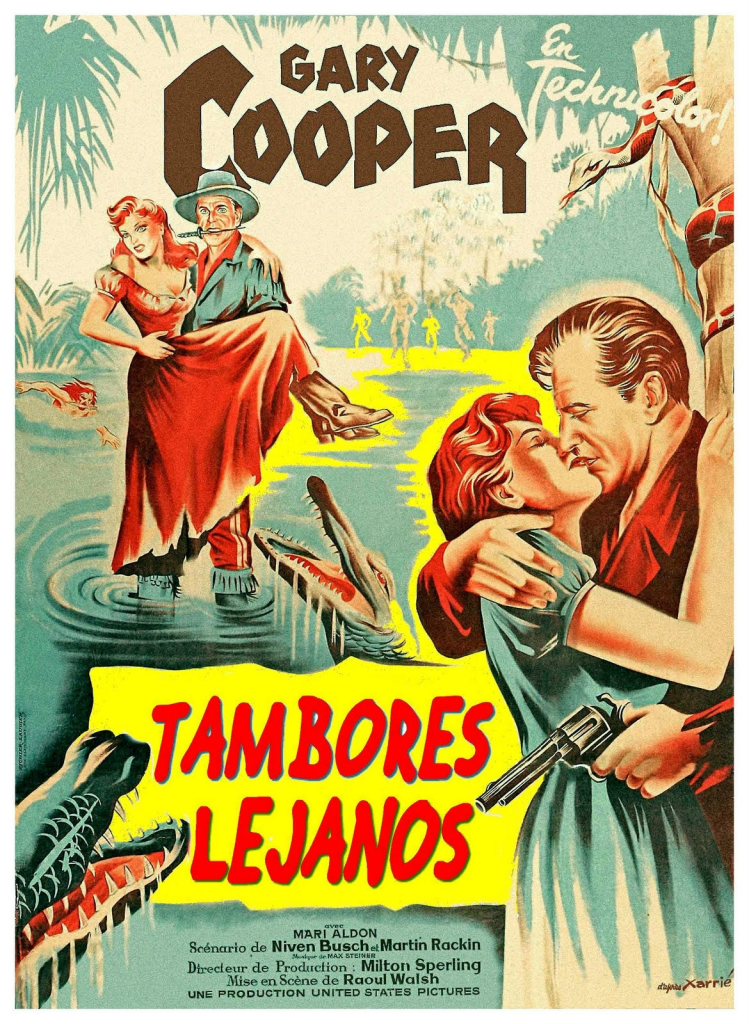
    Of course, Spain has a role in my movie-going experience. In 1964 we stayed at the Rex Hotel on the Gran Via (then Jose Antonio) and next to this hotel was a big movie theater called the REX also and it was showing TAMBORES LEJANOS LA MEJOR CREACION DE GARY COOPER (Distant Drums). I remember the huge hand-painted marquee. I remember my father reading it to me from the sidewalk and when the girls went to some modern art museum he took me to see the film which was VO version (in English with Spanish subtitles). I mention this because I was 9 1/2 years old and I could already count in Spanish from 1-20 and repeat back phrases my father would teach me. He wasn’t fluent in Spanish but he could get by as his French and Italian were very good. He could read EVERYTHING and communicate anything he wanted. I was young and foolish and scared off by Spanish seafood (I wouldn’t touch it) so my father and I would go to the California Bar next to the Rex Hotel and I would eat a hamburger. Later at a nice restaurant, I would have bread and butter and french fries.


But I began the habit of going to the movies in Spain and when I lived in Soria (summer of 1973) or traveled in Spain or lived in Madrid I went to see many films (mostly classic films) in dubbed Spanish versions or VO original version. HIGH NOON, DR ZHIVAGO, JOHNNY GUITAR, SPARTACUS, CABARET, SUPERMAN. It’s A MAD MAD MAD WORLD and others. I didn’t have a TV in my room on Calle Las Huertas in Madrid but I saw movies at Bodas Reales, 5. I learned a lot of Spanish by listening to the radio and going to the movies. By the time I studied in Soria, I had studied Spanish formally for five years, got a 5 on the AP Spanish test (they didn’t have Literature in those days), and a 730 on the Achievement Test. I remember years later my own children did much better scoring 760 and 780 and Ana “AP Ana” got a 5 on AP Spanish Literature, AP Spanish, and an 800 on the Spanish Achievement test. So Spanish and language scholarship runs in the family! So even in our travels, movies played a part in our education. When I traveled in Spain I was often alone but I was never alone when I was writing letters, reading or going to the movies! Juanita, my mother-in-law (Yaya) and I and had some good discussions about classic movies. When she was going with her husband she and he saw HIGH NOON (Uno Solo el Peligro) and later JULIUS CAESAR and she said these were among his favorite movies. He played chess and liked to read and had some books in his library like Sinhue the Egyptian (also a movie but so so, Mutiny on the Bounty and The LAST OF THE MOHICANS. I own the leather-bound Carlos Perez volume which my wife Cari gave to me. I offered her 1000 pesetas because I loved reading it but she said that wasn’t necessary and that if I liked it I could keep it. Little acts of generosity and affection moved my heart and of course, I would return to Madrid and Soria again and again. If I could have earned a living there I could have stayed. I was happy living in Spain but of course, everywhere is wonderful if you have a pocket full of Yankee dollars.

Calling money “Yankee Dollars” of course comes right out of John Wayne movie dialogue! There is no question that movies were a big part of my early education and were a hobby I shared with my parents and grandparents and sisters and cousins.

Sometimes were laughed together and once we all sobbed uncontrollably as during David Copperfield (1935). The hero a young boy walked for days and miles to his aunt’s home with almost no food and sleeping on the side of the road and in the rain and he said, “AND I WALKED ALL THE WAY!. ” I will never forget how everyone including my mother’s mother broke down and sobbed and bawled for about five minutes. I think their own struggles and losses made them identify with the main character.
My third substack post, Time, Time Time

Travels

My wife, Dedra, and I just spent the past week in Pierre, South Dakota. I’m sure Pierre wouldn’t be for everyone, but I love it. I have my chair of contemplation there, and I take daily walks along the Missouri River. The people are incredibly nice (just like my upbringing in Kansas), and I always feel like a member of a small republic when I’m there.

To keep reading, please go here:

https://bradleyjbirzer.substack.com/p/time-time-time

Big Big Train: 2017

Now that summer break has arrived, I have so much more time to listen to great music.

I sit here (I have glorious reading chairs in Michigan as well as in South Dakota), and I read and read great books, and, thanks be to God, I listen and listen to great music.

Right now, I’m marveling at Big Big Train in 2017. What a year for the band and for fans. Not one but three releases that year: Grimspound; Second Brightest Star; and London Song.

Really, has any band so wonderfully treated its fan base before or since?

I would unhesitatingly recommend any of these three to anyone.

Held by Trees: LIVE


For Immediate Release

Two New EPs From Held By Trees Recorded at Peter Gabriel’s Real World Studios Released Exclusively by InnerSleeve.com

Featuring Paul McCartney/Pretenders guitar legend Robbie McIntosh!

Hot on the heels of their critically acclaimed debut album, “Solace”, instrumental project Held By Trees is excited to be releasing two new EPs this year on Sound Canyon Records through InnerSleeve.comrecorded at Peter Gabriel’s famous Real World Studios, the first EP is comprised of live versions of five tracks from “Solace”. The six-piece live iteration of Held By Trees brings together three of the Talk Talk/Mark Hollis alumni that contributed to “Solace” including renowned guitarist Robbie McIntosh. The band recorded playing all together in the ‘Big Room’ at Real World in November 2022, a week after their debut live performances.

The second EP is an entirely new suite of pieces themed on the transition from daylight to darkness. Entitled “Eventide”, it was tracked live at Real World Studios and then additional layers were added by musicians in America and Canada, by old friends of project leader David Joseph.

The twin EPs will be released on separate CDs and as two sides of one vinyl pressing by new American record label, Sound Canyon and their retail arm www.InnerSleeve.com

The new material sees Held By Trees continue to create instrumental music characterized by skilled improvisation over spacious, epic arrangements. The music draws on the influence of Van Morrison and John Martyn, alongside their usual late Talk Talk and Pink Floyd references. The live versions of “Solace” tracks bring a fresh intensity to the music, with a heavier vibe created by the band in real time.

The main musicians who worked on the new EPs are…
Laurence Pendrous – piano
James Grant – bass, double bass
Robbie McIntosh – guitar
David Joseph – guitar
Andy Panayi – flute, clarinet, saxophone
Paul Beavis – drums

Pre-orders available at https://www.innersleeve.com/en-gb/collections/held-by-trees

First 50 customers pre-ordering the bundle (both EP’s and the vinyl) will receive an exclusive signed poster and one lucky winner will receive a set of album cover cushion covers

Videos:
https://www.youtube.com/watch?v=uuam_koJkII
https://www.youtube.com/watch?v=qrUjGIrSAVM
https://www.youtube.com/watch?v=Nb6ZTLgEXhQ

Held By Trees and www.InnerSleeve.com will be celebrating the release with a launch show at the Half Moon in Putney London on September 21st 2023

WHAT THEY SAID….

A fascinating project… Rekindles the spirit of Talk Talk to startling effect… channels their psychedelic post-rock vibe to an almost eerie degree” – Prog Magazine

“…beautifully played throughout…” – Mojo Magazine

A tree is planted for every album sold… I’ll be planting a few trees – giving them out at Christmas!” – Guy Garvey, Elbow / BBC 6 Music

…beautiful, minimalist, instrumental delight” – Scottish Daily Express

Timely, important, beautiful music” – Under the Radar

A tantalising project evokes the spirit of latter-era Talk Talk and David Gilmour-led Pink Floyd…highly recommended for fans of Hollis’ sparse aesthetic” – Classic Pop Magazine

New heroes of post-rock/prog have arrived.” – Record Collector Magazine

“…Lovely but very different guitar work… somehow sparse but also slightly proggy as well which I know will sound very appealing, almost like a perfect combination…” – Elizabeth Alker – Unclassified, BBC Radio 3

“Solace” charted at Number 4 on the Indie Breakers Chart and Number 23 on the main Indie Chart

For more information: www.heldbytrees.co.uk UK

Latest from THE BAND WAGON

Have you seen the latest issue of PROG Magazine? As always, the magazine is filled with exciting news from new and old bands. But, in the latest issue of our eyes fell on the Q&A with Matt Dorsey. Having known Matt for years we are very excited about his debut solo release and pleased that he has allowed us to be a small part of it. Have you heard it? What do you think? We love it, but, then again, we might be biased … 😊
As always, if you know any independent bands or record labels looking for distribution assistance in North America, please feel free to put them in contact with us (sven@thebandwagonusa.com) or drop us a message telling us to check them out.
 HIGHLIGHTSVonn Zandus
Vonn Zandus is the new solo project from Joe Burns from UK proggers, Guranfoe. This project combines keyboards, synthesizers, drums, marimba and glockenspiel into ecstatic progressive music. There is really no better way to describe this rhythmically complex and melodically vibrant album. If you like vibrant instrumental prog, you should really give this one a try.
Vonn Zandus – The Band Wagon USA

Strange Horizon
Strange Horizon is back and kicking … you know what we mean 😊 The labels we attach to music can be strange and sometimes confusing and one of the reasons we often try to avoid them. Strange Horizon is described as Doom Metal or as they like Blytung Skandinavisk Heavy Metal. What we hear is 70’s inspired hard rock that … yes you know what we mean. No matter how you describe it, this is a great album, with lots of energy that begs to get turned up to 11.
Strange Horizon – The Band Wagon USA
Candles – YouTube

Nick Bohensky & Max N’Adamo
Some of you already know Nick and Max from the band The 16 Deadly Improvs. What you may not know is that they have more to offer. While waiting for the next installment from their band to finish up, these two decided they have more to give and have released the EP Imphilosible. Give them a listen, we know some of you will like this. Physically only available on Vinyl.
Nick Bohensky & Max N’Adamo – The Band Wagon USA
Forwards/Backwards by Nick Bohensky and Max N’Adamo – YouTube
Syllogism – YouTube

CURRENT PRE-ORDER CAMPAIGNS

Matt Dorsey – Let Go (CD)
Available Now!

Matt Dorsey – The Band Wagon USA

Dave Foster Band – Glimmer (CD, Black Vinyl, Yellow Vinyl)
CD Available Now! (Vinyl delayed until mid-May)

Dave Foster Band – The Band Wagon USA

Waking Dreams – Sliding Lines (CD & Vinyl)
Available Now!

Waking Dreams – The Band Wagon USA

Aisles – Beyond Drama (CD)
Available Now!

Aisles – The Band Wagon USA

Big Big Train – Ingenious Devices (Hoody)
April 19 deadline for pre-orders has passed
May 12 Release

Big Big Train – The Band Wagon USA

Howlin’ Sun – Maxime (CD, Black Vinyl, Transparent Orange Vinyl)
May 19 Release

Howlin’ Sun – The Band Wagon USA

Hex A.D. – Delightful Sharp Edges (CD, Black Vinyl, Transparent Orange Vinyl)
May 26 Release

Hex A.D. – The Band Wagon USA

Strange Horizon – Skur 14 (CD, Black Vinyl, Purple Vinyl)
May 26 Release

Strange Horizon – The Band Wagon USA
 
Rick Armstrong – Chromosphere (CD)
May/June Release

Rick Armstrong – The Band Wagon USA

Vonn Zandus – Unimortal (CD)
June 9 Release

Vonn Zandus – The Band Wagon USA

Big Big Train – Ingenious Devices (CD, Black Vinyl, Sky Blue Vinyl)
June 30 Release

Big Big Train – The Band Wagon USA

LAST BUT NOT LEAST
Rita is jetting off today to see some Scottish Heavy Metal band (aka Marillion) in Italy. She claims she is “working”, but Sven isn’t buying it. If you are going to be in Padua, stop by the merch desk and say hello. She’ll be the one who kinda looks like our logo 😉 She will be back on Monday, then home for a week before it is off to Montreal for the Marillion Weekend there. Rita will be working at the merch desk, along with running the charity event, helping supports acts Matt Dorsey and John Young, and orchestrating the John Young solo show on Sunday, May 14. Sven will be busy giving Rita grief for doing too much while performing his duties “herding cats” and whatever else bands and management need. If you catch a glimpse of us, come and say hi, we would love to meet you. Don’t be shy, we don’t bite. Unless we are hungry 😊

Are you following us on Facebook and Instagram? If not, we would appreciate if you would, thereby adding another way for us to communicate. It is a great way to see what we are putting up on our site and will usually be the first place you will see it.

The Caravel and the Starship

Prior to the 15th century, European maritime adventures were primarily limited to coastal navigation outside the Mediterranean Sea.  In the late 15th century, spearheaded by Henry the Navigator, the Portuguese developed a new type of ship called the caravel.  The caravel had capabilities beyond other sailing ships of the day, and because of its design, was capable of voyages on the open ocean.  On August 3rd, 1492, the caravels Nina, Pinta and Santa Maria departed from Palos de la Fronterra, Spain, heading westward into the Atlantic Ocean.  On October 12th, they made landfall on an island that is now part of the Bahamas.  Months later, the Nina sailed into the port of Lisbon with news of the discovery.  It was an epochal moment.  The world has never been the same.

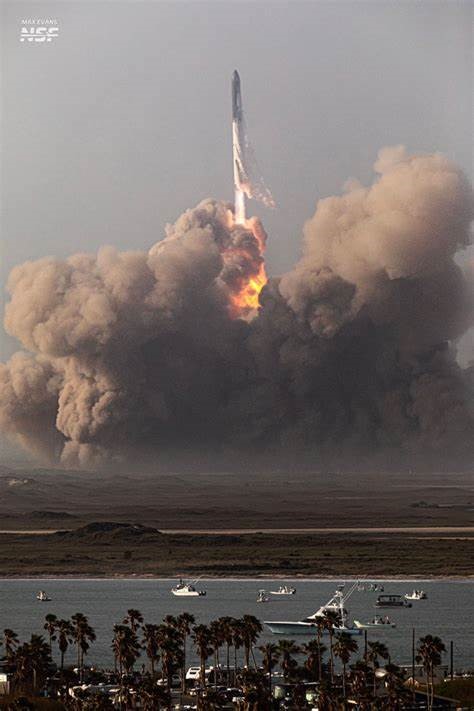
Today, on the Gulf Shore of Southeast Texas, the world witnessed the first launch of the caravel of the Space Age.  Starship, boosted by the Super Heavy first stage (the largest, most powerful rocket ever built) cleared the pad and roared into the skies over the Gulf of Mexico.  While the flight did encounter what Elon Musk refers to as a “rapid unscheduled disassembly, one should not view this test as a failure.  This is particularly true when considering the iterative engineering process of SpaceX – and its mantra of “Move fast, break things.”  The flight hit several important milestones while also yielding valuable data which SpaceX engineers will use to further refine the design, fix flaws, and get the next iteration of this rocket on the pad within a few months.  Keep in mind that SpaceX is the same company now has over 100 consecutive successful, propulsive landings of the Falcon 9 booster – many of them re-used multiple times.  There was a time when the “smart” people said such a thing was not even possible.  And yet, here we are – propulsive landings of the Falcon 9 first stage are nearly as routine as successful airplane landings.  When a company has a track record like that, it’s foolish to bet against them.

Why is Starship significant? Just as the caravel was designed to carry people across the oceans of Earth, Starship was designed for carrying people across the oceans of empty space.  And just as the caravel took many too the new world, the motivation for designing Starship was the same, with Mars being the prime target (a variant will also take astronauts back to the moon).  It will be entirely reusable, capable of returning to the world from which its journey started, just as the Nina did.  No other such crewed spacecraft currently exists or has ever existed. Starship will be the first. Furthermore, it will further reduce launch costs.  Falcon 9 can already put approximately the same amount of payload into the same orbit as the Space Shuttle could – but at 1/20th of the cost.  A fully operational Starship promises at least another order of magnitude reduction in that cost.  Thus, in both cost and capability, Starship will be the vehicle that truly opens the final frontier, not just for a few astronauts that can meet NASA’s exacting standards, but for ordinary people.  When Starship lands on Mars with humans on board, it will be every bit as epochal as the moment when Columbus realized the significance of his discoveries.

Like the 1960’s, we live in tumultuous times.  But also, like the 1960’s, we live in exciting times, certainly when it comes to advances in spaceflight.  Whereas the previous era was driven by governments and the impetus of the Cold War, the advances of the present era are being driven by the private sector, and without many of the non-technical limitations of the former era.  While looking at some of the goings-on in the world today is rather depressing, the world of spaceflight is as exciting as it has been at any time since the build-up to Neil Armstrong’s call of “Tranquility Base here – the Eagle has landed.”  

To be sure, there is a long way to go, as the ending of today’s test flight attests.  But I am more confident than ever that we will see Starship take humans to Mars, and maybe even beyond; that we will see the first trickle of a migration that was once as inconceivable as the migrations to the New World were in 1491.  What an incredible time to be alive.

Godspeed, Starship.

When you find love TAKE IT! Don’t delay! You may never have another chance.

By Richard K. Munro

(16) Puccini – La Bohème – Musetta’s Waltz – YouTube

My old battalion commander who shall remain nameless at this time once said to me “Why have one girl when you can have them all!”

I answered humbly I rather have one good one than 100 bad ones.

Some enchanted evening, you may see a stranger,
You may see a stranger across a crowded room,
And somehow you know, you know even then,
That somehow you’ll see here again and again.

Some enchanted evening, someone may be laughing,
You may hear her laughing across a crowded room,
And night after night, as strange as it seems,
The sound of her laughter will sing in your dreams.
Who can explain it, who can tell you why?
Fools give you reasons, wise men never try.
-RICHARD RODGERS SOUTH PACIFIC

Is love at first sight possible? Do people really meet and in moments later know they have met someone special? Yes, I believe it. There is a lot of evidence for it! LOVE is very powerful. I believe it happens all the time when we least expect it. John Joseph Powell in the SECRET OF STAYING IN LOVE wrote:
“Do you believe in true love? Do you believe in love at first sight? Do you believe in love lasting forever? I think that these love stories will renew or reinforce your faith in love… They are the most famous love stories in history and literature, they are immortal. “It is an absolute human certainty that no one can know his own beauty or perceive a sense of his own worth until it has been reflected back to him in the mirror of another loving, caring human being.” Yes, no one can know true happiness unless they know the love of a husband and wife or of a child. I know when i first saw my grandchildren it was love at first sight! But I am going to write mostly of romantic love today.

The German author Herman Hesse described love at first sight in his charming novel GERTRUDE: “I already thought on that first evening of our meeting how glorious it would be to spend one’s whole life regarded by those beautiful, candid eyes, and how it would then be impossible ever to think or do ill.”

Victor Hugo believed in it when Gringoire saw the beautiful gypsy ESMERALDA in the THE HUNCHBACK OF NOTRE-DAME: “If he had had all Peru in his pocket, he would certainly have given it to this dancer; but Gringoire had not Peru in his pocket; and besides, America was not yet discovered. (p. 66)

This is the actress MAUREEN O’ HARA (1939) as Esmeralda in the film HUNCHBACK OF NOTRE DAME. Who with eyes and heart in breast could not fall in love with such a smile?

Shakespeare believed in love at first sight and described it beautifully:

“Oh, she doth teach the torches to burn bright!
It seems she hangs upon the cheek of night
Like a rich jewel in an Ethiope’s ear,
Beauty too rich for use, for earth too dear.
So shows a snowy dove trooping with crows
As yonder lady o’er her fellows shows.
The measure done, I’ll watch her place of stand,
And, touching hers, make blessèd my rude hand.
Did my heart love till now? Forswear it, sight!
For I ne’er saw true beauty till this night.”

The Finnish author Mila Waltari believed in love at first sight. By the way he was a favorite author of Cari Munro’s Spanish father Carlos Perez (Juanita Perez told me and had his book in Spanish translation). I never met him of course but talked to his father Don Benigno in 1973 and 1976 and I own a book that belonged to Carlos called the LAST OF THE MOHICANS in Spanish.
Waltari wrote:
“Today I saw you and spoke to you for the first time.
It was like an earthquake; everything in me was overturned, the graves of my heart were opened and my own nature was strange to me.
I am forty, and I believed I had reached the autumn of life.
I had wandered far, known much and lived many lives.
The Lord had spoken to me, manifesting Himself in many ways; to me angels had revealed themselves and I had not believed them. But when I saw you I was compelled to believe, because of the miracle that happened to me.”

Arthur Conan Doyle believed in love at first sight:
    “From the first day I met her, she was the only woman to me. Every day of that voyage I loved her more, and many a time since have I kneeled down in the darkness of the night watch and kissed the deck of that ship because I knew her dear feet had trod it. She was never engaged to me. She treated me as fairly as ever a woman treated a man. I have no complaint to make. It was all love on my side, and all good comradeship and friendship on hers. When we parted she was a free woman, but I could never again be a free man.” (From the Return of Sherlock Holmes).

Here is love at first sight that is unrequited. It happens sometimes. The person is married. The circumstances are too difficult the age difference is too big. I met a beautiful woman who was very fond of me but she was a youthful 42 and I was 19. We parted as friends. And I thought I had no one in the world to love so I wrote (true) to my Spanish friend Cari whom I had not seen in two years but with whom I carried on a regular correspondence from 1973 until 1982!

Of course, the idea is romantic. Wonderfully romantic but then I have always been a romantic. Italian operas are romantic. Scottish and Irish songs are romantic and are full of stories of the FORCE OF DESTINY. Today I think we are living in a more hedonistic and less romantic age and dating is very difficult. It almost seems too good to be true that an instant attraction and electric feeling could change our lives forever. And the old saying is very true: “Better to have loved and lost then never have loved at all.” So if you feel that strong attraction you should act on it. Robert Burns sang of one of the most beautfiul girls he had ever seen:

    This Mary Morison – I first heard it sung in concert and later on recordings by Kenneth McKellar.

This is love at first sight:

O Mary, at thy window be !
It is the wish’d, the trysted oor.
Those smiles and glances let me see,
That mak the miser’s treasure poor,
Sae blithely wad I bide the stoure,
A weary slave frae sun tae sun,
Could I the rich reward secure –
The lovely Mary Morison.

Yestreen, when to the trembling string
The dance gaed thro, the lichted ha’,
Tae thee my fancy took its wing,
I sat, but neither heard nor saw:
Tho’ this was fair, and that was braw,
And yon the toast o’ a’ the toon,
I sigh’d and said amang them a’ –
‘They are na Mary Morison!’

O Mary canst thou wreck his peace
Wha for thy sake wad gladly dee?
Or canst thou break that hert o’ his
Whase only faut is loving thee?
If love for love thou wilt na gie,
At least be pity to me shown:
A thought ungentle canna be
The thought o’ Mary Morison.

She was the TOAST OF THE TOWN and immortalized by the poem. I have been to her gravestone. In Mauchline, Scotland not far from the tavern where Burns wrote the poem in her honor.


Poor wee lassie! She died of a fever and no one could save her and that was the end of sweet Mary Morrison! Not even 21 and never married! Sad she had many gifts but health and strength of body were not hers. .But I think she must have felt the thrill of being loved and admired as least for a while and perhaps was waiting for her majority to say yes. The story of Mary Morrison tells us that no one is master of the line of his or her life.

When you find love TAKE IT! Don’t delay! You may never have another chance.

Poosie Nancy’s one of Robert Burns’s pubs. I have been there and had dinner and a few drinks afterward. I recited his poems and as the evening wore on we walked to the graveyard to see the stone of MARY MORRISON:

Exodusters

Exodusters–Voting with one’s feet

                  One of the greatest rights any person can hold is the “right to exit,” that is, the right and ability to depart a bad situation in search of a better one.  With the failure and end of post-Civil War Reconstruction in 1877, numerous ex-slaves voted with their feet, leaving the South for the American West.  The 1870s and 1880s witnessed the beginning of the plains settlement boom, and blacks migrated in significant numbers to western Kansas, western Nebraska, and Oklahoma.  Known as Exodusters, these blacks shook the dust of southern prejudice off their feet.  The Homestead Act of 1862, one of the most liberal and republican of all American laws, did not discriminate on basis of race, and any black males or single black females were welcome to take up a government-provided homestead.  Though records were poorly kept, almost 40,000 blacks migrated to the new communities.  Like many or the original European-derived Great Plains communities, few of these black Gilded Age settlements remain at the beginning of the twenty-first century.  The most prominent of those still extant is Nicodemus in Graham County, Kansas.  It had been the earliest of the Exoduster communities, founded in 1877.

                  The two most prominent individuals in the great exodus from the South were Louisianan Henry Adams, a former slave, and Benjamin “Pap” Singleton.  Both men mixed self-help philosophy and God-given drive with entrepreneurial boosterism to promote the black settlements.  “What’s going to be a hundred years from now ain’t much account to us,” Singleton said, and the “whites has the lands and the sense, an’ the blacks has nothin’ but their freedom, an’ it’s jest like a dream to them.” The promoters sent advertising circulars to black churches, mostly located in the border states and upper South.  Most of the Exodusters came from Tennessee.

                  The enterprise faced many obstacles.  First, many southern whites feared the loss of exploitable, cheap labor.  Armed throughout river ports in the South, whites physically prevented innumerable blacks from migrating.  Second, unlike the many European immigrants to the high plains who had first lived in the steppes of Russia, the blacks from the South had no experience with dry farming.  Continental weather patterns and very little rain hindered black agricultural efforts at first.

                  Still, the new settlers overcame these difficulties and created thriving communities.  “When I landed on the soil I looked on the ground and I says this is free ground,” one black settler said. “Then I looked on the heavens and I says them is free and beautiful heavens. Then I looked within my heart and I says to myself, I wonder why I was never free before?”  A Great Bend, Kansas, newspaper editorialized: “We have been so long aiding white people coming here that certainly no one would think of refusing the freedom of the state to a few hundred colored people seeking liberty and a home.  Treat the colored people exactly the same as if they were white people in like circumstances.”  By 1890, blacks owned roughly 20,000 acres in Kansas.  Inspired by the philosophy of Booker T. Washington, another 50,000 blacks settled in Indian Territory in the 1890s.  The leader of the Oklahoma migrations, Edward McCabe, desired the creation of an independent black state.

                  Blacks participated in more western activities than just farming.  A goodly percentage worked as cowboys or on railroads.  Most famous among western blacks were the so-called “Buffalo Soldiers,” who fought in several important Indian battles between the Civil War and 1890.  Stripped down to peacetime size after the Civil War, the frontier army relied heavily–sometimes exclusively–on black soldiers.  Buffalo soldiers served in campaigns against the Sioux, the Cheyenne, the Comanche, the Kiowa, the Ute, and the Apache.  Black troops also protected the United States border against Mexican bandits.  Congress awarded fourteen medals of honor to black soldiers between 1870 and 1890.

–Brad Birzer

Reconstruction

Gaining a Nation, Losing the Republic: 

Reconstruction, 1863-1877

Bradley J. Birzer, Hillsdale College

For Sheldon Richman/The FREEMAN, January 2011

A dead president, carpetbaggers, scalawags, burning crosses, white hoods, an occupied South, Boss Tweed, Thomas Nast cartoons, the New York Democratic machine, and an imprisoned Jefferson Davis give us vivid images of the dozen years following the surrender of Robert E. Lee’s forces at Appomattox in April, 1865.  As every historian knows, often to his chagrin, these twelve years were tumultuous, confusing, and chaotic, especially in hindsight.  The time period, is also, of course, a let down after the tragedies and nobilities of the Civil War years.  Whereas men had clear purpose—no matter what side the person chose—during the war, political compromises and plunder defined Reconstruction.

A period of governmental corruption, monetary instability, gross expansion of political power, the solidification of public schooling, Anglo-Saxon racialist beliefs, manifest destiny, Indian Wars, and extreme violence, Reconstruction witnessed a giant leap toward a cohesive nation-state and far away from the founding vision of a decentralized federal republic.  

Plunder, Not Peace

A mere two months before John Wilkes Booth assassinated him, President Abraham Lincoln met with his two top generals, Ulysses S. Grant and William Tecumseh Sherman, on the steamship, The River Queen, just outside of Hampton Roads, Virginia.  Though Lincoln would call for “malice toward none” and “charity for all” in his second inaugural, delivered early March of the same year, he offered his fullest plan and desires for what a reconstructed union might look like in a private conversation with Grant and Sherman.  Lincoln, he assured them, wanted nothing more than 

to get the deluded men of the rebel armies disarmed and back to their homes. . . Let them once surrender and reach their homes, [and] they won’t take up arms again. . . . Let them all go, officers and all, I want submission and no more bloodshed. . . I want no one punished; treat them liberally all around.  We want those people to return to their allegiance to the Union and submit to the laws.[1]

While Lincoln had waged a terribly hard and total war, he also desired the softest peace possible.  Indeed, if one takes Lincoln’s words on The River Queen at face value, the United States of 1865 would look very much like the United States of 1860, with one exception: returning states would need to accept the emancipation of all slaves through the Thirteenth Amendment to the U.S. Constitution.  His architects of total war, Grant and Sherman, agreed completely with the president.  Neither of Lincoln’s generals knew how much longer the war would last, they explained to him, but they believed the war was rapidly approaching its an end with possibly only one or two major battles left.  They had reached endgame.

            When Booth cut down Lincoln at Ford’s Theater on Good Friday, two months later, he changed the entire course of American history.  Had Lincoln presided over the peace following the war, one has no reason to doubt, he would have reconciled constitutional relations with, among, and between the former Confederate states, officers, and citizens as quickly as politically possible.  The war, after all, had been viewed by almost all sides as a noble tragedy for the common good of the republic and the vision (no matter how varied) of the American founding fathers.  Men, for the most part, had chosen to fight, and they had chosen to fight, again and again.  Though a draft existed in the North, for example, after the summer of 1863, ninety-four percent of all Union soldiers had volunteered.  As General Joshua Chamberlain, the classicist from Maine’s Bowdoin College, had astutely observed of the surrender ceremonies in April, 1865:

Honor answering honor. . . . [as men] of near blood born, made nearer by blood shed. . . . On our part not a sound or a trumpet more, nor roll of drum; nor a cheer, nor word nor whisper of vain-glory, nor motion of man standing again at the order, but an awed stillness rather, and breath-holding.[2]

Just outside of Appomattox Courthouse, Robert E. Lee’s former Confederate forces, what remained of the Army of Northern Virginia, walked through two lines of Union soldiers.  The Union soldiers saluted the defeated for hours on end that day. “Reluctantly, with agony of expression,” Chamberlain recorded, the Confederate soldiers

tenderly fold their flags, battle-worn and torn, blood-stained, heart holding colors, and lay them down; some frenziedly rushing from the ranks, kneeling over them, clinging to them, pressing them to their lips with burning tears.[3]

Such a scene, of course, is a far cry from the militarization and politicization, the martial law and the intrusion of Leviathan that one normally associates with Reconstruction as it actually happened.  Though President Jefferson Davis’s final executive order called for all CSA troops to divide into terrorist cells and launch attacks against civilians and urban areas, Robert E. Lee countermanded the order through deed and word, telling the men to “be good citizens as they had been soldiers.”[4]

            With Lincoln’s death, though, the war became personal in a way that it had not been during the mass bloodshed of the previous four years.  To many in the country, especially in the North, Lincoln’s death transformed him into a full-fledged American martyr, and his reputation exploded.  Those who took most advantage of this loss and manipulated it to their advantage were the Radicals within the Republican party—Senator Benjamin Wade of Ohio, Senator Charles Sumner of Massachusetts, Representative Thaddeus Stevens of Pennsylvania, and Representative George Julian of Indiana, to name a few–men who had despised and resented Lincoln as a spineless moderate, lacking a proper nationalist and vindictive streak.  

The Radicals had attempted nothing less than a Congressional coup against Lincoln in December, 1862, had openly desired a military dictatorship throughout much of the war, and had proposed their own version of Reconstruction as early as 1863.  Their vision of post-war America involved remaking the entirety of the South in their own image, with extensive punishment for all involved.  Just as they had wanted Lincoln to wage an ever increasingly hard war, they wanted a peace imposed by the sword.  Lincoln’s death provided them with a symbol around which to rally Northerners against their southern brethren.  “Within eight hours of his murder Republican Congressmen in secret caucus agreed,” as Lincoln biographer, David Donald explained, “that ‘his death is a godsend to our cause.’”  As the leader of the Radicals, the Ohio Senator Ben Wade, stated, “there will be no more trouble running the government.”[5]  

Wade and his fellow Radicals would have no small part in nationalizing the United States over the next dozen years. “The New England reformers thought they had struck down evil incarnate when they crushed the Sable Genius of the South; and their horror at the corruption and chaos of the Gilded Age was intensified proportionately as they discovered the extent of their own previous naiveté,” the cultural critic and historian, Russell Kirk wrote.  “They had dreaded an era of Jefferson Davis; but now they were in an era” of the radicals and “of worse.”  The true reformers “awoke to find their fellow-Republicans, the oligarchs of their party, intent upon concrete plunder.”[6]

And, Leviathan Expands Again

            Not surprisingly, the size of government grew dramatically during the four years of the Civil War.  The Union printed greenbacks, founded the U.S. Secret Service (the second federal police force, the first having been set up after the passage of the Fugitive Slave Law of 1850) to protect the green fiat money, taxed incomes, promoted university education, built war factories and railroads, raised tariffs, declared—in some places—martial law and suspended freedoms of speech and habeas corpus, used troops to break labor strikes, and encouraged mobs to do what it believed it could not do openly.  In the South, President Jefferson Davis nullified the Confederate constitution almost from day one.  Davis often ignored Congress and his own Vice President, and he used the full power of his office to harass any political opposition.  Most notably, through fraud, Davis shut down the one opposition to develop, the classical liberal “Conservative Party” of North Carolina.  The CSA taxed incomes, excess profits, and licenses, and raised tariffs on imports as well as exports.  Because currency flowed only intermittently throughout the South, the CSA printed an outrageous amount of paper currency and established—to the horror of average southerners—the Tax-In-Kind men, empowered by the government to take whatever livestock, produce, and materiel they deemed necessary for the war effort.  Unlike the North, the South conscripted throughout much of the war, set prices, and enforced loyalty oaths.  The CSA, contrary to popular memory, also rigorously enforced its own laws against the several states making up the Confederacy.

            In terms of institutional history, very few of these laws continued into the period of Reconstruction.  With the collapse of the Confederate government, no confederate laws continued, of course.  With the end of the war, the Union repealed many, if not most, of its war measures.  The legacy and symbolism of such martial laws, however, remained into the Progressive period and beyond.  If Lincoln could centralize the Union and defeat the Confederacy and Slavery, could we not also use the federal government to wage war against poor standards, poverty, immigrants, or whatever thing the individual Progressive might resent?  In this, the memory and influence of Civil War legacy is a powerful one.  Perhaps no figure better represents this than John Wesley Powell, a Union officer who lost his arm in the 1862 Battle of Shiloh, and is often regarded as the father of American progressives.  Tellingly, through the Department of the Interior, the U.S. Geological Survey, and the Bureau of Ethnography, Powell crafted and promoted plans to remake the West (sometimes, physically) through the powers of the federal government.

            Believing the federal government under Lincoln had never gone far enough, the Radicals of Reconstruction expanded the scope and reach of the federal government as quickly as possible.   Not only did the Fourteenth Amendment to the U.S. Constitution nationalize the Bill of Rights, but it also repositioned virtually all federal law as superior to all state and local laws, thus attenuating even further the already difficult balance of federalism.  Most Reconstruction laws began in the Radical-controlled congressional Joint Committee on Reconstruction, dominated by Ben Wade.  Most importantly, through the impetus of the Joint Committee, Congress passed a series of haphazard laws establishing martial law over various districts of the South.  The rule of law, such that it was, was enforced through military rather than civilian courts.  Through a series of laws, Congress provided extensive funding for public schooling, welfare (direct aid) for freed slaves, and, sometimes, enforced the property rights of blacks.  None of this should suggest that somehow the Radicals were, as a whole, pro-black.  As the Pulitzer-prize winning historian T.H. Williams once noted, the Radicals “loved the Negro less for himself than as an instrument with which they might fasten Republican political and economic control upon the South.”[7]  In reality, the Radicals were little better in their promotion of rights, dignity, and liberties blacks than had been the plantation owners of the previous generations.  Each—white men of the North and South—desired to manipulate the black population for their own aggrandizement and profit.  As Robert Higgs has definitively shown in his path-breaking work, Competition and Coercion, American freedmen did exceedingly well in terms of culture, economics, and literacy in the fifty years after emancipation.  But, as Higgs persuasively argues, they did so through their own efforts and despite significant government and societal obstacles. 

Free from competitive counterpressures and strongly equipped to enforce compliance, public officials could discriminate pretty much as their pleasure or caprice might dictate.  Under these circumstances it was a definite blessing for the blacks that the governments of the post-bellum South were still quite limited in the range of functions to which they attended.  Such salvation as the black man found, he found in the private sector.[8]

By 1910, Higgs shows, one in four blacks owned his own land, two-parent stable families accounted for all black families, and 70% of all blacks were literate.  By any measure, these are impressive gains considering the overwhelming majority of American blacks had never had a choice over any one of these things before the passage of the Fourteenth Amendment.

Not surprisingly, given the abusive attitudes white Radicals held toward American blacks, corruption proved endemic to the entire Reconstruction effort. So much money flowed from Congress into the reconstructed South that manipulators and opportunists profited wherever and whenever possible, which was more often than not.  The Reconstruction governments simply had no manpower or will to prevent the corruption.  More often than not, they participated directly in the corruption, using it for political gain.  The famous nineteenth-century Scottish observer of America, James Bryce, recorded his own thoughts on the time period.  “Such a Saturnalia of robbery and jobbery has seldom been seen in any civilized country, and certainly never before under the forms of a free self-government,” he wrote in his The American Commonwealth, comparing the American officials of Reconstruction to Roman provincial governors in the last days of the Republic.  

Greed was unchecked and roguery unabashed. The methods of plunder were numerous. Every branch of administration became wasteful. Public contracts were jobbed, and the profits shared. Extravagant salaries were paid to legislators; extravagant charges allowed for all sorts of work done at the public cost. But perhaps the commonest form of robbery, and that conducted on the largest scale, was for the legislature to direct the issue of bonds in aid of a railroad or other public work, these bonds being then delivered to contractors who sold them, shared the proceeds with the governing ring, and omitted to execute the work. Much money was however taken in an even more direct fashion from the state treasury or from that of the local authority; and as not only the guardians of the public funds, but even, in many cases, the courts of law, were under the control of the thieves, discovery was difficult and redress unattainable. In this way the industrious and property-holding classes saw the burdens of the state increase, with no power of arresting the process.[9]

While almost all white leftist historians have downplayed or ignored this corruption since the 1960s, they do so at great peril to the dictates of honesty and truth.[10]

As they had failed to do with Abraham Lincoln in the attempted Congressional coup of December 1862, the Radicals tried to gain control of President Andrew Johnson’s cabinet.  When Johnson violated this law in February of 1868, the House of Representatives impeached the president on a vote of 126-47, following strict party lines.  The failure of the Senate to support the House’s impeachment somewhat attenuated the strength and confidence of the Radicals.  Indeed, though Radical regimes remained in power until 1876, the Radicals never again wielded the same kind of power as they had in the second half of the 1860s.[11]

The Lingering Agony of Nationalism

            In part, the Radicals also failed because the eighteenth president of the United States, Ulysses S. Grant, never accepted the fanatical premises upon which Radicalism had developed.[12]  A moderate Republican at best, Grant resented the post-war bloodthirstiness of the Radicals, few of whom had ever seen battle.  Despite this, Grant was a determined nationalist and, when he was not dealing with the corruption in his own administration, he was promoting “Americanness” wherever possible.  This became most clear in his policy toward the American Indians.  

U.S. Government relations the Indians had never been consistent.  It had gravitated between vicious brutality toward the Indians (as had been the case under Andrew Jackson) to respect and protection of Indian property (such as had been the case under Franklin Pierce).  After the Civil War, under the Johnson and Grant administrations, the U.S. Government waged a fierce war against the American Indians, confiscating their best property, relegating what remained of the tribe to the worst land.  The greatest atrocity committed by the federal government against American Indians came just at the very end of the Reconstruction period.  After a tragic misunderstanding, the military decided to round up, forcibly remove, and detain a sizeable minority of the Nez Perce Indians, a tribe faithfully allied to America since 1805.  When the Nez Perce understandably resisted, the government spared neither time nor expense to defeat them.  As the periodical, The Nation, reported:

How far the Indian insurrection on the Pacific Slope is for the present suppressed is not decided, but it were well, while its lesson is fresh, to realize that the Nez-Perces are not to blame for the expensive and sanguinary campaign, unless being goaded into a brief madness by the direct and endless oppression of our Federal authorities be blameworthy. . . . the neglect and bad faith of the general Government, continued for a quarter of a century, are apparent in the records of Congress.  There was swindling, not in petty matters and by individuals, requiring detection and proof, but on a grand scale by the United States itself.[13]

 It would be difficult to find a more telling example of government corruption and abuse of power during this period than its directing of the military against a peaceful, allied people, farmers and ranchers who had been occupying the same land—the Palouse and Camas Prairies of the Pacific Northwest—for nearly five hundred years.

Nation-building always and everywhere demands conformity and destruction of local and individual differences.  To overcome such divisions, the nation must create a religious type of myth and fundamental symbols to rally the population, and defend itself with unrelenting force.  The Reconstruction government did all of this without apology, and immigrants (especially Roman Catholics), blacks, and Indians suffered intensely.  “Nationalism in the sense of national greed has supplanted Liberalism,” one of the great classical liberals of the day, E.L. Godkin, noted in hindsight in 1900. “We hear no more of natural rights, but of inferior races, whose part it is to submit to the government of those whom God has made their superiors.”  Americans, Godkin argued, had forsaken the Declaration of Independence as well as the Constitution.  Further, he wrote, “The great party which boasted that it had secured for the negro the rights of humanity and of citizenship now listens in silence to proclamations of White Supremacy.”[14]

Men who had fought valiantly on the battlefields of the Civil War must have asked themselves what it all had meant, if anything?

Bradley J. Birzer is the Russell Amos Kirk Chair in American Studies and Professor of History, Hillsdale College, Michigan.  He is the author of several books, including his most recent about the American founding, American Cicero: The Life of Charles Carroll (ISI Books, 2010).  He dedicates this article—for his friendship and inspiration for over twenty years—to Larry Reed.


[1] Lincoln’s conversation quoted in Jay Winik, April 1865: The Month That Saved America (New York: HarperCollins, 2001), 68.

[2] Chamberlain quoted in Nesbitt, ed., Through Blood and Fire: Selected Civil War Papers of Major Joshua Chamberlain (Stackpole Books, 1996), 175.

[3] Chamberlain quoted in Mark Nesbitt, ed., Through Blood and Fire, 176.

[4] Jeffrey Hummel, Emancipating Slaves: Enslaving Free Men: A History of the American Civil War (Chicago, IL: Open Court, 1996), 282; and Robert E. Lee quoted in Bruce Catton, The American Heritage New History of the Civil War, 570.

[5] David Donald, Lincoln Reconsidered: Essays on the Civil War Era, 2nd ed., enlarged (New York: Vintage, 1956), 4.

[6] Russell Kirk, The Conservative Mind, 1st ed., (Chicago, IL: Regnery, 1953), pg. 295.

[7] T.H. Williams quoted in Donald, Lincoln Reconsidered, 105.  The obvious exception to this is Thaddeus Stevens.

[8] Robert Higgs, Competition and Coercion: Blacks in the American Economy, 1865-1914 (Chicago, IL: University of Chicago Press, 1980), 133.

[9] James Bryce, The American Commonwealth, with an Introduction by Gary L. McDowell (Indianapolis: Liberty Fund, 1995). Vol. 2: 335-336.

[10] Whether one should emphasize the corruption of the Reconstruction period is an issue hotly debated by historians over the previous century.  While few historians outright dismiss the extent of the corruption, most historians since the 1960s have chosen to see Reconstruction as a failed noble attempt, branding those who focus on the corruption as somehow lacking in idealism.  See especially Kenneth Stampp, “The Tragic Legend of Reconstruction,” the first chapter of his The Era of Reconstruction, 1865-1877 (New York: Alfred A. Knopf, 1965), 3-23.  Unfortunately, Stampp’s view has become orthodoxy among professional historians.

[11] James McPherson, Ordeal by Fire: The Civil War and Reconstruction 3d ed. (New York: McGraw Hill, 2001), 572-581.

[12] The best biography of Grant is Josiah Bunting III, Ulysses S. Grant: The 18th President, 1869-1877 (Times Books, 2004).

[13] The Nation (August 2, 1877).

[14] E.L. Godkin, “The Eclipse of Liberalism,” The Nation (August 9, 1900), 105.