
Between 1629 and 1640, roughly 21,000 Puritans (and servants) immigrated from England (especially East Anglia) to New England. This was one of the four great free folk migrations of the colonial period, along with the Anglicans to Virginia and the Chesapeake, the Quakers to Pennsylvania and Delaware, and the Scotch-Irish to various parts of English colonies.
More than any other colonial group, the Puritans (formally known as Congregationalists) moved in familial groups, and the nuclear family stood as the most important social institution, outside of the Congregation itself.
The Puritans demanded great rigor from their church members, and most residents of New England belonged to some church, especially in the seventeenth century.[1] Five ideas held the Congregationalists together: the depravity of man, the covenant that held all together in this fallen world, that God chose His elect, that all good comes from Grace, and that men and women must love one another.
— Read on theimaginativeconservative.org/2021/03/john-winthrop-imaginative-conservative-bradley-birzer.html
Category Archives: Philosophy
7 characteristics of a successful reading group

I recently wrote a feature piece for Our Sunday Visitor newspaper about my experiences co-founding and helping lead a men’s reading group for over 16 years. While the group is Catholic—and thus reads and discusses books that are Catholic in fact or sensibility—I think the seven points are helpful for a wide range of reading groups. Here’s the start of the essay:
The group, bearing the ambitious moniker “The Neo-Inklings,” first met in the spring of 2004 at a local brew pub, invited there by myself and Anthony (Tony) Clark. The inspiration for the men’s reading group came from Tony, who at the time was working to finish his doctorate in Chinese history at the University of Oregon.
Tony and I had met a few weeks earlier after Divine Liturgy at the local Ukrainian Catholic parish, and we quickly discovered that our shared love for the Catholic faith also extended to reading and good books. “I need a couple of hours each month,” Tony said, “when I can be with men who share the same interests as I do, and we are able to freely discuss Catholic books and the Catholic faith.”
The plan was simple: invite some other men to join us to discuss a book chosen beforehand. In hindsight, after nearly 200 meetings, it’s a minor miracle it worked. So much could have gone wrong; so much should have gone wrong. But we quickly discovered a truth that G.K. Chesterton expressed so well back in a 1904 essay on Shakespeare’s “A Midsummer Night’s Dream”: “The sincere love of books has nothing to do with cleverness or stupidity any more than any other sincere love. It is a quality of character, a freshness, a power of pleasure, a power of faith.”
Love of books is obviously necessary for a book club, of course, but there are other important qualities, including good character, a love of truth and a commitment to faith. A book group that lasts for many years and consistently includes edifying insights and challenging discussions is a bit like a good marriage: It requires purpose, devotion, honesty, patience and, yes, sometimes forgiveness.
Read the entire essay over on the OSV site.
Bill Buckley’s Mischievous Magazine ~ The Imaginative Conservative
Indeed, as I look at NR today, she remains a constant companion, even when I disagree with her (as friends sometimes do). Writers such as Jack, John Miller, Kyle Smith, Kathryn Lopez, and others keep alive Buckley’s wondrous and gregarious spirit. From its beginnings in 1955, NR has sought to build up conservatism rather than tear it apart. Building, as we all know, is difficult; destruction is easy.
As I continue to get my NR “breaking news” updates, read her editorials on this or that political or cultural atrocity, devour Jack’s Saturday emails, buy the newest books recommended by her, and listen to her many podcasts, I’m honored by her friendship and happily acknowledge her just and worthy mission.
— Read on theimaginativeconservative.org/2021/03/william-f-buckley-mischievous-national-review-magazine-bradley-birzer.html
Lecture: Edmund Burke and the French Revolution
YOUNG PEOPLE ARE DYING TO BE NEEDED
Recently, in a discussion about the military, a friend of mine recalled receiving a letter when he was 18 asking him whether he would like to join the military in Belgium. This Canadian friend of mine had a Belgian grandfather, but had never visited the country. “After I received the letter from Belgium, it did make me wonder why I never received such a letter from Canada,” he reflected.
What made my friend briefly consider joining an army in a country he never visited that speaks a language he doesn’t know?
Read the rest, here.
George Washington on Political Parties
From his Farewell Address:
I have already intimated to you the danger of parties in the State, with particular reference to the founding of them on geographical discriminations. Let me now take a more comprehensive view, and warn you in the most solemn manner against the baneful effects of the spirit of party generally.
This spirit, unfortunately, is inseparable from our nature, having its root in the strongest passions of the human mind. It exists under different shapes in all governments, more or less stifled, controlled, or repressed; but, in those of the popular form, it is seen in its greatest rankness, and is truly their worst enemy.
The alternate domination of one faction over another, sharpened by the spirit of revenge, natural to party dissension, which in different ages and countries has perpetrated the most horrid enormities, is itself a frightful despotism. But this leads at length to a more formal and permanent despotism. The disorders and miseries which result gradually incline the minds of men to seek security and repose in the absolute power of an individual; and sooner or later the chief of some prevailing faction, more able or more fortunate than his competitors, turns this disposition to the purposes of his own elevation, on the ruins of public liberty.
Without looking forward to an extremity of this kind (which nevertheless ought not to be entirely out of sight), the common and continual mischiefs of the spirit of party are sufficient to make it the interest and duty of a wise people to discourage and restrain it.
It serves always to distract the public councils and enfeeble the public administration. It agitates the community with ill-founded jealousies and false alarms, kindles the animosity of one part against another, foments occasionally riot and insurrection. It opens the door to foreign influence and corruption, which finds a facilitated access to the government itself through the channels of party passions. Thus the policy and the will of one country are subjected to the policy and will of another.
There is an opinion that parties in free countries are useful checks upon the administration of the government and serve to keep alive the spirit of liberty. This within certain limits is probably true; and in governments of a monarchical cast, patriotism may look with indulgence, if not with favor, upon the spirit of party. But in those of the popular character, in governments purely elective, it is a spirit not to be encouraged. From their natural tendency, it is certain there will always be enough of that spirit for every salutary purpose. And there being constant danger of excess, the effort ought to be by force of public opinion, to mitigate and assuage it. A fire not to be quenched, it demands a uniform vigilance to prevent its bursting into a flame, lest, instead of warming, it should consume.
The Underfall Yard
I make no apologies–“The Underfall Yard” is arguably one of the four or five greatest rock tunes ever written. Only “Supper’s Ready” by Genesis really challenges it for the number one spot.
Enjoy the 2020 remixed version of Big Big Train’s best.
Audio Lecture: The Constitution
A somewhat cut and dried lecture about the mechanics of the U.S. Constitution–its seven articles, its checks and balances, and its relatively clean lines.
Defining The Republic: From the Declaration to the Northwest Ordinance
In this lecture, I define a republic in two ways. First as a mixed government: monarchy, aristocracy, and democracy, comparing it to the human person (mind, soul, stomach). Thus, the republic is always flawed and always in a life cycle of birth, middle age, and death. Second by its elements: virtue, property (as the right to moral ownership), a well-armed citizenry, and decentralized decision making. I also focus on Articles 1-3, 6 of the Northwest Ordinance, and I talk about Hillsdale’s connection (with historian Ransom Dunn’s creation of the Republican Party in 1854—inspired by Article Six of the Northwest Ordinance) to all of this.
Reflections on Lord Acton
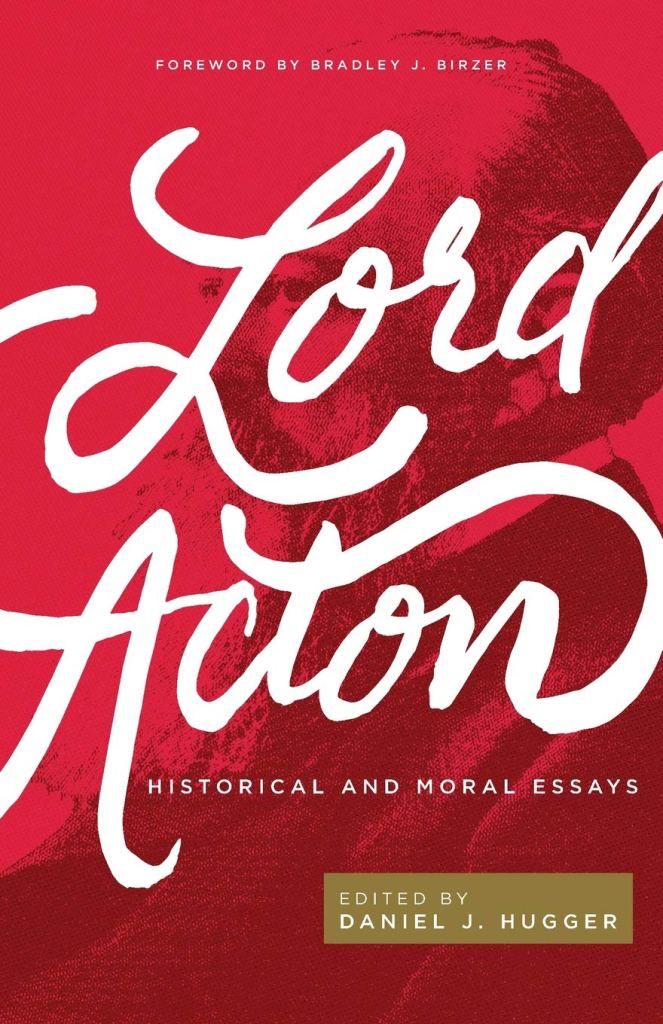
Introduction for Dan Hugger’s LORD ACTON: HISTORICAL AND MORAL ESSAYS (2017).
When scholars discuss the nineteenth century of western civilization, they automatically and reflexively conjure images of the three most profound and original minds of the period: Karl Marx, Charles Darwin, and Sigmund Freud. Sometimes, depending on the scholar, one might list Friedrich Nietzsche as well. This is obvious in the massive and tedious surveys of western civilization as well as in the remaining and lingering canons of Great Books. None of this is false, of course, and the three (or four) men remembered certainly were among the greatest of minds to come into this world of sorrows.
One might, with equal accuracy and a bit more humanity and justice, create a different trinity. What about John Henry Newman, Alexis de Tocqueville, and Lord Acton? After all, as the great Russell Kirk once argued, “In every age, society has been relieved only by the endeavors of a few people moved by the grace of God.” With the possible exception of Darwin, neither the taken-for granted trinity nor their followers were wont to taint the men or their ideas with the airy notion of the “grace of God.”
With the newly-proposed trinity of nineteenth-century thinkers, though, the men and their followers would lovingly accept the grace of [g]od.
Even among these proposed three, however, Lord Acton—the author of the essays you now hold in hands–remains the least known, the least studied, and the least understood. True, every American with any education at all remembers his assertion that “power corrupts.” Other than this, though, he’s largely forgotten or dismissed. It’s as though his entire existence from 1843 through 1902 mattered only for that one sentence. Truly, this is to both our discredit and our loss. Thanks to the Acton Institute and Daniel Hugger, we can begin to rectify this massive error near the beginning of the twenty-first century.
A profound thinker and essayist, Acton argued in his seminal piece of 1862, “Nationality”: “Christianity rejoices at the mixture of races as Paganism, however, identifies itself with their differences, because truth is universal, errors various and particular.” The modern and rising nation-states, though, demand unity of thought, culture, and politics. In essence, Acton believed, the world was re-paganizing, returning to its worship of the state as god. After all, he wrote, “in the ancient world idolatry and nationality went together, and the same term is applied in Scripture to both.”
While this is just one of many profound arguments that Acton advanced during his writing career, it is critical to see him not only as important in his own day and age, but also as the critical link in the arguments about natural rights, liberty, and human dignity between Edmund Burke and Thomas Jefferson, a century earlier, and Friedrich Hayek and Christopher Dawson, a century later.
In his own day and age, though, Acton tapped into something rather deep in the currents and movements of the western tradition. Imagine for a moment the influence the original trinity mentioned above had on the West and on the World. When looking at the depth and intelligence and brilliance of their arguments, one can readily narrow down each to one fundamental element. For Darwin, all things were biological and adaptive. For Marx, they were economic. For Freud, they were psychological. As Acton would well understand, none of these things were untrue. The problem with each was not falsity, but lack of context. Man is biological, economic, and psychological, but not singularly. Rather man is all of these plus a million other things. As with Burke before and Dawson after, Acton knew that man’s greatness and his sin simultaneously resided in the immense complexity of each individual human person, made uniquely in the infinite image of God. With Socrates as well as Hayek, Acton knew that we knew very little and that, through humility, we recognized our limitations of knowledge.
Thus, one can readily picture Acton writing “Christianity rejoices at the mixture of and mysteries of human complexities as Darwinism, however, “identifies itself with their biological adaptation.” Or, as Marxism, however, “identifies itself with their economic base.” Or, as Freudianism, however, “identifies itself with their psychological urges.” To which, each can be answer, “yes, but there’s more.” Again, no matter how significant Darwin, Marx, and Freud were, Acton is more nuanced, broader, and, thus, in the long run, more accurate and insightful. Unlike the three more famous men, Acton never demanded any gnostic sureties in this world or the next. Faith is, after all, not fact.
Of course, this book you now are reading is much deeper than what I’ve just given. Hugger has ably and, indeed, lovingly crafted a book of some of the best arguments Acton made in his life. From a philosophy of history to the history of liberty, from specific personalities to the grand movement of ideas, Acton looked at all with a Catholic and classical wisdom so often lacking in his day. We would do well to remember Acton. In so doing, we remember not just the man, but the insight of one man into a much larger and unfathomably complicated world. True, in choosing Acton over Darwin, Marx, and Freud, we choose an ignorance and humility that the world hates. But, then, the world has generally hated what’s good for it. Have your ideologies if you must, but I’ll take truth, beauty, and goodness anytime.
Oh, and, by the way, power does corrupt.
 Spirit of Cecilia
You must be logged in to post a comment.