
Lewis was, as Dr. Como so correctly notes, always his own man, and his own forceful actions toward colleagues, friends, family, and students—tended to attract or repulse those around him, with little middle ground for neutrals. Those who loved him, loved him dearly. Those who despised, despised him just as dearly. Dr. Como brilliant explains Lewis’s playful and deep love of myth, his extraordinary charity (quite similar to that of Russell Kirk), his normalization of the genre of science fiction, his rather complex and sometimes downright bizarre relations with women, and his vast reading of every possible book. The latter, especially, matters to Lewis’s own writings, as many of his articles and books are really gothic autobiographical reflections of his readings (again, quite similar to that of Russell Kirk).
— Read on theimaginativeconservative.org/2019/03/james-como-introduction-cs-lewis-bradley-birzer.html
Category Archives: Philosophy
Mister miracle (image)
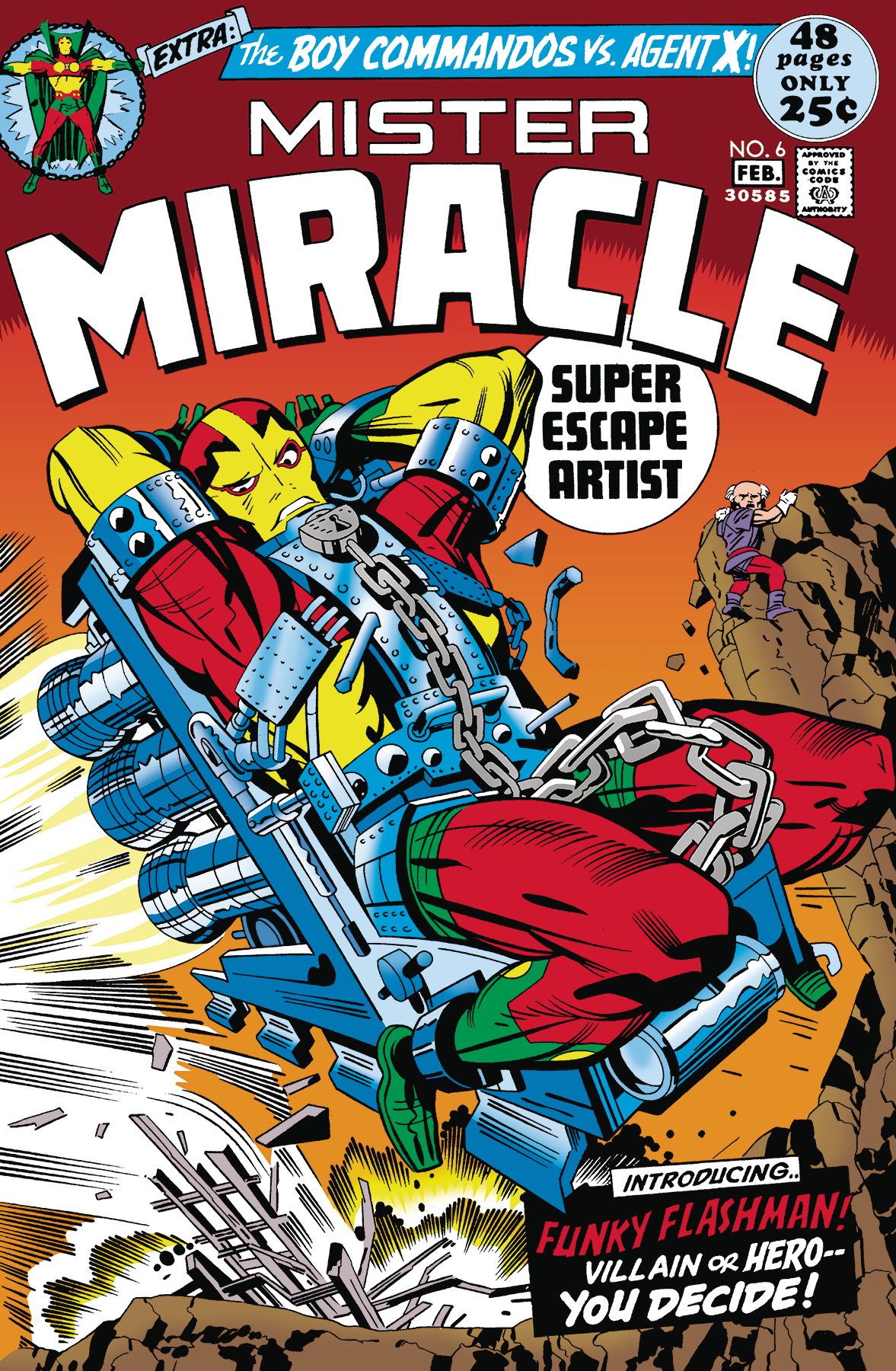
To the myth: man escapes the devil, does good, and gets the girl. God bless you, Jack Kirby.
Why Did Obama Import a Somali Congressional District for Ilhan Omar to Represent?
John Zmirak
So the Democrats couldn’t bring themselves to pass a resolution denouncing anti-Semitism. Until, that is, they’d diluted the resolution by including almost every other kind of prejudice, including the made-up, politicized crime of “Islamophobia.” It had just a few exceptions. White people, males, and Christians are not included among the groups that Congress forbids you to hate.That exclusion is telling. It tells you that the ideology reigning today has no interest in fairness. Or even in fighting hate. It wants to direct that hate toward acceptable targets. Toward “out-groups” that once were “in-groups,” which are now legitimate scapegoats. This is precisely the worldview which philosopher Rene Girard described as Victimism. He also said that it was the ideology of Antichrist.
— Read on stream.org/why-did-obama-import-a-somali-congressional-district-for-ilhan-omar-to-represent/
A fascinating article.
Warner Bros. has big plans for Batman’s 80th anniversary – Superhero News
Warner Bros. has big plans for Batman’s 80th anniversary – Superhero News
— Read on superheronews.com/warner-bros-has-big-plans-for-batmans-80th-anniversary/
Democrats Surrender to Ilhan Omar on Anti-Semitism | National Review
Many on the left believe that as a woman of color, a Muslim, and an immigrant, Omar cannot, by definition, be a purveyor of hate and prejudice. One way that identity politics manifests is that those who are considered oppressed receive immunity to do things that those considered more privileged cannot do. Hence many Democrats, particularly members of the Congressional Black Caucus, sought to defend Omar rather than to disavow her.
— Read on www.nationalreview.com/2019/03/democratic-surrender-on-anti-semitism/
How blind does one have to be? Racism is racism is racism.
On Loving the Tools of Writing ~ The Imaginative Conservative
I have written something close to 1,000,000 words for internet essays over the past eight or so years. Some of these have been historical vignettes; some have been album reviews; and some have been bizarre and personal musings. Students often ask me how I can write so much. By what motivation? To what purpose? Using what tools? Thinking of which topics? As a professor, of course, I spend a considerable amount of my professional time teaching writing. I will freely admit, if I do it well at all, I do it far more by example than by explaining mechanics.
— Read on theimaginativeconservative.org/2019/03/loving-tools-writing-bradley-birzer.html
On Loving Bookstores ~ The Imaginative Conservative
At Hyde Brothers Books in Fort Wayne, Indiana, in the fall of 2001, I found a first American edition hardback of Christopher Dawson’s seminal 1942 book, The Judgment of Nations, published by Sheed and Ward. Hyde Brothers, to this very day, remains my all-time favorite used bookstore, and I can state with absolute certainly that the discovery of the Judgement of Nations—especially after conversations with Gleaves Whitney and Winston—changed my entire world and outlook upon it. I spent my Thanksgiving break that fall reading and contemplating every aspect of that book—from its sentence structures to its arguments to its implications for academic writing. I can also state with certainty that Sam Hyde, the owner of that glorious Fort Wayne bookstore, knows his stuff.
— Read on theimaginativeconservative.org/2019/03/on-loving-bookstores-bradley-birzer.html
C.S. Lewis Kindle Sale (50-75% off)
Reflections on the Psalms – Kindle edition by C. S. Lewis. Download it once and read it on your Kindle device, PC, phones or tablets. Use features like bookmarks, note taking and highlighting while reading Reflections on the Psalms.
— Read on www.amazon.com/Reflections-Psalms-C-S-Lewis-ebook/dp/B01EFM8NOS/ref=sr_1_16
Though not advertised, a number of C.S. Lewis’s books on Kindle are incredibly cheap today. I just spent about $50 trying to complete my collection. Enjoy.
An Unflinching Theological Aesthetic | The Russell Kirk Center
When it comes to the saints, the power of their stories is rooted in their mysterious interiority. One of the most haunting poems in The Hanging God is “Some Will Remember You,” which is addressed to Edith Stein/St. Teresa Benedicta. Born to a German Jewish family, Stein was a brilliant philosopher who converted to Catholicism in 1922 and joined the Carmelites after reading St. Teresa of Avila’s autobiography: “The interior mountain beckoned you to climb, / The floors of the self-darkened room first creaked. / You wrote out what you saw and then sought stillness.” The Nazis later killed Stein at Auschwitz: “After the smoke, bones left forgotten, / Your jotted notes shut in a metal trunk, / As others bore reprisals and arrests, / Your thought lived in the study of a priest.” The second section of the poem begins: “In evil times and aftertimes, in times / When all the stubbled fields of action smolder, / Bowed heads can’t help but make their patient study / Of how the person worlds.” It goes on to depict a young Karol Wojtyła sitting in his wired room behind the Iron Curtain reading Stein’s words aloud “for all / The stashed and sensitive microphones to hear. / In those times, your words, carried on the quiet, / Fostered his own. Thought, act, and judging person, / The self in solitude revealing God, / Clicked like the murdered signal of your voice / Across a telegraph and moved his hand.” She becomes “A sainted sign / Named Edith Stein” whose mysterious love and fortitude nourished by the contemplative life contrasts sharply with the reductionist ideologies of the twentieth century.
— Read on kirkcenter.org/reviews/an-unflinching-theological-aesthetic/
Ep. 1353 The Disastrous New Deal | Tom Woods
Every schoolboy learns that Franklin Roosevelt cured the Great Depression with his New Deal programs. This is false, as libertarians well know. But it’s still
— Read on tomwoods.com/ep-1353-the-disastrous-new-deal/
 Spirit of Cecilia
You must be logged in to post a comment.