

4th August 1914 – 5th May 1919
by RICHARD K. MUNRO
On August 4th 1914, Great Britain declared war on Germany. It was a decision that is seen as the start of World War One. Britain, led by Prime Minister Herbert Asquith, had given Germany an ultimatum to get out of Belgium by midnight of August 3rd. Churchill wrote “It was eleven o’clock at night – twelve by German time – when the ultimatum expired. The windows of the Admiralty were thrown wide open in the warm night air. Under the roof from which Nelson had received his orders were gathered a small group of admirals and captains and a cluster of clerks, pencils in hand, waiting. Along the Mall from the direction of the Palace, the sound of an immense concourse singing ‘God save the King’ floated in. On this deep wave there broke the chimes of Big Ben; and, as the first stroke of the hour boomed out, a rustle of movement swept across the room. The war telegram, which meant, “Commence hostilities against Germany”, was flashed to the ships and establishments under the White Ensign all over the world. I walked across the Horse Guards Parade to the Cabinet room and reported to the Prime Minister and the Ministers who were assembled there that the deed was done.”


News of the war spread all across Britain. In Scotland, men and women were waiting in the street into the night. Then the news spread that Britain was at war. In the air at a great distance cheering could be heard the rousing skirl of pipers. An Argyll recruiting band with pipers and drums was marching down Govan Road in Govan Glasgow (South Glasgow). They played all the well-known tunes of glory: HIGHLAND LADDIE, THE CAMPBELLS ARE COMING, ALL THE BLUE BONNETS, SIR COLIN CAMPBELL’S FAREWELL TO CRIMEA, SCOTS WHA HAE: “We will drain our dearest veins,
But they shall be free.” Thomas Munro, Sr, (Auld Pop) and his friends and their wives were standing on the corner of Harmony Row and Govan Rd near St. Anthony’s RC church. The cheered and waived their handkerchiefs as the band grew near.
Most were shipbuilders at John Brown shipyards. Most were mature Empire builders from the early 20’s to early 40’s. Many were former soldiers and had served in India or South Africa. Others had been in the Merchant Marine or had built railroads and bridges in South America, Africa, India and Australia. They cheered as they saw the band approach and marched out after it, joyously. A crier called out. “WHO WOULD DEFEND KING AND COUNTRY? WHO WILL JOIN US? ” They would defend King and Country! Down the road. There was a recruiting table with flags. with officers in full dress uniforms surrounded by pipers. My father told me a Laird’s son and some other prominent men were there to volunteer. first. Then a speaker told a story of a little neutral nation -BELGIUM -invaded by the Hun and all the channel ports threatened. England is in danger! Scotland is in danger. Great Britain is in danger!
Sometimes I hear stories that the men of 1914 did not know what they were fighting for. There were some boys aged 16 or so but most of them were mature men. They knew EXACTLY why Britain was fighting. To save Belgium and to stop Germany from ruling Europe and thus be in a position to strangle the British Isles and take the bread and butter and mutton our of the mouths of their wives and children!
So as my father told me from what my grandfather told him, there were speeches and flags and barrels of whisky for those who signed up! My father said they must have made quite a party of it and they were there most of the night. Since many of them were married men they had to have been drunk to sign up for war service! They signed up for three years or for the length of the war. I know from my father’s baptismal certificate that originally my grandfather (and his pals signed up for the 3rd Battalion Argyll and Sutherland Highlanders). They did training at Sterling Castle and later outside of London. Later they were drafted into the 1st Battalion Argyll and Sutherland HIghlanders (Dec 1914) and those men saw service in France and Belgium from January 1915. They saw heavy fighting at 2nd Ypres especially April-May 1915. They witnessed the first poison gas attack in history on April 22, 1915. Only a handful ever saw Scotland again.
Now one of my grandfather’s best friends before August 1914 was no other than Willie Gallacher (later a Communist MP for Scotland). My father and grandmother and my father’s sister and brother all knew Willie. Willie was not a Communist in 1914 but like many of the men had deep sympathies with Socialist or Marxist thought. Gallacher often had dinner at my grandfather’s place and they would talk politics My grandmother, who was a devout Catholic, often dismissed Gallacher’s arguments and said, “they were just one man’s opinion. You can’t just make up rules as you go along. God made man in his own image. The good man dreads God and obeys his commandments for that is the whole duty of man.” My grandmother said Willie never helped with the dishes preferring to smoke cigars and pontificate. To Mrs. Munro Red Willie -as she called him- was puffed up with self-importance. His desire was to feel superior and to threaten revolution. How dare Willie Gallacher say the Catholic Faith was just a trick to make the workers bear woes and exploitation on earth in the hope of a “alleged” paradise in heaven! She said the Communists and Socialist abandoned the commandments of God for THEIR OWN pipe dreams and castles in the sky, My grandmother loved the church and the local priests of her parish. To her the priests and missionaries and sisters of the church were gentle heroes full of self-sacrifice and the mother virtue of humility. “The Son of Man came not to be served but to serve.” (Matthew 20:28) Mrs Munro would NEVER spin out to the side of the what she viewed as “the dark angels of Satanic forces.”
In any case, my grandfather’s best friend was “American” Johnny Robertson. Grandfather had known him from his time in America and Robertson had worked for Thomas Edison in NJ. (He showed me as a boy pictures of Robertson in the museum in Orange, NJ with Edison). Robertson happened to be visiting and HE was induced to sign up with his Scottish Pals in the Argylls (even though he was a naturalized American citizen at that time). Hence his moniker “American Johnny.” Unlike, Willie Gallacher, American Johnny was a staunch anti-Communist. He had been a great admirer of Theodore Roosevelt and his family and voted for him once or twice. Johnny had no patience at all with the Far Left of the Red Clyde. So in Johnny my grandmother had ally and she and her friends favored his friendship over the friendship of Willie Gallacher.
So everyone joined up except Willie Gallacher. Willie sneaked away early in the evening and did NOT volunteer although he had said he was with the lads. Later Gallacher was arrested for anti-War activity and my grandmother and her friends brought him food in the jail. Later my father’ s sister later married his kinsman Donnie Gallacher but it was a very unhappy marriage as Donnie was unfaithful. My grandfather and Johnny Robertson and all the others thought Gallacher was a traitor and a coward. Auld Pop often said, “the Gallachers are a treacherous race . They have no honour.”
Of the brave Scottish pals of August 4, 1914 many were killed at 2nd Ypres. Only three men in his company were still on active service by January 1919, Auld Pop (Thomas Munro, Sr.), Johnny Robertson and Jimmy Quigley. When my grandfather returned to Scotland in May 1919 from Constantinople, he saw Willie and said:
” Mr. Gallacher, I have nothing to say to you.”
My grandfather was told if he didn’t go along with the Union leaders he would never work,
But Johnny Robertson said to him, “to hell with those cowardly Reds! Come to America with me! There’s many a dollar to be made and work and bread for al!”
So my grandfather became a bird of passage and worked in America from 1919 to 1927 with one brief return trip to Scotland in 1923. He sent money home to his wife, Mary Sweeney Munro, regularly, but his letters were very brief: “Dear Mary, Running to catch the post.”
My father, aunt, and uncle, as well as my great-grandfather Joel Munro, remained in Scotland until October 1927 though they visited my grandfather in America briefly in 1923. According the the list or manifest of Alien Passengers on the SS Transylvania they arrived in New York October 1, 1927 to join my grandfather. My father was 12 and that’s how he came to graduate from an American High School, Manuel Training High School (later John Jay and now defunct) and then go to Brooklyn College. My father and uncle unlike most of their boyhood friends and their fathers, served in the American forces during WWII.
I remember a poignant story. One afternoon shortly after having arrived my father was sitting on the steps of his Brooklyn apartment He said a strange man with a wee fuzzy dog came up to him and said, “Are you Tommie Munro? I am your father. This is my dog Fuzzy!.” Fuzzy was delighted to make a new friend. Auld Pop had picked up the dog as puppy in Galveston, Texas circa 1923 and had the dog for almost 20 years. Everyone used to say, “There goes Auld Pop with his wee dug.” My father had seen Auld Pop so infrequently that he didn’t even recognize him. That’s sad.
But my father always said that his father always took care of his family and worked hard regularly writing and sending money home to Scotland. When was father was a boy his biggest role model was “Uncle” Johnny Dorian, his fourth grade teacher and later Headmaster of the St. Anthony’s RC school. Johnny Dorian was a Sweeney on his mother’s side and his mother was my grandmother’s sister. My father saw a lot of his mother’s family when he was a boy especially Mrs. Quigley and Mrs. Dorian who had two daughter. The eldest Molly was very close to my father and gave him his first book “THE KEYS TO HEAVEN” which I still have. It is inscribed to “TOMMY FROM MOLLY MAY 1923”. It is a manual of prayers for the old Latin Mass. On the early pages it lists the “Seven Gifts of the Holy Ghost: (WISDOM, UNDERSTANDING, COUNSEL, FORTITUDE, KNOWLEDGE, PIETY and THE FEAR OF THE LORD (or dreading and reverencing unto God),The Our Father, the Hail Mary. Molly and her sister never married and never came to America (they stayed at home to take care of their father).
My father told me their fiancees had been killed in the war. So my father never saw them again after 1927 though they exchanged correspondence and got the telegrams: AUNT ANNIE HAS PASSED AWAY (1936); JOHNNY ROBERTSON HAS MARRIED MRS MACKENZIE (1938); SADDEST OF NEWS JOHNNY ROBERTSON KILLED IN THE GLASGOW BLITZ (May 1941), CONDOLENCES On the death of MRS. MUNRO (MARCH 4, 1942) As Lewis Grassic Gibbon wrote in SUNSET SONG: ” there were lovely things in the world, lovely that didn’t endure, and the lovelier for that… Nothing endures.” Immigration to America had been very stressful for Mrs. Munro. She lived through the Great War in Glasgow every night there were the sound of blaring ambulance sirens bringing the wounded to hospitals. My grandmother lost two brothers, a brother-in-law and seven nephews and cousins. I always though it ironic that HER husband survived two world wars but in the end Auld Pop was the widow for the last twenty years of his life. The war cut the living heart out of Scotland. Many people don’t remember but Scotland, like France, suffered far worse than America. 74, 000 Scots were killed in the Great War far more than in the Second World War and they took about 200,000 casualties. many very serious. My grandfather’s Regiment alone (The Argyll and Sutherland Highlanders) had 7,131 officers and men killed and over 25,000 casualties.
My father, Fuzzy and Auld Pop would go on long walks and talk of many things. Often Johnny Robertson came along with them. They were only working men but were avid readers of newspapers and often looked up countries in their Atlases and almanacs. One the topics was the true nature of Socialism/Communism and the Moscow Trials in the 1930’s in which many of the heroes of the Russian Revolution were executed. Auld Pop had believed in “Socialism” as a young man but grew to hate Communism. He and Johnny Roberson were nationalists and loved America and Britain.
“Uncle Johnny”, as my father called Johnny Robertson made it very clear what he thought of the Communists. “They are the masters of deceit. Don’t trust a one of them. They may act like the Working Man’s friend but it’s all a Grand Illusion. A true Communist Party member follows ironclad discipline and will not brook any disagreement to dissent. They sell their souls to the Party.
“What does it profit them if they gain the whole world but lose their souls?” (Luke 9:25). So from my father’s teens he learned a deep Anti-Communism from Johnny Robertson and Auld Pop and this prepared him for his years at Brooklyn College (1933-1937) when he had many “Socialist” and “Communist” classmates.
Johnny said. ” Some are big mouth show-offs but others would stab you in the back or throw a bomb in an open crowd just for fun! The Communist teaching say,s “Property is theft” and the whole history of the world is a class struggle between so-called “Capitalists” who own the means of production such as the mines, factories, ships, railroads and the so-called “Proletariat” the workers exploited by the Capitalist Bosses. It all starts with Karl Marx and the Communist Manifesto. They say the workers have nothing to lose but their chains, They think religion is just a trick to fool the “Proletarians.” They don’t believe in God or the bible and say God is dead, that is to say the does not exist. There ain’t no Ten Commandments in Communism and so we are just walking dust without any soul or spark nor was man made in the image of God because like they say God doesn’t exist. Communists believe say they believe in pure materialism or dialectal materialism but it is all bunk.” Johnny continued: “The Communists attack the domination of the ruling classes but they themselves want to dominate. They say they want to help the worker. But it is all a lie. What Communists really believe in is power. And they will do anything to get it. Cheat, steal, rob, destroy and murder. Look at Stalin and Soviet Russia! Sure, they expect landowners, property owners and “Capitalist Bosses” to submit peacefully and give up all their property for the good of the workers. Of course, if anyone resists the Communist they have to slaughtered, liquidated. And under Communism the individual counts for nothing. He is just a number, a digit. He is just a strong back carrying a bale of hay or a bag of coal. He is just two hands working the machines in the factory. In America like in Britain or Canada the individual has dignity and worth and is free and is protected by the rights and traditions that are part of our “splendid ancient heritage of freedom that goes back to Magna Carta and the Declaration of Independence. Communism is just a delusion. It goes against all common sense. Everyone wants his own property his own things, his own wife, his own home.
And in America, every man is free and has rights. In Scotland the Communists like Willie Gallacher, our old friend, see a rich man in a motor car with a driver and say, “See that laddie! When the Revolution comes we will take that car away from him.” Well, in America if you see a rich man in fine car, chauffeur or not, an man can tell his son, “Lad, when you grow up you can have a car just like that…”
And Auld Pop would, add, “Aye, laddie or at least a wee Ford!.” My father laughed and loved talking with the two old Scots. Johnny always pointed out that HIS boss, Thomas Edison was a good man who cared about his workers and their families. “And in any case he was more interesting in inventing things than merely making money. Money isn’t the only thing is life. Never marry for money- you and borrow it cheaper. Marry a bonnie woman, not over all and not too young with a good honest character. Real wealth is family, love and friendship. Richness of experience enjoying music, your friend’s company, your mother and aunt singing fine songs at home or in the church. Generosity, giving of yourself and being grateful for everything you have because of your parents and grandparents and your country. Many good men did to keep this country and France and Britain and Belgium free. Never forget they made the Supreme Sacrifice” (ne obliviscaris DO NOT FORGET was a motto he and my grandfather repeated many times) . It was a motto of their old Regiment, the Argyll and Sutherland Highlands, the original Thin Red Line of Heroes.
After the warUncle Johnny went back to Belgium, walked down the Menin Road again with solemnity, sadness and pride. He brought back a set of post cards of Ypres (before and after) which i still have along with some of his books which he gave to my father in 1938. Plays of Shaw, Kipling, poems of Burns.
One the favorite activities of the four friends was to see movies or listen to concerts (John McCormack or Rachmaninov ) or in the summer going to baseball games at Ebbets Field and, occasionally, Yankee Stadium so my father could see Babe Ruth. Later my father would take notes of some of the anecdotes his father told him but lamented he could never get him to settle down and be recorded. It made him too anxious. Auld Pop was also too anxious every to go to Fourth of July picnics. He couldn’t stand to hear the exploding rockets. My father said sometimes his father would tremble uncontrollably on the edge of the bed and would settle down only after having downed half a bottle of whisky. When my father and his brother and sister and mother went to Mass in America on Sundays, Auld Pop never went in. He stayed outside with Fuzzy and smoked with Jimmy Quigley, his nephew (and fellow Argyll veteran). Most of the men in my family were not religious. My father used to say, “I vote yes for eternal life but it is too good to be true.” My father had been, like his mother, a very devout Catholic as a boy. He and his brother attended Mass every Sunday in their kilts. His mother innocently dressed them up that way in the USA too which resulted in fist fights most Mondays at school against many Irish, Polish, Italian and Spanish boys of their very parish. So much for love of neighbor; it was another instance of nationalism trumping Christian brotherhood. Many were on the outside religious to others but on the inside they were full of selfishness and hypocrisy. My father had no use for the world of appearances. But my father never attacked the faith of his mother, whom he loved deeply nor ridiculed those who held sincere religious beliefs. He merely though the ritual and ceremony of many was a fraud. And of course they had another problem. Even though my grandmother was of Irish origin she and almost all of her family members in Glasgow or the south of Ireland were strong Unionists. She was never happy with the anti-British feeling of many of the Irish priests she met in America.
Jimmy Quigley was Thomas Munro wife’s sister’s son and had joined up with the Scottish Pals at age 16 making him the youngest man in the Regiment. Auld Pop had promised his wife and sister-in-law that he and Johnny would look after him. That Auld Pop did and he paid for a piper at his funeral at the relatively young ago of 52 in 1951. That left Auld Pop as the very last living survivor of his Old 1914 Regiment. It was a heavy burden.
The disaster of the Great War destroyed the fragile economic life of my family. They had come from the Islands and Highlands in the 1880’s and 1890’s to work in the Shipyards (many had stints in the Army or Merchant Marine). My grandfather had gone to sea as a boy apprentice at age 8 circa 1895 on a tall ship. He killed a Malay pirate with a Martini Henry rifle when he was 10. It was the job of the boy apprentices to bring ammunition to the sailors. They were under attack from pirates and the sailor near the captain was wounded to the captain told my grandfather to pick up the gun and start shooting. The rifle had a great kick and nearly knocked him over. His shoulder was badly bruised by the heavy gun. So he had a hard life as a boy. He used to say the only Christmas present he ever received was the drunken vomit of the sailors.
Auld Pop sailed around the world twice by the time his was 16. My great grandfather, Joel Munro, worked as a master plasterer in White Star and Cunard line ships as well as hotels in Montreal, Canada, New York, Belfast, Liverpool, London and of course Glasgow. He did the elegant plaster designs you used to see in old hotels and ship restaurants. Many of his brothers and cousins served in Highland Regiments in the 19th century and saw service all over the world.
After being at sea my grandfather went to work as helper to his father. So he went back and forth from Scotland to England, America and Canada many times before he was 20. In his 20’s took a job a the John Brown Shipyards in Glasgow. He met my grandmother Mary Sweeney on a tram in Glasgow while she was on the way to Mass at St. Anthony’s RC Church. She was talking to her sister, Mrs. Quigley, and she had a sweet voice with a dulcet Scots accent, lapsing into Gaelic. She was just over 20 and my grandfather thought she was the most beautiful woman he had ever seen. He had to get to know her.
Auld Pop’s method was to take the tram every Sunday and become familiar to my grandmother by sight. After a few weeks he introduced himself to her and accompanied her to church. Father Collins, the parish priest said to him, Sir, you are a stranger to the parish and my grandfather reportedly said, ” Yes, father but not to the faith. ” Mary Sweeney was born in Oban, Argyll of what they used to call “joad-flittin’ hairst laddies and lassies” (migrant Irish farm laborers from Donegal and Cork) but they eventually settled in Glasgow. She came from a very large family. It is said her father ,Jimmy Sweeney and her mother Catherine Anne O’Rourke had over 100 grandchildren. When my grandparents were courting they used to take the Govan ferry to Kelvin Grove park to walk there. Sometimes they would go to organ concerts at the Kelvingrove Museum. They would have tea with “German biscuits” (later dubbed Empire biscuits). They married at St. Anthony’s in early 1910 and shortly thereafter that year my father’s oldest sister was born Helene (or Nelsie), followed by my father’s brother Jos in 1913. My father was born in 1915 while Auld Pop was in the trenches of the Ypres Salient.
UP THE ANTS! 11th March 1915 – 16th March 1915
My grandfather (Auld Pop) served in the 27th Division with many Indian Army soldiers whom the Scots called the “Dins” after Gunga Din of course. The soldiers Auld Pop respected the most were the Gurkhas of course but he had the closest relationship with the Sikh soldiers. My grandfather and his comrades observed the first use of poison gas on the Western Front on April 22, 1915. As they attacked, the Germans released chlorine gas from over 5,000 cylinders. These formed huge poisonous green clouds that drifted toward two French African divisions. Lacking any protection whatsoever and choking in the gas the French lines essentially collapsed. Those who stayed died and those who retreated were effectively out of action. This created a five-mile-wide gap in the Allied lines but the Germans troops, themselves inexperienced with their gas masks advanced very slowly and tentatively. They too were terrified at the poison fog. The British and Canadian troops without any protection except for handkerchiefs soaked in urine -by tradition the idea of Glasgow University medical students- moved forward to plug the gap. The British then withdrew to a second line of defense, leaving Ypres in Allied hands but virtually surrounded.
Casualties in the Second Battle of Ypres total 58,000 Allies and 38,000 Germans. The Argylls (1st Battalion) at one point experienced 36 days of continuous combat. The Germans and Allies would continue to battle over Ypres in 1916, 1917 and 1918. Winston Churchill and Adolf Hitler both saw action there. Over 600,000 men were killed in the Ypres Salient; about 250,000 were British, Canadian and Commonwealth soldiers. Many of their names are commemorated on the Menin Gate and in the surrounding Commonwealth War Cemeteries.
From Dec 1914-March 1915 drafts of men from the 3rd Battalion Argyll and Sutherland Highlanders and the 4th Battalion were sent to reinforce the depleted ranks of the 1st Battalion. Most of these men were volunteers for “Three Years or the duration of the War.” Among these men were my grandfather Thomas Munro, Sr., his best friend “American” Johnny Robertson (Scots-born but a naturalized US citizen) and Jimmy Quigley aged 16, his wife’s sister’s son-his mother was a Sweeney. Virtually everyone in my grandfather’s company “the Ants” was his pals with the odd Glasgow University student thrown in. The Ypres Salient was the meat grinder. The Argylls, wearing soft Glengarries (tin hats not yet deployed) suffered over 30% casualties in April alone. But they never yielded to the Germans despite overwhelming odds and by May 1915 they had more rifles than men. One tactic they used was having one man load rifles when the rest of the men in the section used rapid fire (20-30 rounds per minute). The Germans thought the British had invented some new kind of light machine gun. Of course, riflemen were more mobile than a heavy machine gun nest and that was a tactical advantage. The greatest danger was that the men would run out of ammunition, food, water, and supplies. For that, there were communication trenches leading back to the Menin Road. That’s was my grandfather’s job. He left his rifle behind and armed only with Webley pistols and grenades he carried heavy boxes (50 pounds or more) from the Menin Road to the front lines. He often came under heavy mortar fire and there was the danger of infiltration by German raiding parties. He had several close calls. But due to the communication system set up by Johnny Robertson (phone lines and colored rockets), the men coming from the rear could communicate if they were challenged by German infiltrators. Then, men from the front lines would charge back to clear out the German infiltrators. But it was often touch and go. The men carrying the boxes were not heavily armed nor carried much ammunition. Typically they would take cover behind their boxes toss a grenade or two and defend themselves with pistols hoping for rescue.
Once at 2nd Ypres (March-April-May 1915) Auld Pop was cut off and isolated in No Man’s Land. He and a few companions had taken cover under the sturdy stairwell of a Belgian farmhouse. The Colonel had written everyone off who had not made the retreat but the men in the front line trench could hear occasion Enfield gun fire from their former positions. They knew their friends -their comrades in arms- were still out there and fighting. They had “no surrendered!” They had “no been captured.”
But Johnny Robertson and the Argylls also knew they could not last for long without food, water and ammunition. All the men were under strict orders to hold their trench and not to advance or leave the trench without orders.
When night came they still heard sporadic Enfield gun fire. “American” Johnny Robertson as you, know was my grandfather’s best friend. Robertson was a corporal at that time and he pieced together from the other men that Auld Pop and men from his section had taken cover in the ruins of a Belgian farmhouse and were last seen firing furiously at the advancing Germans.
“American” Johnny decided to take matters in his own hands. He talked to his pals in Company A (The “Ants” called so because they hailed mostly from St. Anthony’s Parish in Govan and had played on the Ants, a local football (soccer) team). They agreed to lead a rescue patrol. To supplement their force American Johnny went to the Dins -the Indian troops. He knew my grandfather was well-known to them -and they called him Changa Dhost (the Good Comrade) and “Changa Gorai Spahis” (the Good White Soldier). Over a dozen of the Dins volunteered without hesitation. Their leader said in broken English “We save good Christian soldier. We save friend. Changa Dhost. Or we die. The Scots and Indian soldiers would communicate in a Hindi-Punjabi-Gaelic-English patois. Marve e (he is dead). Panee lao (bring water). Nan lao (bring bread/food). Chai lao (bring tea). mara(bad) changa (good). Cheldy cheldy! (quickly! quickly). .303 lao (ammunition). Dhost (comrade).
What act of philia love or Christian love moved them to risk their lives? We will never know. But these were loyal Dins who had served side by side with the Scots on the Northwest Frontier and now in Flanders. But I do know this: “American Johnny” led the patrol in the dark towards where he knew the ruins of the Belgian farmhouse were.
As they drew closer Johnny whistled a few bars of “Hielan’ Laddie”(a regimental march. Auld Pop whistled back. Johnny bravely called out:”UP THE ANTS!”
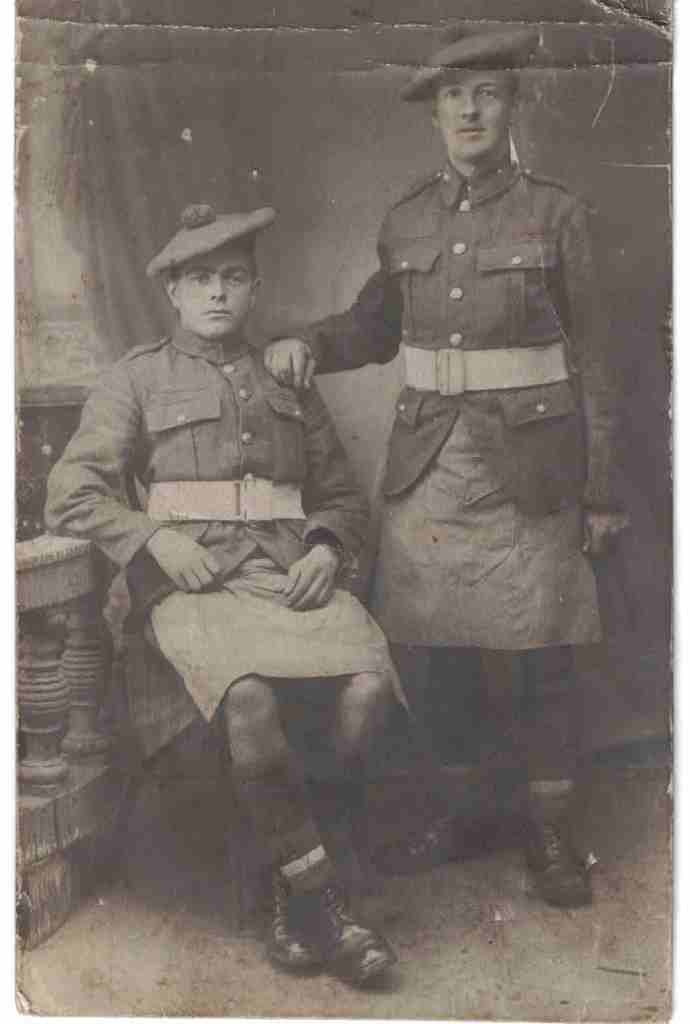
And Auld Pop answered “AYE, UP THE ANTS”Johnny made his way to their refuge and passed canteens all around. Auld Pop-famous in family story- told him: “Guid to see ye,Johnny -I was doon tae ma last Irishman! (he was hiding with his wife’s nephew Jimmy Quigley whom he promised to look after. You can see Jimmy in two of the old photographs taken at Ypres. He is the short, boyish looking one. I never knew him of course but my cousin (who is still living) and my father’s sister and my father mother knew him well in the 1930’s 1940’s and early 50’s in the USA. He was a sad fellow who drank heavily who never married and never got his life together after the war.
The Dins made the rear guard as they cautiously wended their way back to the Allied lines under the cover of darkness. The noise they made garnered some German attention and they began to take fire. Flares slowed their progress. There was sporadic rifle fire then machine gun then mortars. The Dins covered the retreat the entire way. Several were killed and others were wounded. But all the lost Argylls were recovered.
You might have thought Johnny would have won a medal but the Sergeant and the Colonel were furious he had disobeyed orders. Johnny was broken to the ranks. But he remained a legend in our family for his wisdom and for his loyalty and for his great courage. SAN PEUR (without fear) NE OBLIVISCARIS (do not forget: “I will give to them in my house, and within my walls, a place, and a name better than sons and daughters: I will give them an everlasting name which shall never perish.” (Isaiah 56:5) Yes, I will build for them a name and a memorial. I will never forget the brave American volunteers and the more than one million Indian volunteers who served the Allied cause. An imperfect cause you might say but still over two World Wars a good and noble cause upon the whole.
WITH HEADQUARTERS GUARD IN CONSTANTINOPLE 1ST BATTALION ARGYLL AND SUTHERLAND HIGHLANDERS. 1st December 1918 – 5th May 1919
I have two photos of my grandfather while stationed in Constantinople with the 1st Battalion ASH. He told stories of visiting sights such as Hagia Sofia with his best squaddies Johnny Robertson and Jimmy Quigley. He said wherever the Highlanders went it was gang way and the Turks were very polite and submissive. He said they took no casualties and had no serious incidents with the Turks. He did say there was a mutiny when some of the men were told to assemble and go to Russia. As he told it the men were mostly volunteers for War Service and they refused to be deployed. The situation was defused but some NCO’s may have been demoted this time also. So I know my grandfather and his friends never went to Russia. In May 1919 when they were demobilized in Glasgow. The band played the Soldier’s Return. My father was four year old but remember being introduced to his Daddy by his mother who said to him “Tommy, this is your Daddy!” To my father his grandfather as a giant of a man in a kilt with a bonnet. And that was all he remembered from that reunion. I imagine Auld Pop’s reunion with his beloved wife like that of Odysseus and Penelope:
“Now from his breast into the eyes the ache
of longing mounted, and he wept at last
,his dear wife, clear and faithful, in his arms,
longed for as the sunwarmed earth is longed for by a swimmer
spent in rough water where his ship went down
under Poseidon’s blows, gale winds and tons of sea.
Few men can keep alive through a big serf
to crawl, clotted with brine, on kindly beaches
in joy, in joy, knowing the abyss behind:
and so she too rejoiced, her gaze upon her husband,
her white arms round him pressed as though forever.
( Homer, The Odyssey)
My father was born March 10, 1915 and baptized March 17, 1915 while my grandfather was at 2nd Ypres in Belgium. But he never would have known his father without the Dins (the Brave Indian Volunteers) and “American” Johnny Robertson.
IN MEMORIAM:
Thomas Munro AHS, Sr. Dec 22 1886- June 9, 1962 MM,
John Robertson ASH1872- May 1941 (killed in Glasgow Blitz)
DICK MacDONALD PORTEOUS Distinguished Service Order
Captain, 1st Battalion, Argyll & Sutherland Highlanders
Killed in action on 10 May 1915. Age 31.
Son of Lieutenant-Colonel J. J. Porteous, CMG, late Royal Artillery, and Mrs. Porteous.
YPRES (MENIN GATE) MEMORIAL
“War Office, 15 April, 1915: His Majesty the King has been graciously pleased to approve of the appointment of the undermentioned Officers to be Companions of the Distinguished Service Order, in recognition of their gallantry and devotion to duty whilst serving with the Expeditionary Force:
Captain Dick Macdonald Porteous, 1st Battalion, Princess Louise’s (Argyll and Sutherland Highlanders).
For conspicuous gallantry on many occasions throughout the campaign. His very great daring and total disregard of danger on reconnaissance duty, especially at St. Eloi on 19th February, 1915, were most noticeable. Jimmy Quigley, Johnny Robertson and Thomas Munro Sr. went with “Auld Port” on many a night raid and were there when he was struck down (in official reports by a “stray bullet.”) My grandfather said Porteous was killed at the edge of the trench at the crack of dawn after a successful night raid. He always said “It was a German sniper for sure.”
May 10, 1915 was one of the worst days.
839 died on that Monday so long ago the tenth of May, 1915.
These are the Argylls of my grandfather’s unit that died that day:
Captain DICK MACDONALD PORTEOUS (D S O) 1st Bn. Argyll and Sutherland Highlanders
9492 Private JOSEPH LAWRIE 1st Bn. Argyll and Sutherland Highlanders
55 Private ALEXANDER KING 1st Bn. Argyll and Sutherland Highlanders
9812 Private GRAHAM 1st Bn. Argyll and Sutherland Highlanders
9967 Private JAMES REID HARPER 1st Bn. Argyll and Sutherland Highlanders
8817 Serjeant ANDREW JOHNSTONE 1st Bn. Argyll and Sutherland Highlanders
4/9435 Private HERBERT WHITE BELL 1st Bn. Argyll and Sutherland Highlanders
4/8636 Private BARTHOLOMEW LEE 1st Bn. ASH
9267 Private JAMES BOYLE 1st Bn. ASH
1129 Private JAMES BURNSIDE 1st Bn. Argyll and Sutherland Highlanders
10311 Private JOHN GRAY 1st Bn. Argyll and Sutherland Highlanders
798 Private EDWARD McEWAN 1st Bn. Argyll and Sutherland Highlanders
196 Private ROBERT PAUL “A” Coy. 1st Bn. Argyll and Sutherland Highlanders
9909 Private PETER ROSS PRENTICE 1st Bn. Argyll and Sutherland Highlanders
1012 Private WILLIAM STEWART 1st Bn. Argyll and Sutherland Highlanders
Private JOHN McDONNELL Highland Light Infantry
Lance Corporal JAMES D. HERIOT Highland Light Infantry
Private DAVID ATHYA Highland Light Infantry
Lance Corporal PATRICK MURRAY Highland Light Infantry
Private BRAND Highland Light Infantry
Rifleman BIRSAR GURUNG 4th Gurkha Rifles
Sepoy HARDIYAL 57th Wilde’s Rifles (Frontier Force)
Sepoy MIR BAZ 58th Vaughan’s Rifles (Frontier Force)
Sepoy AMAR SINGH 58th Vaughan’s Rifles (Frontier Force)
Sepoy RULIYA SINGH 58th Vaughan’s Rifles (Frontier Force)
Sepoy NABAT 58th Vaughan’s Rifles (Frontier Force)
Sepoy TARU 58th Vaughan’s Rifles (Frontier Force)
Sepoy TULSA SINGH 69th Punjabis
Lance Corporal ARTHUR HENRY WILLS 6th Dragoons (Inniskilling)
Jemadar NAKIA THAPA 7th Gurkha Rifles
Captain MARMADUKE J. N. ABBAY 87th Punjabis
Lance Naik KULMAN THAPA 8th Gurkha Rifles
Rifleman BALU THAPA 8th Gurkha Rifles
Rifleman BARSING THAPA 8th Gurkha Rifles
Corporal HAGAN Black Watch (Royal Highlanders)
Private HARRY HUTCHISON Black Watch (Royal Highlanders)
Private JOHN LINDSAY DUNCAN Black Watch (Royal Highlanders)
Serjeant ROBERTSON Black Watch (Royal Highlanders)
Private WILLIAM YOUNG Black Watch (Royal Highlanders)
Private JOSEPH FLEMING KELLY Black Watch (Royal Highlanders)
Private SIMPSON Black Watch (Royal Highlanders)
Lance Corporal JOSEPH MILTON Black Watch (Royal Highlanders)
Private JOHN ABERCROMBIE Black Watch (Royal Highlanders)
Lance Corporal WILLIAM KERR Black Watch (Royal Highlanders)
Private FOTHERINGHAM Black Watch (Royal Highlanders)
Private McDERMOTT Black Watch (Royal Highlanders
Serjeant SWAN Black Watch (Royal Highlanders)
Serjeant RANKIN Black Watch (Royal Highlanders)
Yes, IN MEMORIAM.
And the all the Scottish Pals of the Ants, and of the Regiment, especially the 7, 131 officers and men who made the supreme sacrifice for the cause of freedom and for King and Country.
Their comrades of the Highland Light Infantry (HLI )(Captain Colin Campbell Mitchell MC battlefield commission to the Argylls from the ranks He was the father of “Mad Mitch”, the WWII and Korean veteran. Colin Campbell, Sr was awarded two Military Crosses.
Also let us remember kinsmen of Mairi MacInnes and Helen MacInnes (wife of Gilbert Keith Highet)
McINNES, T
Private
Argyll and Sutherland Highlanders
19th May 1915
McINNESS, D
Lance Corporal
Argyll and Sutherland Highlanders
25th Sep 1915
McINNES, A
Private
Argyll and Sutherland Highlanders
13th Nov 1916
13th
Nov
1916
McINNES, J L
Private
Argyll and Sutherland Highlanders
16th Jan 1916
McNEISH, J
Private
Argyll and Sutherland Highlanders
14th Jul 1916
McAINSH, J
Private
Argyll and Sutherland Highlanders
20th Jan 1917
McINNES, D
Private
Argyll and Sutherland Highlanders
20th Nov 1917
20th
Nov
1917
McINNES, D
Private
Argyll and Sutherland Highlanders
23rd Apr 1917
McINNES, D
Private
Argyll and Sutherland Highlanders
23rd Apr 1917
McINNES, M
Private
Argyll and Sutherland Highlanders
24th Apr 1917
24th
Apr
1917
McINNES, W
Private
Argyll and Sutherland Highlanders
25th Apr 1917
McANSH, H
Piper
Argyll and Sutherland Highlanders
26th Jul 1918
McGINNES, J
Private
Argyll and Sutherland Highlanders
24th Aug 1918
24th
Aug
1918
McINNES, A
Private
Argyll and Sutherland Highlanders
14th Dec 1918
1
McINNES, A
Private
Argyll and Sutherland Highlanders
18th Apr 1918
McINNES, D
Lance Corporal
Argyll and Sutherland Highlanders
30th Jul 1918
McINNES, D
Private
Argyll and Sutherland Highlanders
22nd Oct 1918
22nd
Oct
1918
McINNES, P
Private
Argyll and Sutherland Highlanders
14th Oct 1918
NEISH, A M
Second Lieutenant
Argyll and Sutherland Highlanders
24th Mar 1918
And the Black Watch. And all the loyal Gallant Allies especially, the French, The Belgians, the Canadians, the ANZACS, the South Africans. the American volunteers (1914-1917) and the DOUGHBOYS who helped finish the job in 1918.
And all the rest whose names are lost in the mists of time.
The Argyll monument at YPRES has an inscription
La a’bhlair, ‘s math na cairdean
“THE DAY OF BATTLE ‘TIS GOOD TO HAVE FRIENDS.”
AYE, ‘S truth, as Auld Pop would say.
***
The young dead soldiers do not speak.
Nevertheless, they are heard in the still houses:
who has not heard them?
They have a silence that speaks for them at night
and when the clock counts.
They say: We were young. We have died.
Remember us.
They say: We have done what we could
but until it is finished it is not done.
They say: We have given our lives but until it is finished
no one can know what our lives gave.
They say: Our deaths are not ours: they are yours,
they will mean what you make them.
They say: Whether our lives and our deaths were for
peace and a new hope or for nothing we cannot say,
it is you who must say this.
We leave you our deaths. Give them their meaning.
We were young, they say. We have died; remember us.
ARCHIBALD MACLEISH




You must be logged in to post a comment.