
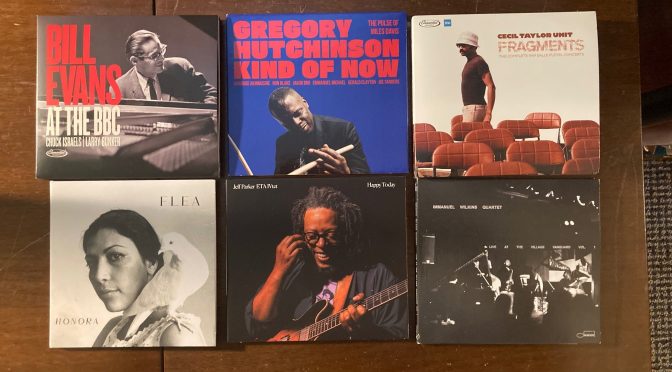
It’s a glorious Memorial Day afternoon – and, on this American holiday weekend, I’m looking back on five months of hearing and reflecting on America’s greatest musical invention. As always, there are plenty of worthwhile jazz albums (whether new or archival) easily in your reach; these are notable selections from what’s come to my attention so far this year. I’ve included listening links within album titles where available, along with a purchase link after my review where necessary.
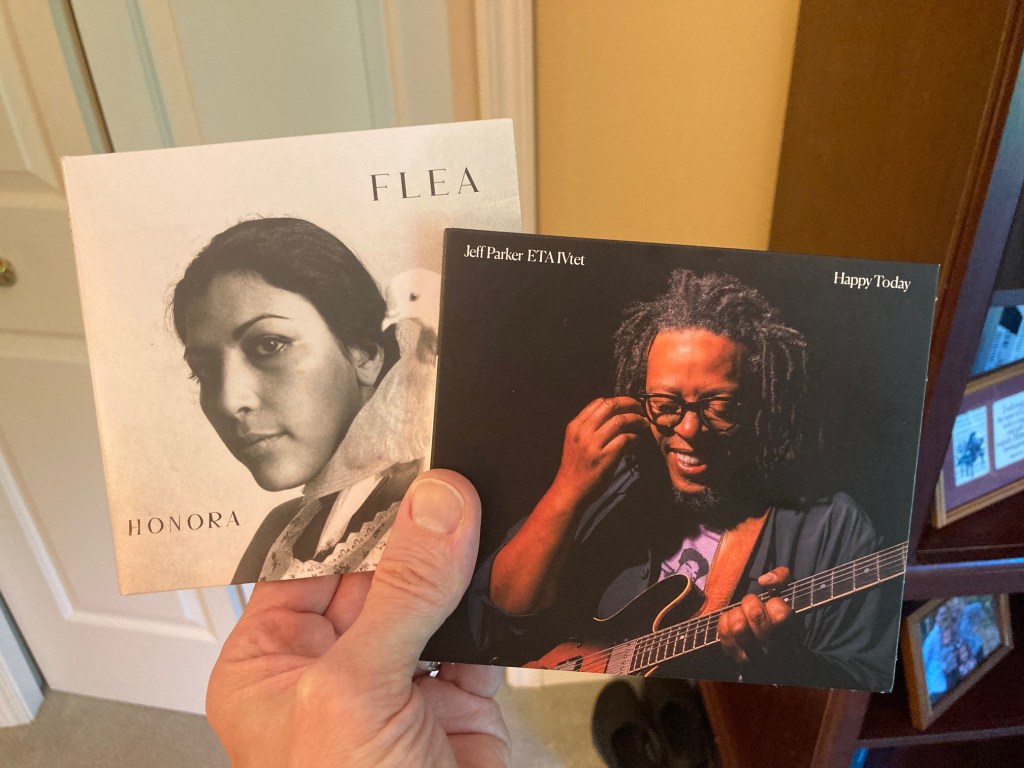
The album I’ve turned to the most (despite being released only this past month) is the Jeff Parker ETA IVTet’s Happy Today. Recorded live at a congenial Los Angeles haunt, guitarist Parker, saxophonist Jeff Johnson, bassist Anna Butterss and drummer Jay Bellerose conjure two generous portions of sheer music from silence. Guitar riffs circle and morph; sax lines are looped into shimmering chords and textures; hovering above capacious, confident rhythm work, all four players constantly listening and reacting, moving together through gradual builds and sudden tempo shifts. Whether weaving around each other’s contributions in a supple dance (“Like Swimming”) or ascending a rainbow of tone colors to a light, sweet shuffle (the title track), there’s no hurry, no contention – just a collaborative climb to lofty, inspired heights. It’s a measure of how rich this album is that every time I listen, I want to hear it again!
Parker, Johnson and Buttress also lay down understated foundations on Flea’s solo album Honora. The Red Hot Chili Peppers’ bassist returns to his heritage as a jazz trumpeter here, and while he’s boned up in recent years, he knows he’s running with thoroughbred players. Flea’s vocal features on the album’s noisier bookends “A Plea” and “Free as I Want to Be” push straight to hot emotional extremes, but his trumpet work is cool and controlled (reflecting the influence of Chet Baker); his original compositions combine understated tension with winning introspection; and his choices of cover tunes (Funkadelic to Glen Campbell to Franks Ocean & Sinatra) and guest vocalists (Thom Yorke backed by a horn section! Nick Cave singing “Wichita Lineman”!) are uniformly surprising and superb. Not what you might have expected, and all the better for it.
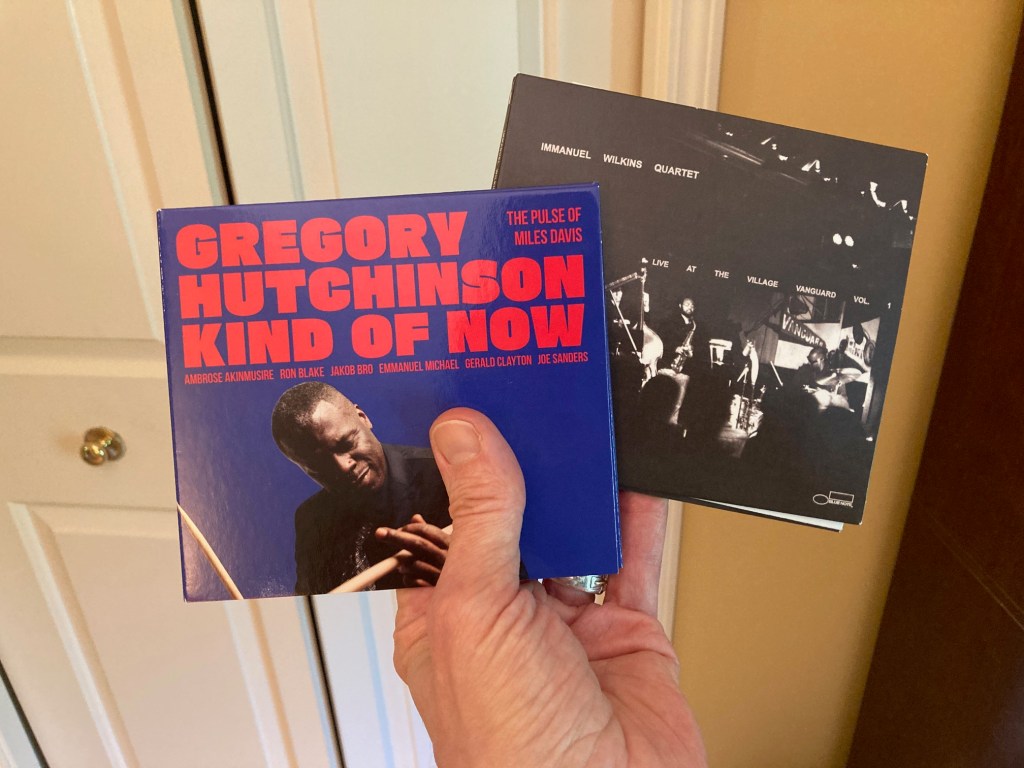
Four years ago, I thought Immanuel Wilkins might be part of jazz saxophone’s future; after hearing his quartet’s breathtaking Live at the Village Vanguard, Vol. 1, I’m convinced he’s now the present, in every sense of the term. Taking one of NYC’s most famous clubs by storm, Wilkins and his quartet (endlessly inventive pianist Micah Thomas, rock-solid bassist Ryoma Takenaga, masterful drummer Kweku Sumbury) are all in their 20s and 30s, but they’ve already lit out beyond previously explored territory to map their own exuberant course; through the modernistic postbop of “Warriors”, the Bachian interplay of “Composition XII”, the deep-rooted, ecstatic gospel of Alice Coltrane’s “Charnam” and the two-part “Eternal” (a time-bending workout that collapses into hypnotic sub-toned minimalism), there’s elegance and earthiness, mind and heart in constant dialogue. The applause after each track is unforced, the audience reacting to the Quartet’s potential unfolding into assured maturity before their ears. (Vol. 2 & Vol. 3 are equally fine, but only available via downloads or streaming. Buy Vol. 1 at Blue Note Records, — or lobby ’em for a complete box set!)
In case you hadn’t heard, Miles Davis’ centennial is this year – this week in fact. There are plenty of reissues already out and still to come, with tributes aplenty following in their wake. The best of the latter I’ve heard so far is Gregory Hutchinson’s Kind of Now: The Pulse of Miles Davis. Drummer Hutchinson’s style as a Young Lion has blossomed into a strong yet tempered sense of groove, thoroughly assimilating the work of the amazing drummers who backed up Davis; here, he leads an all-star group on a wild ride from early bebop (“Ah-Leu-Cha”) through cool school (“Fran Dance”, “Seven Steps to Heaven”) and a quartet of enigmatic Wayne Shorter tunes (including “Orbits” and “Water Babies”) to the pioneering days of jazz-rock fusion (“Bitches’ Brew” and “Circle in the Round”). Ambrose Akinmusere’s thick, liquid trumpet, Ron Blake’s consummately attentive sax work, and Gerald Clayton’s versatile, tasty piano delight throughout; it’s impossible to know what they’ll do at any given moment, but always satisfying in the aftermath. Around and through it all, there’s Hutchinson’s drive, color and sense of space. This is a thoughtful take on the breadth of Miles’ achievement that’s consistently focused and gracious, but marvelously abstract and unpredictable as well. (Buy the CD from Amazon.)
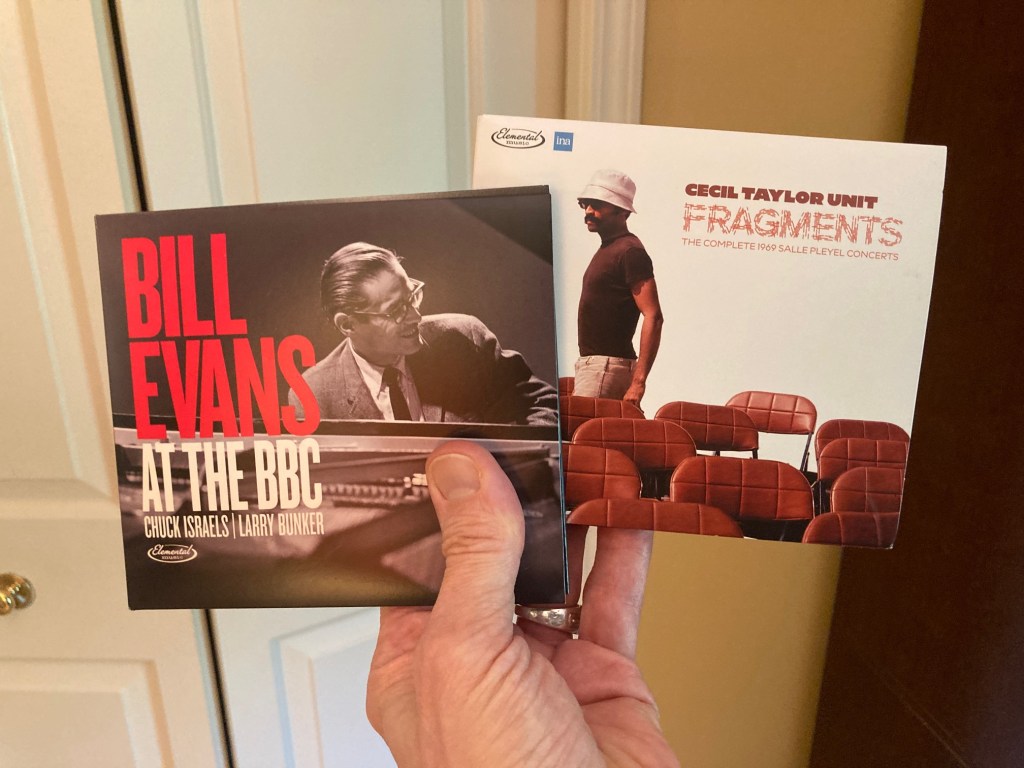
And as always, Record Store Day has brought a clutch of archival releases courtesy of jazz detective Zev Feldman. On Feldman’s 15th production of Bill Evans, At the BBC, the music is exquisite as always, despite severe sonic limitations inherent in the original 1960s television broadcast. Evans and his current trio with Chuck Israels and Larry Bunker shift moods on a dime, using dynamics as a key component in their mutual ebb and flow. Even when they take an uptempo tune like “Nardis” or turn “Waltz for Debby” into a 4/4 swinger, the rapt contemplation at the core of ballads like “My Foolish Heart” and “Who Can I Turn To?” are still winningly present. (Buy the CD from Amazon.)
Pursuing an idiom 180 degrees away from Evans, Cecil Taylor demanded the same level of attentive listening via radically different means – a sidelong take on the jazz piano tradition that reveled in fractured time and tonality, extended compositional statements and improvisations, a nigh-incessant, athletic tsunami of notes too fast to separate. On Fragments, recorded live at a French festival in 1969, Taylor prowls the keyboard like a roaring lion, endlessly pouring out riffs, chords, clusters; saxophonists Jimmy Lyons and Sam Rivers dialogue with and echo Taylor and each other, overblowing and piling up hyperspeed motifs at a frenetic pace; drummer Andrew Cyrille miraculously cooks up a flow in the absence of any downbeat – turning, shifting, reacting, leaping ahead. The two takes of Taylor’s “Fragments of a Dedication to Duke Ellington” are 50 and 90 minutes long, and you’ll feel like you’ve run a marathon after you’ve listened. This isn’t for the faint of heart or the squeamish, but trust me: Taylor’s pioneering free jazz will open up your ears and brain even as they wear them down and possibly out. (Buy the CD from Amazon.)
— Rick Krueger


You must be logged in to post a comment.