
The present Open letter to the bishops of the Catholic Church goes a stage further in claiming that Pope Francis is guilty of the crime of heresy. This crime is committed when a Catholic knowingly and persistently denies something which he knows that the Church teaches to be revealed by God. Taken together, the words and actions of Pope Francis amount to a comprehensive rejection of Catholic teaching on marriage and sexual activity, on the moral law, and on grace and the forgiveness of sins.
— Read on www.ncregister.com/blog/edward-pentin/father-aidan-nichols-signs-open-letter-charging-pope-francis-with-heresy
Category Archives: Republic of Letters
Gilbert highet’s classical tradition
Not a Democracy ~ The Imaginative Conservative
How often has one read or watched the news, only to be told that America, as the leading democratic power, must do this or that because it is in the interest of all free peoples to promote democracy? Democracy has become so overused as to become a synonym for all that is good in the world, especially identified as rainbow-headed unicorns with the wings of a Pegasus, flying unhesitatingly from imagined world to imagined world, the latest one progressing ever more and more toward all that is holy. Democracy, it seems, is freedom, goodness, truth, dignity, and beauty.
This is the absurdity that now surrounds us. Honestly, the unicorns would be preferable. One only has to watch the tumultuous and tenebrous storms of emotion that brew and blow on Twitter to see how well the democratic impulse tends toward goodness.
— Read on theimaginativeconservative.org/2019/04/not-democracy-bradley-birzer.html
Russell kirk lives
Did Political Parties Exist During the American Founding Era? ~ The Imaginative Conservative
Contrary to the vast majority of my fellow scholars of American history, I have never found the account of the creation of political parties in the Founding Era and Early Republic to be credible. I see very little evidence of anything that we would recognize as political parties before 1837… (essay by Bradley J. Birzer)
— Read on theimaginativeconservative.org/2019/04/political-parties-american-founding-era-bradley-birzer.html
A SEVERE LACK OF CULTURAL LITERACY. cHRISTOPHER pLUMMER WHERE ARE YOU?
The TRUE STORY OF MBUTI TENIENTE-My Father
The True Story of Mbuti Teniente, my Father


Every one in my family has nicknames and there are stories we tell about the old folk. My father had several nicknames; one was “Jaja” and the other was “Mbuti Teniente.” Remembering the people you came from was more than honoring tradition to us ; it was an essential part of our education. I told Andrew Roberts once that one of the first mottoes I ever learned was “NE OBLIVISCARIS” -the motto of my grandfather’s Regiment the Argylls- which means “do not forget.” He wrote to me to say it was a wonderful motto for the historian. And it is. I never hesitate to say my earliest and best teachers were my parents, aunts and uncles and my grandparents. I was not merely a student of my schools or colleges but of the “Munro Academy” which was our Lyceum. My father was our Aristotle and our one grandfather was our Chiron. Sadly the other grandfather had been killed long ago but he was remembered too and his blood and name lives on in my children. My father was not rich or famous but we knew he was a “mensch”; a good man and a good father and husband. And we loved him. We all knew he was wise in things of the world and brave, very brave. So we listened. And so we remember. And in these stories is the gift and virtue of gratitude. Gratitude is the pleasure of remembering, of receiving, the joy of friendship, the memory of courage and sacrifice. The knowledge that we never do anything alone. This is a story of gratitude, justice, courage, and the philia love (comradeship) of the soldier that never dies.
I come from an old Scottish family with naval and military ties; in the old days almost all the Highlanders or Islanders served in the Navy or Army. My people were fishermen and small farmers and typically the young men went into the Army as a solid paid career and their goal was to buy a fishing boat and marry a nice Highland woman.This subsistence farming fishing lasted almost into the 20 century but overfishing on coasts and population growth eventually made that kind of living impossible so we went to the industrial town of Glasgow where we worked in construction chiefly commercial and chiefly ships. Then came WWI. My father’s father (Auld Pop) served in WWI; my mother’s father was killed. The post year wars were bad so my family emigrated to America.My father, Thomas Munro, jr was 12 when he came to the USA in the late 1920’s. He graduated from Manual Training High School in Brooklyn, the first man ever to graduate from high school in our family (I am the second). He went on the Brooklyn College where he majored in English and French literature with an aim of becoming a teacher. But then the war came. And he responded to “An Gairm” , the Call to the Colors.

My people have always been good linguists as English was our second language and we have always shown strong proficiency in Latin, Spanish and French. So when WWII came my father joined the US Army in 1942 (he was a naturalized citizen). He helped his sergeant train Puerto Rican soldiers and started to pick up Spanish. He then was a Sergeant in the MPs (and he helped unload German POW’s in New Orleans -my father like my uncle spoke German quite well). Both men said knowing a language could help you make friends and even save your life. He impressed his superiors enough to be sent to OCS and then he was made a 2nd Lt. of an all black platoon in Louisiana. He was shocked so many were almost completely illiterate so he established special afternoon reading and literacy classes instead of yelling at the men for their ignorance and incompetence. He had some success. Many of his men became sergeants in the Transportation Corps.
Then my father was picked to go the Pacific chiefly in a supporting role in supply as an officer in the Transportation Corps. He was in Hawaii, Guam, Tinian and Saipan. General MacArthur wanted men who had some linguistic ability and my father spoke several languages including French so he signed up to study Spanish and Tagalog. Spanish came to him quite easily and Tagalog has many Spanish words and a Latin alphabet so he worked hard to become competent in that language. I can speak Spanish and picked up a little Tagalog from my father. Most of his Pinoy (Filipino) cargadores spoke Tagalog with a little Spanish. My father treated the Filipinos under his command with great respect and kindness so they called him “kaibigan magalang” and “mbuti teniente” which means the “respectful friend” and the “good lieutenant.”
My father often went to baptisms and weddings and attended Mass with the local people; their priests were Spanish and Irish so my father, being Roman Catholic, got along well with all of them. He made sure that the families of the Pinoy workers had plenty to eat and were given the good fresh food like the Americans. If there was Coca Cola for the Americans in his platoon he made sure the cargadores got Coca Cola also. Sometimes he would share a coke with them and listen to their songs. Sometimes, after Mass or at a wedding they would ask him to give a song and he would sing or recite a famous poem he knew by heart. One of his favorite songs was “She Lived Beside the Anner”
She lived beside the Anner,
at the foot of Slievemanon,
a gentle peasant girl,
with mild eyes like the dawn,
her lips were dewy rosebuds
and her teeth were pearls rare
And a snowdrift neath a beechen bough
her neck and nut-brown hair!
How pleasant was to meet her
On a Sunday when the bell,
Came ringing through its mellow tones,
Lone wood and grassy dell,
and at eve young maidens
roamed the river bank alone
And the Widow’s Nut Brown Daughter
Was the loveliest of the throng.
Oh, cruel and well-nigh callous
this weary heart has grown
for thy helpless fate dear Gaeltachtd
And for sorrows of my own!
Yet a tear my eye will moisten
When by Anner’s side I stray
For the Lily of the Mountain Foot
Who died so far away!
Now, most people say “Irish colleen” instead of “peasant girl” and they say “thy helpless fate, dear Ireland” instead of dear Gaeltacht (Highlands) but my father followed the family tradition of personalizing songs. He added his own verses to many old songs and tunes and I sing them still. And he married the “widow’s red-haired daughter”, my mother.
My father was generous and he would give candy to the children and he always donated at Mass.(My father and his family came from a very devout recusant Scottish family; his mother was born in Scotland of Irish parents and was very devout also).
His top foremen were Maliit Tony (Little Tony) and Malakas Tony (Big Tony). They kept him informed of all the comings and goings. They lost a few men to Japanese snipers 1944-45 but as I said my father was mostly in a supporting role so he did not see direct combat during WWII. Combat was always 20 miles away or a few weeks previous. As my father told me by the time he got anywhere the Marines had already cleaned out “the Japs” or “Hapons” and but good. He was very grateful to the Marines.
But in 1946 they had trouble with the Hukbalahap or “Huks”, the Filipino Communists. They were originally anti-Japanese guerrillas :Hukbong Bayan Laban sa mga Hapon”, which means “People’s Army Against the Japanese.” But as in many places after WWII (Korea,Vietnam, Greece) the Communists were trying to take over countries weakened by war. The Huks had a very bad reputation and at the end of 1945 and into 1946 they began attacking American supply bases and assassinating American officers and soldiers. They were very big in Luzon. My father said they were very brutal and they massacred civilians and killed foreign priests. He also heard bloodcurdling stories of how they took revenge and tortured their opponents. My father recalled that later (about 1949) Hukbalahap members ambushed and murdered Aurora Quezon widow of the Philippines’ second president, Manuel L. Quezon, as she was en route to her hometown for the dedication of the Quezon Memorial Hospital. What a mean, cowardly and despicable act he said. To murder a kind widow woman on a deed of mercy in peacetime. So my father hated -and feared- the Huks.
So my father, who had no orders to do so, always assigned some cargadores to protect the local priests and he gave them pistols. The loyal Pinoys enjoyed having that job and they acted like a local police force. They had young boys out as scouts everywhere. The local people appreciated that.
My father operated chiefly north of Manila in Manila Bay and around the coast up north to places like San Antonio, Balanga and so forth. He often had trucks moving north to Cabantuan etc. Though he was in the Army he had a PT boat at his disposal so that he could make trips to Manila for important meetings or to pick up films or medical supplies. He was the entertainment officer of his battalion; once he delivered the only technicolor copy of Laurence Oliver’s HENRY V to Manila so that General MacArthur could see it. He had only about 100 American soldiers in his company but he had several hundred Filipino cargadores normally unarmed except for machetes (bolos) and knives. The Pinoys had dogs as well which were very necessary, for they would give them advance warning of any visitors, friend or foe. The dogs were German Shepherd mixes, and they always barked whenever friendly strangers would be coming up the trail to the village or base. After dark, they always lay on the ground under the table where the soldiers and cargadores ate. They were happy to have the dogs near them for they could sleep without fear of a night attack. But they knew the Huks were out there in the hills in the jungle. Everyone hated -and feared the Hukbalahap-lalakli masuma!(Bad men).
Edward Haggerty in Guerrilla Padre in Mindanao wrote:
“But such a forest is beautiful only from the outside. A narrow trail winds through mud and creek beds in a gloom that weighs one down with its heaviness. You see no birds of gorgeous plumage, no woodland flowers blooming in the grass. Leeches cling to your ankles and insidiously crawl up your legs. They suck the blood from your neck and from behind your ears and leave infection that spreads to a horrible tropical ulcer. Inch-long needles of rattan pierce your feet and hands and face, thorns rip your clothing and pierce to the bare shoulder. A vine may cause an itch; to save yourself from slipping, you grasp and innocent-looking branch and your hand is pierced with a hundred small punctures which leave a sliver inside which swells and festers. There is no water in the slimy brook to drink, and troops of insolent monkeys chatter angrily as you pass, and the weary feet that strike an innocent-looking bit of rattan may launch a sharp bamboo spring into your legs–traps set for pigs and deer and human enemies. At night mosquitoes bite with the deadly sting of malignant malaria which kills after the first symptoms in three or four days. These and more, much more, is a tropical forest, even a forest with a good trail.”
Yes, the Huks were out there, too. Killers in the night. The war may have been over for some but the fighting was not over. Not for my father and his men.
One day my father was in the office attending to his work when a small barefoot boy came running in. He was breathless. He had been running down from the mountains. He said “lalaki masama” (bad men) were coming down from the mountain!
My father instantly put his men on alert and with Malakas and Meleeit Tony and his men they brought all the women and children from the village to the base to hide in the warehouse. For my father it was always women and children first.
Meanwhile the Pinoys and Americans built a road block with bulldozers and trucks and improvised machine gun nests with cargo boxes. They had to hurry; there was no time to lose. Soon the Huks would be upon them.
My father knew the Huk’s brutal reputation; if they couldn’t steal guns and ammo they would terrorize the local inhabitants. Before they knew it the enemy was upon them; they knew where my father’s office was and sprayed it with machine gun bullets and tossed in a grenade.
If my father had not been warned he might have been killed. But he was not there but across the road behind the barricades. He told me he unloaded several clips of .45 pistol into the Huk trucks and said if he ever killed anyone in the war it was that day.
So the Americans and their Pinoy friends fought back furiously, surprising the Huks who had counted on the element of surprise. The resistance was very heavy so that the Huks gave up and quickly retreated. The whole episode took less than 30 minutes. Some of the Americans wanted to follow the Huks into the hills but my father said that was someone else’s job. They were not trained or armed for that kind of fight and they would only get ambushed. Their job was to defend the base and supplies and they would keep on doing it. So the fight was over.
Some of the Filipinos were wounded but no one was killed. And even though the retreating Huks had thrown bombs into the homes of the villagers(nasty people that they were) none of the women or children were harmed, GRACIAS A DIOS, Praised be to God said my father to the Spanish priest.
After the battle all the children and women came up to my father and said SALAMATMBUTI TENIENTE SALAMAT! (Thanks Good Lieutenant). AMERIKANO Mbuti…Huk Masama! The American is good and the Huk bad!
That episode cemented my father’s popularity with the local people and everyone called him Teniente Munro or “Mbuti Teniente”.
General MacArthur came to inspect my father’s base personally -he was impressed they had driven off the Communists successfully with no civilian casualties and very light military casualties. Of course, the local people were very impressed to see MacArthur in person and speaking with my father. MacArthur was there almost 2 hours looking over the base and the village. At the end he said to my father, “Munro, that’s a fine old Scotch name, isn’t it?” And father saluted him and said,”Not as old and distinguished as the name MacArthur, General!” And the general smiled and gave a small laugh. The people cheered as MacArthur left and he waved.


Later July 4th, 1946 when the Philippines voted for independence -you probably know there was a strong statehood party also- Meleeit Tony and Malakas Tony and their people came up to my father with tears. They wanted to stay part of the USA and be able to come to America to work. They said to my father, “Mbuti Tentiente -if all Americans like you we put another star on the flag!” My father embraced them and said”Ah, Kaibigan tapat na loob!”(loyal friends). He was not ashamed to say he had to wipe away the tears from his eyes. It was a wonderful tribute to my father.
I have beautifully hand painted wooden name plate which says “THOMAS MUNRO 1st Lt TC” which was a gift from his Pinoy Cargadores and a painting they made of my mother from a photograph. My father was offered a promotion to Captain and a regular Army commission and he gave it serious consideration.
But he hadn’t seen my mother since 1943 and she wanted him to come home and they weren’t getting any younger (my mother was 30 in1946). So my father left the service and came home to work and start a family.He came home to 52-20. $20 a week. The two Tonys wanted to come to America to be my father’s personal servants and couldn’t understand, really, that my father as a poor immigrant had no property. He had worked his way up from private. I have a couple of photographs of them and my father on bulldozers or near mountains of supplies.
My father died September 27, 2003 at the age of 89 but he always remembered his days in the Philippines with great fondness especially the people. I have inherited this special affinity; I have had Filipino students in my classes and Filipino-Americans as colleagues at my school. They are a substantial ethnic group in Delano and Bakersfield, California where we live now. I look for the faces of Meleeit Tony and Malakas Tony and know one day I will see them.
My father always said to me: “This is the only life you have this side of paradise so don’t be a bastard.” My father came from a very humble immigrant background so he was not a snob; he believed anyone could improve through education.
And I believe his deep Catholic faith -and his Gaelic heritage- gave him a very strong feeling for justice. And the fact he did not run around with local women or cause trouble also caused him to be respected. My father said marriage was a sacrament and he always wore his wedding ring and we he talked about women he talked about his mother, his sister, his aunts and my mother.
I know a few others stories about my father but that is the story the true story of how he came to be called “Mbuti Teniente: the Good Lieutenant. NE OBLIVISCARIS…do not forget.
The egotist is ungrateful because he doesn’t like to acknowledge -in his pride and ignorance- his DEBT to others.
Gratitude is the acknowledgment of this debt. Gratitude rejoices in what has taken place and there for it is a positive virtue and not merely empty nostalgia. Gratitude (what the Greeks called CHARIS and the Gael TAINGEALACHD and the Saxon (THANKFULNESS) is an essential virtue of the mind and soul.
Gratitude is an immortal blessing. Gratitude, like an old song, frees us from death by the joyful knowledge of what was.
The Greek philosopher wrote: “We must heal our misfortunes by the grateful recollection of what has been and by the recognition that it is impossible to make undone what has been done.”
It is sad when a good man or good woman dies; this is the essence of that Gaelic word, untranslatable, “CIANALAS” (that feeling where joy and sadness mingle;that knowledge that all are gone and we meet “nae mair” no more in that beloved time and place).
We make a huge mistake if we do not believe and cultivate education in the home as the basis of all culture and all education and indeed our mother tongue and our faith traditions.
We make a huge mistake if we do not cultivate the virtue of gratitude or thankfulness. NE OBLIVISCARIS…do not forget.
And so I remember my father, a good man, a loyal and true man like his father before him. A patriot who loved America but had it in his heart to love other peoples especially as he used to say “our Gallant Allies.” So I remember Mbuti Teniente: the Good Lieutenant. So it is not a story of great heroism, perhaps, but a small story of a young officer who did his job with diligence and humanity.
Death can never cannot nullify what a man has lived or what he has done.
As my father used to say, “Something always remains of the Good and the Bad; let us try to elevate the Good and reject the Bad.”
Aye, ‘S trrrruth I am telling you. Young Tommie Munro was a goodjin , a leal n’ true mon!
What is america’s common culture? what is our splendid ancient heritage?
One writer said:”What is “the common culture and political principles that immigrants once learned to become Americans?”
What is our “splendid ancient heritage”?
Until we can clearly articulate these concepts we are all guilty of ‘sour grapes’.
Thomas Paine wrote: “If there is a country in the world where concord, according to common calculation, would be least expected, it is America. Made up as it is of people from different nations, accustomed to different forms and habits of government, speaking different languages, and more different in their modes of worship, it would appear that the union of such a people was impracticable…” Yet the union endures because of America’s common culture.
What is America’s common culture?
Learning American sports in school and in the neighborhood. I learned the Star-Spangled Banner and patriotic traditions by attending baseball games with my immigrant parents and grandparents for the Fourth of July.
Of course, serving in the American military helped us transfer our allegiance to America. My father and uncles volunteered for service in the US Army in 1941-1942 and I volunteered for service in the Marines. When I was in school there was much more emphasis on patriotic military culture than there is today in most schools especially in the big cities though I think it true to say heartland America which produces the bulk of ROTC/NROTC officers and military recruits still embraces a popular patriotic military culture.
All Americans ,regardless of race, creed or national origin, can be, as John F. Kennedy said, “proud of our ancient heritage.” I remember a German who told me that America was a nation had “no past and no culture of its own.” I told him he didn’t know America.
America DOES have an ancient and famous record of fighting for freedom and for individual rights. And Americans as an English speaking people, in particular, have a very ancient history of political freedoms. And in any case those of us who are Christians and Jews DO have a strong connection to a philosophical and religious heritage which is ancient indeed. We are heirs to a great and ancient free and ethical tradition of which we can be proud.
What is American’s common culture?
Certainly to be part of America’s common culture one must learn our national language, English. English is the key to understanding our free heritage. There is an old Scottish saying (originally in Gaelic) that said: “‘Tis not good to be an Earl or a servant or a soldier without the Saxon (English) tongue.” And that was written almost 500 years ago by a Maclean poet. It is even more true today.
If you can read this short essay you are already a lucky person. Why? Because you can read, write and (probably) speak English. English is the one language that is known and spoken by more people internationally than any other in the world circa 2019. English is the sine qua non and the lingua franca of today. But it isn’t language alone which makes America special.
Sometimes I am asked the difference between Mexico and the USA and I think it can be summarized to two words: Magna Carta. The USA has a strong tradition of limited government and Mexico does not. The Magna Carta and the legal tradition associated with it came to English North America at Jamestown and at Plymouth. And of course the Mayflower Compact is the seed of what became the United States; there the colonists proclaimed their need to elect their own leaders, and obey laws for the good of the entire community. This helped establish strong notions of popular sovereignty and consent of the governed. This concept of limited government and the rights of Englishmen –such as due process, trial by jury and no taxation without consent were carried into America by the colonial charters issued by the Crown. Most of Latin America did not have this legal and cultural influence. However, New Zealand, Canada and Australia have a very strong democratic heritage because they share this free heritage which comes from England (or Britain as everyone in my family would say).
What is America’s common culture? Learning about Memorial Day, the Fourth of July, King’s Letter from Birmingham Jail, memorizing the Gettysburg Address, learning about the Declaration of Independence and “inalienable rights.”
“What constitutes an American?, wrote Harold Ickes, “Not color nor race nor religion. Not the pedigree of his family nor the place of his birth. Not the coincidence of his citizenship. Not his social status nor his bank account. Not his trade nor his profession. An American is one who loves justice and believes in the dignity of man. An American is one who will fight for his freedom and that of his neighbor. An American is one who will sacrifice property, ease and security in order that he and his children may retain the rights of free men. An American is one in whose heart is engraved the immortal second sentence of the Declaration of Independence.”
And in this America was exceptional. For all the vaunted liberties of the English Bill of Rights there were great flaws in the English system because, for example, religious minorities such as Puritans, Quakers, Jews or Catholics were persecuted or forced to be non-jurors. In America, the Massachusetts Body of Liberties, written 48 years before the English Bill of Rights, was more expansive. America took steps at religious tolerance long before England with the Maryland Toleration Act (1649) which was all the more remarkable because Maryland was a Catholic colony. And of course the American Bill of Rights made defense of religious freedom even stronger.
The whole history of the USA is one of the expansions of rights and educational opportunities. Our country is not perfect I and would not claim for example that every military intervention by the US Marines was “for freedom” alone (sometimes they were protecting US interests and thus “keeping their honor clean” –following orders of civilian leadership). But in the really great wars the U.S. Marines were the tip of the spear for free nations and free societies and they have an exemplary record not only for courage but also for restraint and discipline. Likewise in WWII and WWI American soldiers came as liberators not as conquerors. It is a story that we can all be proud of as Americans.
No one in my family ever voted before they came to America but I recognize the greatness and nobility of George Washington, the Founding Fathers, Lincoln, the Roosevelts, Eisenhower, Kennedy and so on. Their history became OUR history. My immediate ancestors were subject to the whims of monarchs, press-ganging into military service and the oppression of state sponsored established churches.
Of course, there are things of my ancient heritage of which I am proud -our religious faith, our own musical and literary culture- but I do not romanticize the class ridden and undemocratic world of my forebears. My family were “Empire-builders” but they were the common soldiers and sailors in the Merchant Marine, they were the skilled construction workers building dreadnaughts or commercial buildings. Very few had an education beyond elementary school (people forget that universal secondary education was not established by law until 1944). Essentially we were the cannon fodder of empire.
What is the main problem with multiculturalism? it is dishonest and tends to romanticize or misrepresent foreign or ancient cultures. It promotes resentment and a sense of victimhood and exaggerated sense of oppression. Many multiculturalists also flirt, unwisely, with racial and ethnic separatism. My father warned me about romanticizing “the old country.” He also warned me against holding ancient national prejudices. He never told me to marry someone of our racial and ethnic background but to marry someone with similar values. The churches I attended as a boy and young man were never racially segregated. I dated young women from every continent, quite literally. All were young, attractive and reasonably well-educated. Some spoke splendid English. Some spoke not a word of English. But they all had a certain amount of charm.
I understand what America is all about. I, for example, have no English ancestry at all but I identify with an Anglophone or American English-speaking political and cultural heritage. English was, in a very real sense, the language of my mother and father’s liberation. My wife and son-in-law and daughter in-law have no English heritages whatsoever either. But they are americanizing and I have no doubt that my racially mixed grandchildren will consider themselves Americans even though if they have emotional and cultural ties to other nations. I don’t believe being an American has anything to do with race. My parents both graduated from an American public school in 1933 and so were fluent in English by then. They were the first people in their families and the only ones of their generation who graduated from high school and then went on to college.
My mother became a Registered Nurse; my father, who trained as an English and French teacher became an American officer and later a a reasonably successful businessman. He was a natural teacher but never practiced that profession. His entire teaching experience was as a TA at Brooklyn College and as a substitute in New York City. I remember him telling me they paid him five dollars a day!
I will always bless the memory of Mr. Sullivan, my parent’s 11th grade English teacher at the now defunct Manual Training High School in Brooklyn, N.Y. Mr. Sullivan was the child of Irish immigrants from the West of Ireland and he was a great encouragement to my parents. In the old country my parents were ashamed of their social class, their socially declasse religious background (Free Church and Roman Catholic). Their religious and language heritage something the never talked about publically. They were ashamed that their parents and grandparents were illiterate in their native language. Mr. Sullivan was the first to tell my father if one could understand Gaelic or Italian one could learn, French, Latin and Greek more easily than the average monolingual English-speaking person. Mr. Sullivan was the first person to teach the basics of comparative linguistics to my father, Grimm’s Law and the concept of the interrelationship of Indo-European languages.
And though my father never became a scholar of the academy he became very respectable amateur linguist reading the entire canon of classical Greek, Latin, French, German and Italian literature in the original. He also found time to learn Spanish and Tagalog during WWII coming to the attention of General Douglas MacArthur. He corresponded with Gilbert Highet of Columbia University and made his own translations of fragments of Homer, Euripides,Vergil, and Dante. He loved world literature but I know he loved English literature most of all; he also was well read in history and biography as well. His true love was poetry, classical music and opera and he had a vast collection of 78’s, original rare tapes of live operatic recordings and LP’s. Being born and raised in Scotland (he became a US citizen at age 21) he had a great love for Scottish and Irish songs as well as leider in French, Italian and German. One of the most curious albums I remember was an entire album of Scottish songs arranged by Beethoven and sung in German by Dietrich Fischer-Dieskau. I remember my father telling me how close German was to Lowland Scots and conversely how close Highland Scots was to Latin, French and Spanish. He encouraged us all to study both Romance languages and Germanic languages and all of us became competent in several languages.
I have primarily made my modest (local) reputation as a language teacher, especially of English. But I encourage multilingualism and praise students who are literate in their respective native languages. There is no reason not to cultivate several trees in our garden: an apple tree (representing English), an orange tree (representing Spanish) or a cherry tree (representing a third language). Authentic bilingualism should not be a closed and narrow goal; it should be the path to achieving competency in several languages and becoming a polyglot.
Should the government promote maintenance of “home languages” other than English? I don’t believe so. I believe it is up to families and private communities to teach “home languages” or “heritage languages” not the State or Local governments. Nevertheless, the choice of languages taught is up to local communities. I know schools that teach Punjabi as an elective and other schools that are Dual Immersion schools (Spanish and English) . My own daughter is a teacher in a Dual Immersion school; my son is a high school Spanish teacher. We all speak Spanish so we are hardly English-only!
I consider myself a cosmopolitan individual. And I remain an immigration optimist. I see the melting pot bubbling along despite all the ideologues and naysayers of the left and right. I admire and cherish aspects of other cultures and enjoy visiting other places. My family has roots not only in Europe but also Mexico and Latin America. But also know that I owe everything to America. We owe everything to America. Our debt of gratitude for our freedom and opportunities in this great nation is so immense that I would think we should be ashamed if we did not recognize it.
We need to tolerate private differences in language and religion but we should celebrate our common American heritage. As Diane Ravitch has written in her book LEFT BACK “a society that is racially diverse requires….a conscious effort to build shared values and ideals among its citizenry.” These shared values of America’s union will be forged by our public and quasi-public institutions, which include our press and media, voluntary organizations (sports and clubs), our houses of God, our jury box and court house, our armed services as well as our schools, colleges and universities public and private, religious and secular. Yet as we think about national unity we should think of coherence in our lives as families and as individuals. Russell Kirk said, “If you want to have order in the commonwealth, you first have to have order in the individual soul.”
We dare not take our political unity for granted. We dare not take our freedom and prosperity for granted. Our democratic experiment continues but it may yet be defeated by the high birth rate of ignorance by neglect, accident or willful indoctrination.
Theodore Roosevelt wrote “Of all the questions which can come before this nation, short of the actual preservation of its existence in a great war, there is none which compares in importance with the great central task of leaving this land even a better land for our descendants than it is for us.” Our descendants will be Americans and, God willing, they will know love and live in a free society with liberty and justice for all. I will strive to teach them and pass on to them the best of America’s free heritage the best of our “splendid ancient heritage.”
our splendid ancient heritage; our judeo-christian heritage
The term “Judeo–Christian values“ in an an civilizational and ethical sense was not common until almost the middle of the 20th century. Even during WWII Churchill and Roosevelt usually spoke of Christian Civilization. George Orwell used the phrase in a 1939 essay. I believe “Judeo-Christian” became popular as anodyne to discourage anti-Semitism after the horrors of the Holocaust. Of course, Western Civilization or Judeo-Christian Civilization has always mean Greco-Roman/Christian or Greco-Roman-Judeo-Christian heritage. In older books and essays I recall the word Bible or Bible-based culture being used instead of “Judeo-Christian” but usually the ethical sense is the same. And there can be no question we, in the USA, in the West, have a “splendid ancient heritage” of faith and freedom. Lincoln believed so. Roosevelt believed so. John F. Kennedy believed so. Kennedy said, confidently,
| “And yet the same revolutionary beliefs for which our forebears fought are still at issue around the globe—the belief that the rights of man come not from the generosity of the state, but from the hand of God. | 2 |
| We dare not forget today that we are the heirs of that first revolution. Let the word go forth from this time and place, to friend and foe alike, that the torch has been passed to a new generation of Americans— born in this century, tempered by war, disciplined by a hard and bitter peace, proud of our ancient heritage—and unwilling to witness or permit the slow undoing of those human rights to which this Nation has always been committed, and to which we are committed today at home and around the world.” What is this but a defense of Judeo-Christian heritage and natural law? We should be proud of “our ancient heritage” of freedom and faith. Faith in the individual. Faith in limited government. Faith in rule of law. Faith in the free exercise of religion (or faith in the right to not exercise or participate in any religion or be force to support it. Faith in our Republic and Constitution, “under God.” That is what Judeo-Christian heritage is. And it is indeed a proud and splendid ancient heritage. |
https://www.jns.org/opinion/is-it-still-permitted-to-speak-of-a-judeo-christian-heritage/
Chapter one A SHORT HISTORY OF THE ENGLISH LANGUAGE
A SHORT HISTORY OF THE ENGLISH LANGUAGE
By Richard K. Munro, MA
Chapter One: Old English or the “Right-true Saxon tongue”
English -or the “right-true Saxon tongue”[1] as it was once known- is a Germanic language, related at its heart to Dutch, Norwegian, Swedish, Danish and German. English is a not an ancient language, only coming into prominence in the last five hundred years. In the early 17th century barely one hundred individuals spoke English in all the Americas and in the British Isles only about five million people (80% of the population) spoke English[2]. English was not the languages of the schools or higher education at that time; George Washington –born in 1732-was among the first generation of educated English-speaking peoples to be educated almost entirely in the English medium. Prior to 1700 most learned books in Britain and Western Europe were written in Latin and educated people learned French and Latin. How did English rise from an insignificant, unwritten regional Germanic dialect to one of the great culture languages of the world?
Languages have always been instruments of great empires, great cultures and great religions. I once asked my Scottish grandfather why we spoke English if we weren’t English; he answered simply: “English is the language of the banks and the long-range guns. That’s why everyone speaks English including the English.” In other words, the winners write history.
(The terms “England” Ireland, “Scotland”, and “Wales” are used purely to indicate geographic location relative to modern boundaries. Roman Britain was a united province but in this time period the other nations did not exist as independent entities. )
The three big winners in English history were the Romans, the Normans and the English themselves. Jorge Luis Borges said:
You will say that it’s easier for a Dane to study English than for a Spanish-speaking person to learn English or an Englishman Spanish; but I don’t think this is true, because English is a Latin language as well as a Germanic one. At least half the English vocabulary is Latin. Remember that in English there are two words for every idea: one Saxon and one Latin. You can say ‘Holy Ghost’ or ‘Holy Spirit,’ ‘sacred’ or ‘holy.’ There’s always a slight difference, but one that’s very important for poetry, the difference between ‘dark’ and ‘obscure’ for instance, or ‘regal’ and ‘kingly,’ or ‘fraternal’ and ‘brotherly.’ In the English language almost all words representing abstract ideas come from Latin, and those for concrete ideas from Saxon, but there aren’t so many concrete ideas.[4]
We still use a Roman alphabet; many of our everyday words and expressions are French and we speak English because the English-speaking homeland has not been successfully invaded since the Norman Conquest in 1066 and because the English-speaking peoples and their Allies triumphed in all the major wars of the last three centuries most recently against Hitler and the Kaiser. The story of the English language will explain why the English language (or tongue) is so complex, multifaceted, difficult to spell and pronounce and to tell the truth at times strange, weird and inexplicable.
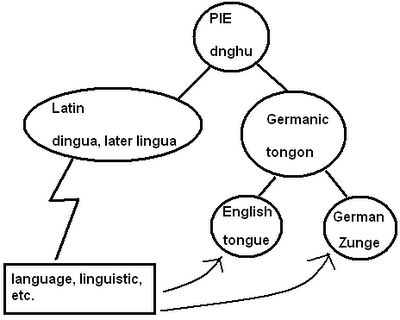
Figure 5 Indo-European roots of “tongue”
English belongs to the Germanic branch of the Indo-European family of languages. The European and many Indian languages go back to a common ancestor called “Indo-European”. Indo-European was spoken about 4500 BC to 2500 BC and all modern Indo-European languages are descended from this single language.[5]
| INDO-EUROPEAN ROOT[1] | ENGLISH MEANING |
| māter | MOTHER |
| pƏter | FATHER |
| bhrāter | BROTHER |
| swesor | SISTER |
| dhughƏter | DAUGHTER |
| seuƏ | SON |
| nepot | NEPHEW |
For comparison we can compare several well-known Indo-European languages.
| English & GERMAN | Latin | Greek |
| mother (OE mōdor Mutter | māter “mother” | mḗtēr” mother” |
| father (OE fæder) Vater | pater “father” | patḗr ” father” |
| brother (OE brōþor) Bruder | frāter “brother | phrā́tēr” member of a phratry (brotherhood) |
| sister (OEsweostor, influenced by ON systir) Schwester | soror “sister” | éor “relative” |
| daughter(< OE dohtor) Tochter | x | thugátēr“daughter” |
| son (OE sunu) Sohn | x | huiús “son” |
| Neve*(OBSOLETE) “nephew” (OE nefa) Neffe | Nepōs (nepōtis)“grandson, nephew” | népodes“ descendants” |
It is obvious from the above list that English is closely related to German and, indeed, English is a Germanic tongue. But English is the least purely Germanic language because it is truly a hybrid. “English is a baptized Anglo-Saxon barbarian with a fancy French makeover a little Latin and less Greek” is how a teacher once put it to me somewhat tongue in cheek. Nonetheless, is it true that English is unusual in that it is a language composed of basically three strata:
1. The Germanic or “Anglo-Saxon”[1] one, which is the basis of English. Many irregular verbs are “Anglo-Saxon” (Germanic)
2. A classical strata mainly French, Latin (Romance)
3. A classic philosophical, technical and academic strata of more sophisticated words and ideas (Greek).
The “Anglo-Saxon words “are short, everyday words. They are stronger sometimes vulgar. The classical words are a more learned, more polite in tone, “colder”; they form more sophisticated stratum.
Speech, tongue, land, understand, stand, sit, eat, head, foot, to mean, meaning, red, black, blue, the, his, her are examples of simple Germanic roots in English. Notice these are mostly three, four or five letter words or compounds of short words. “Early to bed, early to rise makes us healthy, wealthy and wise”; this is an example of an ancient English proverb over a thousand years old. It does not have a single Latinate word.
We should, recall, that literature is older than the alphabet and the earliest genres are myths, orations, poems, prayers and proverbs. Some English proverbs appear to be translations of Latin or French proverbs but others seems to be unique to English.Here are some other examples:
1)“All that glitters is not gold” (appearances can deceive)
2)“When meat is in, anger is out” (one way to remedy anger)
3)“Better to ask the way than go astray” ( ask to as not to get lost)
4)“Hard words break no bones” (effect of criticism)
5) “If a job’s worth doing, it’s worth doing well.” (Value of diligence)
6) “Every shoe fits not every foot” (people are different)
7) “When the moon’s in the full, then the wit’s in the wane”
(Full moons make people crazy)
8) “Make not thy friend thy foe” (don’t make enemies of your friends)
9) “A hedge between keeps friendship green” (privacy helps keep friends)
10)“Many hands make light work” (value of people helping each other)
11) “Little gear, less care” (“gear” means possessions; rich people worry)
`12)“O God, thy sea is so great, and my boat is so small”[1]
Here is an example of writing English in a Germanic (Anglo-Saxon) way
or in an academic/legal (Latin) way:
EXAMPLE#1: ANGLO-SAXON (“Germanic”) English:
Now anything he tries to do in the house without his shoes will be kept from his mother and father as well as his folk. The child’s behavior is trouble.
EXAMPLE #2 LATINATE (Academic/legal) ENGLISH:
It will not be possible to restrain him from exercising in the domicile without his boots nor to conceal it from his parents as well as from the people. The comportment of the neonate is problematic.
Since less than 40% of modern English is Germanic (and about 25% is derived from Anglo-Saxon) it is impossible, today, to communicate without any Greco-Latin (or classical) words. But the Anglo-Saxon roots, generally speaking, are high frequency words and are very emotive words. Sophisticated words or polysyllabic words are almost always Greek or Latin in origin (including French words) but tend to be “colder” in tone. For simplicity’s sake I always say “Anglo-Saxon” rather than “Germanic” or Old English so as to make it clear that I am not referring to German or modern English.
See the chart below for some examples.
Three Strata of English:
| ANGLO-SAXON (includes native British words ****************** ****** and other Germanic) | LATIN Includes Latinate or French words often legal, military or academic words | GREEK often scientific philosophical, medical or technical terms |
| Everyday words “four letter words” | Quotidian; common vocabulary | Koine (standard universal language) |
| To drink | To imbibe | Dipsosis (thirst) Dipsomaniac (person addicted to drinking alcohol) Medical terms |
| To eat | To consume; to devour | Parasite |
| Leech, toady Freeloader | Servile person | Parasite, sponger sycophant |
| Healer “nurse” “saw bones” | Doctor General practitioner (GP) Medical doctor | Physician Surgeon ; surgery The names for specialists are Greek derived: ex. Obstetrician (baby doctor) Pediatrician (child doctor) |
| thing | Object , entity article, commodity | Synthesis, analysis |
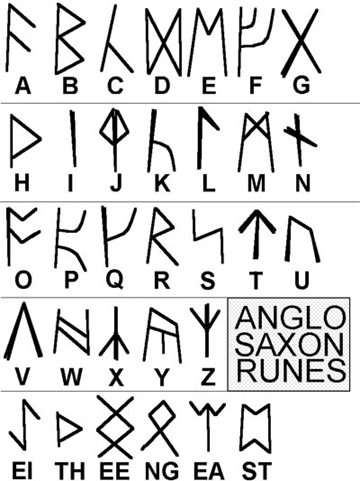
Figure 6 Early Anglo Saxon Runes or Alphabet

The history of English is traditionally divided into three periods usually called Old English (or Anglo-Saxon), Middle English, and Modern English. Three Germanic tribes, called Angles, Saxons and Jutes, invaded Roman Britain in the fifth century AD. They may have first come as barbarian mercenaries and when the Roman legions were withdrawn from Britain the Anglo-Saxons or English –who were pagans- gradually took over from the native Romano-Britons who were Christian. King Arthur, the legendary King of Camelot, [1]is supposed to have rallied the Britons against these pagan invaders from a time; this allowed Wales and Scotland to develop as independent countries with their own languages and traditions.[2] Later those Celtic languages had some influence on English but relatively little until the 18th and 19th century. Some Celtic loanwords in modern English are loch (lake), whiskey, phoney, leprechaun, slogan, kibosh, shenanigans, ceilidh, galore, shanty, colleen, gillie , cairn, plaid , shamrock, clan, bog, cairn. There are a score of others which may be Celtic but are usually considered of unknown origin; Skullduddery? , toting a piece? (Carrying a weapon) , “a “checkered past”(?), “smashing” (good) , noggin ? and so on. I make no claims of my own.; I follow the authority of the Oxford English Dictionary and the American Heritage Dictionary. John Ciardi, the famous linguist, also said America popularized many Irish words which were frowned upon in England until recent times. See John Ciardi, A Brower’s Dictionary Harper and Row, 1980. There are of course many Celtic loanwords in Latin and German dating back to pre-Roman times. See also An Etymological Dictionary of the Gaelic Language (1896) reprinted 1982. Most Celtic words in modern English were popularized by the poems and songs of Robert Burns, the poems of Thomas Moore, William Butler Yeats and the novels and poems of Walter Scott and others of the “Celtic Revival”.
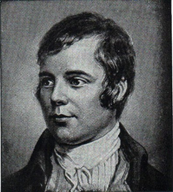
Scotia’s Bard: Robert Burns

Here are a few famous examples: [
| “The Cotter’s Saturday Night ” |
| Robert Burns |
| Inscribed to R. Aiken, Esq. “Let not Ambition mock their useful toil, Their homely joys, and destiny obscure; Nor Grandeur hear, with a disdainful smile, The short and simple annals of the Poor. MY lov’d, my honour’d, much respected friend! No mercenary bard[1] his homage pays; With honest pride, I scorn each selfish end, My dearest need, a friend’s esteem and praise: 5 Only “bard” is a native Celtic word. Bard is a Celtic word (poet); Ingle (fireplace ) is a Celtic word; but most of the “difficult” words such as “weary kiaugh” (cark) burden; worry are Scottish English dialect derived from Middle English. They are archaisms of English not Celtic. “Coronach” Sir Walter Scott (1771–1832) HE is gone on the mountain, He is lost to the forest, Like a summer-dried fountain, When our need was the sorest. The font reappearing 5 From the raindrops shall borrow, But to us comes no cheering, To Duncan no morrow! The hand of the reaper Takes the ears that are hoary, 10 But the voice of the weeper Wails manhood in glory. The autumn winds rushing Waft the leaves that are serest, But our flower was in flushing 15 When blighting was nearest. Fleet foot on the corrie Sage counsel in cumber, Red hand in the foray, How sound is thy slumber! 20 Like the dew on the mountain, Like the foam on the river Like the bubble on the fountain, Thou art gone, and forever. Only a few Celtic words are added (Corry and Coronach) though it is possible the simple style reads like a translation from Gaelic. Correi (or Corrie ; Coire) is a round hollow in the hillside. Use of this Gaelic word adds local color but otherwise the poem is pure English. A coronach id funeral dirge on the bagpipes ( from the Gaelic Coranach ) “How Oft Has the Banshee Cried” By Thomas Moore HOW oft has the Banshee cried! How oft has death untied Bright links that Glory wove, Sweet bonds entwined by Love! Peace to each manly soul that sleepeth; 5 Rest to each faithful eye that weepeth; Long may the fair and brave Sigh o’er the hero’s grave! Once again there is only one Celtic word (Banshee). A banshee (Bean-Sidh) is a legend, a banshee is a fairy woman who begins to wail if someone is about to die. In Scottish mythology the creature is called the bean sìth or bean-nighe and is seen washing the blood stained clothes or armor of those who are about to die. Here is an extended quotation from Merriam Webster. I can read Middle English (Chaucer) with some annotation but I cannot read Anglo-Saxon nor am I an expert on Anglo-Saxon so here it is best to go word by word from an expert source: [1] The following brief sample of Old English prose illustrates several of the significant ways in which change has so transformed English that we must look carefully to find points of resemblance between the language of the tenth century and our own. It is taken from Aelfric’s “Homily on St. Gregory the Great” and concerns the famous story of how that pope came to send missionaries to convert the Anglo-Saxons to Christianity after seeing Anglo-Saxon boys for sale as slaves in Rome : Eft he axode, hu ðære ðeode nama wære þe hi of comon. Him wæs geandwyrd, þæt hi Angle genemnode wæron. Þa cwæð he, “Rihtlice hi sind Angle gehatene, for ðan ðe hi engla wlite habbað, and swilcum gedafenað þæt hi on heofonum engla geferan beon.” A few of these words will be recognized as identical in spelling with their modern equivalents—he, of, him, for, and, on—and the resemblance of a few others to familiar words may be guessed—nama to name, comon to come, wære to were, wæs to was—but only those who have made a special study of Old English will be able to read the passage with understanding. The sense of it is as follows: Again he [St. Gregory] asked what might be the name of the people from which they came. It was answered to him that they were named Angles. Then he said, “Rightly are they called Angles because they have the beauty of angels, and it is fitting that such as they should be angels’ companions in heaven.” Some of the words in the original have survived in altered form, including axode (asked), hu (how), rihtlice (rightly), engla (angels), habbað (have), swilcum (such), heofonum (heaven), and beon (be). *** ” Perhaps the most distinctive difference between Old and Modern English reflected in Aelfric’s sentences is the elaborate system of inflections, of which we now have only remnants. The period of Middle English extends roughly from the twelfth century through the fifteenth…” [2] We can hear elements of Middle English, still, in northern English and Scottish dialects. [1] http://www.merriam-webster.com/help/faq/history.htm [2] http://www.merriam-webster.com/help/faq/history.htm I [ *** |
[1] The excellent English language
[2] The rest spoke Welsh or Irish or Scottish Gaelic languages still spoken in the Isles today.
[3] This fact has a great influence on how modern English is spelled.
[4] Rita Guibert Seven Voices
Knopf Doubleday, 2015 p. 71 ed. Richard Burgin
In-depth and personal interviews by Rita Guibert of Pablo Neruda, Jorge Luis Borges, Miguel Angel Asturias, Octavio Paz, Julio Cortázar, Gabriel García Márquez and Guillermo Cabrera Infante. The Nobel Prize in Literature was awarded to Pablo Neruda in 1971, Miguel Angel Asturias in 1967, Octavio Paz in 1990 and Gabriel García Márquez in 1982.
[5] Also called “Aryan” this was a linguistic group like Latin or Spanish. In Nazism it was considered a “race” of “pure Europeans” (Caucasian Gentiles of a Nordic type). Indo-European speakers were of many races.
 Spirit of Cecilia
You must be logged in to post a comment.