Hope on a Rose

[Dear Spirit of Cecilia Readers, as some of you might know, our website is named not only for St. Cecilia, the patron saint of music, but also for my deceased daughter, Cecilia Rose. Today would’ve been her 17th birthday. We visited her grave just now, and, as my wife so wisely noted, in some ways, it’s been a hundred years since she died, and, in some ways, it’s been 24 hours.

I can be perfectly fine on August 7 and August 9, but I’m always rather down on August 8. Every year without exception. It’s like a huge weight is on my shoulders, and I can only describe this feeling as a form of depression.

Weird how time works. I say this as a professional historian who thinks about the steadiness, the fluctuations, and the chaos of time on a daily basis.

Anyway, here’s a piece I wrote about her on what would’ve been her eleventh birthday. As much as I love the Catholic Church and God, I still can’t but be confused by His Providence. Cecilia Rose was always His, but I just can’t fathom why he would give Dedra and me charge over her, only to take her away at the last moment. All I can do is trust in Him and His ways.

Happy Feast of Little Cecilia Rose, our precious saint.

Yours, Brad]

HOPE ON A ROSE: Had things worked or happened differently, I would be celebrating the eleventh birthday of my daughter, Cecilia Rose Birzer, today. I can visualize exactly what it might be like. A cake, eleven candles, hats, cheers, goofiness, photos, and, of course, ice cream. I imagine that she would love chocolate cake–maybe a brownie cake—and strawberry ice cream. Her many, many siblings cheer here, celebrating the innumerable smiles she has brought the family. As I see her at the table now, I see instantly that her deep blue eyes are mischievous to be sure, but hilarious and joyous as well. Her eyes are gateways to her soul, equally mischievous, hilarious, and joyous. She’s tall and thin, a Birzer. She also has an over abundance of dark brown curls, that match her darker skin just perfectly. She loves archery, and we just bought her first serious bow and arrow. No matter how wonderful the cake, the ice cream, and the company, she’s eager to shoot at a real target. 

She’s at that perfect age, still a little girl with little girl wants and happinesses, but on the verge of discovering the larger mysteries of the teenage and adult world. She cares what her friends think of her, but not to the exclusion of what her family thinks of her. She loves to dance to the family’s favorite music, and she knows every Rush, Marillion, and Big Big Train lyric by heart. She’s just discovering the joys of Glass Hammer. As an eleven-year old, she loves princesses, too, and her favorite is Merida, especially given the Scot’s talents and hair and confidence. She has just read The Fellowship of the Ring, and she’s anguished over the fate of Boromir. Aragorn, though—there’s something about him that seems right to her.

If any of this is actually happening, it’s not happening here. At least not in this time and not on this earth. Here and now? Only in my dreams, my hopes, and my broken aspirations.

Eleven years ago today, my daughter, Cecilia Rose Birzer, strangled on her own umbilical cord. That which had nourished her for nine months killed her just two days past her due date.

On August 6, 2007, she came to term. Very early on August 8, my wife felt a terrible jolt in her belly and then nothing. Surely this, we hoped, was Cecilia telling us she was ready. We threw Dedra’s hospital bag into the car as we had done four times before, and we drove the 1.5 miles to the hospital. We knew something was wrong minutes after we checked in, though we weren’t sure what was happening. Nurses, doctors, and technicians were coming in and out of the room. The medical personnel were whispering, looking confused, and offering each other dark looks. Finally, after what seemed an hour or more, our beloved doctor told us that our child—a girl, it turned out—was dead and that my wife would have to deliver a dead child. 

We had waited to know the sex of the baby, but we had picked out names for either possibility.  We had chosen Cecilia Rose for a girl, naming her after my great aunt Cecelia as well as St. Cecilia, the patron saint of music, and Rose because of St. Rose of Lima being the preferred saint for the women in my family and because Sam Gamgee’s wife was named Rosie.

I had never met my Aunt Cecelia as she had died at age 21, way back in 1927.  But, she had always been a presence in my family, the oldest sister of my maternal grandfather.  She had contracted tetanus, and the entire town of Pfeifer, Kansas, had raised the $200 and sent someone to Kansas City to retrieve the medicine.  The medicine returned safely to Pfeifer and was administered to my great aunt, but it was too late, and she died an hour or two later. Her grave rests rather beautifully, just to the west of Holy Cross Church in Pfeifer valley, and a ceramic picture of her sits on her tombstone. Her face as well as her story have intrigued me as far back as I can remember. Like my Cecilia Rose, she too had brown curly hair and, I suspect, blue eyes. She’s truly beautiful, and her death convinced her boyfriend to become a priest.

The day of Cecilia Rose’s death was nothing but an emotional roller coaster. A favorite priest, Father Brian Stanley, immediately drove to Hillsdale to be with us, and my closest friends in town spent the day, huddled around Dedra.  We cried, we laughed, and we cried some more–every emotion was just at the surface. I’m more than certain the nurses thought we were insane. Who were these Catholics who could say a “Hail Mary” one moment, cry the next, and laugh uproariously a few minutes later? Of course, the nurses also saw just how incredibly tight and meaningful the Catholic community at Hillsdale is. And, not just the Catholics—one of the most faithful with us that day was a very tall Lutheran.

Late that night, Dedra revealed her true self.  She is—spiritually and intellectually—the strongest person I know. She gave birth with the strength of a Norse goddess. Or maybe it was just the grace of Mary working through her. Whatever it was, she was brilliant. Any man who believes males superior to females has never seen a woman give birth.  And, most certainly, has never seen his wife give birth to a dead child. Cecilia Rose was long gone by the time she emerged in the world, but we held her and held her and held her for as long as we could. With the birth of our other six children, I have seen in each of them that unique spark of grace, given to them alone. Cecilia Rose was a beautiful baby, but that spark, of course, was absent, having already departed to be with her Heavenly Father.

For a variety of reasons, we were not able to bury her until August 14.  For those of you reading this who are Catholic, these dates are pretty important. August 8 is the Feast of St. Dominic, and August 14 is the Feast of St. Maximilian Kolbe.

Regardless, those days between August 8 and August 14 were wretched. We were in despair and depression. I have never been as angry and confused as I was during those days. Every hour seemed a week, and the week itself, seemed a year. I had nothing but love for my family, but I have never been that angry with God as I was then and, really, for the following year, and, frankly, for the next nine after that. We had Cecilia Rose buried in the 19th-century park-like cemetery directly across the street from our house. For the first three years after her death, I walked to her grave daily. Even to this day, I visit her grave at least once a week when in Hillsdale.  In the first year after her death, I was on sabbatical, writing a biography of Charles Carroll of Carrollton. Every early afternoon, I would walk over to her grave, lay down across it, and listen to Marillion’s Afraid of Sunlight.  Sometime in the hour or so visit, I would just raise my fist to the sky and scream at God.  “You gave me one job, God, to be a father to this little girl, and you took it all away.” In my fury, I called Him the greatest murderer in history, a bastard, an abortionist, and other horrible things. I never doubted His existence, but I very much questioned His love for us.

Several things got me through that first year: most especially my wife and my children as well as my friends.  There’s nothing like tragedy to reveal the true faces of those you know. Thank God, those I knew were as true in their honor and goodness as I had hoped they would be. A few others things helped me as well. I reread Tolkien, and I read, almost nonstop, Eliot’s collected poetry, but especially “The Hollow Men,” “Ash Wednesday,” and the “Four Quartets.” I also, as noted above, listened to Marillion. As strange as it might seem, my family, my friends, Tolkien, Eliot, and Marillion saved my life that year. I have no doubt about that. And, nothing gave me as much hope as Sam Gamgee in Mordor.  “Sam saw a white star twinkle for a while. The beauty of it smote his heart, as he looked up out of the forsaken land, and hope returned to him that in the end the Shadow was only a small and passing thing: there was light and high beauty forever beyond its reach.” As unorthodox as this might be, we included Tolkien’s quote in the funeral Mass.

A year ago, my oldest daughter—the single nicest person I have ever met—and I were hiking in central Colorado. We were remembering Cecilia Rose and her death. Being both kind and wise, my daughter finally said to me, “You know, dad, it’s okay that you’ve been mad at God. But, don’t you think that 10 years is long enough?” For whatever reason—and for a million reasons—my daughter’s words hit me at a profound level, and I’m more at peace over the last year than I’ve been since Cecilia Rose died. I miss my little one like mad, and tears still spring almost immediately to my eyes when I think of her. I don’t think any parent will ever get over the loss of a child, and I don’t think we’re meant to. But, I do know this: my Cecilia Rose is safely with her Heavenly Father, and, her Heavenly Mother, and almost certainly celebrating her birthday in ways beyond our imagination and even our hope. I have no doubt that my maternal grandmother and grandfather look after her, and that maybe even Tolkien and Eliot look in on her from time to time. And, maybe even St. Cecilia herself has taught my Cecilia Rose all about the music of the spheres. Indeed, maybe she sees the White Star. Let me re-write that: I know that Cecilia Rose sees the White Star. She is the White Star.

Happy birthday, Cecilia Rose.  Your daddy misses you like crazy, but he does everything he can to make sure that he makes it to Heaven–if for no other reason than to hug you and hug you and hug you.

Spirit of Cecilia Visits Kansas

Happy Summer, Spirit of Cecilia readers! In this post, our panel of music lovers takes a look back at two very popular and influential albums from the 1970s: Leftoverture and Point of No Return, by those proggers of the prairie, Kansas! Brad Birzer, Kevin McCormick, Carl Olson, and Tad Wert discuss what they love (and maybe not so love) about these works.

Brad: Carry on, my wayward sons!  The cry of my childhood.  Tad, thanks so much for setting this up.  I’m eager to talk all-things Kansas, especially Kansas in the mid 1970s.  As I’ve had the privilege of writing here and elsewhere, I grew up in central Kansas with two older brothers who collected prog.  My mom encouraged good reading and good music.  My earliest prog memory is of Yessongs, but Kansas and Jethro Tull rank up there.  Of course, growing up in Kansas, it would have been impossible to miss the band.  They were everywhere in the 1970s and proudly so.  As it is, “Carry On, My Wayward Sons” might have been the very first song–as a kid–whose lyrics I memorized.

On a side note, President Arnn of Hillsdale College once introduced me and said, “Carry on, my wayward son,” to which I responded, “Yes, Larry, there will be peace when you are done.”

On another side note, in 1950, the Knights of Columbus erected a huge cross commemorating the priesthood and exploration of Father Padilla.  My grandfather was one of the Knights at the installation ceremony.

A third side note.  Every Fourth of July celebration in my hometown of Hutchinson was always held at the State Fairgrounds and always included “Song for America”–despite it not being very pro-American lyrically–as a part of the soundtrack for the fireworks.

But back to Leftoverture.  I love the album.  It’s a personal favorite and really has been as far back as I can remember.  The interplay of bass, organ (well, moog and keyboards), and violin, I suppose, is the trademark of the band, and it’s done so expertly on this album.  And, Kerry Livgren, who wrote most of the tracks, was simply on fire as a composer.  The album as a whole flows so beautifully, and the lyrics are extraordinary.

Tad: I was a sophomore in high school when Leftoverture came out, and I remember listening to WKDF, Nashville’s “progressive rock radio” station, with my tape deck nearby. As soon as those opening chords of “Carry On, My Wayward Son” came over the airwaves, I hit Record! I still love that song – it’s something I will never tire of. 

Brad, I never imagined that Father Padilla was a real person! With a name like that, I figured he had to be part of the “Magnum Opus” tongue in cheek humor. Speaking of “Magnum Opus”, that is one of my favorite Kansas songs ever. You are right – the album has a perfect flow to it, and “Magnum Opus” is an excellent closer.

Leftoverture was my first exposure to Kansas – I bought that album not long after it came out, but it was years before I listened to any of their earlier ones. Song for song, it’s an incredibly strong offering. I know that Point of Know Return was a huge seller and more popular, but I will always like Leftoverture more.

Brad: Tad, Kansans are as proud of their state as Texans are; they’re just not as loud about it!  Yes, Kansans know Father Padilla.  So, it’s definitely a joke on the part of the band, Kansas, but, to be sure, an inside joke.

In my previous note, I only talked about Leftoverture, but I also love Point of Know Return.  “How long???  To the point of no return.”  

As a kid, this opening track completely and utterly sparked my imagination.  Exactly what was a journey, and what was a journey into unknown?  Now, of course, we have Interstates 35 and 70 that cross Kansas, as well as US281–all glorious highways.  But, connecting Point of No Return as the logical sequel to Leftoverature, one must wonder about the glories of exploration.  What about Cortes and Coronado?  

If Leftoverature ends with exploration of Father Padilla into central Kansas, Point of No Return is nothing if not exploration itself–to the farthest reaches of the globe.  Maybe even more importantly, to the farthest reaches of the very heart of the soul itself.  

“He was off on another plane. . . . no one was sure if he was sane . . . but he knew, he knew more than me or you.”

It must be noted, these lyrics were written long before Kerry Livgren converted to Christianity, but he so clearly longed for it.

I must also note, the best scene of the terribly bad hilarious movie Old School, involves Will Farrell singing “Dust in the Wind” at the funeral of Ol’ Blue.  Again, a terrible movie that I would never recommend, but one that made me laugh so much, I thought I was going to lose my stomach.

Carl: I also listened to both of these albums while in high school—in 1986 and 1987, specifically, which were my junior and senior years. I was first introduced to Kansas via the Best of Kansas compilation, which came out in 1984. Then I found these two and began to play them continuously (on cassette, of course!). The album Power came out in 1986, and I added that to my steady play routine; it introduced me to Steve Morse, which led to Dixie Dregs and Morse’s solo work. And 1988’s In the Spirit of Things is one of my favorite Kansas albums, despite some over production (by Bob Ezrin), as I’ve detailed here.

Kansas, as we all know, is the most famous and popular of the American prog-rock bands of the 1970s and ‘80s, and it is also almost completely dismissed or derided by the coastal critics. I won’t dwell on that point too much, but will note that this critical snobbishness is a bit strange as Kansas really eschewed the sort of pretentious noodling and overplaying that the same critics hated in groups such as Yes and ELP. Yes, Kansas—as these two albums readily demonstrate—composed and performed intricate and even rather epic instrumental passages (or even entire songs), but they were not, in my estimation, works for instrumental virtuosos, as none of the original band members could be fairly described as such. Rather, they were exceptional musicians who often played several instruments (Livgren on guitar and keys, Walsh on vocals, keys, and percussion, etc).

So, what sets them apart? There are many reasons, but I’ll just hone in on three that have really stood out to me over the years. 

First, the writing. Livgren (as Brad notes) was a brilliant writer and arranger, employing an eclectic mix of classic rock, Southern rock, and (quite essential in the big picture) classical motifs and structures. The violin of Robby Steinhardt was essential to the mix, not just tonally, but as an almost cinematic character that held together passages employing hard rock, organ flourishes and solos, and some odd time signatures. And Livgren was also a brilliant lyricist, whose journey from searcher and seeker to (c. 1980) born-again Evangelical Christian is captured throughout the first several Kansas albums. It is one reason that 1975’s Song for America is such a fascinating album (it is also, to my ears, the most “out there” of the Kansas albums, thus holding a special place in my heart).

And so, in Leftoverture (1976) and Point of Know Return (1977) we encounter much existential tension (“Dust in the Wind” is an obvious, but hardly solitary, example), ruminations on mortality and one’s place in the world (“Questions of My Childhood,” “Hopelessly Human” and “Nobody’s Home”), and a sort of romanticized nostalgia threaded through the needle of Native American perspectives, as in “Cheyenne Anthem” (the historicity of which I will leave to Brad!). 

A perfect example of this constant focus on meaning and place is the exceptional track “The Wall”, worth quoting in full here:

I’m woven in a fantasy, I can’t believe the things I see

The path that I have chosen now has led me to a wall

And with each passing day I feel a little more like something dear was lost

It rises now before me, a dark and silent barrier between

All I am and all that I would ever want to be

It’s just a travesty, towering, marking off the boundaries

My spirit would erase.

To pass beyond is what I seek, I fear that I may be too weak

And those are few who’ve seen it through to glimpse the other side
The promised land is waiting like a maiden that is soon to be a bride
The moment is a masterpiece, the weight of indecision’s in the air
It’s standing there, the symbol and the sum of all that’s me
It’s just a travesty, towering, blocking out the light and blinding me
I want to see

Gold and diamonds cast a spell, it’s not for me to know it well

The treasures that I seek are waiting on the other side

There’s more that I can measure in the treasure of the love that I can find

And though it’s always been with me

I must tear down the wall let it be

All I am, and all that I was ever meant to be, in harmony

Shining true and smiling back at all who wait to cross

There is no loss

That’s good stuff, as they say, and it also demonstrates something that separates Kansas from many other prog (and other) rock bands: while the songs grapple with big questions and existential tensions, they do not partake in cynicism, nihilism, or a flippant “who the hell cares?” posturing. They are sincere, and I think such sincerity (quite midWestern and very rooted, it seems to me) is not what the Left Coast types smoke or the East Coast elites drink. 

Secondly: the vocal prowess of Steve Walsh. The man, in his prime, had few equals. He possessed effortless power, beautiful tone, great control, impressive range, and (perhaps most underappreciated) emotional connectivity. He’s easy on the ears and people like his voice! As I think Livgren once put it, Walsh was a soul singer. He had vocal chops aplenty, but he did what all of the band members did (to their everlasting credit): he used them in service of the songs. He didn’t show off or “do his own thing”. Considering that Walsh is apparently, by many accounts, a rather difficult guy, that’s remarkable. And it makes sense he spent so much time itching to make solo records (which have ranged from strongly “okay” to strangely fascinating). His sound and style were perfectly suited to Livgren’s writings and lyrics; further, he and Robbie harmonized with perfect ease. It’s an instantly recognizable voice and yet, in some ways, an underrated voice.

Thirdly: speaking of underrated, let’s give some love to the Ehart-Hope rhythm section. The adjective “underrated” is used often when it comes to Ehart’s drumming, and for good reason. Like Walsh, he has plenty of chops, but always uses them in and for the song. He propels and accents Livgren’s instrumental passages with a marvelous efficiency (not a note too many) and elegance (not a note out of place). And his sound—the snare and toms comes immediately to mind—has aged really well. As for Dave Hope, he is a bit like John Deacon of Queen: nobody knows a thing about him (Hope would eventually be ordained an Anglican minister!), but he held things down perfectly, with a warm, sometimes “fat” sound (a bit like Chris Squire in places) that melded seamlessly with Ehart’s playing. And the two of them laid down some very involved passages in songs such “Carry on My Wayward Son,” “Miracles Out of Nowhere,” “Magnum Opus,” “Paradox,” and “Closet Chronicles.” But they are never in the way; they are always there to support, accent, and propel, which they nail again and again across these two albums.

A final thought, anecdotal in nature: in June 1987, fresh out of high school, I drove down to Phoenix (1262 miles), in my 1976 (!) Buick Skylark. For nearly the entire trip, I played these two albums. While the trip was exhausting (and increasingly hot as we approached Phoenix), I have wonderful memories of listening to Kansas while driving through beautiful country. The sometimes cinematic quality of the music, as well as the spiritual themes, perfectly matched the journey. Thank you, Kansas!

Kevin: For sure Carl! What immediately stands out on listening to these albums again is the tightness of the band, which involves the critical work of the rhythm section. Stop me if I’ve stood on this soapbox too many times, but what separates these “pre-digital era” performances is that the band is totally in the sonic pocket—not because the drummer has a computer clicking in his ears, but because he knows how to lay down a groove regardless of the meter.  These guys have a sense for themselves as a band. It doesn’t sound like egos competing for space, but a “band of gypsies” who know each other with their ears and their instruments.

I must confess that while I’ve heard plenty of both albums, I never actually owned either of them. My earliest memories of Leftoverture are of hearing the songs through the walls of my older brother’s bedroom in our St. Louis home.  Matt had a sophisticated album collection and eclectic tastes, most of which I imbibed vicariously. I was struck by Leftoverture’s complex counterpoint on tracks like “Miracles Out of Nowhere.” The tight vocal harmonies, the shifting meters and phrasing, virtuosic lead runs—all the stuff of classic prog—are infused with sensibilities and themes of the American West from which the band takes its moniker. 

Perhaps extending Carl’s point regarding the lyrics, these two albums both explore heavy themes with real personal connection. It’s not the detached, calculated prog of King Crimson, nor the whimsy of early Genesis. Truth be told, it has occasional hints of Queen’s Broadway bombast, but also their musical penchant for storytelling. One gets the flashing images of Steve Walsh decked out in tennis shorts and knee-high tube socks  illuminated on stage in a solitary spotlight with Kansas performing in the pit below him. Despite the potential for silliness here, it really works more often than not, because they are so committed to the music they are creating. 

Brad: After Carl’s and Kevin’s brilliant exposition about Kansas (and Tad’s love as well), there’s not much to add.  Again, being a Kansas native, I’ll always have (and always have had) a special affinity for the band.  A few years ago, the rockumentary, Miracles Out of Nowhere, came out, and I was completely floored by it.  I could so very much relate to the story of the band.

Over the last several days, a meme about driving across Kansas has appeared a couple of times on my various social media accounts.  The meme is a map of Kansas, with the route from Kansas City to Denver being marked as the most boring route in America.  Sadly, this is the way most people think about the state, and it’s the way many people think about the band.  Kansas is big sky country, and the people are the friendliest people imaginable.  I feel the same about the band–Kansas is big sky rock, and its people are some of the most interesting in the profession.

Miracles out of nowhere, indeed.

At the Stratford Festival: Get That Hope (To the True North, Part 8)

Daddy wants to win the lottery, Mommy is still bitter about getting knocked up at twenty, Simeon has war-related PTSD, and Rachel just wants to get out of her parents’ place and have a home of her own, but first there are a few things she’s got to get off her chest. It’s Jamaica’s Independence Day, Toronto is sweltering, and everyone is on edge–then the air-conditioner breaks.

— publishers’ blurb for Get That Hope

If the above sounds like a downer — well, on stage it didn’t turn out that way! While playwright/screenwriter Andrea Scott explicitly claims Eugene O’Neill’s famously depressing Long Day’s Journey into Night as inspiration for Get That Hope, her new play (currently in previews for its world premiere next month) has too much of the milk of human kindness to leave its audience shattered. There’s misapprehension and conflict shot throughout her bittersweet portrait of the Jamaican-Canadian Whyte family, but as individuals’ secrets are revealed and each character gathers the courage to be honest, the play becomes an affirmation of how the ties that seem to confine can also bind together — in love (however clumsily and reluctantly expressed), in sympathy, in mutual support.

With only five characters, each actor has to make their portrayal count — and each steps up to the challenge. Conrad Coates’ Richard Whyte works hard to be carefree as the head of the family– maybe a little too hard, as he dismissively tries to keep the lid on everyone’s tensions and just have a party. Kim Roberts (a pioneer in Canadian stage, film and TV) vividly portrays the challenges Richard’s wife Margaret faces, both to recover her health and to relate to the household’s adult children. Celia Aloma as Richard’s daughter Rachel bears the brunt of the Whytes’ situation; providing most of the family income, she longs for respect and independence. And son Simeon, sketched with quiet intensity by Savion Roach, wrestles with demons acquired while serving overseas, locked into inaction by his suppressed pain, fear and frustration. Jennifer Villaverde’s Millicent Flores — the family’s Filipino neighbor, Margaret’s care worker, everybody’s confidant — seems to be the glue holding the Whytes together; but a secret that’s only revealed as Act II begins threatens to blow all these tense relationships completely apart.

Misunderstanding between generations and cultures breaks out in the open; Rachel slams into her parents for not living up to her expectations, Richard and Margaret react with disbelief and defensiveness, Millicent has to stand up for herself while Simeon confronts his own emotional paralysis. What’s true to life here — what Scott, director Andre Sills and the company bring home powerfully — is that none of these problems are solved with a pat therapeutic answer, or even a melodramatic apology. Everyone in this circle stands their ground — but everyone also realizes that all they have is each other. And as painful as their vulnerabilities are, leaning on each other, letting go of built-up resentment, is how they’ll get through whatever might come their way, with the play’s final moments hinting at both further suffering and (just perhaps) reasons to hang on.

I found Get That Hope to be a solid slice-of-life drama, resonant in its forthright assertion of how we need each other in the face of adversity — whether it’s eaten at you for years or comes at you from out of nowhere. Come to this new play with an open mind and heart; you won’t be disappointed.

— Rick Krueger

Get That Hope is currently in previews at the Stratford Festival’s Studio Theatre; it officially opens on August 10, playing through September 28. For production information and ticket availability, click here.

At the Stratford Festival: Romeo & Juliet (To the True North, Part 7)

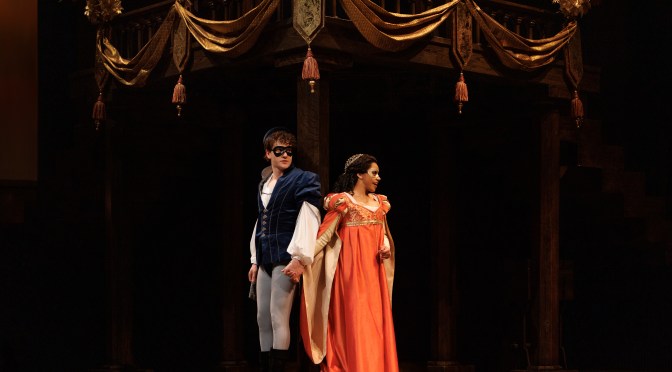
This is why my wife and I return to Stratford. The bells and whistles of featured musicals like Something Rotten are typically engaging, farcical fun; our mileage will vary on time-travel takes on classics (like the current “Summer of Love” production of Twelfth Night) and unsubtly Urgent Cultural Message plays (looking at you, La Cage aux Folles). But what draws us here again and again is what Sam White’s production of Romeo and Juliet provides in plenty: Shakespeare’s archetypal tragedy, presented with unwavering commitment, designed with minimalist period flair, expertly staged and acted. This is a refreshingly down and dirty exploration of a play that resonates down the centuries, not only in its high-spirited vision of young love, but in its taut portrayal of the fears and passions that ultimately thwart its star-crossed lovers.

Members of the company in Romeo and Juliet. Stratford Festival 2024. Photo: David Hou.

A sung prologue sets the table for a whirlwind first half, with White’s deft command of the intimate, surprisingly bare Festival Theatre stage was powerfully evident. Whether in the opening scene’s street brawl or at the masquerade where Romeo meets Juliet, crowd movements are vibrant, organic, purposeful, frequently cued by Graham Hargrove & Jasmine Jones-Ball’s thrusting onstage percussion. Individuals’ speeches fluently unpack each character’s motivation and reactions: a blustering Tybalt (Emilio Vieria), a cautious Benvolio (Steven Hao), the exasperation of Prince Escalus (Nick Dolan), the defensive crouch of the senior Capulets and Montagues — all establish the underlying powder keg of anger and resentment, ready to go off at an antagonist’s tiniest slight to personal honor.

Jonathan Mason as Romeo and Vanessa Sears as Juliet in Romeo and Juliet. Stratford Festival 2024. Photo: David Hou.

Which is the reason Jonathan Martin’s lovesick Romeo and Vanessa Sears’ passionate Juliet stand out; in clans obsessed with judgment and rejection of the other, their soliloquies mark how they crave hope, yearn for a lasting acceptance. And when they find each other, the attraction is immediate, magnetic, unstoppable. The inspired duet of their balcony scene exhilarates; their capricious browbeating of Friar Laurence (consummate Festival veteran Scott Wentworth) into a clandestine wedding feels inevitable in the sweep of their mounting passion. But then, the explosion: with the hair-trigger murders of Andrew Iles’ Mercutio by Tybalt and Tybalt by Romeo — tumbling over each other in a brutal, riveting flash of violence — fear wins out, tragedy gathers momentum. Blackout!

From left: Emilio Vieira as Tybalt, Andrew Iles as Mercutio and Derek Kwan as Tybalt Follower in Romeo and Juliet. Stratford Festival 2024. Photo: David Hou.

This was the moment when my stomach knotted — and even though I’ve known this play since high school, as the second half slammed one door after another and the lovers’ scheming grew more desperate, it refused to untwist. When Graham Abbey’s Capulet compels Juliet’s consent to marry Austin Eckert’s Paris by callous words and physical force; when Juliet threatens suicide, then grasps at the straw of Friar Laurence’s stupefying potion; when Glynnis Ranney’s Nurse keens an anachronistic snatch of Henry Purcell (testimony to White’s love for opera) over Juliet’s grave; when Romeo’s turbulent emotions solidify around his own suicide mission, the tension ratchets up and up, to unbearable heights.

Scott Wentworth as Friar Laurence in Romeo and Juliet. Stratford Festival 2024. Photo: David Hou.

Which is why the final bloodbath in the Capulet vault — as Paris, then Romeo, then Juliet die at the hands of misdirected honor and folly under pressure, to the belated horror of Capulets, Montagues and Prince alike — ultimately feels inescapable, and remarkably universal. In White’s sure, determined hands, this tragedy could be playing out anywhere at anytime, be it Renaissance Mantua or 21st-century Detroit (where her mother kickstarted her passion for Shakespeare at the age of 8, as a disciplinary consequence for catching her listening to Salt’n’Pepa). As she tosses out to close her program notes: “Remember what happens when we don’t love our neighbor as ourselves. Just saying.”

I’m deeply grateful for this production of Romeo & Juliet — its primal commitment to Shakespeare as an artist speaking across and into multiple cultures, its understated opulence and fleet pace, its vivid characterizations and exuberant performances, its cataclysmic clash of the deepest forces at work in our fallen, idealistic, conflicted psyches and societies. For those with ears to hear and eyes to see, it’s a thrill, a warning, and maybe even a necessary passage from heights of joy through depths of despair to chastened, repentant grief. Above all, it’s well worth your time and travel to experience.

— Rick Krueger

Romeo & Juliet plays at Stratford’s Festival Theatre through October 26. Click here for production information. Click here for ticket availability.

New Wave Prog: The Missing Sub-genre?

Admittedly, I might have given this way too much thought, but I wonder if there’s a historical sub-genre of music that we all mislabeled at the time.  The historical orthodoxy is that we went from prog to punk to new wave and post-punk and, then, by the mid 1990s, into third-wave prog. 

Could there have existed a third way, though, a melding of prog and new wave and post-punk?  As such, I think of albums by traditional prog groups such as Yes (Drama and, to a lesser extent, 90125), Genesis (Abacab), or Rush (Moving PicturesSignalsGrace Under Pressure, and, especially, Power Windows) that all benefitted greatly from new wave and post-punk.  

But, I can also think of a number of new wave bands that employed very serious prog elements such as Modern English (After the Snow), Tears for Fears (The HurtingSongs from the Big Chair), The Fixx (Reach the BeachPhantoms, and Walkabout), Ultravox (ViennaRage in Eden, and Lament), Thomas Dolby (The Flat Earth), New Order (Low-Life), XTC (Skylarking), Echo and the Bunnymen (Over the WallOcean Rain), Simple Minds (Sons and Fascination, Sister Feelings Call, and New Gold Dream), and Talk Talk (Colour of Spring).  One might also think of a band like B-Movie.

Maybe, just maybe, Yes and Thomas Dolby have far more in common than we thought.

And, if there was such a sub-genre of New Wave Prog, it would help us understand shoegaze (Cocteau Twins, My Bloody Valentine, Lush) in the late 1980s and early 1990s as well as bands such as Catherine Wheel and even early No-man and Porcupine Tree.

Just my two cents. . .

At the Stratford Festival: Something Rotten! (To the True North, Part 6)

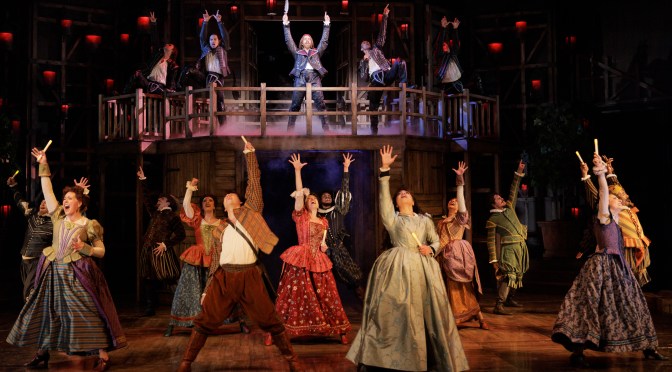
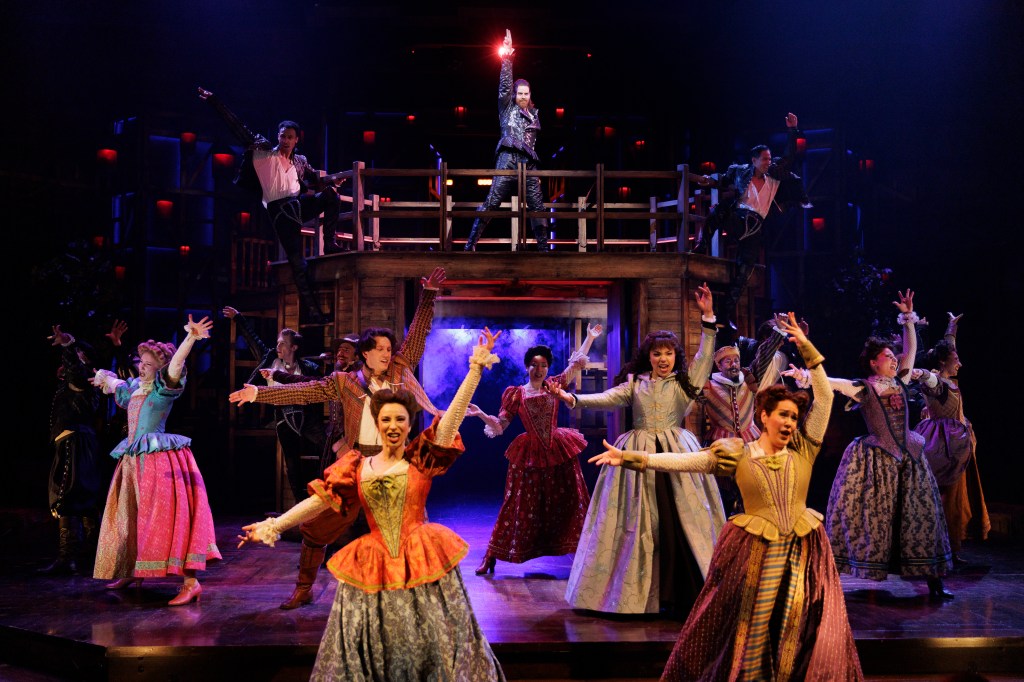
I thought there were three genuinely great things about the Tony Award-winning musical Something Rotten, as currently playing at the Stratford Festival:

1. Mark Uhre’s frenetic take on struggling Elizabethean playwright Nick Bottom. Between his oversized desire for fame, his strained interactions with enterprising wife Bea (a confident Starr Dominque) and poetic little brother Nigel (Henry Firmston in the boy-next-door role), and his obsessive drive to take down William Shakespeare and win the Renaissance fame game, Nick is desperation personified, thoroughly uncomfortable in his own skin and all the funnier for it. Uhre plays him as a live-action version of Daffy Duck, spluttering with unbounded rage at his situation, and thus completely susceptible to any bizarre idea that crosses his path – like inventing the musical – and thus totally willing, no matter how insane the consequences that follow, to “commit to the bit”.

2. The thing is, in this universe, Nick’s right! Framing Shakespeare as a vain, manipulative rock star (continuing the parallel, think Bugs Bunny without redeeming qualities) is Something Rotten’s masterstroke. Trailed by his own theme song and a crew of dancing Bard Boys, basking in the adulation of a solo stadium gig (with hilariously low-tech special effects), scheming against Nick to the point of donning a fatsuit disguise and a Northern accent, stealing Nigel’s best lines and passing them off as his own, Jeff Lillico is a utter hoot, England’s greatest dramatist as an egotistical, over-the-top pantomime villain. Even when he lets his guard down in his big solo “Hard to Be the Bard”(“I know writing made me famous, but being famous is just so much more fun”) , this is a Shakespeare you can love to hate.

3. Speaking of over-the-top, director Donna Feore and her creative team absolutely chose the right path by leaning into the Broadway musical’s inherent absurdities, as foreseen by cut-rate soothsayer Nostradamus (Festival veteran Dan Chameroy in a giddy, disheveled supporting turn):

You could go see a musical
A musical
A puppy piece, releasing all your blues-ical
Where crude is cool
A catchy tune
And limber-legged ladies thrill you ’til you swoon
Oohs, ahhs, big applause, and a standing ovation
The future is bright
If you could just write a musical

Dan Chameroy as Nostradamus with members of the company in Something Rotten!. Stratford Festival 2024. Photo: David Hou.

Every possible cliché you can think of is there onstage for those six minutes: Sung recitatives (with self-mocking asides)! Bawdy double-entendres and suggestive choreography! Costume changes (including nonsensical hats and wigs)! Jazz hands! Synchronized high-kicking (with callbacks goofing on Feore’s 2016 Festival production of A Chorus Line)! It all worked to perfection at this matinee, the capacity audience (including your scribe) yelling and applauding for more (which the company obligingly provided) as if Pavlov had just rung his biggest, shiniest bell. And the places Nick and Nostradamus find themselves going in the second act’s big number scale even zanier heights. Complete the sentence yourself: “When life gives you eggs . . .” Then imagine the costumes!

Where Something Rotten falls short? Compared to the sublime ridiculousness of the main story, the supporting characters’ arcs bog down in vapid sentimentality and already-stale contemporary memes. Bea’s occasional empowerment shoutouts pale in comparison to what she actually does out of love for her husband and his brother, subtly undercutting her role as the true hero of the piece. Nigel’s emergence from Nick’s shadow is a bit of a damp squib; his main solo turn “To Thine Own Self Be True” proves an shallow, unearned manifesto of self-actualization instead of a rite of passage. And the meet-cute romance between Nigel and Portia (Olivia Sinclair-Brisbane, winningly portraying a budding poetry fangirl under the thumb of Juan Chioran, a Puritan father given to pre-Freudian slips) sputters, toggling between aren’t-we-transgressive smuttiness and, in “We See the Light”, a Big Message about tolerance, tediously staged as a clumsy cross between Sister Act and Rent — Feore’s only directorial misfire.

But that said, Something Rotten’s full-on commitment to farce and totally bonkers energy (with Feore, Uhre, Lillico and Chameroy setting the pace for a young, frisky cast) carries the day. Productions about Shakespeare at the Stratford Festival are typically on or about at the same level as their productions of Shakespeare, and this delightfully nutty escape into a toe-tapping alternate version of the Renaissance is no exception.

Members of the company in Something Rotten!. Stratford Festival 2024. Photo: David Hou.

— Rick Krueger

Something Rotten continues at Stratford Festival’s Theatre, with its run now extended through November 17th. Click here for ticket availability.

Peak Piano: Angela Hewitt at Stratford Summer Music (To the True North, Part 5)

Back in the 1990s, I began collecting CDs of J.S. Bach’s keyboard works, played by young Canadian pianist Angela Hewitt, The winner of 1985’s Toronto International Bach Competition, her playing was worlds away from the True North’s previous Bach-on-piano champion, the willfully eccentric Glenn Gould; dancing rhythmic vitality, crystal-clear delineation of melody and counterpoint, and a constantly spinning, singing line have always been Hewitt’s hallmarks. Even before she brought her Bach series to a culmination with an utterly dazzling take on the Goldberg Variations, I was long past fandom into near-adoration.

Since then, Hewitt has re-recorded key Bach works (including an even more impressive 2nd take on the Goldbergs), while moving on to Beethoven’s complete piano sonatas, selected Mozart sonatas and concertos, and a wide sweep of the keyboard and piano repertoire spanning centuries and continents, from Domenico Scarlatti to Olivier Messiaen. With more than 50 consistently superb albums and 40 years of international concerts to her credit, I’d argue that Angela Hewitt is the equal or better of any concert pianist active today (and I’m confident I’d win that argument). So hearing her in concert for the third time as part of our current Canadian odyssey was an absolute must.

This past Sunday, under the auspices of Stratford Summer Music, Hewitt filled the austerely midmod Avondale United Church with both an uncommonly focused audience and a involving, joyous program of serious fun. Playing her calling card right at the start, Hewitt hit the keyboard running with Bach’s Partita No. 6 in E Minor; its elevated Toccata and Fugue, poignant Sarabande, remarkable Corrente, genial Air, lilting Gavotte and surprisingly angular Gigue all unfurled with grace, clarity and strength. But the profound Sarabande — which Hewitt has referred to as Bach “alone in communion with his maker in a dialogue that is at once sorrowful, hopeful, passionate and at times exalted” — was the hushed essence of the work; you could hear a pin drop and feel the listeners breathing with Hewitt as she delved deeply into that movement’s grave, elegant mystery and wonder.

Ludwig van Beethoven’s “Moonlight” Sonata proved both a logical follow-up to the Bach and a welcome change of pace; as Hewitt brought delicacy and sympathetic spirit to the famous opening movement, you could hear both the musical DNA Beethoven inherited from Bach and how he developed it in his own dramatic fashion. And in Hewitt’s hands, the wistful Allegretto and the wildly spiraling climax of the Presto agitato were logical extensions of the opening, but also vivid declarations of Beethoven’s determination to “seize Fate by the throat”. From the prolonged blast of applause that followed, you would have thought that there was nothing more than Hewitt could show an audience already under her spell.

Which is why the sonatas by Domenico Scarlatti that opened the second half of Hewitt’s program were such a refreshing breather. The simple charm of Scarlatti’s D Major Sonata K. 430, the K. 380’s courtly E Major trumpetings and the gyrating tarantella of K. 159 in C Major turned out to be consummate palette-cleansers — substantive yet easily digested appetizers before the daunting final course of Johannes Brahms’ Variations and Fugue on a Theme of Handel.

My 2nd Brahms variation set in 24 hours, the Handels are not for the faint of heart, whether you’re hearing or performing them — in her brief pre-concert introduction, Hewitt mentioned how she had been discouraged from learning the piece when younger because “women can’t play it.” The next half-hour proved how totally wrong such a stupid comment could be: working from memory as she had throughout the recital, Hewitt dealt out Brahms’ 25-plus takes on the theme from Handel’s Keyboard Suite No. 1 with utter commitment and total command. Such lucid structural thinking, such immediately evident dedication to the work, such finely graded touch, and tone, and rubato, and dynamics! What a powerful musician Hewitt is, and how completely she inhabited the moment! It was a performance to revel in, even while looking forward to hearing her promised recording of the piece (scheduled this fall for a future release).

This time, when the music ended, the crowd leapt immediately to their feet, and the applause simply didn’t stop — at least until Hewitt provided a brief, lyrical encore from Mendelssohn’s Songs Without Words. In all probability, this concert will be firmly lodged in the “all-time Top Ten” I keep in my head; it’s hard to beat two hours of total connection between a thrillingly communicative artist & a raptly attentive audience. Brava!

— Rick Krueger

A Grand Night for Singing: The Elora Festival Closing Night Gala (To the True North, Part 4)

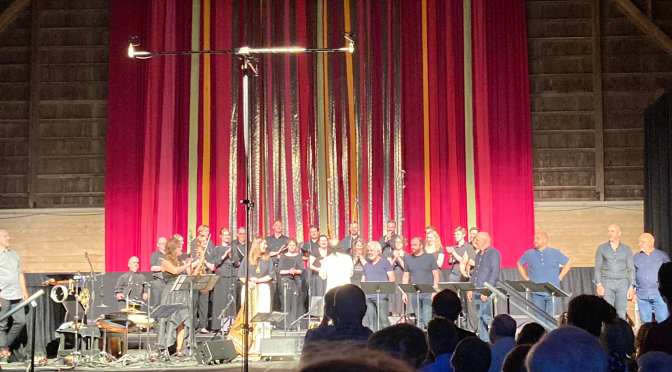
The Elora Singers had me at “hello” when, saluting a sell-out crowd in the town’s Gambrel Barn, they kicked off their 45th festival’s closing night gala with this:

Quick and bright yet wonderfully poignant, Gerald Finzi’s partsong has been the Singers’ unofficial theme tune since they returned to the post-pandemic concert stage. It deftly conveys their genuine delight in making music, made manifest even in the boilerplate welcome speeches of artistic director Mark Vuorinen and festival manager/alto Christine Stelmachovich. As the duo powered through the now-ubiquitous Land Acknowledgment, sponsorship recognitions, dad jokes, etc., their gratitude and glee at seeing an audience literally unable to fit inside the Barn’s walls was impossible to fake.

Then the stage was turned over to piano duo James Anagnoson & Leslie Kinton for a sweeping version of Johannes’ Brahms’ Variations on a Theme by Haydn. Kicking off with an exalted statement of the St. Anthony Chorale, Anagnoson & Kinton teased out Brahms’ imaginative shifts of tempo, texture and tonality throughout the variations, his accomplished use of counterpoint brought firmly to the fore. And when the duo built up the work’s finale (variations on a ground bass leading into a grandly restated chorale) to its tumultuous climax, they received an ovation not only well-deserved, but essential as a response to their first-rate performance.

Next came Toronto’s Elmer Iseler Singers, celebrating their 45th year as Canada’s premier professional vocal ensemble. Conducted by artistic director Lydia Adams (wonderfully gracious when we chatted briefly at intermission), the EIS exhibited their rich tone in a brief set on the lyrical theme of “rising” — bookended by seminal choral classics (James MacMillan’s O Radiant Dawn, Healey Willan’s Rise Up, My Love), investigating the compositional possibilities inherent in Hindu, Islamic and First Nations texts — and unleashing a devastatingly gorgeous, wordless take on Ukranian composer Myroslav Skoryk’s Melodia.

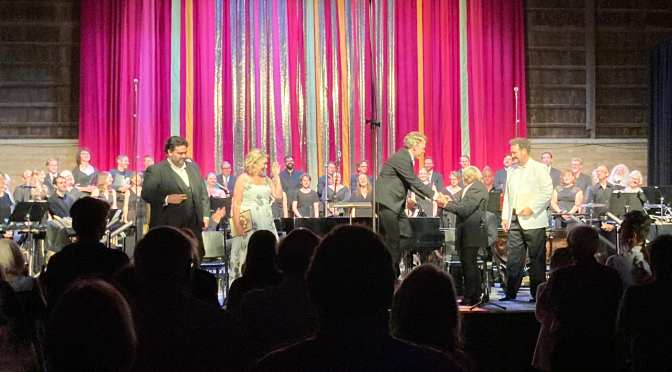
Finally, an hour of everything but the kitchen sink; how else to describe Carl Orff’s gargantuan cantata Carmina Burana, with all the previous forces plus five percussionists and three vocal soloists jammed onstage? Based on a medieval manuscript of secular poems (by disaffected monks?), Orff’s 1936 masterwork is a rhythm-dominated hour of songs about — well, sex and drink and the Middle Ages equivalent of rock’n’roll! Soprano Leslie Fagan as “the girl in the red dress”, tenor Andrew Haij in an infamously difficult cameo (as a swan roasting on a spit) and baritone Russell Braun as a variety of ne’er-do-wells played their parts to the hilt, flirting shamelessly with the front rows; the massed choir lamented the woes of Fortune (“Empress of the World”), raised way too many toasts in the tavern and egged on young lovers with a will. And even in this cut-down orchestration, the pianos and percussion slammed out one driving, kaleidoscopic groove after another. Having performed it multiple times with the Grand Rapids Symphony & Chorus, I can tell you that few classical works build up the momentum or bring the sonic spectacle this work does; with Vuorinen focusing Orff’s inventions to full intensity, the Eloras, Iselers and companions brought down the house, wild applause erupting almost before the final crescendo died away.

In short, this past Saturday proved a grand night for singing. What the Elora Festival accomplished this past weekend (and throughout the past month) is not just another set of rousing performances, but a lasting testimony to music’s ability to move, shake and thrill its creators, performers and listeners. Long may this choral festival bring the best of what’s sung and said to this beautiful village!

— Rick Krueger

Music Crossing Continents: Constantinople & A Filetta at the Elora Festival (To the True North, Part 3)

Park your car in the biggest paved lot you can find in Elora, Ontario — the one adjoining the horse racing track & casino just southwest of downtown. Then, cross the road to the municipal Gambrel Barn — transformed into an unlikely concert hall for three weekends in July.

Filing onstage: Constantinople, an instrumental quartet from Montreal that plays medieval, Renaissance and Baroque instruments from Persia, Turkey, Japan, Europe and Ireland; A Filetta, a male vocal sextet from Corsica, an island ruled by France (Napoleon came from there) where the native language developed from Italian and Greek roots; and The Elora Singers, a impeccably polished, 21-voice Canadian choir. How, you might think, is this all gonna come together?

As it turns out, the answer last night was: in an exceptionally intense, immersive way. Introducing the program Clair-obscur, Constantinople’s music director Kiya Tabassin noted its title and content came into being just before 2020’s worldwide pandemic. After its first performances, in Tabassin’s words, its purpose became “to bring light (clair) to darkness (obscur)“. And over the next 90 minutes, the assembled forces proceeded to do just that, crossing a continent to meld the sounds of disparate times and places into a satisfying whole.

The music, mainly assembled by Tabassin and A Filetta’s leader Jean-Claude Acquaviva, proved thoroughly cosmopolitan and eclectic. The sextet’s singing was the obvious heart of the evening; their sturdy blend of dominant bass drones, fleet interweaving lines stacking up into glancing consonances and luxuriant melodic melismas were consistently riveting, whether voices were raised in a show of strength or hushed in breathtaking tenderness. Tabassin’s 3-stringed setar and Didem Basar’s kanun (a 78-stringed Turkish zither) danced lithely around and about the rugged vocal base, with forthright support from Tanya LaPerriere’s Baroque violin & viola and supple grounding in Patrick Graham’s ten-fingered, two-footed percussion; each player had their evocative solo moment and earned delighted applause from the crowd.

Atop this entrancing musical scaffold, the sung texts unfurled a dizzying collage of Senecan drama, Renaissance epic, Near Eastern poetry from Rumi and Hafez, traditional ponderings on the passion of Christ and Primo Levi’s meditation on the memory of the Holocaust. Here was history stripped of its timeline, collapsed into its component catastrophes and passions — pride, devotion, horror, absurdity, yearning for calm and deliverance – compounded into the moment’s expression and emotions. And when Tabassin raised his reedy voice to cavort over A Filletta’s firm foundations or the Elora Singers enriched the soundscape with supportive reinforcement and embellishments, the chamber effect broadened out to opulent symphonic proportions.

Clair-obscur (the nearest English equivalent would be chiaroscuro, the play of light and shadow in the art of painting) proved a unique mix of folk music and high art, calmly unhurried vocal prowess and upbeat improvisation, a journey through the heart of human life to a resting place of connection, catharsis and celebration. You can check out a sample of this program for yourself below (the complete concert, without The Elora Singers, can be found here):

— Rick Krueger

The Sublime along the Grand: the Elora Gorge & Choral Evensong (To the True North, Part 2)

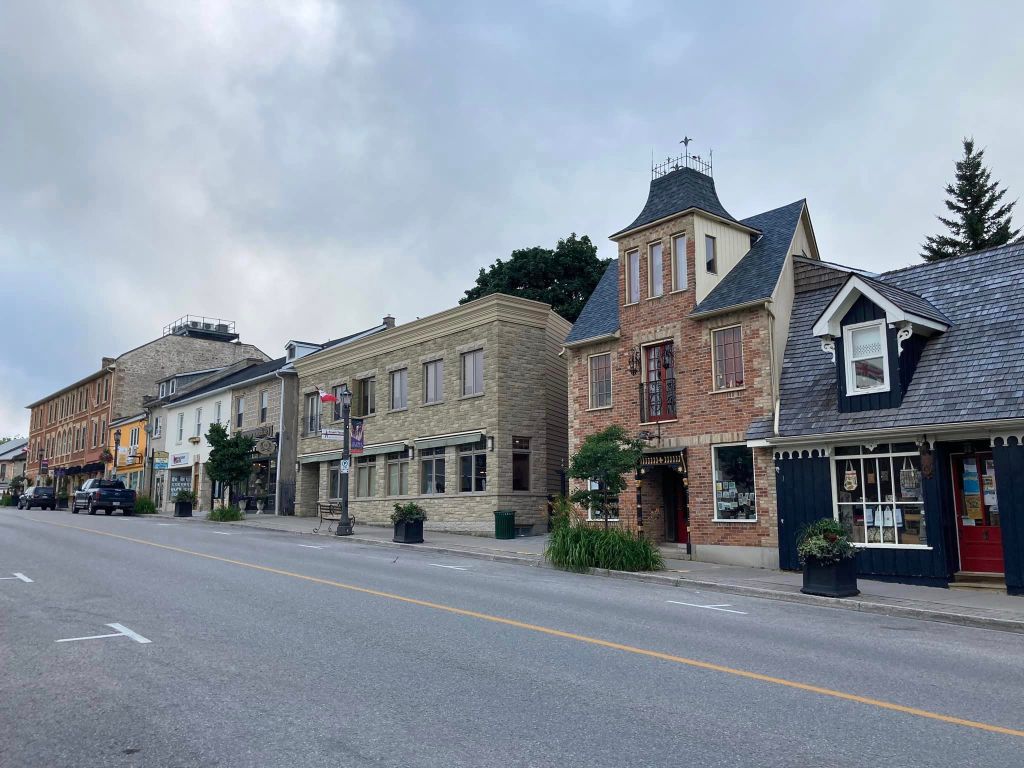
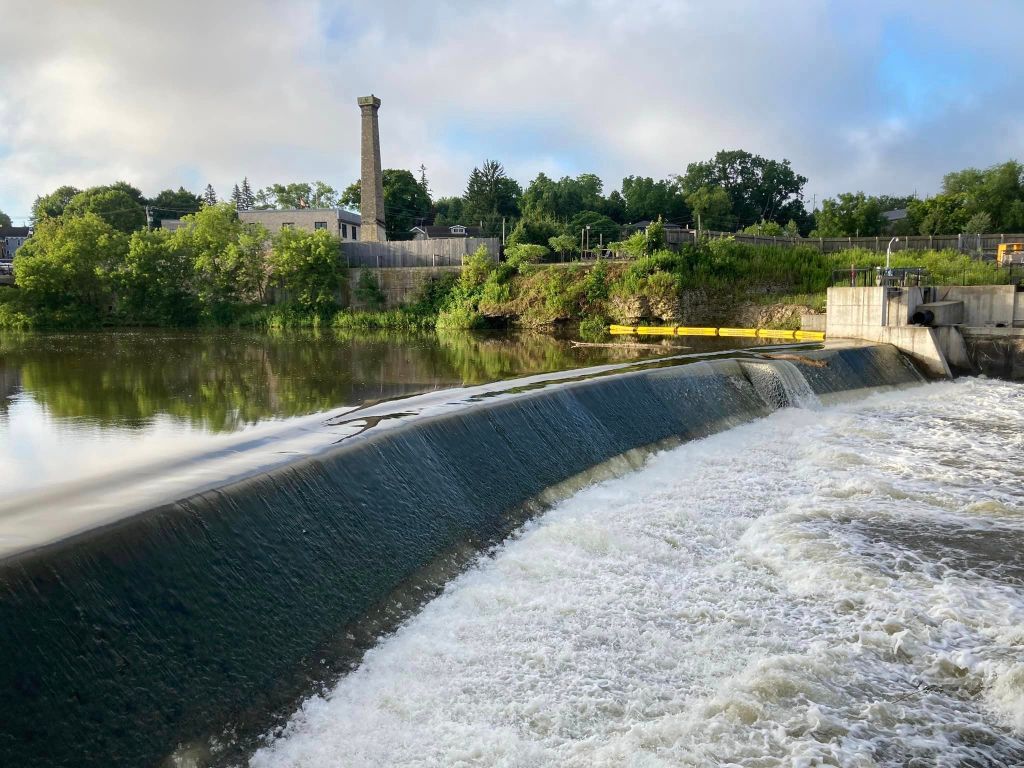
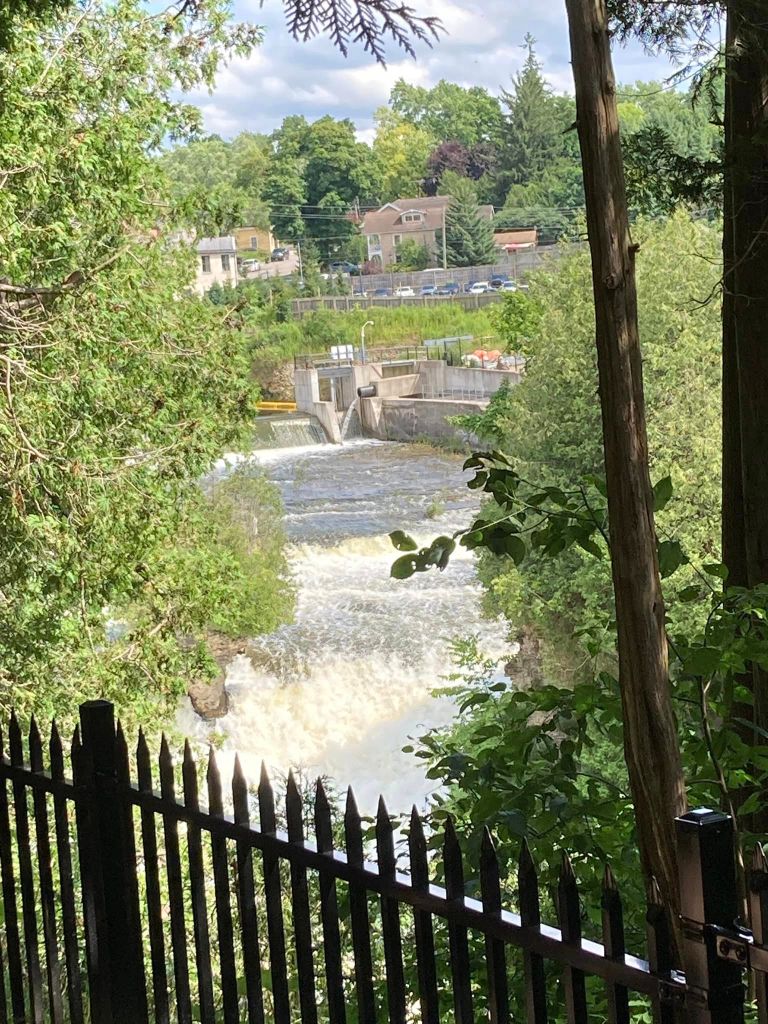
At first glance, Elora is a typical tourist-oriented village in Ontario’s Golden Horseshoe. Its town center sweeps downhill toward a historic mill on the Grand River, now the focus of redevelopment via a luxury hotel/spa complex. It boasts plenty of chichi boutiques, upscale brewpubs and posters about upcoming weekend festivals. A well-stocked local grocery store and the inevitable Shoppers Drug Mart speaks to the place’s practical streak; two enticing bookshops (one stocking new releases, one second-hand treasures) testify that food for the mind and soul are on the menu as well.

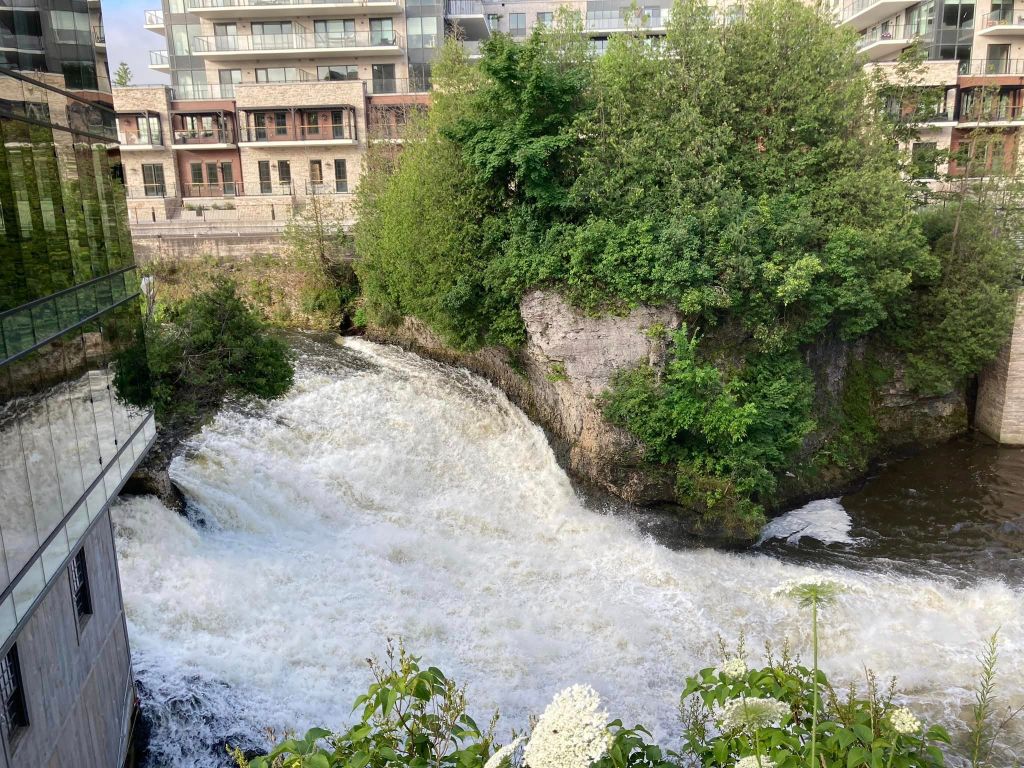
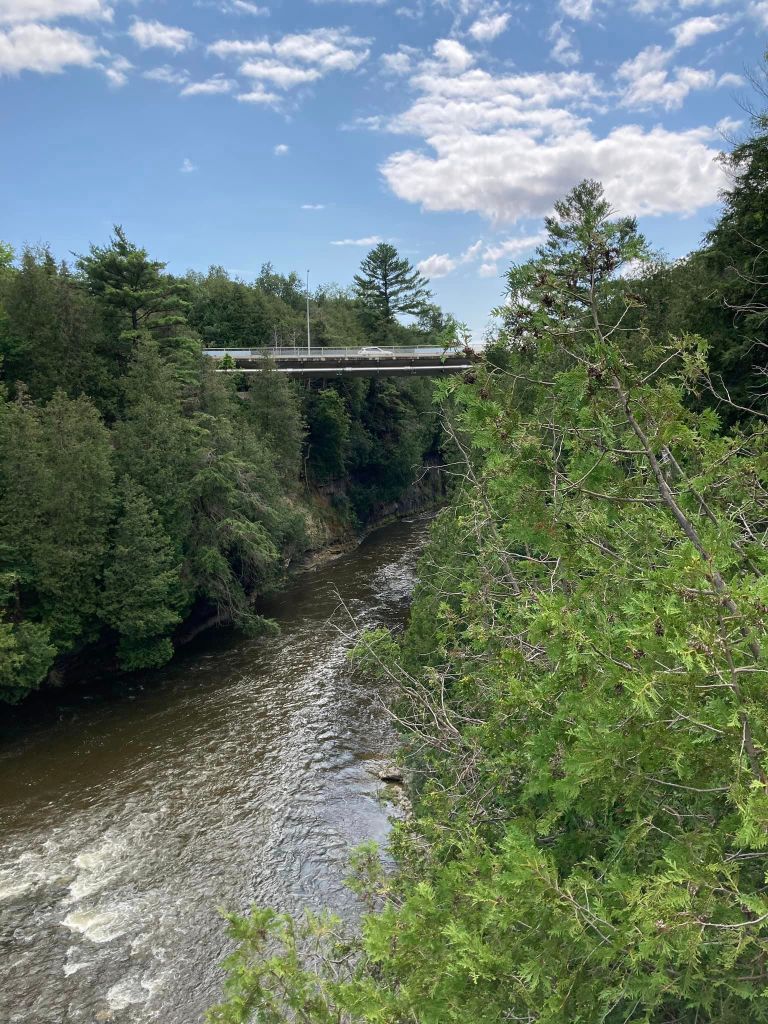
But taking the high concentration of limestone buildings in Elora as a clue reveals the true heart of its attraction. Just west of downtown, the Elora Gorge lies downstream from a 25-foot waterfall, its 72-foot cliffs towering over the path of the Grand for more than a mile. Whether viewing it from the village’s pedestrian footbridge, the elevated trails that wind through and around it, or down at the riverbank itself, the cliffs and crannies quickly bring the word sublime to mind.

Why? The Oxford English Dictionary definition states the substance of the sublime nicely:

Of a feature of nature or art: that fills the mind with a sense of overwhelming grandeur or irresistible power; that inspires awe, great reverence, or other high emotion, by reason of its beauty, vastness, or grandeur.

And that experience chimed perfectly with our day’s next activity – the final Choral Evensong of this year’s Elora Festival, held at the Church of St. John the Evangelist, less than two blocks from the Gorge. The past lies thick within St. John’s walls (constructed in 1875), from the communion set that Florence Nightingale donated to the parish’s first priest (on display behind the organ console) to what a church brochure calls its “strong history of liturgical worship and choral music.”

Led musically by the 21-strong Elora Singers, conductor Mark Vuorinen and guest organist Christopher Dawes, this Evensong unfolded in classic fashion: a long-established liturgical structure augmented with appointed hymns, psalms, readings and prayers. From the opening words of the ancient chant “To You, Before the Close of Day”, the congregation joined in with heart and voice as the choir processed to its stalls; the core texts of Confession, Creed and Lord’s Prayer were spoken with vigor and affection; a whimsical homily on Matthew 26 sharpened to a serious point, tracking remarkably well with Timothy Dudley-Smith’s hymn text on our daily callings “How Clear Is Our Vocation, Lord” (the text itself set to a robust tune by arch-British composer Charles Parry).

And throughout the service, we were given multiple tastes of the musical sublime, starting when Dawes’ rendition of Herbert Howells’ Psalm Prelude based on Psalm 33:3 (“Sing to Him a new song; play skillfully with a loud noise”) roared to life, filling the sanctuary with arresting, rhapsodic melody, thick, juicy chords and supple, flexible rhythms. Howells’ Evening Canticles for King’s College, Cambridge unfurled in similar romantic fashion, the Singers proving exquisitely sensitive to the musical and textual nuances. To quote the composer, in this Magnificat a humble Mary exalted her Son while the mighty were “put down from their seat without a brute force which would deny this canticle’s feminine association”; the Nunc Dimittis’ tenor solo (beautifully voiced by Singer Nicholas Nicolaidis) perfectly “characterize(d) the gentle Simeon” as he held the Christ Child and thanked God for His promised deliverance. So when the chorus and organ ramped up on each canticle’s concluding “Glory be to the Father”, the weight of praise seemed to encompass not just those in attendance, but the whole of creation, landing on “world without end, Amen” with breathtaking depth, substance and impact. But there was more!

Welsh composer William Mathias’ contrasting musical language –cheerful, quicksilver, rooted in a rumbustious sense of the dance — proved equally riveting on the anthem “Let the People Praise Thee, O God” (composed for the wedding of Prince Charles & Lady Diana Spencer and sung with joyous, sympathetic precision) and a closing organ Recessional so vivacious that it set toes tapping, even as the instrument’s festival trumpet echoed around, tumbling down scales like water streaming down the Gorge. It proved an exhilarating coda to the final hymn, “The Day Thou Gavest, Lord, Has Ended”. As John Ellerton’s stirring invocation of God’s presence in creation and the Church unrolled to Clement Schoefield’s majestic melody, the Elora Singers filled the center aisle with rich harmony and a soaring soprano descant to cap a worship service like few others I’ve experienced in my life.

In his new book Cosmic Connections: Poetry in the Age of Disenchantment, Canadian philosopher Charles Taylor explores the roots of what he calls “a language of insight”, a way of exploring “phenomena like value, morality, ethics and the love of art itself” beyond the reductive terms of mechanistic natural science that frame so much of our daily lives. I consider it a gift to have, on the same day, explored the language of Nature and the language of faith, in each instance pulled by the sublime toward a deeper connection with what has been before I was born and, Lord willing, what will continue beyond the hour of my death.

— Rick Krueger

Music, Books, Poetry, Film