Perhaps you might remember that, for twenty years now, my wife and I have been regular attendees at the Stratford Festival in Ontario, Canada. This week, we’re off to the north (and east) for another adventure in world-class theatre! But this time around, there’ll be additions to an already ambitious arts-going itinerary:
Now in its 45th season, the Elora Festival has established a reputation as Canada’s international choral festival, presenting world-class choirs and vocal ensembles over two weeks in July in the artists village of Elora, “Ontario’s most beautiful village”.
We’re looking forward to experiencing the Elora Festival for the first time, taking in these mouth-watering programs:
Then we’ll double back to Stratford – but before we settle into our theatre seats we’ll catch world-renowned Canadian pianist Angela Hewitt as she performs Bach, Beethoven, Scarlatti and Brahms (no pressure!) under the auspices of Stratford Summer Music.
I think it important to have pastimes and hobbies. I enjoy reading, listening to baseball games on the radio, listening to music and studying languages. My sister has an expression “being lost in grammar land” by what she means doing language study and being completely engrossed in it.
I am currently listening to SPOTIFY (BRAHMS) in a few minutes I will be back in my easy chair reviewing languages and studying new ones. I review GERMAN, PORTUGUESE, SPANISH every day for about 10-15 minutes each then dedicate time to study ITALIAN, MODERN GREEK and SCOTTISH GAELIC. I primarily use DUOLINGO but also have dictionaries and Teach Yourself Books to read and study points of grammar and vocabulary. With Duolingo I am more active than merely reading because I have to LISTEN, to REPEAT, to WRITE and RESPOND. I usually do it after some morning reading. I sip on coffee or tea. I do my oral review first and then I go to my notebooks and I keep track of new vocabulary (often drawing pictures in color). English is always in pencil and the target language in a dark color. I use red for emphasis. Especially for Greek it is important to practice writing. My goal is to advance to read the New Testament and then Homer so I have years ahead of me. I already read Spanish and Portuguese poetry as well as Latin and I enjoy German art songs and Gaelic Orain Mora (big songs). When I am reading and studying languages while listening to classical music I am truly in another world. No commercials. No interruptions. No phone calls. I check any texts afterwards. I find it very satisfying and soothing. And of course if the spirit calls the end of the afternoon I may sing along or recite a poem. Some of the songs and poems I have known for forty or fifty years and of course have fond associations with people and places I have known.
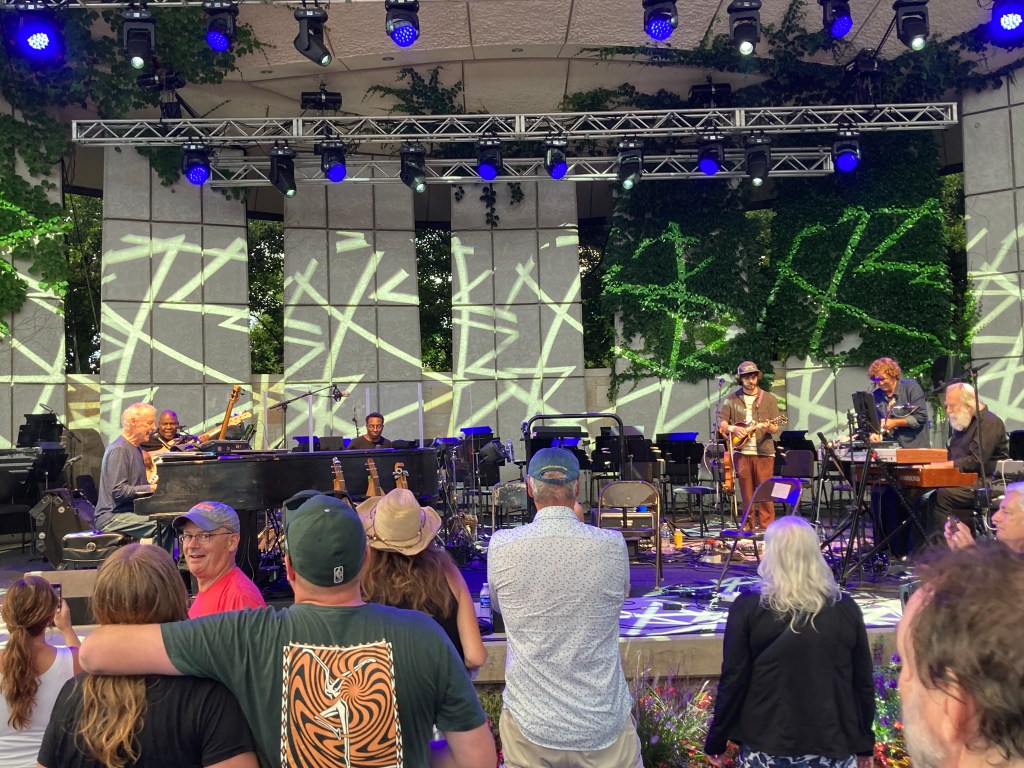
Bruce Hornsby and the Noisemakers with the Grand Rapids Symphony, Frederik Meijer Garden Amphitheater, July 11, 2024.
You know, you can’t wing it with an orchestra!
— Bruce Hornsby, fielding requests onstage
So far, so good: after a week where their shows were cancelled and rescheduled due to vocal troubles, Bruce Hornsby and his Noisemakers had hit the amphitheater stage. The Grand Rapids Symphony, ably conducted by Bob Bernhardt, were teasing out plush, precise orchestral backdrops for jauntily sardonic opener “Life in the Psychotropics”, Bon Iver collaborations “Cast Off” and “Meds” and a fresh, reflective arrangement of early hit “Every Little Kiss”.
The ballad “Here We Are Again” stood out as prime latter-day Hornsby: a haunting melody arching over extended harmonies and pointillistic piano/orchestral splatters, effortlessly meshed with lyrics unfolding a time-travel love story by way of cutting-edge physics. While Bruce’s singing had some rough edges, the performers were tuning in; the capacity crowd was listening raptly; the evening was gathering momentum.
Then the heavens opened: remnants of Hurricane Beryl that had been circling let loose persistent, soaking rain and uncomfortably close rumbles of thunder. As Hornsby launched into one of his solo piano hymns, management pulled the orchestra offstage. Calling an audible with the hit “Mandolin Rain”, Bruce then asked the audience to help with the high-pitched shout chorus he admitted he couldn’t manage; from his response, you could tell we’d covered it to his satisfaction.
And oddly enough, that was where the fun really started! Cued by the lyrics “listening to the bluegrass band”, John Mailander on mandolin and Gibb Droll on guitar served up a tasty breakdown, working off of Bruce’s hand signals and head nods; free associating on the playout, Hornsby served up an apropos snippet of early Paul McCartney: “That would be something/To meet you in the falling rain, mama”, indeed!
Then organist J.T. Thomas joined in the merriment for a groovily funky “Country Doctor”; unleashed from balancing with the orchestra, bassist J.V. Collier and drummer Chad Wright gleefully bumped up the low end up a notch. Even with Hornsby announcing a rain delay, from the eye contact and the smiles between all the musicians you could tell the Noisemakers didn’t want to call it a night.
The clouds and the rain stayed stuck in place, but after twenty minutes of roadies looking at the sky, checking weather apps, and bringing out multiple dulcimers, Bruce and the band came back to strut a bit more of their stuff: “Prairie Dog Town,” a outlandish mash-up of bro-country and hip-hop, followed by the streetball throwdown “Rainbow’s Cadillac” reimagined to the music of The Spinners’ “Rubberband Man”! “The Way It Is”, played straight up but stretched out with features by Mailander on fiddle, Droll, Thomas, and Wright served as an encore, a wry acknowledgment of circumstances beyond control, and a final showcase for what these superb players could do.
Ultimately, Bruce Hornsby and the Noisemakers made the best of a tough situation, keeping their drenched fans engaged until Meijer Gardens called a halt. With no tracks from the album they’re touring behind (1998’s Spirit Trail) and only a smattering of the symphonic goodies promised, the show certainly didn’t turn out as advertised; nevertheless, it turned out to be a surprising, satisfying night on the town.
Our founder, Brad Birzer, recently did a two-part episode of National Review’s music podcast, Political Beats. If you are not familiar, this podcast usually features a guest and a discussion of a particular band. For this two-parter, Brad and the normal panel discuss the career of progressive rock giants Yes, album-by-album. I’ve conversed with Brad in a group chat about the episode, and he liked my comments enough to ask me to present them here. As such, here they are, unedited save for a few interjections.
First comment, after listening fully to Part 1 and a little bit of Part 2 (in italics, my additional interjections in brackets]:
Hi Brad – I just finished listening to the first Yes episode and have listened up through the discussion on GFTO in the second episode. I loved the discussion on TFTO, and I think “beautiful failure” is an apt description, although I would also add it was a necessary failure. They found their limits on that album because they tested those limits, and I think that allowed them to be more concise and focused with their next two albums. [Tales from Topographic Oceans was Yes’s most ambitious album, and to paraphrase what Jon Anderson said about it, it was the meeting of high ideals and low energy. It certainly has some brilliant music on it but also has a lot of mindless noodling. Most of the panel thought the first and last pieces of the album – The Revealing Science of God and Ritual, respectively – were the best pieces. For my money, it’s actually the second piece, The Remembering, which holds together best (although even it suffers a little from needless padding). On that note, I think the bass playing in that piece is brilliant, often subtle and understated (not often a Chris Squire trademark), and he says as much that he was proud of that in YesStories by Tim Morse]
I also liked the observation that at times on TFTO, they were fitting the art to the format instead of just letting it flow organically. That’s one reason I’m not as down on the digital formats as some are today, because it essentially removes such restraints an allows the artist to just create without having to adapt the art to the format. I think Gazpacho’s Night is a great example of that, as I just don’t think it would flow anywhere near as well if it had to be adapted to (and possibly compromised by) the LP format. [In line with the discussion above, I think a lot of the problem with TFTO was directly related to this observation. Multiple panelists stated this album could have been better with some editing, but such editing within the limitations of the LP format would have been much more difficult.]
I would have been a slightly dissenting voice in the GFTO discussion with regard to Awaken, which I think is pure, magical, utter freakin’ brilliance and even in a catalog that includes Close to the Edge, it’s my favorite Yes composition. The production, the dynamics of the piece, the playing, the shifts in mood … all of that adds up to me as just an incredible musical journey that leaves me satisfied every time I hear it, and yet wanting more of it at the same time. [This was my biggest dissent with the panel. Not that they disrespected Awaken, but they certainly didn’t see it the way I do. Progressive rock (particularly, symphonic progressive rock) was often described as the fusion of rock and classical music, and this piece more than any exemplifies that fusion in its best form to my ears. The tone and timbre of the instrumentation here (especially with the harp and the church organ) really give it a classical feel in a way that exceeds event hat of Close to the Edge. The crescendo that consumes the second half of the piece, beginning with a few quiet plucks of the harp by Anderson is brilliance, slowly, patiently building to a powerful conclusion. Give it another try. On the other hand, I loved that they all showed so much love to Parallels, my second favorite song on this album, which features incredible playing (and interplay) among Howe’s guitar, Squire’s bass, and Wakeman’s keyboards. I had a lot more to say about this album some years ago on Progarchy, that piece can be found here.]
Will let you know what I think of the rest of it when I finished. Really looking forward to the discussions of Drama and 90125.
Second Comment after listening to Part 2:
Finished the second episode now. Definitely enjoyed the discussion and agreed with a majority of the takes. After Magnification, the only Yes album that has interested me is Fly From Here: Return Trip because of the Drama connection. Drama, BTW, might be my favorite Roger Dean cover. I love the album, although I will admit that the overselling of “Yes” on Tempus Fugit wore on my after a while (but instrumentally, it’s an incredible song). [That’s about my only issue at all with Drama, which is a great album in its own right. I share the sentiments with others on the panel that wonder what might have been had that lineup continued.]
Thought the observation that some of the ideas on Tormato were good ideas poorly executed was a good one. My pick for that would by Onward, which I actually liked much better on Keys to Ascension when Howe brought in the nylon string guitar in place of the electric in the studio version. [Onward is one of many pieces by bands I love that seem to come off better live than in the studio, and Howe’s nylon string guitar on the KTA version is the reason why here. Gates of Delirium is another Yes piece l like better live than in the studio due to some production issues (although the Steven Wilson remaster seemed to fix most of those).]
As for Release Release, I’ve always preferred a cover by Shadow Gallery (from the tribute album Tales from Yesterday) to the original studio version, as it has the punch that the original was lacking. [That song just needed to rock more. While Howe was excellently versatile in many styles of guitar, he didn’t seem to have an affinity for the kind of bone-crunching power chords that song needed, or at least he saved that for Machine Messiah on the next album]
Like you and the rest of the panel, I was pretty disappointed with Big Generator, other than Shoot High Aim Low, it was pretty forgettable. Trivia note: I heard a Rabin interview where he stated that Love Will Find a Way was a song he had originally written for Stevie Nicks, but the rest of the band wanted to keep it for themselves. [Yeah, what a disappointment after 90125. On the other hand, I loved the discussion of 90125, and was happy that nobody on the panel was such a prog snob that they dismissed the album as other prog snobs are wont to do. Sure, it was a lot different from their previous work, but it was undoubtedly Yes, and it was the kind of reinvention that only a band like Yes could pull off in such a spectacular fashion.]
If you’re a Yes fan and haven’t listened to these this two-part episode, I strongly recommend you do so. You won’t be sorry!
I was a classroom teacher for over 34 years. Mostly 9-12 but also junior college. I graded AP exams for almost 18 years. What keeps a teacher motivated? What makes a teacher great?
#1 A teacher has to believe in his school, his community, his country and in a larger sense his civilization. I am and always have been grateful my my country and the freedoms and opportunities that it afforded me.
#2 A good teacher has to believe in his subject material like a doctor believes in health. If a teacher is enthusiastic and knowledgeable in his subject area(s) this will influence students in a positive way. It is unfortunate that one must deal with a lot of indifference and anti-intellectualism in American education. But having done what men must a teacher suffers and endures many things for many days and many years. Enduring a lack of respect for his profession is one of those things.
#3 a good teacher is flexible and can “fill in” temporarily as a substitute or tutor but should know his assigned subject as well as possible and continue to improve his knowledge and expertise.
I was very strong as a Foreign Language (Spanish) and ESL (English teacher) and I taught Social Studies as well (mostly to immigrant English learners). I was not a great baseball or soccer coach BUT I shared my love of the games with my students and used the sports to promote English and character building. I am proudest that my teams were composed of eligible players. I cared more about their academic performance and personal happiness than winning championships.
#4 A good teacher cares for his students. He gets to know them and understands his or her background and community.
His love is a philia love kind of love for his students. He wants what is best for them and helps them as much as possible. I encouraged an amateur interest in classic movies, documentaries, literature, history and reading about sports and sports officiating. Teaching in a rural area many of my students joined the military. A few went to the service academies. Once five students from one class came back to visit from Camp Pendleton (USMC) in uniform. I was very proud of them. We sang the MARINE HYMN together from memory. The greatest burden I experienced as a teacher was to attend funerals of students killed in Iraq and Afghanistan. But I remained proud of their service.
A good teacher avoids having intimate relationships with his students outside of the classroom. I never dated a teacher or dated a student. One avoids temptation. It will be there especially for younger teachers in their 20s and 30s. But if you love your students you will not hurt them. You will want to see them happy and successful.
#5 A good teacher works well and collaboratively with colleagues in his department and throughout the school. However, he stands up for order and tells the truth about school discipline or lack of it and school safety or lack of it. Once I backed up a student -one who had never been suspended or disciplined- for fighting in a soccer game. His mother had been cursed and reviled in a most despicable way. So he lost it. The referee had not heard it BUT I DID. I went to the principal and school board to say YES expelling him for the team permanently was an acceptable behavior but not expelling him from school when he was so near graduation and it was a first offense. Especially when the student who started the fight was not disciplined in any way. The student never played another game but later graduated.
It was not popular for me to say -it was embarrassing for some-I would grade our school security at D+ (we had no fences, could not lock our classrooms from the inside and were told we had to keep our doors unlocked at all times). I always knew a school massacre was always a possibility and one gun and one unlocked door away. A good teacher tells the truth not for his sake but for the sake of the community and the school’s integrity. One has to know WHEN to throw the gauntlet and when to challenge the Teacher’s Union or Administrators. Be prepared for retaliation and ever lasting enmity. One thing I learned was that if one doe not have the department chair and administrators on his side it is best to “vamoose.” You have to have someone batting for you on the administration side.
#6 No question a good teacher will volunteer for many school and community assignments and not expect financial recompense in most instances. For years I tutored former students who were in JC or college or gave them advice for research papers. I was a Church catechist for over 20 years. I didn’t leave for doctrinal differences. I left because under a new regime they wanted me to “guide” non-academic classes with no Scripture or Bible readings. I felt I was not needed for arts and crafts. So I resigned. I don’t think I will go back. A good teacher must know when to vote with his feet. I was a strong advocate of ETS and AP classes and exams for almost 30 years. But I left in the end. My last ETS memory was not being complimented for my high productivity but chastised for going to the bathroom twice in the morning and twice in the afternoon. Not smoking breaks but calls of nature for a teacher past 60. I decided then and there that I was finished with ETS and AP. I served on many juries over the years (with ZERO compensation; I lost money on transportation and food). But I now have a medical exemption and think it unlikely I will ever return as a juror. I served my time as a soldier, as juror, as a teacher, as a coach. I worked very hard as a classroom teacher tutoring on Saturdays and working many nights and summers. But I never neglected my own children’s education, my wife or my home. It is one of the reasons I never took up golf.
It is hard but a good teacher must accept disappointments and if his school or assignments are unacceptable he must MOVE (apply for a transfer) or RETIRE. I have done both. There were times I wanted to quit but I could not as I was hostage to fortune as it was essential to have health insurance and economic security for my family. But when things were bad I prepared to make a strategic retreat over time and I exercised this smoothly. It helped that I had a free and clear car and money in the bank and solid credit.
I still am interested in education but am now retired. I have no interest to return to the classroom though I still promote education and encourage it in others. But I have decided to spend the rest of my life continuing MY OWN EDUCATION and doing things I never had the time for like studying Italian and Greek. I swim every day. Spend time in my garden. Listen to entire baseball games and read all the box scores. Read only to inform myself and for pleasure. Listen to podcasts. See a movie (at home) now and then especially the old classics. I spend as much time as possible with my grandchildren. When they are here I put away my phone do not watch sports but play games with them, do puzzles and swim in the pool. I enjoy having breakfast and dinner with them (no phones no TV or electronic devices). I tell them stories. I speak to them in several languages and encourage them to be budding polyglots. All are fluent in two languages and have been introduced to several more through music and cultural events.
#7 LAST BUT NOT LEAST. A good teacher does not sacrifice his family life or faith life for his school. A good teacher has balance in his life. HE TAKES CARE OF HIS HEALTH. And he prepares for a life beyond and outside of the classroom, school, and education.
A reader responded to me over at my other website, Stormfields. Here’s the note he left–
Dear Dr. Birzer,
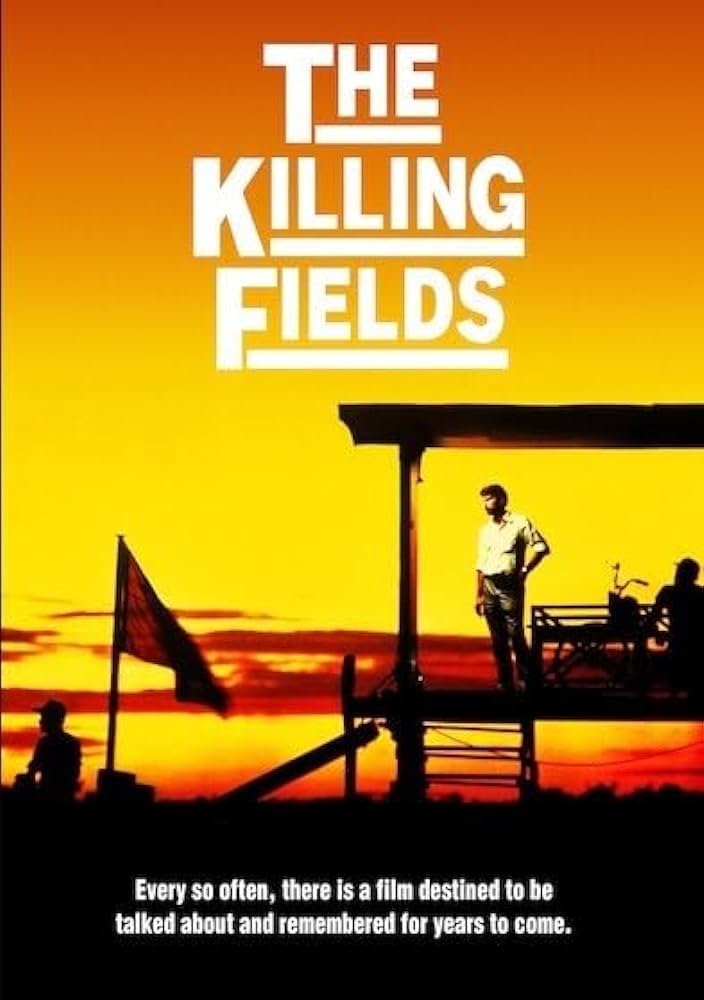
Your piece on “The Killing Fields” was timely in an Internet sense, in that the film has been prominently on Netflix of late and a lot of folks may be rewatching or encountering it for the first time (me). Your essay made me want to contact you directly. I’m fine with doing so here. I completely agree with perhaps 90% of your take on the film; the other 10% I vehemently disagree with, because it is Reaganite revisionism.
The issue you DO touch on– the culpability of the U.S. in regimes like KR coming to power– is where we disagree. The Cambodian genocide never happens if the U.S. doesn’t decide to fight (and lose) a catastrophic proxy war in Vietnam. Wars destabilize nearby countries. This was OUR fault. The movie, in fact, makes this very clear, putting it in lines spoken by Sam Waterston’s Sydney Schanberg. The intensification of conflicts and wars makes groups like KR MORE paranoid and ruthless in their aims.
You also have quite a lot of nerve to call the KR “racist” because they were slaughtering ethnic minorities (although, curiously, they idolized the Chinese Mao). What was the U.S., then, who are estimated to have killed some 3 million people in Vietnam? I always return to the General Westmoreland’s response in “Hearts and Minds”: “Life is cheap in the Orient.” What could be a more racist justification for wanton slaughter of soldiers and civilians alike?
I have to admit my disbelief that you are trying to use this film as a rationale for your larger project of Christian nationalism. At the same time, it intrigues me that you would do so, and that you are actually interested in memory– unlike most of the Right in the U.S. right now. So I hope you’ll engage me in a dialogue.
My response.
Dear Roberto, thanks so much for your note. I appreciate your taking me and my arguments seriously.
Honestly, I don’t think we disagree on much. Maybe my wording was a little off. Here’s what I wrote in the unedited version of the piece regarding U.S. involvement:
The U.S. Role
In 1970, a military coup, possibly with the backing of the CIA, displaced the Cambodian king, and he and the Khmer Rouge became unlikely allies. The U.S., then fighting a war against North Vietnam, expanded into Cambodia in the early 1970s, through air power and infantry (U.S. infantry had gone into the country at least as early as 1969, a full year before the coup).
Disturbingly, the United States—unconstitutionally, illegally, and secretly (at least to the American public)—dropped nearly 540,000 tons of explosives on the beleaguered country, itself already fighting a civil war.
This tonnage was more than all the tonnage dropped on Japan during World War II. To state that the United States destabilized an already destabilized area of the world is the understatement of understatements. While one could never logically blame the atrocities of the Khmer Rouge on U.S. intervention in the region, it would be equally a mistake to dismiss what the U.S. did to the region in the years leading up to the Watergate crisis. A country wrecked by internal division became radicalized against the West, driving many would-be neutral Cambodians into the ranks of the Khmer Rouge.The United States ended its mass bombings in 1973 and abandoned its Cambodian embassy on April 12, 1975.
So, I’m most certainly not opposed to blaming the U.S. Clearly, our bombing was tragically immoral and unconstitutional. I do believe that the atrocities committed by the Khmer Rouge were made out of the free will of those involved. I hate indiscriminate bombing, but our bombing of Japan and Germany (again, sometimes deeply immoral such as the dropping of the atomic bomb on Nagasaki or the firebombing of Dresden) didn’t lead to radicalization but to pacification. So, there can’t be a direct correlation between U.S. bombing and population radicalization. Undoubtedly, though, our bombing served to move many more Cambodians into the ranks of the Khmer Rouge.
Please note, however, that I never criticize the movie for it blaming the U.S. I honestly don’t know what the causation was.
As to the racism of the U.S. in Cambodia and Vietnam, you’re quite possibly right. It’s not something I’ve given enough thought to, but I should. Given that we gave amnesty to huge numbers of Southeast Asians in the 1970s, though, our racism (if it existed) couldn’t be a blanket racism.
As to the change of being a Reaganite, I plead guilty, and I don’t think I’ve ever not said as much. I loved the man and still revere his memory as our last great president. I have his picture hanging proudly in my office (along with a portrait of John Paul II).
As to being a Christian nationalist–this one intrigues me. I’ve never been accused of being any such thing. You’re the first! I’m a practicing Roman Catholic (and, thus, a papist), so I can’t really be a nationalist. Further, my politics are extremely libertarian and, therefore, decentralized. I’ve published numerous articles–especially at The Imaginative Conservatism–attacking any form of nationalism.
Anyway, thank you again for comments. I hope my answer helps.
Spirit of Cecilia loves the prog group IZZ! It’s always a cause for rejoicing when they release a new album, and member John Galgano was kind enough to share an advance copy with us. It’s called Collapse the Wave, and it contains some of the best music they’ve ever recorded. Brad Birzer and Kevin McCormick share their thoughts on this new set of songs.
Brad: I always love doing these with you guys. Kevin, thanks for being my partner here.
I absolutely love IZZ. Indeed, the band represents best what we try to do at Spirit of Cecilia. Art for the sake of intellectual and spiritual edification, understanding the dignity of the human person, and playing like men and women possessed by the muses. Lyrics that read like T.S. Eliot wrote them based on the theology of John Paul II and the philosophy of C.S. Lewis. What’s not to love?
Every part of the band is incredible–from John Galgano’s excellent voice and bass to Laura Meade’s rather heavenly vocals. Tom Galgano (I love that this is a family affair)’s majestic keyboards and vocals, to Paul Bremner’s astounding guitar work, to the two profound drummers, Brian Coralian and Greg Dimideli. Amazing. Astounding. “This is the real thing.”
To be sure, IZZ and Glass Hammer are my two favorite rock bands from the U.S. If anything, I just can’t believe that IZZ isn’t HUGE! They deserve to be adored and well loved. Frankly, they should be as loved here in the States as Big Big Train is in the U.K. and Europe.
I also love how the band–though unique in its own sound–reflects the loves of the members of IZZ: Gentle Giant, Genesis, ELP, Yes, Jethro Tull, and others. In other words, they readily blend tradition with innovation, no mean feat in 2024.
My own history with the band goes back over a dozen years now. In fact, I was introduced to the band by their 2012 album, Crush of Night. I’m not sure, now, how I came across it. It was probably a submission to Progarchy, and I was reviewing for CatholicVote and The Imaginative Conservative, then, too. Man did I fall in love with that album or what? To me, it was (and remains) a perfect album. Composition, lyrics, mood . . . everything rock deserves. To this day, it remains one of my all-time favorite albums. And, it was a part of a trilogy of albums, including The Darkened Room from 2009 and Everlasting Instant from 2015. A trilogy of albums! Aside from Riverside and Glass Hammer, what band does this anymore? Dang, I loved it.
And, here’s just a sampling of the lyrics from Crush of Night:
I could run only half the way
Though she loved me more than I can say
How could I falter?
How could I fall?
Though I’d remember I would not call
When I was young she said, “Pick out the toys
That you want
I’ll see what I can do
Did I take care of you?
By the way
A dollar or two can go a very long way
Use it to buy anything you want.”
The droning sound of the rosary
Etched in my heart
More than a memory
In one of my more obnoxious (or daring!) moments, I wrote the band the year I was living in Colorado (2014-2015 academic year), and they responded by sending me several of their CDs! I still remember opening the mail box in Longmont and discovering such a rich treasure trove. It meant everything to me. This act of kindness predisposed me toward the band, of course, and I immediately back ordered everything–going all the way back to album no 1, 1998’s Sliver of the Sun. If these guys were going to support me, I was most certainly going to support them.
Two other things convinced me of IZZ’s greatness. First, I bought their live DVD, simply called IZZ LIVE, and I devoured it. [If amazon.com is to be believed, I ordered it on May 4, 2013] I couldn’t believe how cooly normal (and normally cool) these people looked. They didn’t look like long-haired metal heads but like normal, professional people. I would’ve been looking at a video of my history department colleagues. Yet, what they were doing on stage was definitely beyond normal. Cool, sure. But, not normal. Extraordinary passion and talent manifests itself in that DVD. It’s still one of my favorite live concerts, and I would’ve given a lot to have been there at the recording of it. Thank the Good Lord, they preserved the show.
Second, in 2012, I had also listened to and reviewed John Galgano’s gorgeous solo album, Real Life is Meeting. I thought Galgano was as great alone as he was in his band. The man simply brims with creativity and integrity. Then, we started corresponding through email and social media. Again, Galgano stunned me as a truly genuine person. I know almost as much about Galgano’s love of the Mets as I do about his love of prog!
But, Kevin, I’ll shut up for a minute and let you jump in.
Kevin: Well this is my first exposure to IZZ. What strikes me immediately is the variety of music on this new release, Collapse the Wave. The opening, “We Are 3rd,” is an expansive track that covers a lot of prog ground in its eight and a half minutes running. The keys and drums harken to mid-era Genesis with the guitars and melody lines more-styled on Yes’s similar mid-era work. The bass lines offer an excellent grounding to the dense textures and carry wonderful counter-melodies. And then about two-thirds of the way into it the tune opens up to expose a piano ostinato and glockenspiel in tandem and highlights the lyric:
Coming to the brink of change
The past is shifting out of range
The wind is at our back
It’s a beautiful moment and definitely one my favorite sections on the record.
Musically there is a great deal of variety on the record. “We Are 3rd” and “Brace for Impact” have a relatively heavy guitar leads, but with many contrasting sections. “Brace for Impact” in particular has moments reminiscent of King Crimson’s angularities, which almost reprises in the final track “And We Will Go.” Elsewhere we hear solo piano accompanying voice in both “So Many Voices” and “Deep Inside.” The latter piece shifts into a folk-like arrangement with acoustic guitar and bass.
The title track, “Collapse the Wave” shows hints of jazz meeting Kansas at their most jam-bandish, eventually settling into an almost reggae back beat, the drums holding a tight groove. There are moments that even feel like latter-day XTC—a sound heard again later on the album in “Soak Up the Sunlight.”
I really like the acoustic passages used by IZZ on this record. The aforementioned piano echoes later in the guitar intro to “Sometimes Sublime.” They definitely know how to shift between contrasting styles and thus melding them into their own sound.
Brad: You’ve covered the music brilliantly, Kevin. Thank you! I love your analysis. I will admit, I’d not thought of Kansas and being a jam band. But, relistening to “Collapse the Wave,” I totally agree. This could be something (updated, of course) off of Leftoverature.
And, speaking of jam bands, maybe there’s a bit of Phish in here! Oh, those East Coasters. . .
I already noted this above, but when it comes to IZZ, I especially appreciate the vocals and the lyrics. That the band has three vocalists gives us a Yes “Leave It” or Yes, “All Good People” vibe. As much as I love the Galgano voices, I’m especially taken with Laura Meade. Her solo album from last year, The Most Dangerous Woman in America, remains a favorite, even though it’s a bit poppier than IZZ. It’s hard not to fall in love with her–arguably one of the greatest vocalists in rock music today.
Well, there is so much more we could say about IZZ and Collapse the Wave. But, probably the best thing we can do is recommend it. And, we HIGHLY recommend it. Yes, I’m shouting at you. It comes out in a just a few days, and you can pre-order it here: https://izzmusic.bandcamp.com/album/collapse-the-wave







 Spirit of Cecilia
You must be logged in to post a comment.