Pyrrhus, He of the Pyrrhic Victory and Alexander the Great and his legend

quotes and commentaries gathered by

RICHARD K. MUNRO

Famed Greek general Pyrrhus of Epirus gave birth to the immortal phrase “pyrrhic victory.” 

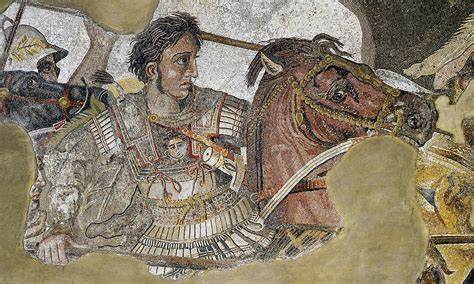
The Alexander Mosaic, also known as the Battle of Issus Mosaic, is a Roman floor mosaic originally from the House of the Faun in Pompeii.
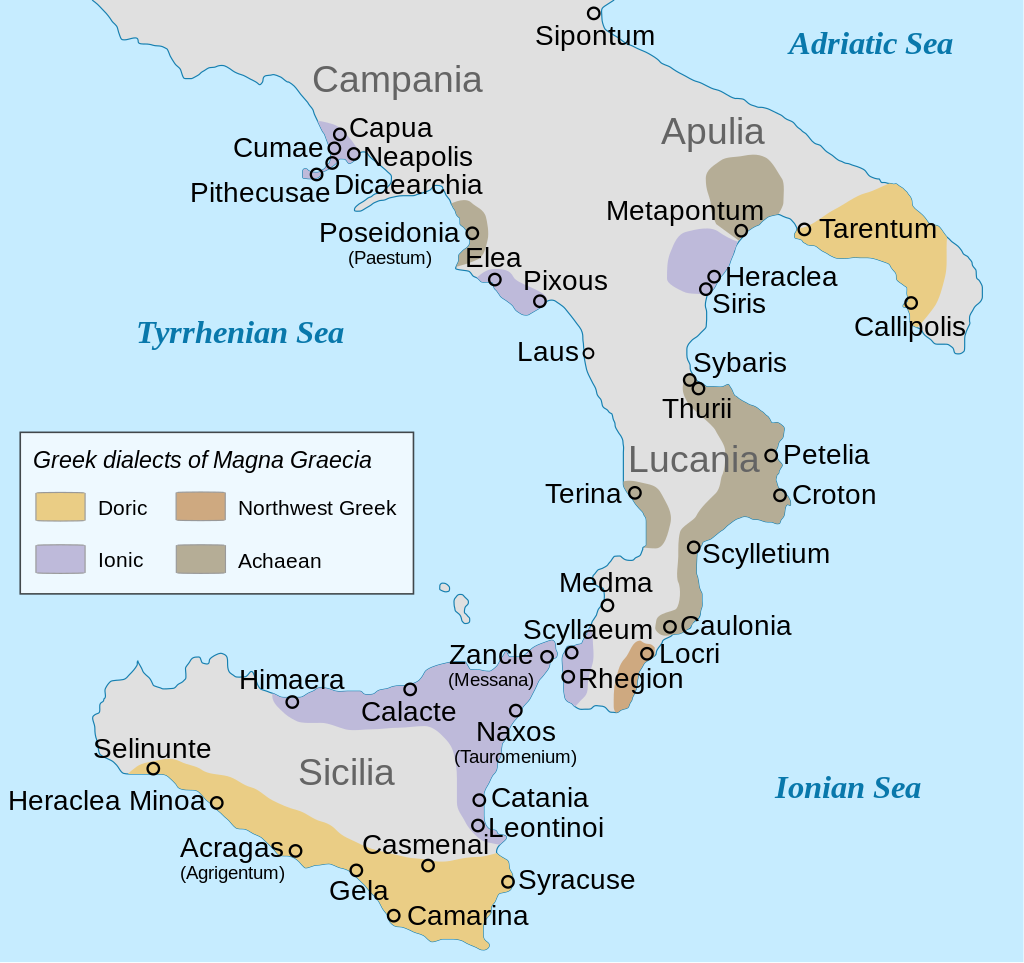
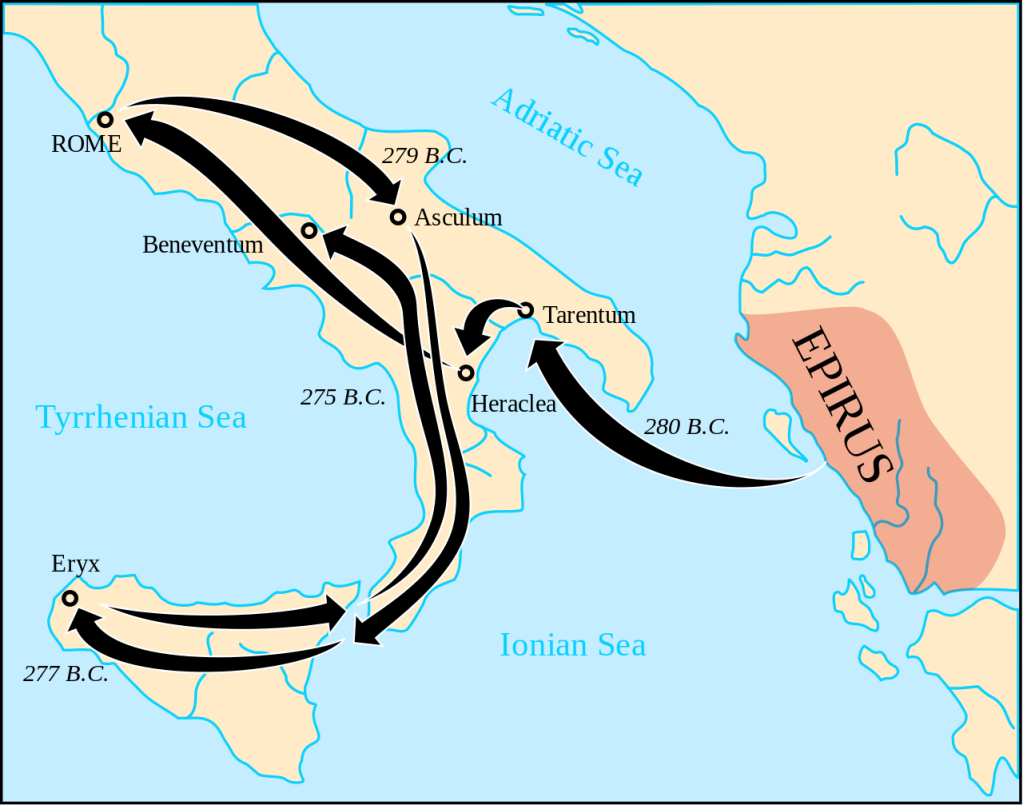
MAGNA GRAECIA
Campaigns of Pyrrhus

After the battle of Asculum (279BC) Plutarch relates in a report by Dionysius :

The armies separated; and, it is said, Pyrrhus replied to one that gave him joy of his victory that one other such victory would utterly undo him. For he had lost a great part of the forces he brought with him, and almost all his particular friends and principal commanders; there were no others there to make recruits, and he found the confederates in Italy backward. On the other hand, as from a fountain continually flowing out of the city, the Roman camp was quickly and plentifully filled up with fresh men, not at all abating in courage for the loss they sustained, but even from their very anger gaining new force and resolution to go on with the war.

— Plutarch, Life of Pyrrhus

Pyrrhus was a mercenary general and mercenaries fight only for money and glory. My grandfather used to say ” a soldier will die for the
colours but not for an extra two bob a day.” The Romans of old had deep civic virtue and patriotism and that unity and courage were tough nuts to crack. It makes one think of the Russians 1941-1945 and the Ukrainians in our day (2022-2024). If the Ukrainians get the aid and weapons they need I think they will be unconquerable and eventually the Russians will tire of their bloody Pyrrhic victories. They may tire of
Putin himself.
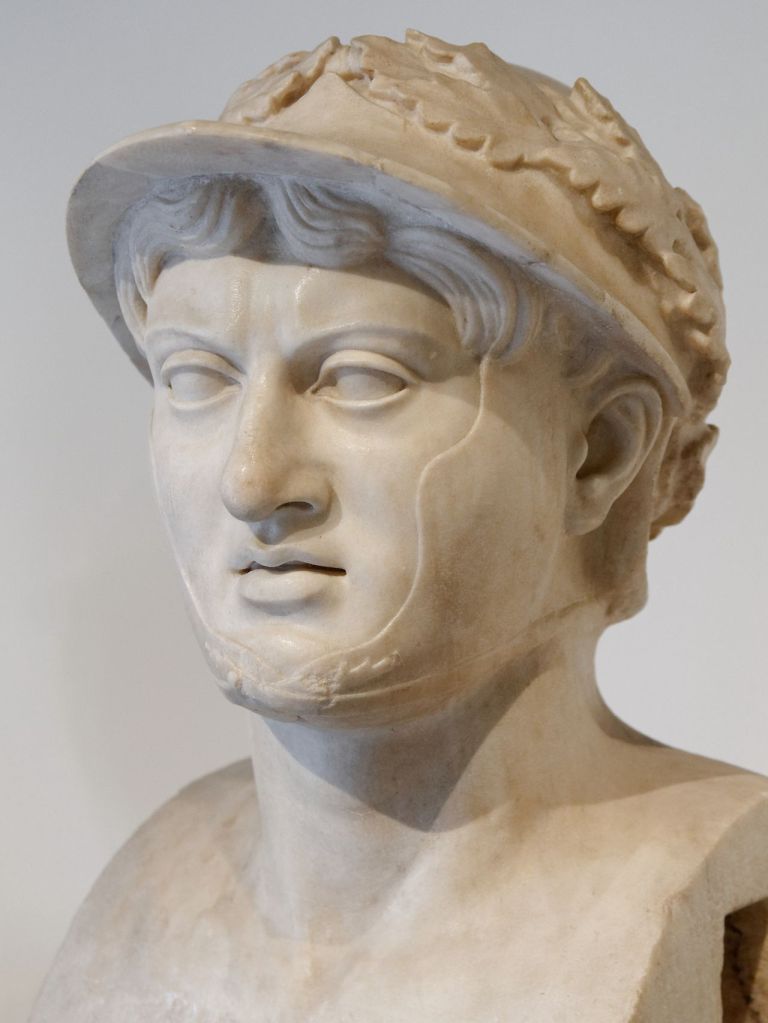
Pyrrhus of Epirus  Πύρρος (Pýrrhos;)c 319/318–272 BC)
A marble bust of Pyrrhus from the Villa of the Papyri at the Roman site of Herculaneum, now in the National Archaeological Museum of Naples, Italy It is quite possible that Julius Caesar himself gazed upon this very portrait as the Villa of the Papyri belonged to a close relative.

“…on the eve of battle [Alexander the Great] appeared in a dream to Pyrrhus, boldest of Greek generals, and when Pyrrhus asked what help a ghost could promise, ‘I lend you,’ he answered, ‘my name.’ True to the story, it was the name which retained a living fascination for two thousand years. It attracted the youthful Pompey, who aspired to it even in his dress; it was toyed with by the young Augustus, and it was used against the emperor Trajan; among poets, Petrarch attacked it, Shakespeare saw through it; Christians resented it, pagans maintained it, but to a Victorian bishop it seemed the most admirable name in the world. Grandeur could not resist it; Louis XIV, when young, danced as Alexander in ballet; Michelangelo laid out the square on Rome’s Capitol in the design of Alexander’s shield; Napoleon kept Alexander’s history as bedside reading, though it is only a legend that he dressed every morning before a painting of Alexander’s grandest victory. As a name, it had the spell of youth and glory: it was Julius Caesar who once looked up from a history of Alexander, thought for a while and then burst into tears ‘because Alexander had died at the age of thirty-two, king of so many peoples, and he himself had not yet achieved any brilliant success.’”

FROM Alexander the Great by Robin Lane Fox (1973)

( a wonderful book I read this when I was at NYU and there have been other biographies since but this remains one of the best and is of the highest literary quality).

My favorite Candy

by Richard K. Munro

“Candy is dandy, but liquor is quicker.” said Ogden Nash.

As a kid I loved Baby Ruth bars and Snickers. Now I find them too sweet. But I still love chocolate. 

\My favorite is probably Swiss chocolate but I enjoy good old Hersey’s with Almonds. The reality is I rarely eat candy today. The closest I get to it is hot chocolate in the winter or a glass of chocolate ovaltine. But if I am on the road and need a snack I probably will get a Snickers bar to tide me over!

Daily writing prompt
What’s your favorite candy?

We Really Like The Bardic Depths’ “What We Really Like In Stories”!

Bardic Depths Stories

In this post, Kevin McCormick and Tad Wert discuss The Bardic Depths’ new album, What We Really Like In Stories. It is the third album from them, and it features songwriting by Dave Bandana and Gareth Cole, with lyrics by Bradley Birzer.

Tad: Kevin, it’s great to be reviewing this album with you! I know you and Brad go way back in your friendship – did you ever imagine he would someday be the lyricist for a British progressive rock group?

Kevin: Thanks Tad–great to be writing it with you as well.  It was definitely a surprise when Brad first mentioned he was writing lyrics for a rock recording—we had a good laugh! But in retrospect it seems a natural step. We shared a love of the early prog music from the start of our friendship and he writes constantly, albeit in a more academic setting than rock lyrics. So it’s not as much of a stretch as you might think. One of his favorite aspects of Tolkien’s and Chesterton’s writings are their poems. And he’s a huge fan of T.S. Eliot. But I think his collaboration with Dave on the Bardic Depths albums is a great fit and I’ve enjoyed watching the development of the concepts and sounds over the years. You know, the first album started out as just a friendly experiment. Dave had some music he had written and asked Brad for a lyric to put with it.

Tad: Kevin, I always enjoy learning the “behind the scenes” details of albums, so thanks for sharing those. 


Okay! Let’s talk about What We Really Like In Stories. As I mentioned, this is the third album from The Bardic Depths, and I think they just improve with every release. I really, really like this one. First, I think these are the best lyrics Brad has written yet. Every song is a tribute to an author, and taken as a collection they illustrate Brad’s love for various genres, primarily fantasy and science fiction. The title track refers to C. S. Lewis and J. R. R. Tolkien, who are responsible for two of the most popular fantasy series of the twentieth century: The Chronicles of Narnia and The Lord of the Rings, respectively. Birzer imagines them discussing their literary aims over a drink and a smoke in the local pub:

Could we write fiction
That might combine these things:
A love of history; a desire to debate the defenders of the modern world
Promote one’s philosophical and religious thoughts
Could a modern writer create art but not be over blatant?  

“You’ve Written Poetry My Boy” is about Ray Bradbury (The Martian Chronicles, Something Wicked This Way Comes, The Illustrated Man, among many others), and refers to some praise that Aldous Huxley gave him. “Vendetta” is dedicated to Alan Moore, who put together the graphic novel, V for Vendetta. “Old Delights” is a delightful little song in honor of midwestern American author Willa Cather, while “The Feast Is Over” recognizes the genius of pulp writer Robert E. Howard (Conan the Barbarian stories). “Stillpoint” pays tribute to Walter M. Miller (A Canticle for Leibowitz), and the last track is about British fantasist Robert Rankin. 

In other words, this is a very literate collection of songs, and they celebrate some of the greatest bards of modern times. I was an avid reader of Bradbury, Lewis, Tolkien, Howard, and Miller when I was in high school, so it is a joy to see them properly honored by The Bardic Depths. I’m not familiar with Rankin’s work, but I am certainly going to check him out now.

Kevin: Without a doubt this new album is a real step forward for the band.  Everything from the songwriting, to the instrumental performances, to the production is excellent. You can see the maturation process as the band really seems to blend and complement one another so well. The vocal harmonies are tight and solid. The lead lines are powerful and expressive and carry the songs into new spaces.

I think my favorite track at the moment is “You’ve Written Poetry My Boy.” It opens with a beautiful arpeggiating twelve-string guitar evoking memories of early Genesis. But it is soon joined by an equally-beautiful soprano sax (if this is a keyboard patch it’s an extremely natural sound). The unlikely pairing dance around each other’s lines and set up the entrance to the tune proper.  Again there are hints of Genesis here, but the band seems to have found a sound of their own.  And I love the variety in the instrumentation–string pads, piano, organ, and I think I hear some harpsichord in there. And then mid-song there is a shift to a minor section which briefly darkens the mood and serves as a platform for a sax solo, only to pass through back to the main theme. Shifts like this can be clunky sometimes in prog bands, but TBD avoid this pitfall by carefully crafting the transition compositionally.

Overall I must say that I hear hints and suggestions of so many great prog bands throughout this album. Those hints position the album in a space that sits well with other classic recordings yet still retains its own voice. Moments of the Floyd and Supertramp peak out here and there, and there’s a bluesy hard rock sensibility in the final track, “Whispers In Space,” and some even some techno in Stillpoint. Some of the vocal work has shades of Big Big Train. But again, there is a TBD color in the sound that holds everything together as a part of the larger work.

Tad: Kevin, I knew you had excellent taste – “You’ve Written Poetry My Boy” is my favorite track as well! And that is Peter Jones on clarinet and alto sax. I too hear glimmers of classic Genesis (the Steve Hackett years) in this song, and I find that very appealing. There’s no wonder they chose this track to be the first single.

I also want to give a shoutout to Gareth Cole’s guitar work throughout the album – it is truly stellar. His solos in Vendetta are spectacular – driving, melodic, and pure. His slide guitar in “The Feast Is Over” is terrific!

To wrap things up, I think we can agree that What We Really Like In Stories is a big leap forward for a group that improves upon excellence. They seem to have really gelled as a unit – Dave Bandana, Gareth Cole, and Brad Birzer are at the top of their form as far as songwriting goes, and Peter Jones’ vocal and instrumental contributions are wonderful. I also like Dave’s vocals on “The Feast Is Over” – he’s got an “everyman” sound that is quite inviting. 

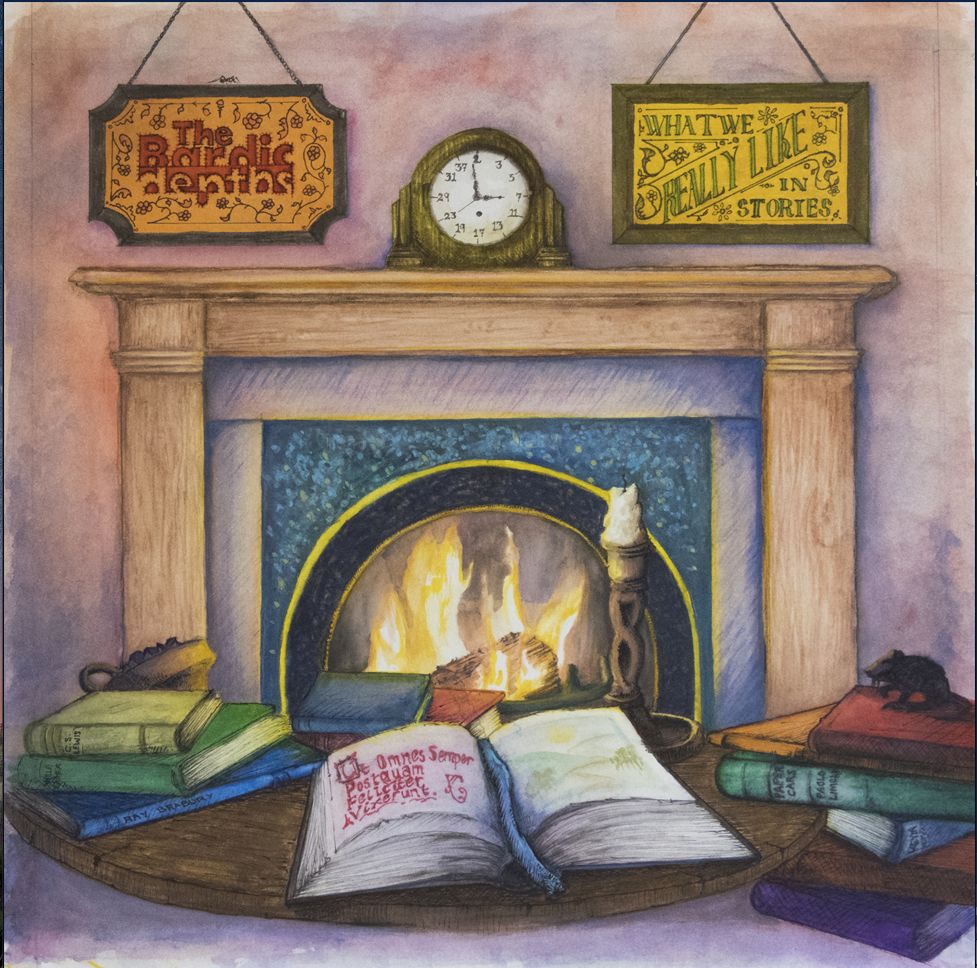
Before we close, I’d like to mention how interesting Kevin Thompson’s artwork is. The style is somewhat primitive and whimsical, which complements the songs perfectly. Stylistically, it reminds me of the cover art for the Beach Boys’ Smile album. Thompson’s painting is of a cozy room with a fire blazing away, and piles of books on a table. The authors are the ones featured in the songs, and there are needlepoint hanging that spell out the “The Bardic Depths” and “What We Really Like In Stories”. I’m intrigued by the clock on the mantel: the numbers aren’t the standard 1 through 12! Instead, they run 2, 3, 5, 7, 11, 13, 17, 19, 23, 29, 31, 37.

What We Really Like In Stories is a contender for album of the year in my book. The subject matter of the songs is thought-provoking while remaining playful, while the musicianship is first-rate. This is one album I’ll be enjoying for years to come.

Here’s the video for “You’ve Written Poetry My Boy”:

FIDO: Our Beloved Link to Paradise

By Richard K Munro

A hummingbird in our garden in January 2024.
OUR PALS: LANEY AND LEO IN OUR GARDEN JANUARY 2024. We just adopted Laney as his mistress, our neighbor had recently died.

“Dogs are our link to paradise. They don’t know evil or jealousy or discontent. To sit with a dog on a hillside on a glorious afternoon is to be back in Eden, where doing nothing was not boring–it was peace.”

(Milan Kundera)


I recently read a horrendous article about dogs being dumped over the outskirts of town and left to die. There was a redeeming characteristic to the article: two volunteers pledged to bring the dogs water and food. Like me, they were saddened at the cruelty and selfishness of so many humans and wanted to help the dogs. 

Dogs are fascinating. They vary immensely in size and color more than any other mammal, so they are unique. 

Dogs are, of course, Man’s Best Friend. They are probably our oldest animal companion the very first domesticated animal. In fact, without the dog our civilization may not have come into existence at all!  

My father had a dog. My grandfather had a dogs almost everyone had a dog at one time or another. They were part of the family and part of the family history.

Lincoln loved dogs. He had a dog named Fido. Stanley Coren tells us:

“This dog was almost always with Lincoln and the people of Springfield would report that it was a common sight to see Lincoln walking down the street with Fido walking behind, carrying a parcel by the string tied around it. A regular stop for Lincoln was at Billy’s Barbershop for a haircut. Fido would settle down to wait outside patiently, although he could easily be lured into a game involving jumping and twirling when young children came by and paid any particular attention to him.”

Dogs have their flaws, however, They need attention and can be expensive to maintain. I think dogs tend to be dirty and greedy (for food). 

And dogs have been known to fight over food. 

Dogs who have been abandoned generally speaking are the most aggressive about defending their food. Having a bad master or none at all is bad for dogs. Through neglect and through the fear of hunger dogs can become aggressive. They say a hungry dogs forgets his training, forgets his master and believes in nothing to his bones and his meat when starving. So bad behavior is not really the dogs fault.

Sadly, very aggressive dogs have to be put down sometimes.  So dirtiness and possible danger and aggression (particularly in large dogs) are a problem. 

But are they any worse than human beings are in this flaw?  Many poorly raised and marginalized people have poor hygiene and are thieves and aggressive bullies.

But given half a chance the average dog has one purpose in life: to be a loving companion to his master or mistress and loyally give his or her heart.

There is no friend like a dog. He will always welcome you home with affection and a jolly wag of his tail and a happy glint in his eye!  He will warn you of danger, of strangers or intruders. If he doesn’t he is telling you something as well. 

I remember the famous Sherlock Holmes story, The Silver Blaze.

“Is there any point to which you would wish to draw my attention?’

‘To the curious incident of the dog in the night-time.’

‘The dog did nothing in the night-time.’

‘That was the curious incident,’ remarked Sherlock Holmes.”

The fact the dog communicated was whoever came to see the horse in the stable was NOT a stranger but a well-known and trusted individual.

If there is a leak in the laundry room he will tell you. 

If there is smoke he will sound the alarm. 

Poor fellow! he is confused and frightened by the 4th of July as well as thunder and lightning. 

But when you comfort him he brings you delight and more than ever is glad YOU ARE HIS MASTER and YOU ARE HIS FRIEND. 

You are glad he is by your side. 

And of course we talk to our dogs and wish they could talk to you! Sometimes it seems as if they try!

I genuinely love dogs and do not want to see them suffer or be harmed in any way.  I love animals in general and am fascinated by them. I love the birds who visit our garden and who make their nests and lay their eggs in our eaves. 

But my favorite animal is the dog because they are our link to paradise. 

The saddest thing about a dog is we know he will be with us only for a short while.  We get a dog and we know we will probably have to say goodbye to it long before we die because their lives are short.

But perhaps this is one of the greatest gifts a dog bestows to us. 

The dog teaches us not to worry too much about tomorrow. We are all mortal. 

The dog teaches us to be happy and grateful for small things that each day of life provides.

A warm blanket. A satisfying meal. A full water bowl. A scented garden. A cool summer breeze. A sweet breath of clean air.  

A quiet evening. 

And the love and companionshp of a true friend. 

“And all I ask is a merry yarn from a laughing fellow-rover,

And quiet sleep and a sweet dream when the long trick’s over.”

(John Masefield)

“Your days are numbered. Use them to throw open the windows of your soul to the sun. If you do not, the sun will soon set, and you with it.” MARCUS AURELIUS  GARY COOPER IN GARDEN OF EVIL (1954)

Ah, moon of my delight, [who know'st]1 no wane,
The moon of Heav'n is rising once again:
How oft hereafter rising shall she look
Through this same garden after me - in vain!

And when Thyself with shining Foot shall pass
Among the Guests Star-scatter'd on the Grass,
And in thy joyous Errand reach the Spot
Where I made one - turn down an empty Glass!
orship:

by Edward Fitzgerald (1809 - 1883), appears in The Rubáiyát of Omar Khayyám, First Edition, no. 75, first published 1859 FROM THE PERSIAN
Daily writing prompt
What is your favorite animal?

Heart Land Mines, Vol. 1: Dave Kerzner’s Love Letter to the Past

Heart Land Mines

In this, our latest dialogue, Brad Birzer and Tad Wert discuss the new album from the multi-talented Dave Kerzner, Heart Land Mines, Vol. 1. Kerzner has been involved in many different projects, all of them excellent. Besides his solo albums, he was also a member of Sound of Contact, Arc of Life, and In Continuum. He rivals Neal Morse and Mike Portnoy in the number and variety of musical ventures he participates in.

Tad: Brad, when I read Dave’s liner notes to Heart Land Mines, Vol. 1 and saw that these were songs from the 90s that he wrote after a relationship with a girlfriend broke up, I had low expectations. But I have really enjoyed this album from the first time I listened to it! It doesn’t hurt that Kerzner has a great ear for a musical hook – “Dreaming In LA” sounds like classic Bad Company to me, but better. 

This album is proggy – Kerzner’s voice has that laconic quality that always recalls David GIlmour – but it’s primarily a straightforward rock album that would be at home on an FM radio station in 1975. There’s a lot of acoustic guitar – “Back To One” sounds like an Eagles hit with its vocal harmonies. Anyway, maybe I’m emphasizing its retro qualities a little too much, but I find myself really taken with them!

Brad: Tad, thank you so much for asking me to do this review of Kerzner’s Heart Land Mines.  I’m sorry to be late in replying.  Since you first invited me to write this, I’ve been to the University of Louisville and back.  Not quite Tennessee, Tad, but still a beautiful city and state!  I gave lectures on sociologist Robert Nisbet and fabulist J.R.R. Tolkien, and I had a blast while I was there–especially seeing one of my long-time friends, Gary Gregg.  He’s not a progger, but he is a brilliant guy.

As far as I know, I have everything Kerzner has released (at least if bandcamp is to be believed), and I’ve been a huge fan of his since the deluxe edition of New World came out.  Wow, do I remember when that came out–I was utterly blown away by it.  Indeed, that album would rank as one of my all-time favorites, and I go back to it frequently.  I also really enjoyed Static and would also rank it very highly in my all-time lists.  His In Continuum albums also move me and have a high place in my rankings.

From my perspective, Kerzner is ELO progged up, and Pink Floyd popped up.  He has an infectious way about creating an ear-friendly riff while also complicating the matter in the proggiest fashion.  And, his production is always crystal clear and fetching.

For whatever reason, however, I’ve not been able to get into Heart Land Mines.  I’ve listened to it now three or four times, but it’s failed to grab me in the way that Kerzner’s previous albums have.  

I will say, however, that you’re absolutely right, if this were 1975, Kerzner would be huge on Album Rock Radio.  On the album, he clearly embraces the ethos and sound of Led Zeppelin, the Eagles, Bad Finger, etc.

Don’t get me wrong.  I really like Heart Land Mines, but it’s yet to become a part of my being in the way that his other albums have.  At this point, I’m happy to move on to his other albums and consider Heart Land Mines a labor of love, but not of genius.  

Please tell me why I’m wrong!

Tad: Brad, as always, you have the perfect phrase to describe an artist’s work: “ELO progged up, and Pink Floyd popped up” is Kerzner in a nutshell!

I wouldn’t say Heart Land Mines is a work of genius, but gosh, I think it’s a blast to listen to. It serves as a reminder of how far pop music has fallen since the 70s. We both agree Heart Land Mines would be a huge hit on mid-70s AOR. Today, it appeals to a niche audience. I know, I know – in the 70s guys our age were complaining about how great big band music was, and how awful radio was!

Anyway, I have enjoyed Kerzner’s semi-autobiographical musical journey here. He took what seems to be an ugly breakup of a relationship and turned it into a very catchy set of songs. “Manic Calm” has an irresistible guitar riff (I’m a sucker for a descending scale) that I can listen to over and over. “Eye Of The Storm” is the best Pink Floyd song since “High Hopes”. And I love the way he reprises a couple of songs to pull everything together into a cohesive package.

Like you, I’ve tried to buy everything Kerzner has put out, but it’s hard to keep up with the guy!  Sound of Contact’s eponymous album was near-perfect progressive rock, but it looks like personality clashes have kept them from ever getting together again. I have both of his In Continuum albums, and I like them a lot, but to my ears, neither of them have any melodies that are as memorable as some of the ones on Heart Land Mines

I agree that Heart Land Mines is a labor of love (or maybe broken love!), but I find it to be a thoroughly pleasurable listen. Sometimes, that’s all I want or need. I’ve always had a soft spot for power pop, and if a song’s melody doesn’t grab me, I have a hard time getting into it. Kerzner is a fantastic songwriter, I am so glad he decided to dust off these old tunes and record them.

Brad: thanks for the good words and the reminder, Tad.  You’re absolutely right, Heart Land Mines is a work of AOR genius, and it would’ve been a massive hit–along with Hotel California–in the 1970s.  Too bad for Kerzner that he’s temporarily out of joint!

For what it’s worth, I’ve given Heart Land Mines a few more listens since I wrote the first reaction, and the album very much continues to grow on me.  I would say that the album not only embraces The Eagles and Bad Company, but also, to a certain extent, Elvis Costello.  

Overall, it’s a delight of influences.  I even hear bits of Stone Temple Pilots and Steely Dan and other bands from the 1980s and the 1990s.

Kerzner is never shy about his debt to other bands, but these debts seem quite blatant and serious.  

Regardless, I’m so glad to live in the same world as Dave Kerzner  Whatever I think of this particular album, I know that my life is immensely better because of his music.

Tad: And on that note, I think we’ll bring this joint review to a close. Spirit of Cecilia readers, if you haven’t yet experienced the magic of Dave Kerzner’s music, you should check out his first solo album, New World; if you like it (and we think you will!), then Heart Land Mines is a worthy followup.

Here’s the official video for “Eye Of The Storm”:


FIVE THINGS I HABITUALLY DO FOR FUN AND ENTERAINMENT

Richard K Munro

  1. READ WSJ COMMENTARY LOCAL PAPER
  2. LISTEN TO PODCASTS OR AUDIBLE BOOKS DURING BASEBALL SEASON LISTEN TO BASEBALL GAMES ON THE RADIO OR MLB AT BAT YOUTUBE NEWS (London TImes/Sky News/etc).
  3. WORK IN GARDEN clean the pool. ENJOYING NATURE OR GO FOR WALKS IN THE PARK SWIM WHEN WEATHER IS GOOD 
  4. STUDY LANGUAGES ON DUOLINGO AND ALSO WITH SUPPLEMENTARY DICTIONARIES AND READINGS WHILE LISTENING TO CLASSICAL MUSIC AND SIPPING ON THERMOS OF TEA
  5. READ X (TWITTER) AND POST ON BLOG OR FB read books.

(I USED TO LOVE TO GO TO THE MOVIES BUT HAVE ONLY GONE OCCASIONALLY RARELY SINCE 2017. LAST MOVIES I SAW IN THE MOVIES WERE BARBIE 2023 (ok) 1917 and Darkest Hours.).

I like old movies and will see one now and again. Most TV series are too much for me. I enjoyed REACHER. But it was a limited series and not too long.

Bloganuary writing prompt
List five things you do for fun.

THE KEYS TO MEMORY: ORG! a MEAN FAM A/R EFFORT

          By Richard K. Munro, MA

RICHARD K MUNRO (Ricardo Munro) aka “AULD MUNRO” or “EL SUPREMO” I taught memory techniques writing, study skills, , history, languages for over 34 years. I have studied languages for over 50 years.

From my earliest days as a teacher (chiefly a language and history teacher) I taught my students a little unit THE KEYS TO MEMORY.   ‘ORG a MEAN FAM AR EFFORT”[1] (“Arg! A mean family is an effort”) is a mnemonic device.[2]   The keys to memory are ORGANIZATION, MEANINGFULNESS, FAMILIARITY, ACTIVE REHEARSAL and EFFORT.   Org! a Mean Family AR EFFORT! This fictional somewhat humorous sentence I invented myself for a psychology class in 1987.  I used it my entire teaching career.  No matter what class I taught I stressed the KEYS TO MEMORY as a study aide.   I believe it was helpful to many.

Creating mnemonic devices can be time consuming and it takes experience to make effective ones. It is always good, as much as possible to make your OWN study cards and invent mnemonic devices. Naturally one can borrow mnemonic devices from others.  In my experience ready-made vocabulary or study cards have the virtue of being correct and ready for review and study.  Also, ready-made study cards are expensive.  Another problem with “spark charts” or study cards you are just passively reading.  And the cards or charts may not align directly with the text one is using.     Passive listening and passive reading ALONE are not effective learning strategies.  But they are better if combined with other strategies such as active note-taking, audiovisual aids (music, maps, films), reading aloud, speaking and writing practice.       And there is no question that if one does not PRACTICE and REVIEW and ACTIVELY USE skill one tends to forget over time.   I remember arithmetic, basic geometry and elementary algebra but I have forgotten calculus, chemistry, and most of anatomy because I have hardly used them in my career.   I remember typing, Spanish, Latin, history, literature very well because I have studied and taught these my entire career.

Excellent examples of common mnemonic devices.

Great example of a Spanish mnemonic device WITH practical examples and vocabulary. It displays the complete present indicative of the two verbs (SER and ESTAR).  It even has examples of ERRORS that one should avoid.

very good summary of memory retention and WHY WE FORGET. It is interesting to study WHY WE FORGET but not as useful as studying the KEYS TO MEMORY>

#1   Let us begin with organization one of the KEYS TO MEMORY. ORGANIZATION which is have some SYSTEM of some way of organizing information for review and study.  I annotate dictionaries [i](adding words and idioms I find in reading. I always keep NOTEBOOKS. Some notebooks are for subject matter (Spanish, Italian, Greek, history, science, literary terms, and literature notes).  One can organize by themes, characters,  chapter, by author, by time period by category (domestic vs. foreign).  Organizing by elements are classified as metals (iron, gold, mercury, copper, silver -good conductors of heat and electricity) , nonmetals ( sulfur and phosphorus -reactive with air).    Some notebooks were for vocabulary and grammar only (with examples).    Spanish has to separate verbs for “to be” (SER and ESTAR).  One simple way to remember most of the distinctions is  ESTAR=LO/TEMP (location, illness temporary condition).   SER=TOC (tic tock =TIME ORIGIN OR CHARACTERISTIC )  “DEDOS” (fingers) is a good mnemonic for the usage of the SUBJUNCTIVE in Spanish.  DEDOS=Deseos (desires) emoción (emotion) Dudas (doubts) opinión (opinion) sugerencias (suggestions).   This mnemonic also is a good way to review Spanish vocabulary. .)  “DOCTOR/PLACE” (see chart) is also a good mnemonic  for SER and ESTAR BUT perhaps a little TOO DEVELOPED (so harder to memorize and teach).  Whatever sticks is the one you should use.

Prepositional use, for example, in Spanish and English require special study. I know from experience prepositions are translation problem. Here mere translation of a word is not enough; one must have a complete example for total clarity. I have these extended examples in my notebooks and study cards.

ENGLISHSPANISHtranslation
FROMLe quitó el lápiz a su hermanaHe took the pencil FROM his sister.
FROM MORNING TO NIGHTTrabaja el maestro de la mañana a la nocheThe teacher works from morning to night.
On/onto the floorLos huevos cayeron al sueloThe eggs fell onto (on) the floor.
By handLo hizo a manoShe made it BY hand

I noted early on my studies my Spanish to English comprehension was almost 99% BUT going from English to Spanish I made most of my mistakes.  Reading vocabulary is a passive skill and that will normally be your best skill.   Speaking and writing are active skills that require more practice and thought.   I made study cards for terms or new vocabulary. 

I used color coding with ink, pencils, and index cards as well as abbreviations. I always used PENCIL for English and RED for IMPORTANT (or REVIEW).  I normally use colors for the target language. When I taught bilingual social studies and Spanish for Native Speakers GREEN was always Spanish and blue or black for English.  It doesn’t matter what color you use as long as you are consistent.  For example, I always use PENCIL for English.   I vary colors for other target languages chiefly out of practicality.

YOU CAN GROUP words and concepts by part of speech such as ADJECTIVES or VERBS.   List synonyms and antonyms.  For synonyms I always used = sign.   I always use slash mark for antonyms GOOD/BAD.  FOR FALSE or PARTIALLY FALSE COGNATES I use this symbol:  ≠ for example Spanish éxito (success) ≠ Salida (exit). I would usually mark them with a RED ASTERISK.  Injuria is an example of a partially false cognate MEANING an insult or slanderous allegation NOT a physical injury which would be in Spanish herida.    Concepts like FALSE COGNATES, SYNONYMS, ANTONYMNS and (true) Cognates are very important for vocabulary development and language learning.      Problem(English or German) or problema Spanish or Greek (πρόβλημα )  problème  (French)is a derivative word that appears in dozens of languages.    So one is not learning merely ONE Spanish word but really a root that is used in hundreds of languages.


[1]  Some mnemonic devices are well-known.  I favor acronyms (4-7 letters), acrostics and fictional invented names such as “Roy G. Biv” (the colors of the rainbow) or “F X Misterio” (romantic themes in Spanish literature: Fáustico, Exótico, Misterioso (Mysterious, exotic and Faustlike)  Acrostic rhymes are more time consuming  to create as are rhyming poems but they certainly aid the memory.   It appears studies show chunks of three names or acronyms of 5-7 words or letters are ideal. After you’ve introduced the acrostic strategy and acronym strategies you can do whole class activities occasionally.   The important thing is sharing practical mnemonic devices and encouraging students to use these strategies.  Other well-known acronyms are for example, FANBOYS for the seven coordinating conjunctions For, And, Nor, But, Or, Yet, So HOMES for the five great lakes in North America: Huron, Ontario, Michigan, Erie, Superior.  Q& A (Question and Answer ) is one of the easiest and most universally used acronym. There are also internet acronyms used in texts and chats:LOL (laughing out loud) and other variants. IMHO (in my honest opinion). TTYL (Talk to You Later) EMT (Emergency Medical Technician). There are many military acronyms at well and new ones are created all the time.  You can google them when you need them.  Some of the common ones are POW (prisoner of War) MIA (Missing In Action) KIA (killed in action) AWOL (absent without leave)PT (physical training)

[2] Mnemonics, Psychology of – ScienceDirect


#2 MEANINGFULNESS which is the quality  of being useful, beneficial , or important.

A learner must have a positive attitude to what he or she is studying. When I taught English for learners or Spanish, I always began my class with the reasons WHY English was important, useful, beneficial and FUN.   I always began my Spanish classes with why Spanish was BEAUTIFUL, USEFUL, BENEFICIAL and FUN. I passed out an index card to each student and had them copy down these simple motivational phrases in Spanish. They were to say this ALOUD every day at least once and the more the better.

  1. Me gusta el español (I LIKE SPANISH; SPANISH IS PLEASING TO ME)
  2. A me gusta español, (I really like Spanish)
  3. El español es útil y puede ayudarme (SPANISH IS USEFUL and CAN HELP ME
  4. El español es hermoso (SPANISH IS BEAUTIFUL)
  5. El español es fonético (Spanish is phonetic and easy to spell).
  6. El español no es difícil (SPANISH IS NOT DIFFICULT)
  7. Es bueno estudiar y respasar todos los días (It is Good to study and review EVERY DAY).

I would also joke that Spanish helped my romantic life.  Being bilingual made it twice as easy to get a date Saturday night.   Latin aunts and mother in laws liked me because I was polite, brought food, wine and presents AND I spoke to them in Spanish.   I would ask when autocontrol was good and when it was bad.  In Spanish it was Good (autocontrol=self control) but in English (OUT OF CONTROL) it was bad.   In Spanish being an AS is Good a compliment (it means ACE or STAR)  In English being an ASS is pejorative.  I remember the first time I heard this expression when a Spanish friend said to me with a smile and a laugh Tú eres un as (YOU ARE AN ACE).  At first I was momentarily angry but I quickly understood =everyone was smiling and laughing- he was giving me a compliment!   Here is some simple humor I would work into my basic classes.

Q Por qué está tan triste el cuaderno de matemáticas? (why is the math notebook so sad?  

 A Porque tiene muchos problemas. (Because he is full of problems!)

Q ¿Cuál es la fruta más cómica? (What is the most comical fruit)
A Naranja ja ja ja.   (ORANGE HA HA HA)

Q¿Cuál es la fruta más paciente? (What is the most patient fruit?)
A Es pera. It’s the pear! (espera WAIT)

Q ¿Cómo se dice nariz en inglés?  (HOW DO YOU SAY NOSE IN ENGLISH?)
A No sé.  NOSE.[1]   

Liking a language or having a love or affection for it helps MEANINGFULNESS enormously. If one develops a passion or devotion for a subject it will become more meaningful.  I loved Spanish music and songs at was attracted to them.   Also, I was fascinated that soccer and baseball were broadcast and written about in Spanish so that was how I began to read and listen to Spanish and with great joy[2].  I also found it was fun to talk to players in their native languages (and get a few autographs). [3]The first Spanish I ever read for pleasure was the baseball roundup in El Diario newspaper. I learned basic Spanish sports and baseball vocabulary and the past tense of common verbs.

The subject matter or language you study must have a PRACTICAL advantage (such as learning a useful language such as Spanish for social or commercial purposes or gaining a certificate in a technical field) or an INTELLECTUAL advantage (such [4]as helping with comprehension of grammar by studying Latin, the appreciation of music such as opera or lieder such as Italian, French or German). Studying Latin and Greek will help with the study of medical or technical terms.  Meaningfulness if found through literature, poetry gives us JOY or a SPIRITUAL or philosophical advantage (such as studying Stoic Philosophers or the Bible).  I never tire to read or listen to Stoic philosophers, reading C. S. Lewis, Gilbert Highet’s CLASSICAL TRADITION or his shorter book MAN’S UNCONQUERABLE MIND or JESUS and LAO TZU: the Parallel Sayings (ed. Aronson).  Some things have an entertainment value such as learning how to draw, studying chess, learning to play music or gaining the finer points of golf or soccer or baseball as a player, manager or fan.   Spanish was never a chore when I heard music, a song or listened to a good ball game.  When I lived in Spain, I saw many movies dubbed in Spanish or VO (version original usually English with Spanish subtitles).  To this day I see many movies on NETFLIX with English subtitles or dubbed in Spanish or Portuguese just for fun.

#3 FAMILIARITY  which is an acquaintance or knowledge of something. If one grows up in New York or the Spanish Southwest one will have contact with Spanish language ads, restaurants and native speakers.  If one can travel it helps to be immersed in a German-speaking or Italian-speaking or Spanish-speaking environment. If Spanish, Yiddish or German are the heritage languages of your parents and grandparents you probably have some familiarity with those languages.  When I lived in New York I heard or spoke Spanish every day! I also heard a lot of Yiddish words in conversation or on the radio. When I visited Italy the first time, I had some familiarity with Italian from songs and operas AND my knowledge of Spanish.  I could communicate effectively with Italians from day one.   If one knows the history of Indo-European languages one realizes the inseparable connection between these languages. If one learns Latin grammar, then the grammar of other languages is easier to understand.  I know Spanish well and realize that Greek, Spanish Italian, Latin and English are all related and share roots and vocabulary.  “Any time someone learns a foreign language it leads them to consider the workings of their own language in greater detail, and , since the syntactic structures of Latin….are relatively complicated, familiarity with that language can give students the understanding needed to work with a greater repertory of grammatical possibilities in English as well.”[6] Therefore, learning Italian or French will be easier for someone with a good vocabulary of English, Spanish and Latin.     German or Swedish is easier if one knows English and so on.  Even a language like Hindi or Punjabi which use different alphabets are easier to learn to speak due to their similarities to English, French, Spanish and Gaelic.[7] 

Scottish soldiers communicated with Indian soldiers during WW1 via a patois of Gaelic, English, Hindi and Punjabi

In general the more technical and academic the root word the more likely it is a true or identical cognate.  False and partially false cognates are about 5-10%.   When I was teaching Spanish (or English) I often would just made a pre-test like this (note some cognate words are partially false or need explanation):

SpanishEnglishCommentary
perdonarTo pardon or to forgive 
terminarTo end or terminate (finish off) 
La direcciónDirection or ADDRESSAlso means MANAGEMENT  or course (of a boat or plane) (rumbo) Also tendency.
El compañeroCompanion, comradeClassmate colleague
El talentoTalent or aptitudeAncient coin (talent)
El críticoCritic, reviewerEl momento crítico (crucial momento)  la crítica (criticism; literary criticism ;critique
La miseriaMisery sufferingPoverty Misero=wretched

#4 ACTIVE REHEARSAL

Active rehearsal is very important for memory development and learning.  If possible, Active Rehearsal should be ALOUD or (next best) by WRITING and even better by TOTAL PHYSICAL RESPONSE. [8]  With TPR you act out the words (if possible, such as going to the right, going to the left, going up, going down, drinking, pointing, eating, cooking, mixing, kicking, hitting, throwing standing, or sitting or singing).  I always used large color picture cue cards in my classes to stimulate conversation or responses.  I had a picture of a HELICOPTER but also taught the common words (HELO or BIRD).  The students would hear these words in movies or TV shows.  The advantage of using a picture is one is NOT TRANSLATING.  A/R or active rehearsal is a way of reviewing information and moving it from short-term to long-term memory. During active rehearsal, you repeat (practice) the vocabulary or material to be remembered in a very active and deliberate way.

One sequence I found helpful was to make a series of QUESTIONS AND ANSWERS with the most common interrogative words on large cue cards. One starts with the most COMMON words first such as  WHERE , YES, NO, THANK YOU  and then QUE/DONDE/COMO/CUANDO/POR QUE (words that are not inflected (masculine or feminine  or have plurals.[9]  

I know some languages well but many others I have only a smattering but I always get by.    When in Greece some years ago we woke up in a rural area and there seemed to be almost no activity and no signs or advertisements.   After a few moments we saw a Greek man walking down the street I waved at him and asked Milás angliká? (Do you speak English)[10] Ochi, he said (NO).  So I asked simply WHERE IS BREAD AND WATER, YES? Poú eínai psomí kai neró nai?[11]   He understood completely and showed us where a small café offered us bread, water, olives, cheese as well as coffee.  Efcharistó[12], I said THANK YOU!  My father who spoke Spanish and Tagalog in the Philippines during WW2 said knowing another language was helpful and could even save your life. With only a basic vocabulary one can communicate and find things.   Of course, one can use a smartphone translator I suppose but it is so much easier to rely on yourself and save your batteries.


Here are more examples of active rehearsal. As mentioned, before I always use index or study cards. Just MAKING THEM and writing them out is a good learning technique.  ROTE LEARNING can be effective if it is varied and active.  A very poor way is what I did when I first studied Spanish.   I just read over the vocabulary which was listed alphabetically. It was followed by a short list of idioms and cognates (which I always ignored because they were never on the quizzes). I always did my homework and spent time studying but typically I got the first word and last words right and missed those in the middle.  In addition, since I didn’t practice writing them, I made spelling and accentuation mistakes.  I was frustrated by getting C’s and B’s on quizzes and tests.  I could never get an A.   After talking to my teachers and classmates I changed my approach.

 I began to COPY OUT ALL OF THE WORDS ON STUDY CARDS and shuffled them. I studied SPANISH TO ENGLISH and then (more difficult) ENGLISH TO SPANISH.  I quickly identified words I knew and made a list of the words I did not know. I would put the ones I knew in one pile.  I reviewed 20-30 words a day.  My mother did not know Spanish, but she could quiz me at random.  I began to get 90% and then sometimes 100% on my quizzes.  I went from a B student to a solid A student and then became an AP Spanish student.  I won the Spanish Language Prize at my school.  I began to copy out the “bonus words” (cognates) and translate them with my dictionary.  I began using colored drawing to help explain words.  One thing I loved doing was drawing in full color the flags of Spanish speaking countries or the Allies/Central Powers or Allies/Axis power.  Over time I became aware of the concept of COGNATES (TRUE COGNATES) and FALSE FRIEND or FALSE COGNATES.  The key is organizing the study cards and if learning a language not putting too much information on the card.  I always used a color for the target language (or bright highlighting).  Usually, I would have only one word on each side, the exception being verbs.  Sometimes I would break down the verbs starting with GERUNDS or INFINITIVES.   Then I would progress to studying persons and tenses.  If studying a subject material, I would break down into topics and have short outlines.   I always tried to develop MNEMONIC DEVICES for geography, lists of allies[13],  causes of a war,  advantages and disadvantages, debates or for essays.

#5 EFFORT  is perhaps the key to memory. If one studies effectively with good organization,  knowledge of connections or familiarization,if one believes one’s studies are meaningful, and if one varies his practice or active rehearsal consistently with focus and effort one will advance as much as one is able.  Effort is the physical or mental effort to achieve something or produce something.  Effort must be consistent.  Time on task is an important part of consistent effort.  No matter how good is your teacher is or how excellent your textbook or language learning program your progress depends principally on your own attitude -a sense of meaningfulness- and consistent serious effort. 

 Helen Keller said: “Be of good cheer. Do not think of today’s failures, but of the success that may come tomorrow. You have set yourselves a difficult task, but you will succeed if you persevere; and you will find a joy in overcoming obstacles. Remember, no effort that we make to attain something beautiful is ever lost.”  Theodore Roosevelt wrote:“ Nothing in the world is worth having or worth doing unless it means effort, pain, difficulty… I have never in my life envied a human being who led an easy life. I have envied a great many people who led difficult lives and led them well.”

No  skill is should be practiced indifferently and intermittently.  Any art or skill worth learning will require TIME and CONSISTENT EFFORT.  Of course, not everyone will develop a high skill level in every field.  I always wanted to draw and paint better but I could become a great artist but I became good enough to help make simple drawings to help me learn languages or teach.   I always loved music and wanted to be a virtuoso at the piano.   I learned to read music and memorized the notes.   But I realized after a number of years I was never going to get beyond TORNA A SORRENTO or LOCH LOMOND or JOY TO THE WORLD.  But knowing something about music has always given me greater understanding and delight.

There is no royal road to geometry as has been attributed to Euclid [14]. [i] There is no such thing as “instant Spanish” or “instant Algebra”.   On the contrary true learning means following the path of hard work and persistence over a long period of time day after day, week after week month after month even years.

Remember, ideally, mnemonic devices should be chunked to 5 to 7 letters.  Everyone is different but one should experiment and choose the techniques which work the best for you.

When studying for my comprehensive Spanish MA exams I had many of my books and notebooks at hand for reference if necessary but created study cards for themes with literary terms and outlines of literary works or chronology. 

I knew the basic outline of the exams (written and oral). I still have my notes.  I started with series of cards I taped to the wall near the desk where I studied daily for about six weeks. (I also was finishing 9 credits at the time and had exams for those three classes).  To get my MA I had to have 27 credits in Spain plus one independent study (a paper on Don Quixote in Spanish).  I studied in 1989, 1990, 1991,

It is important to know what material is being testing and how the tests are organized. I grew up with essays and pencil and paper tests but I learned late in life that online testing was a different skill and required special practice.   

Friday July 26 1991:   

                EXAM: CELA

For each of these I had notebooks from years of study and color-coded study cards I created myself.

Saturday July 27 1991:

  1. Medieval Literature (Poem of the Cid etc) SALMON COLORED CARDS
  2. Spanish Grammar WHITE & YELLOW CARDS
  3. Spanish Civilization and culture YELLOW CARDS

Sunday July 28, 1991    

1)Golden Age (Emphasis Drama) Siglo De Oro (Salmon Colored cards)

2)19th Century (Emphasis Romantic Drama) Salmon colored cards

3) 20th Century Literature (Emphasis  Cela, Lorca, Machado)

Monday July 29, 1991

                1)Poem of the Cid

                2)19th Century Romantic Poetry

JULY 30, 1991  No exam scheduled (oral exams) STUDY AND REVIEW

July 31 1991 Oral Exams with three native speaking Spanish PhDs

1) grammar orthography and accentuation

2) familiarity with the list of the 50 most famous plays, poems and books in the Spanish language including Garcia Lorca, Machado, La Celestina, Tirso de Molina, Cervantes

3) General questions on Spanish civilization and comparative literature.

I made reference to the operas of Verdi based on Spanish plays and compared Yeats and Shakespeare to Garcia Lorca, and referred to the influence of Shaw,  Fennimore Cooper, and Walter Scott on Spanish literature.  I did well on all my essay exams but I really shone on the oral exams due to my fluent Spanish and deep knowledge of Spanish and Western Literature.   One could say I prepared thirty years for that test!   Had I been younger and with fewer obligations, I might have gotten into a Ph.D.  program in comparative literature.  However, it was not in the cards.   I could not afford to stop working, quit my job and lose my medical benefits. So without regrets, I made my career as a k-12 language and bilingual teacher.

My GPA for my MA was 3.97.     The only reason I got that was because I had to type my paper on Don Quixote on an old Smith Corona typewriter while I was teaching full-time and coaching soccer. I had some typos that I corrected with white out and one of the three professors gave me a B+ and two with more sympathy gave me an A hence the A-.  For economic reasons, I had to get my last three credits before Dec 31 so as to raise my salary retroactively for the whole year. 

 I would like to close on the use of technical resources such as computers and online resources such as search engines like BING or GOOGLE .   I read an article a few years ago “Are search engines supplanting our memory?” “People worry about what our relationship to technology is doing to our cognition,” said Betty Sparrow, a researcher at Columbia University who led the research. “They worry about looking up everything online and not remembering it all.”

Ubiquitous availability of the Internet may be causing a shift in how much information we retain in our memories, researchers claim. Because search engines such as Google and Bing are so readily at hand, through desktop computers and mobile phones, we feel less need to remember details that can be easily looked up, note researchers from Columbia University, the University of Wisconsin, and Harvard University. ?” [15]

This is a problem for schools as smartphones and AI can be used for cheating.   I feel personal phones should be restricted during school hours and prohibited absolutely during formal testing.   I remember even a few years ago students would turn in short essays that were merely pasted on translations from Google Translate.  I knew the students were cheating but I ignored this and thanked them for their work. I then said that was merely step one of the assignment.   Step two was to create a glossary of the vocabulary in the essay.   Step three was to use at least 15 new words in complete original sentences (in class).   Students could use hard-cover dictionaries but no electronic devices.   Teachers must have some oral questions and answering, oral presentations, dictations, and written exercises with paper and pencil in class.   You cannot rely entirely on scantron tests or take-home assignments.   When are 100% online as in some Canvas Zoom classes in my opinion one must schedule exams over a week and orally test each student.  

I use search engines and online encyclopedias and dictionaries.   But I don’t rely on them entirely.[16]    While search engines provide a vast source of information at our fingertips, they also present a possible peril for us by the repetition of an error or a fake quotation as well as deliberate misinformation.   Photographs , documents and recordings CAN BE altered or faked,

“Use it or lose it” is an old saying. Not using your brain could affect your mental health over the years.   I spent years studying Portuguese but found though I could still read it fluently I had lost some of my oral fluency over the years.  So I decided to review and practice Portuguese [17] at least 10 minutes a day when I do my language study.  It has helped revitalize my Portuguese and introduce me to Brazilian accents and vocabulary (I had lived in Funchal and Lisbon only). 

Similarly, if one doesn’t do math in one’s head or by pencil and paper one may become completely dependent on calculators.  So I still calculate my tips or basic sums in my head or by pencil.  Over reliance on our laptops and smartphones is very tempting but by doing so we lose a lot.  

When I come into contact with non-English speakers I try to see if they speak a language, I know such as Spanish and if they don’t I use what I know of oral Arabic or Greek or Hindi.    In the years I taught I always picked up words and phrases from the native languages of the students I had.    I could then remind them to behave or to speak English.  

Of course, words like COFFEE, TEA, COCA-COLA are almost universal!  alraja’ altahaduth bial’iinjilizia  ….iinjilizia SPEAK ENGLISH PLEASE (ARABIC) krpaya angrejee mein baat karen SPEAK ENGLISH PLEASE (Hindi) Qǐng jiǎng yīngyǔ )SPEAK ENGLISH PLEASE (Chinese).    I didn’t need to recur to my smart phone though I had cardboard study cards with words and commands for various languages.    As a language teacher, I invited my students to speak English, especially in class.  But I never told them to “shut up and talk American” on their breaks or free time and I didn’t mind talking to them in their language after school.   I gave my students bonus points for making inspirational posters in their native languages with the phrase ONLY THE EDUCATED ARE FREE (Epictetus) in English and Arabic as well as Greek, Tagalog, Spanish, Portuguese, Latin, Gaelic, Hindi, Punjabi, Chinese, Karen,  Japanese and Chinese.      In doing so I spread a very important concept (The importance of education for our lives) and also the importance of AUTHENTIC BILINGUALISM and LITERACY in multiple languages.    Students were fascinated by the variety of languages spoken at the school.   I found out many times that students could speak and understand a language but could no longer write it.  So sometimes their parents would help them.   Students would prepare Hindi and Arabic glossaries for me that I would share with future students.   

 A person who reads and studies in another language and who makes his own translations gains great knowledge as well as analytical skills that make for mastery of a language and the ability to communicate.  Foreign contacts (and possible romantic partners) will be favorably impressed by your respect for their language and culture and your seriousness in dealing with them.    Fluent command of a language is based upon THE KEYS TO MEMORY.  

San Joaquin Valley, USA January 2024


[1] One time I was baffled by a student’s response to a test.  He responded over and over again NOSE NOSE NOSE.  I finally realized he was saying “no sé” (I don’t know).

[2] Spanish Baseball Terminology | MiLB.com

[3]  I met a few bullfighters in my day plus had nice conversations with Orlando Cepeda, Felipe Alou, Rico Carty,  Roberto Clemente and Luis Tiant.  I didn’t always get an autograph but I got a few. The experience was what was really memorable!

[4] Unlocking the Mystery of Baseball Positions in Spanish: A Personal Journey to Understanding [Plus 5 Essential Terms and Stats for Beginners] – Belvidere Youth Baseball

[5]

[6] George, Coulter H. 2020. How Dead Languages Work. Oxford University Press, USA.

[7] Hāṁ, uha māṛī hai kuṛī      YES SHE IS A BAD GIRL. (Punjabi )Ella es mala SHE IS A BAD GIRL Spanish.   Hāṁ uha mara gi’ā hai  YES HE IS DEAD (Punjabi) Tha tha e marbh (HA HA E MARV) He is dead (Gaelic).  My grandfather told me that during WW1 Scottish Highlanders and Indian soldiers communicated via a Gaelic/English/French/Hindi/Punjabi patois made easier by having some vocabulary in common. Maiṁ hāṁ (I AM, Punjabi) (MISE, me Gaelic) Tusī hōō (YOU ARE, Punjabi) Is tusa (You are Gaelic) Uha hai (HE IS, Punjabi) Tha E (he is GAELIC) Tusīṁ pi’āsē hō (YOU ARE THIRSTY; Punjabi) tha am pathadh ort (YOU ARE THIRSTY; Gaelic). Ika dō tina cāra paja (one two three four five, Punjabi) aon dhà trì ceithir còig Gaelic=5 Pump (Welsh)(One two three four five). Zīrō, kujha nahīṁ (ZERO, nothing). ITALIAN (niete). SPANISH NADA(nothing).

[8]  Asher, James J. “What is TPR – Updated: Immersion and Dual Language”. www.tprsource.com. Retrieved 2024-1-20     See also:

(16) EL BARQUITO CHIQUITITO, canciones infantiles – YouTube   is a Good way to practice numbers and basic vocabulary.   Song with subtitles, for example, this type of active rehearsal is the way many children learn the abedecario (ABCS) their ABCs by singing the rhyming alphabet song. Songs, poems, and rhymes are very effective mnemonic devices BUT they are very time-consuming to create so I don’t normally recommend them UNLESS they are well-known and ready-made.

Canciones del Abecedario (ABC Alphabets Song) | Canciones infantiles en Español | ChuChu TV (youtube.com)

[9] EXTENDED LIST in SPANISH/ENGLISH

  • qué = what (or which)
  • cuál, cuáles = which (or what)
  • cuándo = when
  • quién, quiénes = who
  • dónde = where 
  • cómo = how
  • cuánto, cuánta = how much
  • cuántos, cuántas = how many
  • por qué = why ≠because porque or a causa de because of

[10] Μιλάς αγγλικά

[11] Πού είναι ψωμί και νερό ναι

[12] Ευχαριστώ

[13]  TAG (Turkey Austria Germany)  RED WHITE AND BLUE POWERS  (Allies)  FRANCE, BRITAIN, USA. WW2 Hitler did a jig JIG (JAPAN ITALY GERMANY ) Axis powers.  I would act out caricatures of world leaders and the kids could identify them….CHURCHILL with hat and  cigar and V for victory.  FDR in a chair with his cigarette holder, Hitler with his mustache, Mussolini with his chin and gestures.  Stalin with picture cards of a block of ice and sign GULAG THIS WAY.

[14] μὴ εἶναι βασιλικὴν ἀτραπὸν ἐπί γεωμετρίαν, Non est regia [inquit Euclides] ad Geometriam via) The Greek is from Proclus (412–485 AD) [14] (in Commentary on the First Book of Euclid’s Elements, the Latin translation is by Francesco Barozzi in 1560)  The absence of a “royal road” to geometry implies that there is no substitute for the fundamental building blocks of knowledge. Lacking these essential foundations leads to a weak or imperfect understanding.  To get you have to exert effort to sweat. “You sweat you get, you snooze you lose.”

[15]Are search engines supplanting our memory? | InfoWorld

[16] I have many dictionaries and still like to use physical dictionaries. I enjoy audible books and e-books but I find that I remember much more when I read a physical book. [16] For example, when I read e-books I can’t remember the title or the author.  For serious study, I like to have a printout or a physical book.  

  I have Latin-Spanish dictionaries, German-Spanish dictionaries, Spanish-only dictionaries, and Portuguese-only dictionaries.   I have Greek dictionaries, Latin dictionaries, Scottish Gaelic dictionaries, Irish Gaelic dictionaries, French dictionaries, and multilingual dictionaries (including Rumanian as well as major languages).  I have etymological dictionaries.   I do use online dictionaries of course but for study and review, I prefer a physical dictionary.  Older dictionaries have literary quotations or references that one would find nowhere else.  One reference book I use regularly is the OXFORD COMPANION TO ENGLISH LITERATURE (5th edition) edited by Margaret Drabble.


HAIM GINOTT AND GILBERT HIGHET: FOUNDATIONS OF EDUCATION

By Richard K Munro

I agree with the Greco-Roman philosophers that wisdom is, eventually, chief among virtues. However, wisdom is a virtue that comes later in life and slowly. Wisdom is a slow growth. It is not, then, first among the virtues we can hope to impart or encourage in the youth. The very first virtues, I think, a child can learn are politeness, thankfulness (gratitude) and obedience.

Cicero said: “Beginning with the bonds of affection between family and friends, we are prompted to move gradually further out and associate ourselves firstly with our fellow citizens and then with every person on earth.”

So what is early education? Child rearing (or breeding) is the product of one’s personal associations in the home, in one’s neighborhood, one’s community, and one’s school. Rearing or bringing up the youth presupposes properly coordinating the habits of the young and subordinating the wild, the unhygienic, the selfish, and the baser instincts of our single but riven race.

A people, a nation or a civilization must have its moral education, its code of civility and norms as well as its time of formal instruction or schooling.

There is a Spanish saying of which I am fond: “Para la virtud, la educación; para la ciencia la instrucción” which means “First teach virtue, manners, good habits and civility; then school for knowledge.” This saying has long fascinated me because it implies that formal education (instruction; schooling) must be preceded and accompanied by what we used to call “breeding” or “upbringing” or training in manners, socially acceptable behavior, politeness, or civility.

In English, there is much confusion today as to the role of parents, community, and school in the rearing, training, and education of children and youth, and this confusion is reflected in our opaque, modern usage of silly and synthetic expressions like “parenting”, “empowering” etc. which are cut off from the Aristotelian concepts which were once the basis of all Western schools.

In the division favored traditionally by the French and Spanish, we can clearly perceive the influence of Thomistic and Greek philosophy (particularly Aristotle and Plato). So in Spanish one can say without any irony that one’s grandparents were bien educados (polite, generous and courteous) but sin instrucción alguna (without formal schooling -even illiterate). Himmler was formerly schooled, a wise Spanish nurse said to me, but muy maleducado (without social graces, without a moral conscience, boorish and rude, in short, a barbarian).

Haim Ginott made a very wise observation in his wonderful book Teacher and Child :


On the first day of the new school year, all the teachers in one private school received the following note from a principal:

Dear Teacher:
I am the survivor of a concentration camp. My eyes saw what no man should witness.
Gas chambers built by learned engineers
Children poisoned by educated physicians/
Infants killed by trained nurses.
Women and babies shot and burned
By high school and college graduates.
So I am suspicious of education.
My request is: Help your students become human.
Your efforts must never produce learned monsters, skilled psychopaths, educated Eichmanns.
Reading, writing and arithmetic are important only if they serve to make our children more humane.

Ginott is saying that moral and character education (what the Spanish know as ‘”educación”) is really more important even than academic achievement or excellence because it is what makes people respectful, merciful, decent and fully human or humane. The Spanish language makes it very clear that education is a process of socialization and ethical development which is accompanied by and followed by “aprendizaje” (which means learning but also “apprenticeship”) which leads to a higher intellectual development called formal education or instruction (formación o instrucción).” The French have the same concept and a similar vocabulary and speak of ‘bonne éducation’ (good manners) or “politesse et civilité” (politeness and civility) as important virtues. Formal schooling is sometimes called “education” or “études” (studies) but especially “instruction et formation” (schooling and academic training). Language helps shape our ideas and our perspectives. It for this reason I believe the well-educated person will have training in one or more languages besides English.

Music, Books, Poetry, Film