
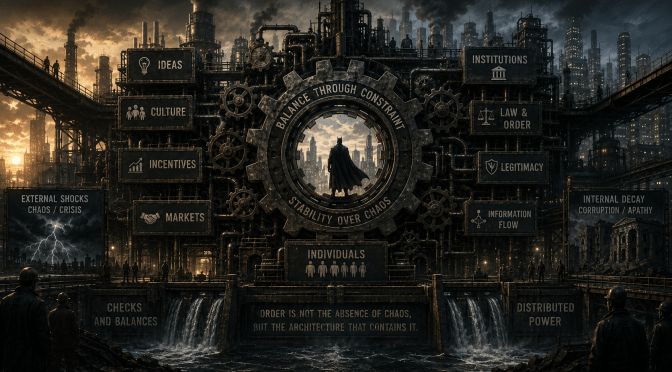
An AI generated summary of an evening conversation with ChatGPT on Chris Nolan’s Batman trilogy.
Christopher Nolan’s Dark Knight trilogy stands apart from most superhero films because it functions simultaneously as psychological drama, political allegory, and systems-level exploration of order and instability. Beneath the action and spectacle lies a deeper question: how does civilization preserve itself when confronted with corruption, chaos, fear, and institutional decay?
The trilogy’s central conflict is not simply hero versus villain. Instead, each film examines a different form of systemic instability and Batman’s role as a force attempting to restore equilibrium without becoming tyrannical himself.
At the center of this structure is Batman — not merely as a vigilante, but as a stabilizing force operating outside formal institutions while paradoxically protecting their legitimacy. Unlike traditional heroes driven primarily by revenge or personal glory, Nolan’s Batman is motivated by the need to understand and repair structural disorder. Bruce Wayne’s journey in Batman Begins is therefore less a conventional origin story and more an intellectual and psychological search for reality itself.
The death of his parents destroys Bruce’s early assumptions about justice and social order. Gotham appears corrupted at multiple levels: criminals dominate the streets, institutions are compromised, and fear shapes behavior everywhere. Instead of reacting impulsively, Bruce travels, studies criminality, and joins the League of Shadows. This phase of the film is critical because Bruce behaves less like a future superhero and more like a student attempting to understand the architecture of civilization and decay.
Ra’s al Ghul represents the trilogy’s first philosophical challenge. His worldview assumes civilizations inevitably become corrupt and therefore require periodic destruction and renewal. Gotham, in his eyes, has become irredeemable. Bruce rejects this conclusion. Importantly, he does not reject the observation that Gotham is corrupt — he rejects the solution. This distinction defines Batman’s entire philosophy throughout the trilogy. He acknowledges darkness within society but refuses to embrace destruction or absolutism as the answer.
This tension becomes even more explicit in The Dark Knight. The Joker is not primarily interested in money, political control, or territorial conquest. He is obsessed with exposing what he believes to be the true nature of humanity. According to the Joker, moral order is merely performance. Under sufficient pressure, ordinary people abandon ethics, institutions collapse, and civilization reveals itself as fragile theater.
The Joker functions almost like a philosophical stress test placed upon Gotham. The ferry scene perfectly captures this idea. By forcing civilians and prisoners into a mutual destruction dilemma, he attempts to demonstrate that human beings are fundamentally self-preserving and morally weak. Throughout the film, he repeatedly targets systems of trust: law enforcement, public morality, political leadership, and even Batman himself.
Batman’s response is not to deny the Joker’s observations. In many ways, he understands them. Gotham is corrupt. Human beings are imperfect. Fear and self-interest are real forces. Yet Batman believes civilization survives through the preservation of structure despite these flaws. His role becomes that of a stabilizer absorbing chaos before it cascades into institutional collapse.
This is why Batman’s refusal to kill is so important within Nolan’s interpretation. The no-kill rule is not merely sentimental morality; it functions as a structural boundary. If Batman allows himself to become judge, jury, and executioner, he ceases to be a guardian of the system and instead becomes sovereign power outside all restraint. His refusal to cross that line preserves the distinction between corrective intervention and authoritarian domination.
Harvey Dent’s arc further reinforces the trilogy’s concern with institutional fragility. Dent initially represents lawful reform from within the system — Gotham’s hope that legitimate institutions can still function. His eventual corruption demonstrates how even idealistic structures can fracture under sufficient psychological pressure. Batman ultimately absorbs the blame for Dent’s crimes in order to preserve Gotham’s belief in lawful institutions. Whether morally correct or not, the decision reveals Batman’s willingness to subordinate his personal reputation to broader systemic stability.
The Dark Knight Rises expands the trilogy’s focus from individual morality to institutional legitimacy itself. Bane operates at a different structural level from the Joker. The Joker attacks human nature; Bane attacks the foundations of Gotham’s political order. He exposes the hidden compromises underlying the Dent Act and weaponizes public resentment against the city’s elite structures.
Bane’s revolution is built upon delegitimization. Gotham collapses not simply because Bane is physically powerful, but because the city’s institutional confidence fractures. Courts become performative, law enforcement is neutralized, and the public narrative sustaining Gotham’s order disintegrates.
Bruce Wayne’s condition at the beginning of the film mirrors Gotham’s stagnation. In peacetime, Batman loses clarity and purpose. His return initially reflects overconfidence and attachment to an outdated understanding of the threat. Bane defeats him not merely physically but structurally. Bruce is forced to confront the limitations of his own assumptions.
The prison pit sequence symbolizes recalibration rather than simple rebirth. Bruce rediscovers fear, mortality, and purpose. He no longer fights to preserve his identity as Batman, but to restore balance to Gotham itself. This distinction matters because Nolan consistently portrays Batman not as a ruler or conqueror, but as a temporary corrective force designed to stabilize systems under extraordinary stress.
What makes the trilogy conceptually rich is that it operates simultaneously across multiple layers. At the psychological level, it explores trauma, fear, identity, and moral boundaries. At the political level, it examines institutional legitimacy, surveillance, emergency power, and corruption. At the societal level, it studies how narratives, trust, and fear shape collective behavior.
Most importantly, Nolan’s trilogy refuses simplistic conclusions. The films acknowledge that civilization is fragile, institutions are imperfect, and human beings are deeply flawed. Yet they also reject nihilism and absolutism. Batman ultimately represents disciplined constraint: a figure who understands darkness but refuses to surrender to it.
That tension — between chaos and order, truth and stability, fear and responsibility — is what gives the Dark Knight trilogy its enduring conceptual power.


You must be logged in to post a comment.