Tag Archives: Elora Singers

A 2024 Coda: kruekutt’s Highlights in Classical & Jazz

To complement Brad, Tad & Carl’s fine “Best of” selections, herewith a sampler of favorites and notable releases from the year in both classical music and jazz. As often as I drift away from both genres, I return to them on a regular basis — and it happened again to fine effect in 2024! Listening links are included in the album titles.

Highlights in Classical Music
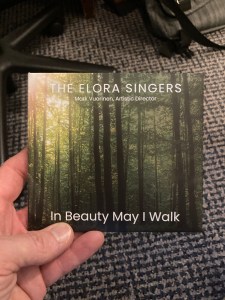
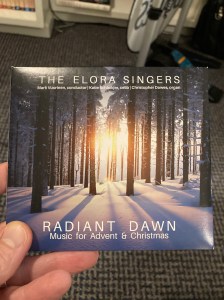
If you followed my series To the True North this past summer, you learned how impressed I was by Canada’s Elora Singers and their annual Festival. The Singers’ latest album In Beauty May I Walk was released in time for this year’s closing festival weekend; a collection of contemporary works drawing inspiration from the theme of revelation, it offers an absorbing balance of breathtaking precision and deeply felt emotion. Eriks Esenvalds “In Paradisum” and “Only in Sleep”, Jonathan Dove’s title piece and Stephanie Martin’s “A Frost Sequence” are highlights, but every composition (whether musing on nature, the search for God or time’s inevitable passage) draws in the listener and cuts to the heart. Never indulging in sentimentality, conductor Mark Vuorinen and the Singers nonetheless lay bare the human condition and affirm life’s inherent value; this is choral singing at its finest, and an official 2024 Favorite. (The Singers’ recent Christmas album Radiant Dawn is well worth hearing this time of year, too.)
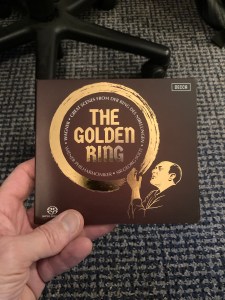
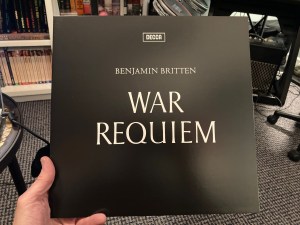
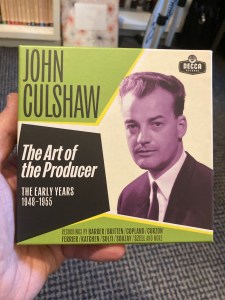
This year was the centennial of John Culshaw, who pioneered stereo recordings of opera and classical music as a producer for Decca Records in the decades following World War II. Unbeknownst to me, Decca had already completed new high-definition transfers of two Culshaw classics: the first complete set of Richard Wagner’s marathon operatic cycle The Ring of the Nibelungs (with the Vienna Philharmonic plus a bevy of postwar vocal talent, conducted by a young Georg Solti; consistently considered one of the recording industry’s greatest achievements); and the recorded premiere of Benjamin Britten’s War Requiem (the composer’s shattering anti-war masterwork, this album changed my life) — longtime Favorites which I snapped up new versions of straightaway. Now the actual centenary sees the release of John Culshaw, The Art of the Producer – The Early Years, 1948-1955. The first impression of this 12-disc set, recorded entirely in mono, is how fresh and vivid everything sounds; whether working live or in controlled conditions, Culshaw’s keen ear and finely honed production skills place you in the room with the performers. Wagner operas staged live at Bayreuth, Britten performing at his own Aldeburgh Festival and Samuel Barber conducting his music in the studio stand out, but even an underprepared Brahms German Requiem (with Solti squeezing the best he can out of overmatched forces) has its charms. Beyond sheer documentary value, this set demonstrates how essential Culshaw’s sonic discernment, organizational skills and empathetic rapport with artists was in developing the lifelike recorded sound we take for granted today.
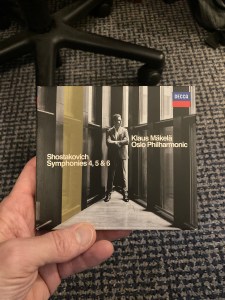
Even as it’s been swallowed up by one multinational conglomerate after another over the decades, Decca has maintained its commitment to both vivid, dynamic sound and talented artists in development. The latest case in point: the youthful Finnish conductor Klaus Mäkelä, who’s quickly made waves in the orchestral world with fully grounded yet remarkably fresh readings of 20th-century classics, from Jean Sibelius’ organically evolving symphonies to Igor Stravinsky’s kaleidoscopic early ballets. At the helm of the Oslo Philharmonic for Symphonies 4, 5 & 6 by quintessential Russian modernist Dmitri Shostakovich, Mäkelä reaches new heights: the 4th’s macabre, Mahlerian grotesquerie (suppressed for a quarter-century due to Soviet disapproval) and the 6th’s journey from ethereal beauty to dry, exhausted humor unfold relentlessly, while a less- pressurized-than-usual 5th revels in cool control that builds to an appropriately tumultuous climax, all captured for maximum impact. Recently headhunted to lead both Amsterdam’s Concertgebouw Orchestra and the Chicago Symphony (where I’ll be seeing him conduct next spring), Mäkelä is a classical superstar in the making, and this double set (definitely on the Favorites list) shows both his already prodigious skills and his rich potential.
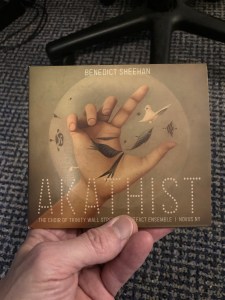
Finally, toward year’s end I stumbled across a wonderfully eclectic oratorio, Benedict Sheehan’s Akathist. Setting a lengthly Russian Orthodox prayer that literally thanks God for everything, Sheehan’s musical approach is anything but predictable: chant from both Western and Easter traditions rubs elbows with Baroque polyphony, Romantic impressionism, Gospel and jazz. And yet, the broad, inevitable arch of the piece readily encompasses the multiplicity of text and texture, gathering up protest against the wounds of the world, cameraderie as comfort amidst pain, and overwhelming gratitude for blessings great and small into a moving, integrated whole. The assembled forces of The Choir of Trinity Wall Street, Artefact Ensemble and Novus NY pull off this music with style and panache to spare. Not just a Favorite; if there’s an essential classical recording for 2024, I’d argue this is it.

(Highlights in jazz follow the jump . . .)

Continue reading A 2024 Coda: kruekutt’s Highlights in Classical & Jazz
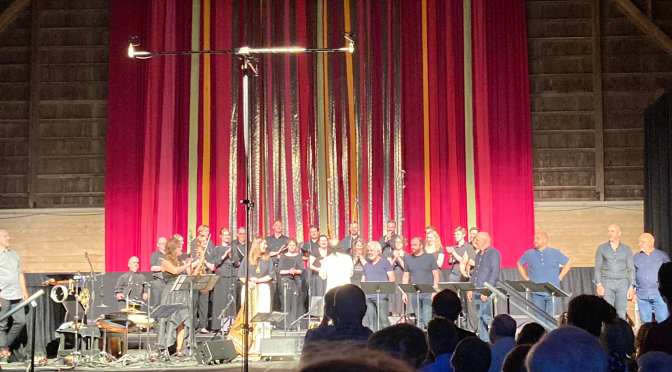
A Grand Night for Singing: The Elora Festival Closing Night Gala (To the True North, Part 4)

The Elora Singers had me at “hello” when, saluting a sell-out crowd in the town’s Gambrel Barn, they kicked off their 45th festival’s closing night gala with this:

Quick and bright yet wonderfully poignant, Gerald Finzi’s partsong has been the Singers’ unofficial theme tune since they returned to the post-pandemic concert stage. It deftly conveys their genuine delight in making music, made manifest even in the boilerplate welcome speeches of artistic director Mark Vuorinen and festival manager/alto Christine Stelmachovich. As the duo powered through the now-ubiquitous Land Acknowledgment, sponsorship recognitions, dad jokes, etc., their gratitude and glee at seeing an audience literally unable to fit inside the Barn’s walls was impossible to fake.

Then the stage was turned over to piano duo James Anagnoson & Leslie Kinton for a sweeping version of Johannes’ Brahms’ Variations on a Theme by Haydn. Kicking off with an exalted statement of the St. Anthony Chorale, Anagnoson & Kinton teased out Brahms’ imaginative shifts of tempo, texture and tonality throughout the variations, his accomplished use of counterpoint brought firmly to the fore. And when the duo built up the work’s finale (variations on a ground bass leading into a grandly restated chorale) to its tumultuous climax, they received an ovation not only well-deserved, but essential as a response to their first-rate performance.

Next came Toronto’s Elmer Iseler Singers, celebrating their 45th year as Canada’s premier professional vocal ensemble. Conducted by artistic director Lydia Adams (wonderfully gracious when we chatted briefly at intermission), the EIS exhibited their rich tone in a brief set on the lyrical theme of “rising” — bookended by seminal choral classics (James MacMillan’s O Radiant Dawn, Healey Willan’s Rise Up, My Love), investigating the compositional possibilities inherent in Hindu, Islamic and First Nations texts — and unleashing a devastatingly gorgeous, wordless take on Ukranian composer Myroslav Skoryk’s Melodia.

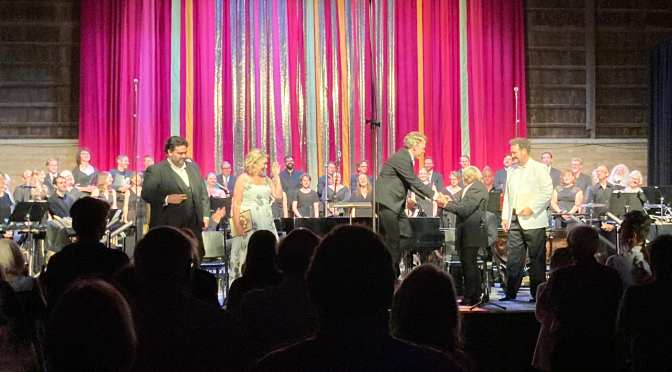
Finally, an hour of everything but the kitchen sink; how else to describe Carl Orff’s gargantuan cantata Carmina Burana, with all the previous forces plus five percussionists and three vocal soloists jammed onstage? Based on a medieval manuscript of secular poems (by disaffected monks?), Orff’s 1936 masterwork is a rhythm-dominated hour of songs about — well, sex and drink and the Middle Ages equivalent of rock’n’roll! Soprano Leslie Fagan as “the girl in the red dress”, tenor Andrew Haij in an infamously difficult cameo (as a swan roasting on a spit) and baritone Russell Braun as a variety of ne’er-do-wells played their parts to the hilt, flirting shamelessly with the front rows; the massed choir lamented the woes of Fortune (“Empress of the World”), raised way too many toasts in the tavern and egged on young lovers with a will. And even in this cut-down orchestration, the pianos and percussion slammed out one driving, kaleidoscopic groove after another. Having performed it multiple times with the Grand Rapids Symphony & Chorus, I can tell you that few classical works build up the momentum or bring the sonic spectacle this work does; with Vuorinen focusing Orff’s inventions to full intensity, the Eloras, Iselers and companions brought down the house, wild applause erupting almost before the final crescendo died away.

In short, this past Saturday proved a grand night for singing. What the Elora Festival accomplished this past weekend (and throughout the past month) is not just another set of rousing performances, but a lasting testimony to music’s ability to move, shake and thrill its creators, performers and listeners. Long may this choral festival bring the best of what’s sung and said to this beautiful village!

— Rick Krueger

Music Crossing Continents: Constantinople & A Filetta at the Elora Festival (To the True North, Part 3)

Park your car in the biggest paved lot you can find in Elora, Ontario — the one adjoining the horse racing track & casino just southwest of downtown. Then, cross the road to the municipal Gambrel Barn — transformed into an unlikely concert hall for three weekends in July.

Filing onstage: Constantinople, an instrumental quartet from Montreal that plays medieval, Renaissance and Baroque instruments from Persia, Turkey, Japan, Europe and Ireland; A Filetta, a male vocal sextet from Corsica, an island ruled by France (Napoleon came from there) where the native language developed from Italian and Greek roots; and The Elora Singers, a impeccably polished, 21-voice Canadian choir. How, you might think, is this all gonna come together?

As it turns out, the answer last night was: in an exceptionally intense, immersive way. Introducing the program Clair-obscur, Constantinople’s music director Kiya Tabassin noted its title and content came into being just before 2020’s worldwide pandemic. After its first performances, in Tabassin’s words, its purpose became “to bring light (clair) to darkness (obscur)“. And over the next 90 minutes, the assembled forces proceeded to do just that, crossing a continent to meld the sounds of disparate times and places into a satisfying whole.

The music, mainly assembled by Tabassin and A Filetta’s leader Jean-Claude Acquaviva, proved thoroughly cosmopolitan and eclectic. The sextet’s singing was the obvious heart of the evening; their sturdy blend of dominant bass drones, fleet interweaving lines stacking up into glancing consonances and luxuriant melodic melismas were consistently riveting, whether voices were raised in a show of strength or hushed in breathtaking tenderness. Tabassin’s 3-stringed setar and Didem Basar’s kanun (a 78-stringed Turkish zither) danced lithely around and about the rugged vocal base, with forthright support from Tanya LaPerriere’s Baroque violin & viola and supple grounding in Patrick Graham’s ten-fingered, two-footed percussion; each player had their evocative solo moment and earned delighted applause from the crowd.

Atop this entrancing musical scaffold, the sung texts unfurled a dizzying collage of Senecan drama, Renaissance epic, Near Eastern poetry from Rumi and Hafez, traditional ponderings on the passion of Christ and Primo Levi’s meditation on the memory of the Holocaust. Here was history stripped of its timeline, collapsed into its component catastrophes and passions — pride, devotion, horror, absurdity, yearning for calm and deliverance – compounded into the moment’s expression and emotions. And when Tabassin raised his reedy voice to cavort over A Filletta’s firm foundations or the Elora Singers enriched the soundscape with supportive reinforcement and embellishments, the chamber effect broadened out to opulent symphonic proportions.

Clair-obscur (the nearest English equivalent would be chiaroscuro, the play of light and shadow in the art of painting) proved a unique mix of folk music and high art, calmly unhurried vocal prowess and upbeat improvisation, a journey through the heart of human life to a resting place of connection, catharsis and celebration. You can check out a sample of this program for yourself below (the complete concert, without The Elora Singers, can be found here):

— Rick Krueger