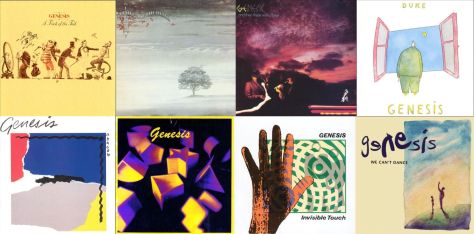
Tag Archives: Genesis

Can a Progger Be Christian?

For what it’s worth, I’ve been traveling since last Wednesday.  I went from Michigan to Colorado, Colorado to Kansas, and now, I’m enroute back to Michigan.  My soundtrack has been prog, prog, and then a bit more prog.

Version 1.0.0

A few days ago, the mighty Tad Wert and I reviewed Steven Wilson’s new album, The Overview.  Though we questioned a few things about Wilson, we loved the album.  During his review, however, Tad brought up the majesty of the universe as described in the Psalms.

Today, this was posted on Facebook: “An interesting review of Steven Wilson’s latest album, which I’ve added here as Andie/The Tangent get name-checked. Quite an enjoyable read, despite the reviewer’s annoying habit of adding somewhat superfluous (and potentially divisive) references to The Goat Herder’s Guide to the Galaxy.”

Being in the car for hours on end, I turned this comment over in my mind.  Now, it’s worth noting, our website (the one you’re currently reading) is named after the Catholic patron saint of music, St. Cecilia.  Of the five main editors of Spirit of Cecilia, three are practicing Catholics, one is a Methodist who leans toward Eastern Orthodoxy, and one is a skeptic.  Frankly, I’m amazed at how restrained we are when it comes to the issue of religion.

Still, after reading the Facebook comment today, I had to ask: can a Progger be a Christian?  For some, the immediate answer is to turn to Neal Morse or Glass Hammer.  But, frankly, both artists are so open about their faith that each might appear to be the exception that proves the rule.

So, for the sake of a good argument, I offer all praise to Morse and to Glass Hammer, but I’m going to leave them out of the discussion.

Then, I gave it a bit more thought, and I realized that the Christian religion is deeply embedded in much (certainly not all) of the progressive rock tradition.  So, I chose my songs from several different eras of prog.

Yes, Close to the Edge:

“My eyes convinced, eclipsed with the younger moon attained with love
It changed as almost strained amidst clear manna from above
I crucified my hate and held the word within my hand
There’s you, the time, the logic, or the reasons we don’t understand”

Clearly referencing the Gospel of St. John.

Genesis, Supper’s Ready:

“There’s an angel standing in the sun
And he’s crying with a loud voice
“This is the supper of the mighty one”
Lord of Lords, King of Kings
Has returned to lead his children home
To take them to the new Jerusalem”

Clearly referencing St. John’s Revelation.

Talk Talk, New Grass:

“Lifted up
Reflective in returning love, you sing
Errant days filled me
Fed me illusion’s gate in temperate stream
Welled up within me
A hunger uncurbed by nature’s calling
Seven sacraments to song
Versеd in Christ, should strength desert me
They’ll come, they come”

Again, a clear reference to the New Testament and, specifically, a liturgical understanding of Christianity.

Roine Stolt, Humanizzimo

“With the blood of Jesus on the nail
We turn the balance on a scale
In pain and fearless suffering
Lies a message from the King of Kings”

Again, a clear reference to the passion of Christ.

The Tangent, Le Sacre du Travail:

“And all the blue plaques in all the buildings
Say they’re “Investors in Our Souls”
But I don’t believe them, not ’til I see it
Until I put my finger in the holes

Yet again, a clear reference to Doubting Thomas.

Big Big Train, The Wide Open Sea:

“Lying ahull
Ride out this storm
Doused all the sails
I let the boat drift

And so upon this tumbling sea
Fathoms below
Heavens above me

I’m setting sail for Les Marquises
From cradle bound for Calvary”

I could be wrong, but this very much reminds me of Jesus calming the waters.

Every one of these songs requires some biblical literacy.  Were Yes, Genesis, Talk Talk, Roine Stolt, Andy Tillison, and Big Big Train divisive?  Without a doubt. Was Tad being divisive? I certainly doubt that was his intention.

So, back to the main question. Can a progger be a Christian?  It seems so.

Dave Kerzner’s New Lamb/IT

I’ve been into music—mostly progressive rock and jazz—for as long as I can remember.  As I’ve mentioned before, my first love was YESSONGS—owned by two older brothers.  I loved everything about it—the music, the lyrics, the art.  It also just seemed like a super science-fiction project to my very young mind.  I would’ve been six when YESSONGS came out.

After Yes, my second loves were Kansas and then Genesis.  I encountered Kansas in 1975, sometime around age 8.  In fact, living in Kansas, there was no escaping Kansas.  Americans don’t often realize it, but Kansans are as proud of being Kansans and their fellow Kansans as Texans are about being Texan; they’re just not loud about it.  So, yes, we lived and breathed LEFTOVERTURE and POINT OF NO RETURN.

Genesis, though, didn’t come to me until about 1978, me aged 10, when I fell in love with “Follow You, Follow Me” and purchased AND THEN THERE WERE THREE.  That was one of the first albums I ever bought.  Followed by DUKE, by ABACAB, by GENESIS.  From there, worked backward to TRICK OF THE TALE and WIND AND WUTHERING and, especially, SECONDS OUT.  I loved SECONDS OUT.  I even had video recorded—through the USA Network—a concert from the SECONDS OUT period with Bill Bruford on drums.

I also really liked Peter Gabriel—especially SECURITY—but for some reason I was reluctant to take a deep dive into Gabriel-era Genesis.  Honestly, I have no idea why, except that I so admired the Phil Collins period—especially TRICK and WIND.  

I love the Peter Gabrel era of Genesis so much now, however, that I can barely remember a time when I didn’t love them.  

So, right before I went to college (fall of 1986), I bought LAMB LIES DOWN ON BROADWAY.  To state that my mind was boggled, would be an understatement.  I knew “Carpet Crawlers” of course, but to listen to it in context truly floored me.  At the time (remember, I was 18), I thought Lamb was either the greatest statement of prog ever written or a statement of chaos and madness.  Either way, I wasn’t surprised that Gabriel chose to leave after making the album.  Clearly, the album means something profound and deep in the history of prog.

It’s a strange album lyrically, as a young Puerto Rican male wants to escape from the corporate conformity imposed at every level of his life.  Ah, you “progressive hypocrites.”

When Kevin McCormick—one of my all-time closest friends, a professional classical guitarist, a key contributor to this website—and I first talked Genesis (this would’ve been the fall of 1986), I expressed my love of Lamb, and he thought I was crazy.  Only a true Genesis weirdo would like LAMB, just as only a true Yes weirdo would like TALES FROM TOPOGRAPHIC OCEANS.  It was a funny conversation.  Kevin, it should be noted, was the first friend I had who could talk music as much as I could.  A high school friend, Joel, came close, but Joel was mostly into college rock and alternative music, not rock or prog.  So, his opinion (or, given LAMB, his anti-opinion) really meant a great deal to me.  Still, I continued to love LAMB as an act of mad genius.

Jump forward fifty years. . . and the mighty and awesome Dave Kerzner has recreated and recorded a brand new version of LAMB simply called IT.  If you don’t know the work of Kerzner, you really should.  He’s the great touchstone or fountainhead of our era’s (third wave or beyond) progressive rock.  From Sound of Contact, through his solo work (NEW WORLD DELUXE and STATIC), through his work with In Continuum, Kerzner is a genius.  He knows how to write the best lyrics, and he also knows how to write the best hooks.  But, there’s one thing about Kerzner that often doesn’t get recognized.  He’s a perfectionist, an audiophile at the level of Steven Wilson.  Don’t get me wrong, Steven Wilson has one of the best ears out there.  But, Kerzner’s is equally good.  

He just gets sound.

As far as I knew there’s nothing that Kerzner has released that I don’t proudly own.  So, when I heard he was remaking LAMB, I was absolutely thrilled.  And, there’s nothing about Kerzner’s version that doesn’t satisfy me.  From his production to its use of real strings, it’s a glorious masterpiece, so very worthy of its now-fifty-year old original.  Kerzner is exactly a year younger than me, and while I don’t know him, I wouldn’t be shocked if he and I encountered the album in much the same way.

In every way, Kerzner has done justice to LAMB.  For 1975, it was immaculately produced, but that simply can’t compare to the immaculate production of 2025.  IT—Kerzner’s version—replicates the entire album, again always advancing the production, especially with live orchestration.  Additionally, Kerzner offers a third disc with alternative versions of the classic tracks.

Even the band of IT is an all-star cast of current prog royalty: Kerzner, Francis Dunnery, Nick D’Virgilio, Fernando Perdomo, Billy Sherwood, and special guests.

Spirit of Cecilia readers, it just doesn’t get better than this.  Whether it’s genius or madness, who can say?  Except to note, there’s always a bit of madness in all genius, and a bit of genius in all madness.  LAMB/IT is smack-dab in the center.  Since Kerzner first sent me the tracks via Bandcamp, I’ve been listening obsessively.  That obsession—part madness and part genius—will continue for sometime, especially as we approach the end of the semester and with finals starting to loom larger. . . .

To order IT, please click here.

Steve Hackett: Supper’s Ready (Genesis)

Walking across the sitting-room, I turn the television off
Sitting beside you, I look into your eyes
As the sound of motorcars fades in the night time
I swear I saw your face change, it didn’t seem quite right
And it’s hello babe, with your guardian eyes so blue 
Hey my baby, don’t you know our love is true

Coming closer with our eyes, a distance falls around our bodies
Out in the garden, the moon seems very bright
Six saintly shrouded men move across the lawn slowly
The seventh walks in front with a cross held high in hand
And it’s hey babe your supper’s waiting for you
Hey my baby, don’t you know our love is true?

I’ve been so far from here
Far from your warm arms
It’s good to feel you again
It’s been a long long time
Hasn’t it? 

I know a farmer who looks after the farm
With water clear, he cares for all his harvest
I know a fireman who looks after the fire

You, can’t you see he’s fooled you all
Yes, he’s here again
Can’t you see he’s fooled you all?
Share his peace, sign the lease
He’s a supersonic scientist
He’s the guaranteed eternal sanctuary man
Look, look into my mouth he cries
And all the children lost down many paths
I bet my life you’ll walk inside 
Hand in hand
Gland in gland 
With a spoonful of miracle
He’s the guaranteed eternal sanctuary
We will rock you, rock you little snake
We will keep you snug and warm

Wearing feelings on our faces while our faces took a rest
We walked across the fields to see the children of the West
But we saw a host of dark skinned warriors standing still below the ground

Waiting for battle

The fight’s begun, they’ve been released
Killing foe for peace, bang, bang, bang
Bang, bang, bang
And they’ve given me a wonderful potion
‘Cause I cannot contain my emotion
And even though I’m feeling good
Something tells me I’d better activate my prayer capsule

Today’s a day to celebrate, the foe have met their fate
The order for rejoicing and dancing has come from our warlord

Wandering in the chaos the battle has left
We climb up the mountain of human flesh
To a plateau of green grass, and green trees full of life
A young figure sits still by a pool
He’s been stamped “Human Bacon” by some butchery tool
He is you

Social Security took care of this lad
We watch in reverence, as Narcissus is turned to a flower
A flower? 

If you go down to Willow Farm
To look for butterflies, flutterbyes, gutterflies
Open your eyes, it’s full of surprise
Everyone lies like the fox on the rocks
And the musical box
Oh, there’s Mum and Dad, and good and bad
And everyone’s happy to be here

There’s Winston Churchill dressed in drag
He used to be a British flag, plastic bag, what a drag
The frog was a prince
The prince was a brick, the brick was an egg, the egg was a bird 
(Fly away you sweet little thing, they’re hard on your tail) 
Hadn’t you heard? (they’re going to change you into a human being!) 
Yes, we’re happy as fish and gorgeous as geese
And wonderfully clean in the morning

We’ve got everything, we’re growing everything
We’ve got some in, we’ve got some out 
We’ve got some wild things floating about 
Everyone, we’re changing everyone
You name them all, we’ve had them here
And the real stars are still to appear
(All change!) 

Feel your body melt
Mum to mud to mad to dad 
Dad diddley office, Dad diddley office
You’re all full of ball
Dad to dam to dumb to mum 
Mum diddley washing, Mum diddley washing
You’re all full of ball

Let me hear your lies, we’re living this up to the eyes
Ooh, aah, na-na-na 
Momma I want you now

And as you listen to my voice
To look for hidden doors, tidy floors, more applause
You’ve been here all the time
Like it or not, like what you got
You’re under the soil (the soil, the soil)
Yes, deep in the soil (the soil, the soil, the soil!)
So we’ll end with a whistle and end with a bang 
And all of us fit in our places

With the guards of Magog, swarming around
The Pied Piper takes his children underground
Dragons coming out of the sea
Shimmering silver head of wisdom looking at me
He brings down the fire from the skies
You can tell he’s doing well by the look in human eyes
Better not compromise, it won’t be easy

666 is no longer alone
He’s getting out the marrow in your backbone
And the seven trumpets blowing sweet rock and roll
Gonna blow right down inside your soul
Pythagoras with the looking glass reflects the full moon
In blood, he’s writing the lyrics of a brand-new tune

And it’s hey babe, with your guardian eyes so blue
Hey my baby, don’t you know our love is true?
I’ve been so far from here, far from your loving arms
Now I’m back again
And babe, it’s gonna work out fine

Can’t you feel our souls ignite?
Shedding ever-changing colours
In the darkness of the fading night
Like the river joins the ocean
As the germ in a seed grows 
We have finally been freed to get back home

There’s an angel standing in the sun
And he’s crying with a loud voice
“This is the supper of the mighty one”
Lord of Lords, King of Kings
Has returned to lead his children home
To take them to the new Jerusalem

Source: LyricFind

Songwriters: Mike Rutherford / Peter Gabriel / Phil Collins / Steve Hackett / Tony Banks

Supper’s Ready lyrics © BMG Rights Management, Carlin America Inc

Steve Hackett’s Golden Anniversary Celebration

Hackett

Brad Birzer and Tad Wert are having a listen to Steve Hackett’s new live set, Foxtrot at 50. Here are their reactions to this latest offering from one of the most important artists in the world of prog.

Tad: Ok, Brad, you are the one who wanted to discuss this album. I had not heard it before you shared it with me, and I am really impressed. For a guy in his 70s, Mr. Hackett can really cook on the guitar! He has assembled a crack band for this tour, and I love the format: a mix of solo and Genesis tunes on the first disc, followed by a complete performance of Genesis’s classic album, Foxtrot.

I think it’s terrific how Hackett has come into his own the past few years. While Genesis seems to have effectively retired from the music scene, and Peter Gabriel releases an album once a decade or so, Steve Hackett has built a thriving career on his solo albums as well as offering contemporary takes on classic Genesis cuts.

Brad: Dear, dear Tad.  So glad to have this conversation with you, my friend.  A few years ago–back when we were with Progarchy–I had the chance to interview Steve Hackett.  Somehow, I’d messed up the time (yes, me being a humanities guy, big surprise!), and I was an hour off.  It didn’t matter.  I think I had messed up Hackett’s dinner time, and he was still a total gentleman with me.  I had already loved the guy, but this made me love him even more.  So very gracious.

Over the past 11 years, Hackett has done a brilliant job of re-imagining Genesis, 1970-1977.  In 2012, he released Genesis Revisited II, including contributions from Steven Wilson and Neal Morse.  I think this was an album that helped define a moment in progressive rock history–a recreation of prog wave 1 into prog wave 3.  Since then, Hackett has continued to make his own music, but he does so by reforming the past rather than revolutionizing it.  In other words, Hacket holds the distinction of being a man of piety–one of the three most important virtues for the republicans of Rome.

Genesis Revisited II is a gorgeous album.  

Revisited II

Since then, he’s been releasing live albums with his band.  In each live album, he has excellently mixed his own original and new genius music with that of the music of Genesis.  Honestly, it feels like he never left Genesis (Peter Gabriel-era and immediately post-Peter Gabriel era).  Instead, his music–especially the newer material–feels like an incredible extension of what Genesis did so gloriously in the early to mid-1970s.  Again, as noted above, there’s that brilliant level of piety, a virtue I hold in highest esteem.

I’m proud to proclaim Hackett’s music as simply the best of past and current prog!

As the latest album indicates, Hackett and his superb live band had decided to celebrate Foxtrot, now a little bit over the half-century mark in age.  As such, the band plays, live, Watcher of the Skies, Time Table, Get ‘Em Out by Friday, Can Utility and the Coastliners, Horizons, and Supper’s Ready.


While all six songs are extraordinary, it’s the deftness of the last three that really make one long prog track, a contrived track worthy of celebration.  Even thematically, these last three songs go together, looking at and examining the sycophancy surrounding King Canute to the Apocalypse and the second coming of Our Lord, Jesus Christ (the “eternal Sanctuary man”!).

I’ve often joked that I want Big Big Train to play Supper’s Ready at my funeral.  However, hearing Hackett’s live version, I might want his band.  Or, better yet, maybe Big Big Train and Steve Hackett’s live band playing at my funeral.  I’d also like Supper’s Ready to be a forty-minute version (complete with Spawton’s brass band) rather than the typical 28-plus minute version.

And, for what it’s worth, Tad, I absolutely love to bake bread.  One of my favorite things in the world.  What does this have to do with Genesis?  Here’s my explanation.  Foxtrot is my go-to album when I’m baking.  It’s exactly the right length of time and has the right cadences to not only mix the bread but to knead it and set it into the oven, allowing it to rise.  So, no album has more permeated my kitchen than Foxtrot.  I assume my kids associate it with the smell of yeast and beer (to raise the bread properly).

Tad: Brad, what a wonderful application of Foxtrot! I agree that Hackett does not merely recreate the old masterpieces of Genesis’s heyday, but he reforms them, updates them, and puts his personal stamp on them. I see that Nad Sylvan is the vocalist. He sounds terrific – he has a bit of Peter Gabriel’s rasp, but he also makes these familiar songs new and interesting.

For a live album, I am really impressed with how good the sound is overall. There is some venue ambience, but the instruments and vocals are all clean and well-defined. The audience is obviously attentive, appreciative, and respectful. The “Watcher of the Skies” on this album is really stunning, and then comes “Time Table”, which is even better!

Finally, I love having such an excellent performance of “Supper’s Ready” that was recorded with the most up-to-date technology.

Brad: Yeah, Tad, I’m not exactly sure how Hackett does it, but he does have the uncanny ability of melding his own music–whether from the 1970s or from his most recent album–with that of early Genesis.  Maybe his sound from Genesis was so unique in its contributions, but he simply continues to contribute to that sound. . . which NEVER sounds dated.  In fact, if there’s one thing that can be stated with absolute certainty is that Hackett is always and everywhere a class act.  A true gentleman in prog world.

I would like to note here that I think his original tracks, Ace of Wands, Tower Struck Down, and, especially Shadow of the Hierophant sound not just as good as Genesis, but sound as if they could’ve come from Gabriel-era Genesis itself.

I especially love Shadow of the Hierophant, a classic progressive rock track.

You mentioned Nad Sylvan as the perfect singer for Hackett’s latest incarnation, and I couldn’t agree more.  On Shadow, he has Amanda Lehmann sing, and she has a gorgeous voice.  While this isn’t from Foxtrot at Fifty, it does capture perfectly the power of the song live:

Lehmann, drummer Gary O’Toole, and bass pedalist Nick Beggs especially make this version come alive.


Tad: Well, Brad, I think we can both agree that Mr. Hackett is enjoying a well-deserved career renaissance! I really appreciate the fact that he is nurturing so many younger musicians on his tours. There are very few people whose career has spanned so many years and remain vital, creative artists. May Steve Hackett have many, many more years to delight us!


Waxing Nostalgic Over Genesis

The Spirit of Cecilia dialogues continue; this one is focused on the Phil Collins-era of the massively popular music group, Genesis. Editor-In-Chief Brad Birzer and Arts Editor Tad Wert exchange thoughts and memories that were inspired by Birzer’s recent appearance on Political Beats.

Brad: Tad, I find it hard to believe that the last Phil Collins-Genesis album came out 29 years ago.  Thanks, by the way, for your comments regarding the show, Political Beats, that I did with Jeff and Scot.  I had an absolute blast talking with those guys about the Phil Collins-era of Genesis, 1976-1991.  I’m curious–in 2020–what you think of Genesis?  That is, what role do they play in the history of music, and, especially, in the history of progressive rock?

I just–as I was working on sociologist Robert Nisbet–watched and listened to Genesis, live in 1976, for the Trick of the Tail tour, with Bill Bruford on drums, and I was struck, yet again, by the beauty of the music and the vitality of the band. In some ways, they might’ve defined progressive rock.  That is, they might’ve been the quintessential prog band.

I also listened to Duke, which (aside from “Misunderstanding,” a song I despise) might also be one of those perfect (well, nearly) albums.  Thoughts?

Tad: I LOVE Genesis, in all of its incarnations. I consider their career to encompass three distinct groups or eras: the Gabriel years, the Hackett years, and the Collins years. If I consider each era on its own merits, there are many wonderful moments to enjoy in each one.

A small Genesis-related vignette: when I was 13 years old, my family spent a semester in Cambridge, England. My father had taken a sabbatical to do engineering research at the University there. I remember listening to Radio Caroline on a small transistor radio as I worked on my homework in the evening, and Selling England By The Pound was on heavy rotation on that pirate station. Even coming through the small, tinny speaker, I was struck by the exceptional music that flowed forth, and I was hooked.

When I was old enough to afford buying my own lps, A Trick of the Tail was one of the first I bought with my own money. I didn’t realize at the time that the vocalist on ATOTT was not the same as the one on SEBTP! “Dance On A Volcano” was one of the most challenging pieces of music my 14-year-old self ever encountered, but I loved it.

When Wind and Wuthering was released, I confess I wasn’t interested, because I was in my punk/New Wave phase (Ramones, Wire, and Elvis Costello!), and I had no time for prog rock “dinosaurs”. But then I heard “Turn It On Again” from Duke, and I thought, “This is something I can get into.” I bought the album and fell in love with the Phil Collins pop/rock juggernaut version of Genesis. 

So, to answer your question, yes, I think Genesis, unlike some other “big” groups of the ‘70s and ‘80s, will only grow in stature over time. Their curse in the ‘80s was to get so popular that they oversaturated the airwaves. Now that 29(!) years have elapsed, we have some space to objectively assess the quality of their music, and there are very few groups who consistently produced such challenging yet entertaining music.

What I found fascinating in your podcast conversation was the acknowledgement that the so-called “pop” releases in the ‘80s still contained some very sophisticated music.

Brad: Tad, I think our age difference is slight.  Abacab is the first album I bought from Genesis at the time of its initial release.  Then, I went back through the Phil Collins era, falling in love with And Then There Were Three especially. I can still remember listening to the tape I bought from Peaches in Kansas City and watching Bill Buckley (I’d never seen him before) on TV—Genesis and Buckley all in the same evening.

But, for me, 1981 was the year of Abacab and Moving Pictures.  They almost seemed to be two parts of a whole to my then young mind.  In 1982, I purchased Three Sides Live and, then, Duke.  I really liked Phil Collin’s first solo album as well. Indeed, I became as obsessed with Genesis as I was with Rush that year—beginning a life-long obsession with both. Soon, I had Trick of the Tail and Wind and Wuthering as well.  My debate colleague and one of my closest friends, Ron Strayer, and I used to listen to Genesis, over and over again, analyzing the lyrics and trying to figure out the song structures. We had every part of Genesis (1983) memorized, and we would shout out the lyrics as we drove around town in his yellow Toyota truck.

I have other odd memories as well—such as a video recording of Genesis in Concert, 1976, with Bill Buford as the drummer (mentioned above).  It appeared on USA network’s Nightflight, and I watched that so many times, the VHS tape began to fade.  I also had audio recordings of a few concerts that our local AOR station, Wichita’s KICT-95, often aired.  One of my prized possessions (which, stupidly, I sold) was the last release with Steve Hackett, an EP called Spot the Pidgeon.  

Funny what things stick in the mind.

I also remember the day Invisible Touch came out.  I had just received my college entrance letter (a huge thrill), and, for some reason, my high school girlfriend was put out with me because I wanted our date that night to be a serious listen of the new album!  She didn’t think that the highest form of a date, but I wanted to share that first listen with her.  Needless to write, she went home in a huff, somewhat disgusted by my priorities.

But, Tad, I’m not being very helpful in our discussion, just nostalgic. So, let me state—there was a reason Genesis meant so much to me. I loved both the seriousness and the playfulness of the band, and I often read things into the lyrics that might or might not have been there.  As a kid, I especially thought Abacab was full of hidden meanings, such as the title track being about someone committing adultery, or that the “Man on the Corner” was some kind of unrecognized prophet, or that Sarah Jane must be the kindest woman in the world. 

Ok, I’m still being nostalgic. . .

As to your question and comment regarding Genesis and pop.  I do think that once Steve Hackett left the band, the band became much more art rock rather than progressive rock.  After all, songs like “Lurker” and “Dodo” and, especially, “Mama,” should never have been hits!  They’re not pop, but they’re not prog, either.

Tad: Abacab is a very special album to me as well. I think the title track is one of the top songs they ever recorded. I also love “Man On The Corner”; it’s one of Collins’ finest vocal performances. When it was released, one of my college suitemates bought it in great anticipation. He was a big prog fan – listened to King Crimson, UK, Yes, and other British prog groups. When the Earth, Wind, and Fire horns came blasting out of his stereo on “No Reply At All”, he jumped up and yelled, “WTF is this?” and wouldn’t listen to another song. That’s how I acquired my copy of Abacab!

I also liked the tracks on the fourth side of American version of Three Sides Live. When I replaced my vinyl of that album with the CD, I was disappointed that they weren’t included. I loved “Paperlate”, “Evidence of Autumn”, and “Me and Virgil”. As a matter of fact, the only reason I bought the three-disc Platinum compilation was to have “Paperlate” on CD. I gave up ever finding a CD edition of the American album, when, lo and behold, a couple of months ago I found it in my favorite used record store!

It’s almost impossible for me to choose which album I think is better: Genesis or Invisible Touch. It depends on what mood I’m in, but I would probably give the nod to Invisible Touch. I think it more consistently excellent, even if songs like “Tonight, Tonight” are extremely dark. Genesis’ “Mama” has to be the most unlikely #1 hit ever released!

Here’s how I would rank the post-Gabriel era: 

  • A Trick of the Tail
  • Abacab
  • Invisible Touch
  • Genesis
  • Duke
  • Wind and Wuthering
  • And Then There Were Three
  • Calling All Stations
  • We Can’t Dance

The live albums I put in this order:

  • Three Sides Live
  • Seconds Out
  • The Way We Walk
  • Live Over Europe 2007

I also think the box set, Archives Volume 2 is essential.

I imagine you are outraged at my low ranking of And Then There Were Three, but I have had a hard time getting past the muddy production, and I’ve never been able to maintain interest through the whole set.

Brad: Tad, I’m not outraged in the least!  And, I’m in agreement with you about the rankings of the live albums, though I might switch one and two, depending on what day it is.

As to the studio albums, I would put them in this order:

  • A Trick of the Tail
  • Duke
  • Wind and Wuthering
  • Abacab
  • Genesis
  • And Then There Were Three
  • Invisible Touch
  • We Can’t Dance
  • Calling All Stations

We can definitely agree, Tad, that there’s a lot of aural excellence to be enjoyed!!

Tad: I could definitely move Duke up a few spots. Like you said, it depends on what day it is!

Regardless of how we rank these albums internally, I think it’s fair to say almost no other artist in rock has produced such consistently excellent music. I put And Then There Were Three relatively low among Genesis albums, but compared to other albums released in 1978, it is near the top. To my mind, only the Beatles show the same extraordinary quality control that Genesis had, and they were active for less than a decade. Genesis stuck together for more than 28 years! 

For our next dialogue, I think we owe it to Peter Gabriel to cover his solo career. Are you up for that, my friend?

Brad Birzer Talks Genesis

Beats

Our Founder and Editor-In-Chief, Bradley Birzer, is the guest on the latest episode of Political Beats. No, it’s not a podcast about politics, but rather political writers and pundits talking about music. And in this episode, boy, do they talk! Three and a half hours’ worth of conversation regarding the Phil Collins years of Genesis! You can find it on Apple Podcasts, Stitcher, and other podcasting platforms. Or, you can listen to it online by clicking here.

Forthcoming: Genesis 1967-1975, The Peter Gabriel Years

[Our friend and ally, Greg Spawton, has begun a book publishing firm, Kingmaker, and has announced the first book, Genesis, 1967-1975: The Peter Gabriel Years. Here’s the announcement, with the pre-order link at the bottom–}

Two of the almost constant elements of my life have been music and books. On the music side of things I am a member of Big Big Train, but involvement in book publishing remained an unfulfilled dream. However, last year I formed a company with journalist Nick Shilton which has a goal of publishing high-quality books about music. Our first book is now available for pre-order from our official store Burning Shed. The book has been written by Italian author and journalist Mario Giammetti and is called Genesis 1967 to 1975: The Peter Gabriel Years. 

I have read of lot of books about rock bands and music in general and I have to say that this volume is an absolute gem. It tells the story of the early years of one of progressive rock’s most important bands. It is full of original interviews with band members and associates which have never before been published in English. There are photographs and insights in the book that cannot be found anywhere else. Most importantly, while the Genesis story is an interesting one full of personalities, the focus throughout the book remains on the most important thing of all: the music. 

I would like to thank Mario for trusting us with his wonderful words. I would like to thank Octavia Brown who translated the book into English from the original Italian and has put her heart and soul into this project. I would like to thank Geoff Parks who proof-read the book with his customary eye for detail. Finally, I would like to thank Nick for being a most excellent publishing partner. 

–Greg Spawton (of Kingmaker and Big Big Train)

If you would like to pre-order the book (a highly recommended course of action!) the Burning Shed link is here:

https://burningshed.com/store/kingmaker/mario-giammetti_genesis-1967-to-1975_book?fbclid=IwAR2O8m6y4InDxAsAsCxnY0qttnyKFohRekyNyZWxRXV_Zl4hJ43gUGDkHaU

Ad Fontes

From Lutheran Service Book’s Daily Lectionary for November 22:

Then I heard what seemed to be the voice of a great multitude, like the roar of many waters and like the sound of mighty peals of thunder, crying out,

“Hallelujah!
For the Lord our God
the Almighty reigns.” (Revelation 19:6)

Or, to put it another way (especially if you’re George Frederic Handel (and his librettist Charles Jennens):

But wait, there’s more …

Then I saw an angel standing in the sun, and with a loud voice he called to all the birds that fly directly overhead, “Come, gather for the great supper of God, to eat the flesh of kings, the flesh of captains, the flesh of mighty men, the flesh of horses and their riders, and the flesh of all men, both free and slave, both small and great.” (Revelation 19:17-18)

Or, to put it another way, if you’re Genesis with Peter Gabriel:

https://www.youtube.com/watch?v=HhRYRNuyGVI


— Rick Krueger