

The Chicago Symphony Orchestra, Friday, May 2, 2025.
It had been more than 15 years since I had heard the Chicago Symphony Orchestra live – and nearly 25 since I had heard them on their home ground, Orchestra Hall in Symphony Center. So last year, when the CSO announced that young conducting phenomenon Klaus Mäkelä (referenced in my highlights of 2024 post) had accepted the post of Music Director Designate, I decided that a renewed acquaintance with one of the USA’s top orchestras was long overdue.
Orchestra Hall, dating all the way back to 1904, is a unique venue in and of itself: its wide but thin stage and steeply raked balconies make for a intimate (if not always comfortable) concert experience. Renovations in the 1990s added gallery seats above and behind the stage, as well as a suspended shell to soften and deepen a challenging acoustic. So it wasn’t hard to imagine the musicians feeling like they were in a fishbowl as they clambered atop multilevel risers in front of a full house.

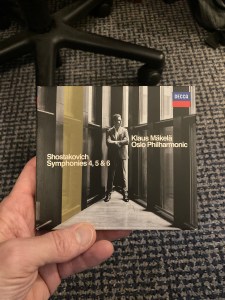
But beyond the typical pre-concert buzz, there was a question in the air. By and large, Mäkelä has made his reputation in post-Romantic and 20th-century music — well-regarded recordings of Sibelius and Stravinsky, Chicago guest shots focused on big pieces by Shostakovich and Mahler. Would his take on the core classical repertoire — works the CSO has performed since its start in the 1890s, conducted by everyone from founding conductor Theodore Thomas to previous Music Director Riccardo Muti — measure up?
That question was answered in a flash, as Mäkelä and CSO Artist in Residence Daniil Trifonov whipped up a fresh, appealing reading of Johannes Brahms’ Piano Concerto No. 2. None of the overbearing, ponderous sludge that unimaginative historians accuse Brahms of here! Trifonov’s playing was always flowing, supple and strong, with no hints of pounding or cloudy tone; CSO principals Mark Almond (horn) and John Sharp (cello) made the most of their lyrical solo moments with warm tone and deep expressiveness; and the orchestra sounded lithe and limber in the extended opening, energetically playful in Brahms’ scherzo, chastely gorgeous in a delectable Andante, and delightfully bouncy in the closing Allegretto. All the while, Mäkelä was sculpting the overall sound, focusing balances, dynamics and timing for maximum emotional impact. The scattered spontaneous applause after every movement (the grinning conductor and pianist had to restrain themselves before pouncing on the finale) was proof that the music hit home, even before the final ovation and the outsized reaction to Trifonov’s encore (a Chopin prelude lasting less than a minute).
After intermission came a centennial tribute to the CSO’s late Principal Guest Conductor Pierre Boulez (who conducted the orchestra the last time I’d heard them — a dark, lush program of Ravel and Bartok in Ann Arbor, back in 2010). Well executed by brass septet and precisely conducted by Mäkelä, Boulez’s Initiale lived up to its billing — a tart, postmodern appetizer announcing itself pointedly, quickly tying itself into contrapuntal knots, then breaking loose for a final flourish. Complete with a tuba mute (which always makes me smile)!
But it was the last work on the program, Antonin Dvořák’s Symphony No. 7, that really showed what Mäkelä and the CSO can accomplish together. The orchestra’s tone was at its richest, its dynamic range wider and its rhythmic flow freer than in the Brahms. Mäkelä threw himself into the piece with greater animation and more sweeping body language — but also with a greater willingness to let the players take the reins, dropping his beat to focus on accents and phrasing for surprisingly long stretches. The powerful resonance of Dvořák’s opening themes and their punchy development, the breadth of feeling in his Andante, the infectious swing of the Scherzo’s cross-rhythms, and the hard-won, dramatic climax — they were all there in vibrant technicolor, fully formed, overflowing with life and vigor. You could tell that Mäkelä dug leading the CSO, and they obviously dug playing with him. And the audience absolutely loved it, leaping to its feet as Makela acknowledged the symphony’s featured musicians, brought the orchestra up for their bow — and modestly pointed to Dvořák’s score as the applause continued.
When he becomes the CSO’s Music Director in the fall of 2027 (while at the same time taking over Amsterdam’s Concertgebouw Orchestra), Klaus Mäkelä will be 31. Based on last Friday night’s concert, he’s got an amazing head start — both on a lifetime of personal musical growth, and building a potentially astounding rapport with one of the top orchestras in the world. Believe me, I’ll be back to Chicago much sooner next time!
- Klaus Mäkelä conducts the Chicago Symphony Orchestra in works by Berlioz, Beethoven, Schumann, Sibelius, Richard Strauss, Milhaud, Gershwin and Stravinsky during the 2025-26 season.
- The CSO can be heard weekly on Sundays at 8 pm Central time on WFMT.
- Numerous recordings by the CSO and related artists are available on CD from The Symphony Store.
— Rick Krueger
 Spirit of Cecilia
You must be logged in to post a comment.