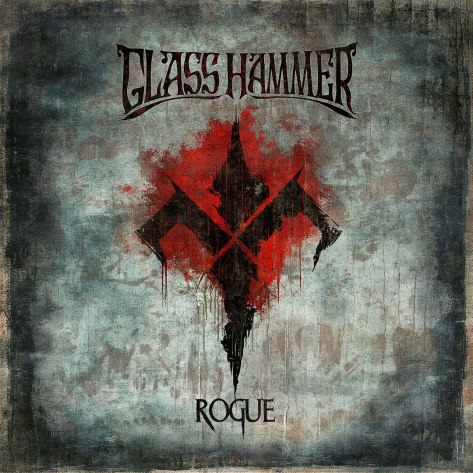
Glass Hammer’s “Rogue” spins the tale of one man’s fateful, final journey. “He leaves everything he knows behind,” explains composer Steve Babb. “And thinks he’s returning to a place where he once knew happiness, but in reality, his odyssey will sweep him away to somewhere completely unexpected.”
Babb explains that the ten-song album explores themes of regret, heartache, and the mortal salience that comes with age. “Life is fleeting,” he continues. “It’s a heavy topic for an album, but the music isn’t as heavy as our last few releases. Rogue is much more like the Glass Hammer albums our fans refer to as “classic.”
And who’s in the lineup? “It’s no secret that Glass Hammer reinvents itself every few albums,” says Babb. “It’s happened again! This time with a lot of new faces.”
Rogue features performances by Fred Schendel, Reese Boyd, and David Wallimann (GH guitarist 2006-2010). Vocalists Thomas Jakob (Netherlands) and Olivia Tharpe (USA) are new to the band. They’re joined by guitarist Oliver Day (UK), keyboardist Ariel Perchuck (Argentina), drummer Evgeni Obruchkov (Poland), and others. “It’s an international cast of characters,” Babb points out. “A super-talented group that our fans are sure to love.”
The hour-long Rogue is Glass Hammer’s twenty-second studio album. Fans can pre-order autographed copies, t-shirts and downloads on the band’s website. www.glasshammer.com
ON FIRE: LIVE FROM THE BLUE MOROCCO, A HEATED UNISSUED 1967 PERFORMANCE BY FREDDIE HUBBARD, DUE FROM RESONANCE AS LIMITED THREE-LP SET ON RECORD STORE DAY APRIL 12
Legendary Trumpeter is Heard at His Ferocious Peak at Sylvia Robinson’s Bronx Club with an All-Star Combo Featuring Bennie Maupin, Kenny Barron, Herbie Lewis, and Freddie Waits
Deluxe Package, Also Available on CD on April 18, Includes New Interviews with Maupin and Barron, Notes by Jazz Authority John Koenig, Appreciations and Interviews with Charles Tolliver, Eddie Henderson, Steven Bernstein, Jeremy Pelt and More Trumpet master Freddie Hubbard is heard at the apex of his early brilliance in the newly unearthed collection On Fire: Live from the Blue Morocco, which arrives on April 12 as an exclusive, limited three-LP Record Store Day release from Resonance Records.
Remastered from the original tapes by Matthew Lutthans, with the LPs mastered by Bernie Grundman and pressed at Le Vinylist, the previously unreleased set was captured by recording engineer Bernard Drayton in 1967 at the Blue Morocco, a jazz spot located in the New York borough of the Bronx and operated by Sylvia Robinson, later a co-founder of Sugar Hill Records. The collection was produced with the full endorsement of the trumpeter’s son and estate representative Duane Hubbard.
Hubbard’s work with Art Blakey & the Jazz Messengers, his appearances on historic recordings by John Coltrane and Ornette Coleman, and his own brilliant recordings as a leader for Blue Note and Impulse! Records led contemporary observers to hail him as the masterful successor to the late Clifford Brown. He is heard on the new release playing a storming set of his own compositions and a pair of smartly arranged standards. Hubbard is backed by his working group of the day, a skilled unit that included saxophonist Bennie Maupin, pianist Kenny Barron, bassist Herbie Lewis, and drummer Freddie Waits.
The package — which will also be issued as a two-CD set on April 18 — is co-produced by Bernard Drayton, his celebrated son and drummer Charley Drayton, and Zev Feldman, the award-winning “Jazz Detective” and co-president of Resonance Records. It includes an introductory essay by jazz scholar John Koenig; new interviews by Feldman with Maupin and Barron; and interviews and appreciations by trumpeters Charles Tolliver, Eddie Henderson, Steven Bernstein, and Jeremy Pelt; and more.
Feldman says, “This album captures Freddie Hubbard at an important point in his career. He had come fully into his own and was forging for himself an honored place in the pantheon of the world’s greatest jazz trumpet players. These live recordings represent Freddie at the height of his powers. The band on these recordings was Freddie’s working group at the time, and they certainly rose to his level.”
“We were excited about Freddie Hubbard coming to the Blue Morocco,” says Drayton, who also captured the previously unreleased recording of Kenny Dorham at the club that is being released for RSD by Resonance. “By 1967, when this album was recorded, Freddie was laying his claim, as Dizzy Gillespie put it, as the greatest trumpet player in the world. Freddie was a dynamo, full of energy and full of pepper. As you can hear, he was on fire. I’m proud to have documented this page in the annals of Freddie’s career.”
Duane Hubbard adds, “My dad, to me and millions of fans, was one of the greatest trumpet players in history. He came to New York from Indianapolis with the drive to be great. In New York, he worked with the top musicians of the time. He took every gig, and he practiced so much and worked so hard that with his natural gifts he rose to be one of the greatest jazz musicians of his, or any, generation.”
“As the performances on this album show,” Koenig writes, “it’s easy to see the qualities that allowed Freddie to make his way into the rarefied milieu of the jazz elite as an instrumentalist. But with this recording, we also have a view of Freddie coming fully into his own as a bandleader. These tracks have never before been heard publicly. They show Freddie in action in a live setting with what was his first regular working band.”
Hubbard’s gifted sidemen of the day testify that playing alongside Hubbard at the top of his game was a thrilling experience.
“Playing with Freddie was very, very intense,” Maupin says. “It was really exciting for me to be able to be a part of the group and be doing these things with him. It was a lot of fun, just great musical fun. For me, playing with someone who had been working with people like Art Blakey, who had that kind of incredible experience, I realized what I needed to do just to keep up with him: I had to really practice a lot. It inspired me to really up my game.”
Hubbard’s formidable legacy as a trumpeter has served as an example for his successors on the instrument.
“Hub was one of my trumpet heroes in my youth,” Tolliver says. “Initially coming out of Brownie, by slightly modifying an already great embouchure, he was able physically to fashion and create the style he was aiming for — to execute and muscle the trumpet in a saxophone-like pianistic manner resulting in incredible improvisational feats and solos never heard before, while at the same time delivering a big, sassy, warm, brass sound without ever sacrificing those crucial inherent elements of our art form — swing, the blues, and pure sophistication.”
Henderson recalls, “Freddie dominated the trumpet scene in the ‘60s, ‘70s and ‘80s. He was without a doubt the top of the hill — his trumpet expertise and prowess, his execution and facility, his range. And his compositions were so challenging, over and above what was coming out of the bebop era. They were very difficult harmonically to maneuver through.”
In an enthusiastic outburst, Bernstein says, “This recording is insane! It’s one of the most exciting live documents I’ve ever heard in my life. It’s f!cking mind-blowing. Freddie’s on fire. It’s just so damn good.”
Resonance Records is a multi-GRAMMY® Award-winning label (most recently for John Coltrane’s Offering: Live at Temple University for “Best Album Notes”) that prides itself in creating beautifully designed, informative packaging to accompany previously unreleased recordings by the jazz icons who grace Resonance’s catalog. Headquartered in Beverly Hills, CA, Resonance Records is a division of Rising Jazz Stars, Inc. a California 501(c) (3) non-profit corporation created to discover the next jazz stars and advance the cause of jazz. Current Resonance Artists include Tawanda, Eddie Daniels, Tamir Hendelman, Christian Howes and Donald Vega. www.ResonanceRecords.org
My mother had an uncle whose name was Rikard and my grandmother liked the name. But my father objected because it was too exotic and he said the kids in school would call me RETARD. So Rikard was out!
So they agreed to change it to RICHARD after Richard Strauss a favorite composer (my parents were very fond of classical music).
Nonetheless from my earliest boyhood my name was RICKY or RICARDO and yes sometimes I was called RICKY RICARDO.
My father had been an American officer in the Philippines and he taught me basic Spanish and Tagalog as boy for fun. If he called me in Spanish or Tagalog I knew he was calling for me.
Halika dito RICARDO! COME HERE! I heard hundreds of times.
The name Richard itself is probably Celto-Germanic in origin meaning RIC “ruler or king” and HART (hard or brave) or ARD (CELTIC) meaning LOFTY OR MIGHTY. In any case it is an old warrior name.
In Britain it became popular with the advent of the Normans after 1066. Of course, the most famous Richard is Richard I the Lionheart one of the leaders of the Third Crusade.
People who don’t know me call me RICHARD.
People who do usually call me AULD MUNRO or RIC or Ricardo. In baseball and the Marines people called me MOOSE. When I was at UVA everyone called me MOOSE. It was easy to remember.
I much prefer RICARDO to “Reek” (Rick to Spanish speakers).
But I am not very particular. I don’t even mind if people add an E to my surname. As long as the check goes through! I have cashed a lot of checks with MONROE or MUNROE!
When I lived in Spain i subscribed to a Spanish newspaper as RICARDO MUNRO A. (there were spaces for two surnames so I put an A for Anderson my mother’s maiden name!). That was my tongue in check Spanish alias.
Daily writing prompt
Write about your first name: its meaning, significance, etymology, etc.
ELEMENTAL MUSIC UNEARTHS BILL EVANS IN NORWAY FOR RSD BLACK FRIDAY RELEASE AS EXCLUSIVE TWO-LP SET ON NOV. 29
Master Pianist’s Energetic 1970 Performance at the Kongsberg Jazz Festival Arrives as a Deluxe CD Version on Dec. 6
Comprehensively Annotated Set Includes Interviews with Evans, Bassist Eddie Gomez and Drummer Marty Morell, and Norwegian Pianist Roy Hellvin; Reflections on Evans’ Art by Keyboardists Aaron Parks and Craig Taborn; and Notes by Evans Scholar Marc Myers
Elemental Music will release Bill Evans in Norway, a brilliant 1970 trio concert captured at the Kongsberg Jazz Festival, as an exclusive RSD Black Friday two-LP set on Nov. 29.
The 180-gram vinyl package, mastered by Matthew Lutthans at the Mastering Lab and pressed at Memphis Pressing, will be succeeded by a deluxe CD version on Dec. 6.
This latest Evans archival find by the team at Elemental Music, produced for release by the award-winning “Jazz Detective” Zev Feldman, is being issued in cooperation with the Bill Evans Estate. The package includes a rare interview with Evans conducted by Norwegian critic and impresario Randi Hultin at the Kongsberg Jazz Festival; new interviews with bassist Eddie Gomez and drummer Marty Morell, members of the pianist’s longest-lived trio, who supported him at the festival; an interview with Norwegian pianist Roy Hellvin, who was in the audience at the performance; reflections on Evans’ art by pianists Aaron Parks, Craig Taborn, and Eliane Elias; and concert photographs by Arthur Sand.
“Between Resonance Records and Elemental Music, I’ve had the good fortune of working with Evan Evans of the Bill Evans Estate for the past 14 years, and this will be my 12th production working with the family,” producer Feldman says. “These recordings come from the archives of Norway’s Kongsberg Jazz Festival, which was founded in 1964. It’s been a major breakthrough for us to have established contact with their team in 2023 and we’re very excited about this new relationship.”
Jak Kilby/Arena PAL
The Kongsberg appearance on June 26, 1970, found the Evans trio in especially stirring form. The pianist — who had recently begun to wean himself off a longtime addiction to heroin in a supervised methadone program — was especially sensitive to his audience’s tastes, and brought a fresh energy to his repertoire.
Myers notes, “Evans appreciated Norwegians’ reserve, modesty and politeness. He also was aware that their moods tended to be lugubrious in the winter, when there was less sunlight each day, and more gleeful in the summer, when the sun set around 11 p.m. While preparing the Kongsberg set list, he knew Norwegian concertgoers would have a deep connection to wistful songs such as ‘What Are You Doing the Rest of Your Life?,’ ‘Turn Out the Stars,’ and ‘Quiet Now.’ But as you listen, you’ll notice that the Bill Evans Trio took many of these traditionally somber songs at a more spirited clip.”
Evans himself said on the day after the date, “This is an excellent audience, and it’s weird to think that a little place like Kongsberg can hire musicians from all over the world just because they like jazz here. I admire the enthusiasm of the organizers, who do all of this without earning a penny for it….These days here in Kongsberg have really meant something to me. It’s a beautiful place, and I’ve been able to relax.”
The pianist’s rhythm section, both experienced hands at European touring, took their cues from the leader’s approach. Gomez says, “When we played in Kongsberg, we had just played at the Montreux Jazz Festival in Switzerland. The recording of that event was called Montreux II. And at that time Montreux was a very high-profile festival. Having passed that hurdle, we went on to Kongsberg, and that was a relief. I felt really relaxed, like, ‘Okay, this is good. It’s not like Montreux, there’s less pressure.’ And I think the outcome is a record that’s quite good.”
Adds Morell, “There’s nothing like playing jazz in Europe — Norway, Scandinavia. Bill was loved, and it was always a special treat, and an honor really, to play for those people, because he was appreciated so well. But then you go to Paris and London and other countries, and it was a similar vibe. And South America, too. Bill was revered all over the world.”
Hellvin says, “It was a great kick for me to hear the tape of this 1970 Bill Evans concert 54 years after being there. I can still remember the atmosphere created by the trio. The summer in Norway was unusually warm that year, but inside the Kongsberg cinema there was a special mood. I don’t think I’ve ever seen another audience so quiet and concentrated, especially during Bill’s rendition of Leonard Bernstein`s ‘Some Other Time.’ It really left us spellbound! To me, Evans was playing a little harder than usual, and with more attack on his up-tempo numbers.”
The players touched by Evans’ influence find the essence of the keyboardist’s genius expressed in a fresh way in the unique Kongsberg performance.
“I’ve come to realize that on Bill’s playing there is lyricism and sensitivity,” Parks says, “but also deep intelligence, and above all a great muscularity. There’s a tactile, grippy kind of thing to the way in which he approaches harmony. There’s a real vitality, and a sense of putting skin in the game, rhythmically. All of that can be felt on this Kongsberg concert.”
Taborn says, “The group playing in Kongsberg is really interesting for me, because I think the Marty Morell years are fascinating….With Morell, Bill is really on top a lot. He has a much brighter feel. He’s really pushing stuff. Even bringing the tempos up a little bit. This group is swinging along in a brighter way, which really brings out the more rhythmic side of Bill Evans.”
Summing up the impact of Evans’ enduring music, Elias says, “Bill Evans created his own musical universe in harmony, melody and rhythm and has influenced generations of musicians with his sound and conception of interplay. I consider him to be one of my important influences.”
Greetings, Spirit of Cecilia readers! In this post, Brad Birzer, Erik Heter, and Tad Wert revisit three progressive classics: Discipline, Beat, and Three of a Perfect Pair, from King Crimson.
Tad: Brad and Erik, I am so looking forward to hearing your thoughts on these albums! We haven’t really delved into the incredibly large and diverse discography of King Crimson, and Discipline is a personal favorite of mine. It came out in 1981, after most fans assumed Robert Fripp had put King Crimson to rest for good. As a matter of fact, on their previous album, the 1974 live set USA, Fripp put R.I.P. on the back cover. That album is another favorite of mine, featuring the formidable lineup of Fripp (guitar), Bill Bruford (percussion), John Wetton (bass and vocals), and David Cross (violin). This is the same group that recorded Lark’s Tongues In Aspic (with Jamie Muir added on percussion) and Starless and Bible Black. This group was ferocious in its ability to improvise, but apparently it was exhausting for all involved.
So it was quite surprising when word got out that Fripp was rehearsing a new lineup for King Crimson: Bruford (again), Tony Levin (bass and stick), and Adrian Belew (guitar and vocals). I was a subscriber to Musician magazine at the time, and it started running a series of “diary” entries from Fripp that detailed his excitement (and worries) about the music they were creating.
As interested as I was in what this new iteration of KC was going to sound like, nothing could have prepared me for Discipline. I was familiar with Belew from his work with Talking Heads and David Bowie, but I hadn’t heard him sing before. I knew Tony Levin was a much-in-demand bassist, but I didn’t realize how much of a pioneer he was with the Chapman Stick. The shift in style from Starless and Bible Black to Discipline is one of the most radical metamorphoses in rock history. And what is so impressive is that they pull it off – pleasing long time fans and attracting new wave listeners.
When it came out, I was in college, and one of my suitemates got a copy. We listened to it several times in one evening, trying to understand what Fripp et al. were doing. To my ears, it was the perfect marriage of challenging, yet accessible rock. The cover art was understated and perfect: Bright red with a basic silver font simply stating, “King Crimson Discipline”, and a Celtic knot that isn’t easily untangled. Rhythmically, it was very straightforward. Melodically, it was almost minimalist in its composition, but it fit in comfortably with what groups like Talking Heads, The Police, Ultravox, and Simple Minds were producing. The more I listened, the more I was taken with it.
Okay, I’ve rambled on for too long! How did Discipline strike you, Brad, when you first heard it?
Brad: Tad, what a wonderful way to start us off. Thank you so much for your many good thoughts on this. Sadly, I won’t be able to match your good introduction. Yet, I loved reading about yours.
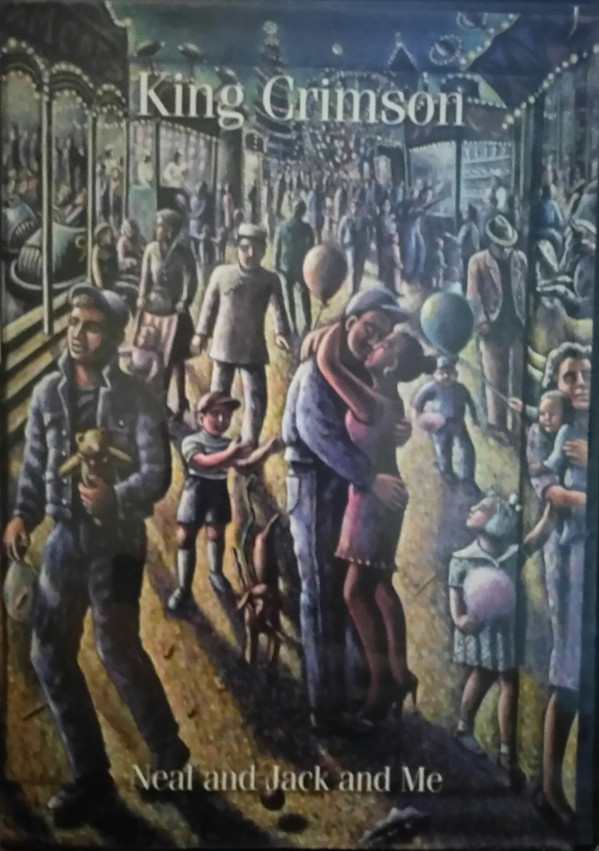
Though I grew up with progressive rock–Yes, Jethro Tull, and Kansas, in particular–I knew nothing about King Crimson until my college years. I didn’t start college until 1986 (and the three Discipline-era albums had already come out), and I first encountered the band through a radio station copy of Beat and, in particular, the song “Neal and Jack and me”–which I instantly fell in love with.
I remember being taken with the minimalist cover and diving into the music.
After encountering it at the radio station, I purchased a copy of Beat, and, from there, I bought Discipline and Three of a Perfect Pair. To me, these three albums have to go together, one followed by another. I really have a hard time thinking of any one of the three–red, blue, and yellow–in isolation from the other. As such, I came VERY late to In the Court of the Crimson King, and the albums had progressed so much that I had a very hard time thinking of “my” King Crimson as the King Crimson of “In the Court. . .” Much later, I would buy Thrak–which has far more in common with Discipline-era King Crimson than the original King Crimson albums.
I knew very little about Adrian Belew or Robert Fripp, but I’d been a long time fan of Bill Bruford because of Yes and Tony Levin because of Peter Gabriel. So, I was really curious as to what they were up to.
Additionally–should I admit this here???–though I never had a religious fundamentalist phase, I was returning to my childhood Catholicism (I’m what’s called a “revert” in Catholic circles) at the same time that I first encountered Discipline, Beat, and Three of a Perfect Pair, and I was really freaked out that the band named themselves after the devil! I thought, what a crazy thing to do. Why would you even mess with such a thing?
That stated. . .
I’ll do my best to focus on Discipline, though, for this dialogue. Tad, for better or worse, I often think of Discipline-era King Crimson as New Wave Prog, in the same way I think of Rush’s Power Windows, Yes’s Drama, or The Fixx’s Reach the Beach. It’s definitely progressive, but in such an early 1980s way.
Tad: Brad, I agree that Discipline, Beat, and Three of a Perfect Pair make a seamless trilogy. It must have been deliberate – look at the artwork for them: same font with a single icon on each. As a lover of symmetry, I have always been bowled over by this series of album covers. I even framed them when I was first married, and my understanding wife let me hang them on our den wall!
Your characterization of this music as New Wave Prog is perfect. I think you’ve created a hitherto unknown genre of music, but one that, with hindsight makes sense! At the time, it seemed to just fit in with all the weird and crazy music being produced in the early 80s.
Okay, let’s discuss the songs on Discipline. It opens with “Elephant Talk”, in which Belew bellows,
“Talk, it’s only talk
Arguments, agreements, advice, answers
Articulate announcements
It’s only talk”
while his guitar emits sheets of cascading sound. Levin lays down nimble basslines on his Stick, and Bruford plays a cacophonous yet steady racket on drums. All the while, Fripp is furiously pushing out scales on his guitar and creating a soundbed for the others to play on. Each verse is a list of synonyms for verbalizing in alphabetical order: the first is all A’s, the second all B’s, etc. This illustrates an aspect that I love so much about this iteration of KC: their sense of humor. Even though the music can be crushingly dense at times, there is a feeling of fun and sheer joy in it.
Erik: Like you, Brad, I was a latecomer to King Crimson – for the most part anyway. I do remember hearing Discipline once or twice when it first came out, but to use a Heinlein-ism, I absolutely did not grok it at all. So I put it aside for well over a decade and a half before finally revisiting it. In the meantime, I had purchased In the Court of the Crimson King, Lizard, and most importantly (for the purposes of priming the pump for Discipline), Larks Tongues in Aspic. While the latter is quite different from Discipline-era Crimson, if one listens close enough they can hear a few stylistic threads connecting them (and indeed, Three of a Perfect Pair includes Larks Tongues in Aspic Part III). If anything, I think the music of Discipline and the subsequent two albums is where they would have ended up anyway if they hadn’t broke up in 1974.
Another thing Brad – like Tad, I think your description of Discipline-era Crimson as New Wave Prog hits the nail on the head. The music has so much of that quality in other 80’s music that was described by the phrase once uttered by Yes’s Tony Kaye – dimensionally sparse. No previous Crimson album ever left as much space between the instruments as Discipline and its two successors did. This description applies to a majority of the album, with the notable exceptions of Indiscipline and Thela Hun Ginjeet. Because of this approach, Discipline fit in with the contemporaneous music of the early 80’s as well as the early Crimson albums fit in with that of the early 70s.
What makes these albums familiar to Crimson fans was the presence of Fripp and Bruford, who were well-established by the release of Discipline. What made them fresh was the presence of newcomers Belew and Levin. Belew brought in the quirky, New Wave-y 80s vocal stylizations that he learned during his time with the decidedly non-prog Talking Heads. Meanwhile, Levin brought in not only a new way of playing bass, but also introduced to Crimson the Chapman stick and the new sounds that came with it. When it was all thrown into the same pot, the result was a type of music that was eclectic and often intricate.
If I had to pick some favorite songs off of the album, there are three that really stand out to me. First is the easy, breezy Matte Kudasai, the uptempo romp of Thela Hun Ginjeet, and the instrumental The Sheltering Sky. The latter two of these tracks include some of the best percussion work Bill Bruford has ever performed in any of the bands he’s been in – which is quite a statement considering his pedigree. In Thela Hun Ginjeet, Brufords drumming comes in fast and furious yet with exquisite precision. In The Sheltering Sky, Bruford’s percussion is almost understated and yet still manages to demand the listener’s attention. This track also includes both Belew and Fripp on the weird, wonderful guitar synthesizer.
I’m still relatively new to the latter two albums of this trio, so I’ll visit those in my next entry. For now, back to you guys!
Tad: Erik, thank you for your insights on this album! I’m glad you brought attention to Bruford’s contributions. One thing I remember from those articles Fripp published in Musician is how he kept trying to rein in Bruford, because he wanted this music to be disciplined.
If I had to pick my favorite songs, it would be “Frame By Frame” and “The Sheltering Sky”. In the former, I really like the relentless groove that Fripp, Levin, and Belew set up, while Belew’s and Levin’s vocals hover delicately above it all.
I agree with you about Bruford’s excellent percussion work in “The Sheltering Sky” – I have a DVD of a concert they performed at the time this album came out, and Bruford is masterful on congas while Fripp wigs out on guitar. I love the way the song takes its time building – it’s quite a while before Levin enters on Stick, and when he does, it brings the music to another level. I don’t think Fripp ever had another guitarist as empathetic as Belew was with him. The two of them traded phrases off each other as if they were of one mind.
Fun fact: “Thela Hun Ginjeet” is an anagram for “Heat In The Jungle”!
Brad: Dear Tad and Erik, what excellent responses. One of the things I love most about Discipline is that it starts off with the utterly bizarre “Elephant Talk.” The band could’ve easily and victoriously started the album with the much more radio and listener friendly “Frame by Frame.”
Instead, they begin with the offbeat one. Again, I love this about the band. They definitely define their own path.
I’m not sure I have specifics about this album. Again, to me, it’s an intimate part of a trilogy of releases, and, Tad, I love that you had the artwork displayed. What would we do without our loving and forgiving wives!
And, I would agree, my favorites among these tracks are “Frame by Frame” with its relentless roar, and “The Sheltering Sky” which feels like a Talk Talk song from the same period, at least in terms of its rhythm.
I mentioned this above, but my favorite album of the trilogy is Beat, as it combines the weirdness of “Elephant Talk” with the accessible and intense sounds of “Frame by Frame.”
“I’m a 1952 Studebacker coupe!”
But, I also really love the title track of Three of a Perfect Pair. So wonderfully quirky.
Tad: It’s a tough call, but I think this iteration of King Crimson is my favorite. At least, I come back to these three albums more than any others in Crimson’s long, long career. I don’t think Fripp ever assembled a more talented crew than these four guys, and they are at the top of their game. I never saw them live, but as I mentioned, I have a couple of concerts on DVD, and they make this difficult music look effortless.
As I have revisited this trio of albums in order, I’m struck by how much the “accessible” songs sound more accessible, while the “out-there” songs are more and more out-there. Brad, maybe that’s why Beat is your favorite – it hits the sweet spot between pop and experiment. While it contains beautiful and gentle love songs like “Heartbeat” and “Two Hands” it also has the atonal and terrifying “Requiem”. I think that’s why this iteration of King Crimson packed it in after Three of a Perfect Pair; by the third album, “things fell apart; the center couldn’t hold” (to paraphrase Yeats!). That album contains their most pop song ever, “Sleepless”, while also giving us “Industry”, which is close to pure noise in places.
Erik: While my familiarity with Discipline dates back to about the mid-90s, Beat and Three of a Perfect Pair are both relatively new to me. Yet one thing that strikes me is the consistency of sound across these albums – it’s almost as if they could have all been released as one triple album instead of as three separate albums. From a production standpoint, these albums really stand out as being of a particular time. One odd thought I’ve had listening to these – particularly Beat – is how similar the production (not the music!) was to the first two solo albums of Robert Plant. Indeed, I had to go back and look it up to find out who the respective producers were, but they were different. It must have been just something in the air at the time.
Another observation about these three albums – they mark some of the best, if not the best work of Bill Bruford in his entire career. As a hardcore Yes fan, I do not say that lightly. One great example of this is Sartori in Tangier from Beat (which, for some reason, I keep reading as Santoni the Tiger … I think I need some Frosted Flakes, but I digress). Another is Sleepless from Three of a Perfect Pair. Sleepless is also one of the songs in this trio that includes Tony Levin’s use of the Chapman Stick, along with Neurotica and The Howler (from Beat), as well as Industry and the title track of Three of a Perfect Pair.
All that said, by the end of Three of a Perfect Pair, I start to hear a certain sameness in the music, and thus it’s not surprising to me in retrospect that Fripp broke up the band again. Maybe that’s just how Fripp worked best, in bursts followed by long breaks. I do get the impression he wasn’t easy to work with, and have read that both Bruford and Belew were a bit miffed when Fripp split them up again in 1984.
That being said, I don’t want to close on a sour note, so here goes. You guys, being in the same age range as me, might remember the early 80s TV show Fridays, which was basically ABCs attempt at creating their own version of Saturday Night Live. Both had the same format – sketch comedy, a “news” break, and musical guests. And on one glorious night during the 81-82 timeframe, they had as their musical guests Fripp, Belew, Levin and Bruford, under their collective name of King Crimson – preserved for posterity thanks to YouTube. Enjoy!






 Spirit of Cecilia
You must be logged in to post a comment.